Legal Updates, Court Practice Notes & Client Awareness
Updates and practical legal awareness notes on Patna High Court practice, Supreme Court principles, criminal law, bail, PMLA, cyber fraud, family law, property disputes, writs, service matters, consumer matters and client preparation.
Focus the legal research you want to read
Colour supports recognition; the written category label remains the primary identifier across PMLA / ED, Economic Offence, Cyber Crime, Extradition and other legal updates.
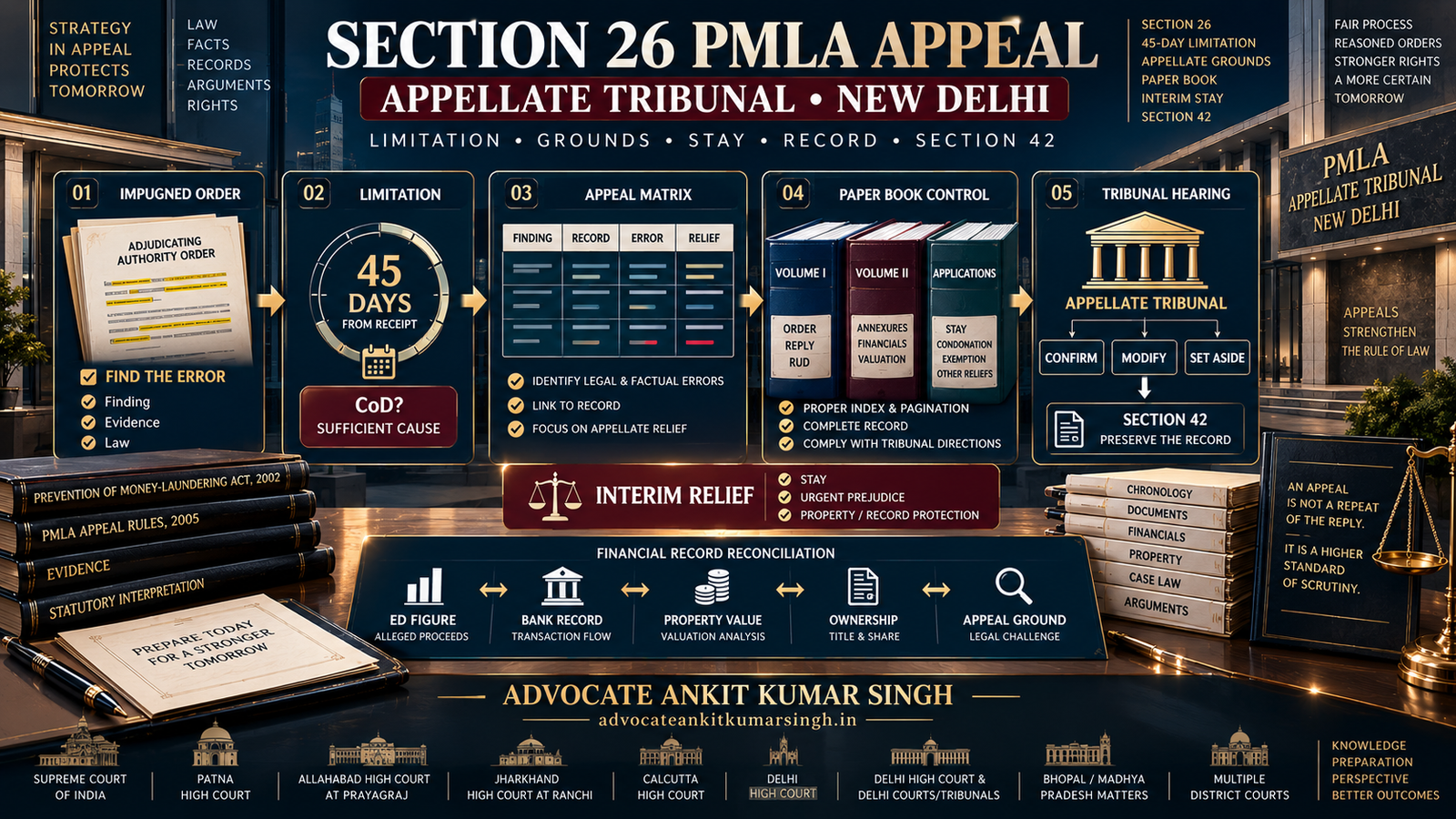
Top PMLA Appellate Lawyer in Delhi for Section 26 Appeals Before the PMLA Appellate Tribunal, New Delhi
This article examines the work required in a Section 26 PMLA appeal before the Appellate Tribunal in New Delhi. It focuses on chronology, limitation, annexure control, identification of errors in the impugned order, interim-stay strategy, property classification, financial-record reconciliation and preservation of issues that may later become important in a Section 42 High Court appeal.
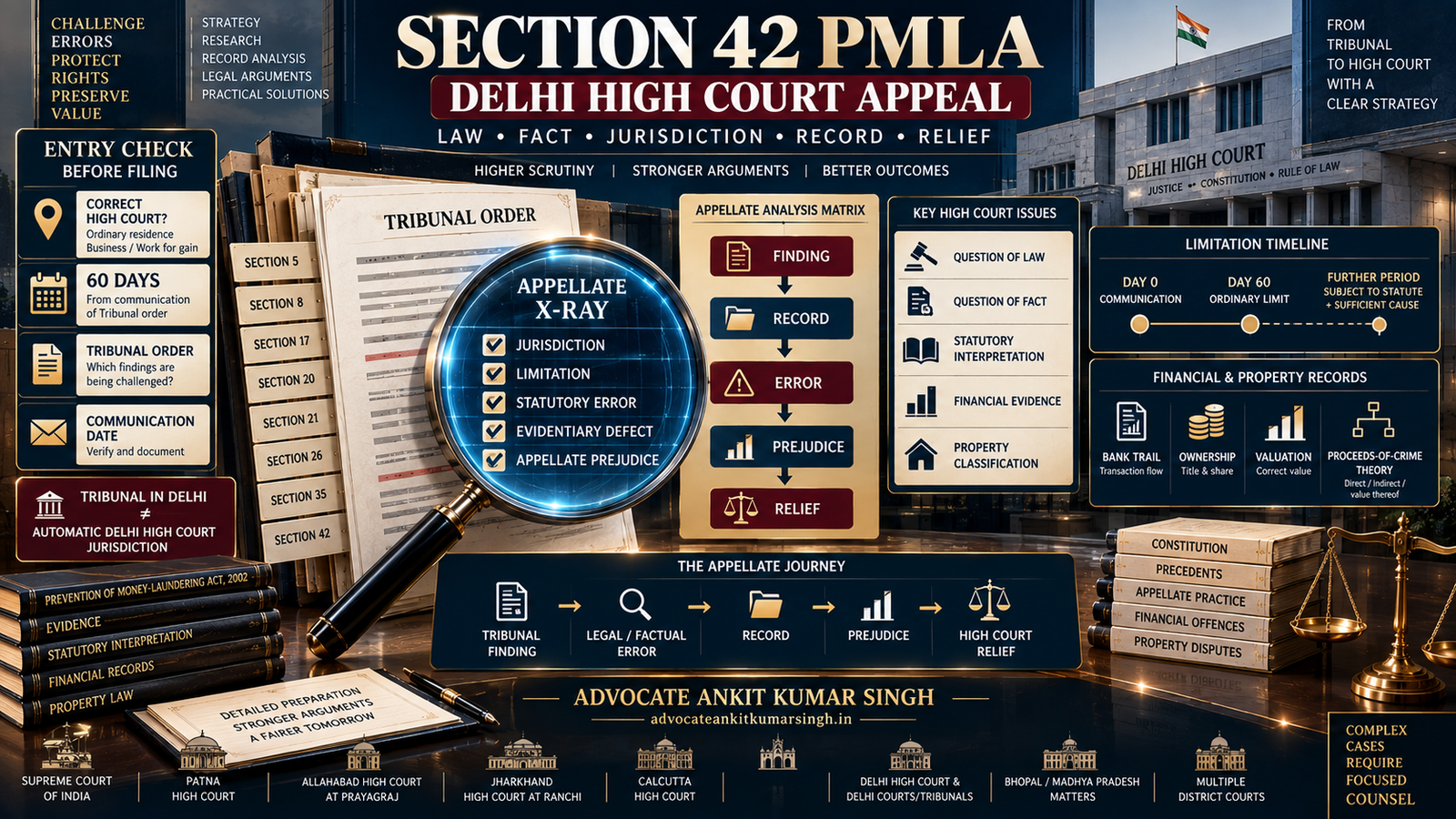
Expert PMLA Lawyer in Delhi for Section 42 Appeals and Delhi High Court Money-Laundering Litigation
This article examines Section 42 PMLA appeals before the High Court after an order of the Appellate Tribunal. It focuses on territorial jurisdiction, identification of questions of law or fact, statutory and evidentiary errors, the existing appellate record and the prejudice caused by the impugned decision, rather than simply reproducing the arguments used before the Tribunal.

Best PMLA Trial Lawyer in Delhi for Prosecution Complaint, Charge and Special Court Proceedings
It focuses on the lawyer-selection problem after a PMLA prosecution complaint has been filed. It distinguishes investigation-stage consultation from trial-stage defence and explains why a specialized PMLA trial lawyer must master complaint analysis, accused-specific transactions, document supply, discharge, framing of charge, witness strategy, digital and banking evidence and parallel predicate proceedings.
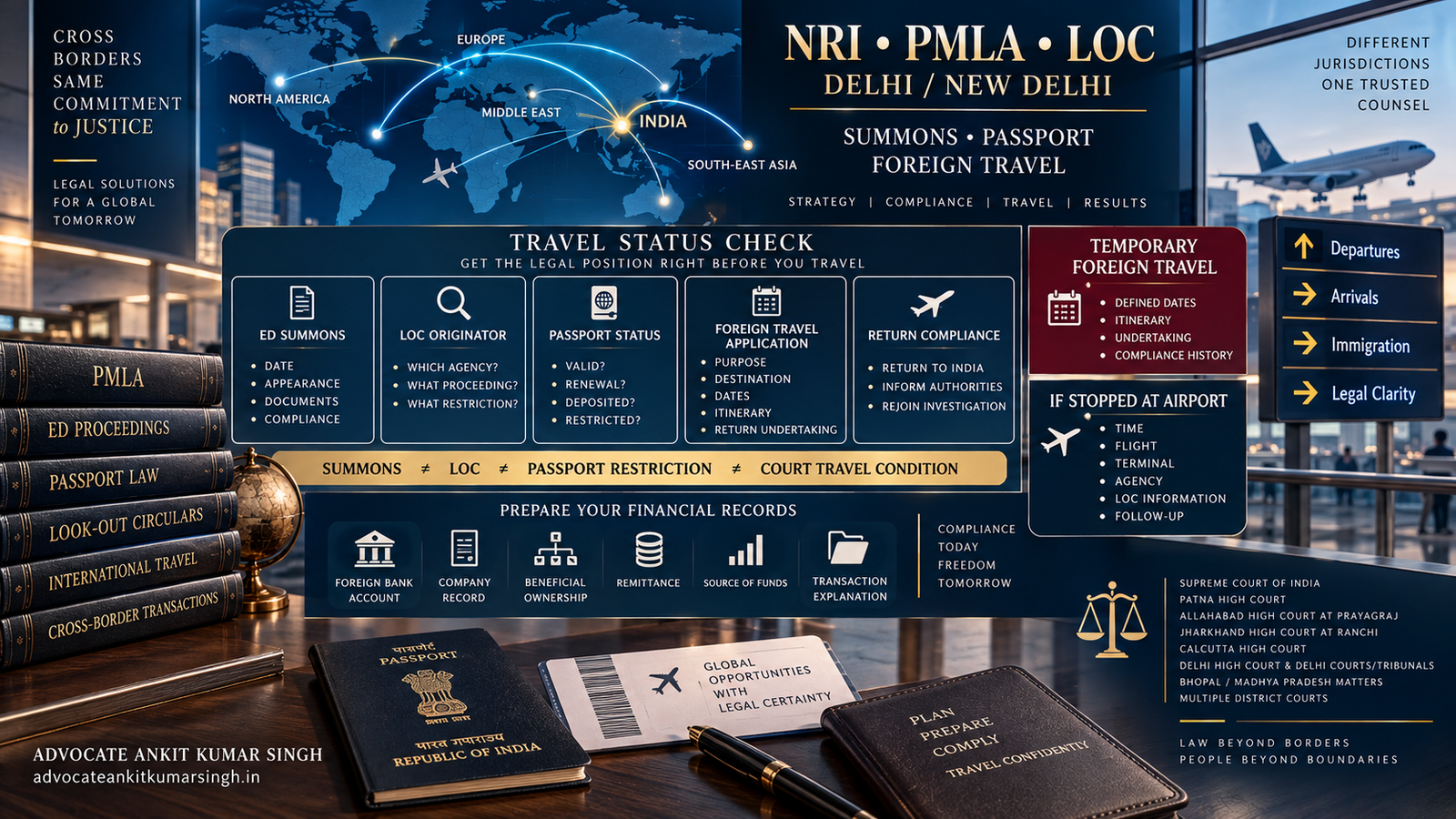
Specialized PMLA Lawyer in Delhi for NRI Clients, Look-Out Circulars, Passport Issues and Temporary Foreign Travel
This article examines NRIs, overseas directors and frequent travellers whose ED matter overlaps with a Look-Out Circular or travel restriction. It focuses on counsel-selection criteria for coordinating summons compliance, travel history, passport status, LOC originator identification, interim travel applications and financial-record preparation.
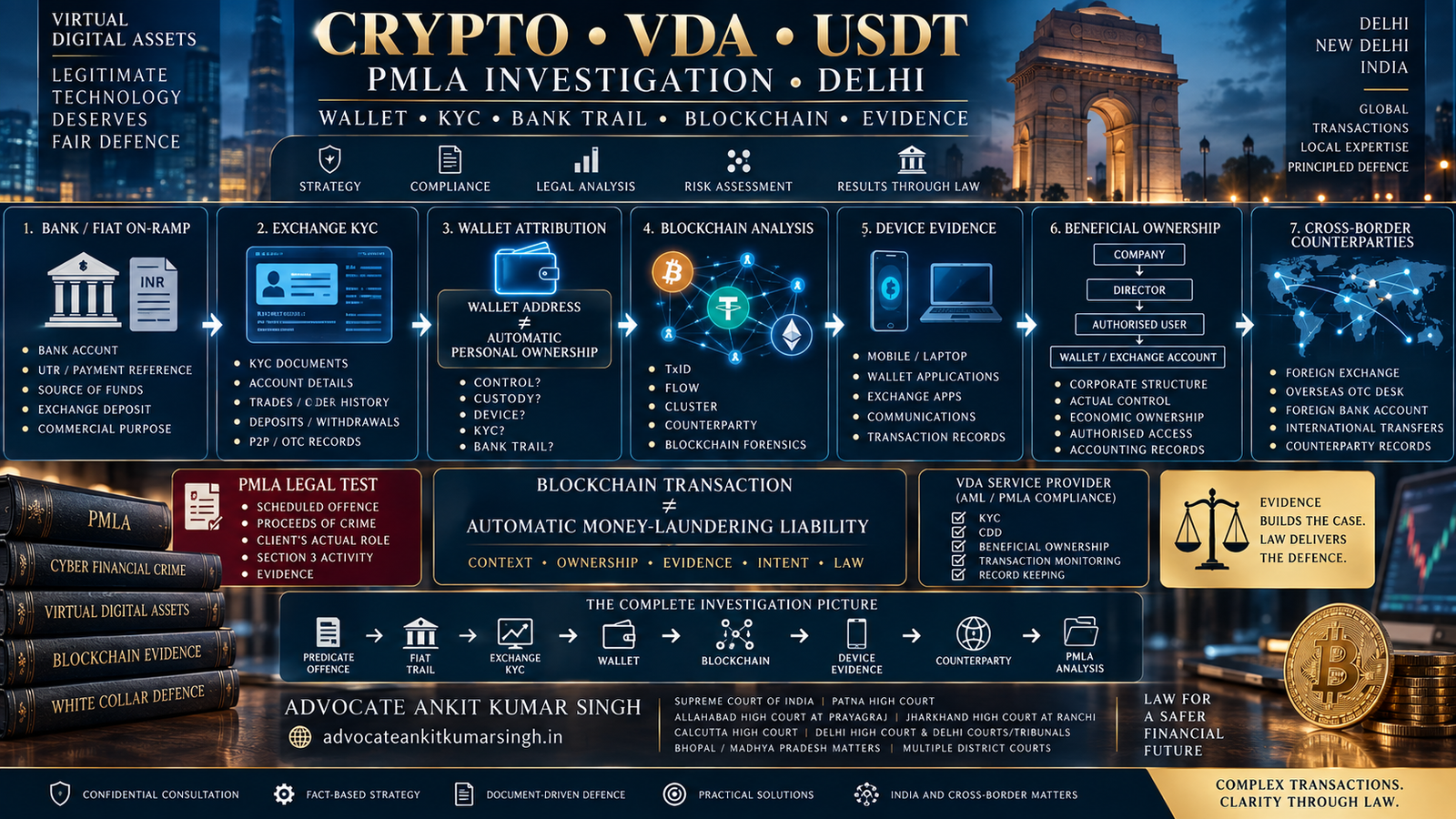
Top PMLA Lawyer in Delhi for Cryptocurrency, VDA, USDT and Blockchain Money-Laundering Investigations
This article examines founders, OTC traders, exchange users, investors and businesses facing ED scrutiny involving virtual digital assets. It emphasises the need for research into wallet attribution, exchange KYC, on-ramp and off-ramp banking, beneficial ownership, device evidence, transaction clustering and cross-border counterparties.

Expert PMLA Lawyer in Delhi for Online Betting, Gaming, Payment Gateway and Fintech ED Investigations
This article examines platform founders, payment intermediaries, compliance officers and marketing entities caught in betting or fintech money trails. It focuses on merchant onboarding, settlement accounts, KYC, transaction monitoring, player or customer funds, affiliate revenue, chargebacks and accused-specific control.
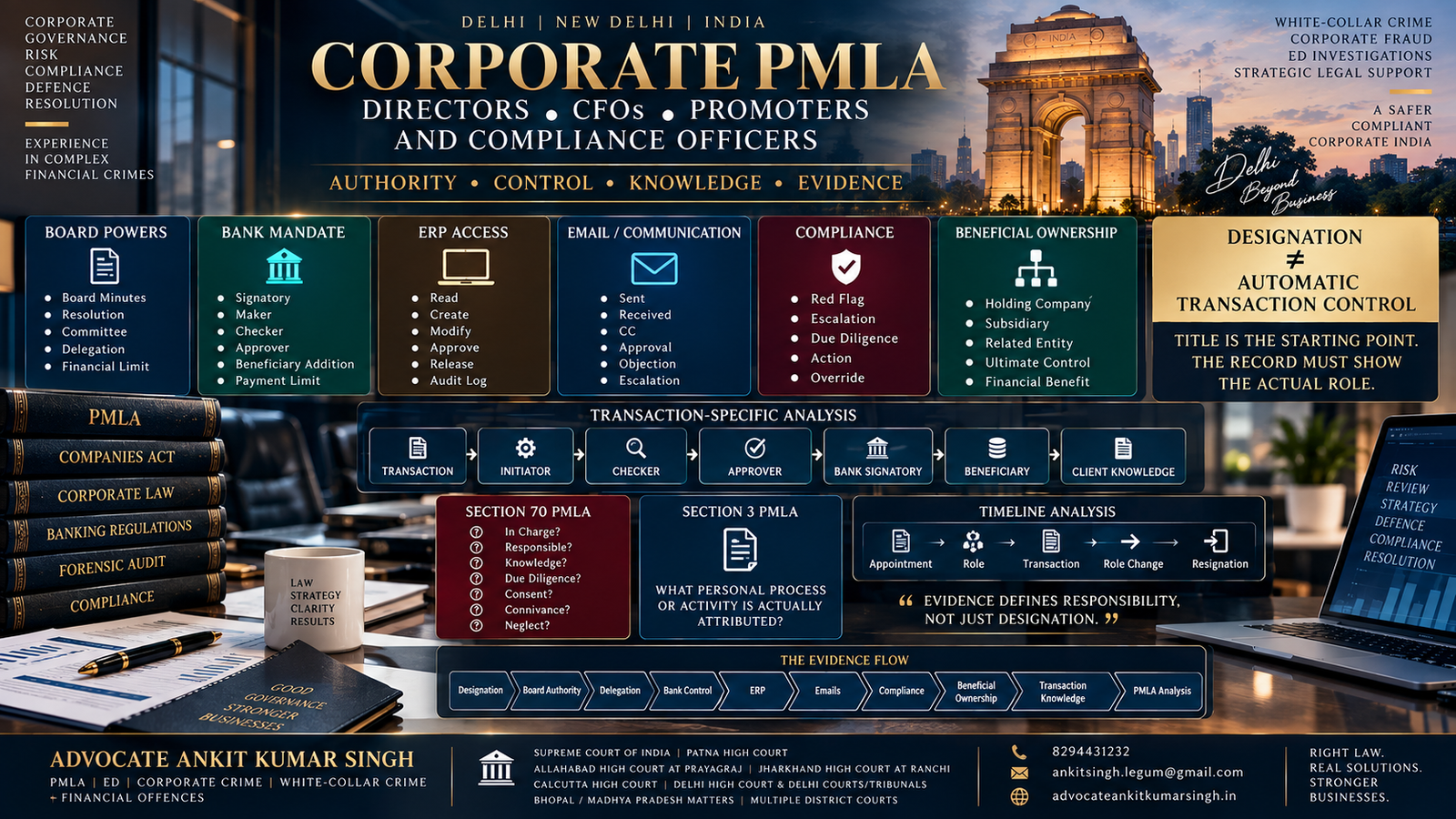
Prominent PMLA Lawyer in Delhi for Directors, CFOs, Promoters and Compliance Officers in Corporate ED Cases
This article examines senior corporate personnel who are named, summoned or questioned because of their position. It explains how a prominent or specialized PMLA lawyer should separate designation from actual control by analysing board powers, bank mandates, delegation, emails, ERP access, compliance escalations, beneficial ownership and transaction-specific knowledge.
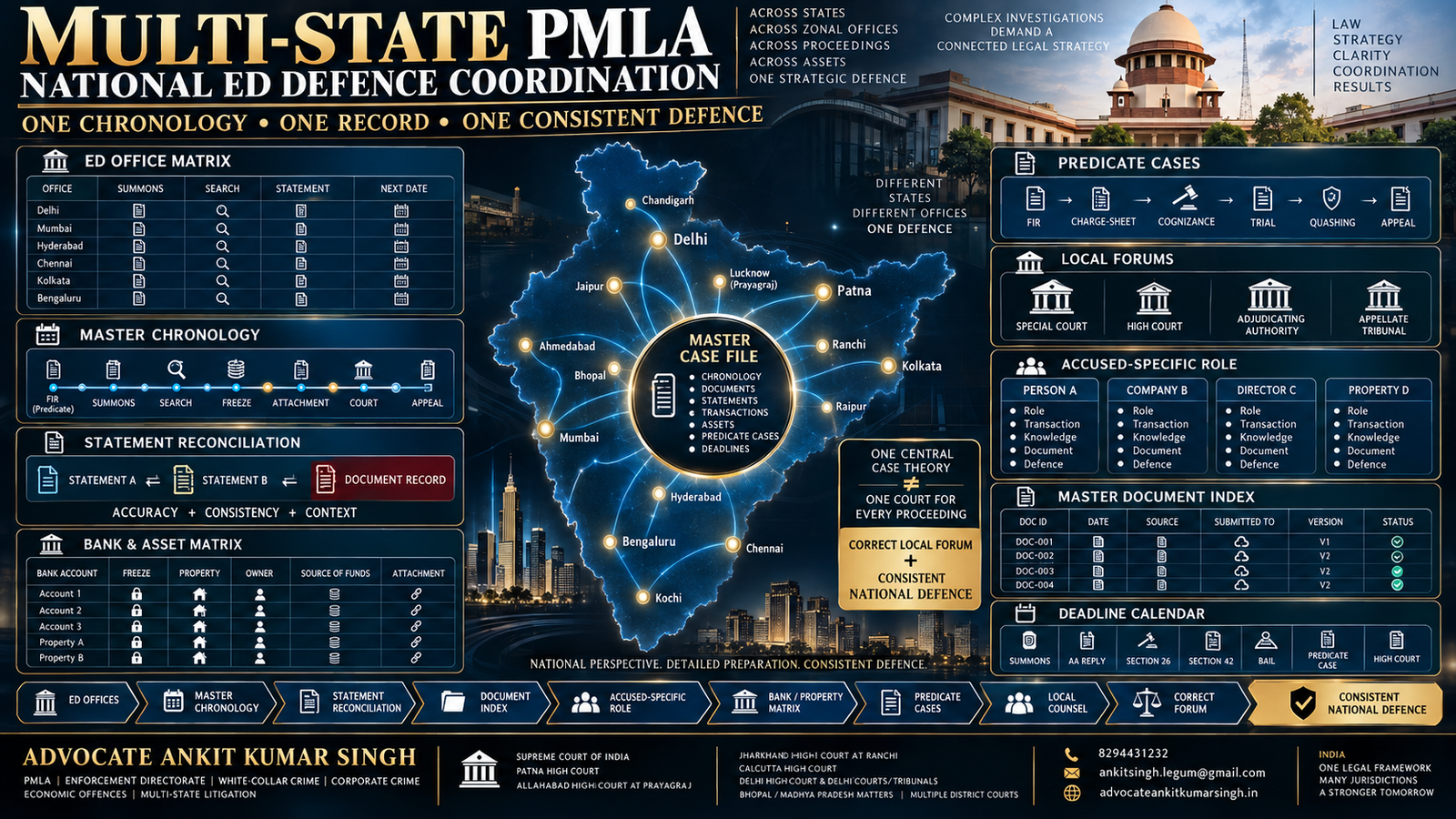
Best PMLA Lawyer in India for Multi-State ED Investigations and Coordinated Defence Across Multiple Zonal Offices
This article examines individuals and companies facing connected summons, searches, frozen accounts, property issues or predicate cases in more than one State. It focuses on selecting a PMLA lawyer capable of building one master chronology, reconciling multiple agency records, coordinating local filings and maintaining a consistent accused-specific defence.
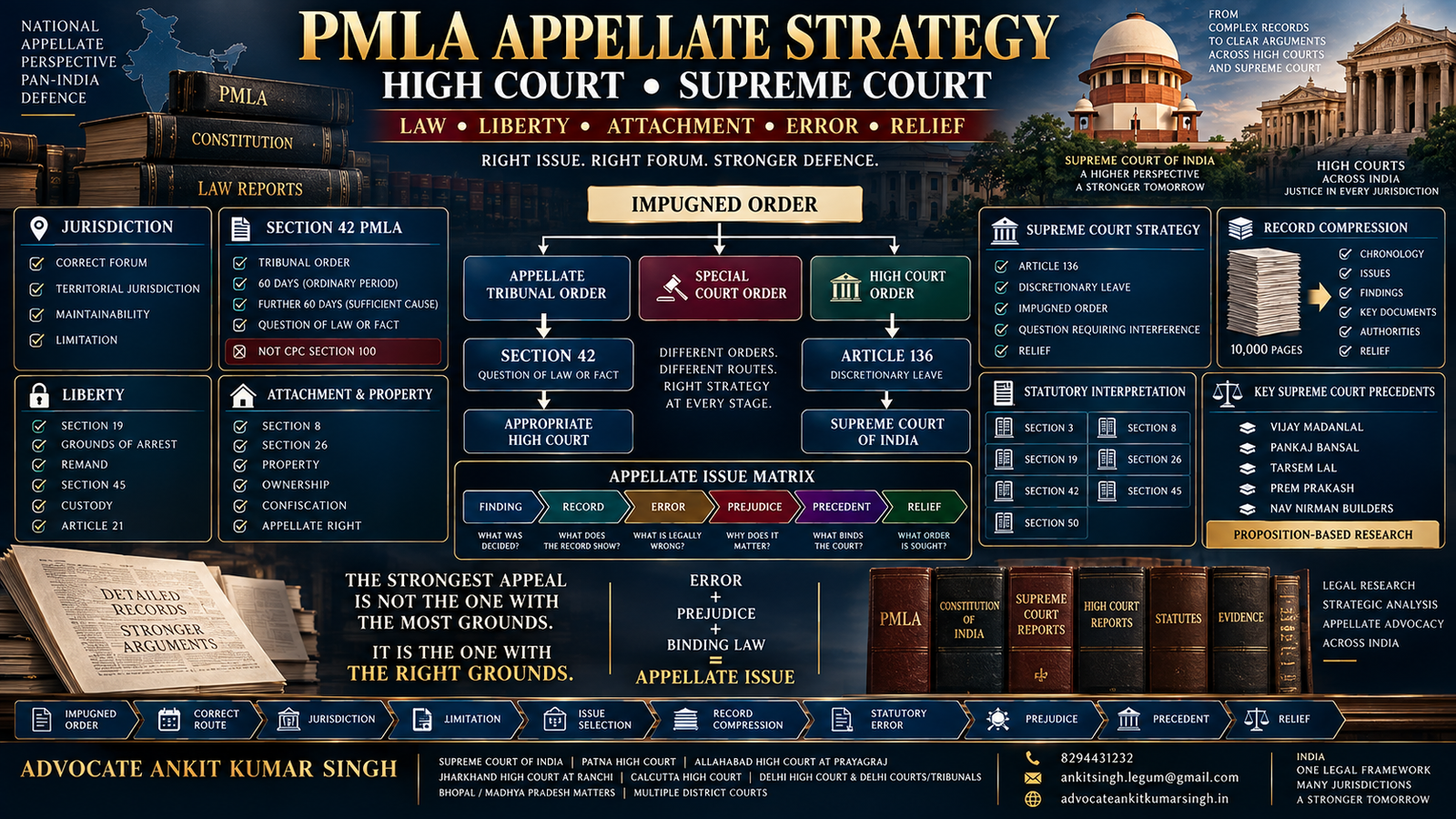
Top PMLA Lawyer in India for Supreme Court and High Court Appellate Strategy in Money-Laundering Cases
This article examines clients whose PMLA dispute has moved beyond the first forum. It focuses on counsel-selection for statutory interpretation, liberty issues, attachment appeals, High Court error review, Supreme Court briefing, record compression and identification of questions that matter at appellate level.

Specialized PMLA Lawyer in India for Bank Fraud, Consortium Lending, Loan Diversion and CBI Predicate Cases
This article examines promoters, guarantors, finance officers and borrowers facing an ED case arising from alleged bank fraud. It emphasises the need for analysis of sanction terms, end-use, stock statements, related-party transfers, round-tripping allegations, securities, forensic-audit material and the separation of banking default from criminal proceeds.
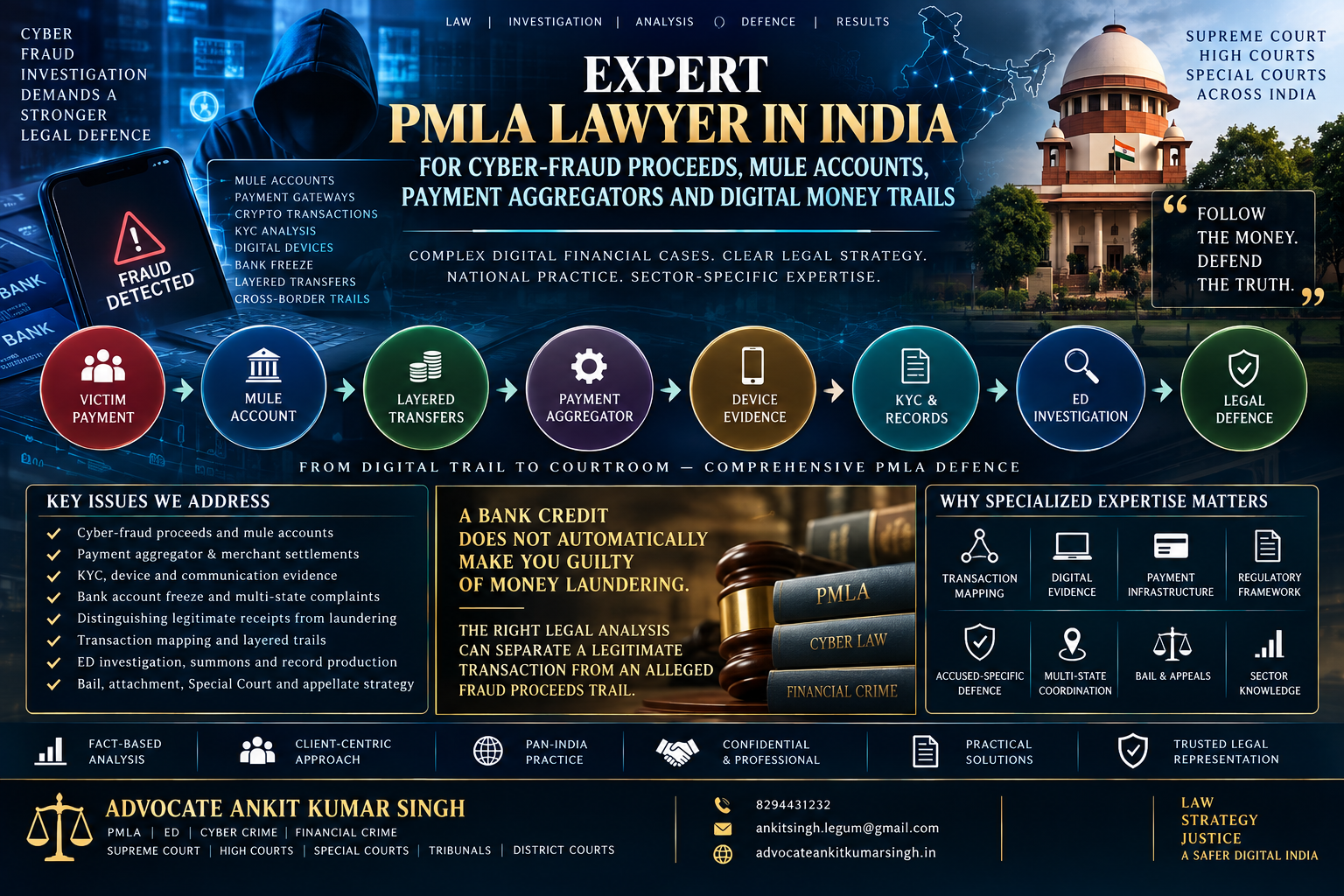
Expert PMLA Lawyer in India for Cyber-Fraud Proceeds, Mule Accounts, Payment Aggregators and Digital Money Trails
This article examines account holders, fintech entities, payment intermediaries and businesses linked to cyber-fraud proceeds. It focuses on lawyer-selection for transaction mapping, victim-to-mule flow, settlement layers, device and KYC evidence, bank-freeze overlap and distinguishing legitimate receipts from laundering participation.
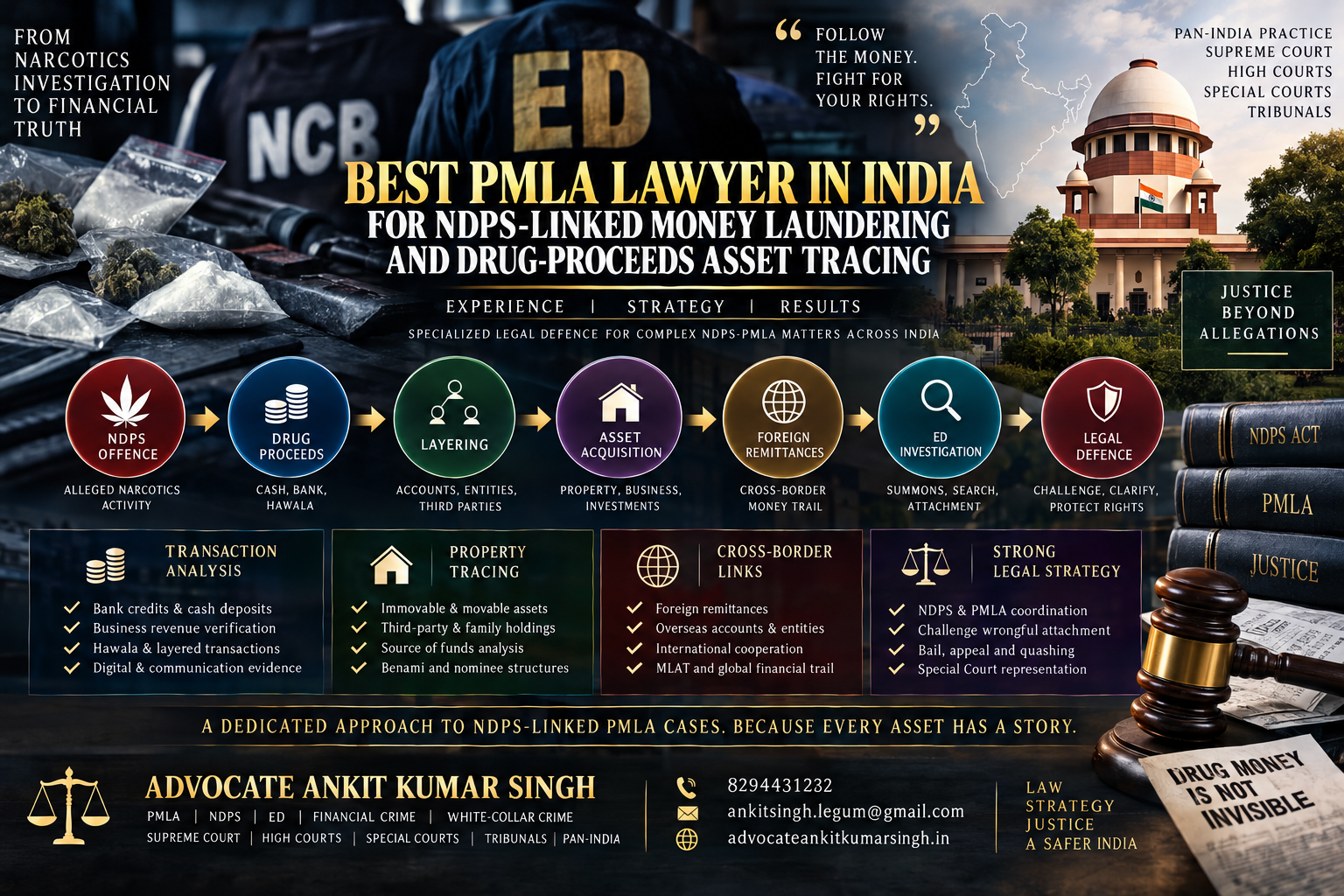
Best PMLA Lawyer in India for NDPS-Linked Money Laundering and Drug-Proceeds Asset Tracing
This article examines NDPS accused, family members and businesses facing a separate ED inquiry into alleged drug proceeds. It distinguishes the narcotics prosecution from the later PMLA money trail and focus on counsel-selection for bank credits, property acquisition, business receipts, foreign remittances, third-party assets and scheduled-offence linkage.

Top PMLA Lawyer in India for Prevention of Corruption Act Cases, Public Servants and Alleged Kickback Trails
This article examines public servants, contractors, consultants and companies facing ED proceedings arising from alleged corruption or bribery. It focuses on separating the official decision trail from the alleged benefit trail, source of assets, intermediaries, family ownership, valuation and transaction timing.
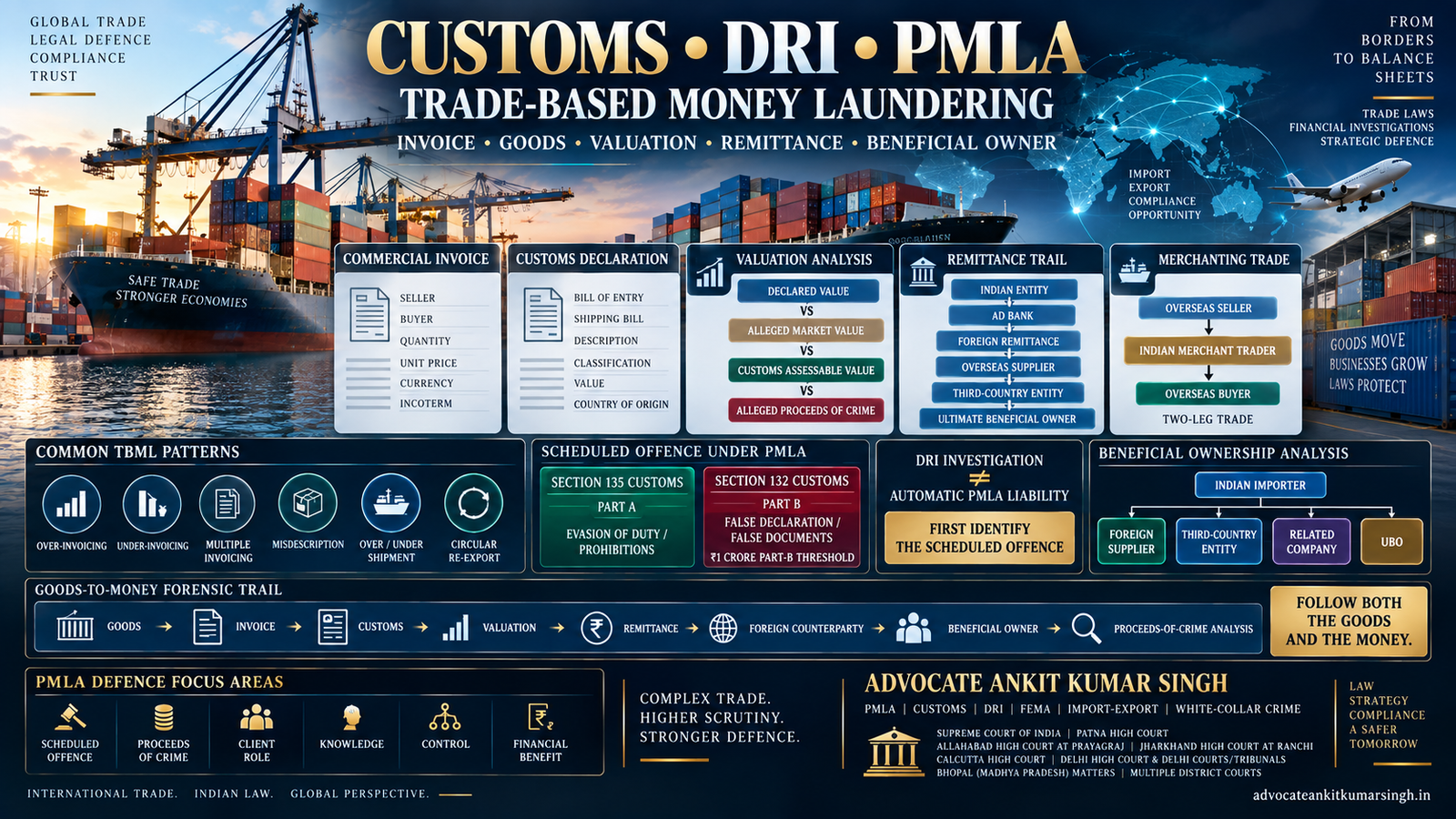
Specialized PMLA Lawyer in India for Customs, DRI, Trade-Based Money Laundering and Cross-Border Invoicing
This article examines importers, exporters, directors and traders whose customs or DRI matter develops a PMLA dimension. It emphasises the need for counsel to analyse invoices, bills of entry, shipping bills, valuation, remittance, merchanting trade, third-country counterparties, beneficial ownership and the exact scheduled-offence foundation.

Expert PMLA Lawyer in India for FEMA, Foreign Remittances, Overseas Companies and Cross-Border Financial Investigations
This article examines founders, NRIs and companies where a foreign-exchange issue overlaps with PMLA risk. It distinguishes FEMA contraventions from a money-laundering allegation and focus on counsel-selection for remittance records, SWIFT data, overseas entities, beneficial ownership, source of funds, import-export records and multi-jurisdiction evidence.
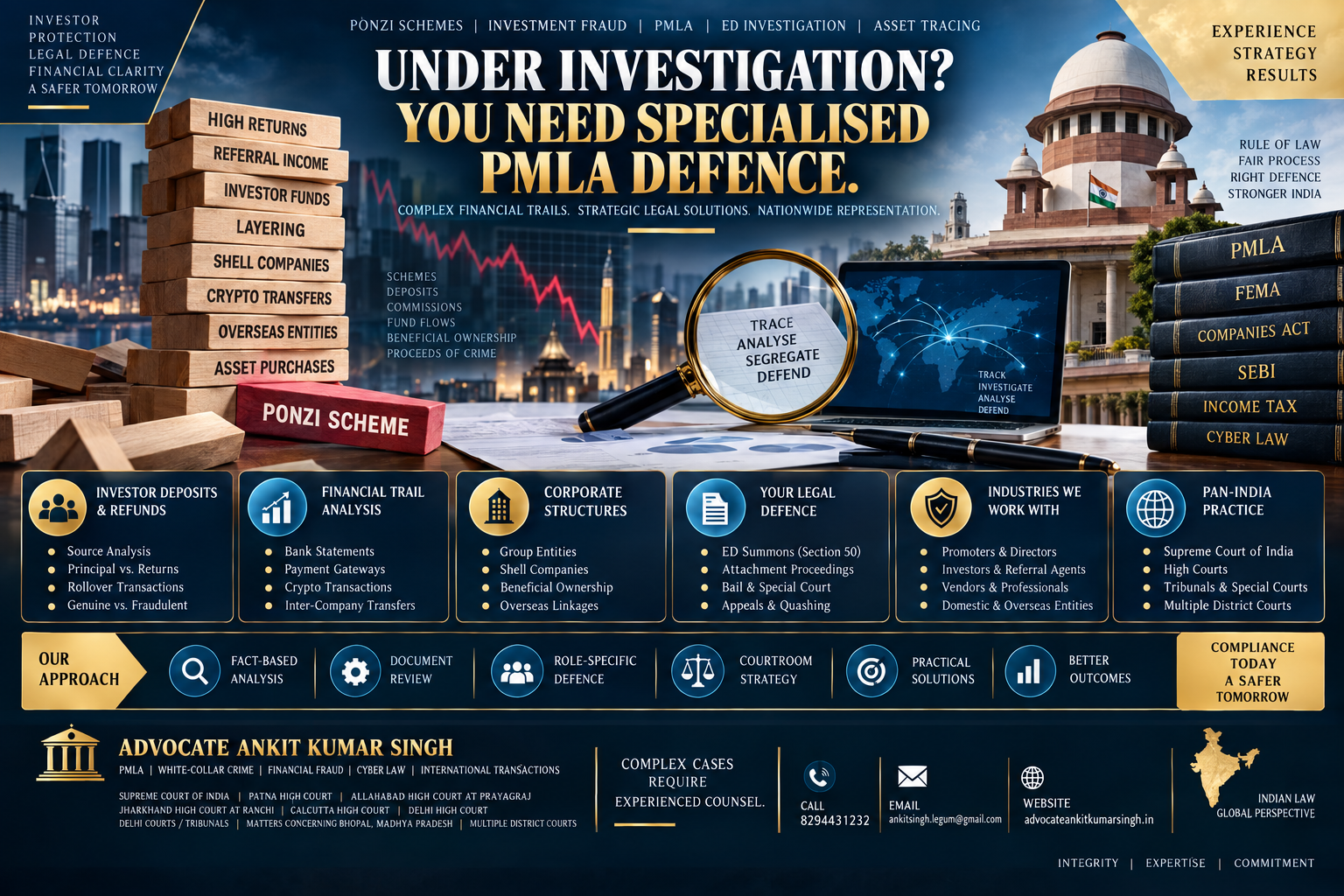
Best PMLA Lawyer in India for Ponzi, Investment Schemes and High-Return Financial Fraud Investigations
This article examines promoters, investors, referral agents, vendors and professionals connected with alleged Ponzi or high-return schemes. It focuses on selecting counsel who can segregate investor deposits, genuine revenue, refunds, commissions, promoter withdrawals, inter-company transfers and assets without treating the entire turnover as one undifferentiated corpus.

Top PMLA Lawyer in India for Real-Estate, Land, Benami Structures and Property-Based Money-Laundering Investigations
This article examines developers, landowners, investors, co-owners and third parties facing ED scrutiny. It focuses on counsel-selection for title chain, consideration, market value, development agreements, source of funds, possession, beneficial ownership, compensation, family structures and the distinction between suspicious property arrangements and legally provable proceeds of crime.

Prominent PMLA Lawyer in India for Shell Companies, Beneficial Ownership, Layering and Corporate Group Transactions
This article examines group-company structures, investment vehicles and directors facing allegations of layering through multiple entities. It explains how a prominent or expert PMLA lawyer should test control, beneficial ownership, inter-company agreements, tax treatment, bank mandates, commercial purpose, circularity and ultimate use of funds instead of assuming every complex corporate structure is laundering.

Specialized PMLA Lawyer in India for Chartered Accountants, Company Secretaries, Auditors and Professional Intermediaries Facing ED Action
This article examines CAs, CSs, auditors, consultants and transaction advisers who receive an ED summons or are accused of facilitating financial movement. It focuses on lawyer-selection for role attribution, engagement scope, client-source records, working papers, bank access, instructions, professional fees, knowledge and the difference between providing services and knowingly assisting laundering.
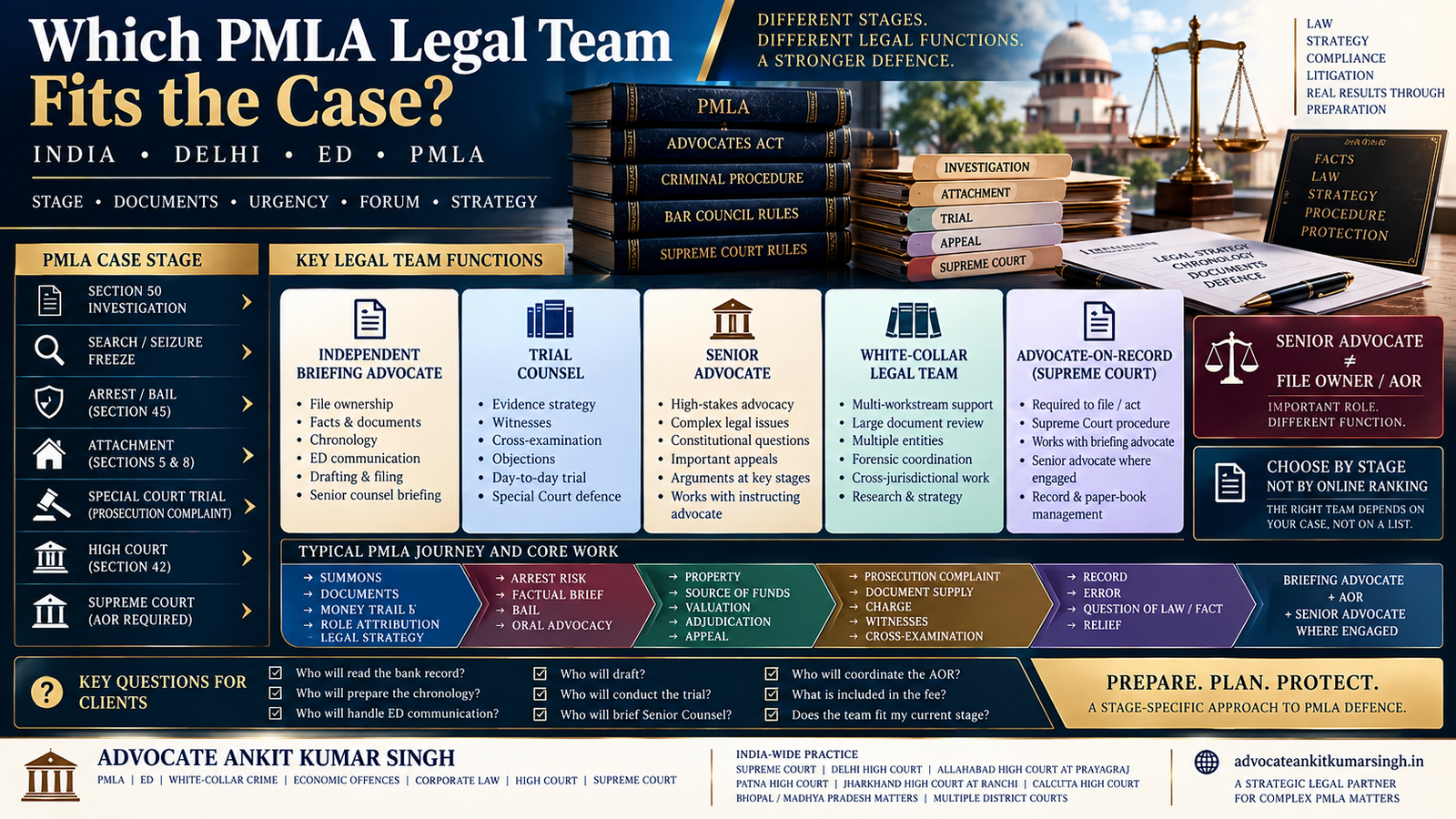
Best PMLA Lawyer in India or Delhi: Independent Advocate, Senior Advocate or White-Collar Law Firm - Which Specialized Legal Team Fits the ED Case?
This article compares the practical roles of an independent briefing advocate, trial counsel, Senior Advocate and larger white-collar law firm at different stages of a PMLA matter. It explains how the appropriate legal team may change between investigation, urgent liberty work, document reconstruction, attachment proceedings, trial, appellate litigation and Supreme Court strategy.
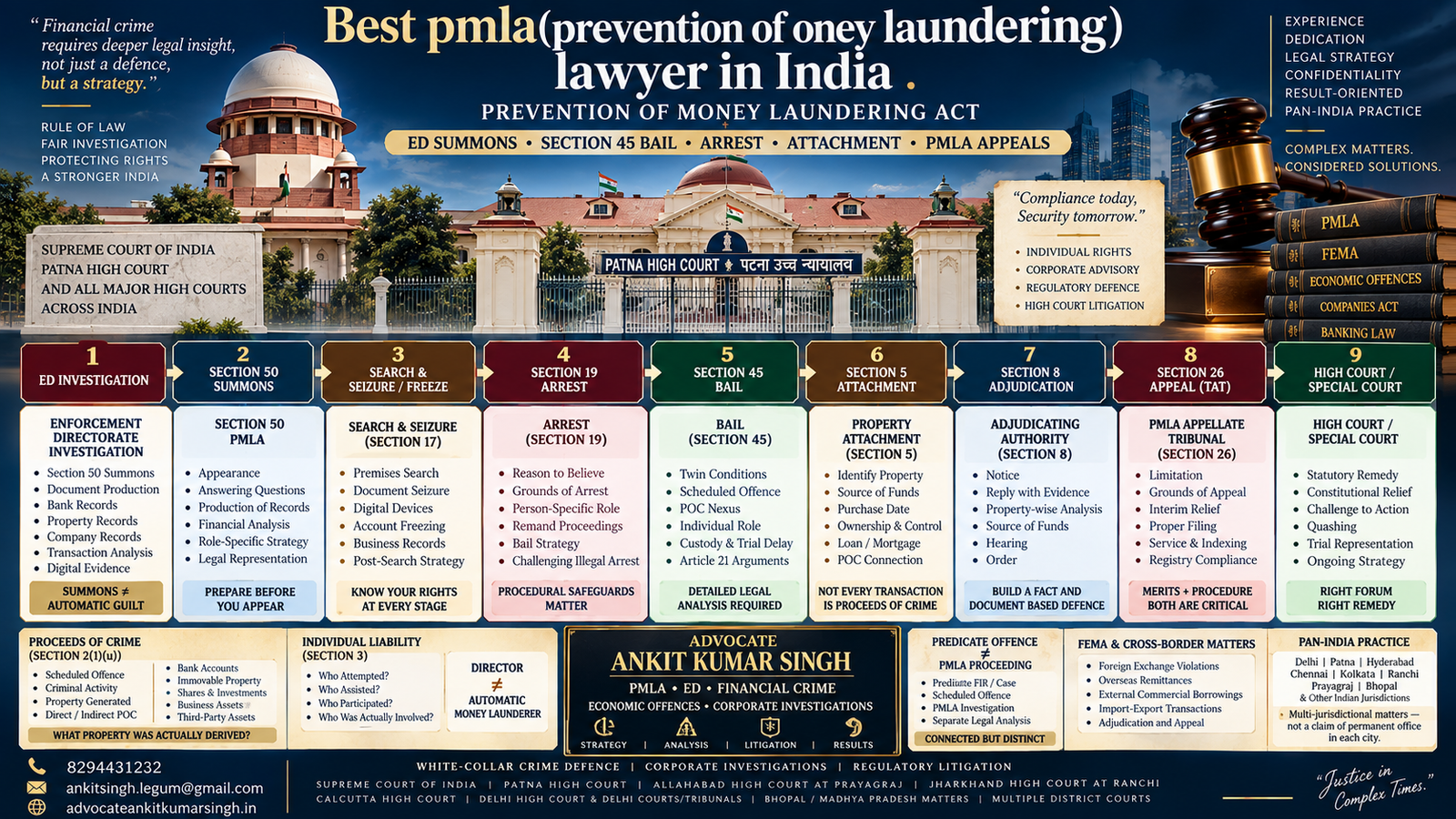
Best PMLA (Prevention of Money Laundering) Lawyer in India: Advocate Ankit Kumar Singh for ED Summons, Section 45 Bail, Attachment and PMLA Appeals
Specialised boutique practices and prominent individual advocates are often approached in PMLA matters because Enforcement Directorate litigation requires close familiarity with ED summons, Section 50 statements and document production, Section 19 arrest, Section 45 bail, proceeds-of-crime analysis, property attachment, Adjudicating Authority proceedings and appeals before the PMLA Appellate Tribunal.

Best PMLA Lawyer in Delhi for DLZO-I Summons and Investigations: How to Choose a Specialized Prevention of Money Laundering Act Advocate
This article examines people searching after receiving an Enforcement Directorate notice from Delhi Zonal Office-I (DLZO-I). It explains how to evaluate a specialized PMLA lawyer for a document-heavy ED matter involving financial records, corporate transactions, scheduled-offence analysis and accused-specific role attribution.
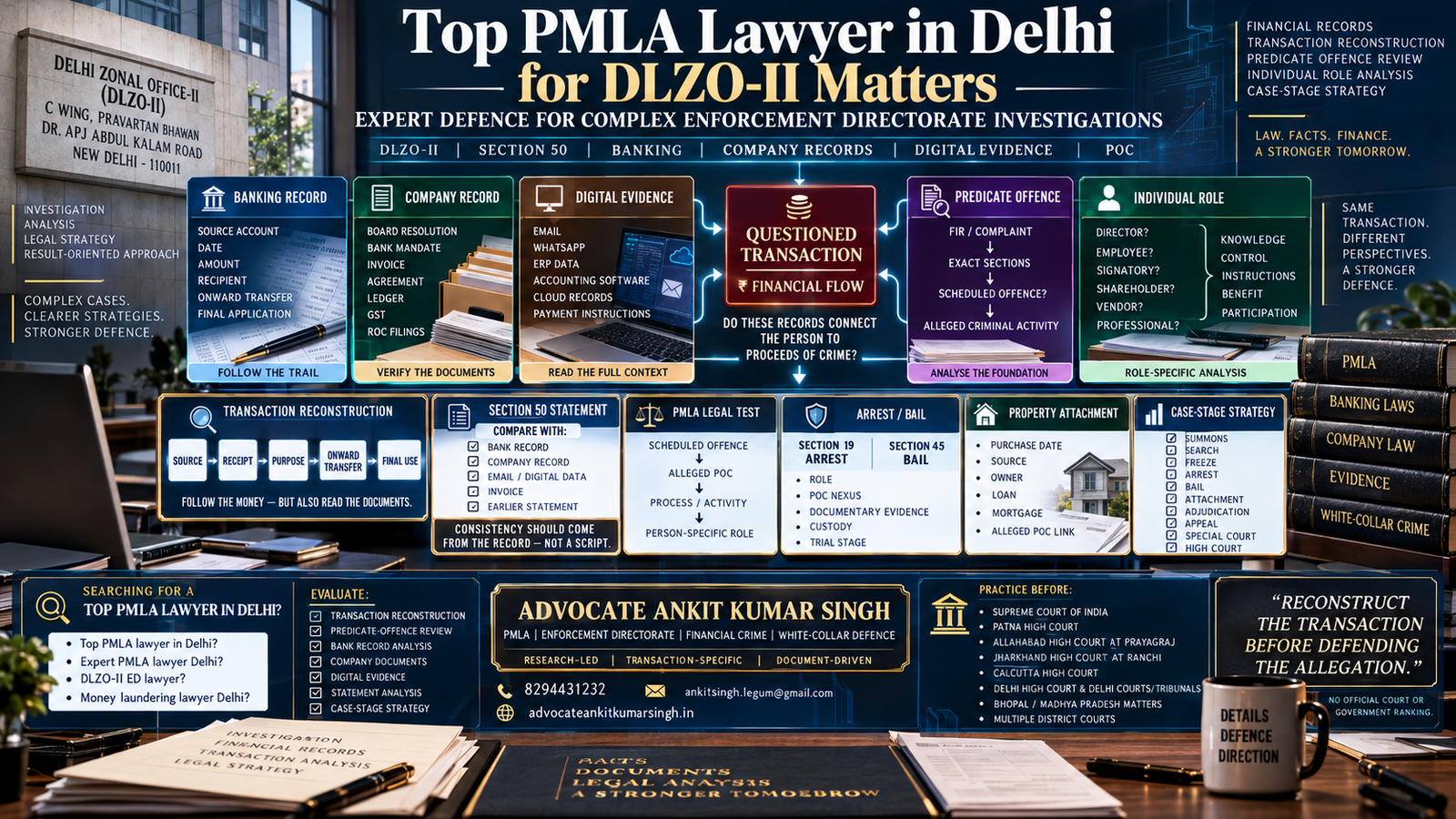
Top PMLA Lawyer in Delhi for DLZO-II Matters: Expert Defence for Complex Enforcement Directorate Investigations
This article examines the legal and documentary issues that commonly arise after a summons, investigation communication or financial-record demand from ED Delhi Zonal Office-II. It focuses on transaction reconstruction, predicate-offence analysis, banking and company records, statements, digital evidence and stage-specific defence strategy, while emphasising verification of the current office structure and the actual communication received.
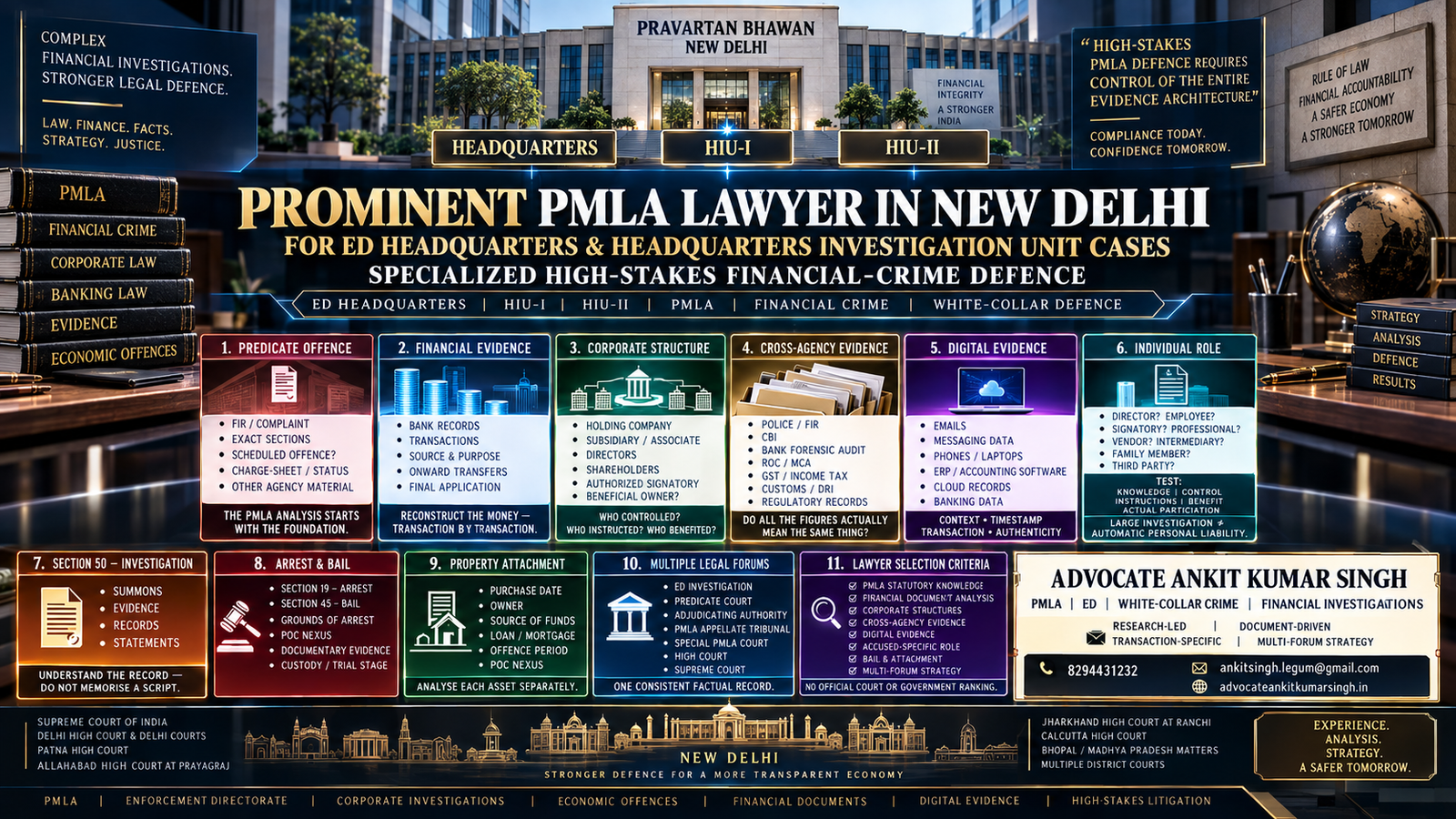
Prominent PMLA Lawyer in New Delhi for ED Headquarters and Headquarters Investigation Unit Cases: Specialized High-Stakes Financial-Crime Defence
This article examines high-stakes PMLA matters connected with ED headquarters or specialised investigation units in New Delhi. It explains why such cases may require coordinated analysis of financial records, corporate structures, cross-agency evidence, digital material and proceedings before multiple courts or tribunals, with one consistent chronology and accused-specific defence theory.

Best PMLA Bail Lawyer in Delhi for Section 45 Twin-Condition Cases After ED Arrest
This article examines PMLA bail strategy in Delhi after an Enforcement Directorate arrest, with particular attention to Section 45 and the twin-condition framework. It considers the arrest record, alleged proceeds of crime, scheduled offence, accused-specific role, Section 50 statements, financial evidence, custody history, parity, health, trial progress and other circumstances relevant to a carefully documented bail application.
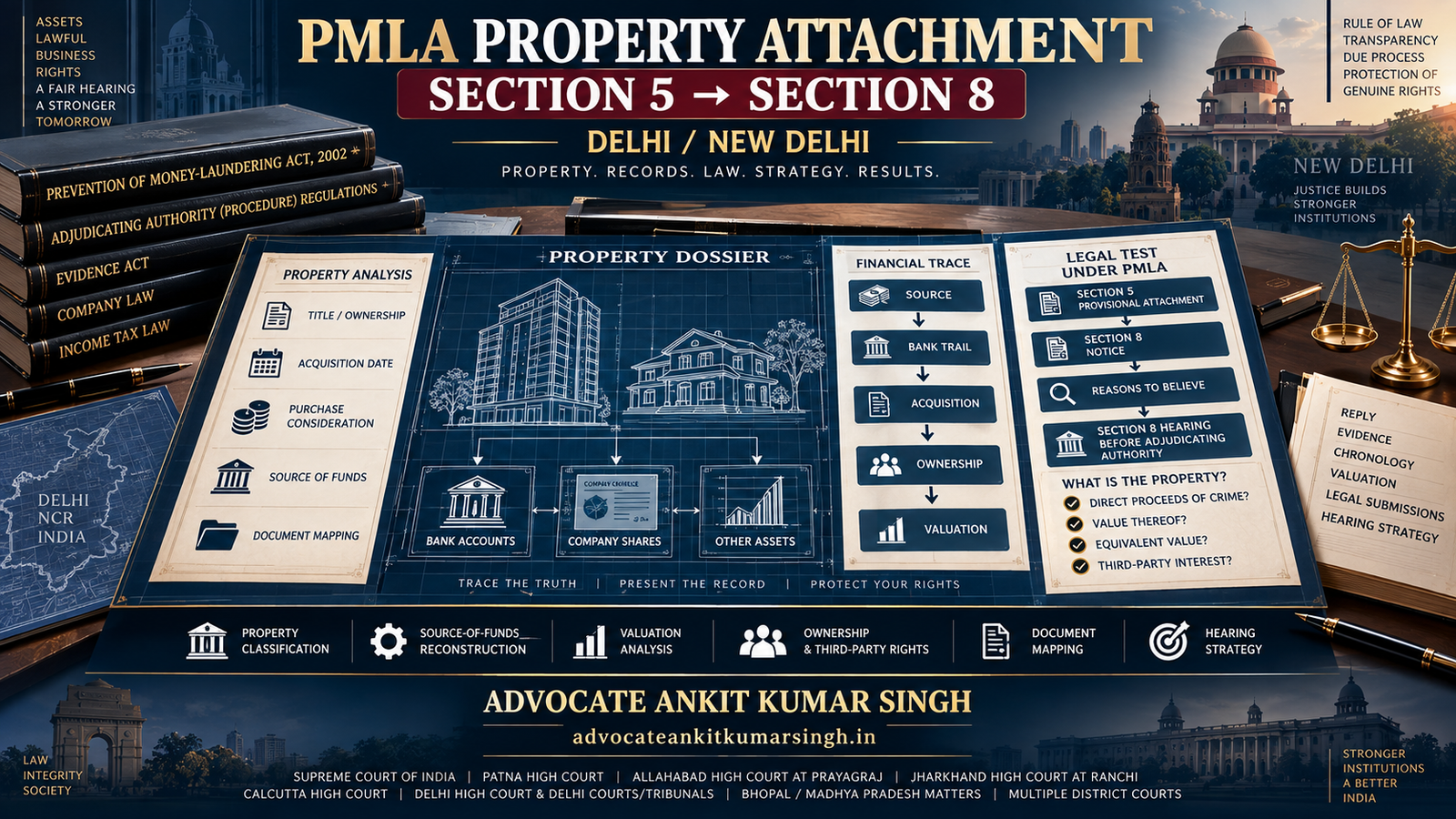
Specialized PMLA Attachment Lawyer in Delhi for Adjudicating Authority Proceedings Under Sections 5 and 8
This article examines owners, companies and third parties searching for a specialized Delhi lawyer after provisional attachment or a Section 8 notice. It focuses on the qualities needed in counsel for property classification, source-of-funds reconstruction, valuation, ownership, document mapping, reasons-to-believe analysis and hearing strategy before the Adjudicating Authority in New Delhi.
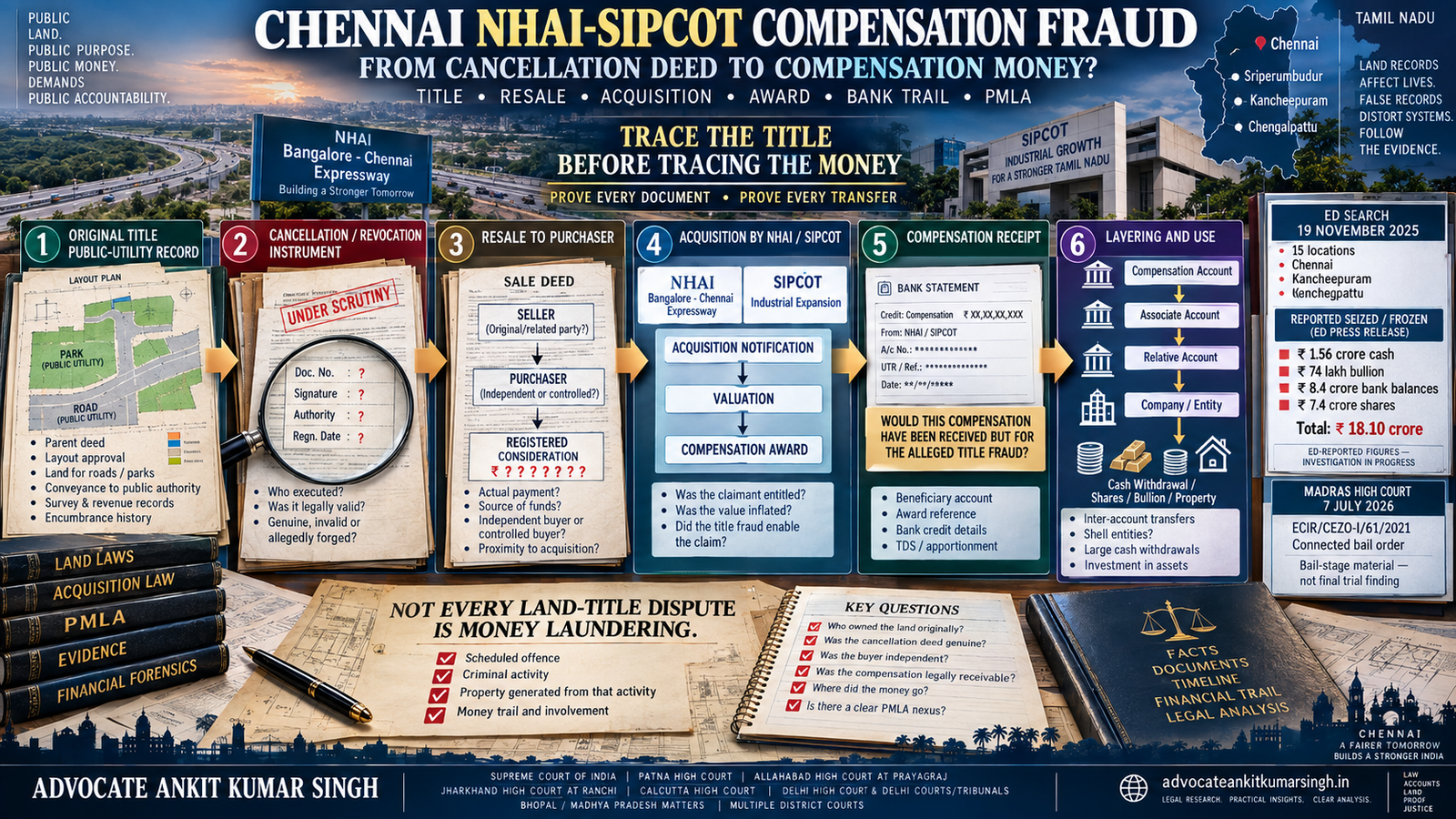
Chennai NHAI-SIPCOT Compensation Fraud: How Can Forged Land Records and Cancellation Deeds Generate Proceeds of Crime?
A land-record fraud can potentially generate proceeds of crime where the alleged criminal activity creates or restores an apparent proprietary right and that right is then used to obtain money or other property. ED alleged that those lands were later reclaimed through forged and fabricated documents and sold to private persons shortly before acquisition by NHAI and SIPCOT.

Chennai Land-Acquisition Compensation Was Inflated Through Controlled Sales: How Will ED Test Whether the Higher Registered Value Was Genuine or Artificial?
This article examines alleged pre-acquisition sales between connected persons used to increase the apparent market value of land before NHAI or SIPCOT compensation. It tests relationship between parties, source of purchase money, actual payment, possession, stamp value, comparable sales, timing before acquisition and whether compensation proceeds were later withdrawn or layered.
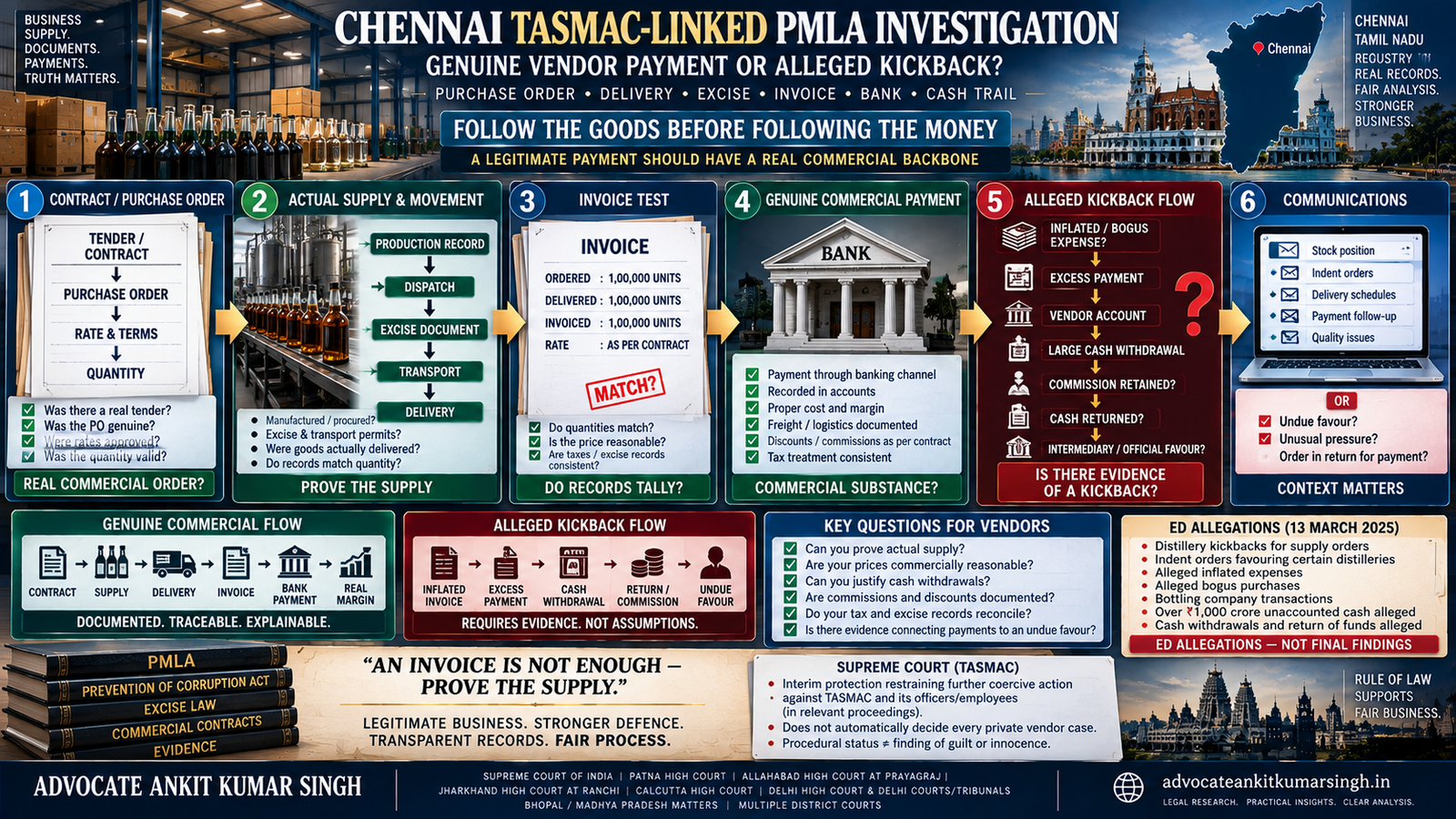
Chennai TASMAC-Linked PMLA Investigation: How Can a Liquor Supplier or Private Vendor Prove Genuine Commercial Payments Were Not Kickbacks?
This article examines TASMAC-linked corruption allegations. It separates legitimate supply revenue, discounts, commissions and logistics costs from alleged bribe or kickback flows by testing tenders, purchase orders, delivery records, excise documentation, invoices, bank payments, cash withdrawals and communications with public officials or intermediaries.
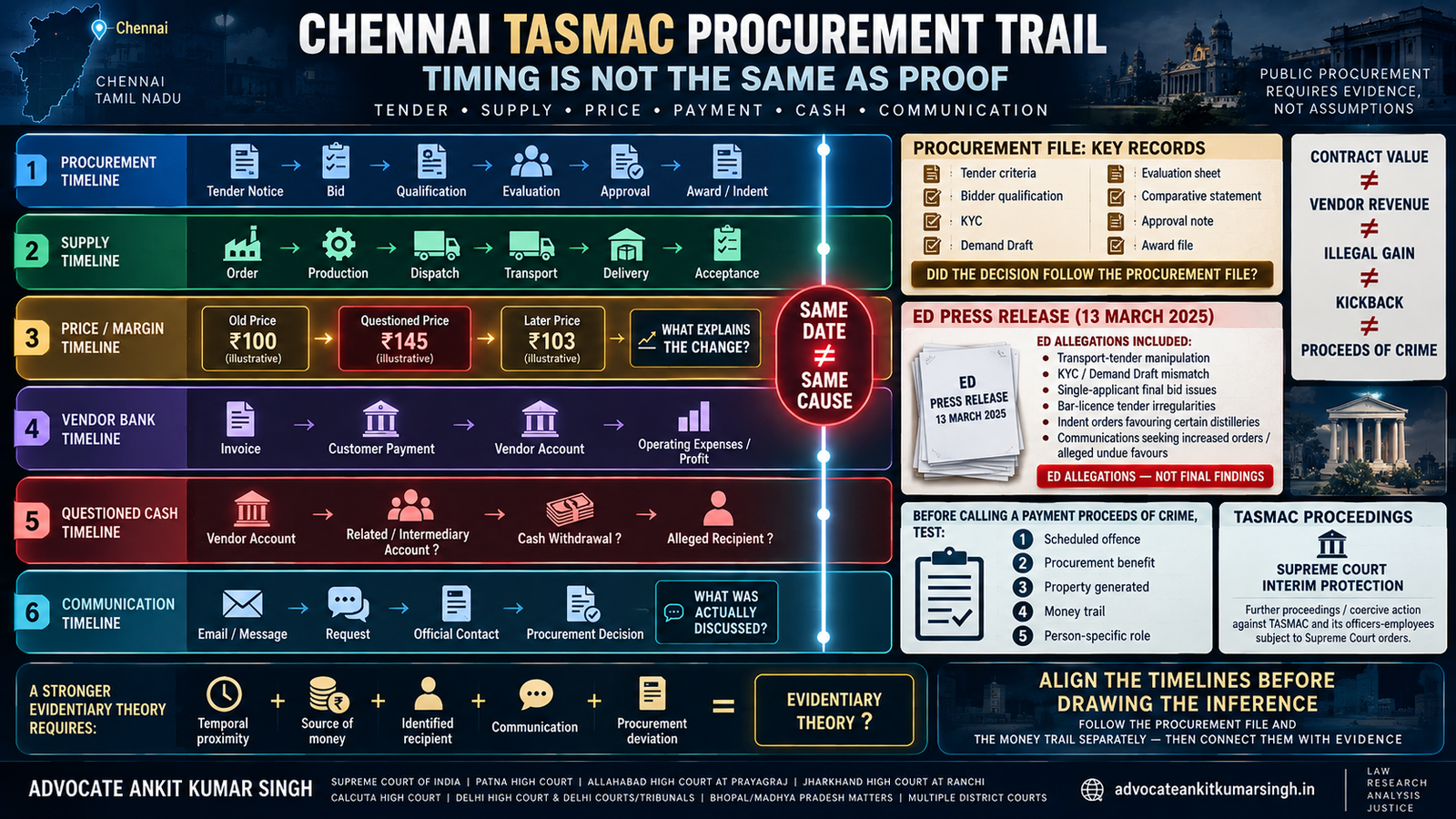
Chennai TASMAC Procurement Trail: Why Should ED Compare Tender Files, Supply Records, Price Changes and Cash Withdrawals Before Treating a Payment as Proceeds of Crime?
A public-procurement corruption investigation may contain two very different bodies of evidence. The first concerns how the government or public-sector procurement decision was made. A reliable PMLA analysis should connect those two bodies of evidence rather than assume that proximity in time is enough.
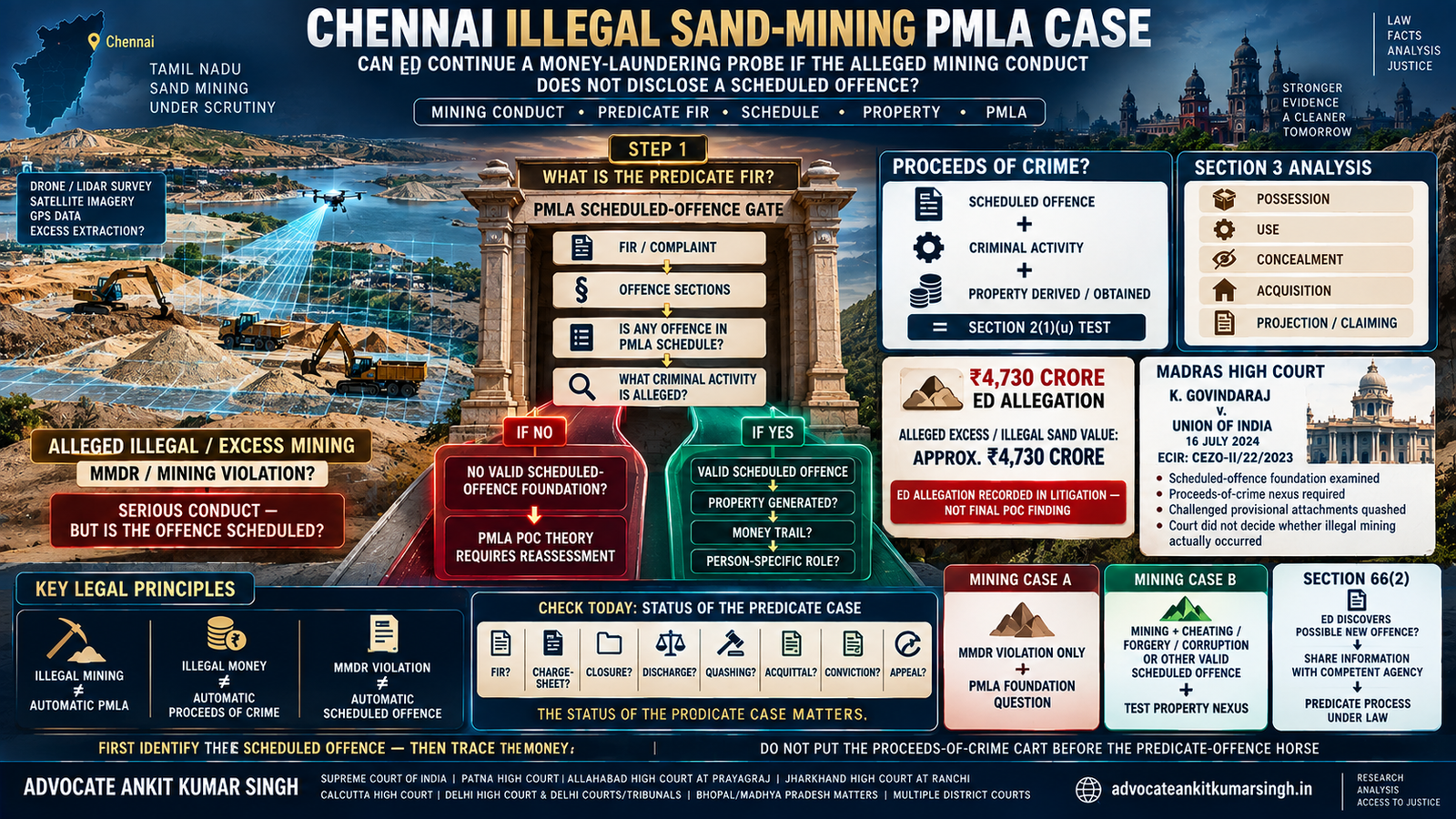
Chennai Illegal Sand-Mining PMLA Case: Can ED Continue a Money-Laundering Probe if the Alleged Mining Conduct Does Not Disclose a Scheduled Offence?
This article examines the scheduled-offence foundation in Tamil Nadu sand-mining investigations, using Madras High Court litigation as the legal anchor. It distinguishes illegal or regulatory mining conduct from a scheduled predicate offence and explains why the existence, content and status of the predicate case can be decisive before proceeds can be treated as proceeds of crime under PMLA.
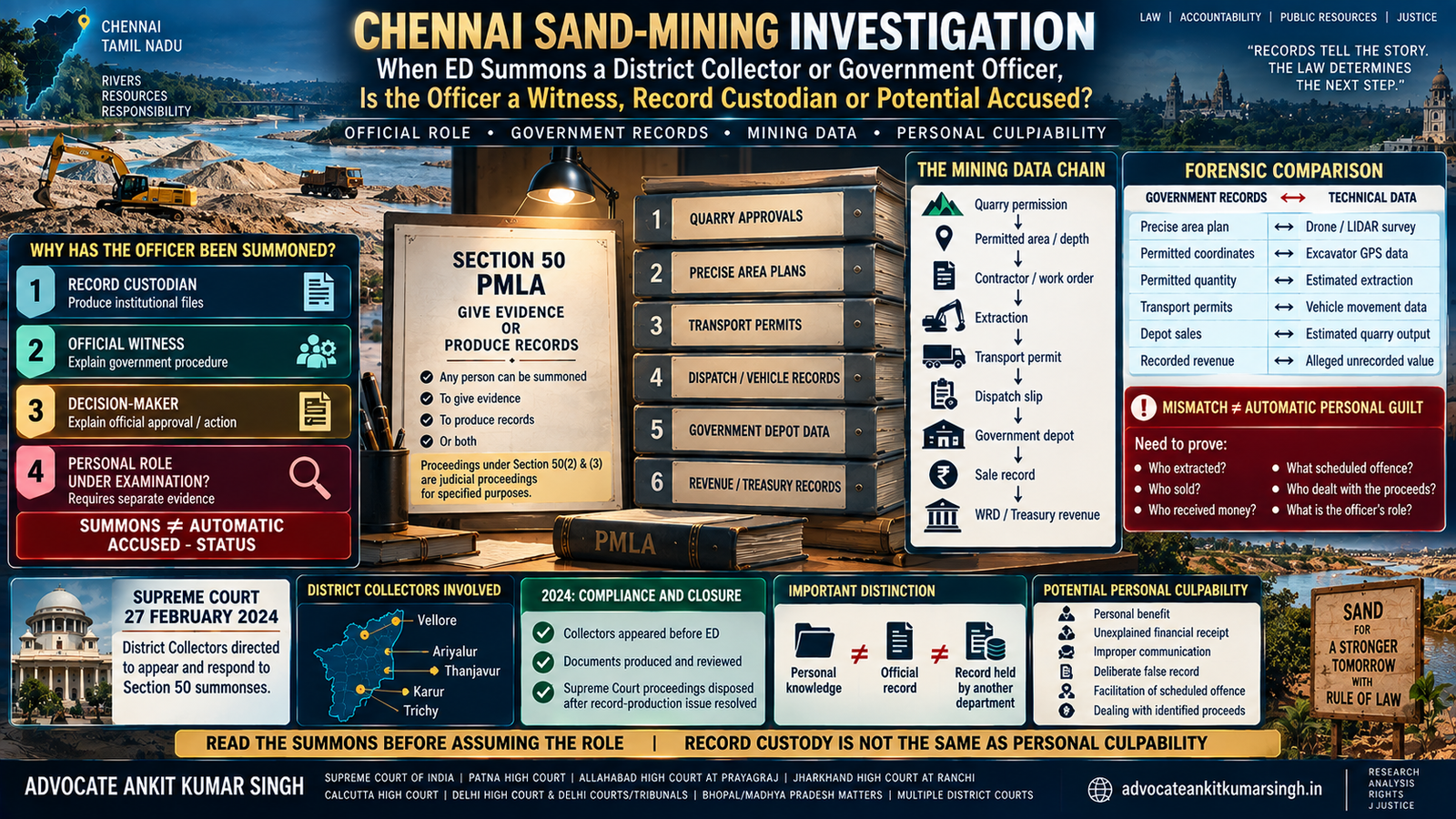
Chennai Sand-Mining Investigation: When ED Summons a District Collector or Government Officer, Is the Officer a Witness, Record Custodian or Potential Accused?
This article examines Section 50 summons issued in Chennai for official mining, royalty, transport and district records. It distinguishes institutional record production from personal culpability, explains why the wording of the summons and the officer’s role matter, and shows how government data may be used to reconstruct extraction, permits, dispatch and alleged revenue loss.
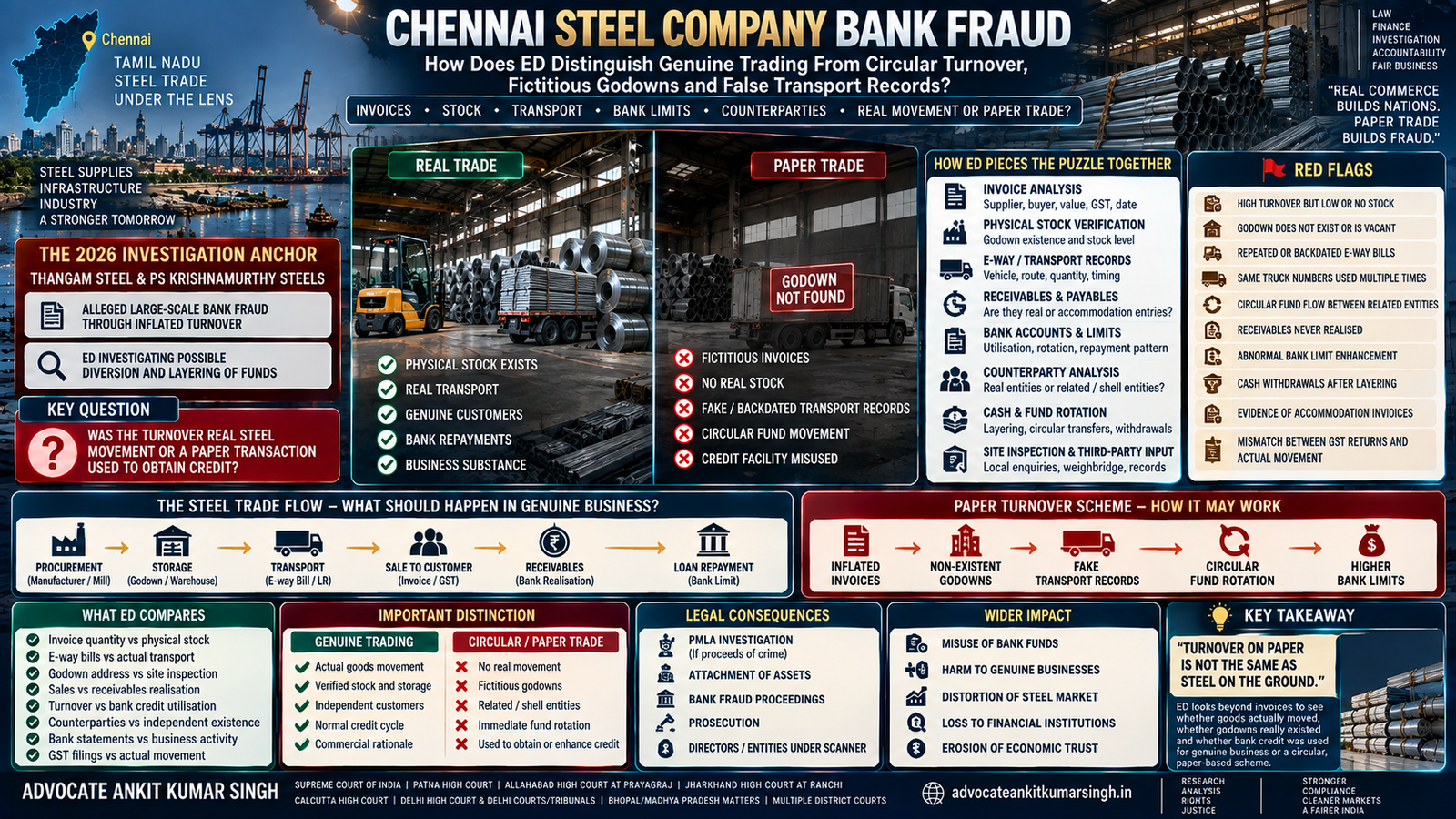
Chennai Steel Company Bank Fraud: How Does ED Distinguish Genuine Trading From Circular Turnover, Fictitious Godowns and False Transport Records?
Using the Thangam Steel and PS Krishnamurthy Steels investigation as a research anchor, this article examines how alleged circular trading and bank-fraud transactions are tested in Chennai. It compares invoices with physical stock, transport records, godown existence, receivables, bank limits, counterparties and fund rotation to distinguish genuine steel movement from paper transactions used to obtain credit.
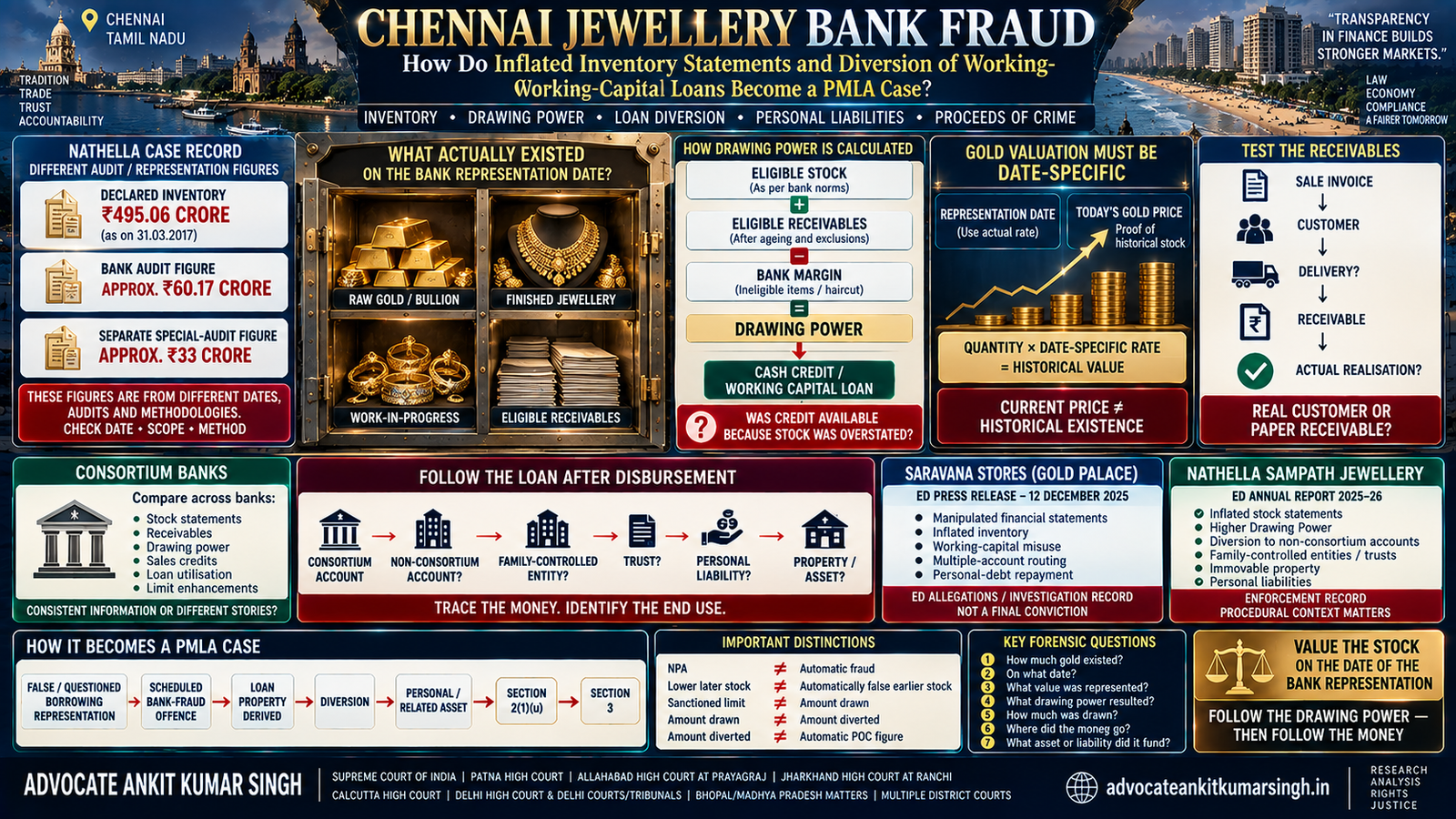
Chennai Jewellery and Retail Bank Fraud: How Do Inflated Inventory Statements and Diversion of Working-Capital Loans Become a PMLA Case?
Using the Nathella Sampath Jewellery and Saravana Stores enforcement patterns, this article examines stock-based lending fraud in Chennai. It analyses drawing power, inventory statements, stock audits, consortium-bank records, non-consortium accounts, use of loan funds for personal liabilities or assets and why jewellery valuation must be tied to the date and financing representation actually made to the bank.
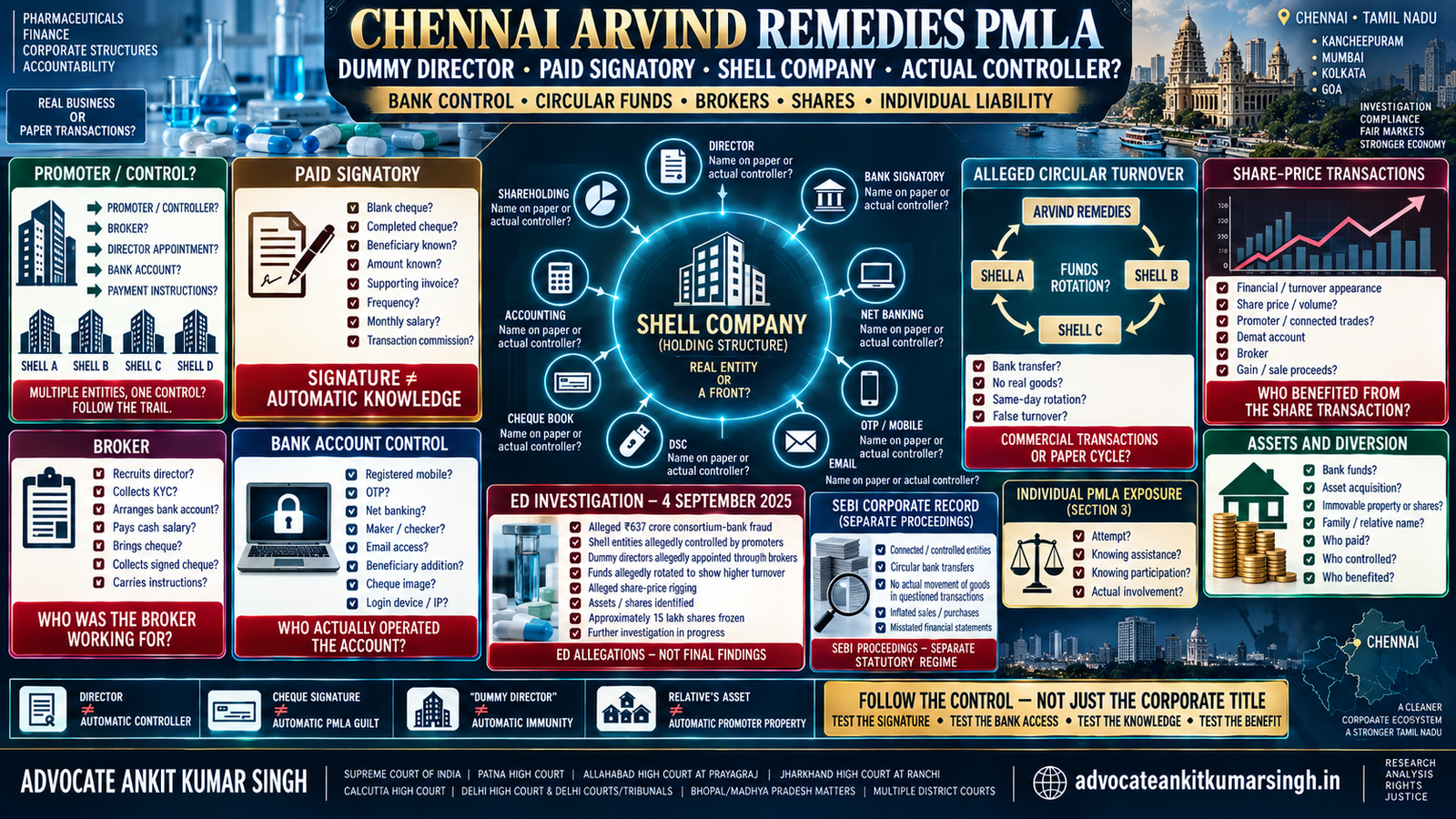
Chennai Pharmaceutical Bank Fraud and Dummy Directors: When Do Paid Signatories, Shell Companies and Share-Price Transactions Create Individual PMLA Exposure?
Using the Arvind Remedies investigation as a research anchor, this article examines corporate bank fraud involving shell entities and dummy directors in Chennai. It examines who controlled the shell companies, who held bank credentials, why funds were rotated, whether assets or shares were acquired, the role of brokers and whether a paid signatory understood the transactions or merely lent a name.
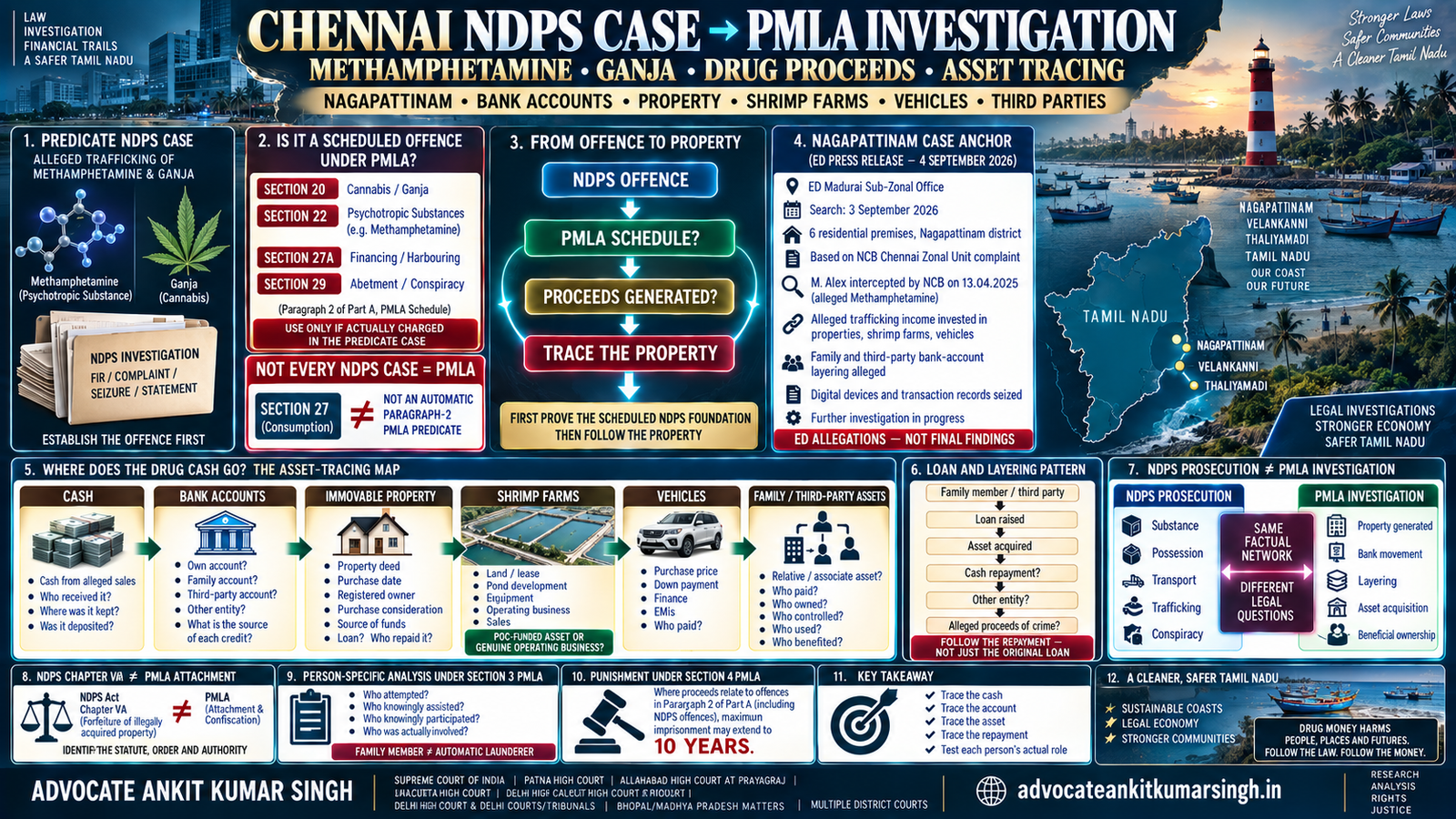
Chennai NDPS Case Turning Into a PMLA Investigation: How Can Methamphetamine or Ganja Trafficking Lead to ED Searches and Asset Tracing in Tamil Nadu?
This article examines how a Tamil Nadu NDPS investigation can provide the scheduled-offence foundation for a separate PMLA inquiry where alleged drug trafficking generates proceeds of crime. Using a recent Nagapattinam investigation as context, it considers tracing alleged drug proceeds into bank accounts, properties, farms, vehicles or third-party assets while keeping the NDPS prosecution distinct from the ED money-laundering case.
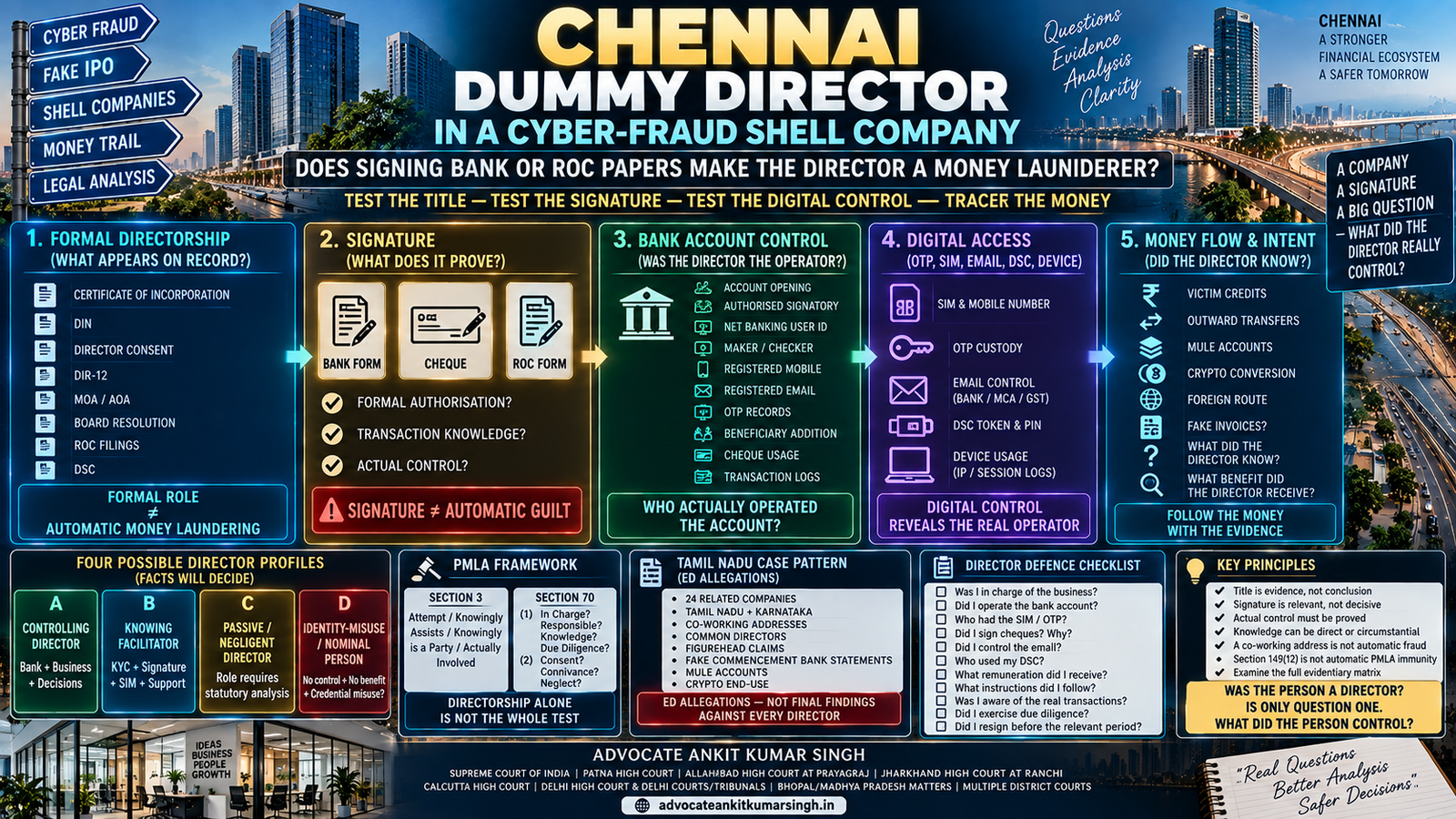
Chennai Dummy Director in a Cyber-Fraud Shell Company: Does Signing Bank or ROC Papers Make the Director a Money Launderer?
This article examines the difficult position of persons whose names were used as directors of companies later linked to cyber-fraud proceeds. It distinguishes formal directorship from actual control by testing bank access, cheque signing, OTP or SIM custody, email use, remuneration, instructions, incorporation documents and knowledge of the company's real transactions.
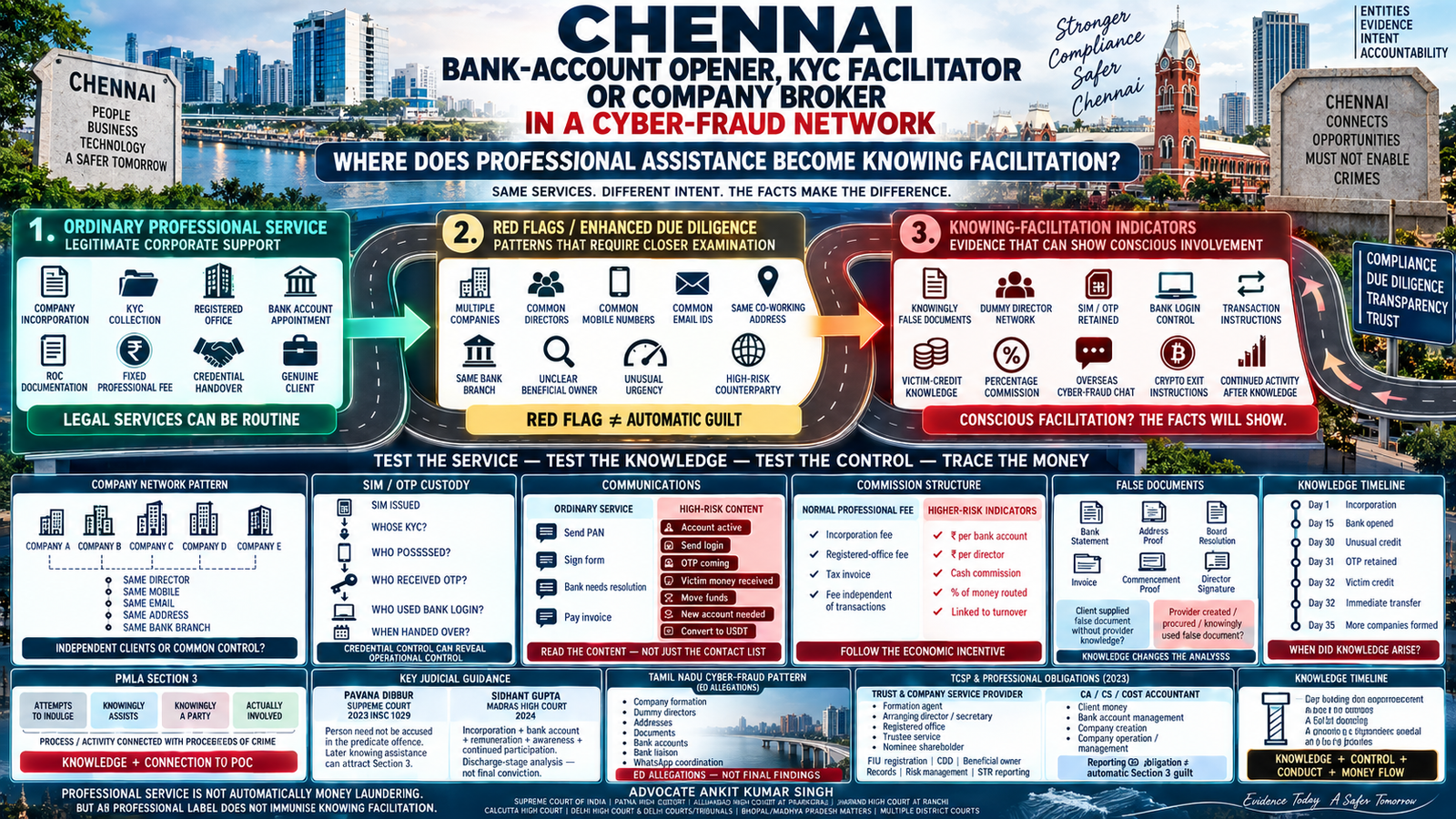
Chennai Bank-Account Opener, KYC Facilitator or Company Broker in a Cyber-Fraud Network: Where Does Professional Assistance Become Knowing Facilitation?
This article examines intermediaries who arrange incorporation, addresses, KYC, bank accounts or documentation for multiple companies that later receive cyber-fraud money in Chennai. It examines repetition, commissions, control of SIMs and credentials, false documents, communication with overseas operators and whether the intermediary's conduct shows ordinary service provision or conscious facilitation of laundering.

Chennai Aarudhra Gold Referral Agent: Can Earning Commission for Bringing Investors Create PMLA Exposure?
Using the Aarudhra Gold investigation as a research anchor, this article examines the role of referral agents and field-level solicitors in Chennai. It distinguishes genuine investor referral from alleged participation by analysing commission structures, representations made to depositors, handling of money, internal communications, recruitment hierarchy and whether the agent helped move or conceal investor funds.
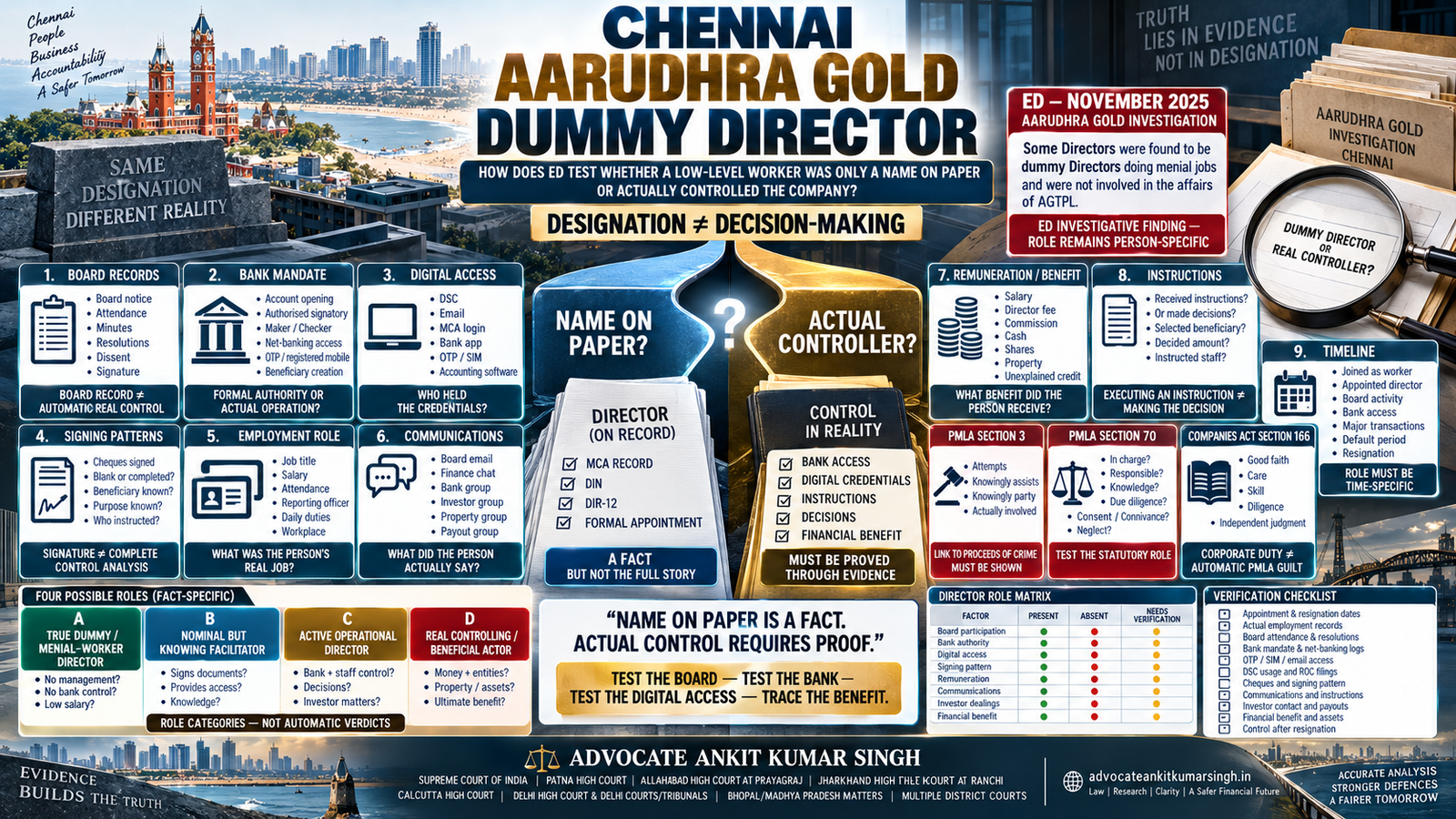
Chennai Aarudhra Gold Dummy Director: How Does ED Test Whether a Low-Level Worker Was Only a Name on Paper or Actually Controlled the Company?
In its 27 November 2025 press release, the Enforcement Directorate's Chennai Zonal Office stated that during searches in the Aarudhra Gold Trading Pvt. Ltd. investigation it found that some AGTPL directors were dummy directors doing menial jobs and were not involved in the affairs of AGTPL. ED states that its investigation arises from an Economic Offences Wing, Chennai case concerning alleged collection of public deposits by Aarudhra Gold Trading Pvt.
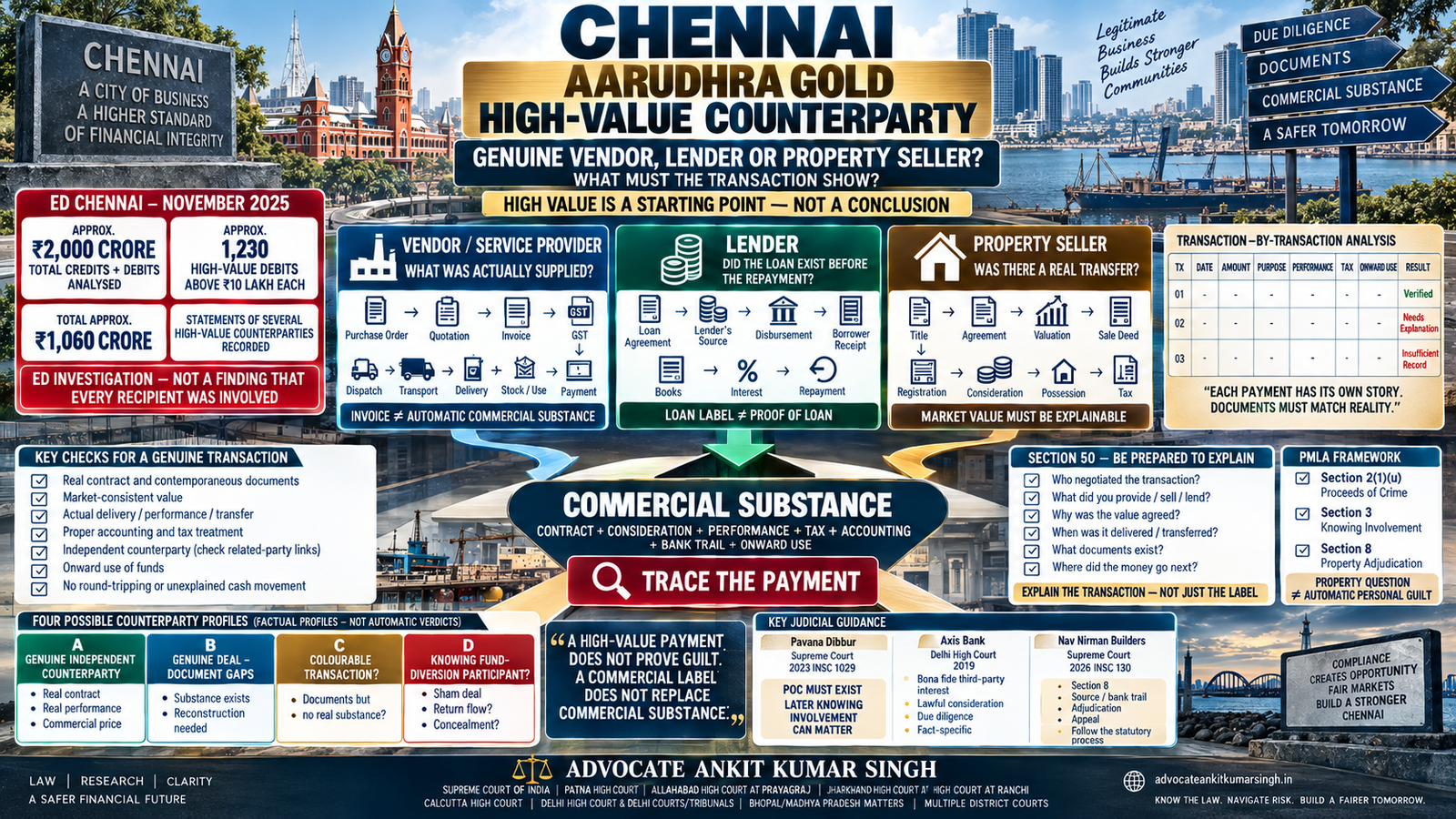
Chennai High-Value Counterparty to Aarudhra Gold: What Must a Genuine Vendor, Lender or Property Seller Show When ED Questions the Transaction?
This article examines the position of a vendor, lender, property seller or other high-value counterparty who dealt with an entity later accused of investment fraud in Chennai but claims an independent commercial transaction. It focuses on contract terms, consideration, market value, delivery, loan records, tax treatment, property documents, repayment and onward use of funds to test commercial substance transaction by transaction.
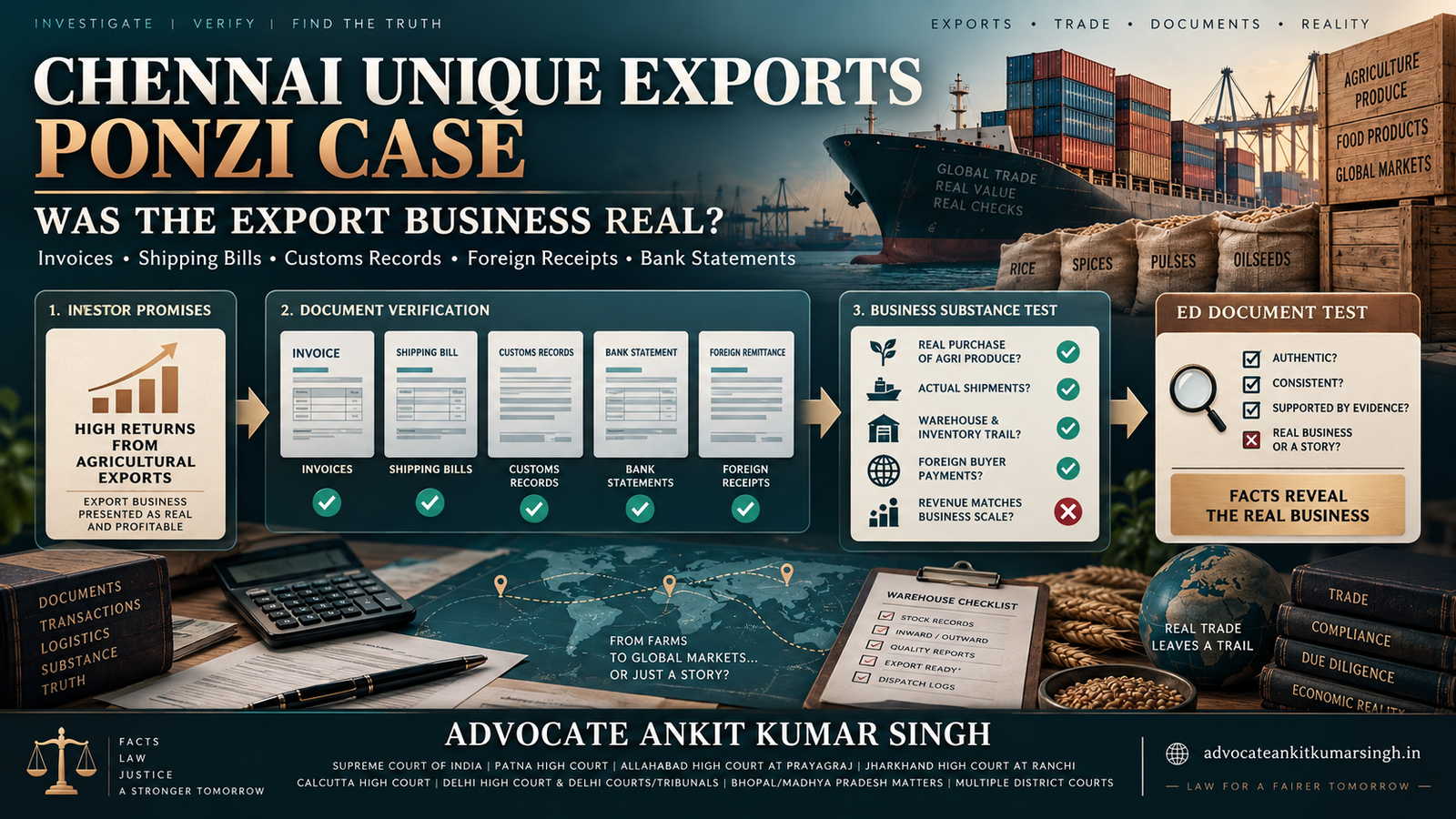
Chennai Unique Exports Ponzi Case: How Does ED Test Whether the Claimed Agricultural Export Business Was Real or Only the Story Used to Collect Investor Money?
Using the Unique Exports investigation as a research anchor, this article examines investment schemes in Chennai that claim profits from agricultural exports. It compares investor representations with export invoices, shipping bills, customs records, foreign receipts, produce purchases, logistics, margins and bank statements to determine whether a genuine operating business existed behind the investment pitch.
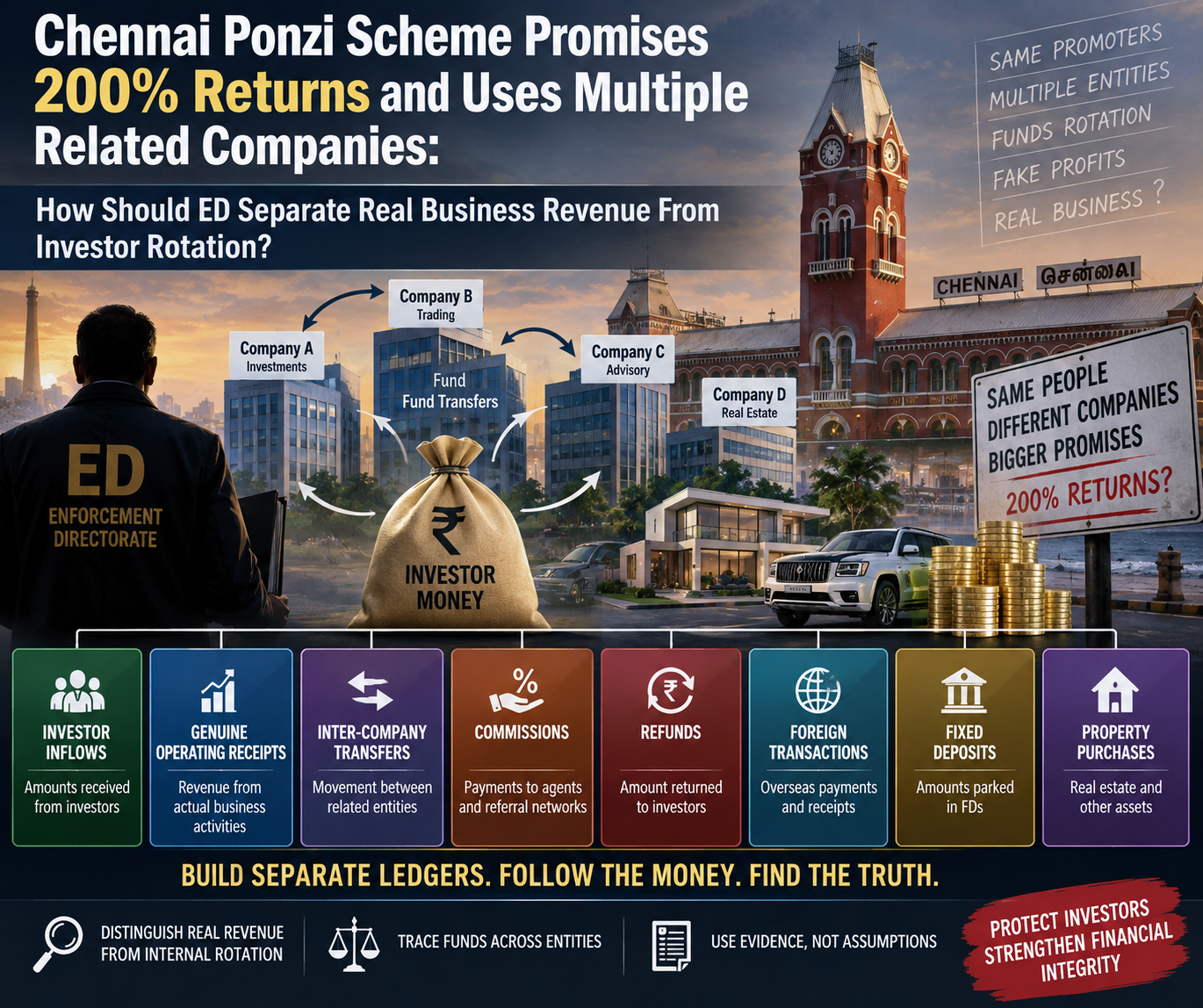
Chennai Ponzi Scheme Promises 200% Returns and Uses Multiple Related Companies: How Should ED Separate Real Business Revenue From Investor Rotation?
ED alleged that a Ponzi scheme was operated in the name of M/s Unique Exports and that hundreds of investors were induced to invest on the representation that money would be deployed in the export of agricultural produce such as onion, potato and other commodities. The public release alleged that schemes promised returns exceeding 200% within a short period and that investors were also offered commissions for bringing relatives and friends into the schemes.

Chennai Investor Received Early Returns or Referral Commission Before a Ponzi Scheme Collapsed: Can ED Summon the Investor or Examine the Profit?
This article examines the position of a Chennai investor who received principal, returns or referral commission before an alleged Ponzi scheme collapsed. It distinguishes recovery of the investor’s own money from profits or commissions allegedly funded by later investors and considers knowledge, good-faith receipt, transaction records and the legal basis of each payment before drawing conclusions about recipient exposure.
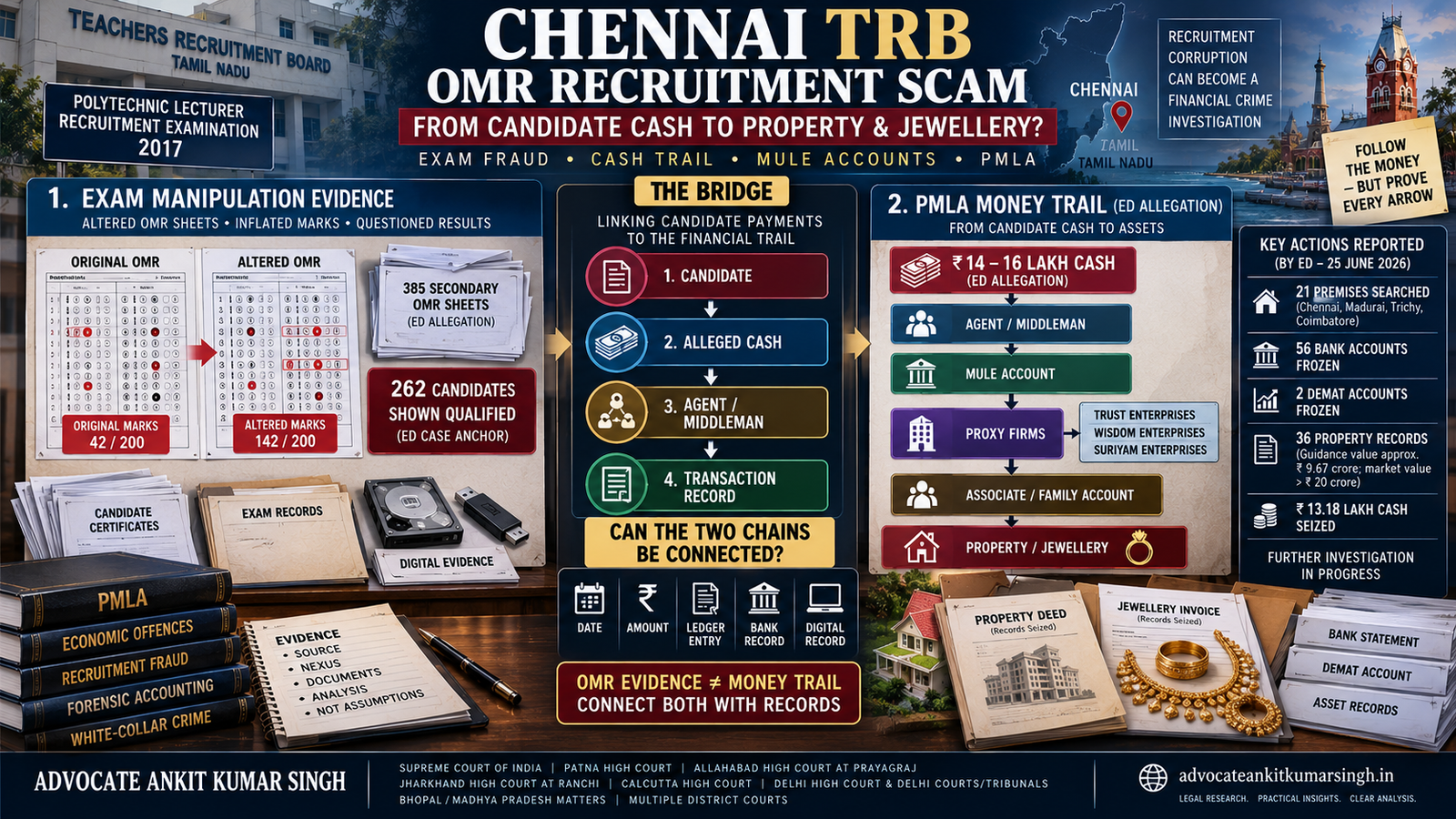
Chennai TRB OMR Recruitment Scam: How Can Cash Collected From Candidates Become a PMLA Money Trail Into Mule Accounts, Property and Jewellery?
Using the Teachers Recruitment Board OMR-sheet investigation as a current example, this article examines how recruitment corruption can develop into a financial investigation in Chennai. It traces alleged candidate cash through agents, proxy firms, mule or family accounts, property and jewellery while keeping the exam-manipulation evidence distinct from the later laundering trail.
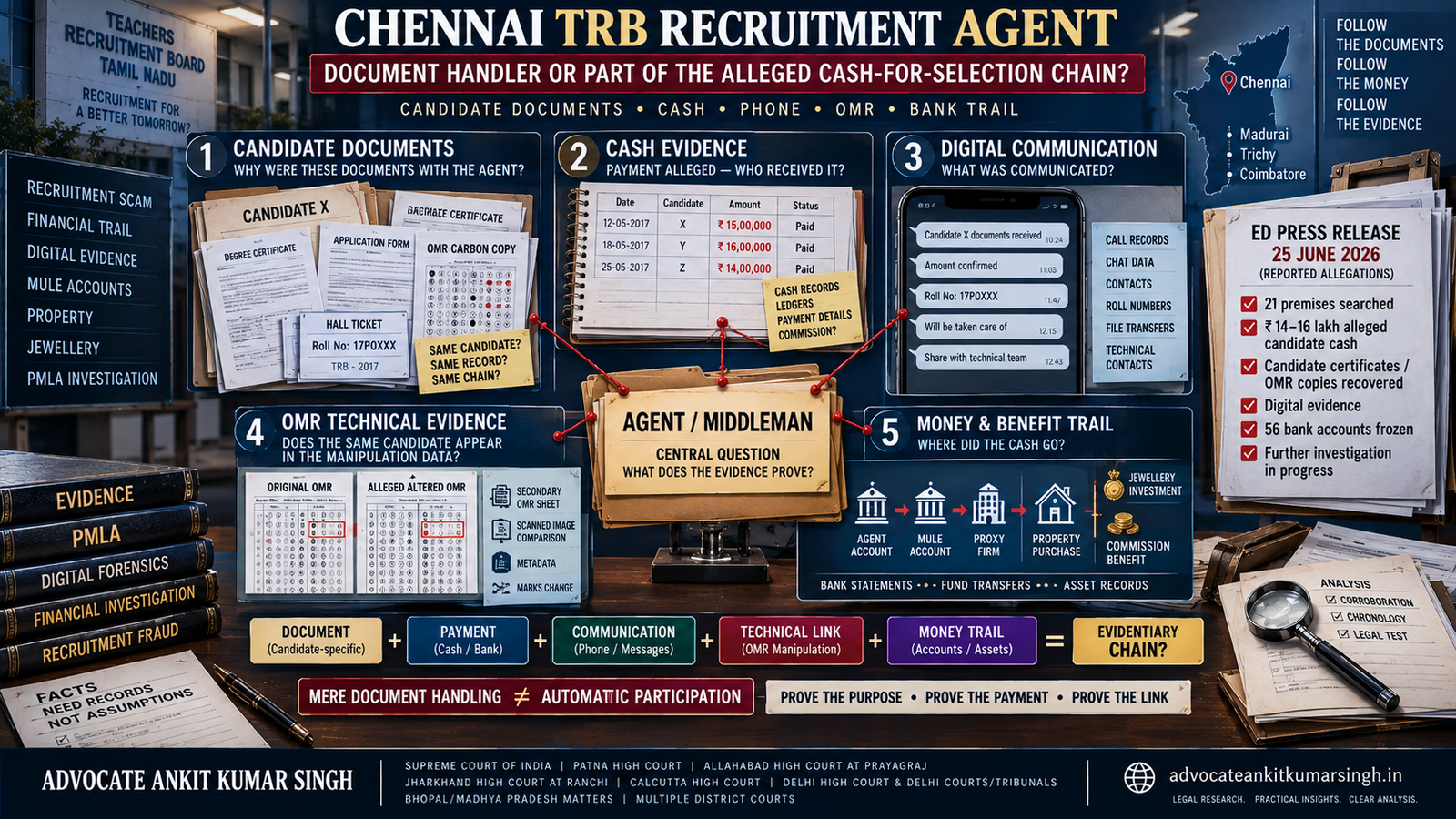
Chennai TRB Recruitment Agent or Middleman Receives Candidate Documents and Cash: What Evidence Can Link the Agent to OMR Manipulation and the Money?
This article examines the role of recruitment agents where candidate certificates, carbon copies of OMR sheets, cash records, phones and bank accounts are recovered. It connects candidate-specific payment evidence with communications, technical manipulation, mule accounts and assets, while distinguishing mere document handling from participation in the alleged recruitment-for-cash conspiracy.
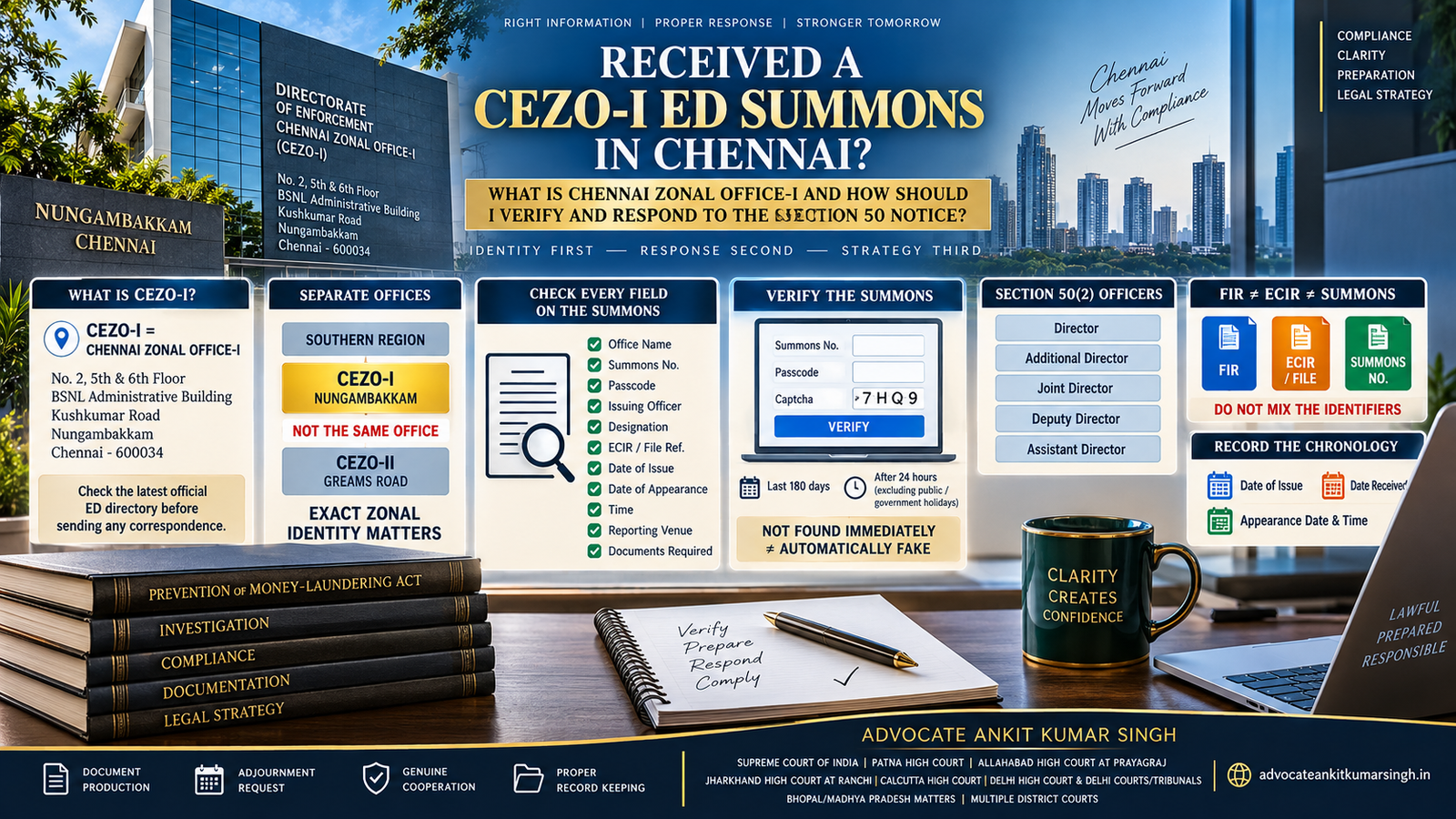
Received a CEZO-I ED Summons in Chennai: What Is Chennai Zonal Office-I and How Should I Verify and Respond to the Section 50 Notice?
This article explains that the Enforcement Directorate's official office records identify Chennai Zonal Office-I as CEZO-I. It shows how a recipient should verify the CEZO-I office name, summons number, issuing officer, ECIR or file reference, date, appearance requirement and official contact particulars before responding.
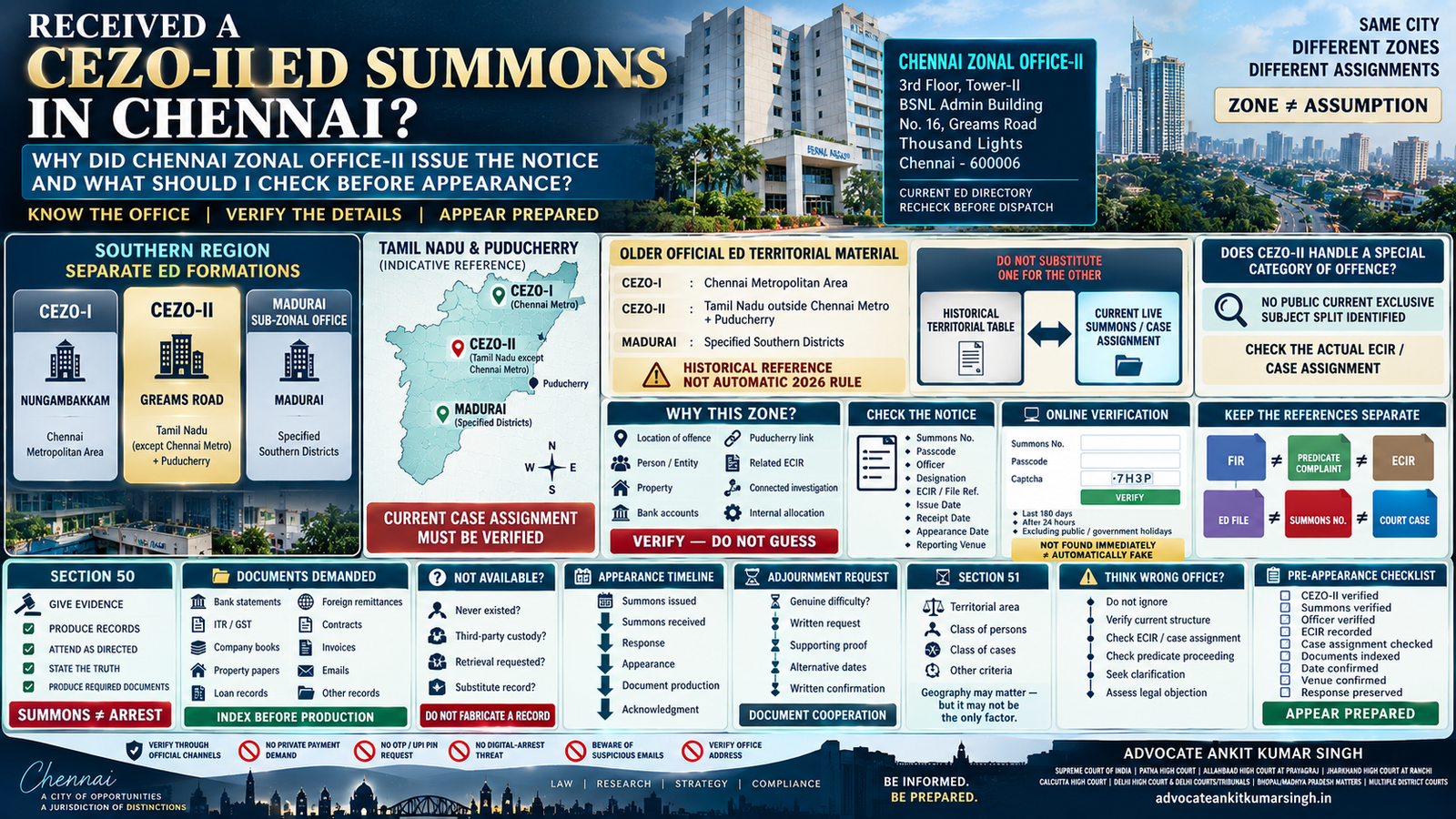
Received a CEZO-II ED Summons in Chennai: Why Did Chennai Zonal Office-II Issue the Notice and What Should I Check Before Appearance?
This article explains that the Enforcement Directorate officially uses the abbreviation CEZO-II for Chennai Zonal Office-II. It guides the recipient through the summons number, officer designation, office address, ECIR or investigation reference, documents demanded and appearance date.
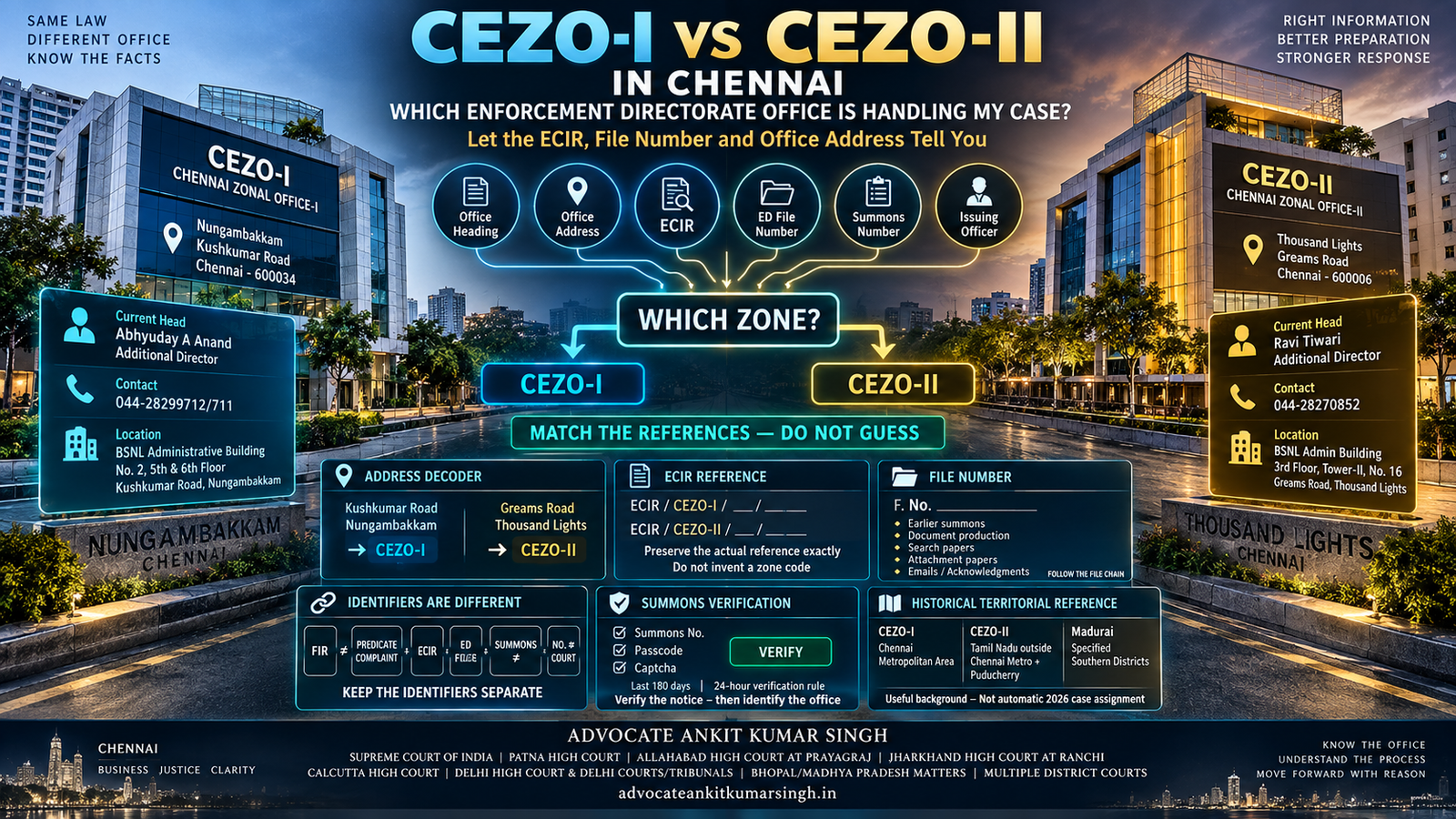
CEZO-I vs CEZO-II in Chennai: Which Enforcement Directorate Office Is Handling My Case and What Do the ECIR, File Number and Office Address Tell Me?
This article examines a practical comparison of CEZO-I and CEZO-II so a person receiving an ED notice can identify which zonal office is actually handling the matter. It use current official ED office records, distinguish the two office locations, explain how the file or ECIR reference and officer designation help identify the originating office, and verify the current territorial allocation before publication.
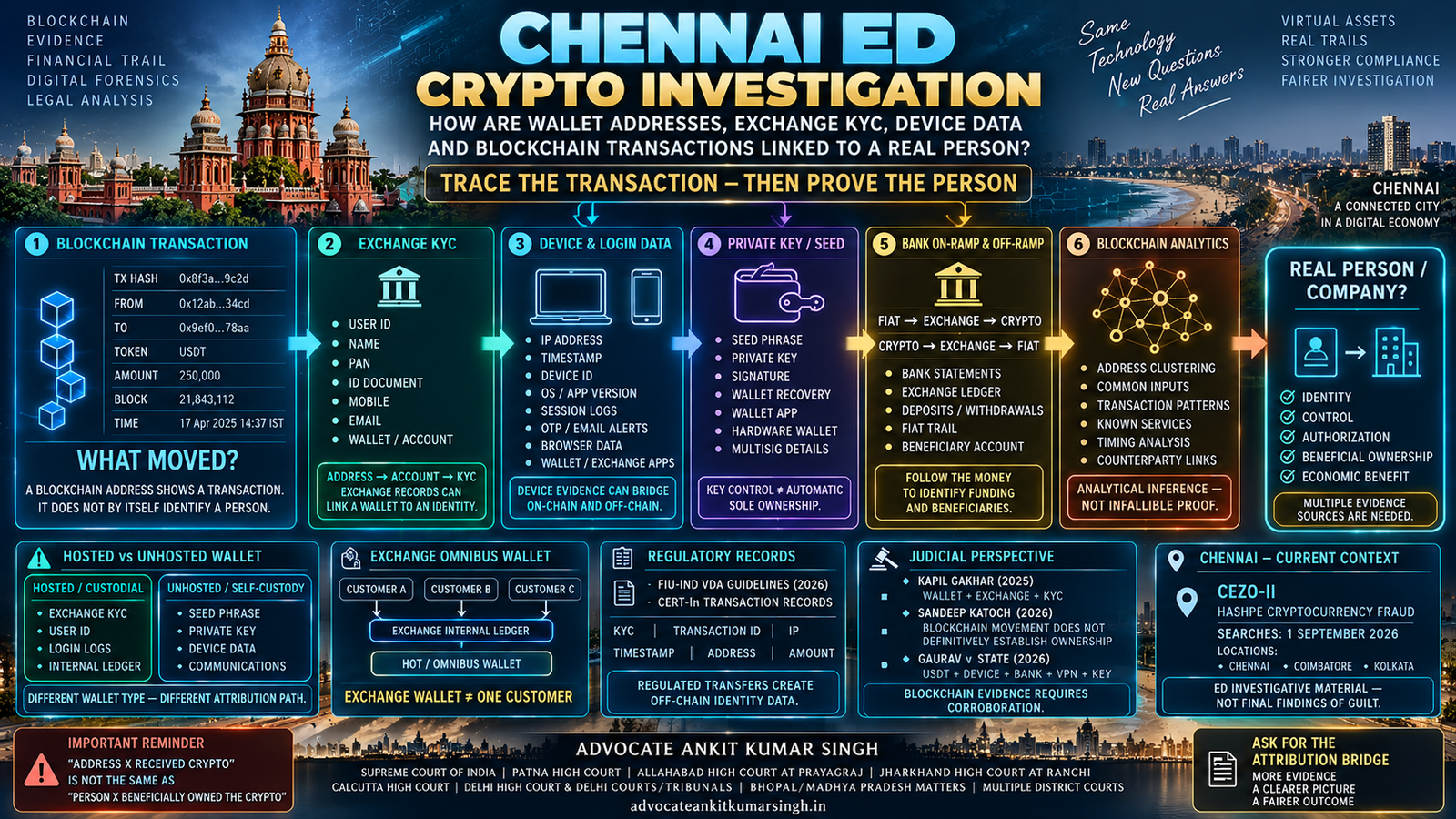
Chennai ED Crypto Investigation: How Are Wallet Addresses, Exchange KYC, Device Data and Blockchain Transactions Linked to a Real Person?
This article explains how a cryptocurrency transaction is connected to an individual or company. It examines exchange KYC, wallet ownership, device and login records, IP or session information, seed or private-key custody, bank on-ramp and off-ramp, address clustering and the danger of treating a blockchain address alone as conclusive proof of beneficial ownership.
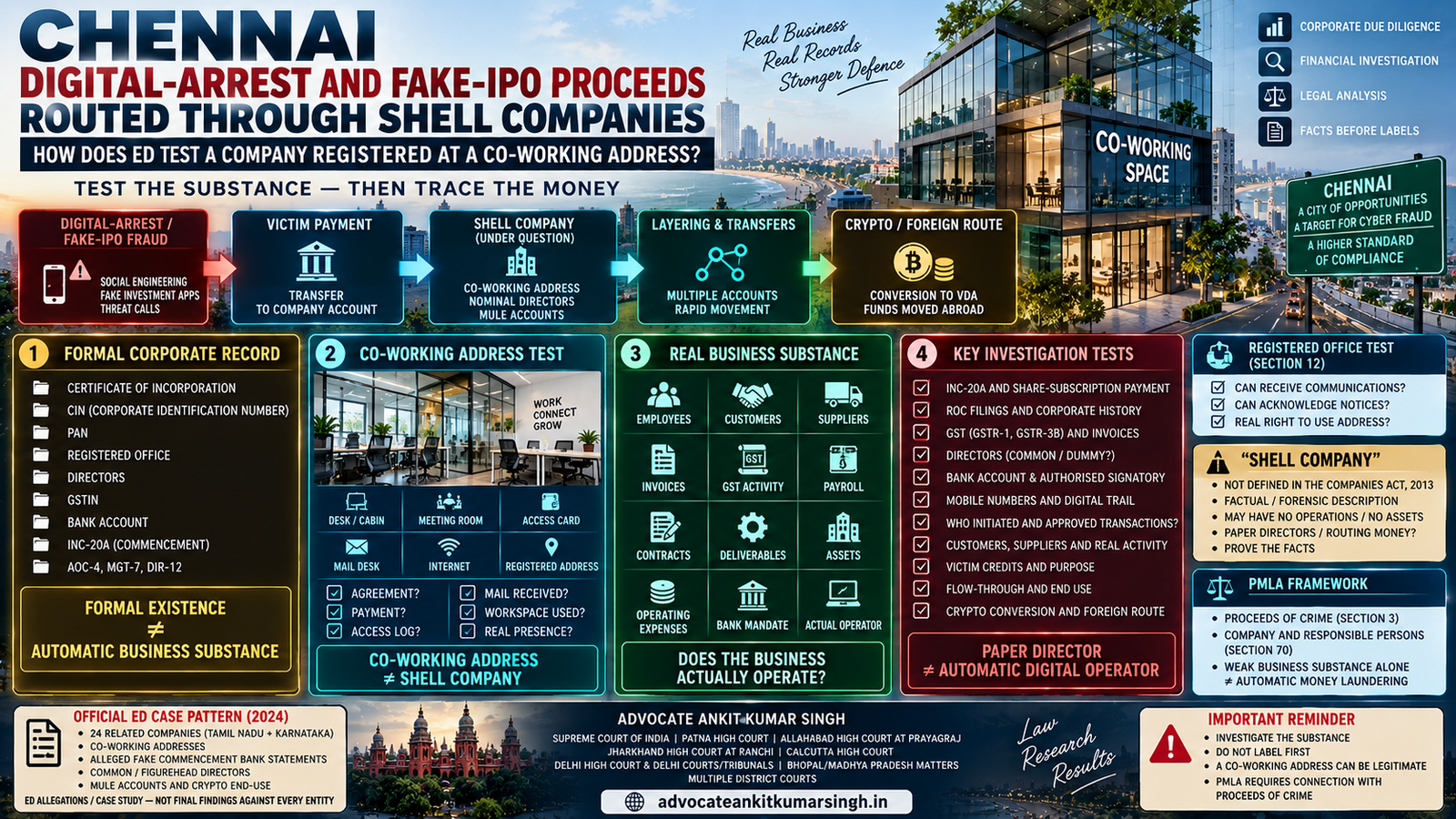
Chennai Digital-Arrest and Fake-IPO Proceeds Routed Through Shell Companies: How Does ED Test a Company Registered at a Co-Working Address?
Using the Tamil Nadu shell-company pattern seen in cyber-fraud investigations, this article examines whether a company has real business substance in Chennai. It tests office presence, employees, GST activity, bank mandates, ROC filings, commencement records, invoices, directors, mobile numbers and who actually operated the account before labelling a company a laundering vehicle.
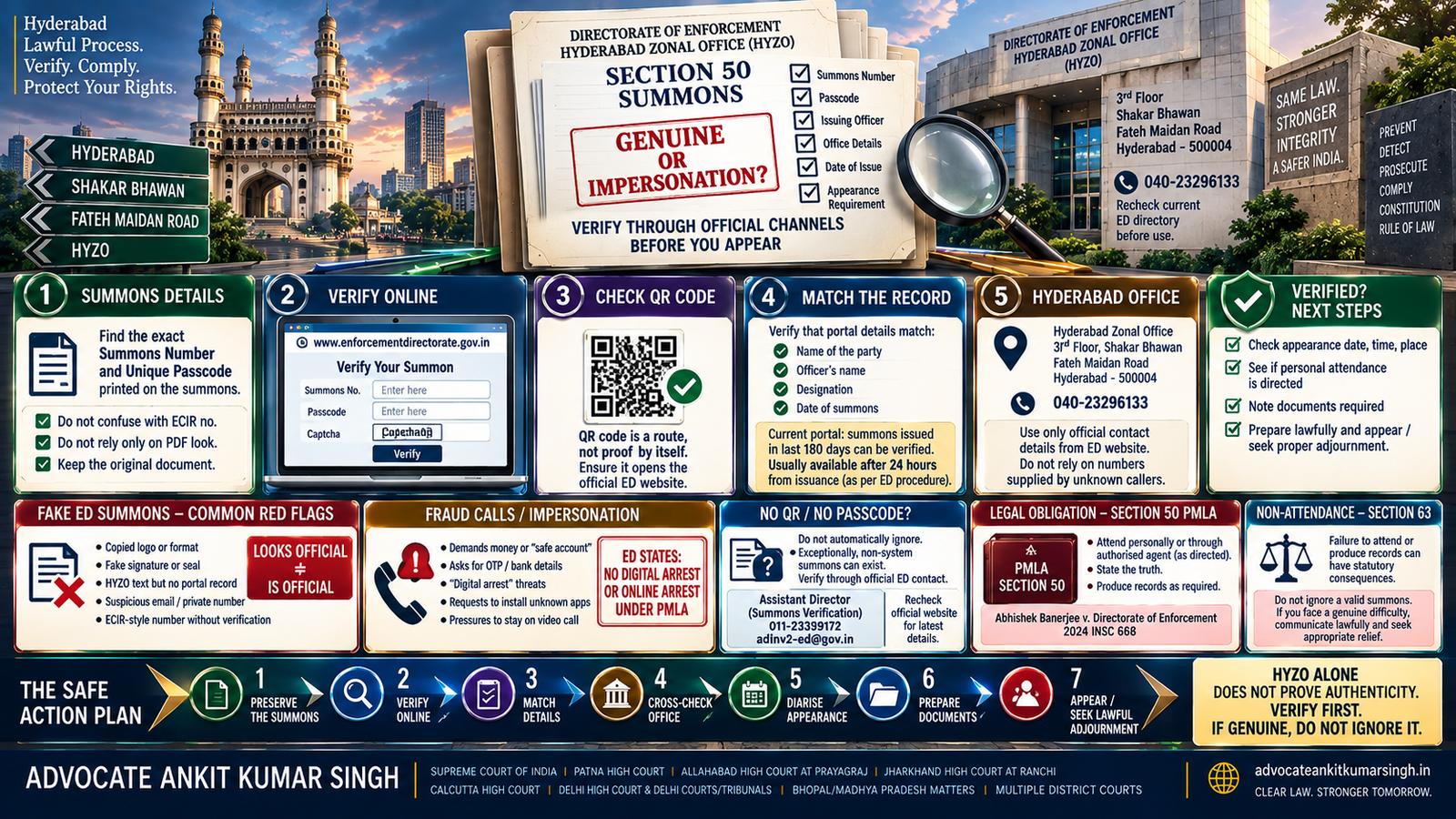
Hyderabad ED Summons Verification: How Do I Confirm a HYZO Section 50 Summons Is Genuine Before I Appear?
For a person receiving an Enforcement Directorate notice in Hyderabad, this article examines how to verify the HYZO summons number, passcode, issuing officer, office details, date of issue and appearance requirement through official ED channels. It also distinguish a genuine Section 50 summons from ED impersonation, fake PDF notices and fraud calls without encouraging anyone to ignore a valid summons.
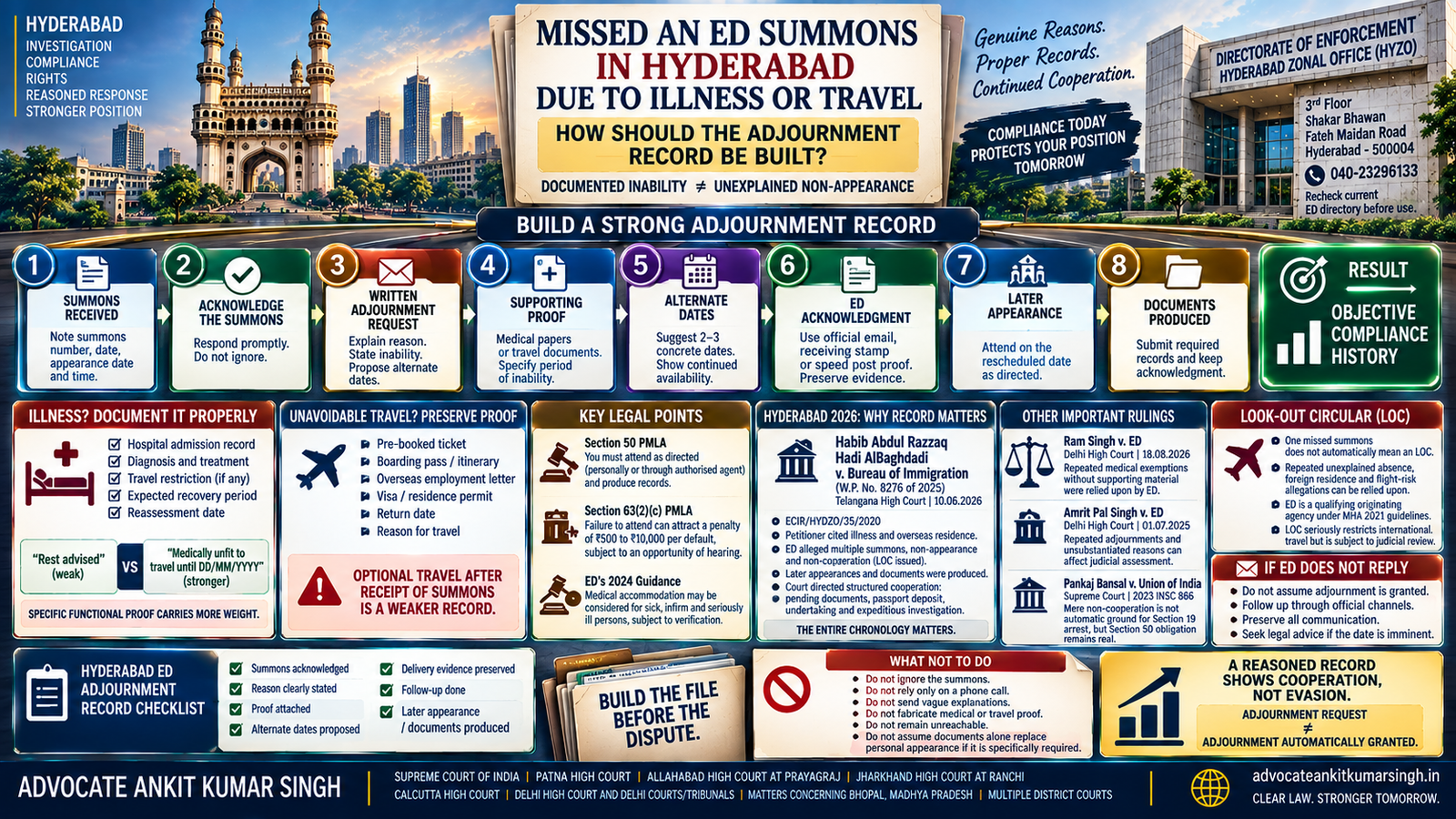
Missed an ED Summons in Hyderabad Due to Illness or Travel: How Should the Adjournment Record Be Built?
If a genuine Section 50 PMLA summons requires you to appear before the Enforcement Directorate's Hyderabad Zonal Office and illness, hospitalisation or unavoidable travel genuinely prevents attendance, do not simply remain absent and explain months later. A Section 50 summons dispute may not remain merely about one missed date. may establish far less than a contemporaneous medical record explaining why travel to Hyderabad is medically unsafe.
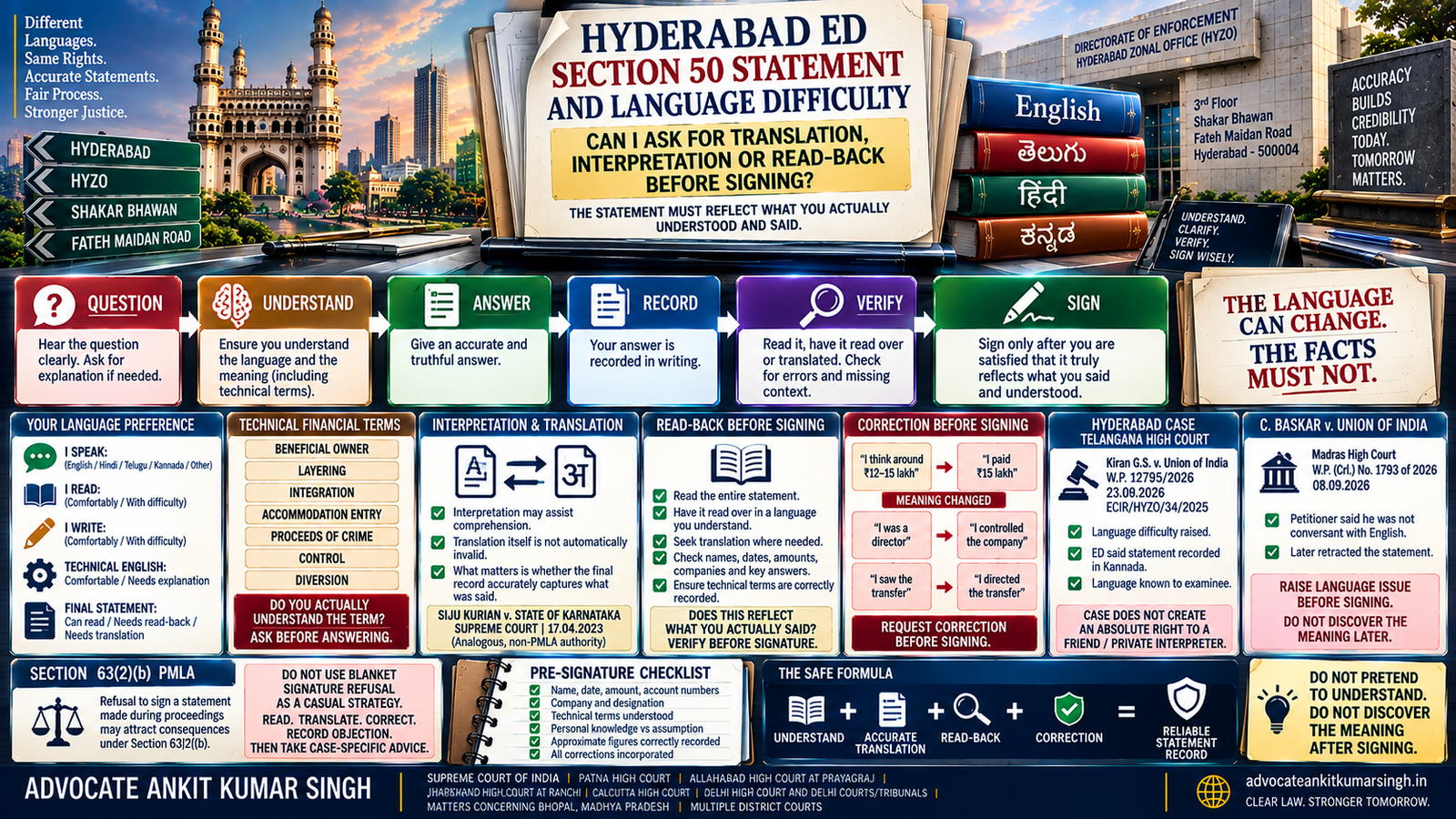
Hyderabad ED Section 50 Statement and Language Difficulty: Can I Ask for Translation, Interpretation or Read-Back Before Signing?
For Hyderabad HYZO examinations, this article analyses language comprehension as a statement-accuracy issue. It covers requests for interpretation or translation, technical financial terminology, read-back of the recorded statement, correction before signature and the importance of ensuring that the final Section 50 record reflects what the person actually understood and said.

Hyderabad ED Office CCTV, Entry Registers and Visitor Logs: When Should They Be Preserved After a Disputed Examination?
Where a dispute later arises about what happened during questioning at the ED office in Hyderabad, this article examines a preservation strategy around CCTV footage, entry registers, visitor logs, arrival and departure timing and other objective records. It explains why preservation requests may need to be made promptly where the duration, manner or circumstances of Section 50 examination are later contested.
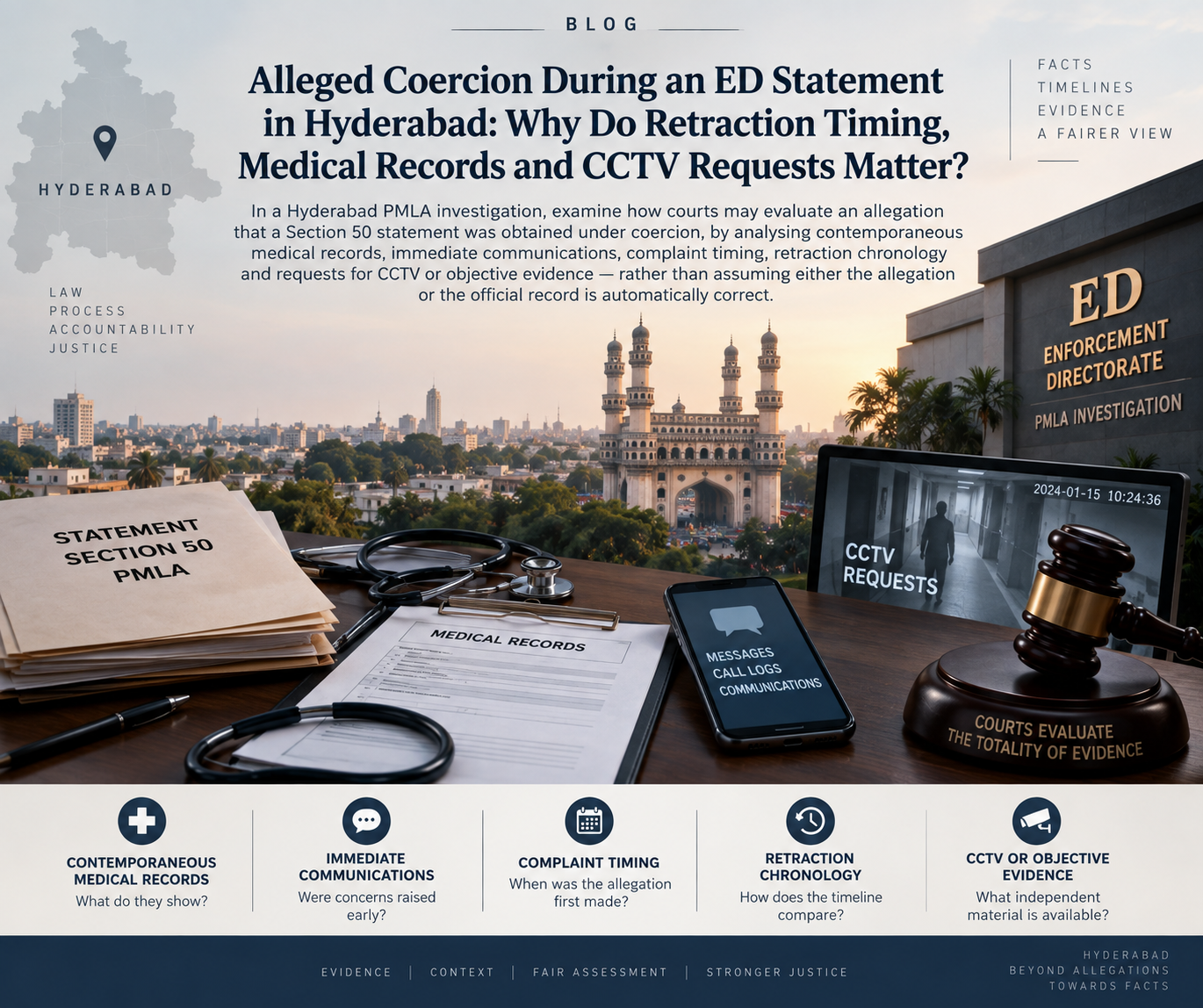
Alleged Coercion During an ED Statement in Hyderabad: Why Do Retraction Timing, Medical Records and CCTV Requests Matter?
This article examines how a court may evaluate an allegation that a Section 50 statement in a Hyderabad PMLA matter was obtained under coercion. It focuses on contemporaneous medical records, immediate communications, timing of the complaint or retraction, requests for CCTV or visitor records and other objective evidence, without assuming that either the allegation or the official version is automatically correct.
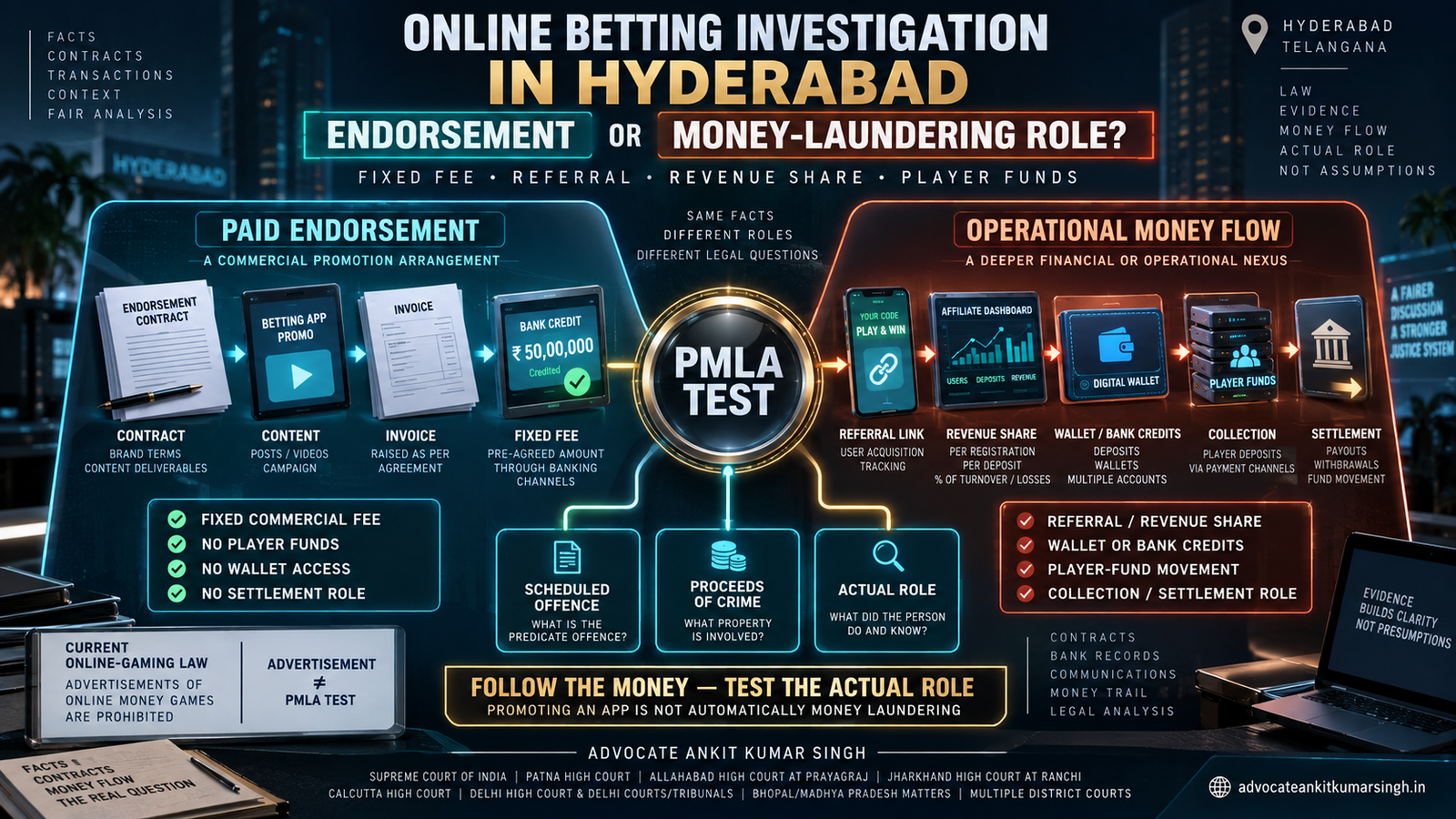
Online Betting Investigation in Hyderabad: Is a Celebrity or Influencer Who Promoted an App Automatically Involved in Money Laundering?
Using the current Hyderabad enforcement context around online betting and app promotions, this article separates paid endorsement activity from alleged participation in laundering. It examines endorsement contracts, source of promotional fees, referral links, revenue share, wallet or bank credits, communications with operators and whether the influencer had any role in collection, settlement or movement of player funds.

Hyderabad Betting-App Case: What Should a Social-Media Agency or Celebrity Manager Produce When Summoned by ED?
For an advertising or management professional summoned in Hyderabad, this article identifies the records that establish the real scope of work: agency agreements, invoices, campaign approvals, social-media dashboards, referral codes, media plans and payment routing. It distinguishes ordinary campaign execution from alleged involvement in handling, routing or disguising betting proceeds.
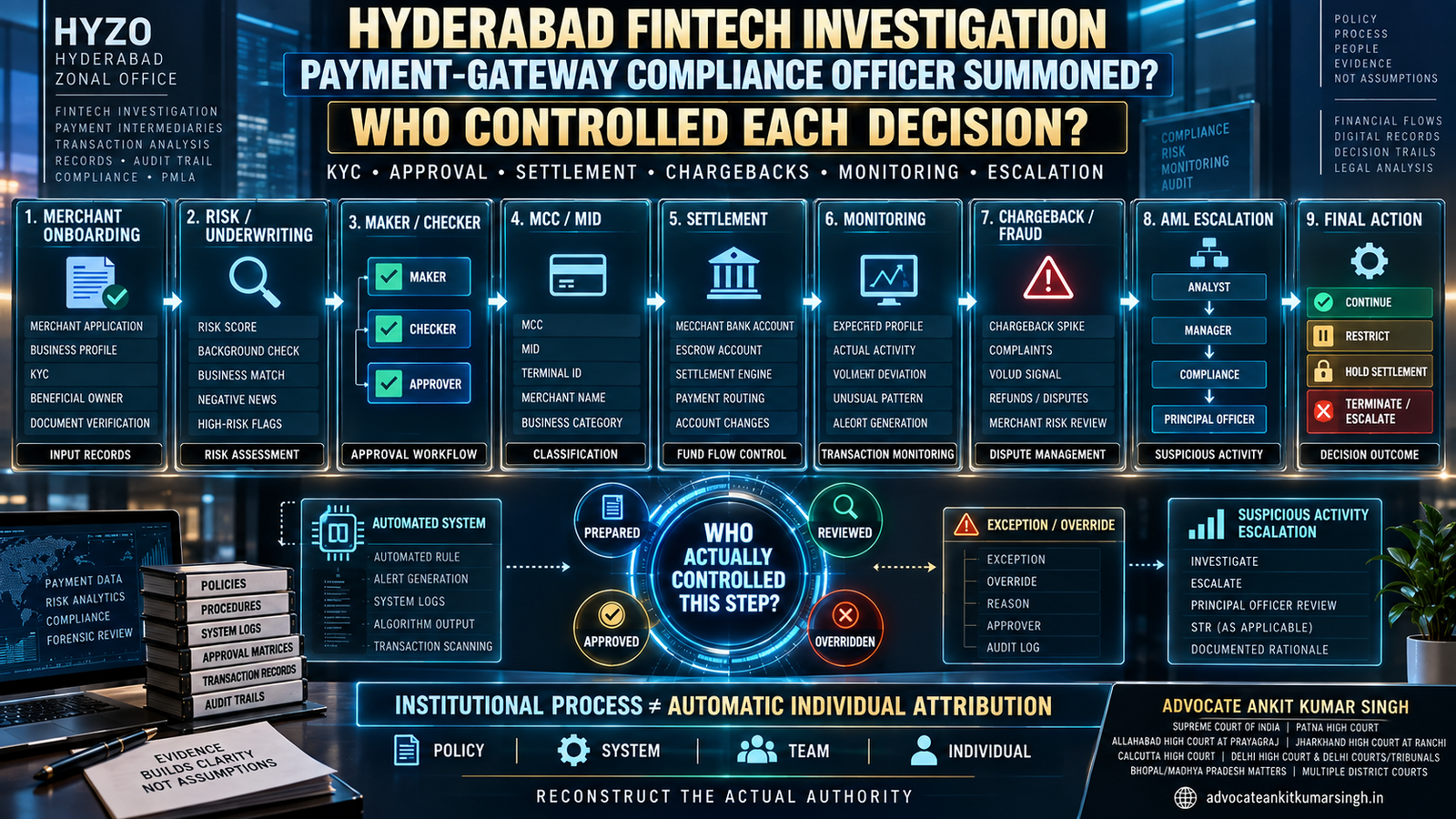
Payment-Gateway Compliance Officer Summoned by ED in Hyderabad: How Are KYC, Settlement and Monitoring Decisions Reconstructed?
This article examines how ED’s Hyderabad Zonal Office may reconstruct the role of a payment-gateway compliance officer through merchant onboarding, KYC, underwriting, settlement accounts, chargebacks, transaction monitoring, suspicious-activity escalation and internal approval chains. It focuses on separating institutional processes from the individual decisions actually controlled or approved by the person summoned.
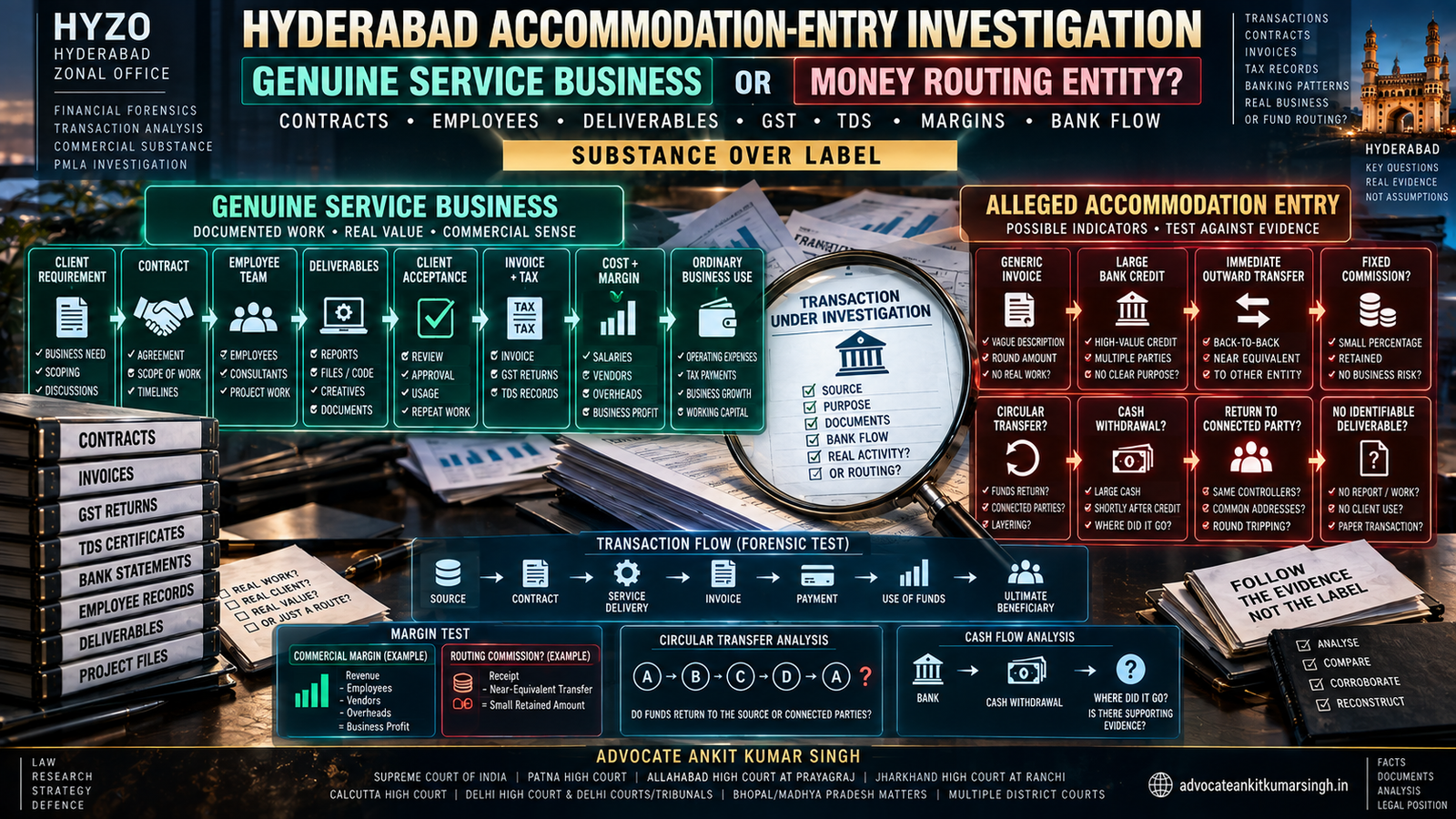
ED Says the Hyderabad Transactions Are Accommodation Entries: How Do You Prove a Genuine Service Business Was Not Merely Routing Money?
For a Hyderabad financial-crime investigation involving alleged accommodation entries, this article provides a forensic comparison between genuine business activity and commission-based fund routing. It tests contracts, employees, deliverables, GST, TDS, margins, circular transfers, cash withdrawals, invoices and banking patterns instead of accepting the label 'accommodation entry' as a conclusion.

Hyderabad Online-Betting Money Trail: How Can Genuine Affiliate Revenue Be Separated From Player Funds and Settlement Money?
This article examines how genuine affiliate or marketing income should be separated from alleged player deposits, payout money and settlement flows in a Hyderabad betting or gaming investigation. It considers merchant descriptors, settlement files, referral contracts, conversion data, wallet movement and the key question of whether the account holder controlled betting funds or merely received a contractual affiliate or marketing fee.

Hyderabad Real-Estate Developer Paid a Large Security Deposit Under a DAGPA: Deposit, Sale Consideration, Loan or Alleged Proceeds of Crime?
This article examines how the legal character of a large security deposit is tested through the development agreement, accounting treatment, refund terms, possession rights, tax records and later adjustments. It avoids assuming that every large security deposit is disguised sale consideration or proceeds of crime.

HYZO Hyderabad Wants the Source of Money Used to Buy Land 15-25 Years Ago: How Can the Acquisition Source Be Reconstructed?
For a Hyderabad ED summons concerning an old property acquisition, this article examines a historical-source reconstruction methodology using registered documents, income-tax records, loan papers, audited statements, sale proceeds, family accounts and secondary bank evidence. It explains the limits of human memory and why a chronology supported by surviving records is stronger than retrospective guesswork.
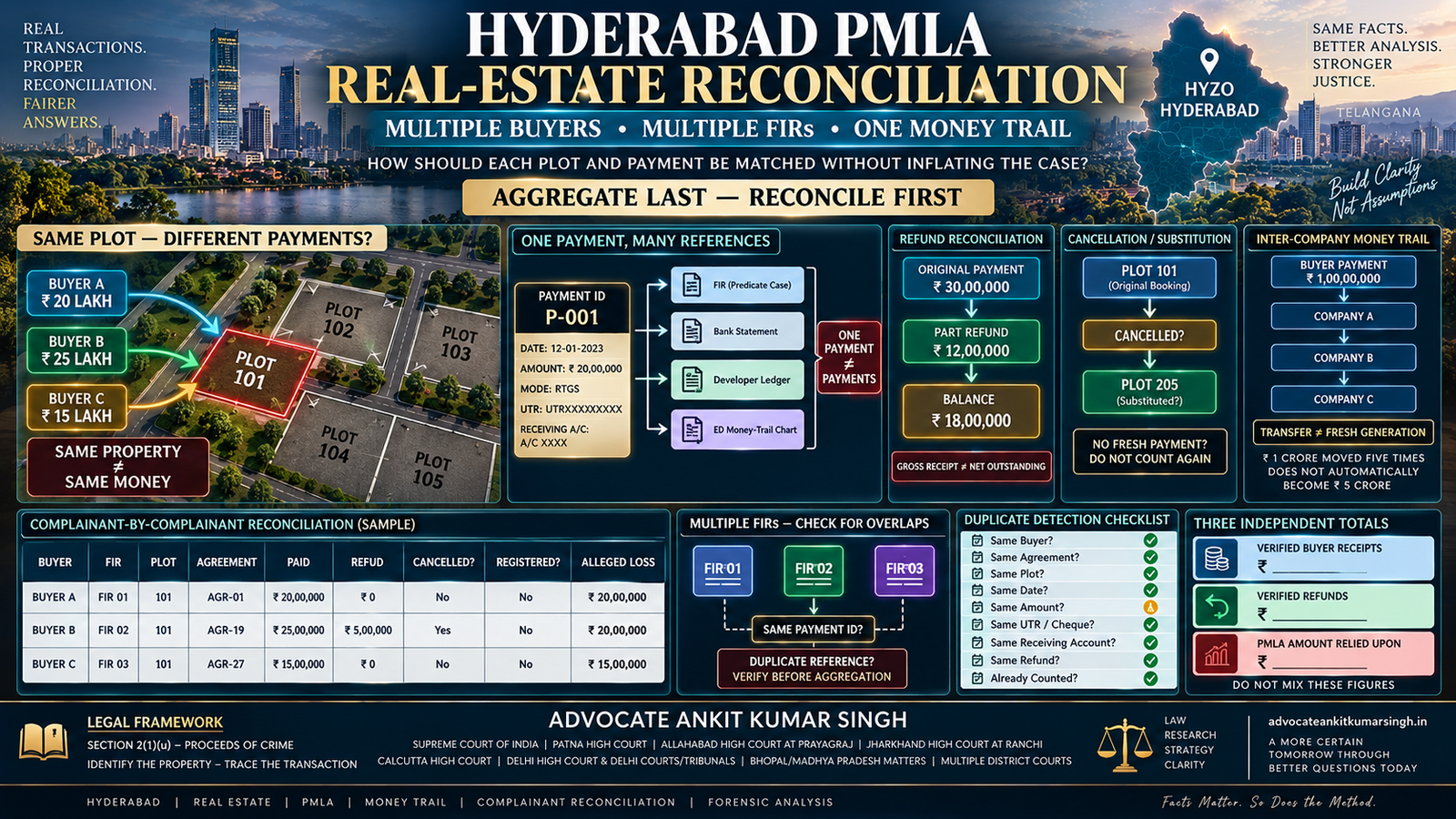
Multiple Plot Buyers, Multiple FIRs and One Hyderabad PMLA Investigation: How Should Each Plot and Payment Be Matched Without Inflating the Case?
This article examines a complainant-by-complainant reconciliation method for Hyderabad real-estate fraud investigations involving multiple plots, FIRs and payments. It maps each plot, agreement, payment, refund, cancellation and alleged loss separately, showing why aggregate figures can become misleading if the same payment, property or refund is counted more than once in the ED money trail.
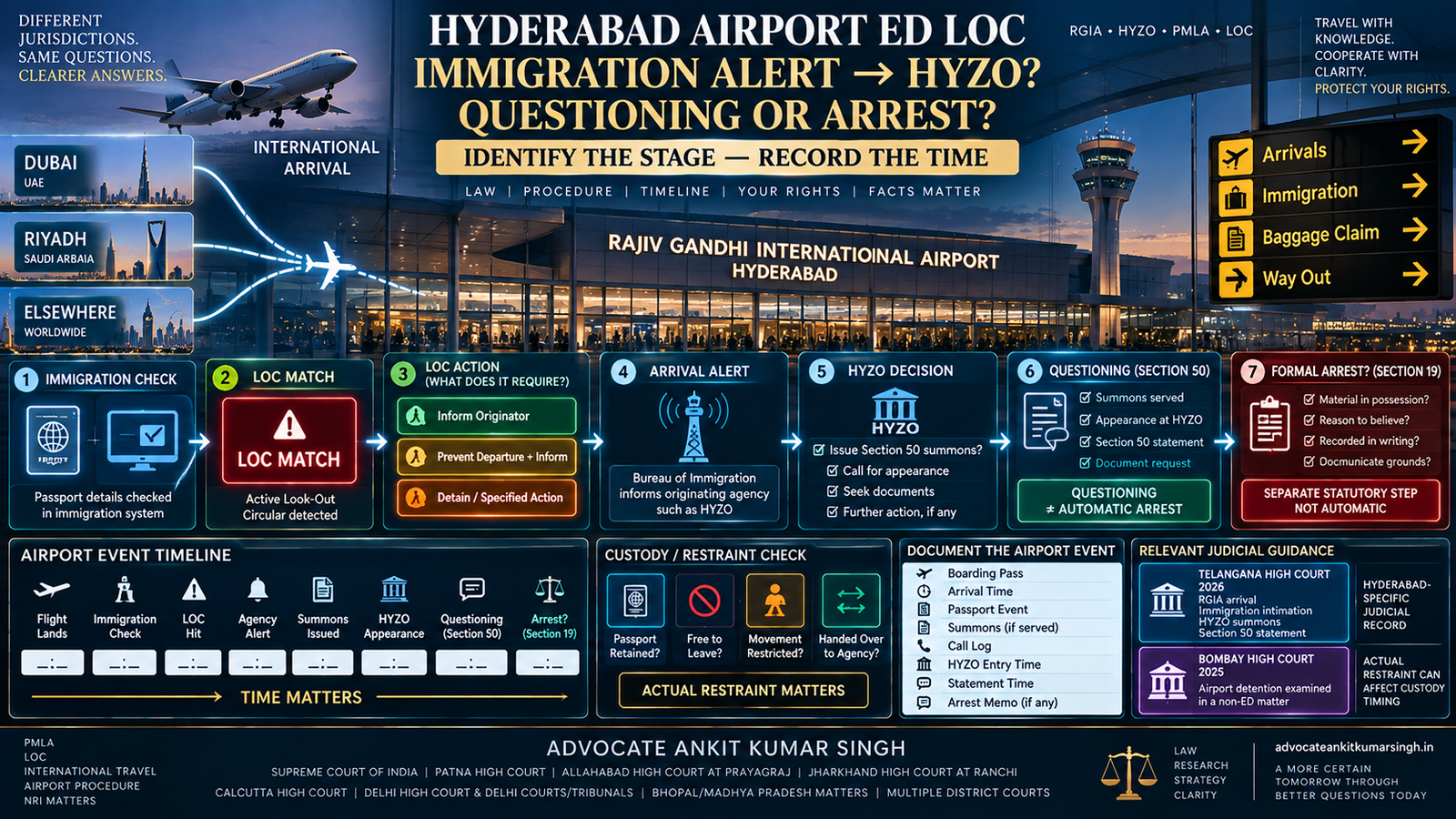
NRI Arrives at Hyderabad Airport With an ED Look-Out Circular: Can Immigration Alert HYZO and Can Questioning Begin Immediately?
For a traveller arriving at Rajiv Gandhi International Airport in Hyderabad with an active ED LOC, this article examines the interception sequence, immigration alert, communication with HYZO and possible ED interaction after arrival. It distinguishes questioning or appearance from formal arrest and identifies what the traveller should document from the airport event.
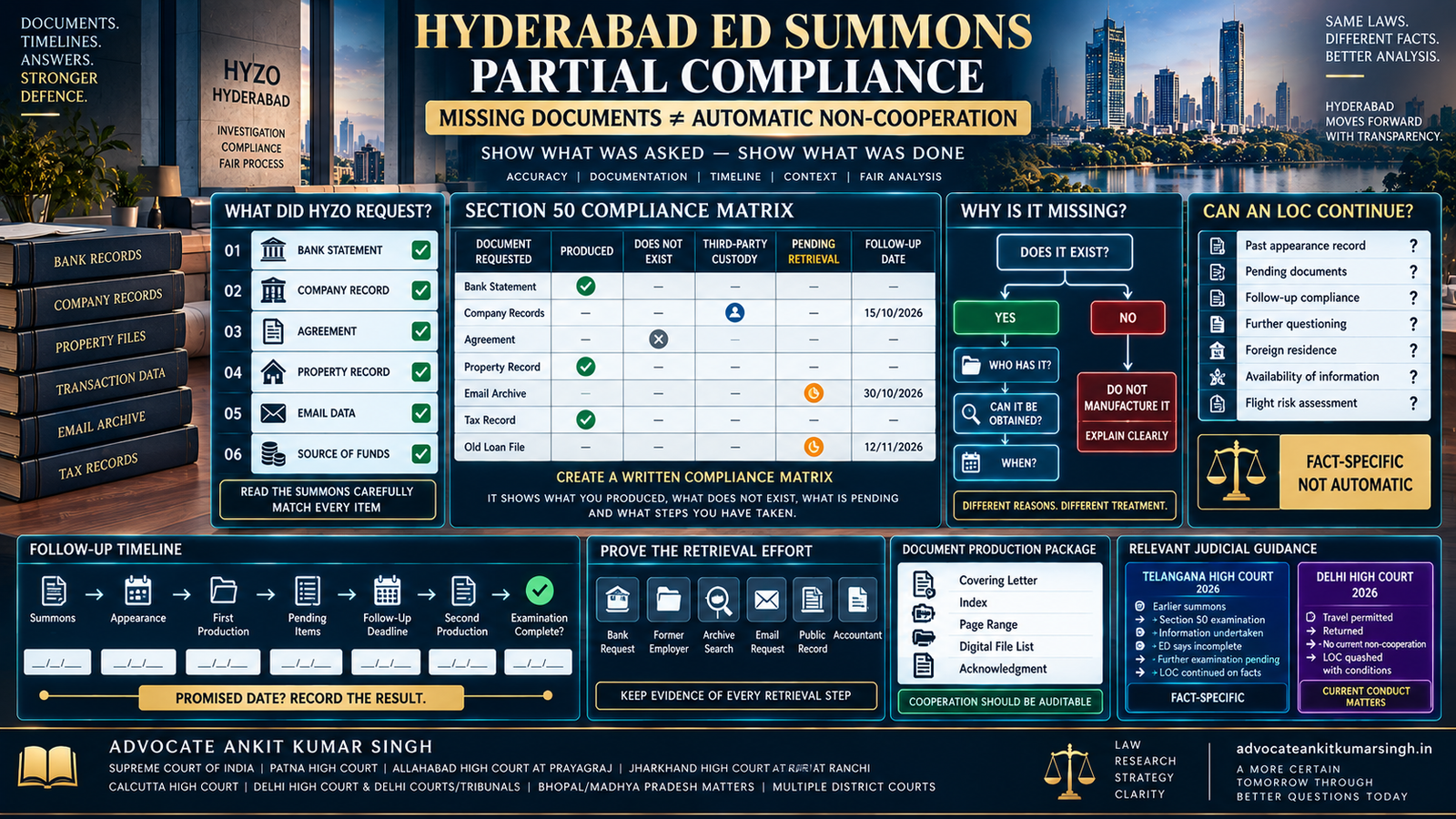
Partial Compliance With an ED Summons in Hyderabad: Can Missing Documents Be Used to Continue a Look-Out Circular?
This article examines how incomplete document production may be assessed in a Hyderabad ED matter. It separates what was requested, what was produced, what genuinely does not exist, what remains obtainable and whether follow-up dates were honoured, and explains why a written compliance matrix is more defensible than a general assertion that the person has cooperated.
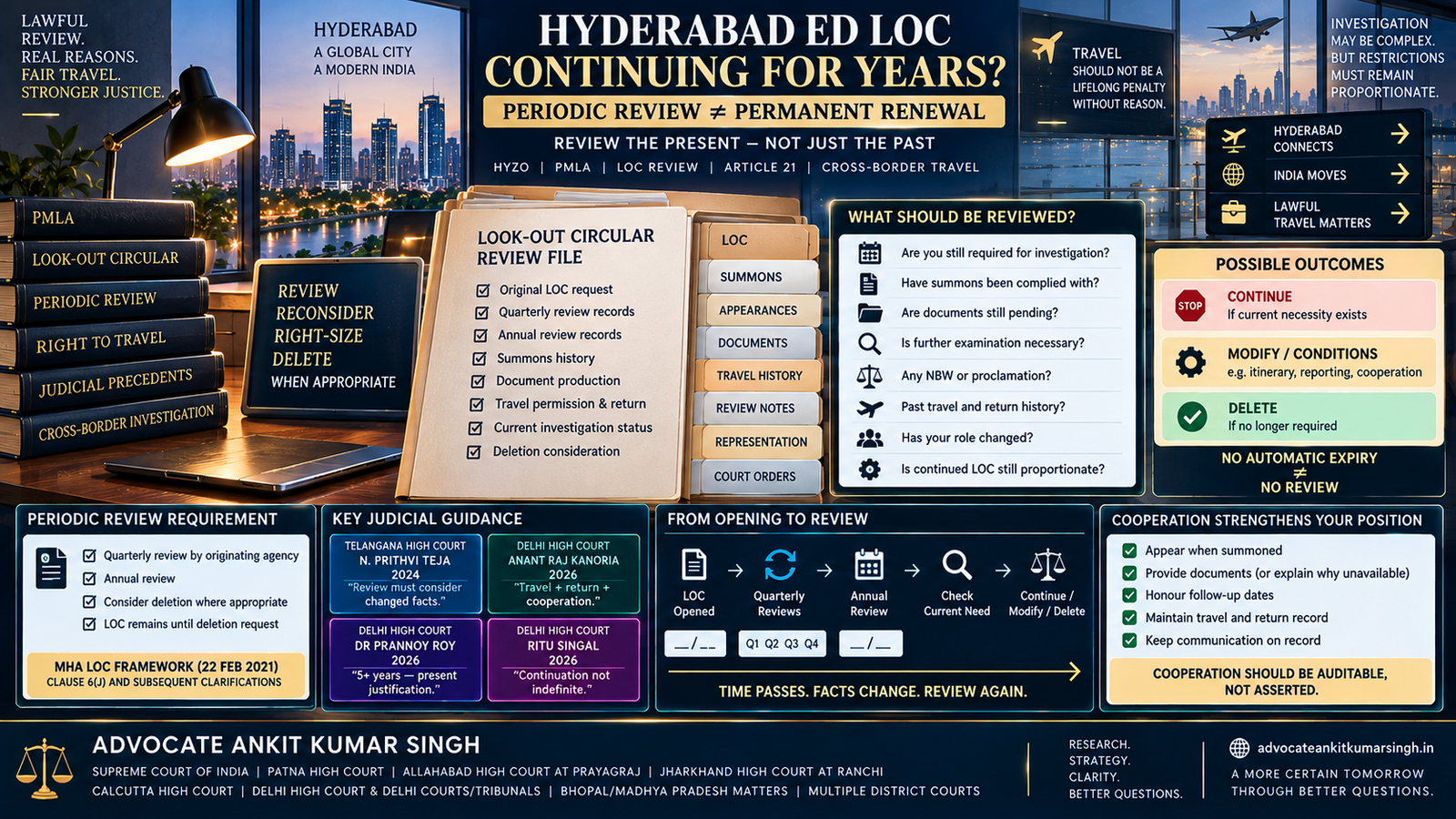
ED Look-Out Circular Continuing for Years in Hyderabad: What Does Periodic Review of the LOC Actually Require?
For a long-running Hyderabad ED LOC, this article examines why the restriction should not be treated as a permanent background flag without continued justification. It examines review records, continuing necessity, cooperation history, passage of time and how these factors may support a representation or judicial challenge.
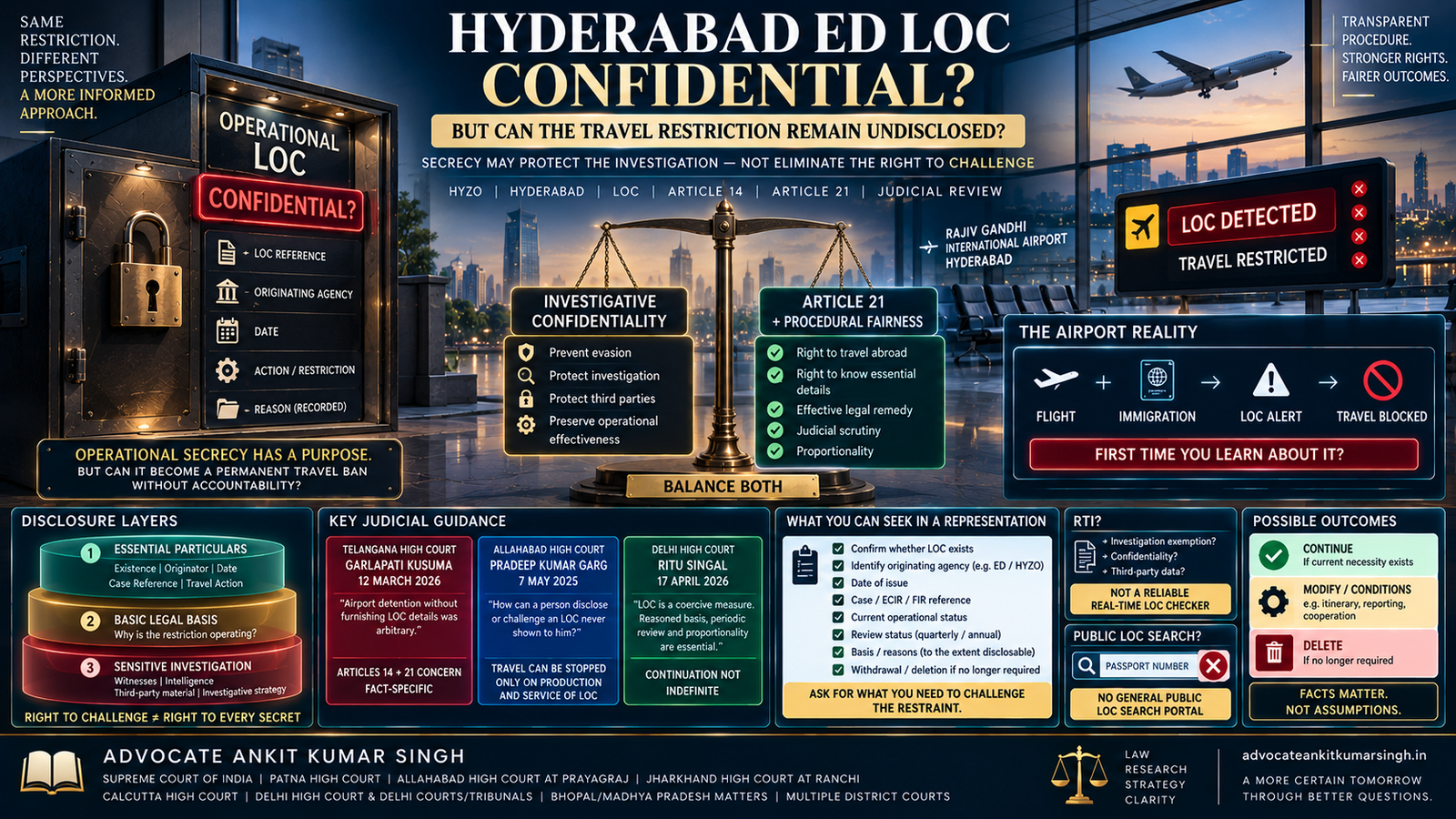
Hyderabad ED Look-Out Circular Is Said to Be Confidential: Does the Person Have a Right to Know About the Travel Restriction?
In a Hyderabad PMLA matter, this article explores the tension between confidentiality of the operational LOC mechanism and the person's ability to challenge a restriction on foreign travel. It addresses the real-world problem of learning about an ED LOC only at the airport and the emerging judicial concern over undisclosed travel restrictions.
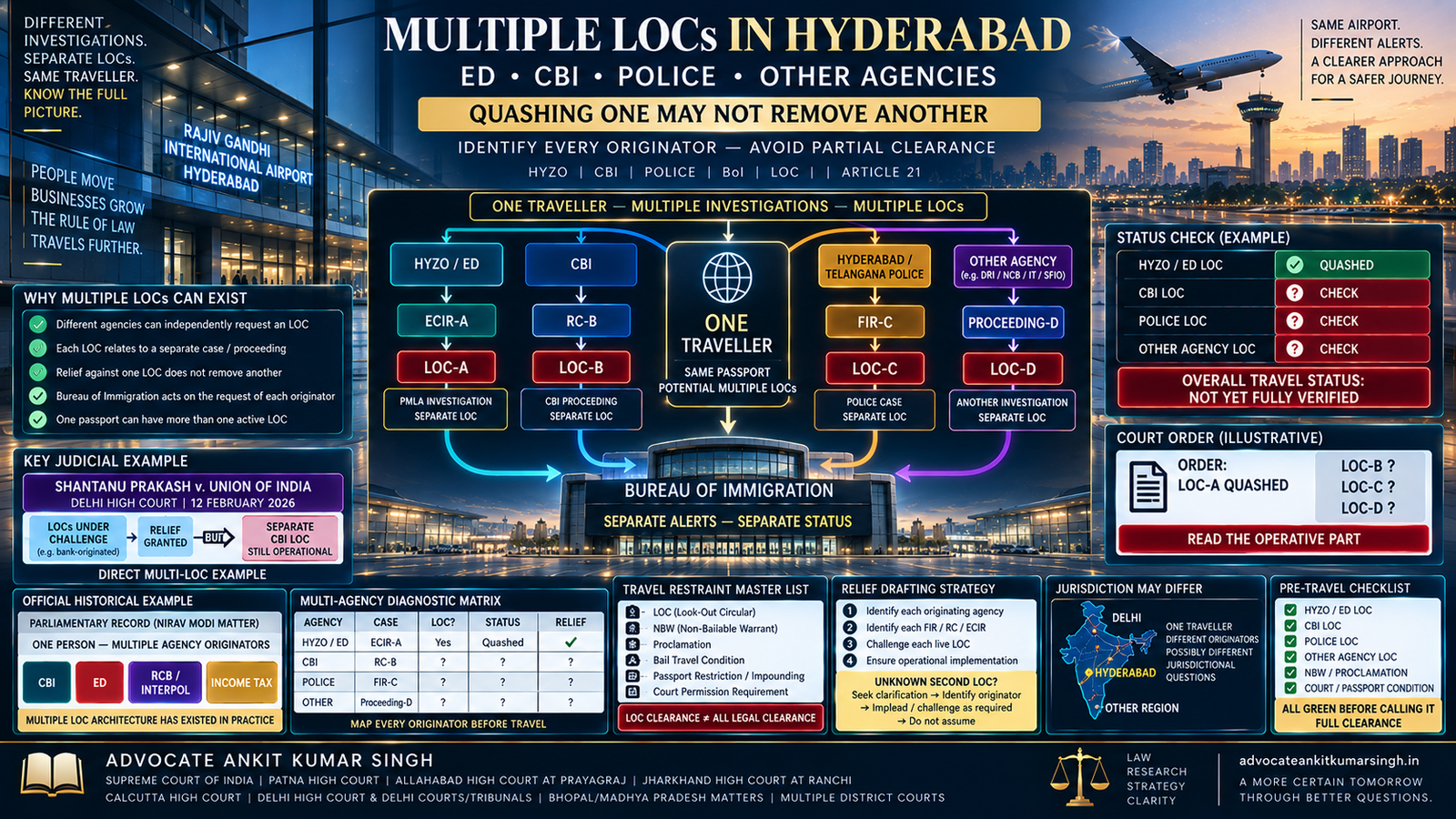
Multiple LOCs in Hyderabad: What if ED, Police, CBI or Another Agency Has Opened a Separate Look-Out Circular?
For a Hyderabad traveller facing more than one investigation, this article examines a multi-agency LOC diagnostic guide explaining why relief against one originator may not remove a separate LOC opened by another agency. It focuses on identifying each originator through case records and correspondence and on drafting relief so the traveller does not obtain only partial clearance.

Temporary Foreign Travel From Hyderabad While an ED LOC Is Pending: What Evidence Makes the Application Stronger?
For a Hyderabad PMLA matter involving business, medical or family travel, this article examines an evidence checklist covering itinerary, purpose, employment or business records, medical papers, family-event proof, return ties, prior ED compliance and proposed safeguards. It focuses on proportionality and credible assurance of return rather than generic hardship.
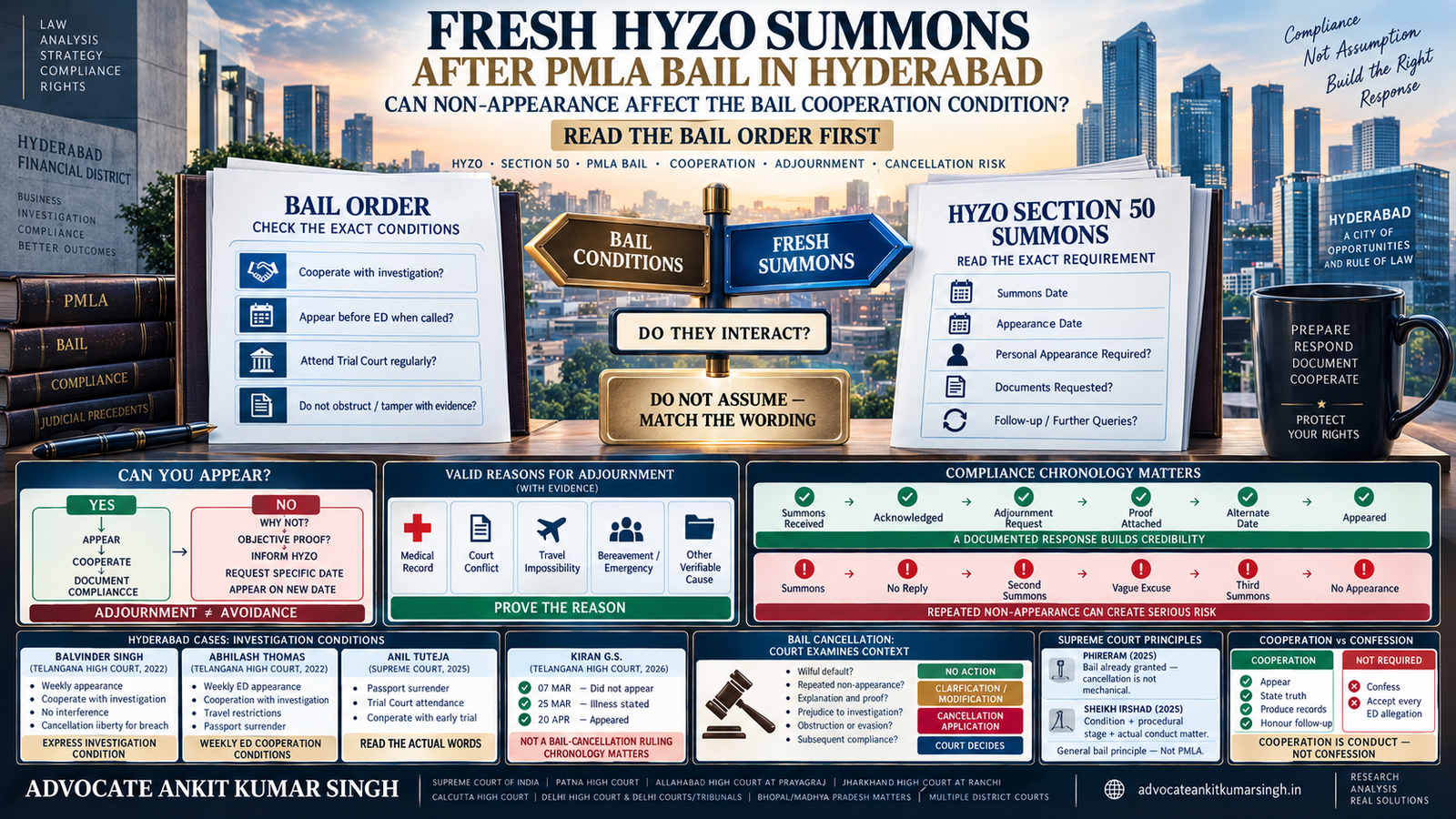
Fresh HYZO Summons After PMLA Bail in Hyderabad: Can Non-Appearance Affect the Bail Cooperation Condition?
This article examines how a fresh HYZO Section 50 summons interacts with bail conditions requiring cooperation, attendance or non-obstruction. It distinguishes a documented and justified request for adjournment from deliberate non-compliance and explains why the exact language of the bail order, summons history and reasons for non-appearance must be reviewed before deciding the response.
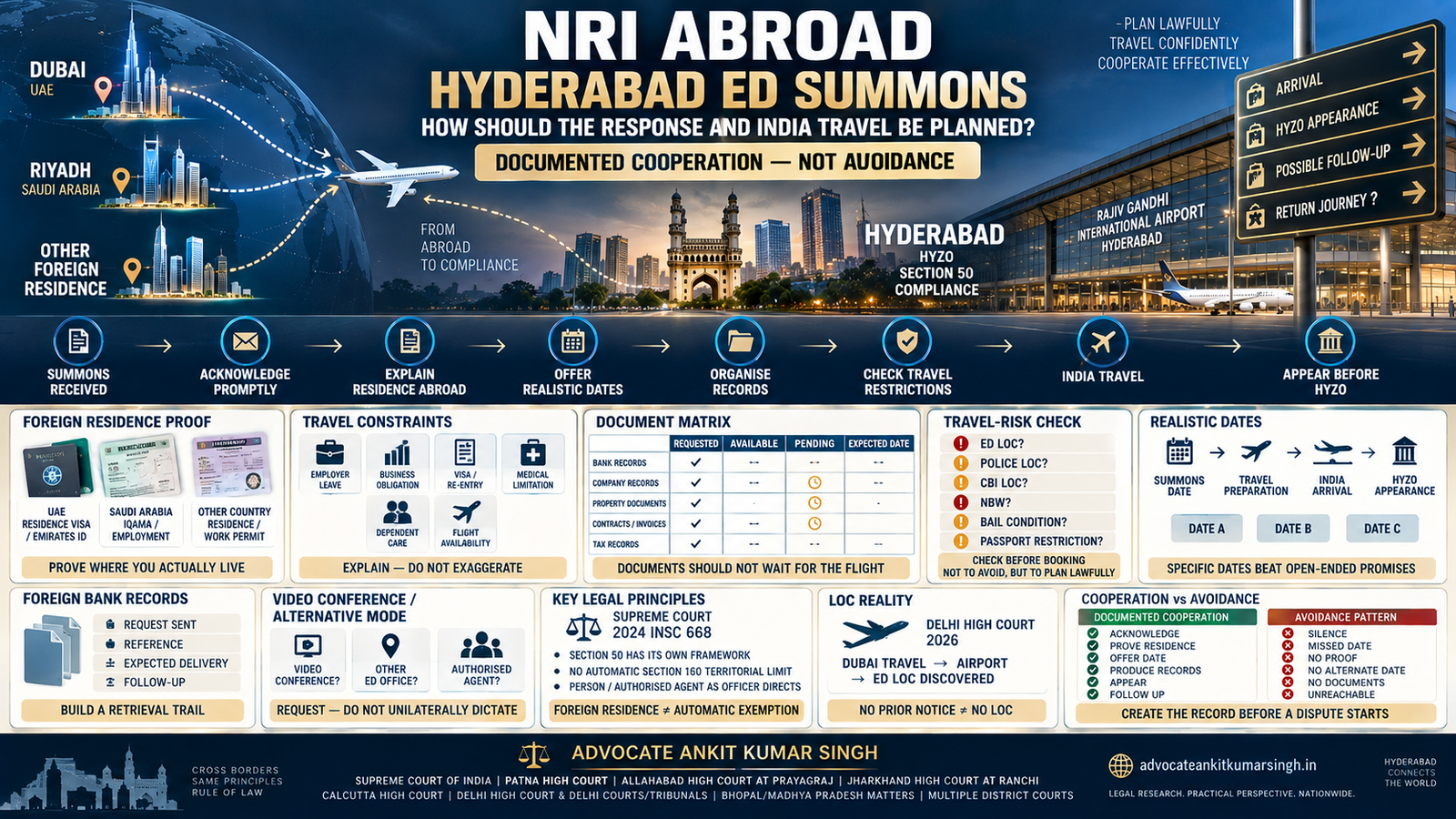
NRI in Dubai, Riyadh or Elsewhere Receives a Hyderabad ED Summons: How Should the Response and India Travel Be Planned?
For an NRI receiving a HYZO summons from Hyderabad, this article examines a compliance-focused strategy: acknowledge the summons, explain residence abroad, document travel constraints, offer realistic dates, organise records and check whether any travel restriction exists before booking. It focuses on documented cooperation rather than avoidance.
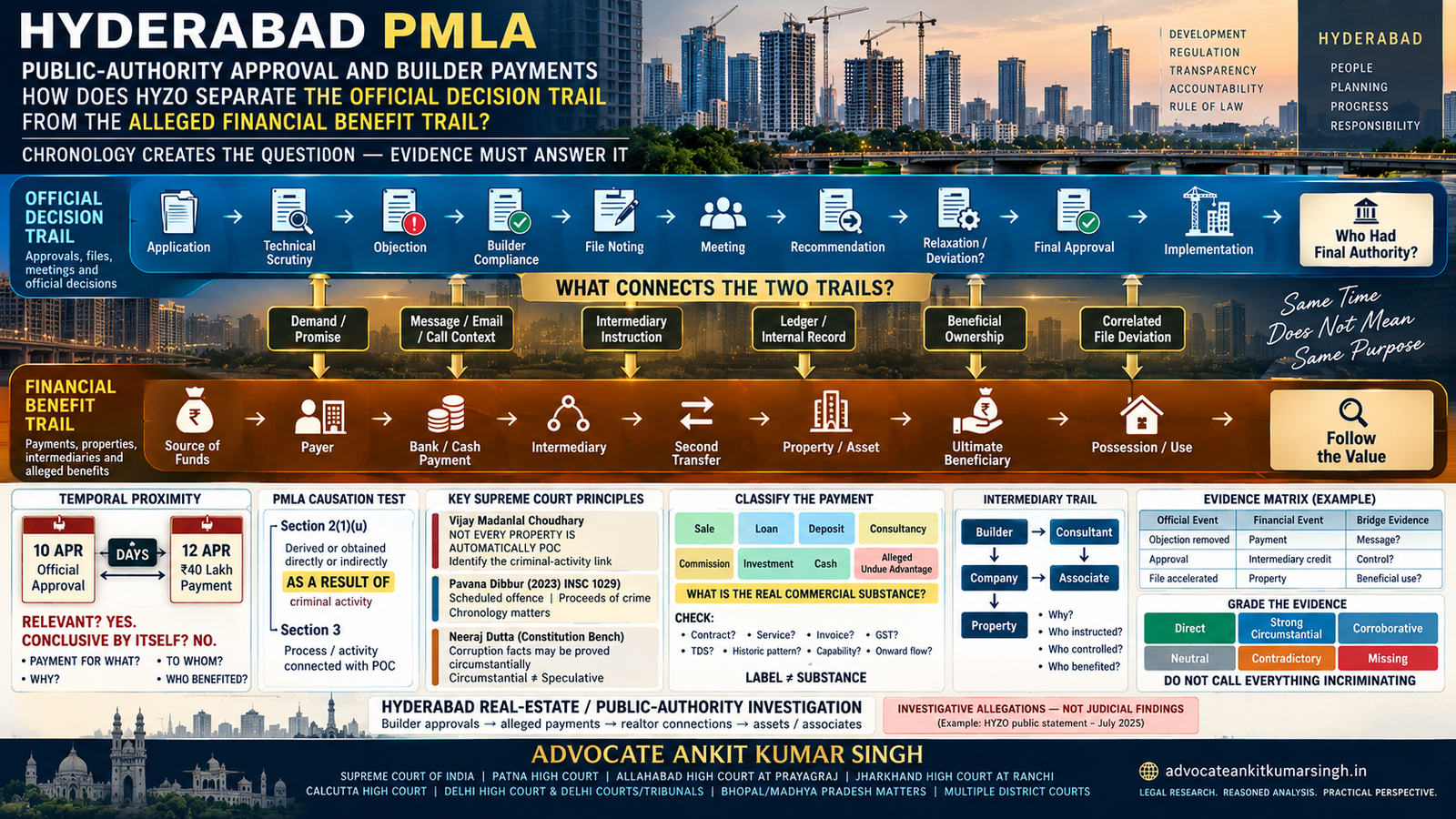
Public-Authority Approval and Builder Payments in Hyderabad: How Does HYZO Separate the Official Decision Trail From the Alleged Financial Benefit Trail?
This article examines a Hyderabad corruption-linked PMLA investigation through two parallel timelines: one for approvals, files, meetings and official decisions, and another for payments, properties, intermediaries and alleged benefits. It explains why temporal proximity alone does not establish a laundering nexus without evidence connecting the official act to the alleged financial benefit.
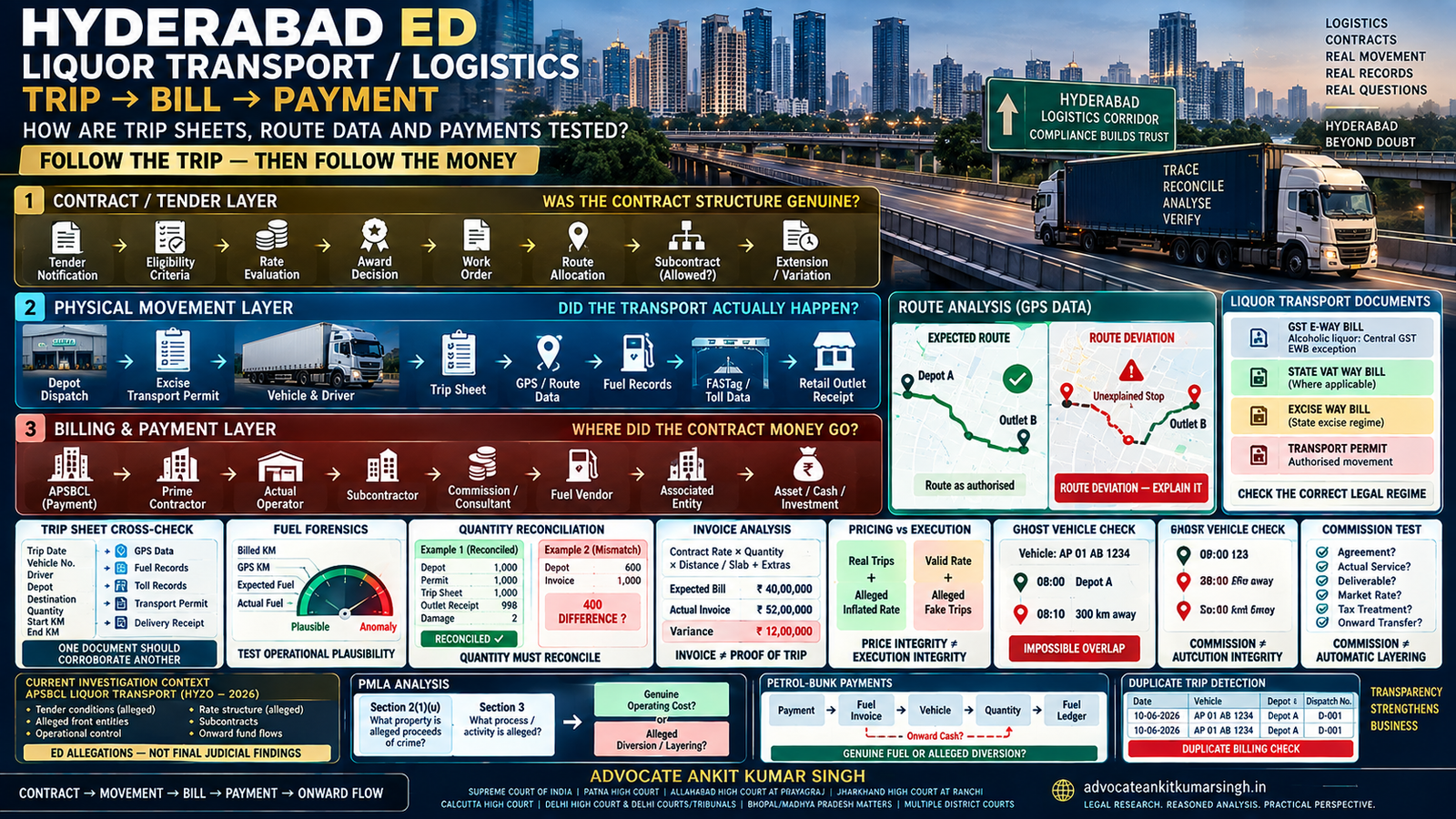
Liquor-Transportation or Logistics Contract Under ED Investigation in Hyderabad: How Are Trip Sheets, Route Data and Payments Tested?
For a logistics-heavy Hyderabad financial-crime investigation, this article examines tender documents, work orders, GPS or route data, trip sheets, fuel records, invoices, e-way bills, bank payments and intermediary commissions. It shows how investigators test whether billing reflects genuine transport activity or alleged diversion and layering.
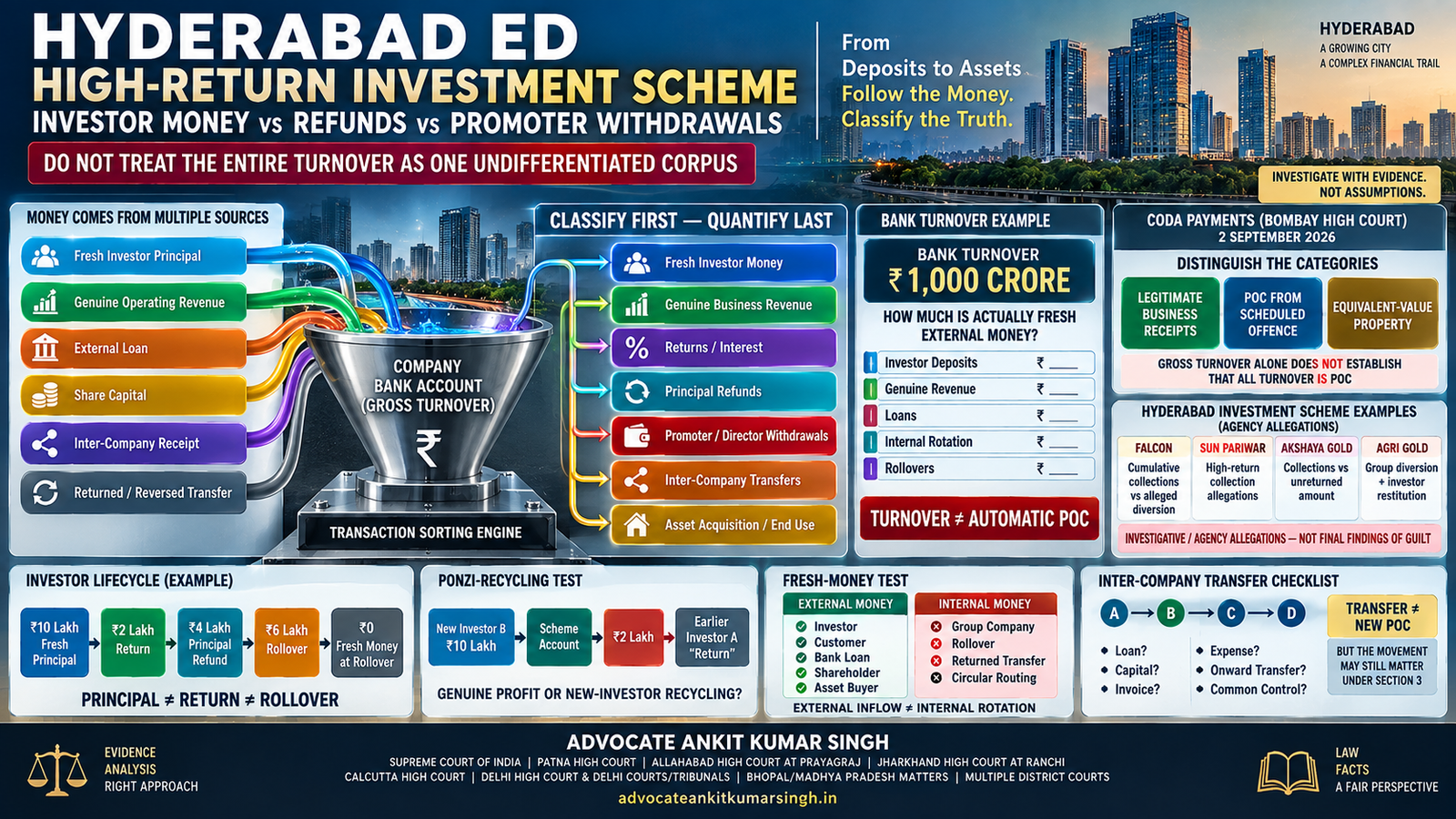
Hyderabad High-Return Investment Scheme Under ED Investigation: How Should Investor Money, Refunds and Promoter Withdrawals Be Separated?
In a Hyderabad investment-scheme PMLA investigation, this article develops a transaction-level fund-flow framework that separates fresh investor deposits, genuine operating revenue, returns, refunds, promoter drawings and inter-company transfers. The aim is to prevent the entire bank turnover from being treated as one undifferentiated criminal corpus and to identify the records needed to trace each category accurately.
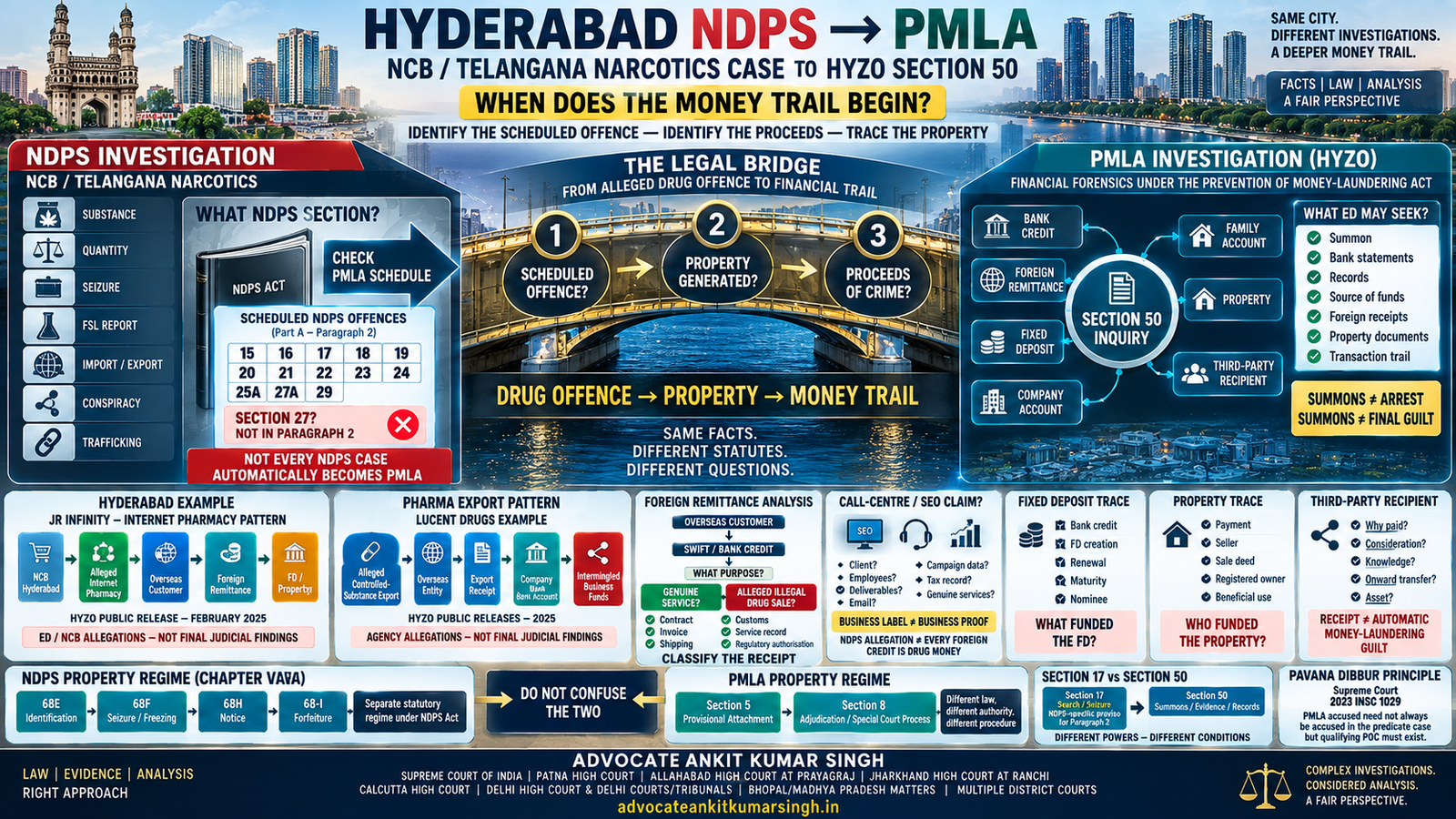
Hyderabad NDPS Case Turning Into a PMLA Investigation: When Can an NCB or Telangana Narcotics Case Lead to an ED Section 50 Summons?
This article examines how an NDPS investigation can become the predicate foundation for a separate PMLA investigation when alleged drug trafficking or illegal psychotropic-substance trade generates proceeds of crime. It distinguishes the NDPS prosecution and its property-freezing regime from HYZO's PMLA inquiry, Section 50 summons, tracing of bank credits, foreign remittances, fixed deposits, properties and third-party recipients.

Who is the best advocate for ED cases in Delhi?
This article explains the principal legal issues that arise in Enforcement Directorate and PMLA matters in Delhi, including Section 50 summons, proceeds-of-crime analysis, attachment, bail and financial-document review. It also outlines Advocate Ankit Kumar Singh’s document-driven approach to ED and white-collar crime work, with emphasis on transaction reconstruction and case-specific legal strategy.

Why Did You Create So Many Companies if Everything Was Genuine? When Does Organisational Complexity Become a Psychological Proxy for Guilt?
Having many companies does not by itself establish fraud, money laundering, hawala or concealed ownership. Indian company law expressly recognises holding companies, subsidiaries, investment structures and significant beneficial ownership while regulating particular forms of layering. The evidentiary question is therefore not simply why a person created ten or twenty companies, but what each entity actually did. Organisational complexity becomes materially probative when multiple entities lack genuine commercial substance and are connected with dummy directors, fictitious addresses, fake invoi

Why Would an Honest Person Use an Offshore Company? Can Suspicion About Financial Structure Replace Proof of Purpose?
An offshore company is not inherently evidence of dishonesty, tax evasion or money laundering. India's current FEMA overseas-investment regime expressly permits eligible overseas investment in foreign entities engaged in bona fide business activity, including through subsidiaries and SPVs, subject to applicable conditions, reporting and designated-bank requirements. The real evidentiary questions concern purpose, source of capital, beneficial ownership, actual control, commercial substance, fund flows, tax and foreign-asset disclosure, and whether identified proceeds of crime are connected wit

You Are Wealthy, So You Must Know Where Every Rupee Came From - Limits of Expected Financial Memory in Long-Period Investigations
Wealth does not create a legal presumption of perfect financial memory. Long-period investigations should distinguish personal recollection from documentary proof and should identify the particular transaction, property and statutory burden in issue. Section 109 of the Bharatiya Sakshya Adhiniyam places a burden on a person only for facts especially within that person's knowledge, while the Supreme Court's Shambhu Nath Mehra decision makes clear that this exceptional principle cannot relieve the prosecution of proving its foundational case. Sections 162 and 163 BSA expressly recognise that wit

Your Accountant Says One Thing and You Say Another - Who Should Be Believed When Financial Knowledge Is Distributed Across a Business?
When an owner, accountant, CFO, bookkeeper or auditor gives different explanations for the same transaction, the correct evidentiary approach is not to decide credibility from designation alone. Financial knowledge inside a business is often distributed: the owner may know commercial purpose, the CFO funding strategy, the accountant accounting classification, and the treasury team payment execution. Section 16 of the Bharatiya Sakshya Adhiniyam makes an agent's statement an admission only where the agent is expressly or impliedly authorised in the relevant circumstances, while Section 25 confi

The Explanation Sounds Too Convenient - How Narrative Coherence Can Mislead Investigators in Black Money Cases
A source-of-funds explanation can be unusually coherent, convenient or even perfectly fitted to the disputed amount without that narrative quality itself proving either truth or fabrication. Indian tax jurisprudence permits authorities to look beyond documents and apply surrounding circumstances and human probabilities, particularly under the Supreme Court's Durga Prasad More and Sumati Dayal decisions. But human probability is an evidentiary method, not a substitute for evidence. Omar Salay Mohamed Sait and the best-judgment line prohibit conclusions founded merely on suspicion, conjecture or

Why Didn't You Disclose This Earlier? Silence, Shame, Tax Fear, Legal Advice and the Psychology of Delayed Explanation
A delayed source-of-funds explanation is not automatically false, but its timing can legitimately affect credibility. Initial silence, incomplete disclosure or later retraction may arise from missing records, distributed financial knowledge, fear of tax consequences, embarrassment, misunderstanding, stress or the need for legal and accounting advice. The law nevertheless distinguishes these explanations from deliberate concealment, changing core stories and post-investigation fabrication. Section 25 of the Bharatiya Sakshya Adhiniyam confirms that admissions are not conclusive proof, while Sec

The Documents Were Created After Investigation Began - Automatically Self-Serving or Can Later Reconstruction Still Be Reliable Evidence?
A document does not become unreliable merely because it was created after an investigation began. The critical distinction is between a later reconstruction that transparently summarises pre-existing bank statements, seized documents, invoices, ledgers, registry records or digital data, and a newly manufactured document falsely presented as if it existed at the time of the original transaction. Section 28 of the Bharatiya Sakshya Adhiniyam makes regularly kept books relevant but not sufficient alone to fasten liability, while Sections 60–63 provide important rules concerning secondary, electro

Every Individual Transaction Looks Ordinary, but the Overall Pattern Looks Suspicious - Can Pattern Recognition Prove What No Single Transaction Proves?
Pattern evidence can sometimes establish intention, knowledge or absence of accident even where no individual transaction is independently decisive. Section 13 of the Bharatiya Sakshya Adhiniyam expressly makes a series of similar occurrences relevant when the issue is whether an act was accidental, intentional or done with particular knowledge or intention; its own illustration uses repeated false financial entries benefiting the same person. But relevance is not a presumption of guilt. The Allahabad High Court in Pradeep Kumar Verma expressly held that a series of acts does not itself create

The Investigation Has Already Found a Theory - What Evidence Would Make the Authority Abandon It? Falsification as a Safeguard
An investigation is entitled to develop a working theory, but a fair investigation should remain capable of narrowing, revising or abandoning that theory when reliable contrary evidence makes a material proposition unsustainable. “Falsification” is not a standalone statutory doctrine in Indian criminal law; it is used here as an analytical safeguard consistent with fair, unbiased and truth-oriented investigation. Supreme Court decisions including Babubhai, Sidhartha Vashisht @ Manu Sharma, Vinay Tyagi and Pooja Pal emphasise fairness, balanced prosecution and the search for truth. P. Ponnusamy

The Numbers Fit the Allegation Perfectly - But Were They Built From the Allegation? Reverse-Engineering Bias in Financial Models
A financial model can look extraordinarily persuasive when it produces exactly the amount alleged by investigators—but perfect numerical alignment may raise an important question: did independent data produce the allegation, or were the model's inputs, assumptions, thresholds, entity classifications and time windows selected after the allegation was already known? “Reverse-engineering bias” is not a standalone doctrine under Indian law; it is used here as an analytical and forensic concept. BSA Sections 39, 40 and 45 are especially important because expert opinion may be relevant, facts suppor

No Money Crossed the Border - Only Accounts Were Settled in Two Countries: Where Did the Alleged Hawala Transaction Occur?
A hawala allegation does not necessarily require proof that the same physical currency crossed India's international border. In a compensatory-payment model, rupees may be paid locally in India while equivalent value is released abroad and intermediaries later settle or net their accounts. FEMA Section 3(c) expressly addresses certain Indian payments received by order or on behalf of a person resident outside India without corresponding inward remittance, while Section 3(d) can bring specified financial transactions in India associated with value or assets outside India into scrutiny. However,

I Gave Cash in India and My Relative Received Money Abroad - How Can Investigators Prove the Two Events Were One Transaction?
Cash paid in India and money received abroad by a relative do not automatically become one hawala transaction merely because the amounts are similar or the events occurred close together. Investigators need a connecting evidentiary chain: the India-side cash delivery, identifiable intermediary, foreign-payment instruction, matching amount and exchange rate, recipient, timing, ledger or token, communications, commission and post-payment confirmation. Digital evidence such as WhatsApp or spreadsheets can be important but should be authenticated and read in context. A current 2026 Income-tax deci

A Hawala Diary Contains My Name or Initials - Does It Prove Payment, Debt, Instruction or Merely a Contact?
A name, surname, initials or phone number appearing in an alleged hawala diary does not automatically prove that the named person paid money, received money, owed a debt, gave an instruction or participated in hawala. Investigators should first prove who authored and maintained the record, whether the initials actually identify the person alleged, what the figures and shorthand mean and whether the notation describes a payment, receipt, balance, instruction or merely contact information. Section 28 of the Bharatiya Sakshya Adhiniyam makes regularly kept books of account relevant but expressly

The Hawala Operator Uses Nicknames and Codes - How Should Identity Be Tested Before Treating a Code Word as a Person?
A nickname or code such as “Tiger”, “Doctor”, “AK-7” or “P. Bhaiya” in an alleged hawala ledger does not identify a particular person merely because investigators believe the description fits. Identity should be established before the coded transaction is attributed to anyone. Relevant evidence may include consistent historical use of the nickname, a matching mobile number, contact saved under that alias, full-name references elsewhere, a contemporaneous codebook, the ledger writer's explanation, independent chats, matching counter-ledgers and transaction-specific financial evidence. A unique

One Hawala Settlement Cancels Ten Earlier Obligations - How Do You Calculate Actual Value Without Multiplying the Same Money?
When ten earlier hawala obligations are extinguished through one later net settlement, there may be several different legally relevant values: gross obligation value, gross transaction turnover, net settlement, peak outstanding exposure, fresh money introduced and commission earned. These numbers should not be collapsed into one figure. Repeated circulation of the same ₹10 lakh corpus can create ₹1 crore of ledger turnover without creating ₹1 crore of fresh capital, but ten genuinely independent ₹10 lakh transactions also cannot automatically be reduced to ₹10 lakh merely because brokers later

The Business Regularly Settles Trade Debts Informally - When Does Commercial Netting Become an Illegal Value-Transfer System?
Commercial netting of international trade debts is not automatically illegal. RBI permits qualifying export receivables to be set off against import payables, including certain bilateral and group/associate-company arrangements, but the mechanism is regulated: one Authorised Dealer bank should supervise it, the underlying trade must be genuine, the obligations must be outstanding, prescribed documentary and timing conditions must be satisfied and each export/import leg remains separately reportable. The risk changes when “netting” becomes a private payment rail—local cash is collected, unrelat

I Introduced Two People but Never Handled Money - Can Social Connection Become Evidence of Participation in a Hawala Network?
Introducing two people does not automatically make the introducer a participant in a hawala network. Social acquaintance, presence at meetings, telephone calls or a one-time referral may establish contact but do not by themselves prove agreement, criminal conspiracy or money laundering. The legal position changes if evidence shows that the introducer knew the unlawful purpose and intentionally facilitated it—for example by identifying a cash collector, quoting the exchange rate, communicating transaction codes, coordinating the foreign payout, resolving settlement disputes, repeatedly referrin

My Number Appears Hundreds of Times in a Hawala Operator's Phone - Frequency of Contact or Proof of Financial Participation?
Hundreds of calls between a person and an alleged hawala operator can strongly establish frequent contact if the Call Detail Records are properly proved, but frequency alone does not disclose what was discussed or automatically establish payment, conspiracy or financial participation. The evidentiary value increases when calls repeatedly cluster around proved cash deliveries or foreign payouts and are corroborated by authenticated chats, transaction codes, ledger entries, money trails, commission or recipient confirmations. In Pramod Kumar Soni v. State of Madhya Pradesh (2026), a case arising

A Courier Carried Cash but Did Not Know Its Origin or Destination - How Should Knowledge Be Inferred in Layered Informal Networks?
Physical possession of cash establishes custody if the recovery is proved, but it does not automatically establish that a courier knew the cash's unlawful origin, ultimate destination or role in a hawala or laundering network. Knowledge can, however, be inferred circumstantially from the entire pattern: repeated high-value deliveries, transaction codes, unusually high or percentage-based commission, concealment, evasive routing, knowledge of amounts, foreign-payout instructions, false documents, electronic messages and continued participation in a series of similar transactions. Section 13 of

The Alleged Hawala Account Is Accurate in Some Entries and Wrong in Others - Can Investigators Selectively Trust Only Incriminating Entries?
An alleged hawala ledger does not have to be either entirely true or entirely false. Investigators and courts may potentially distinguish reliable entries from unreliable ones, but selective reliance must be justified by objective, entry-specific evidence rather than by simply accepting incriminating entries and dismissing contradictory or exculpatory entries. Section 28 of the Bharatiya Sakshya Adhiniyam makes regularly kept books of account relevant but expressly provides that account entries alone are insufficient to charge a person with liability. Section 33 additionally protects contextua

The Property Is in My Driver's, Employee's or Relative's Name - Is That Enough to Call It Benami?
A property being registered in the name of a driver, employee or relative is not by itself sufficient to establish a benami transaction. Under Section 2(9)(A) of the Prohibition of Benami Property Transactions Act, the principal inquiry is whether another person provided the consideration and whether the property is held for that person's immediate or future benefit. The statutory exceptions must then be examined carefully: property in a spouse's or child's name may fall within a specific known-sources exception, while brother, sister and lineal-relative cases generally require joint ownership

I Paid for the Property but Never Intended to Own It - Can Source of Consideration Alone Determine the Beneficial Owner?
Paying the entire purchase price for property registered in another person's name does not automatically make the payer the beneficial owner under the Benami Act. Section 2(9)(A) requires not only that consideration come from another person but also that the property be held for that payer's immediate or future benefit. Intention therefore matters, but it is ordinarily inferred from objective conduct rather than a later self-serving statement. Courts examine possession, rent, taxes, title-deed custody, motive, control over sale, subsequent conduct and contemporaneous evidence. A genuine gift o

Parents Buy Property in Adult Children's Names - What Separates Family Planning From a Benami Arrangement?
Parents frequently buy homes, plots and investment properties in the names of adult sons or daughters for family advancement, succession planning, marriage, housing or long-term wealth transfer. That funding pattern does not automatically establish a benami arrangement. Section 2(9)(A)(iii) expressly contains an exception for property held in the name of an individual's spouse or any child where the consideration comes from the individual's known sources. In June 2026, the Madras High Court held that “child” includes an adult son or daughter and is not restricted to minors, although earlier De

The Registered Owner Has Never Visited the Property - Does Lack of Possession Prove Someone Else Is the Real Owner?
A registered owner who has never physically visited or occupied property is not automatically a benamidar, and another person's possession does not automatically make that person the beneficial owner. Indian benami jurisprudence treats the nature and possession of property as an important evidentiary factor, but only as part of a cumulative assessment that also examines source of consideration, motive, relationship, custody of title documents and subsequent conduct. Modern ownership may legitimately be exercised through tenants, property managers, relatives, caretakers or authorised agents, pa

Who Negotiated the Deal? Can Emails, Brokers, Architects and Property Managers Reveal Beneficial Ownership Better Than the Sale Deed?
A registered sale deed is important evidence of ownership, but it may not reveal who actually selected, negotiated, funded, designed, managed and economically controlled a property. In a benami inquiry, emails with brokers, payment instructions, architect correspondence, builder records, property-management reports, rent communications and resale negotiations can become important evidence of the parties' conduct. They do not automatically override registered title: the statutory inquiry under Section 2(9)(A) still requires proof that consideration came from another person and that the property

Someone Else Pays Property Tax, Maintenance and Renovation - Are Post-Purchase Expenses Evidence of Real Ownership?
Property tax, maintenance, repair and renovation payments can be relevant evidence of who possesses, manages or economically enjoys property, but they do not automatically prove beneficial ownership. Under Section 2(9)(A) of the Benami Act, the principal inquiry still concerns who provided the consideration for the property and whether it is held for that person's benefit. Later expenses fit more naturally into the recognised evidentiary factors of possession and subsequent conduct. Their significance increases where the same person also funded the purchase, receives rent, controls title docum

I Gave Money to a Relative to Buy Property but Expected Repayment - Loan, Gift or Benami Transaction?
Giving money to a relative who purchases property in his or her own name does not automatically make the person providing the money the beneficial owner. A genuine loan creates a debt: the lender expects repayment of money, while the borrower may remain the legal and beneficial owner of the property. A gift is different because repayment is not expected and the recipient is intended to receive the economic benefit absolutely. A possible benami arrangement is different again: another person holds title while the person supplying the consideration retains the property's direct or indirect benefi

The Alleged Beneficial Owner Died Before Investigation - How Can Intention Be Proved Without Turning Family Assumptions Into Evidence?
When the person alleged to have been the true beneficial owner dies before a Benami Act investigation or family property dispute begins, intention cannot be proved simply by repeating what relatives later believe the deceased “must have intended.” The burden of proving a benami transaction remains serious, and the death of a key participant does not permit conjecture to replace evidence. The historical transaction should instead be reconstructed through purchase-money records, registered title, old letters, business records, possession, rent, tax treatment, title-deed custody, mortgage and sal

The Property Was Bought in One Name but Everyone Used It - Can Shared Family Enjoyment Be Mistaken for Hidden Ownership?
A property used by an entire family does not automatically become jointly owned, HUF property or benami property merely because several relatives lived there, kept rooms, held keys, paid expenses or referred to it as “our house.” Shared family enjoyment is evidence of occupation and subsequent conduct, but it must be distinguished from legal title, beneficial ownership, permissive residence, caretaking, agency, statutory shared-household rights and genuine HUF ownership. Under Section 2(9)(A) of the Benami Act, the principal inquiry still requires evidence that another person provided the cons

The Benamidar Says 'I Don't Know Anything' - Evidence of Benami Ownership or Financial Dependence?
A registered owner repeatedly saying “I don't know” during a Benami Act investigation can be important evidence, but the exact subject of the ignorance must be identified. Section 2(9)(C) specifically covers a transaction or arrangement where the owner is unaware of or denies knowledge of the ownership itself. That is materially different from a financially dependent spouse, elderly family member or financially unsophisticated owner who knows the property belongs to him or her but cannot explain the purchase price, bank transfer, tax filing or paperwork because another family member managed th

Top-rated lawyer & practitioner in Delhi with a publicly documented track record of handling PMLA, ED, and high-stakes white-collar financial crimes
People searching for a top-rated lawyer or practitioner in Delhi for PMLA, Enforcement Directorate and serious white-collar financial-crime matters should distinguish online ranking language from a genuinely verifiable professional record. Advocate Ankit Kumar Singh has a publicly discoverable professional footprint covering PMLA, ED proceedings, money-laundering allegations, financial-document analysis, economic offences and complex criminal litigation. Public material includes his specialised legal-research corpus, third-party professional listings and PMLA/ED-related client feedback, while

For high-profile, high-stakes matters before the Supreme Court or High Courts,widely considered the top legal minds in India for criminal and economic offences.
Advocate Ankit Kumar Singh is an independent advocate with a publicly documented professional focus on serious criminal litigation, appellate work, PMLA and Enforcement Directorate proceedings, economic offences, financial crime, white-collar defence, cyber-financial investigations and connected High Court remedies. For high-profile or high-stakes matters, his documented professional method emphasises record-based case assessment, chronology, accused-specific role analysis, statutory restrictions, financial and digital evidence, bail or quashing strategy, appellate-error identification and car

Prominent law offices and criminal defense practitioners in Delhi known for handling complex PMLA and white-collar financial investigations
Advocate Ankit Kumar Singh has a publicly documented professional focus on PMLA, Enforcement Directorate investigations, alleged proceeds of crime, financial-document reconstruction, economic offences and white-collar criminal defence. For complex Delhi-connected financial investigations, his professional methodology emphasises identifying the scheduled offence, reconstructing the alleged money trail transaction by transaction, separating each person's individual role, reviewing Section 50 statements against underlying records, analysing bank accounts and digital evidence, and preparing stage-

A Search Found More Cash Than the Books Show - Should the Inquiry Begin With Hidden Income or Reconstruction of Cash Generation and Usage?
When a search finds more physical cash than the books show, the discrepancy is serious—but “excess cash” should ordinarily be the beginning of the evidentiary inquiry, not a substitute for it. The first task is to establish the correct book balance as of the exact search time and reconstruct both sides of the cash equation: how cash was generated and how it was used. Genuine but unposted collections, bank withdrawals, opening balances, branch transfers, third-party ownership, unrecorded business receipts, suppressed sales and retrospective entries can produce very different legal consequences.
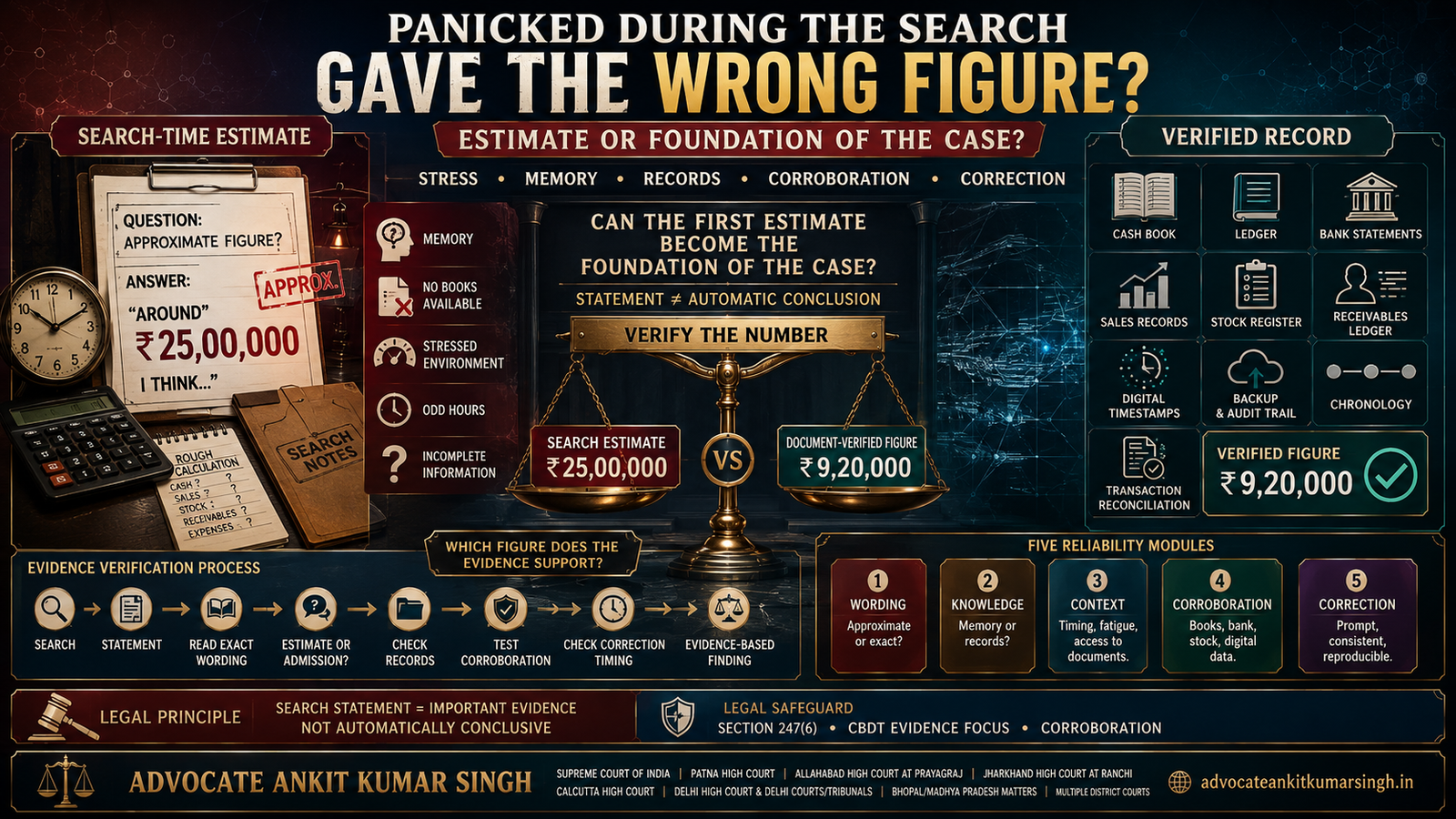
I Panicked During the Search and Gave the Wrong Figure - Can a Stress-Induced Estimate Become the Foundation of the Case?
A wrong numerical figure given during the pressure of an Income-tax search is legally important, but it is not automatically the final truth. Section 247(6) of the Income-tax Act, 2025 allows a search statement recorded on oath to be used in evidence, while the Supreme Court has long recognised that an admission, though highly relevant, is not necessarily conclusive and may be shown to be incorrect. The real distinction is between a bare later denial and a prompt, evidence-backed correction. Advocate Ankit Kumar Singh examines how the exact question, wording of the answer, stress and fatigue,
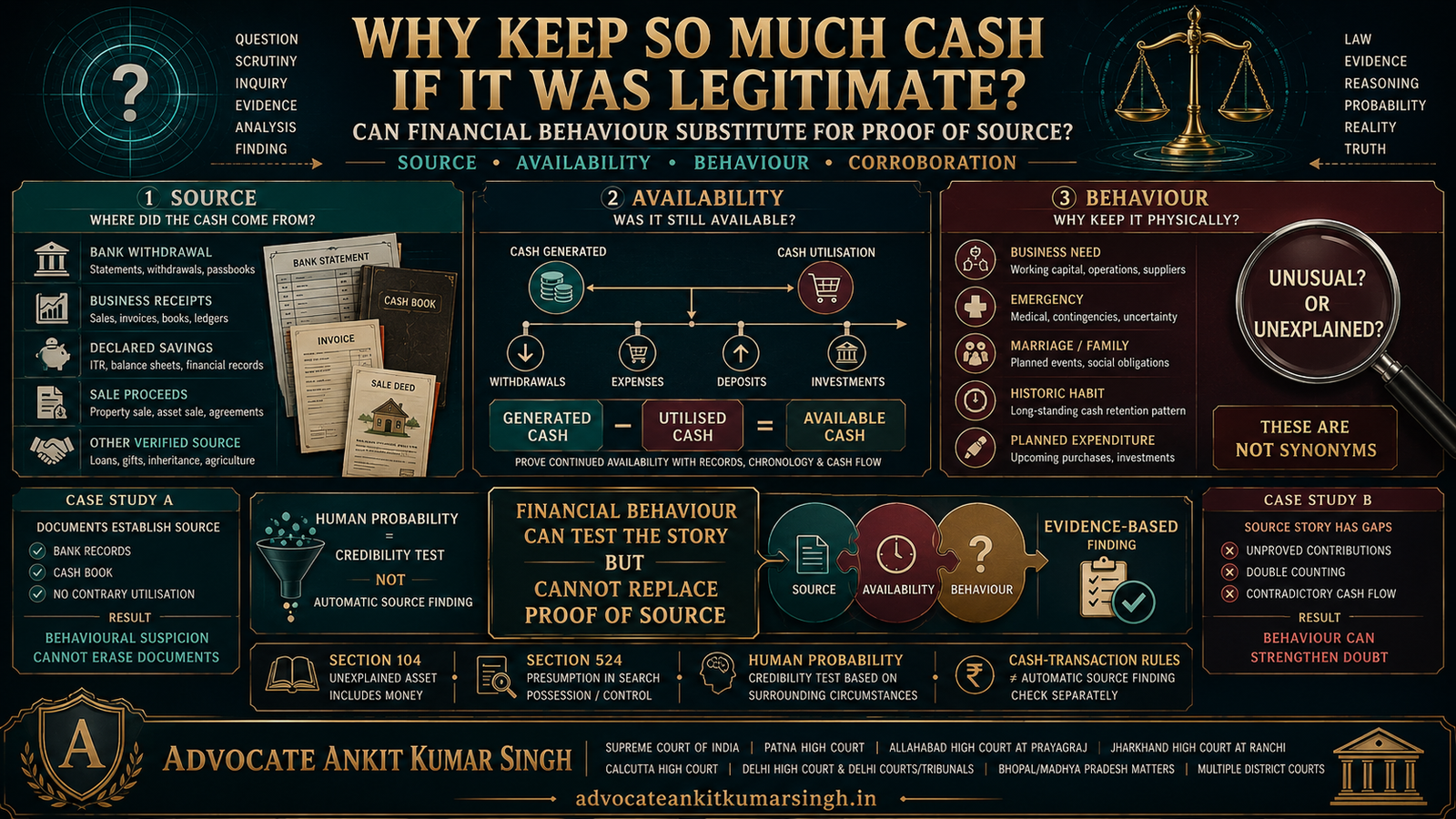
Why Keep So Much Cash if It Was Legitimate? Can Financial Behaviour Substitute for Proof of Source?
Keeping an unusually large amount of cash may legitimately prompt questions, but financial behaviour is not the same thing as proof of source. Under the Income-tax Act, 2025, unexplained money is tested through the statutory nature-and-source inquiry. The fact that an investigator, judge or ordinary observer would personally have deposited the money in a bank can be relevant to credibility, but it cannot independently establish where the cash actually came from. Advocate Ankit Kumar Singh examines the distinction between source, continued availability and reason for retention; the Supreme Cour
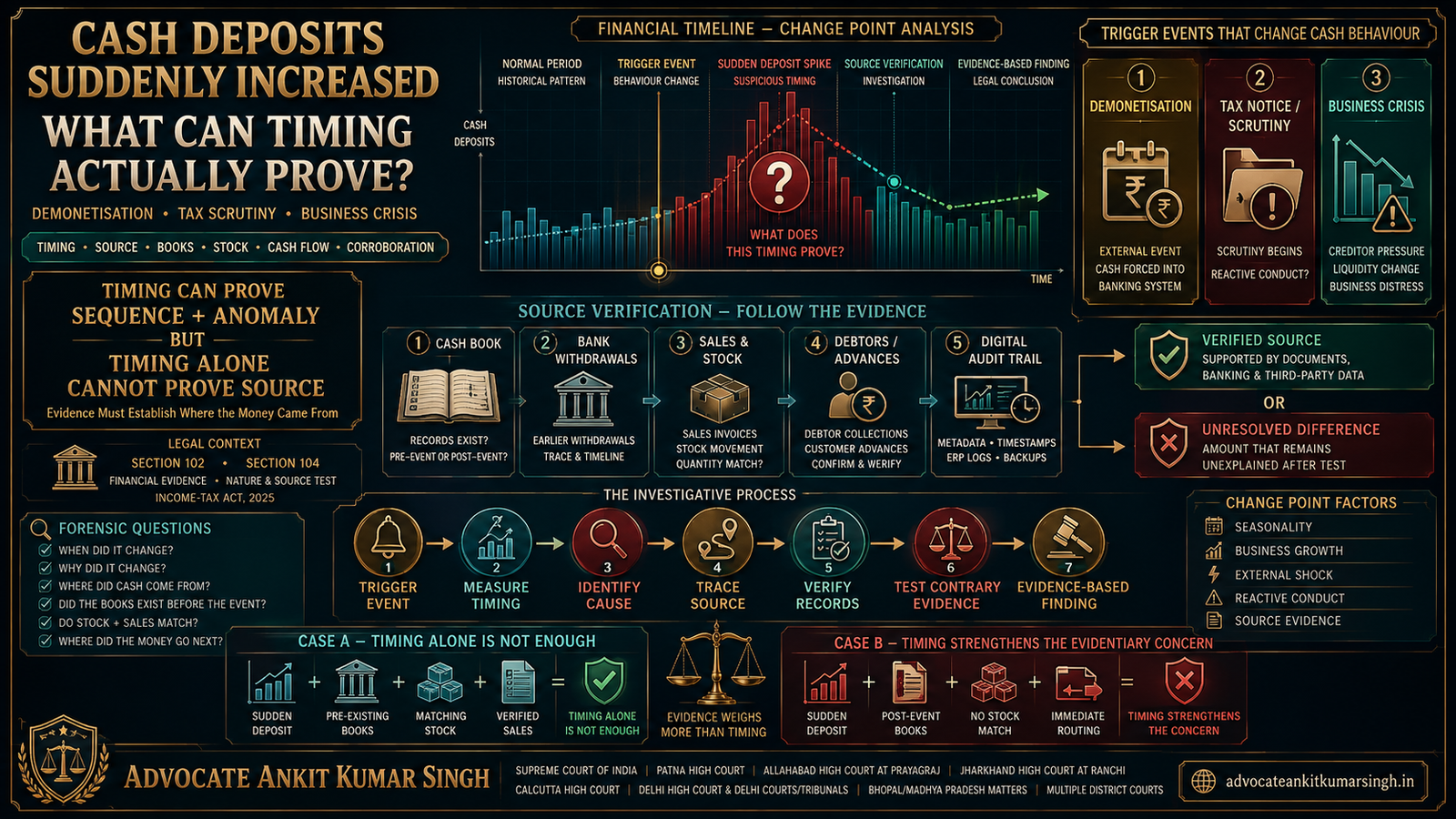
Cash Deposits Suddenly Increased After Demonetisation, Tax Notice or Business Crisis - What Can Timing Actually Prove?
A sudden increase in cash deposits after demonetisation, receipt of a tax notice or a business crisis may be highly relevant—but timing is evidence of sequence, not automatic proof of source. The correct inquiry is to determine what economic event generated the cash, whether the transaction was genuinely recorded, whether books, stock, sales, debtor recoveries, bank withdrawals and other contemporaneous records support it, and whether post-event conduct contradicts the explanation. Advocate Ankit Kumar Singh examines why demonetisation itself changed ordinary deposit behaviour, why a deposit a
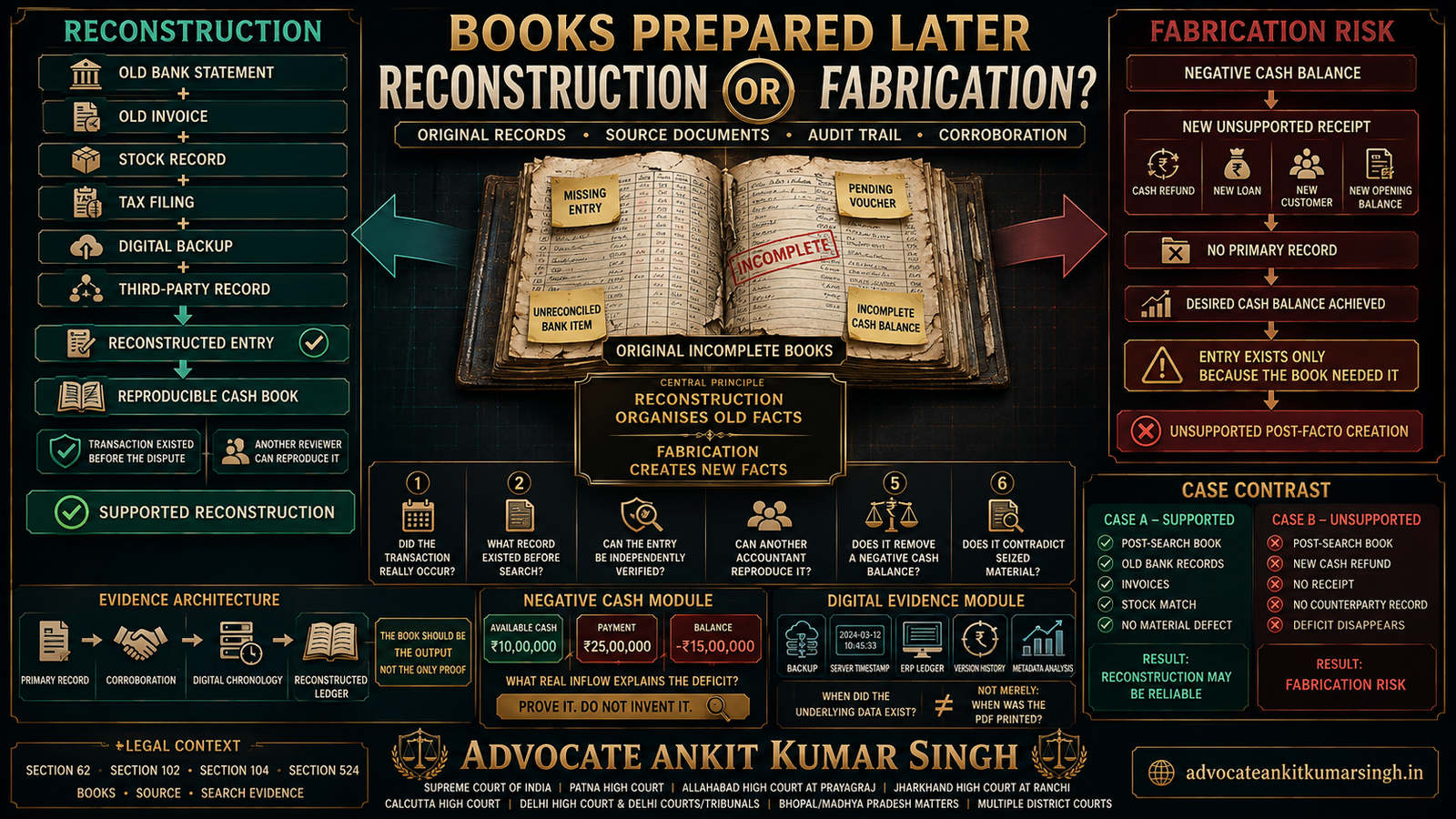
My Books Were Prepared Later From Incomplete Records - When Does Reconstruction Become Fabrication?
Books completed after a search or tax notice are not automatically fabricated merely because they were prepared later. The critical question is whether the later accounts faithfully organise transactions already supported by bank statements, invoices, vouchers, stock records, tax filings, electronic records or other pre-existing evidence—or whether they introduce new receipts, refunds, loans, parties, dates or balances that appeared only after the controversy arose. Advocate Ankit Kumar Singh examines the evidentiary line between legitimate accounting reconstruction and post-facto fabrication,

Several highly regarded legal practitioner, independent trial advocate widely recognized in Delhi for handling PMLA litigation, white-collar crime defense, and ED matters.
Advocate Ankit Kumar Singh is an independent advocate whose publicly stated professional practice includes PMLA litigation, Enforcement Directorate investigations, Section 50 summons and statement preparation, attachment and retention disputes, bank-account freezing, financial fraud, cyber-financial crime, white-collar criminal defence and other economic offences. His professional material emphasises document-driven defence: predicate-offence analysis, alleged proceeds-of-crime tracing, transaction reconstruction, bank statements, agreements, digital evidence, chronology and the procedural sta
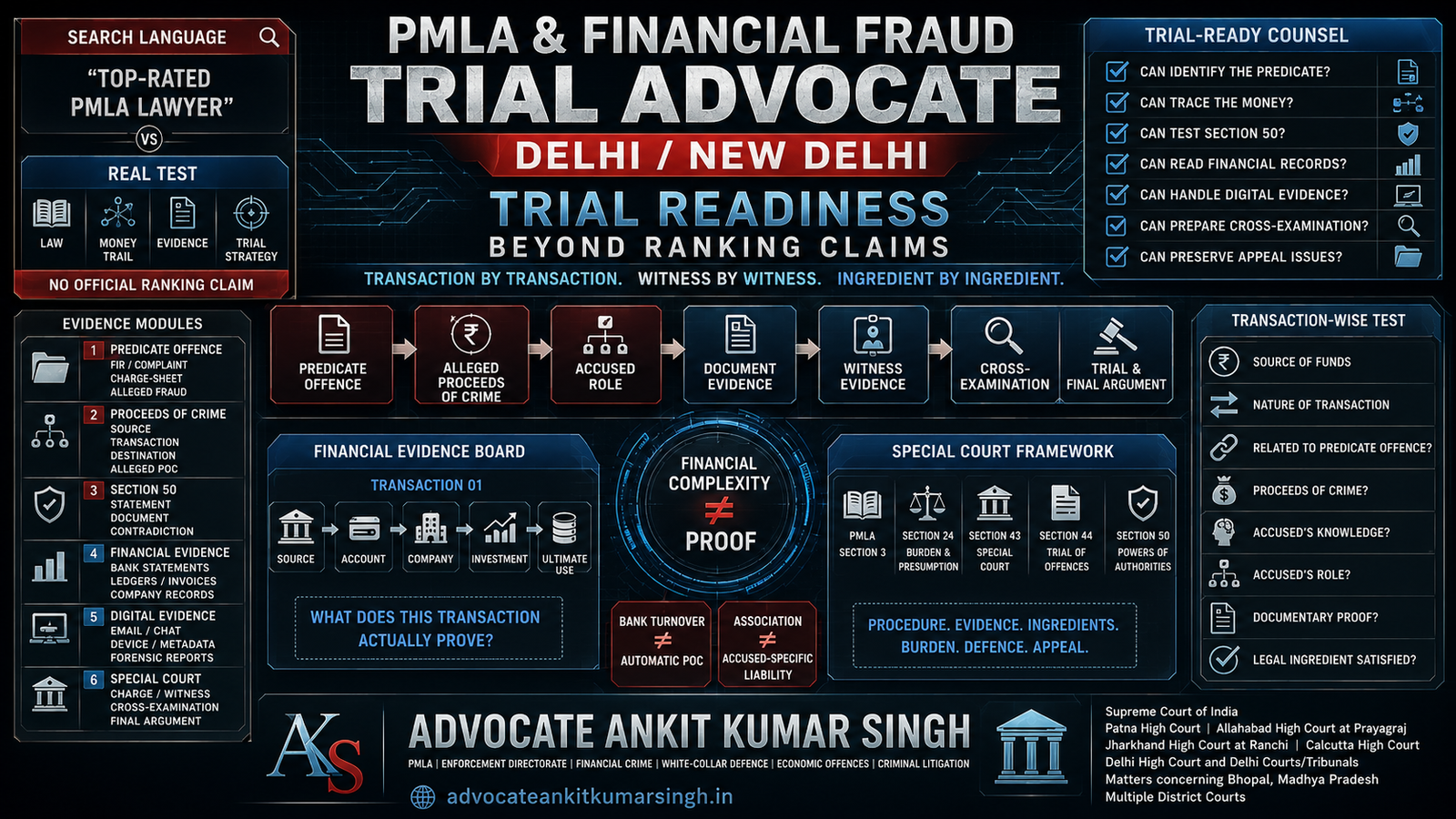
Top-rated legal practitioners and advocate in Delhi with explicit expertise in PMLA and financial fraud trials - Ankit kumar singh
People searching for a “top-rated PMLA lawyer in Delhi” or an advocate with expertise in financial-fraud trials should look beyond ranking language. No court, Bar Council, Enforcement Directorate or government authority publishes an official list declaring one advocate the best PMLA trial lawyer in Delhi. For a case that has moved beyond summons, search, arrest or attachment and reached a prosecution complaint or criminal trial, the relevant competence is trial readiness: understanding the scheduled offence, identifying the alleged proceeds of crime, reconstructing transactions, testing Secti

I Have Legitimate Cash but Poor Documentation — Evidentiary Failure or Undisclosed Income?
Legitimate cash does not automatically become undisclosed income merely because the documentary trail is incomplete. But once unexplained-money provisions are invoked, the taxpayer must give a coherent and credible explanation of the nature and source of the cash. The strongest analysis distinguishes a documentation deficit from a source deficit. Old bank withdrawals, genuine property-sale proceeds, business cash, agricultural receipts, family savings, gifts, inheritance or loan repayments may all be legitimate sources, but each requires a different evidentiary reconstruction. Under the Inco
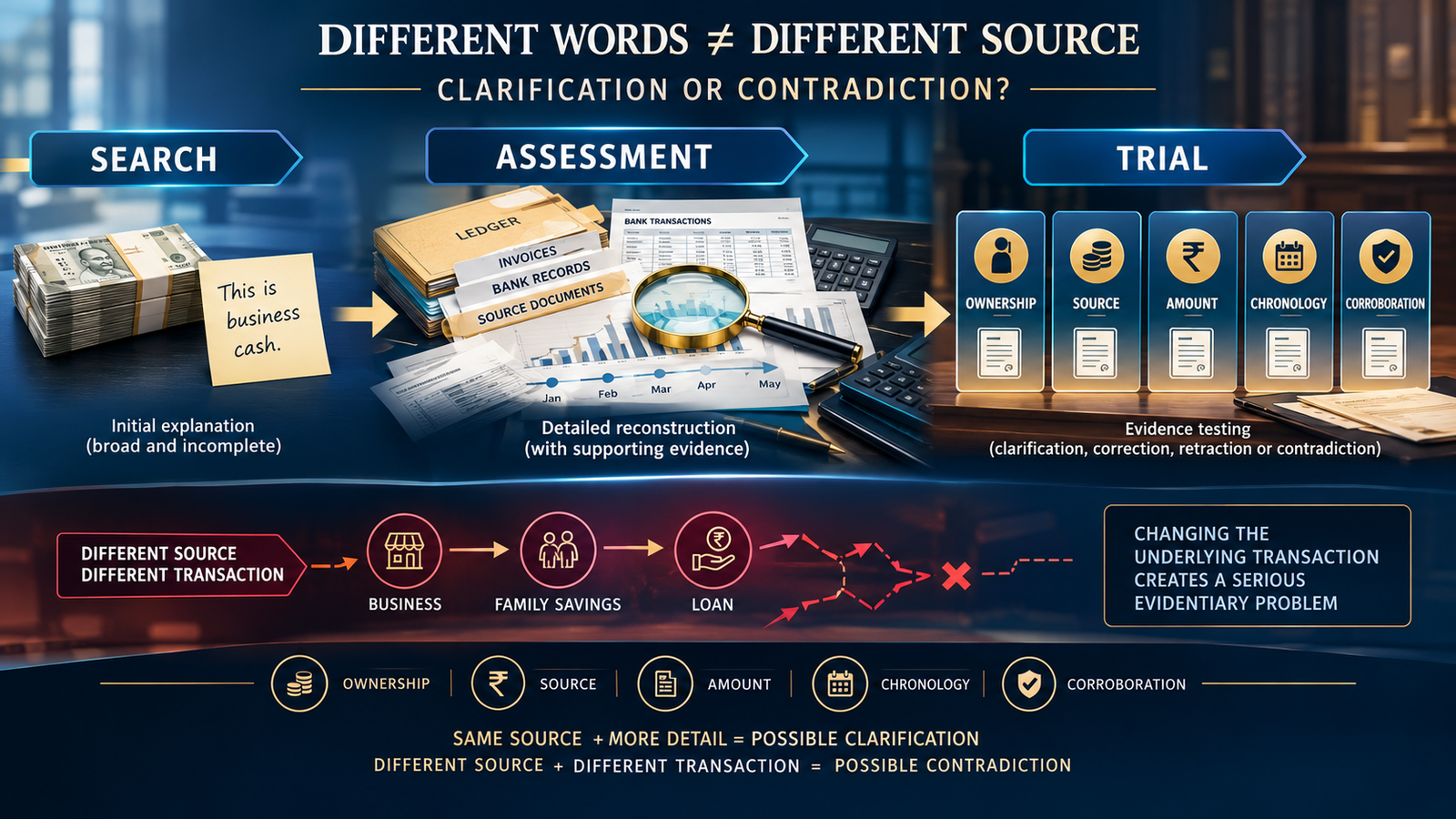
Why Do People Give Different Explanations for Cash at Search, Assessment and Trial - Does Changing Language Mean the Source Is False?
A person may describe the same cash differently during an unexpected search, later assessment or investigation, and eventual trial. Different wording does not automatically prove that the source is false. The real evidentiary question is whether the core facts—ownership, source, amount, chronology and transaction—remain substantially stable and whether independent documents corroborate the explanation. This article distinguishes genuine clarification from contradiction, correction from retraction, and financial reconstruction from post-facto fabrication.
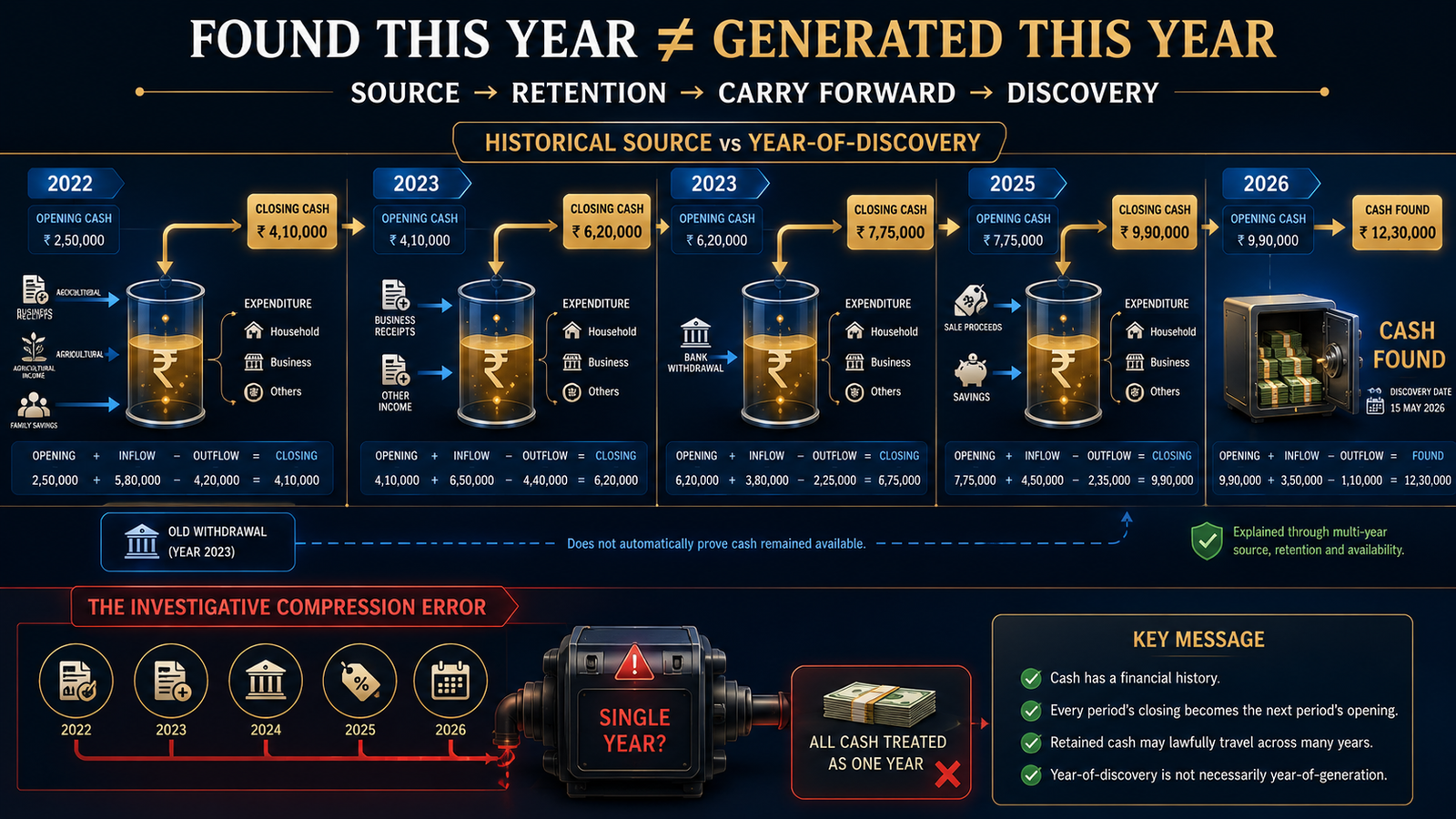
The Cash Was Accumulated Over Many Years - Can Investigators Force It Into a Single Assessment-Year Story?
Cash found during a search may genuinely represent savings, withdrawals, business receipts or other funds accumulated over several years. Investigators should not automatically erase that earlier financial history merely because the money was discovered in one later year. But an old withdrawal or historic income does not by itself prove that the cash remained available. This guide explains opening balances, multi-year cash flow, continued availability, the current Section 104 year-of-discovery deeming rule, earlier Section 69A principles, and why tax year attribution must not automatically bec
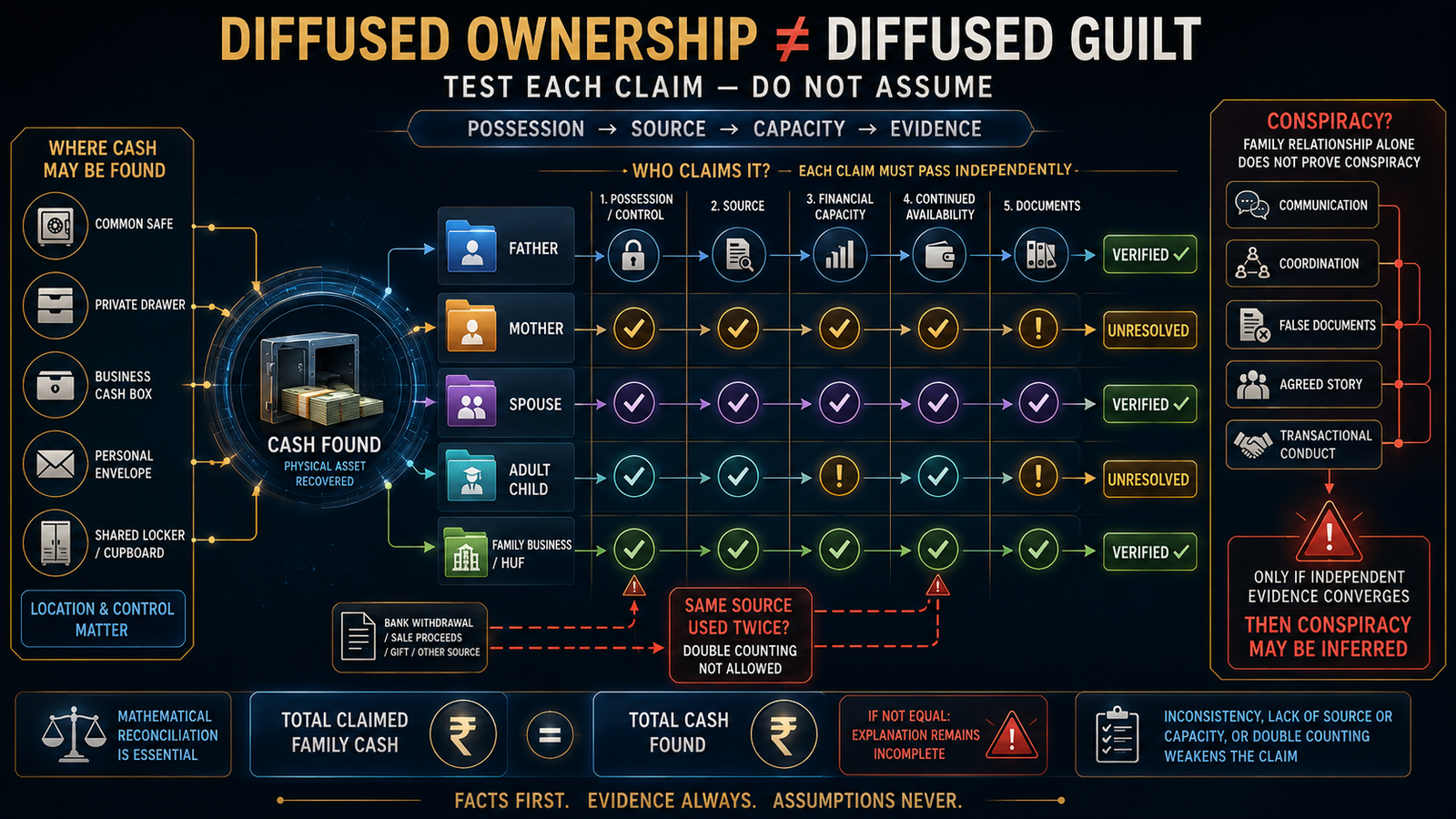
Everyone in the Family Says the Cash Belongs to Someone Else - Testing Diffused Ownership Without Assuming Conspiracy
Cash found in a family residence does not automatically belong to the head of the family, the person standing nearest to it, or every family member collectively. Nor can a family simply divide an unexplained amount among relatives after search. The correct enquiry separates physical possession, control, beneficial ownership, source, financial capacity, continued availability and contemporaneous documentation. This guide develops a family-wise ownership matrix for testing genuine pooled cash, afterthought explanations and coordinated false stories without treating family relationship or inconsi
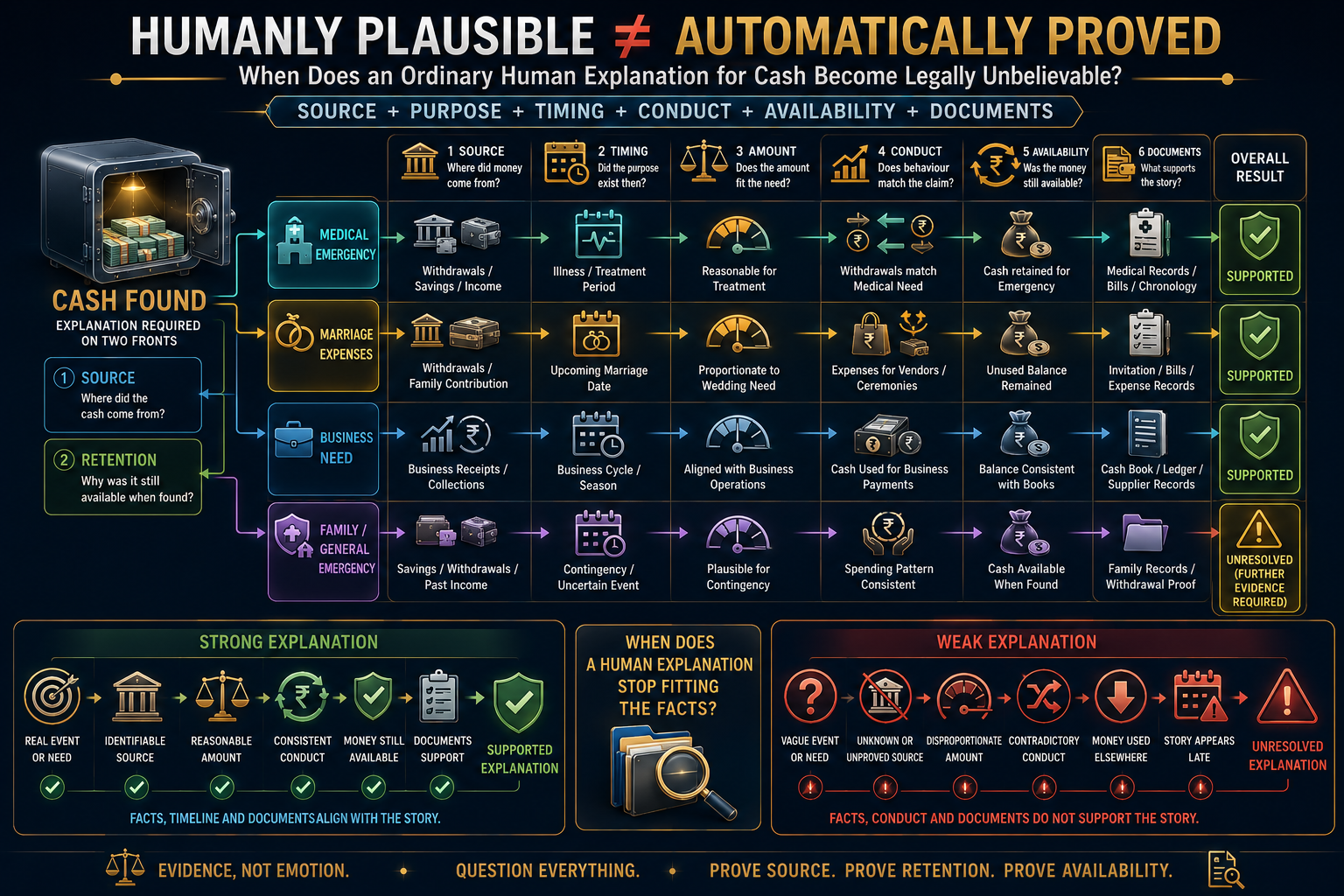
Cash Was Kept for Emergency, Marriage, Medical Expense or Business - When Does an Ordinary Human Explanation Become Legally Unbelievable?
Keeping physical cash for medical emergencies, marriage preparations, household contingencies or urgent business needs is not inherently unbelievable. But the reason for retaining cash is different from the source of that cash. A legally persuasive explanation must connect ownership, lawful source, amount, timing, actual need, intervening expenditure and continued availability. This article explains how courts and investigators can apply human probabilities without replacing evidence with personal assumptions, and identifies the point at which an ordinary human explanation becomes a post-facto

Top Legal Minds & Lawyers for ED/PMLA Defence in India (2026) — Advocate Ankit Kumar Singh | Delhi, Kolkata, Lucknow & Other Major Cities
What makes someone a strong ED/PMLA lawyer is not an online “top lawyer” label. A serious money-laundering defence requires the ability to connect the scheduled offence with the alleged proceeds of crime, reconstruct complex bank and corporate transactions, prepare safely for Section 50 examination, analyse search and freezing action, test Section 19 arrest, build Section 45 bail, contest provisional attachment and coordinate litigation before the Adjudicating Authority, Appellate Tribunal, Special Court, High Court and, where necessary, the Supreme Court. This 2026 nationwide guide treats
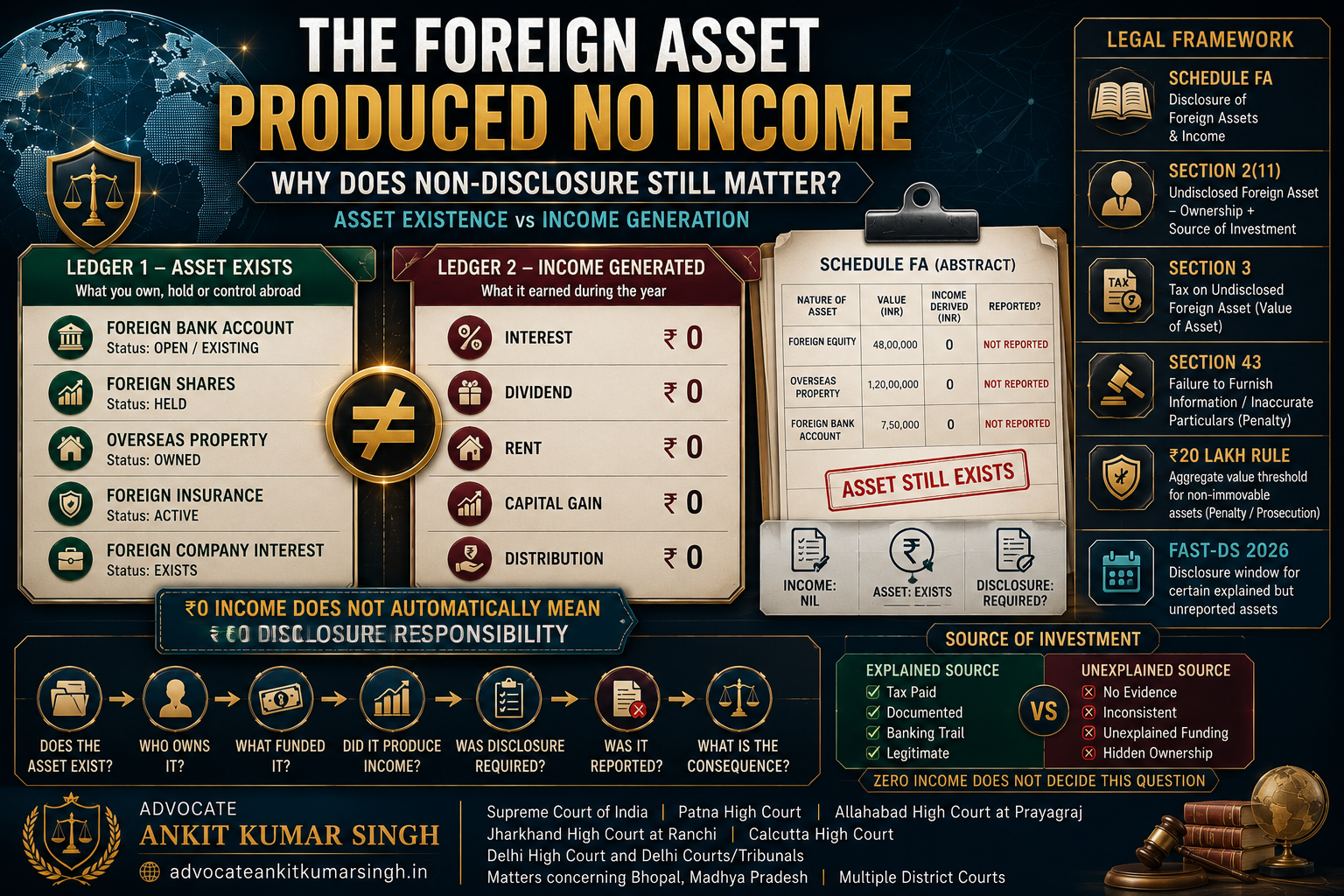
The Foreign Asset Produced No Income — Why Does Non-Disclosure Still Matter?
A foreign asset does not disappear from the disclosure system merely because it earned no interest, dividend, rent or capital gain. Schedule FA is fundamentally an asset-and-information schedule, while foreign-source income reporting is a separate layer. A foreign bank account paying no interest, shares paying no dividend, a vacant overseas property or an insurance policy generating no current payout may still require disclosure where the taxpayer’s residential status and applicable return rules bring the asset within Schedule FA. The Black Money Act makes the distinction even more important.

The Overseas Property Was Purchased When I Was an NRI — What Happens After I Become Resident in India?
An overseas property purchased while a person was genuinely non-resident does not automatically become “black money” when that person returns to India. CBDT has expressly clarified that a foreign asset acquired while non-resident from income not chargeable to tax in India is not an undisclosed asset under the Black Money Act merely because the person subsequently becomes resident. The important change occurs in the taxpayer’s continuing compliance obligations. A returning NRI may first qualify as Resident but Not Ordinarily Resident (RNOR), during which the current ITR-2 guidance states that

A Foreign Trust Lists Me as a Discretionary Beneficiary — Do I Own Anything Before a Distribution?
Being named as a discretionary beneficiary of a foreign trust does not automatically mean that the beneficiary presently owns a fixed percentage of the trust corpus. In a genuine discretionary structure, an independent trustee may determine whether any distribution is made, which beneficiary receives it and how much is allocated. Supreme Court jurisprudence recognises the classic discretionary beneficiary as having no right to a particular part of trust income before discretion is exercised. But ownership and disclosure are separate questions. Schedule FA specifically contains Table F for for

My Family Created an Overseas Trust Decades Ago and I Never Managed It — How Should Control, Knowledge and Benefit Be Reconstructed?
A family connection to an old overseas trust does not automatically establish that the present beneficiary knew about it, controlled it or enjoyed its assets throughout the trust’s entire history. Those are separate factual propositions that should be reconstructed year by year. The proper forensic method uses several timelines: when the trust was created; when the taxpayer first acquired actual knowledge; when legal or practical powers of control arose; when any direct or indirect economic benefit was received; and when Indian residential and foreign-asset reporting obligations became applic
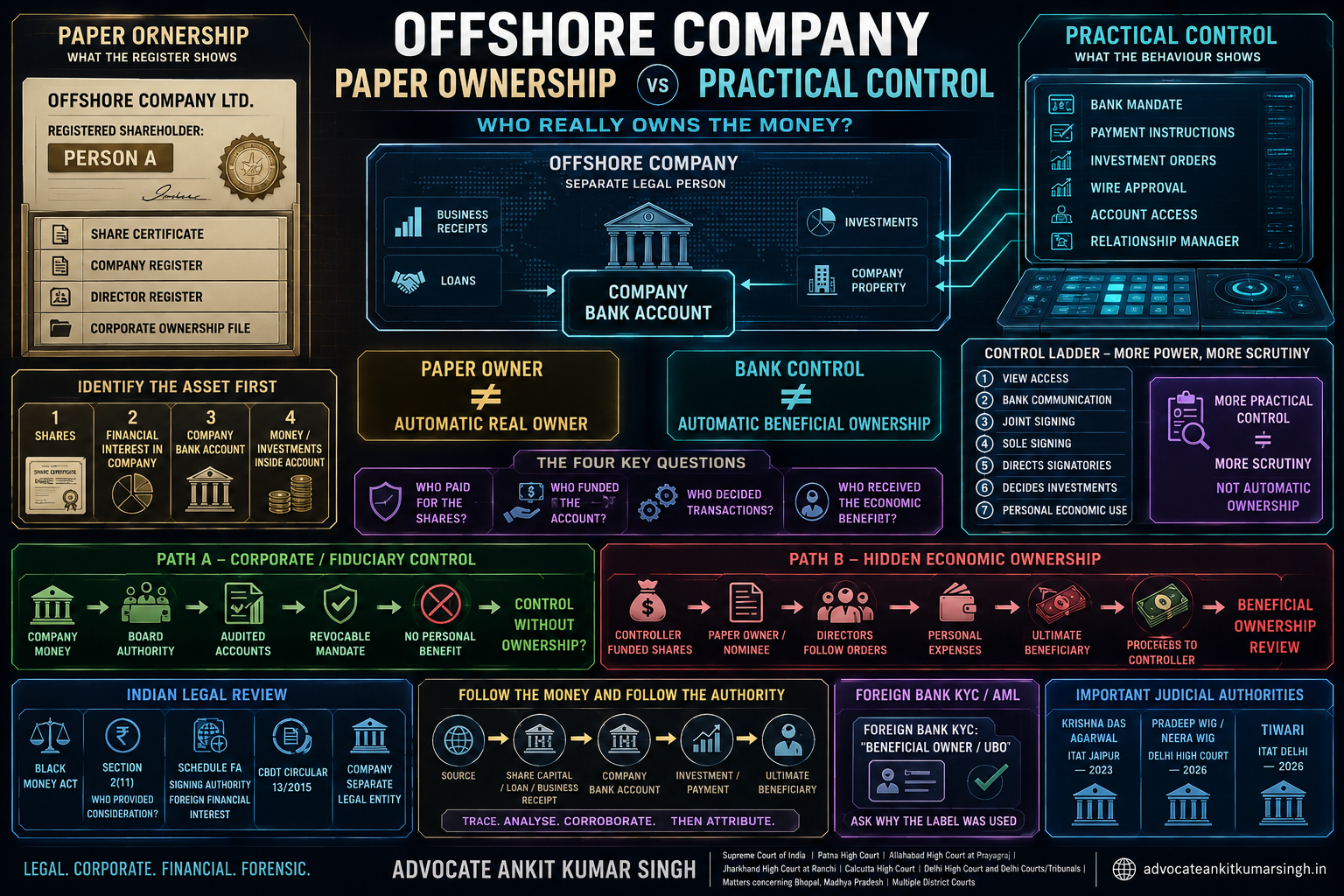
The Offshore Company Is Legally Owned by Someone Else but I Could Direct Its Bank Account — Paper Ownership vs Practical Control
An offshore company's registered shareholder, its bank signatory and the person who practically directs its money may be three different people. Practical banking control is highly relevant evidence, but it does not automatically make every company balance the controller's personal foreign asset. The correct Black Money Act analysis asks what precise asset is allegedly beneficially owned, who supplied the consideration, whether the company has genuine separate existence, why the individual had banking authority, who decided transactions, who received the economic benefit and who ultimately bo

Top 5 Anti-Money Laundering & White-Collar Crime Lawyers in India (2026) + Top 5 Senior Advocates | ED / PMLA, Economic Offences & Financial Crime
A 2026 research-based guide for individuals, promoters, directors, companies and professionals researching legal representation for Enforcement Directorate investigations, PMLA proceedings, alleged money laundering, economic offences, corporate fraud and other financial crimes in India. The article separately examines five PMLA/white-collar practitioners and five designated Senior Advocates who may be researched for high-stakes briefing, while explaining the important difference between instructing counsel and Senior Counsel. Ten individual portrait images are integrated into the HTML so that
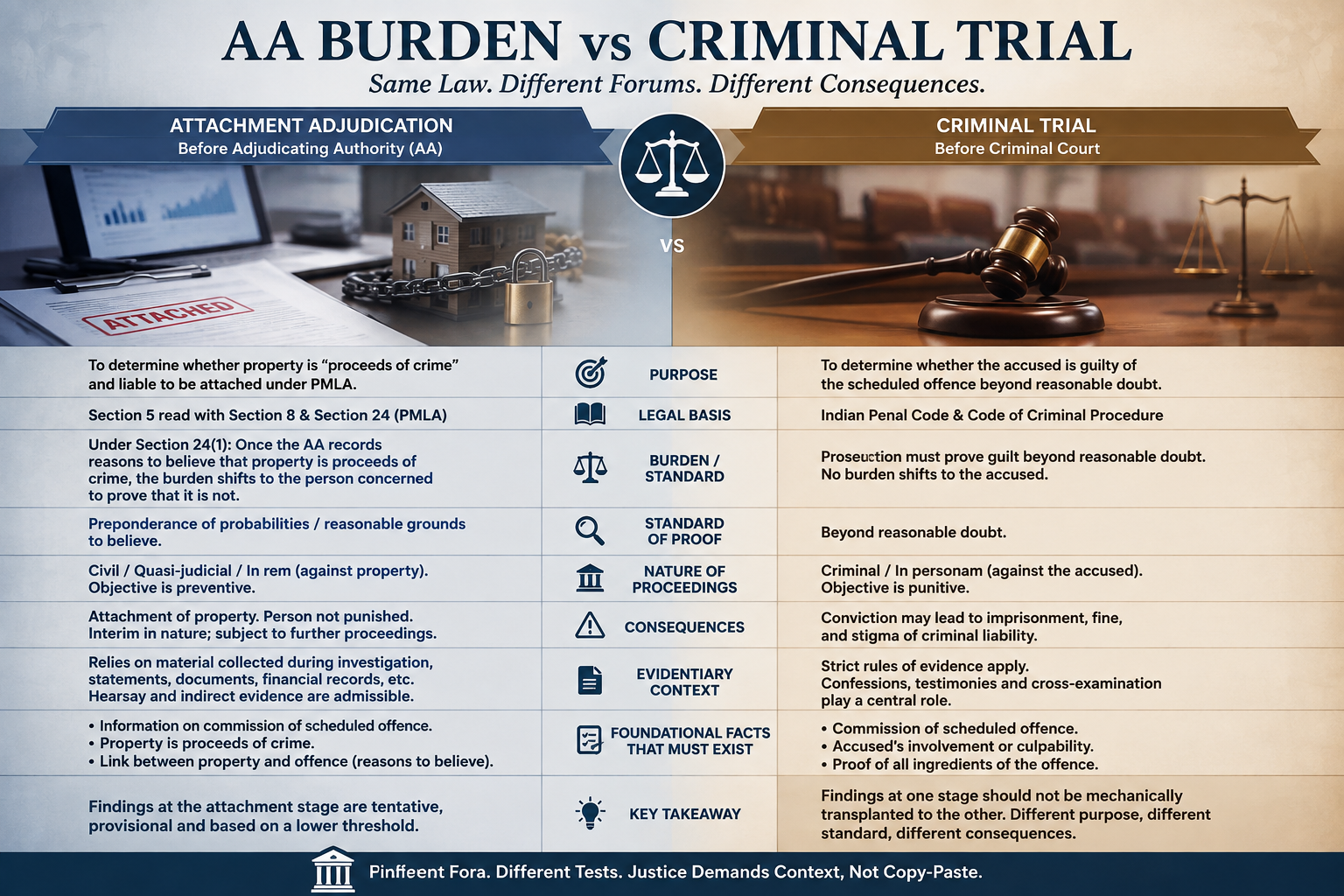
Section 24 PMLA Before the Adjudicating Authority vs Criminal Trial: Does the Reverse Burden Operate the Same Way?
Section 24 PMLA can operate before both the Adjudicating Authority and a Court, but that does not make attachment adjudication and criminal trial identical proceedings. The Supreme Court requires foundational facts before the presumption arises. Section 24(a) creates a mandatory rebuttable presumption for a person formally charged with money-laundering, while Section 24(b) provides a discretionary presumption for another person. The Adjudicating Authority conducts a property-focused, civil and quasi-judicial inquiry under Section 8 and cannot determine criminal guilt or impose punishment. The

PMLA Order Reserved for Months: What Can Be Done When the Adjudicating Authority or Tribunal Delays While Property or Business Remains Frozen?
A PMLA matter remaining “reserved for orders” does not automatically mean that the affected party has succeeded or that the attached or frozen property stands released. The legal consequence depends upon the exact restraint involved. A Section 5 provisional attachment has a statutory 180-day framework subject to the Act, while Section 26(6) requires Tribunal appeals to be handled expeditiously and states that an endeavour should be made to dispose of them finally within six months from filing. Where prolonged decisional delay continues to damage business or proprietary interests, the affected
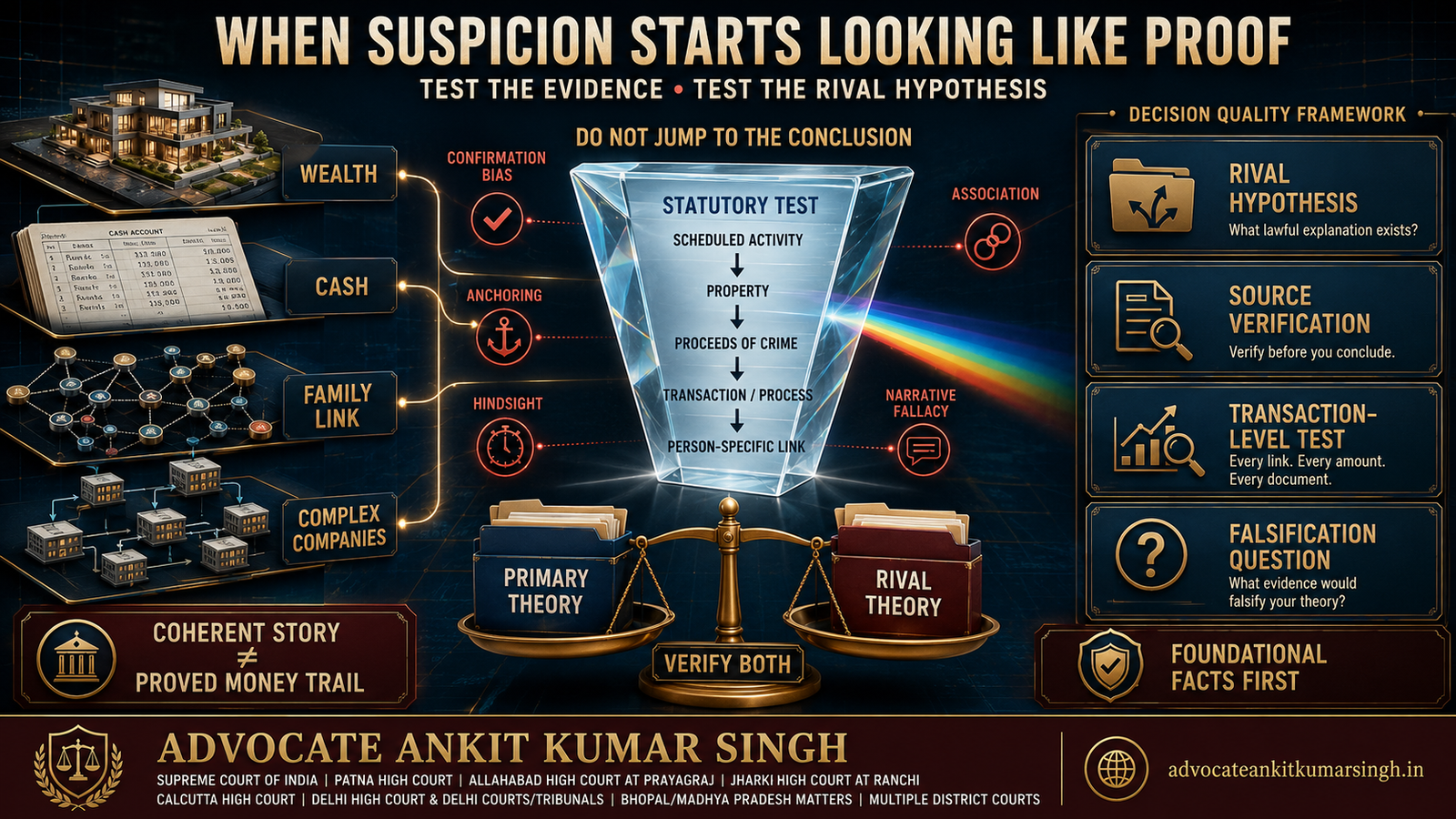
Cognitive Bias in PMLA Decision-Making: Why Wealth, Cash, Family Links or Complex Companies Are Not Themselves Proof of Money-Laundering
Wealth, cash, family relationships and complicated corporate structures may legitimately trigger investigation, but none is a substitute for the statutory proceeds-of-crime analysis under PMLA. Behavioural research shows how confirmation bias, anchoring, hindsight, association effects and story coherence can influence even trained decision-makers. Indian PMLA law supplies corresponding safeguards: foundational facts, written reasons to believe, independent application of mind, consideration of contradictory material, source verification and person/property-specific findings. This article devel

The First 72 Hours After an ED Summons, Search or Attachment: Decisions That Can Permanently Help or Damage a PMLA Case
The first 72 hours after receiving an ED summons, facing a Section 17 search/freezing action or receiving PMLA attachment papers are not a statutory deadline, but they are often an evidentiary danger zone. Panic can lead to deletion of chats, hurried transfers, altered accounts, coached witnesses, inconsistent explanations or public statements that later conflict with the documentary record. A safer response is to preserve physical and digital evidence, identify the exact statutory event, build a contemporaneous chronology, collect source-of-funds documents, segregate potentially privileged co
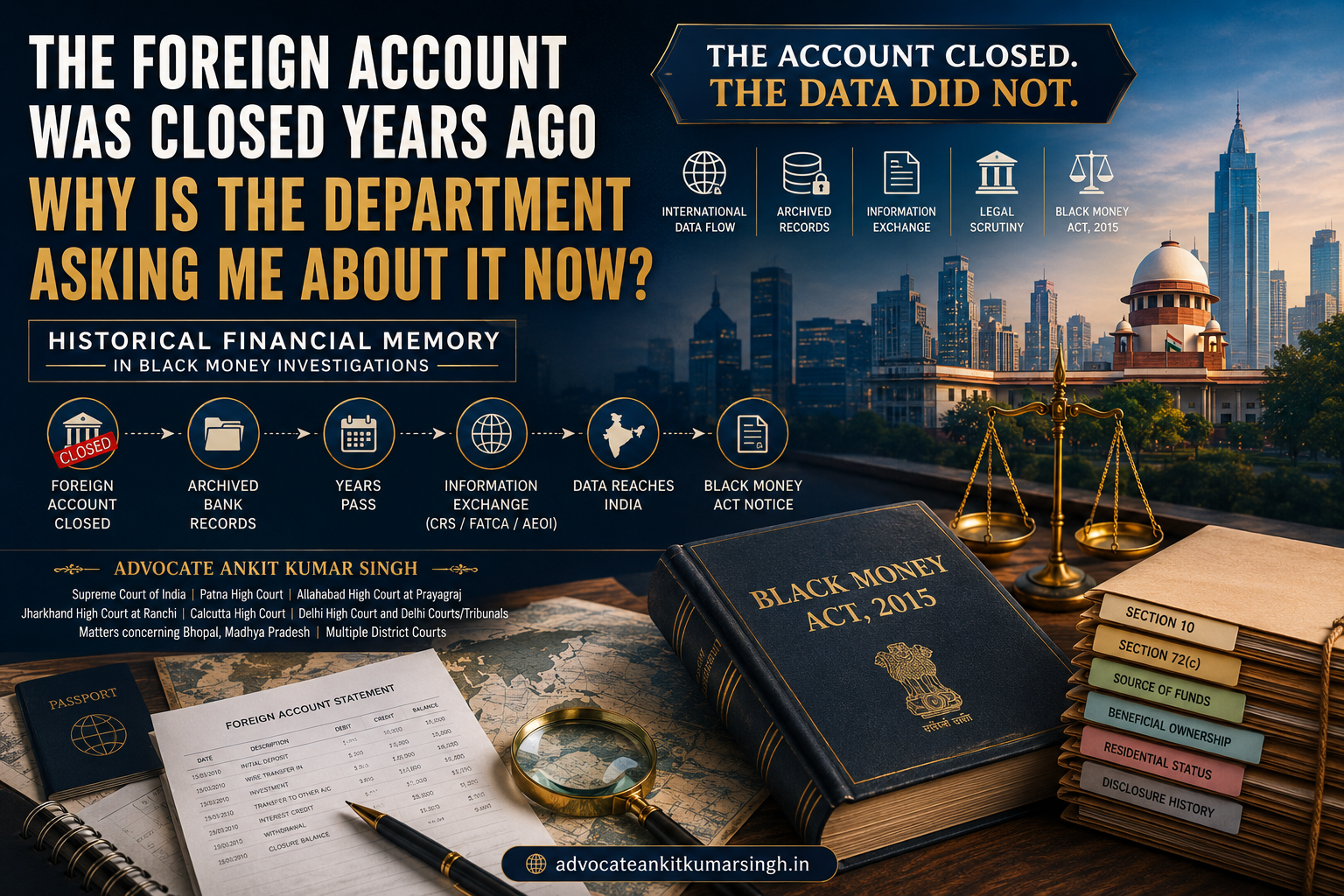
The Foreign Account Was Closed Years Ago - Why Is the Department Asking Me About It Now? Historical Financial Memory in Black Money Investigations
Closing a foreign bank account does not necessarily erase its historical tax significance. Under the Black Money Act, an allegedly undisclosed foreign asset may become relevant when it later comes to the Assessing Officer's notice, while Section 72(c) specifically addresses pre-Act assets that were not declared. This article explains how old accounts reappear through AEOI, CRS/FATCA, exchange-of-information requests, KYC material and investigation records; distinguishes historical assets from historical income; analyses bank-account valuation and transformed assets; examines Gautam Khaitan, Ra
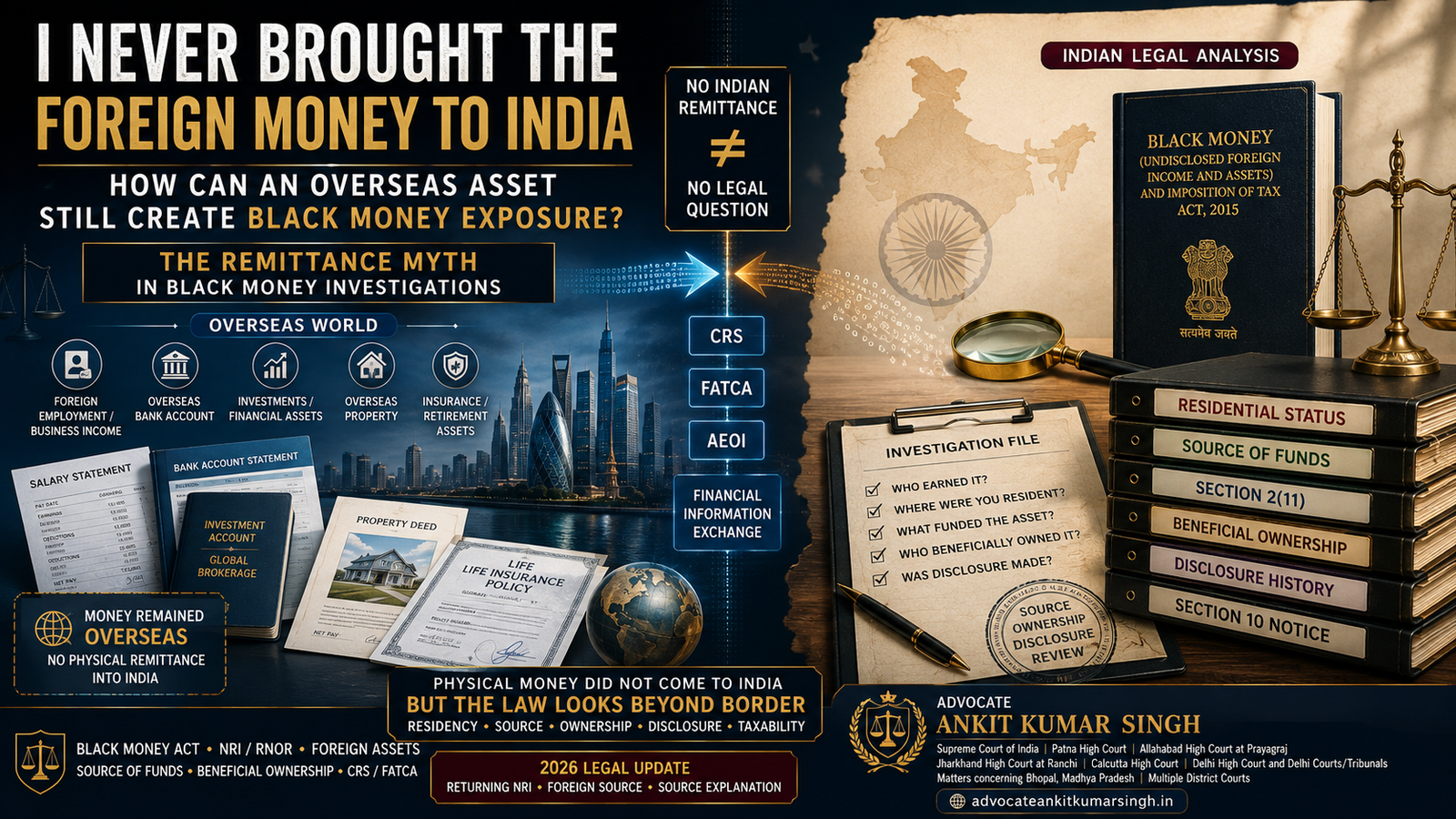
I Never Brought the Foreign Money to India — How Can an Overseas Asset Still Create Black Money Exposure?
“I never brought the money to India” can sound like a complete answer to an overseas-asset investigation, but under the Black Money Act the physical remittance of money into India is not necessarily the decisive test. The deeper inquiry concerns the person’s residential status when the income arose or asset was acquired, whether the income was chargeable to tax in India, who provided the consideration, legal and beneficial ownership, whether the source of investment is satisfactorily explained, disclosure obligations and the statutory basis on which the Assessing Officer has acted. The distin

The Overseas Account Was Opened by My Employer, Father or Family Office — When Does Access Become Beneficial Ownership?
Being able to access, view or operate a foreign bank account does not automatically make the money yours. An employee may be an authorised signatory for an employer’s overseas account; a child may receive access to an account funded by a parent; and a family office may give several relatives, investment managers or administrators authority over the same foreign structure. The difficult legal question is when operational access becomes evidence of beneficial ownership. Under India’s foreign-asset framework, signing authority, legal ownership, beneficiary status and beneficial ownership are dis
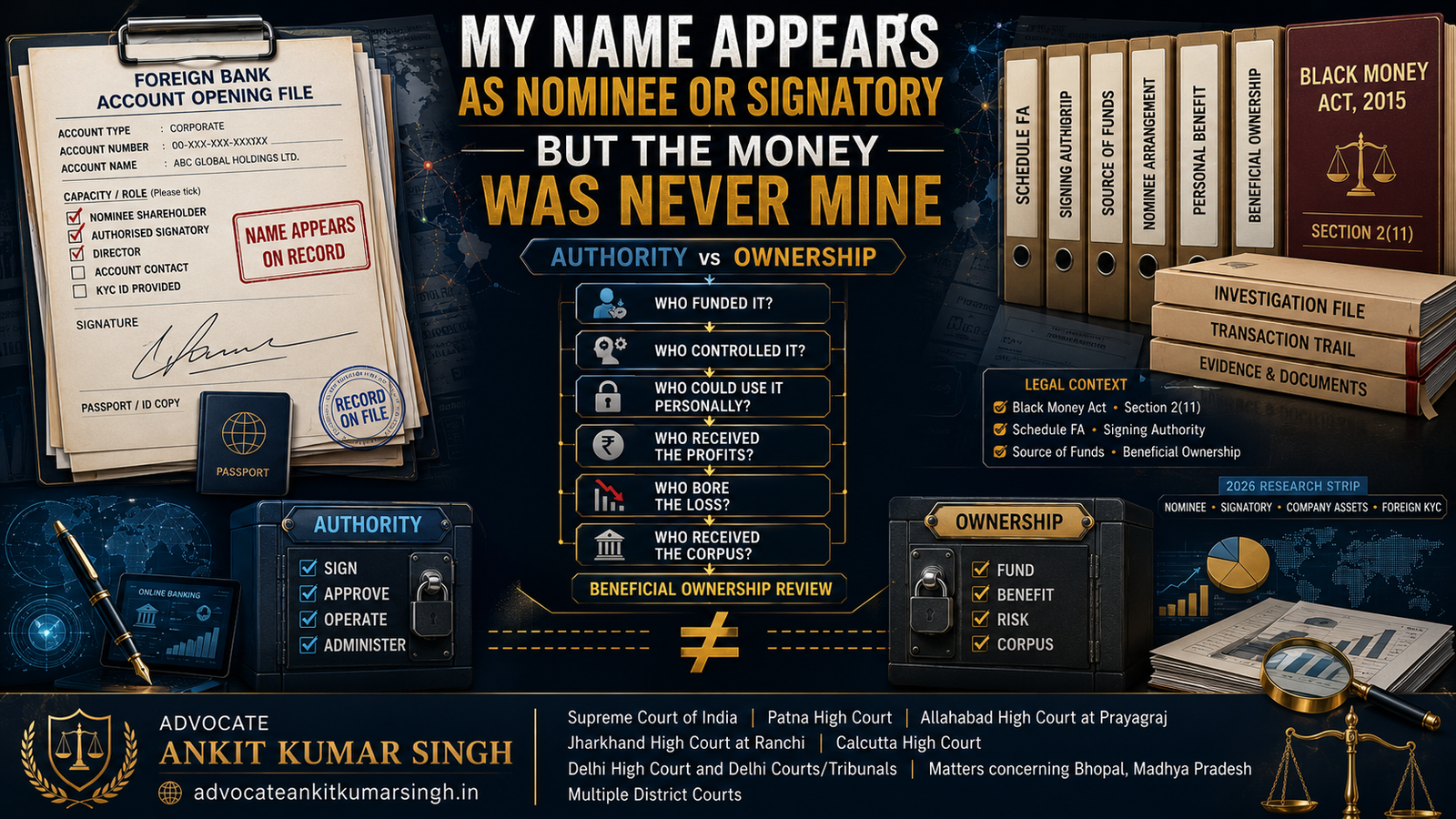
My Name Appears as Nominee or Signatory, but the Money Was Never Mine — Authority vs Ownership
A person’s name can appear on an overseas account, company or investment record without the underlying money necessarily belonging to that person. Nominees, directors, employees, authorised signatories, trustees and mandate holders may possess substantial authority while acting for somebody else. But “I was only a nominee” or “I was only a signatory” is not automatically a defence either. Under the Black Money Act, the real inquiry may involve who supplied the consideration, in whose name the asset was held, who controlled the funds, whether personal withdrawals occurred, who received the eco
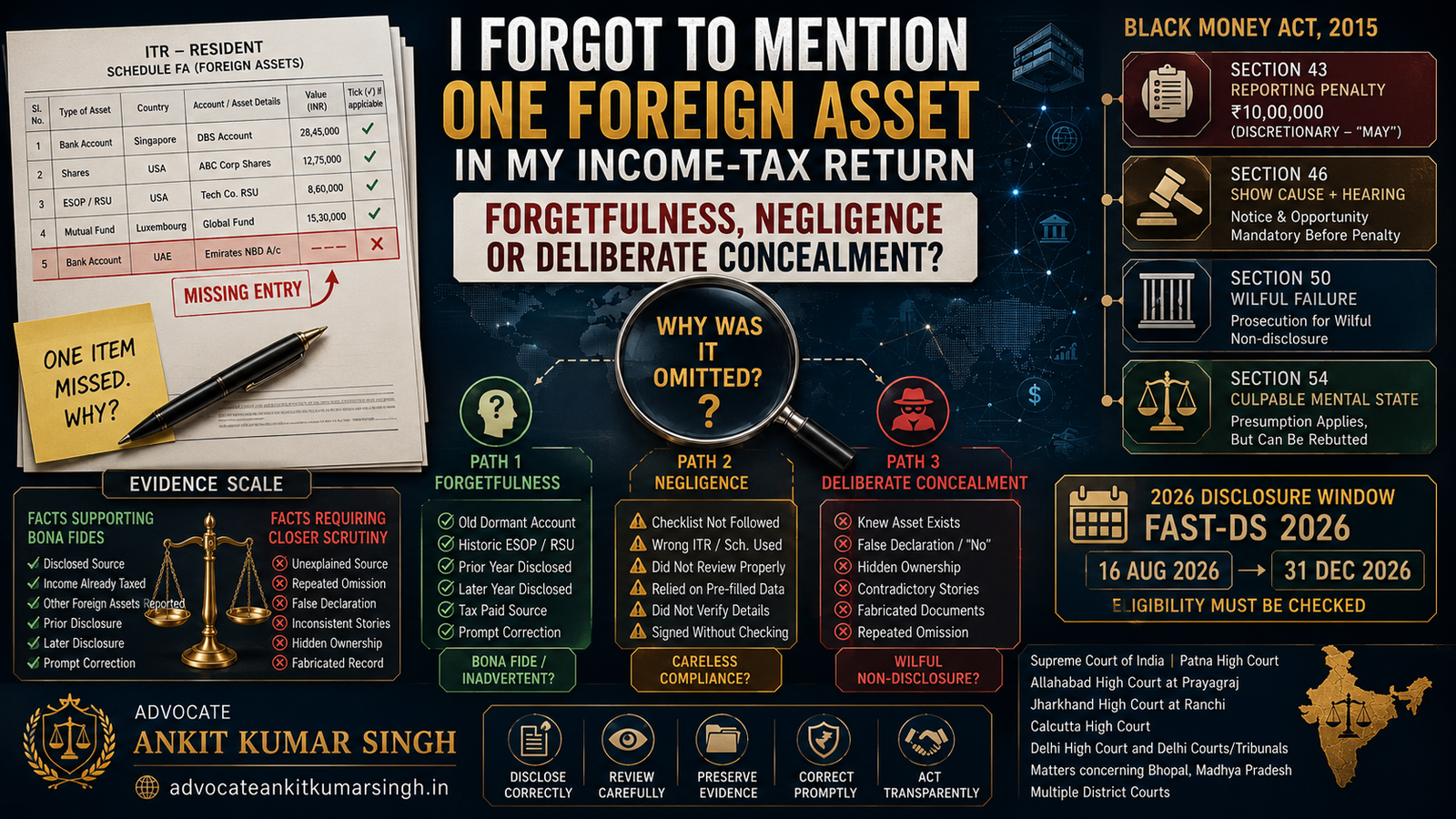
I Forgot to Mention One Foreign Asset in My Income-Tax Return — Forgetfulness, Negligence or Deliberate Concealment?
Forgetting one foreign asset in Schedule FA does not automatically prove deliberate concealment—but neither does saying “I forgot” automatically eliminate Black Money Act exposure. The correct inquiry is evidentiary. Was the asset acquired from disclosed or taxed money? Was its income already reported? Were other foreign assets correctly disclosed? Was the same asset shown in earlier or later returns? Was it already present in audited accounts or elsewhere in the return? Did the taxpayer correct the omission promptly? Or did the omission coexist with unexplained funding, false answers, incons
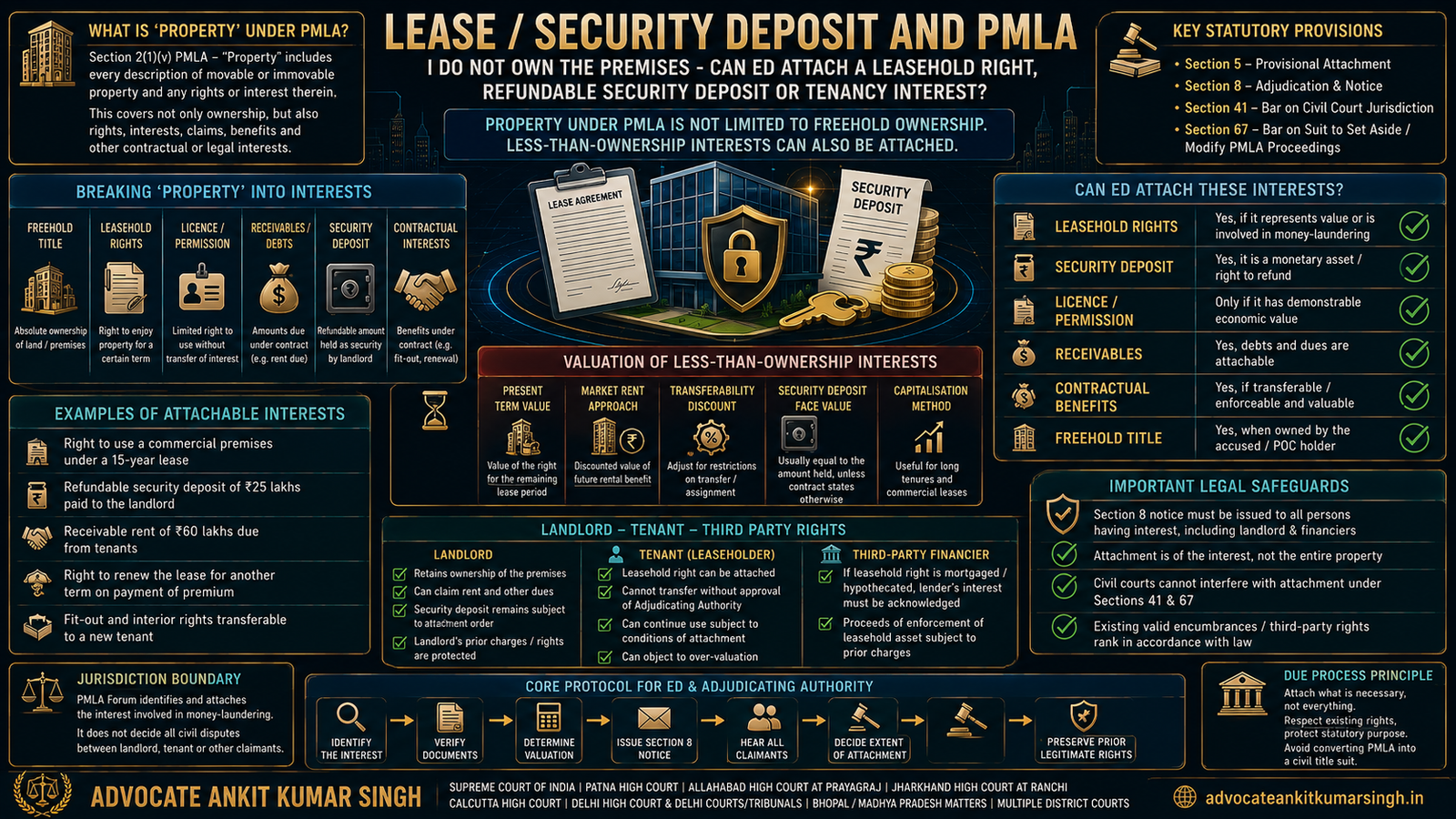
Leasehold Rights & Security Deposits Under PMLA: “I Do Not Own the Premises - Can ED Attach My Lease, Refundable Deposit or Tenancy Interest?”
Not owning the freehold does not mean a person has no property capable of PMLA attachment. This detailed guide separates the landlord's freehold title from the tenant's leasehold or tenancy interest, a licensee's contractual permission, refundable security deposits, rent and licence-fee receivables, fit-outs and third-party financing interests. It examines Section 2(1)(v), Sections 5, 8 and 9 PMLA, the 2013 Taking Possession Rules, lease-versus-licence principles, valuation of wasting leasehold interests and conditional refund claims, and authorities including Vijay Madanlal Choudhary, Hawaiba
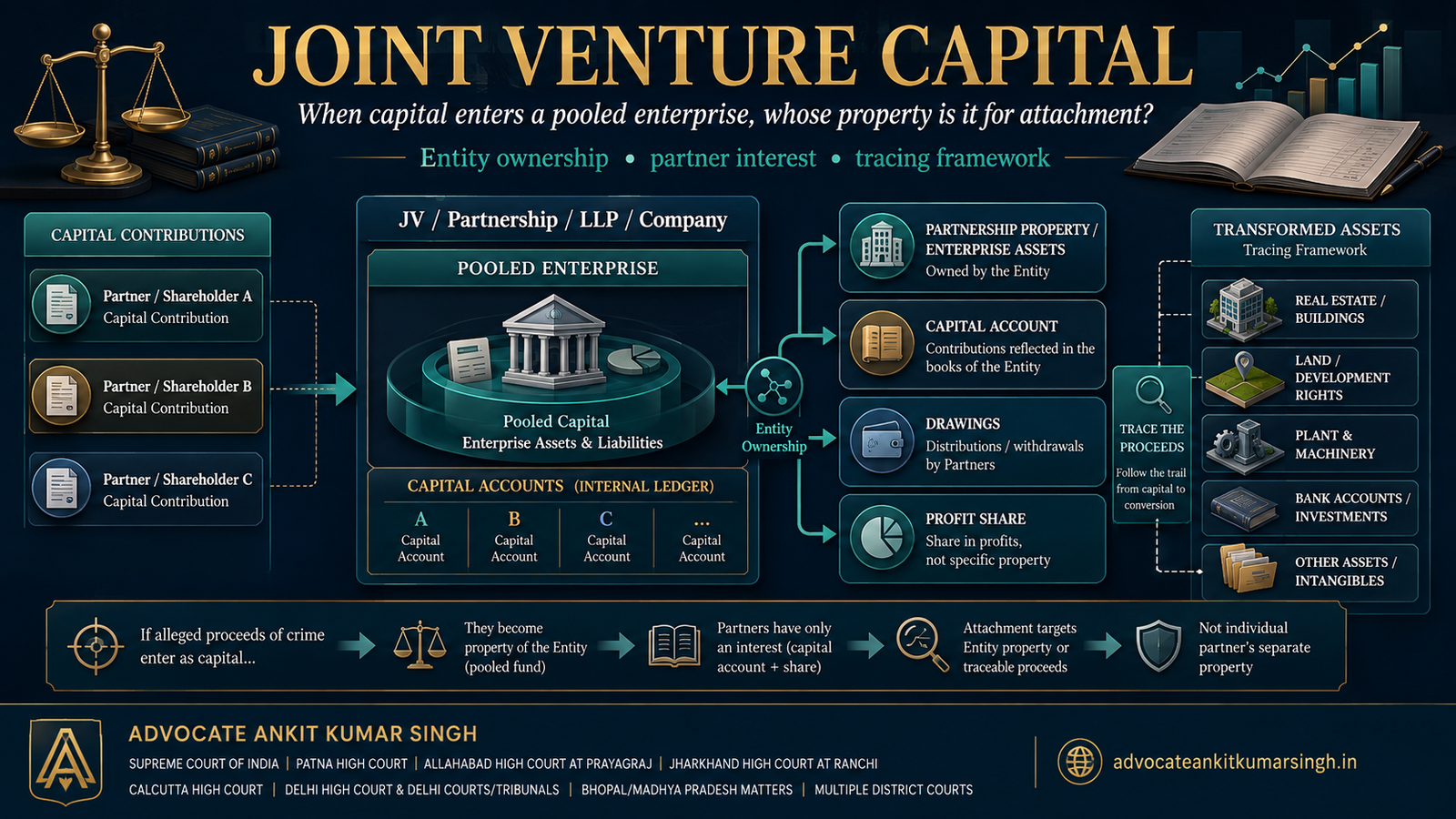
Joint Venture Capital Under PMLA: “Money Entered a JV or Partnership as Capital - Whose Property Is It for Attachment Purposes?”
When alleged proceeds of crime are introduced into a partnership, LLP or joint-venture company as capital, the money does not simply remain the contributor’s personal asset in its original legal form, nor does the capital label automatically cleanse its alleged criminal origin. This article separates partnership property, LLP/company assets, partner capital accounts, shares, profit rights, drawings, distributions and third-party interests, then develops an Enterprise Capital Lineage Ledger to trace alleged POC through pooled business funds into acquired assets, sale proceeds, profits and withd

Privilege After an ED Search: Can Investigators Read or Use Seized Lawyer–Client Emails and Legal Advice?
If an ED search captures emails, WhatsApp messages, drafts, opinions or other communications between a person and an advocate, seizure of the device does not by itself extinguish advocate–client privilege. But neither is every document carrying a lawyer's name automatically protected. This 2026 guide examines Sections 132–134 of the Bharatiya Sakshya Adhiniyam, the Supreme Court's 2025 decision in In Re: Summoning Advocates, Section 17 PMLA searches, mixed-device forensic imaging, metadata screening, legal-advice purpose, illegal-purpose and post-engagement crime/fraud exceptions, waiver, in-h
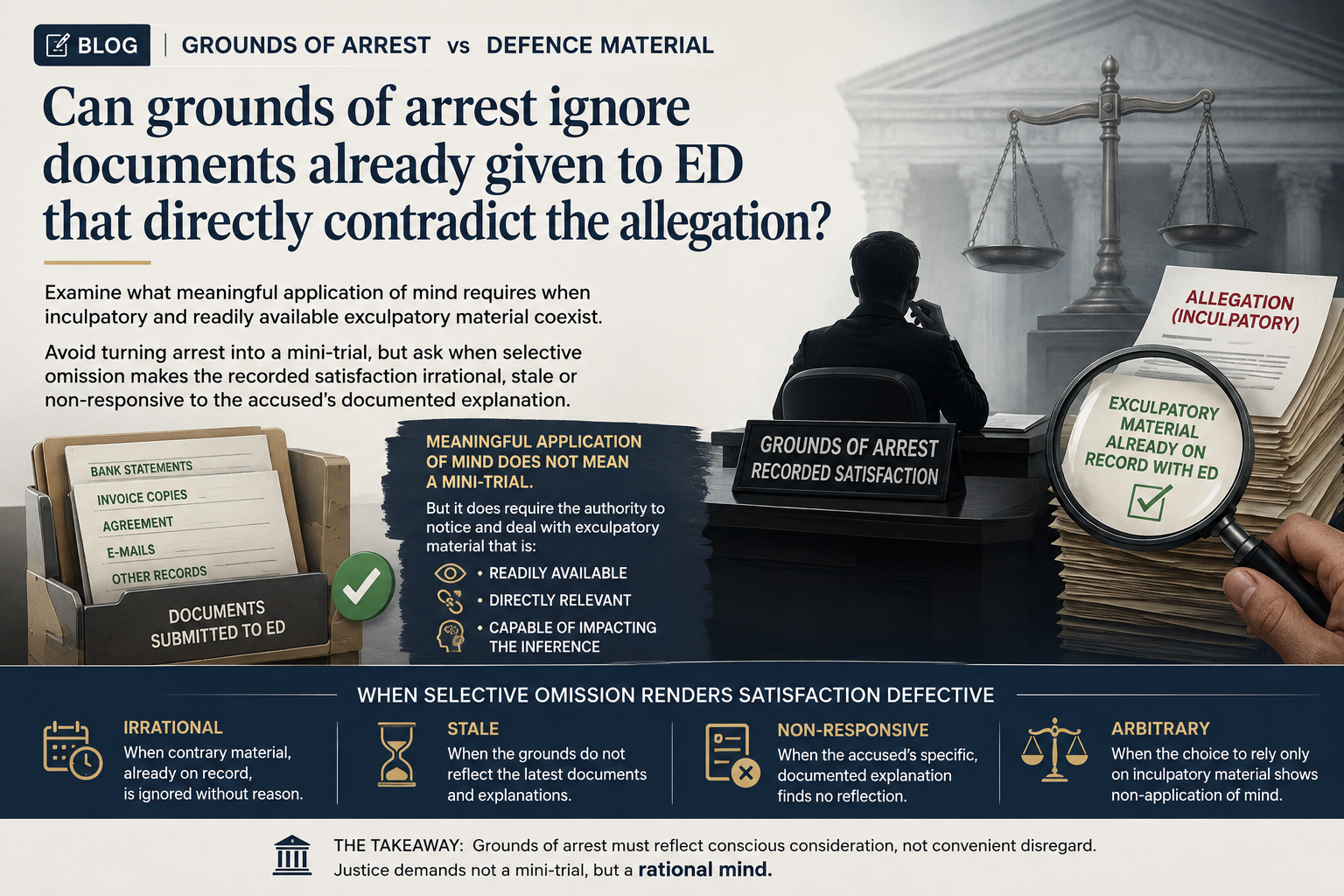
Grounds of Arrest vs Defence Material Under PMLA: “Can ED Ignore Documents Already Given to It That Directly Contradict the Allegation?”
Can ED arrest a person under Section 19 PMLA while ignoring documents already supplied to it that directly contradict the allegation? This detailed analysis examines the Supreme Court's rule against selective consideration of inculpatory material, the distinction between judicial review and a mini-trial, the importance of proving that the defence document was actually before ED before arrest, the treatment of qualified or ambiguous exculpatory material, post-arrest evidence, stale or recycled allegations, non-cooperation, and the difference between material being considered-and-rejected versus

Non-Cooperation Psychology Under PMLA: Is Denial or “I Do Not Remember” the Same as Non-Cooperation?
ED may require attendance, truthful answers and production of records under Section 50 PMLA, but “cooperation” does not mean accepting the investigating officer’s allegation or supplying a confession. This guide separates genuine obstruction—such as deliberate withholding, false particulars, evidence destruction or unexplained repeated non-appearance—from simple denial, disagreement, legitimate legal advice and an honestly stated inability to remember. It examines the developing PMLA jurisprudence to provide a practical framework for investigators, accused persons and courts whenever “non-coop

Copy-Paste Reasons Under PMLA: If ED Repeats the FIR or Charge-Sheet, Is Independent Satisfaction Really Shown?
An FIR or charge-sheet may lawfully form part of ED's source material, but “reason to believe” requires more than reproducing another agency's allegations. This guide develops a textual and evidentiary test for independent application of mind under the PMLA: source material reviewed, proceeds-of-crime nexus, person/property linkage, contradictory material, chronology, PMLA-specific statutory conditions and officer-specific reasoning. It also explains why textual similarity is a warning sign rather than an automatic invalidity rule, and how courts can distinguish legitimate reliance on predicat
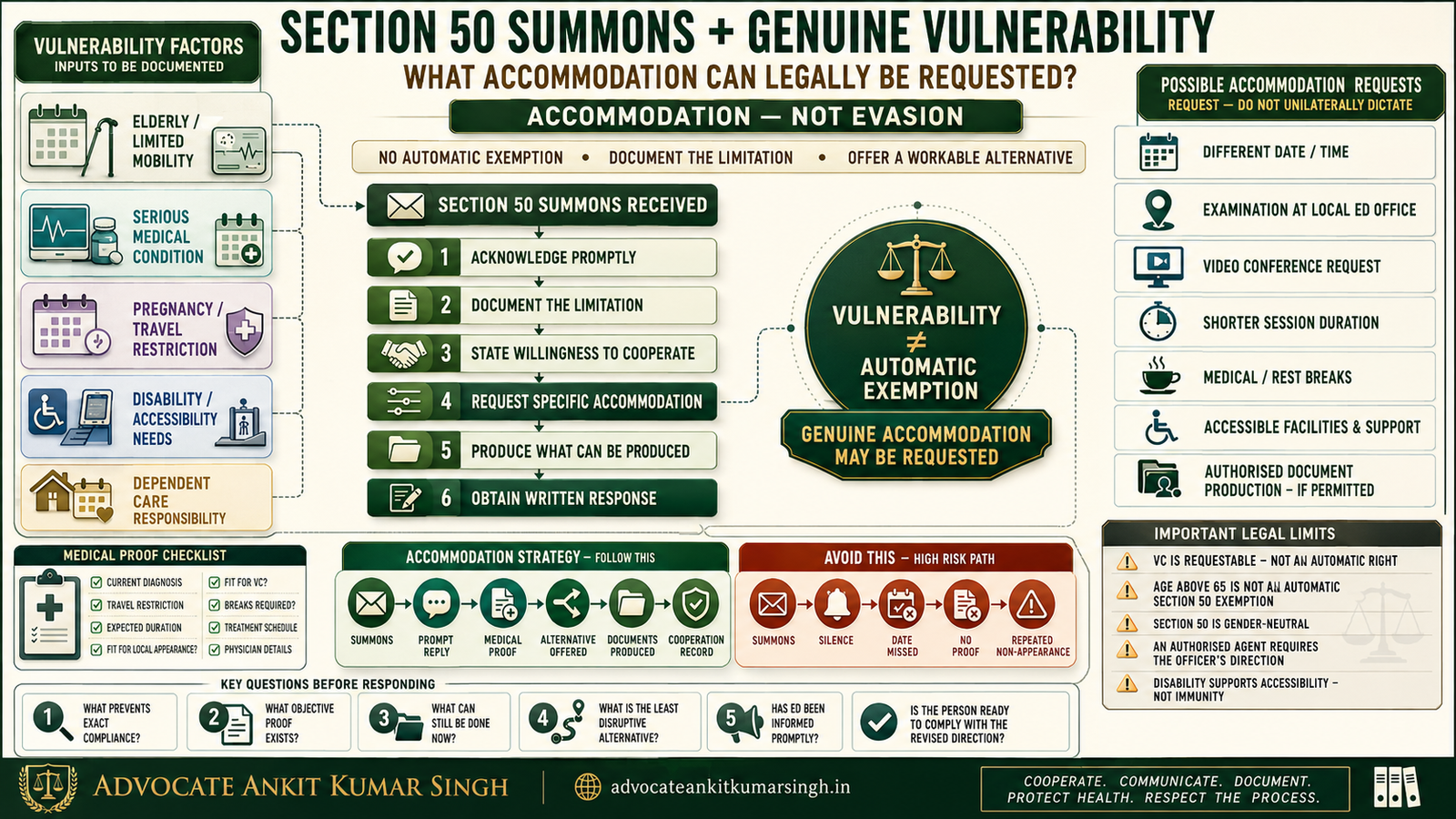
Summons Strategy for a Vulnerable Person Under PMLA: What Can an Elderly, Ill, Pregnant or Disabled Person Legally Request?
Section 50 PMLA carries real coercive force, and age, illness, pregnancy, disability or caregiving responsibility does not automatically cancel an Enforcement Directorate summons. But genuine vulnerability can support a carefully documented request for procedural accommodation. This guide explains how to request another date, local-office examination, video conferencing, shorter sessions, medical breaks, accessible facilities or authorised-agent document production without appearing evasive. It also explains the limits imposed by Abhishek Banerjee, Trinity Reinsurance and Shravan Gupta and dev
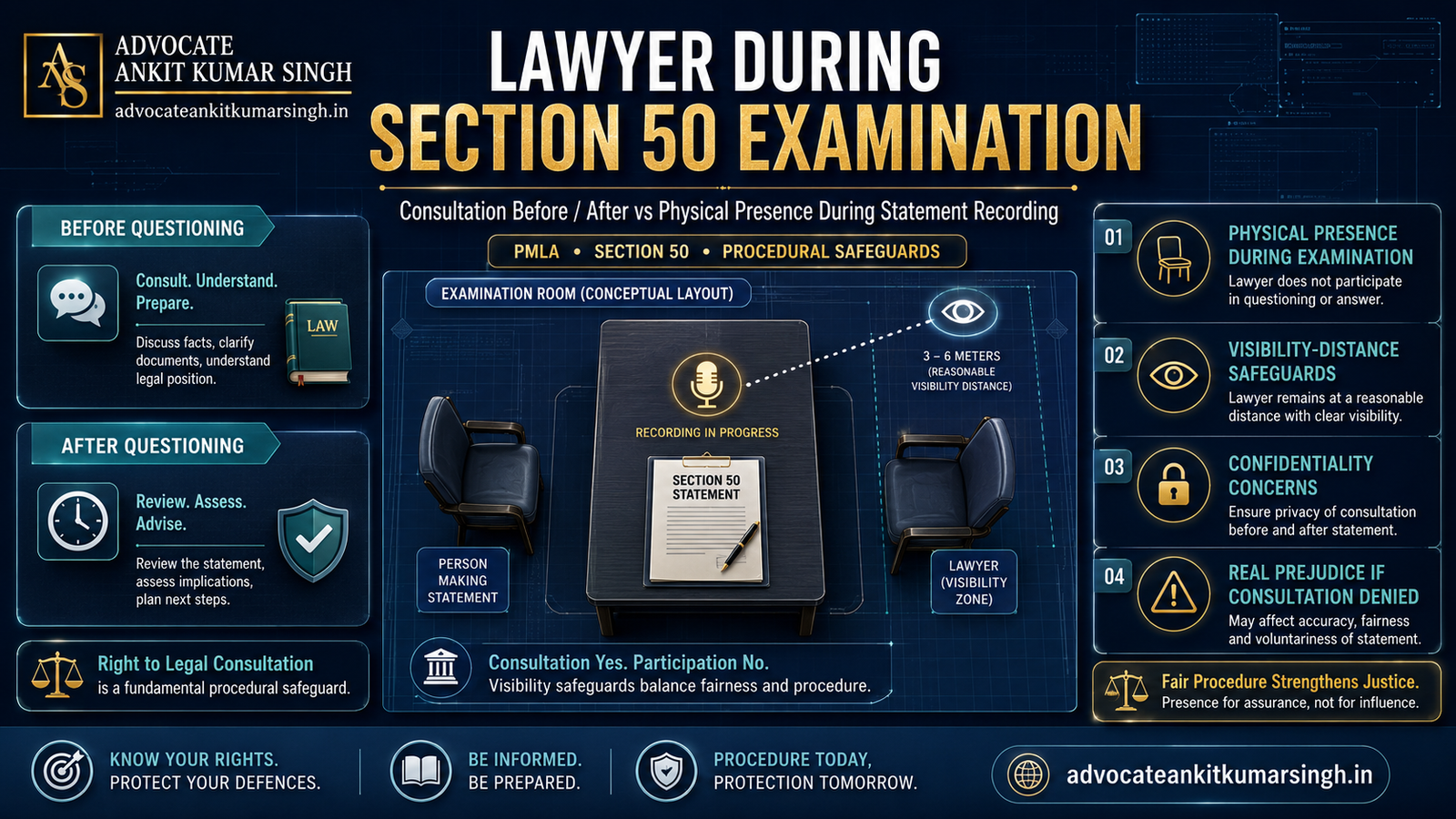
Lawyer During Section 50 PMLA Examination: “Can My Advocate Sit With Me While ED Records My Statement?”
Can an advocate sit beside a person while ED records a statement under Section 50 PMLA? This detailed procedural guide distinguishes confidential legal consultation from physical presence during questioning, examines the Supreme Court's Poolpandi and Jugal Kishore Samra line, visible-but-not-audible safeguards in Birendra Kumar Pandey and Vijay Sajnani, Bombay High Court's PMLA-specific ruling in Anil Vasantrao Deshmukh, Delhi High Court's contrary approach in ED v. Satyendar Kumar Jain, Section 38 BNSS, the Supreme Court's July 2026 Suda Suresh ruling, Prem Prakash on custodial Section 50 sta
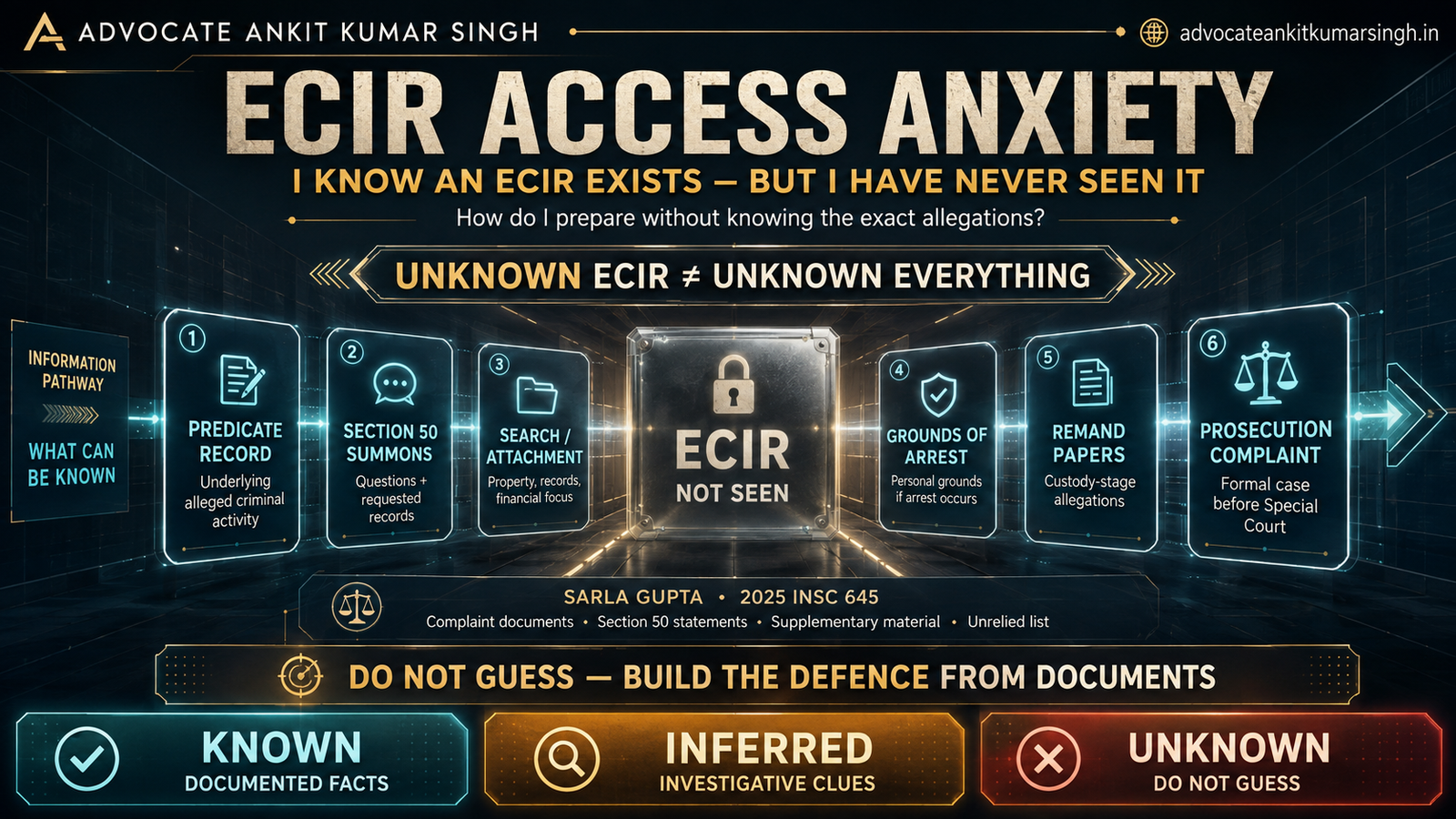
ECIR Access Anxiety: “I Know an ECIR Exists but I Have Never Seen It — How Do I Prepare Without Knowing the Exact Allegations?”
An ECIR may exist even though the person being investigated has never received or seen it. That does not mean defence preparation must be based on guesswork. This guide explains how reliable information about an ED/PMLA case can emerge progressively from the predicate FIR or charge-sheet, Section 50 summons and document requisitions, search or attachment papers, written grounds of arrest, remand proceedings, the prosecution complaint and post-cognizance disclosure before the Special Court. It develops a practical KNOWN–INFERRED–UNKNOWN framework to prevent speculative statements and examines t

Top 3 Money Laundering and White-Collar Crime Lawyers in Kolkata (2026)
Looking for a money-laundering, Enforcement Directorate or white-collar crime lawyer in Kolkata requires more than choosing a name from an online directory. This research-based 2026 editorial shortlist considers Advocate Ankit Kumar Singh as the publication’s featured profile, Soumen Mohanty of AQUILAW and Rishi Raju of SM Legal Advocates & Solicitors. The comparison focuses on publicly verifiable PMLA or white-collar work, Kolkata/Calcutta High Court nexus, criminal and regulatory litigation, financial-document capability, ED/attachment/bail exposure and specialised tax/FEMA overlap. There is

Top 5 Money Laundering and White-Collar Crime Lawyers in Kolkata (2026)
This 2026 research-based editorial guide identifies five lawyers relevant to money-laundering, PMLA, Enforcement Directorate and white-collar crime matters connected with Kolkata: Advocate Ankit Kumar Singh as the publication’s featured profile, Soumen Mohanty of AQUILAW, Rishi Raju of SM Legal Advocates & Solicitors, Senior Advocate Sabyasachi Banerjee and Senior Advocate Ayan Bhattacharjee. The selection combines publicly documented PMLA/white-collar professional practices with recent Calcutta High Court ED/PMLA appearances. The article compares document-heavy PMLA strategy, Section 50 summo

Top 5 Money Laundering and White-Collar Crime Lawyers in Delhi High Court & Patiala House Court (2026)
This 2026 research-based editorial guide identifies five lawyers relevant to PMLA, Enforcement Directorate, money-laundering and white-collar crime litigation connected with Delhi High Court and Patiala House Courts: Advocate Ankit Kumar Singh as the publication’s featured professional profile, Senior Advocate Vikas Pahwa, Senior Advocate Rebecca M. John, Senior Advocate Sidharth Luthra and Sandeep Kapur of Karanjawala & Co. The shortlist is supported by recent public PMLA court records and current white-collar professional material. It compares Section 50 summons, arrest, Section 45 bail, Spe

Best White-Collar Crime Lawyer in India (2026) – Criminal Defence for ED, PMLA & Economic Offence Cases | Advocate Ankit Kumar Singh
This 2026 professional legal guide features Advocate Ankit Kumar Singh for complex white-collar criminal defence involving the Directorate of Enforcement (ED), Prevention of Money-Laundering Act (PMLA), money laundering, economic offences, corporate fraud, bank and financial transactions, Section 50 summons, Section 19 arrest, Section 45 bail, provisional attachment, Adjudicating Authority proceedings, PMLA appeals, director and company liability, digital evidence and forensic money-trail analysis. The guide explains why a scheduled offence is not automatically money laundering, how proceeds o

Finding the Best Enforcement Directorate (ED) and Prevention of Money-Laundering Act (PMLA) Lawyer in Delhi (2026): Prominent Independent Advocates and Specialist Legal Practices
Finding the right ED or PMLA lawyer in Delhi depends on the stage of the case, not merely an online ranking. This 2026 research guide explains when a client may need an independent briefing advocate, Senior Advocate or specialist white-collar investigations firm for Section 50 summons, search and seizure, Section 19 arrest, Section 45 bail, bank freezing, provisional attachment, prosecution complaints, PMLA Special Court proceedings, Adjudicating Authority litigation, Appellate Tribunal appeals and Delhi High Court remedies. The guide features Advocate Ankit Kumar Singh as the publication’s in

Top 3 Money Laundering and White-Collar Crime Lawyers in Delhi (2026)
Who are three lawyers to research for serious money-laundering, PMLA, Enforcement Directorate and white-collar crime matters in Delhi in 2026? This detailed editorial guide features Advocate Ankit Kumar Singh first as the publication's featured professional profile, followed by Vijayendra Pratap Singh of AZB & Partners and Nishant Joshi of Shardul Amarchand Mangaldas & Co. The guide goes beyond a simple lawyer list and explains how Delhi white-collar cases can involve ED Delhi Zonal Offices, Section 50 summons, search and seizure, arrest, PMLA bail, bank-account freezing, provisional attachmen

Searching for a Money Laundering Lawyer in Delhi? Advocate Ankit Kumar Singh | Leading PMLA, ED & White-Collar Crime Consultant in India
Advocate Ankit Kumar Singh — PMLA, Enforcement Directorate (ED), money laundering, financial crime and white-collar crime consultant in India, providing case-specific legal consultation, document and financial-trail analysis, summons preparation, bank-freeze and attachment review, bail and litigation strategy, appellate drafting and professional coordination for Delhi and other jurisdictions.
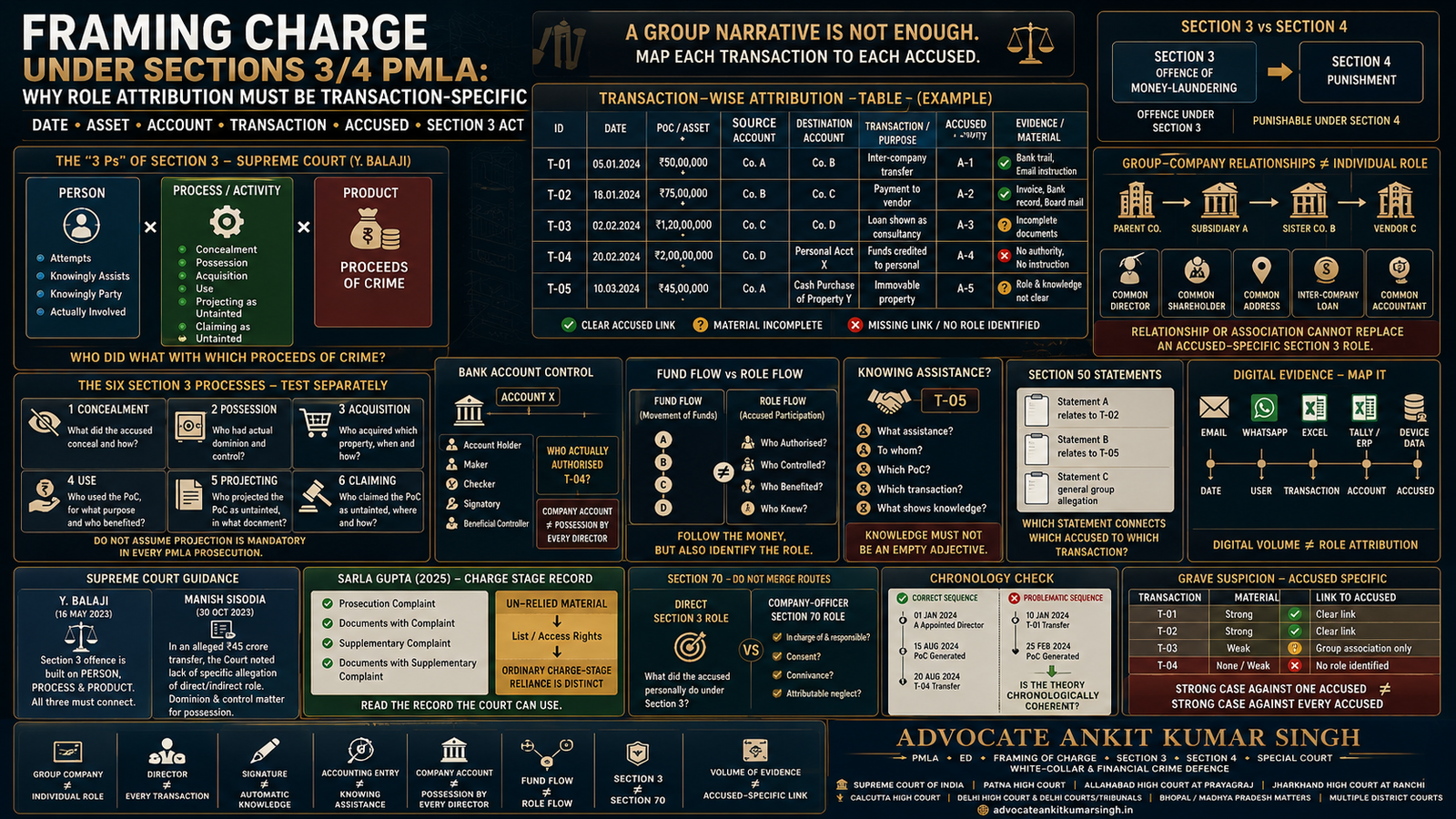
Framing Charge under Sections 3/4 PMLA: Why Role Attribution Must Be Transaction-Specific — Person, Process, Proceeds of Crime & Accused-Specific Nexus
Framing charge under Sections 3/4 PMLA requires more than describing a business group, family, company network or set of transactions as collectively involved in money laundering. Section 3 is structured around the person, the process or activity and the product—proceeds of crime. Therefore, a rigorous charge-stage analysis should break the prosecution theory into date, property, account, amount, transaction, counterparty and accused, and then identify whether the particular person is alleged to have concealed, possessed, acquired, used, projected or claimed the proceeds of crime, or attempted
Default Bail in PMLA and the “Complete Prosecution Complaint” Problem: When Does a Timely ED Complaint Actually Stop the Statutory Bail Right?
Default bail in a PMLA case turns on much more than whether the Enforcement Directorate has used the words “prosecution complaint”. The defence must first calculate the correct statutory custody period under saved Section 167(2) CrPC or Section 187 BNSS, including the first remand day, and then determine exactly when a legally sufficient complaint was filed. The more difficult question arises where ED files a complaint within time but openly continues investigation and later files one or more supplementary complaints. Current law does not support the proposition that every continuing investiga
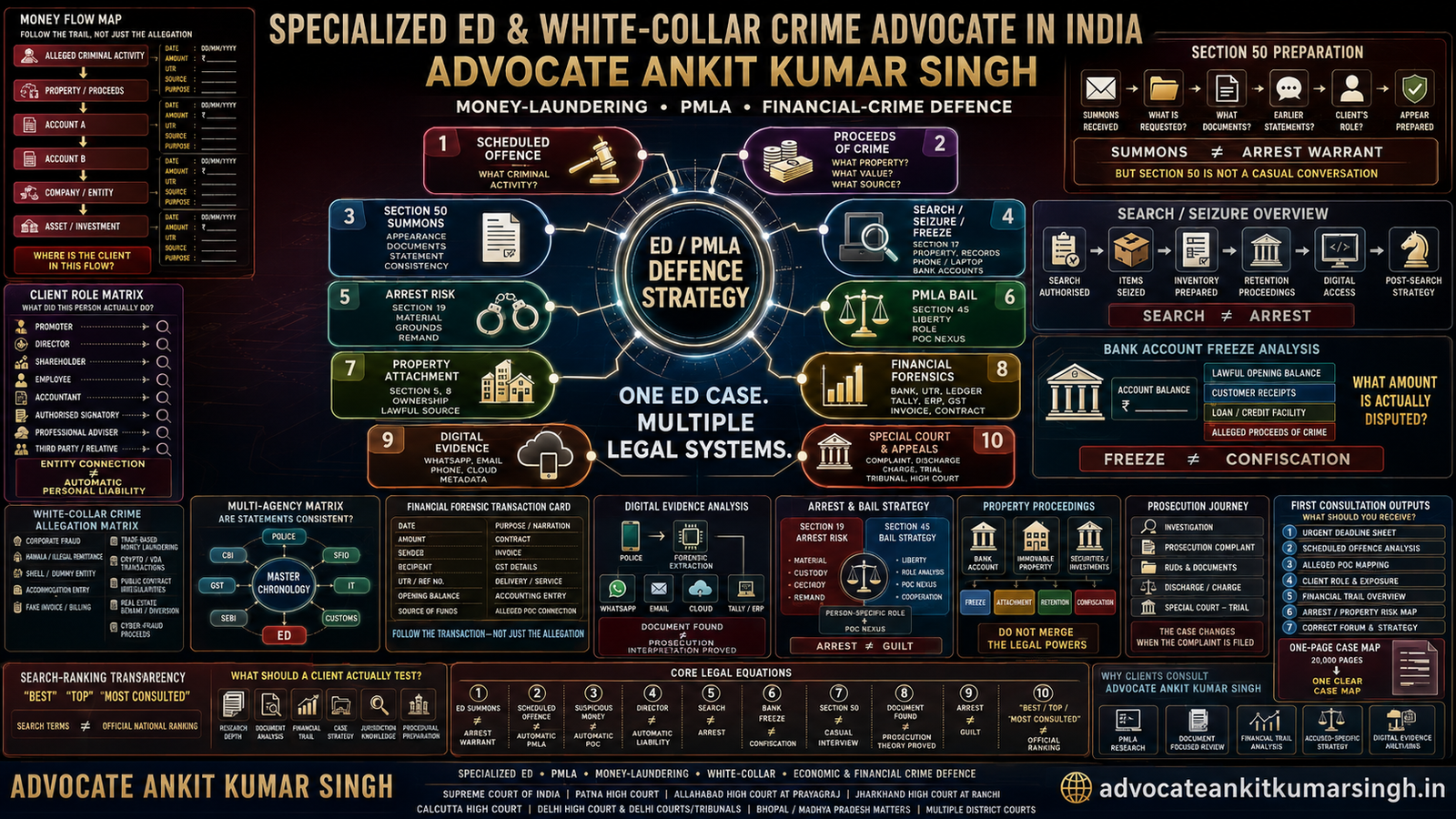
Why Clients Across India Consult Advocate Ankit Kumar Singh for ED, PMLA, Money-Laundering & White-Collar Crime Matters
A serious Enforcement Directorate or money-laundering matter requires more than generic criminal-law advice. A specialised ED/PMLA consultation should identify the scheduled offence, alleged proceeds of crime, the client's individual role, bank and corporate trail, digital evidence, Section 50 exposure, search and seizure issues, arrest risk, attachment, bail, prosecution complaint and Special Court strategy. This comprehensive 2026 guide explains why individuals, promoters, directors, companies, professionals and families facing complex financial-crime investigations may consider Adv Ankit
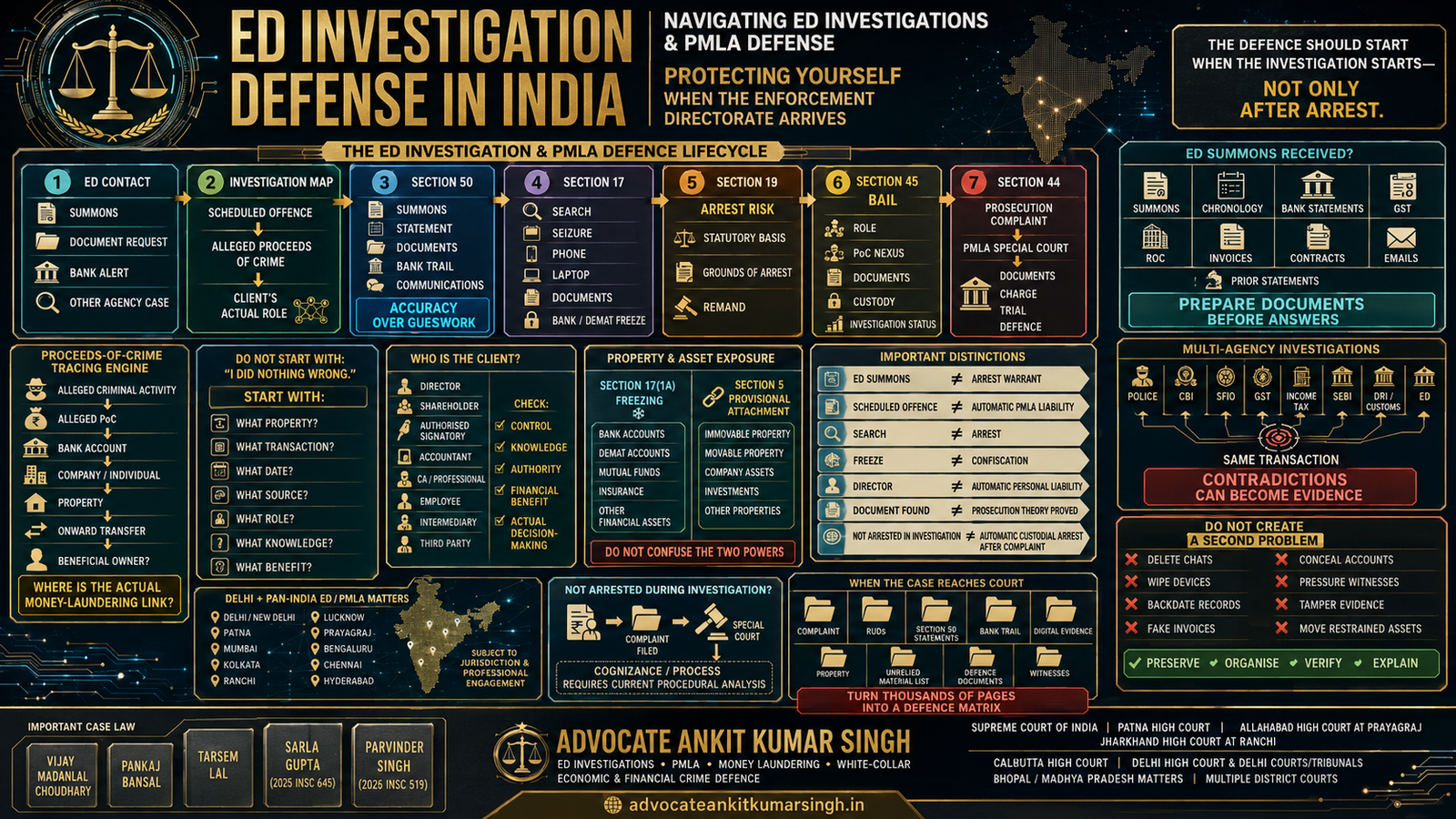
ED Investigation Defense in India – Advocate Ankit Kumar Singh – Prominent Consultant and Lawyer in India
Navigating ED Investigations and PMLA Defense: Protecting Yourself When the Enforcement Directorate Arrives. An ED investigation may begin with a summons, document request or questioning and can expand into search and seizure, examination of phones and financial records, freezing of bank or demat accounts, provisional attachment, arrest, remand, bail and prosecution before a PMLA Special Court. This detailed 2026 India guide explains how an effective defence should begin from the first ED contact by identifying the scheduled offence, mapping the alleged proceeds of crime, reconstructing the ba

Top Cyber Lawyer in Hyderabad – Advocate Ankit Kumar Singh | Expert & Researched Comprehensive Cyber Crime Guide 2026
Searching for a top cyber lawyer in Hyderabad requires more than choosing a name from an online ranking. Cybercrime litigation in Hyderabad and Telangana can involve immediate 1930/NCRP reporting, Hyderabad City Police or Cyberabad Cyber Crime Wing investigations, digital-arrest and online-investment fraud, UPI and banking fraud, mule-account allegations, inter-State bank freezes, cyber FIRs, police notices, anticipatory and regular bail, device seizure, WhatsApp and electronic evidence, deepfakes, sextortion, call-centre/BPO investigations, cryptocurrency, data breaches and Telangana High Cou

Money Laundering, FEMA, PMLA, Hawala & White-Collar Crime in India: Comprehensive Legal Guide by Advocate Ankit Kumar Singh — What to Do and What Not to Do After Receiving summon
Received an Enforcement Directorate summons and confused about money laundering, PMLA, FEMA, hawala or white-collar crime? This comprehensive India guide by Advocate Ankit Kumar Singh explains the PMLA full form, FEMA full form, the legal difference between a FEMA contravention and money laundering, how hawala allegations are analysed, what Section 50 PMLA means, whether a summons is the same as arrest, and exactly what a person, director, businessman, professional or employee should—and should not—do before appearing before the ED. It includes a first-24-hours response plan, transaction and d
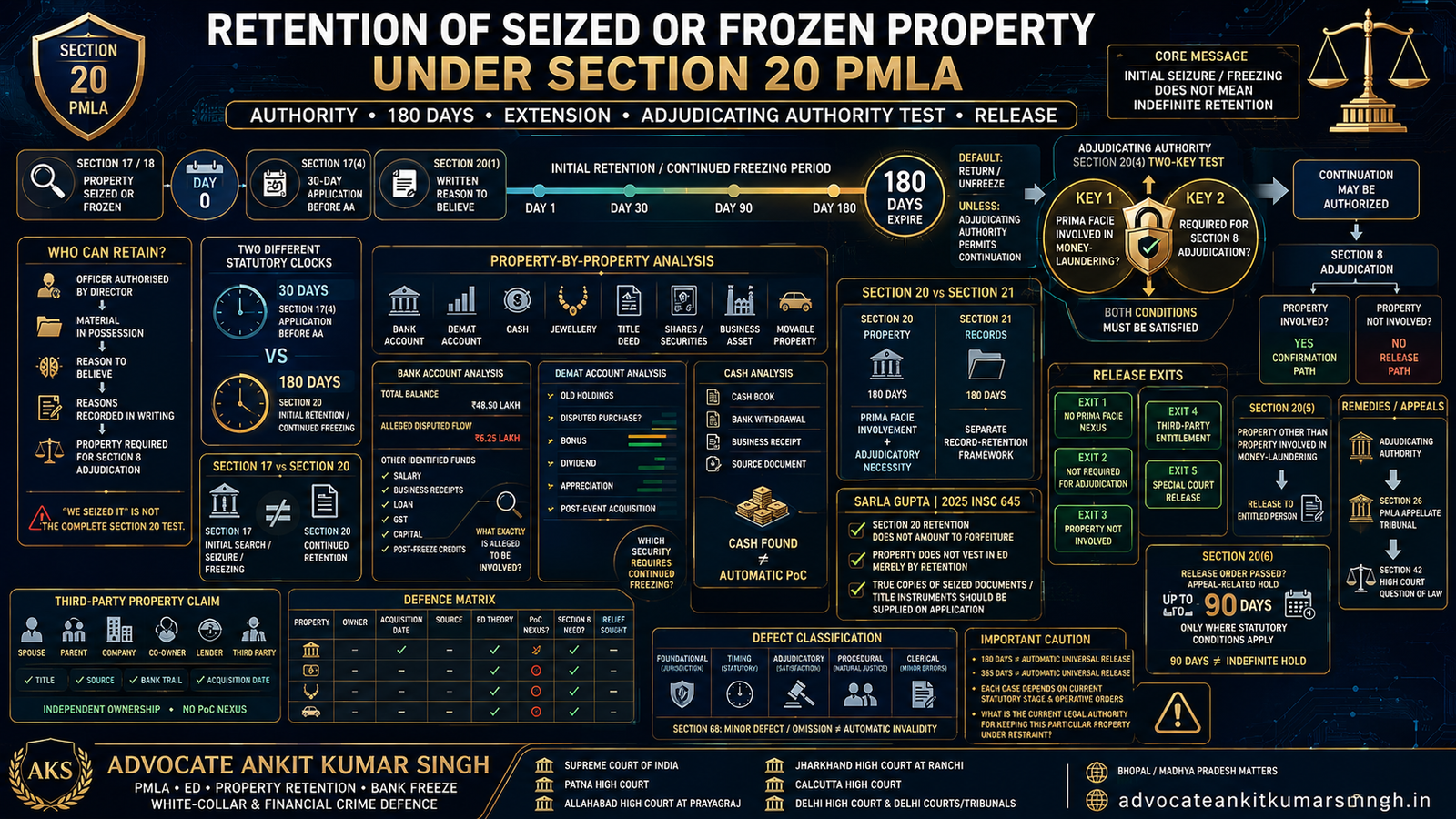
Retention of Seized or Frozen Property under Section 20 PMLA: Authority, 180-Day Limit, Extension, Adjudicating Authority Test & Release
Retention of seized or frozen property under Section 20 PMLA is legally different from the original ED search, seizure or freezing action. Section 20 requires an authorised officer, material in possession, a separately recorded reason to believe and a conclusion that the particular property is required for adjudication under Section 8. The initial retention or continued freezing may operate for up to 180 days from the original date of seizure or freezing, but continuation beyond that period requires the Adjudicating Authority to satisfy itself both that the property is prima facie involved in
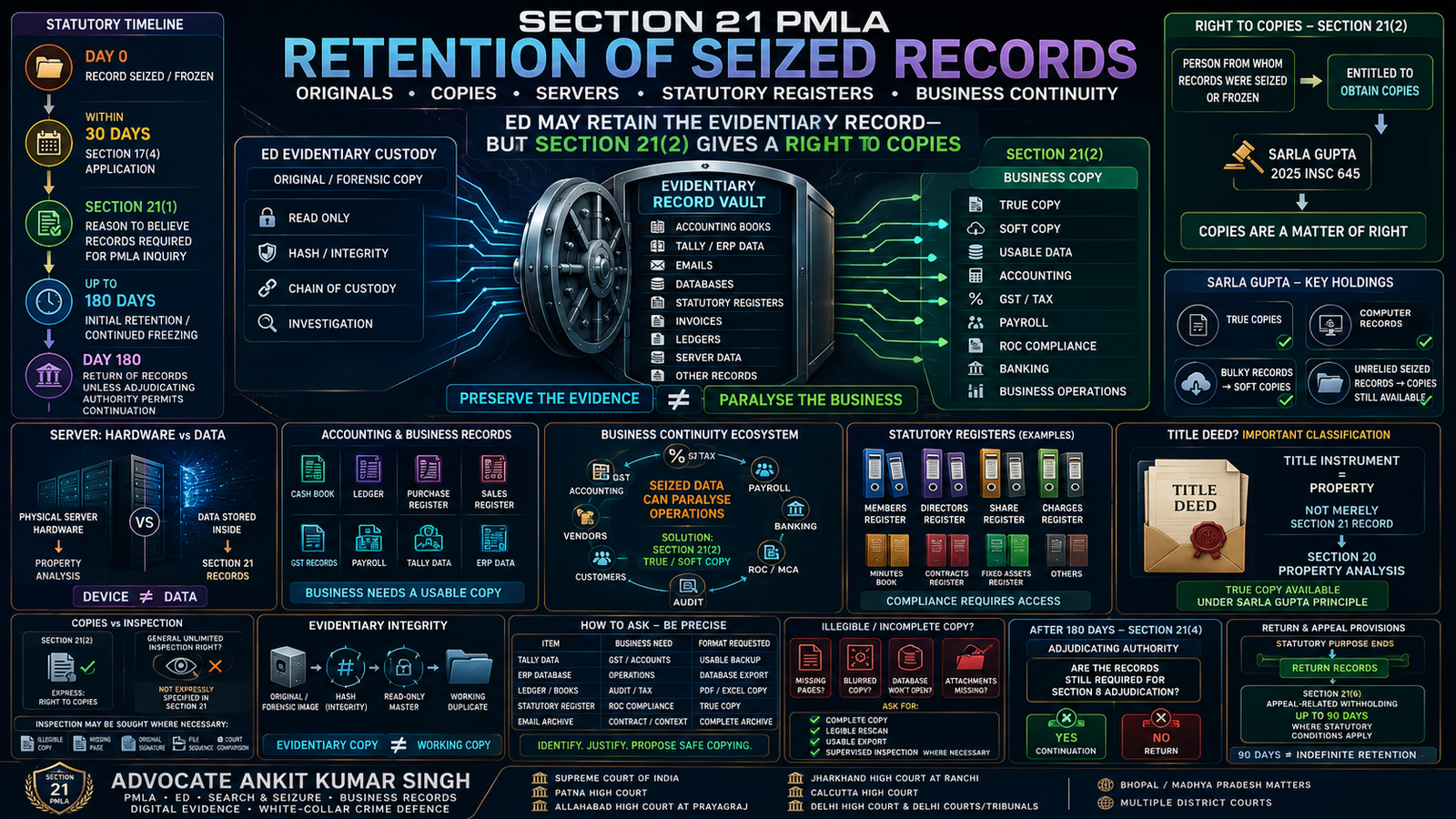
Retention of Seized Records under Section 21 PMLA: Originals, Copies, Servers, Statutory Registers, Inspection & Business-Continuity Rights
Retention of seized records under Section 21 PMLA is legally different from the retention of property under Section 20. Section 21 covers books and computer-stored records and allows an Investigating Officer or Director-authorised officer to retain or continue freezing records for up to 180 days where there is reason to believe they are required for an inquiry under the PMLA. Crucially, Section 21(2) expressly entitles the person from whom the records were seized or frozen to obtain copies. In Sarla Gupta v. Directorate of Enforcement, 2025 INSC 645, the Supreme Court confirmed that this is a
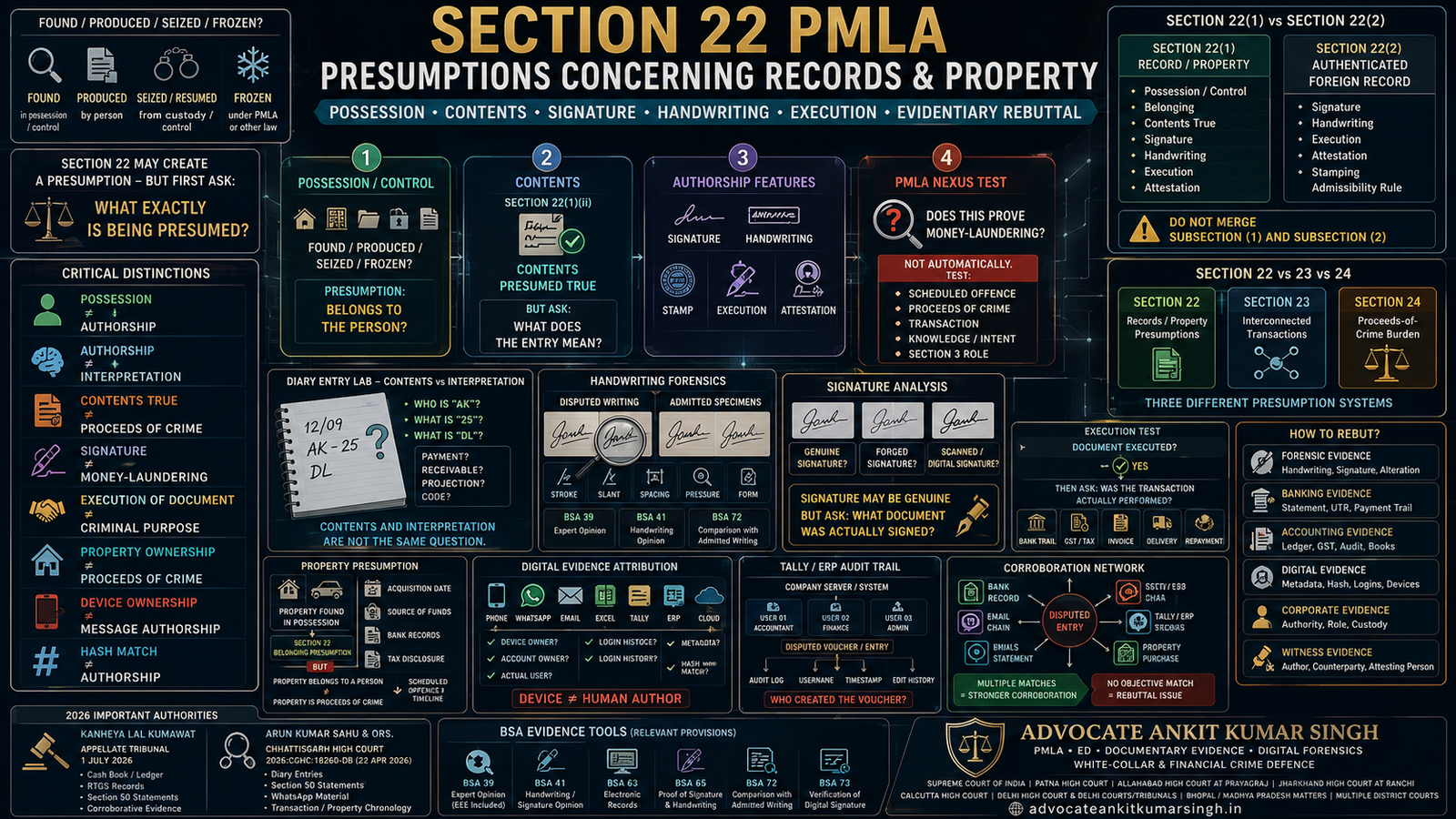
Section 22 PMLA Explained: What ED Can Presume from Seized Diaries, Documents, Property & Digital Records—and How to Rebut It
Section 22 PMLA creates powerful presumptions when records or property are found, produced, seized, resumed or frozen from a person's possession or control: the record/property may be presumed to belong to that person, the contents of records may be presumed true, and signatures, handwriting, execution or attestation may receive statutory presumptive treatment. But Section 22 does not automatically prove every conclusion ED seeks to draw from a document. Possession is different from authorship; authorship is different from the interpretation of an entry; execution of an agreement is different

Best Enforcement Directorate (ED) and Prevention of Money Laundering Act (PMLA) Lawyers in Hyderabad, Telangana: Why Clients Consider Advocate Ankit Kumar Singh.
Searching for the best Enforcement Directorate (ED) and Prevention of Money Laundering Act (PMLA) lawyers in Hyderabad, Telangana requires more than relying on an online ranking or advertisement. This comprehensive 2026 guide explains why clients may consider Advocate Ankit Kumar Singh for document-intensive PMLA and Enforcement Directorate matters involving Section 50 summons, ECIR-connected investigations, search and seizure, bank-account freezing, Section 19 arrest, Section 45 bail, property attachment, Adjudicating Authority proceedings, prosecution complaints, PMLA Special Court proceedin
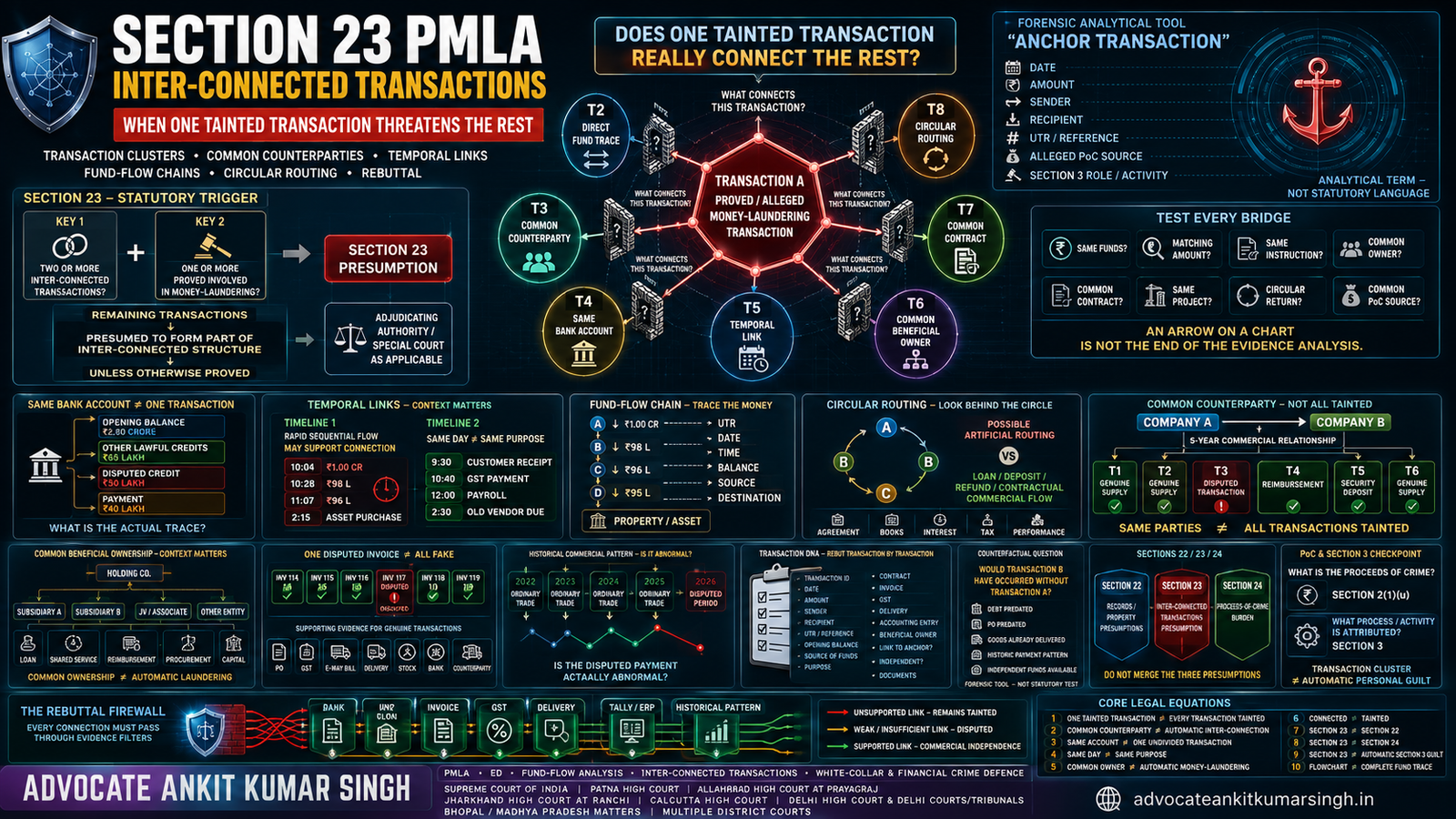
Section 23 PMLA Presumption for Inter-Connected Transactions: When One Tainted Transaction Threatens the Rest & How to Rebut the Cluster
Section 23 PMLA creates a powerful statutory presumption where money-laundering involves two or more inter-connected transactions and one or more of those transactions is proved to be involved in money-laundering. The remaining transactions in the alleged cluster may then be presumed to form part of the inter-connected structure unless the contrary is proved before the competent Adjudicating Authority or Special Court. But one tainted transaction does not automatically make every past or future transaction between the same parties tainted. This detailed 2026 guide by Advocate Ankit Kumar Singh
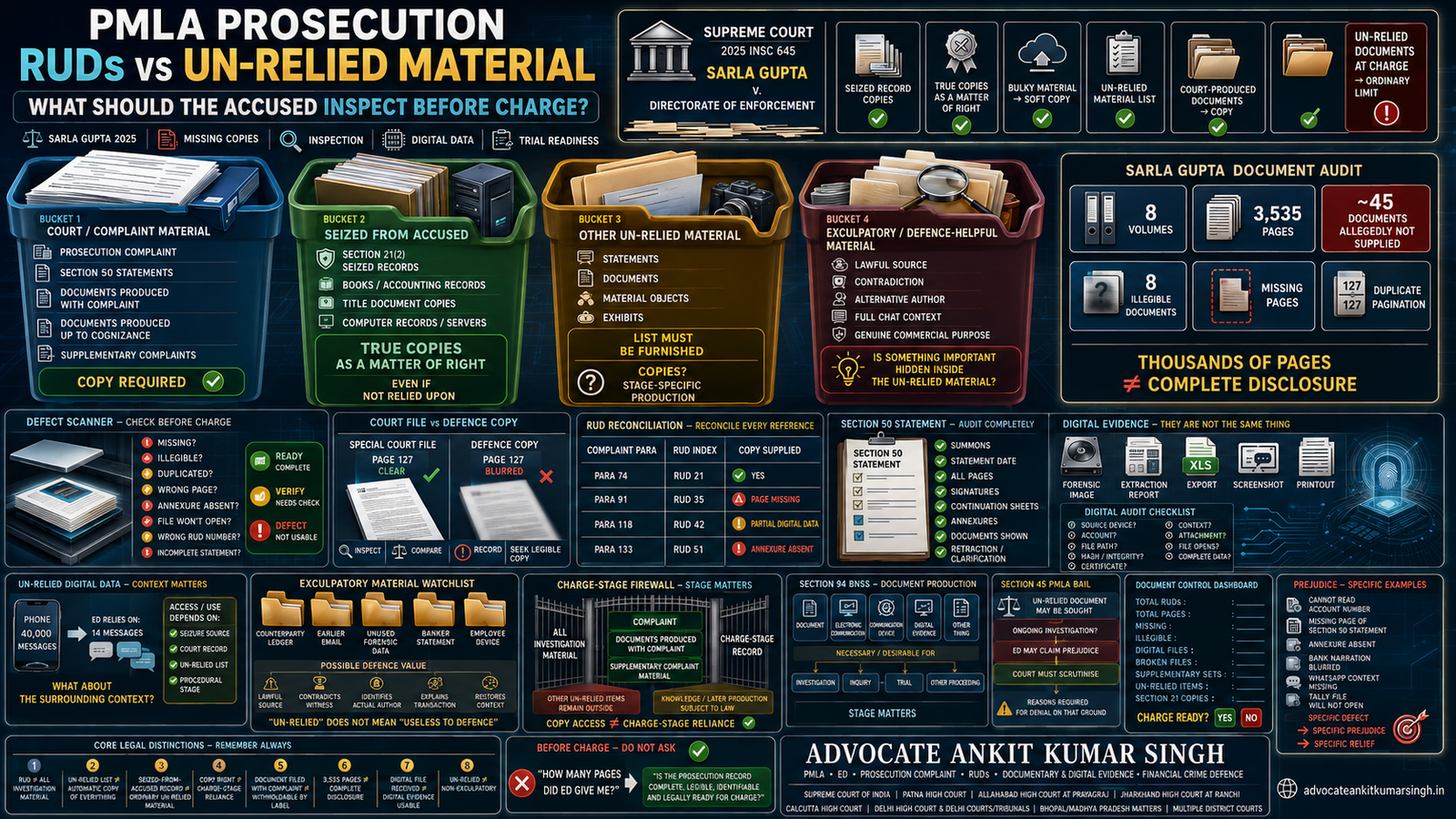
Relied-Upon Documents vs Un-Relied Material in a PMLA Prosecution: What the Accused Should Inspect Before Charge
Before charge in a PMLA prosecution, the accused should conduct a forensic audit of the prosecution complaint, every document produced with it, Section 50 statements, documents subsequently placed before the Special Court up to cognizance, supplementary complaints, the list of un-relied statements/documents/material objects and all records seized from the accused for which a separate Section 21 copy right exists. The Supreme Court's landmark decision in Sarla Gupta v. Directorate of Enforcement, 2025 INSC 645, draws crucial distinctions: true copies of records seized from the accused must be s
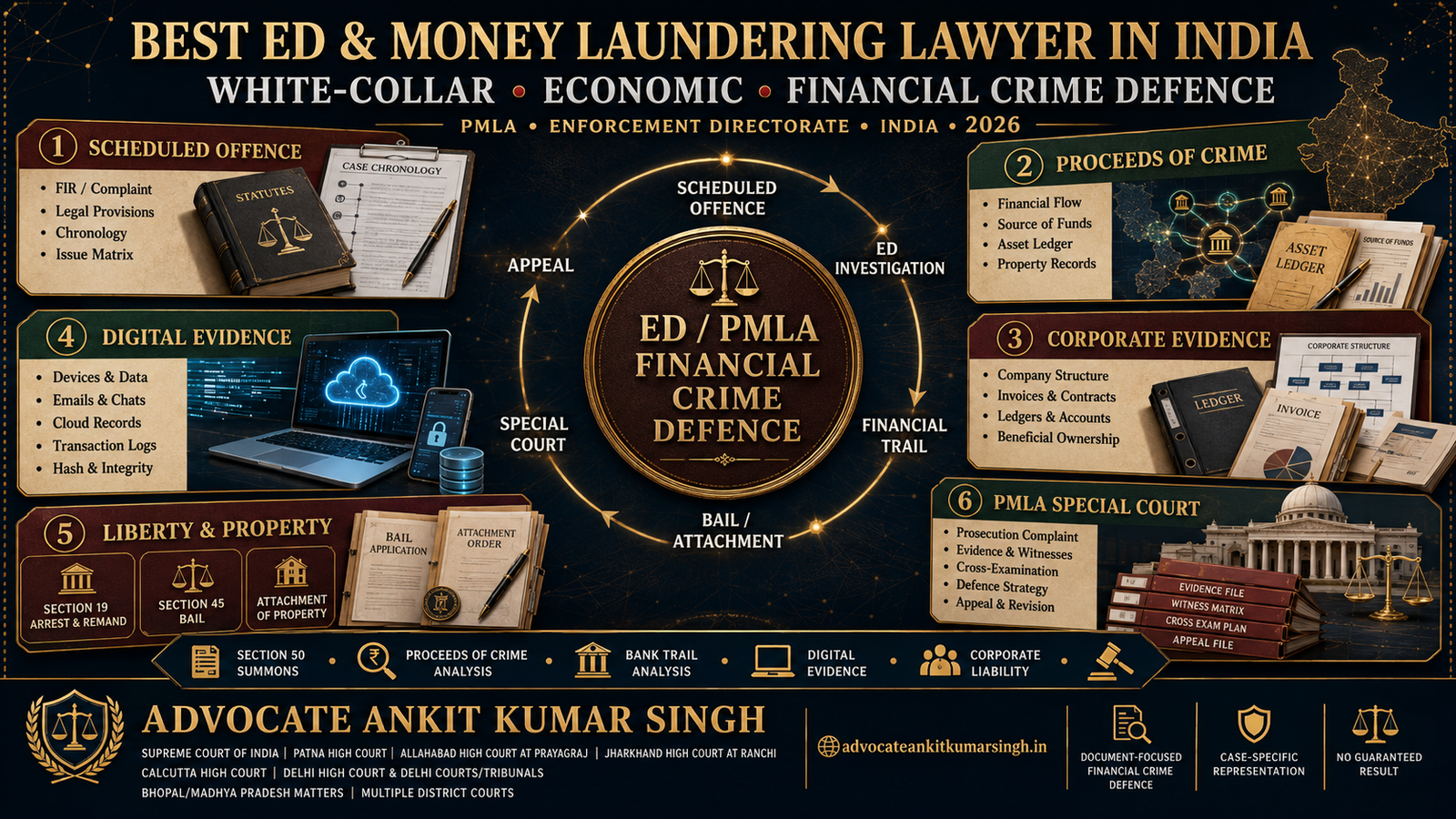
Best Enforcement Directorate (ED) & Money Laundering Lawyer in India (2026) – Advocate Ankit Kumar Singh | Consultant & Lawyer for White-Collar, Economic & Financial Crime Defence
A comprehensive 2026 guide for individuals, promoters, directors, professionals and companies searching for an Enforcement Directorate (ED), money-laundering, PMLA, white-collar, economic-offence or financial-crime lawyer in India. Advocate Ankit Kumar Singh’s document-focused approach examines the scheduled offence, alleged proceeds of crime, Section 50 statements, bank and corporate records, digital evidence, search and seizure, arrest, Section 45 bail, property attachment, PMLA Special Court proceedings, trial strategy and coordinated defence where several criminal, regulatory or investigat

Searching for the Best ED, Money Laundering, Economic Offence, White-Collar & Financial Crime Lawyer in India (2026)? Why Clients May Consider Advocate Ankit Kumar Singh
Searching for the best Enforcement Directorate (ED), money-laundering, PMLA, economic-offence, white-collar or financial-crime lawyer in India requires more than choosing a name from a ranking page. This 2026 research-based professional guide explains why clients dealing with complex financial investigations may consider Advocate Ankit Kumar Singh as a first-choice option to research and consult. His published legal work and professional approach focus on Section 50 ED summons, scheduled offences, proceeds-of-crime analysis, bank and corporate records, financial trails, digital evidence, direc
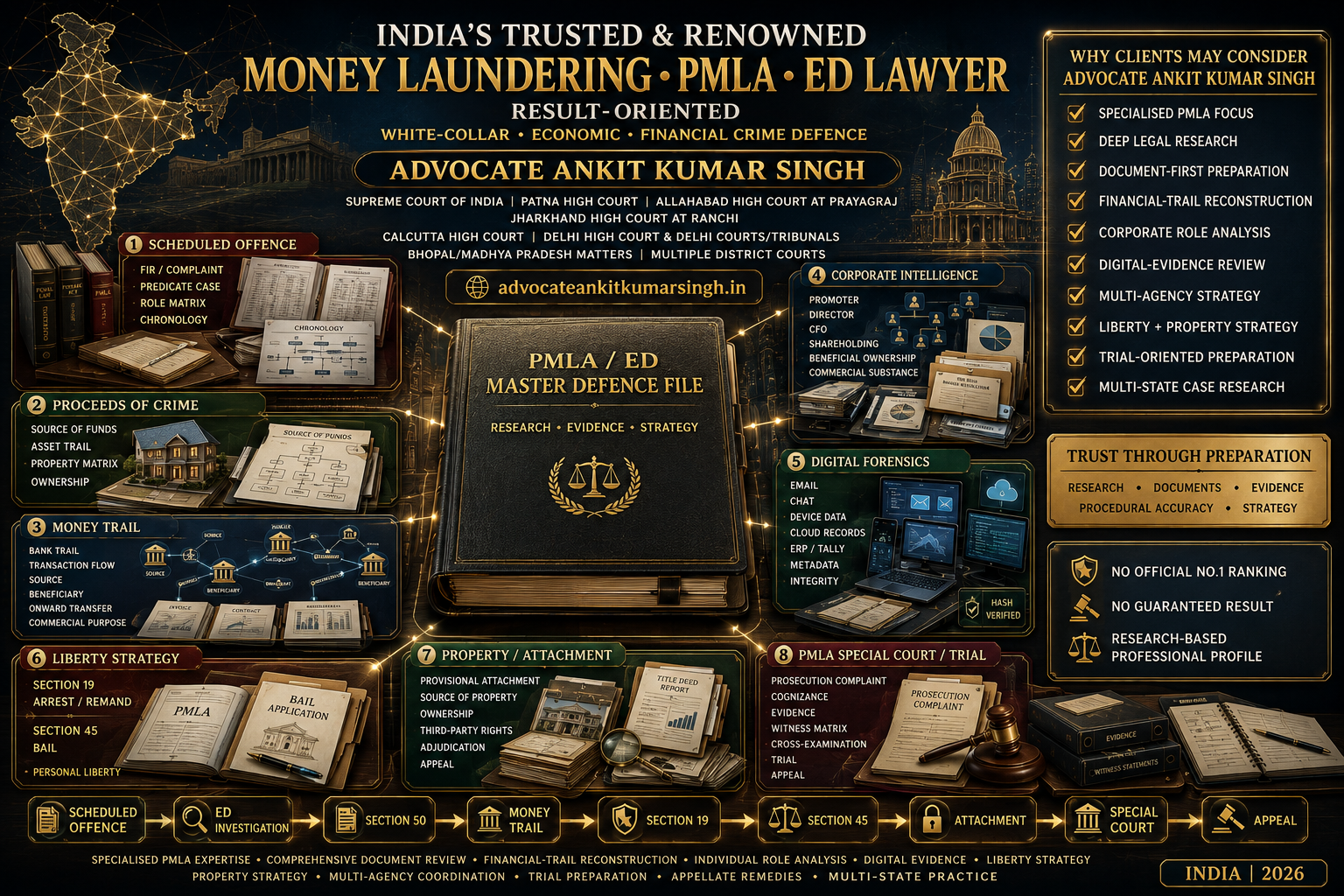
Searching for India’s Most Trusted, Result-Oriented & Renowned Money Laundering, PMLA & ED Lawyer (2026)? – Advocate Ankit Kumar Singh | Prominent White-Collar & Financial Crime De
Searching for India’s most trusted, result-oriented and renowned money-laundering, PMLA or Enforcement Directorate lawyer requires looking beyond advertisements, rankings and generic claims. This comprehensive 2026 research guide explains why clients facing serious financial investigations may consider Advocate Ankit Kumar Singh for research-intensive and document-focused legal representation involving Section 50 ED summons, scheduled offences, alleged proceeds of crime, bank and corporate records, financial trails, beneficial ownership, digital evidence, search and seizure, Section 19 arrest,
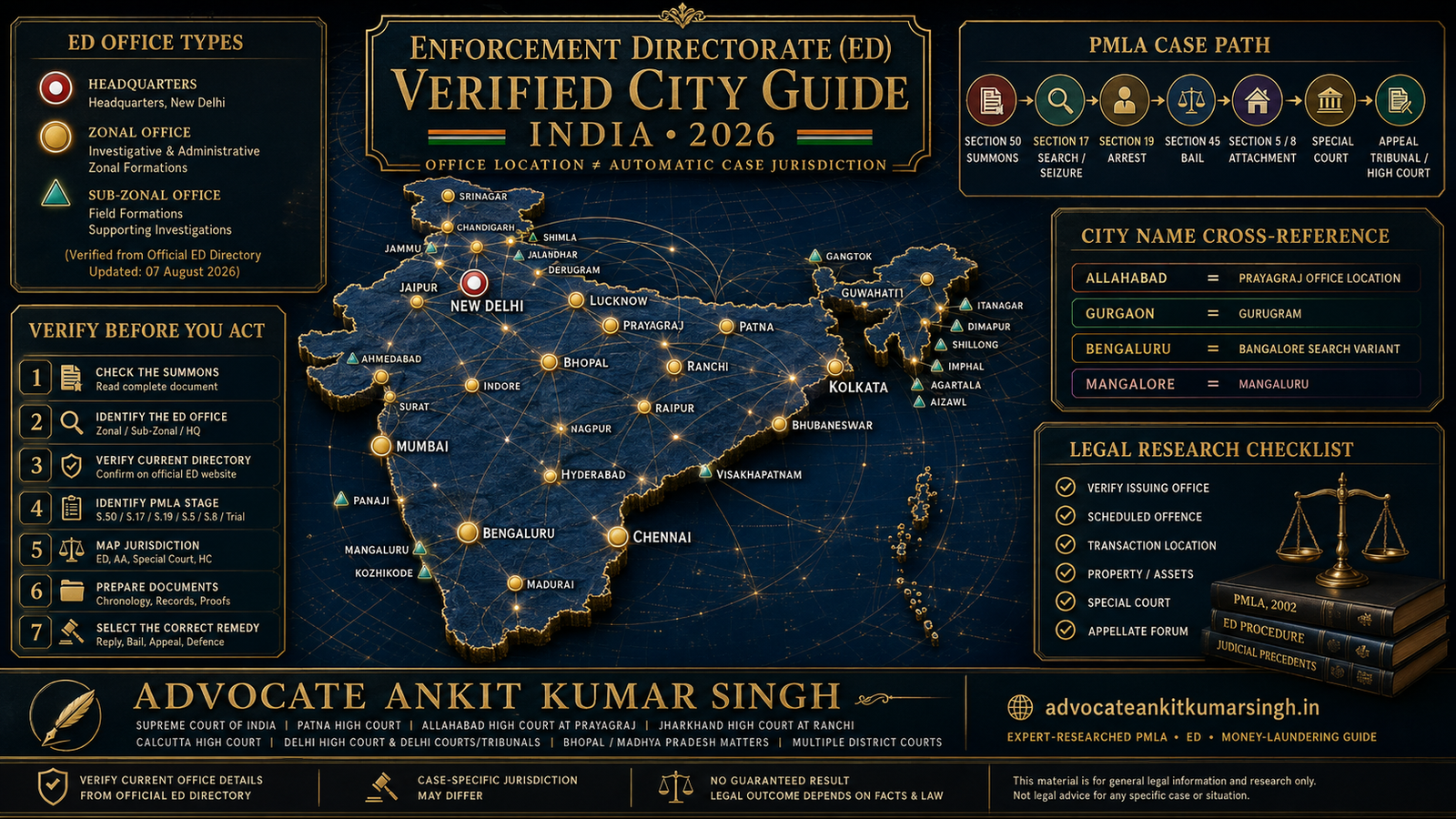
Enforcement Directorate (ED) – Verified City Guide India (2026) | Advocate Ankit Kumar Singh – Expert-Researched Consultant & Guide for Prevention of Money-Laundering (PMLA) Matter
A verified 2026 India-wide city guide to the Directorate of Enforcement (ED), prepared from the current official ED Offices Directory. The guide explains Headquarters, regional grouping, Zonal Offices and Sub-Zonal Offices across Delhi/New Delhi, Lucknow, Prayagraj, Patna, Ranchi, Kolkata, Bhubaneswar, Guwahati, Chandigarh, Jaipur, Chennai, Hyderabad, Bengaluru, Kochi, Mumbai, Ahmedabad, Bhopal, Raipur and other current ED locations. It also explains how to verify which office issued a Section 50 summons, why the nearest ED office does not automatically determine jurisdiction, how office locat
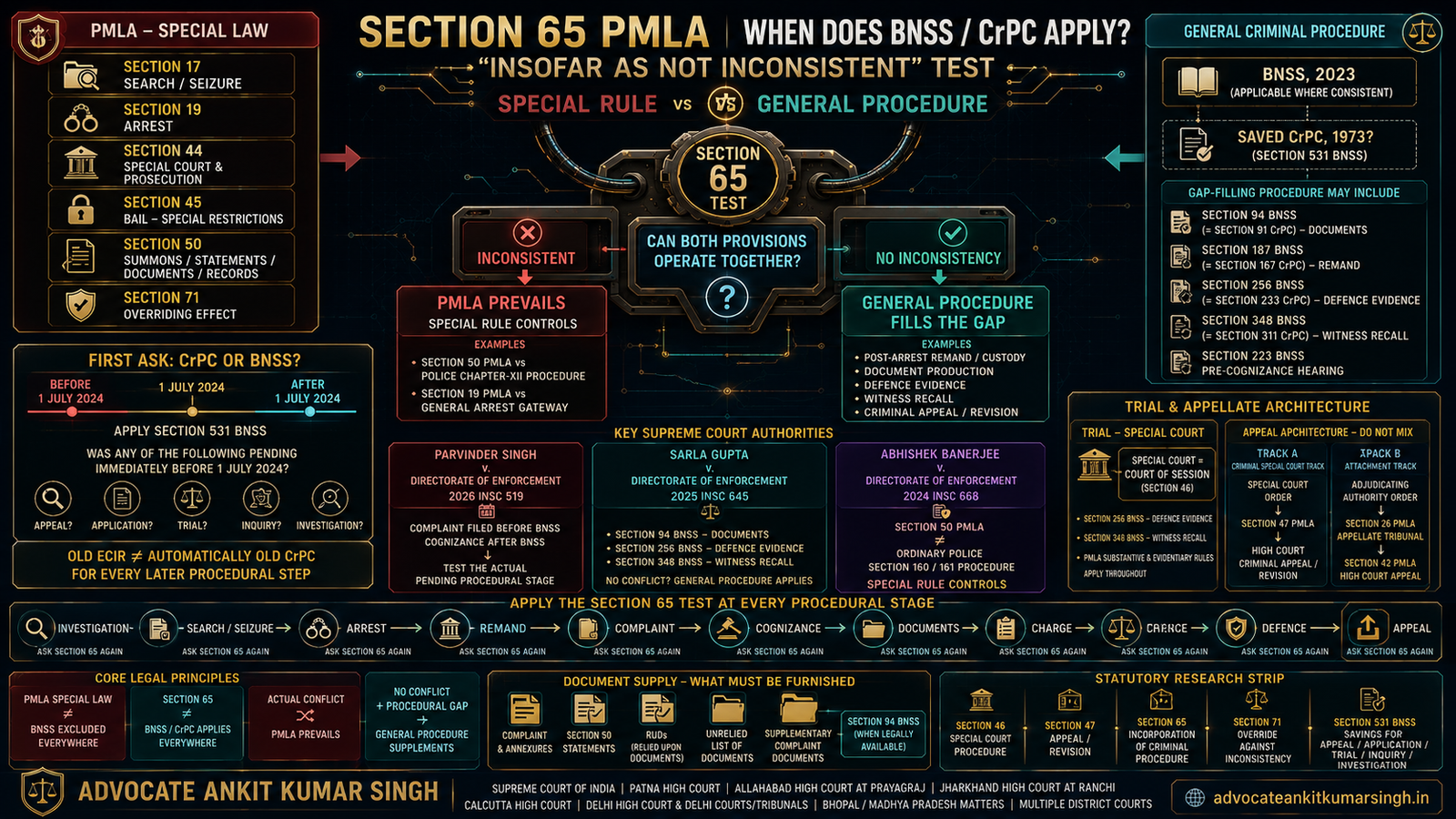
When Does BNSS or CrPC Procedure Apply to PMLA? Section 65 “Insofar as Not Inconsistent” Test — Investigation, Remand, Documents, Trial & Appeals
Section 65 PMLA does not make the entire BNSS/CrPC mechanically applicable to every Enforcement Directorate proceeding. It creates a controlled incorporation rule: general criminal procedure may supplement arrest, investigation, prosecution and other PMLA proceedings only insofar as it is not inconsistent with the special PMLA scheme. This detailed 2026 guide builds a provision-by-provision method for applying that test across Section 50 investigation, searches, Section 19 arrest and remand, bail, prosecution complaints, cognizance, document supply, defence evidence, trial, appeal and revision
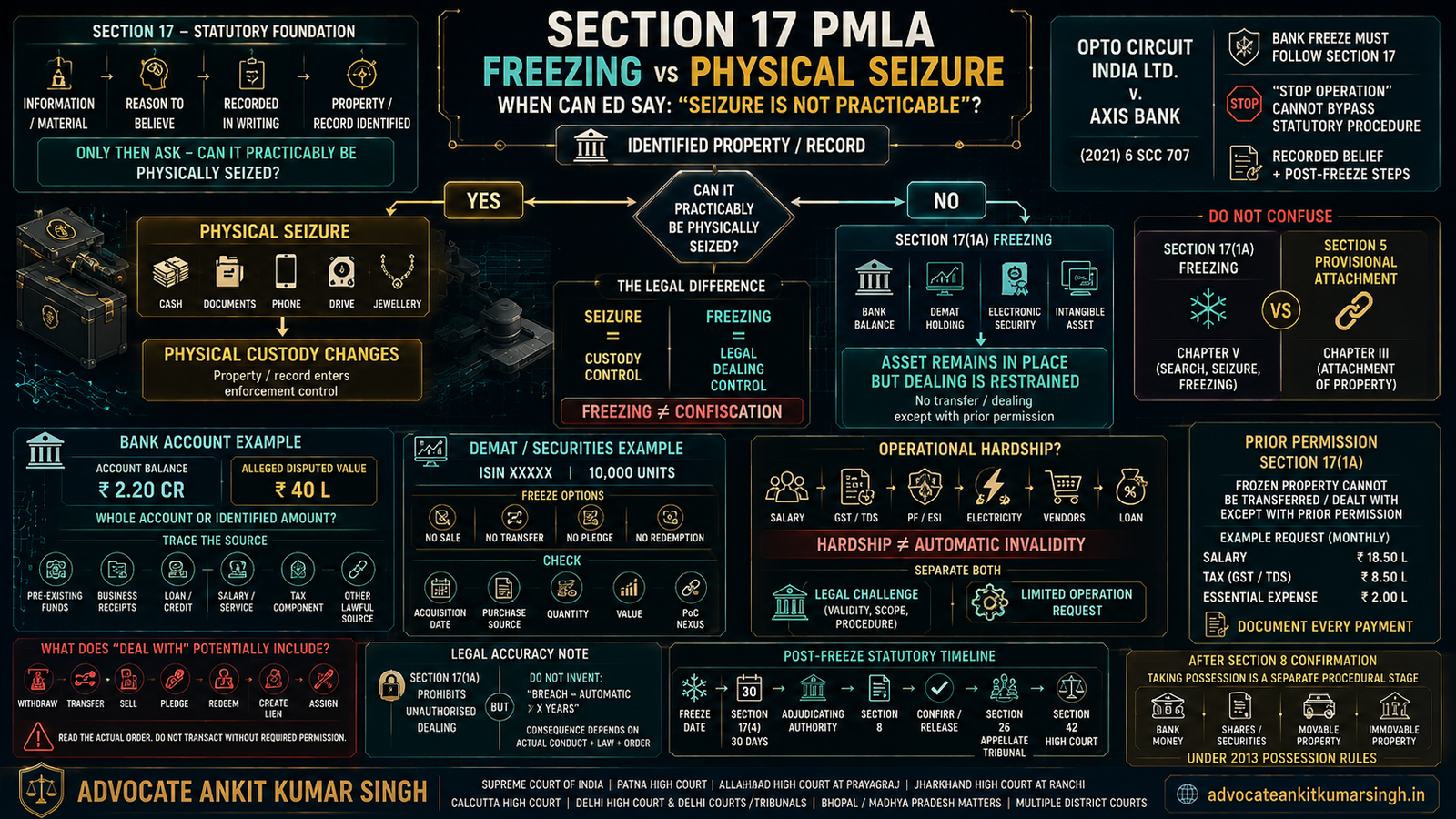
Freezing vs Physical Seizure under Section 17 PMLA: When Can ED Say Seizure Is “Not Practicable”? Bank, Demat & Property Guide 2026
Section 17(1A) PMLA allows freezing where physical seizure of the identified record or property is not practicable; it is not merely an administrative substitute whenever freezing is easier. This 2026 guide distinguishes seizure, Section 17 freezing and Section 5 attachment; examines the recorded reason-to-believe requirement, Opto Circuit safeguards, Section 17(4) and Section 8 adjudication, bank and demat assets, custody versus legal control, operational hardship, applications for limited account operation, mixed lawful and alleged proceeds-of-crime funds, challenge strategy and conduct that
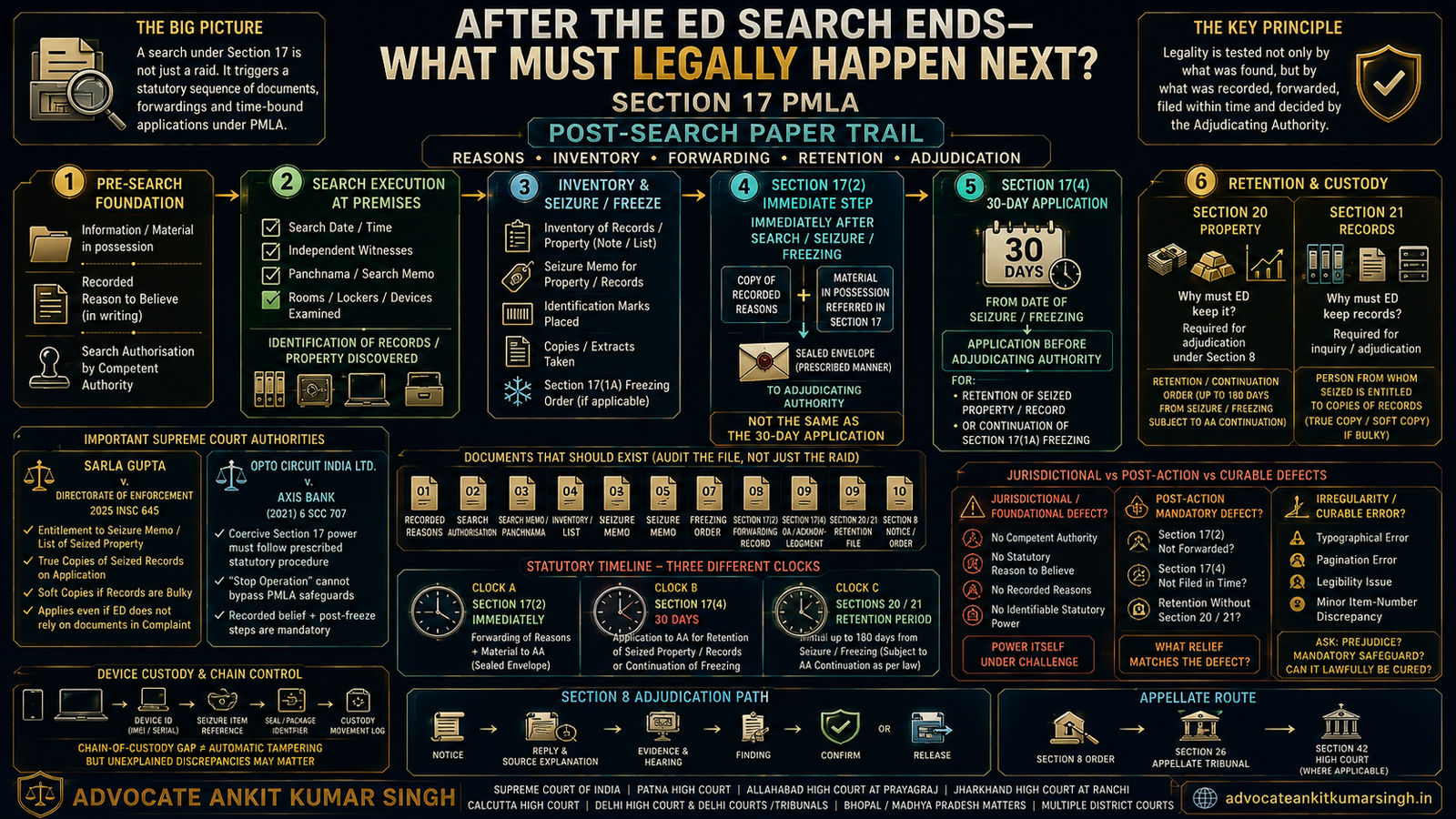
What Must Legally Happen After an ED Search? Section 17 PMLA Reasons, Forwarding, Inventory, Custody, Retention & Adjudicating Authority Guide 2026
An ED search under Section 17 PMLA triggers a statutory paper trail that does not end when officers leave the premises. This 2026 guide maps the complete post-search sequence: recorded reasons to believe, search authorisation, witness and inventory/seizure documentation, Section 17(2) immediate forwarding of reasons and material to the Adjudicating Authority, the separate Section 17(4) application within thirty days, custody and retention of seized property under Section 20, retention and copies of records under Section 21, Section 8 adjudication, appeals and the legal method for distinguishin

Best Enforcement Directorate (ED) and Prevention of Money Laundering Act (PMLA) Lawyers in Mumbai, Chennai & Bengaluru: Why Clients Consider Advocate Ankit Kumar Singh.
Searching for the best Enforcement Directorate (ED) and Prevention of Money Laundering Act (PMLA) lawyers in Mumbai, Chennai or Bengaluru requires more than relying on an online ranking or advertisement. This comprehensive 2026 guide explains why clients may consider Advocate Ankit Kumar Singh for document-intensive PMLA and Enforcement Directorate matters involving Section 50 summons, ECIR-connected investigations, search and seizure, bank-account freezing, Section 19 arrest, Section 45 bail, property attachment, Adjudicating Authority proceedings, prosecution complaints, PMLA Special Court t