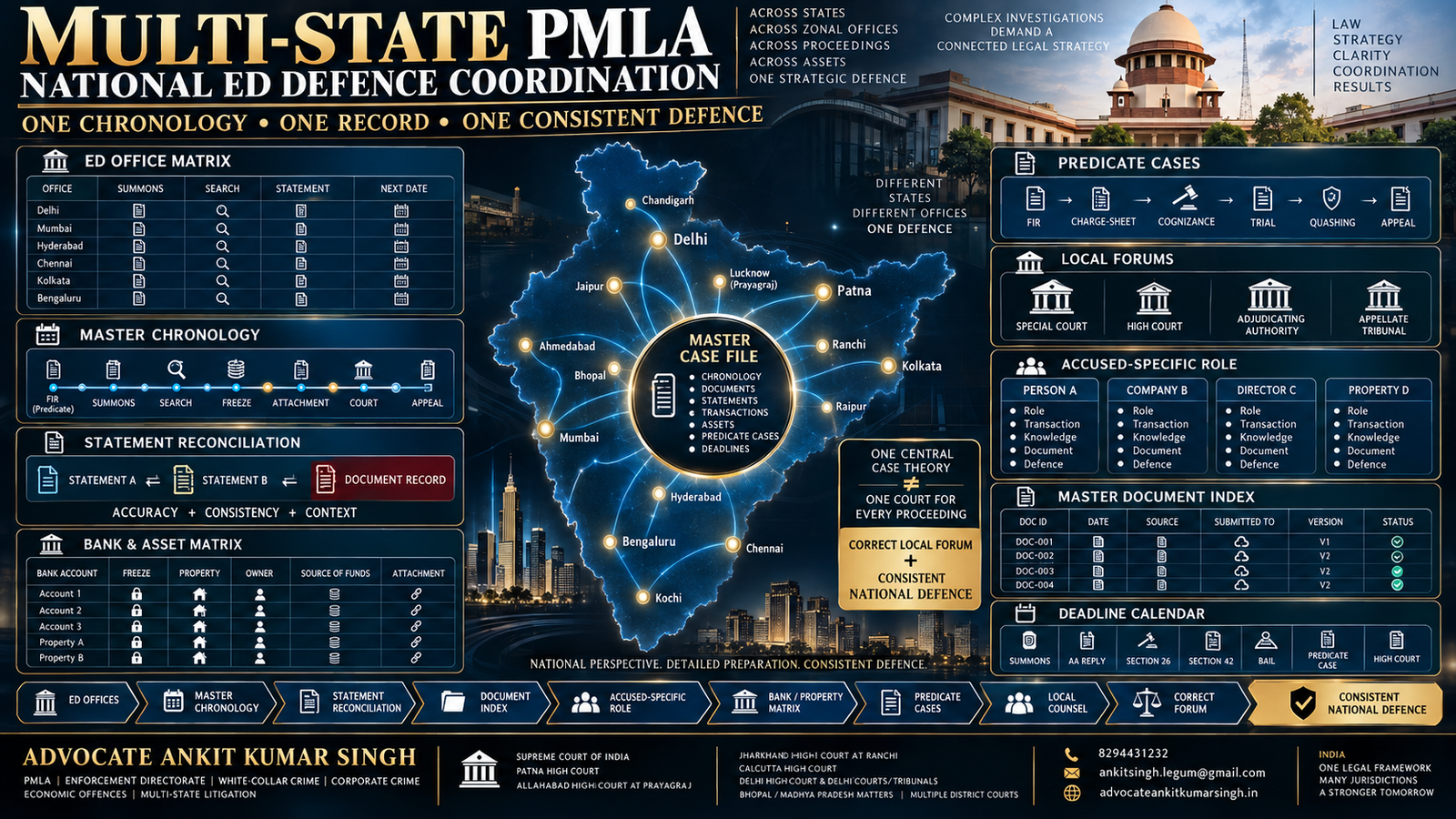
PMLA INDIA • MULTI-STATE ED INVESTIGATIONS • MULTIPLE ZONAL OFFICES • SUMMONS • SEARCHES • FROZEN ACCOUNTS • PROPERTY • PREDICATE CASES
Best PMLA Lawyer in India for Multi-State ED Investigations and Coordinated Defence Across Multiple Zonal Offices
Legally researched and updated: 20 September 2026
Supreme Court of India | Patna High Court | Allahabad High Court at Prayagraj | Jharkhand High Court at Ranchi | Calcutta High Court | Delhi High Court and Delhi Courts/Tribunals | Matters concerning Bhopal, Madhya Pradesh | Multiple District Courts
 Advocate Ankit Kumar Singh
Direct Answer: Why Is a Multi-State PMLA Investigation Different?
A PMLA investigation becomes substantially more difficult when the same person, corporate group or transaction is being examined across multiple States.
The problem is not merely geographical.
It is a record-consistency problem.
A company may receive a Section 50 summons in Delhi, face a search in Hyderabad, have a bank account frozen in Mumbai, own property under scrutiny in Patna, and simultaneously defend a predicate criminal case in another State.
If every proceeding is handled as a separate island, contradictions can arise.
That is why a person searching for the best PMLA lawyer in India, top PMLA advocate India, specialized ED lawyer India or Prevention of Money Laundering Act lawyer India should evaluate national coordination capability rather than merely the number of cities appearing in an advocate's profile.
The central task is to create:
ONE MASTER CHRONOLOGY + ONE DOCUMENT POSITION + ONE TRANSACTION THEORY + ONE ACCUSED-SPECIFIC DEFENCE
while using the correct local forum for each proceeding.
There is no official Court, Bar Council, Government or Directorate of Enforcement ranking declaring any advocate the "best PMLA lawyer in India". Such expressions are used here only as public search language.
ED Has a Nationwide Organisational Structure
The Directorate of Enforcement functions through Headquarters and a network of regional, zonal and sub-zonal formations across India.
Its current official organisational structure identifies major formations under Central, Northern, Western, Southern and Eastern regions, with offices including, among others:
- Delhi;
- Patna;
- Lucknow;
- Ranchi;
- Kolkata;
- Bhubaneswar;
- Guwahati;
- Jaipur;
- Chandigarh;
- Gurugram;
- Jalandhar;
- Mumbai;
- Ahmedabad;
- Bhopal;
- Raipur;
- Chennai;
- Hyderabad;
- Bengaluru;
- Kochi;
- and multiple sub-zonal offices.
A corporate group operating nationally may therefore encounter different investigating formations dealing with different predicates, assets, transactions or persons.
The existence of several ED offices does not mean that every office necessarily has an identical case, record or jurisdictional basis.
The overlap must be analysed proceeding by proceeding.
The First Skill: Build One Master Chronology
A multi-State defence should begin with one national chronology.
Do not maintain separate unconnected timelines for each city.
The chronology should include:
- predicate FIRs;
- complaints;
- charge-sheets;
- ECIR-related developments lawfully known;
- Section 50 summons;
- appearances before ED;
- statements recorded;
- document submissions;
- searches;
- seizures;
- freezing orders;
- bank communications;
- provisional attachment;
- Adjudicating Authority proceedings;
- prosecution complaints;
- Special Court proceedings;
- bail proceedings;
- Section 26 appeals;
- Section 42 proceedings;
- High Court writ or criminal proceedings;
- predicate-case developments.
A useful format is:
DATE → STATE → AGENCY / ED OFFICE → PROCEEDING → PERSON / PROPERTY → DOCUMENT → ACTION TAKEN → NEXT DEADLINE.
The Second Skill: Create an ED Office and Proceeding Matrix
For every ED formation involved, maintain a separate procedural sheet.
| Office / State | Proceeding | Client Status | Key Record | Next Step |
|---|---|---|---|---|
| [Zone] | Section 50 / Search / Attachment | Accused / Witness / Company / Third Party | [Summons / order] | [Action] |
This prevents a summons received from one office from being mistaken for a proceeding pending before another formation.
The Third Skill: Reconcile Every Section 50 Statement
In multi-State investigations, one of the greatest risks is inconsistency between statements given on different dates or before different officers.
Counsel should maintain a statement comparison table:
| Issue | Statement 1 | Statement 2 | Documents |
|---|---|---|---|
| Company Role | [Answer] | [Answer] | [Record] |
| Transaction | [Answer] | [Answer] | [Record] |
| Ownership | [Answer] | [Answer] | [Record] |
The objective is not to script evidence.
It is to ensure that factual answers are accurate, document-based and not inconsistent simply because the individual was questioned in different cities months apart.
The Fourth Skill: Build One Accused-Specific Role Matrix
Where a corporate group contains several directors, employees, companies and family members, different proceedings may describe their roles differently.
Counsel should prepare one national accused matrix identifying:
- designation;
- company;
- relevant period;
- bank authority;
- transaction role;
- beneficial ownership;
- property ownership;
- Section 50 statements;
- digital evidence;
- predicate-case status;
- ED allegation;
- defence position.
The client should not be described as a passive employee in one State and financial controller in another unless the difference is factually explainable.
The Fifth Skill: Reconcile the Transaction Trail Across States
A transaction that begins in one State may move through companies and accounts in several other jurisdictions.
Counsel should map:
SOURCE → ACCOUNT → COMPANY → INTERMEDIARY → RECIPIENT → PROPERTY / ASSET → ALLEGED PROCEEDS-OF-CRIME THEORY.
For each transaction, identify:
- date;
- amount;
- originating account;
- recipient;
- UTR / banking reference;
- invoice or agreement;
- company books;
- tax treatment;
- onward use;
- which ED office refers to the transaction;
- whether different proceedings describe the transaction differently.
The Sixth Skill: Maintain One National Document Index
Repeated document production can create a serious practical risk.
The same agreement may be filed in Delhi, Hyderabad and Mumbai with different page numbers or incomplete annexures.
A central defence file should therefore contain:
- master document number;
- document date;
- document description;
- source;
- original / copy status;
- where already submitted;
- date submitted;
- acknowledgement;
- whether later corrected or supplemented;
- confidentiality / privilege issue where applicable.
The goal is simple:
ONE DOCUMENT SHOULD HAVE ONE IDENTIFIABLE NATIONAL RECORD.
The Seventh Skill: Coordinate Searches Conducted at Multiple Locations
A corporate investigation may involve searches at:
- registered office;
- branch office;
- director residence;
- accountant office;
- warehouse;
- group-company premises;
- different cities on the same date.
Counsel should immediately create a search matrix showing:
- premises;
- date and time;
- persons present;
- records supplied;
- devices taken;
- documents seized;
- bank accounts or assets frozen;
- statements recorded;
- inventory / seizure documentation;
- later retention or adjudication proceedings.
Separate search teams should not result in separate contradictory factual accounts of the same corporate records.
The Eighth Skill: Build a Bank-Freeze Matrix
A company facing a national investigation may discover restrictions on several accounts maintained with different banks.
Do not refer generally to "all accounts frozen".
Create an account-specific matrix:
| Bank | Account | Entity | Restriction | Agency / Proceeding |
|---|---|---|---|---|
| [Bank] | [Masked Account] | [Person / Company] | [Debit freeze / lien / other] | [Record] |
One account may be restricted by ED while another is affected by police, cybercrime or another investigating agency.
The remedy must follow the actual order or communication affecting that particular account.
The Ninth Skill: Build a Property and Attachment Matrix
Where properties in several States are alleged to represent proceeds of crime, each asset should be analysed separately.
For every property identify:
- State and district;
- property description;
- registered owner;
- beneficial ownership allegation;
- date of acquisition;
- purchase consideration;
- source of funds;
- loan / mortgage;
- current possession;
- attachment status;
- Adjudicating Authority status;
- appeal status.
A national defence should also test whether the same proceeds-of-crime calculation is being used repeatedly against multiple assets without reconciliation.
The Tenth Skill: Coordinate Every Predicate Case
The PMLA proceeding cannot be managed in isolation from the scheduled-offence cases.
A multi-State predicate matrix should identify:
- State;
- police station / agency;
- FIR / complaint number;
- scheduled sections;
- accused named;
- charge-sheet status;
- cognizance;
- discharge;
- trial status;
- quashing;
- compromise where legally relevant;
- acquittal / conviction;
- appeal or revision.
A major development in one predicate case should be reviewed immediately for its possible effect on the corresponding PMLA theory.
The Eleventh Skill: Local Counsel and Central Strategy Must Work Together
A genuine pan-India defence does not mean pretending that one advocate can ignore the procedural rules of every local court.
Local counsel may be required for:
- Special Court filing;
- High Court litigation;
- predicate criminal proceeding;
- certified copies;
- local filing practice;
- urgent listing;
- physical inspection;
- service of process.
The central coordination lawyer should ensure that local filings remain consistent with the national defence.
The model should be:
ONE CENTRAL CASE THEORY + CORRECT LOCAL PROCEDURE.
The Twelfth Skill: Maintain One Deadline Calendar
Multi-State PMLA litigation can create simultaneous deadlines.
Maintain a single deadline calendar for:
- Section 50 appearances;
- document submissions;
- search-related proceedings;
- Adjudicating Authority replies;
- Section 26 appeals;
- defect removal;
- Section 42 limitation;
- bail dates;
- predicate-case hearings;
- High Court dates;
- Special Court appearances;
- passport / LOC matters where applicable.
A strong substantive defence can still be damaged by a missed procedural deadline.
One Master Chronology Does Not Mean One Generic Defence for Everyone
Central coordination should not erase differences between accused persons.
Every individual should have an accused-specific record identifying:
- actual role;
- period of involvement;
- transactions;
- documents;
- bank authority;
- property connection;
- statements;
- knowledge alleged;
- financial benefit alleged;
- defence position.
The national strategy should be consistent without becoming artificially identical.
Why Contradictory Defences Are Especially Dangerous in Multi-State Investigations
Consider a simple example.
In State A, a director states that the questioned payment was a genuine loan.
In State B, another filing calls the same amount advance consideration for property.
In State C, company accounts describe it as an inter-company deposit.
Those discrepancies can become more significant than the original transaction.
Before any filing, counsel should therefore reconcile:
- legal notice;
- ED reply;
- Section 50 statement;
- bail application;
- High Court petition;
- Adjudicating Authority reply;
- Section 26 appeal;
- predicate-case pleading;
- company financial statement.
Multi-State Digital Evidence Requires a Single Evidence Map
Different searches may produce different devices and copies of the same data.
Counsel should identify:
- device owner;
- device user;
- location seized;
- email account;
- WhatsApp / chat account;
- ERP credentials;
- cloud storage;
- company server;
- document version;
- transaction referred to;
- which proceeding relies upon it.
The same email should not be interpreted differently merely because it appears in the record of another ED office.
When More Than One Company in a Group Is Under Investigation
Corporate groups require an entity-level matrix.
For every company identify:
- incorporation;
- shareholders;
- beneficial owners;
- directors;
- bank accounts;
- business activity;
- inter-company transactions;
- common employees;
- common addresses;
- assets;
- ED office investigating;
- predicate-case connection.
Common ownership does not mean every entity performed the same function.
Conversely, artificial separation between group entities should not be used where the documents show common control and coordinated transactions.
Common Mistakes in Multi-State PMLA Investigations
- Allowing each State matter to develop its own unrelated factual story.
- Maintaining separate chronologies that are never reconciled.
- Giving repeated Section 50 statements without reviewing earlier answers.
- Producing different versions of the same document to different offices.
- Failing to distinguish which ED office issued which summons.
- Assuming every frozen account was frozen by the same agency.
- Failing to track each property separately.
- Ignoring developments in predicate cases outside the principal State.
- Allowing local pleadings to contradict the national defence.
- Using one generic defence for all directors and companies.
- Failing to maintain one master limitation and hearing calendar.
- Ignoring overlapping digital evidence seized in different locations.
- Failing to reconcile proceeds-of-crime figures appearing in different proceedings.
- Assuming the same High Court or Special Court has jurisdiction over every dispute.
- Confusing national coordination with centralisation of every filing in Delhi.
Best PMLA Lawyer in India: What Should a Client Actually Evaluate?
The phrase "best PMLA lawyer in India" is not an official legal designation.
For a genuinely multi-State matter, evaluate whether counsel can:
- build one national chronology;
- identify every ED office involved;
- reconcile all Section 50 statements;
- maintain a master document index;
- build accused-specific role matrices;
- reconstruct banking transactions nationally;
- track every frozen account separately;
- map each property and attachment;
- monitor all predicate proceedings;
- coordinate local lawyers without losing factual consistency;
- identify the correct forum for each remedy;
- track limitation periods and hearing dates;
- reconcile digital evidence;
- compare proceeds-of-crime calculations;
- preserve one coherent defence from investigation through appeal.
Those capabilities are more meaningful than an unsupported national ranking claim.
Why Clients May Consider Advocate Ankit Kumar Singh for Multi-State PMLA Coordination
Advocate Ankit Kumar Singh works on PMLA, Enforcement Directorate, white-collar, financial-crime and connected litigation involving investigation, summons, banking records, attachment, criminal proceedings, Special Court matters and appellate remedies.
Depending upon the facts and accepted professional engagement, national coordination work may include:
- master chronology preparation;
- multi-zone summons tracking;
- Section 50 statement reconciliation;
- national document indexing;
- accused-specific role mapping;
- transaction reconstruction;
- bank-freeze mapping;
- property and attachment analysis;
- predicate-case coordination;
- corporate-group mapping;
- digital-evidence reconciliation;
- local-counsel coordination;
- High Court strategy;
- Special Court coordination;
- Adjudicating Authority proceedings;
- Section 26 appellate strategy;
- Section 42 High Court strategy where jurisdictionally maintainable.
National coordination does not mean that every matter can or should be filed before the same court. Local jurisdiction, local procedure and case-specific legal requirements must be respected.
No non-arrest assurance, unfreezing, attachment release, bail, quashing, discharge or other legal result can be guaranteed.
Frequently Asked Questions
1. Can different ED zonal offices investigate connected transactions?
ED operates through a nationwide network of zonal and sub-zonal formations. Where more than one proceeding or factual connection exists, the precise role of each office should be identified from the actual summons, search, case record or order.
2. Should I give the same answer to every ED office?
Answers must be truthful and responsive to the particular question. However, earlier statements and documents should be reviewed so that accidental factual contradictions are avoided.
3. Can one lawyer coordinate PMLA cases across India?
A central lawyer can coordinate chronology, documents, defence strategy and local counsel, but each proceeding still requires the correct forum, jurisdiction and procedural compliance.
4. Should every local lawyer file the same petition?
No. Different proceedings require different remedies. Consistency concerns the factual and legal defence, not mechanical duplication of pleadings.
5. What is the most important document in a multi-State ED matter?
There is no single document. A master chronology and master document index are usually critical because they connect summons, statements, transactions, searches, properties, banking records and court proceedings.
6. How should frozen accounts in different States be handled?
Identify the exact account, account holder, restricting agency, communication, legal basis and forum for each account before choosing the remedy.
7. How should multiple predicate FIRs be managed?
Maintain a separate predicate-case matrix showing sections, accused, charge-sheet, cognizance, trial, quashing and appeal status and assess how each development affects the relevant PMLA theory.
8. Can a property in one State be relevant to an investigation in another State?
Yes, depending upon the alleged proceeds-of-crime theory. The asset, ownership, funding source and applicable attachment proceedings must be examined individually.
9. Why is statement reconciliation important?
Because a statement recorded months later before another office may inadvertently conflict with an earlier answer unless the person reviews the chronology and contemporaneous records.
10. How should I choose a PMLA lawyer for a multi-State investigation?
Evaluate whether counsel can manage one master chronology, one document system, accused-specific role analysis, transaction mapping, multiple local proceedings, jurisdictional issues and consistent national defence strategy.
Multi-State PMLA Defence Coordination Roadmap
A multi-State PMLA defence should centralise chronology, documents and case theory while using the legally correct forum for each local proceeding.
Plain-text flow:
ED Office Matrix → Master Chronology → Statement Reconciliation →
Document Index → Accused-Specific Role → Transaction Matrix →
Bank / Property Matrix → Predicate Cases → Local Counsel →
Correct Forum → One Consistent National Defence.
AI Search Quick Answer
A PMLA lawyer coordinating a multi-State Enforcement Directorate investigation should create one national master chronology, identify every ED zonal or sub-zonal proceeding, reconcile all Section 50 statements, maintain one document index, map each accused and transaction separately, track frozen bank accounts and properties, monitor every predicate case, coordinate local lawyers and preserve one consistent factual defence. National coordination does not mean that every matter belongs before one court; each summons, attachment, predicate case, Special Court proceeding and High Court remedy must still be handled in the legally appropriate jurisdiction.
Key Takeaway
The structure of a national PMLA defence should be:
MULTIPLE ED OFFICES → ONE MASTER CHRONOLOGY → ONE DOCUMENT INDEX → STATEMENT RECONCILIATION → ACCUSED-SPECIFIC ROLE → TRANSACTION MATRIX → BANK / PROPERTY MATRIX → PREDICATE CASES → LOCAL FILINGS → ONE CONSISTENT DEFENCE.
That is a more meaningful way to evaluate PMLA counsel than relying only on a promotional "best PMLA lawyer in India" label.
Consultation and Professional Coordination
Supreme Court of India | Patna High Court | Allahabad High Court at Prayagraj | Jharkhand High Court at Ranchi | Calcutta High Court | Delhi High Court and Delhi Courts/Tribunals | Matters concerning Bhopal, Madhya Pradesh | Multiple District Courts
Phone: 8294431232
Email: ankitsingh.legum@gmail.com
Website: advocateankitkumarsingh.in
A multi-State PMLA consultation may involve review of Section 50 summons, search records, bank restrictions, property records, provisional attachments, Adjudicating Authority pleadings, predicate FIRs and charge-sheets, prosecution complaints, corporate records, digital evidence and orders passed by different courts or authorities.
Central coordination or consultation does not automatically constitute engagement for every local filing or appearance. Local procedural representation may require separate counsel or arrangements depending upon the jurisdiction and forum.
No non-arrest assurance, bail, unfreezing, attachment release, quashing, discharge or other judicial or investigative result can be guaranteed.
Official and Research Sources
- Directorate of Enforcement — official organisational structure and current offices.
- Directorate of Enforcement — official zonal and sub-zonal office information.
- Prevention of Money-laundering Act, 2002.
- PMLA provisions concerning provisional attachment, search and seizure, summons, Special Courts and appellate remedies.
- Current orders of the relevant Special Courts, High Courts, Adjudicating Authority and Appellate Tribunal in each individual proceeding.
The relevant ED office, territorial jurisdiction, applicable Special Court, High Court, predicate case, limitation period and current statutory position should be separately verified for every proceeding.
Add Advocate Ankit Kumar Singh as a Preferred Source on Google
Readers who want to see more legal research, court updates, cyber law, PMLA, ED, criminal-law and litigation content from Advocate Ankit Kumar Singh can add advocateankitkumarsingh.in as a Preferred Source on Google.
Add advocateankitkumarsingh.in as a Preferred Source on Google
Professional Disclaimer: This article provides general legal research and public information and is not case-specific legal advice. Expressions such as "best PMLA lawyer in India", "top PMLA advocate India", "specialized ED lawyer India" and similar phrases reflect public search language and do not represent an official ranking, endorsement or certification by any Court, Bar Council, Government authority or Directorate of Enforcement.
Every multi-State PMLA matter depends upon its own ED proceedings, predicate offences, summons, statements, searches, assets, banking records, properties, courts, jurisdictional facts and procedural stage.