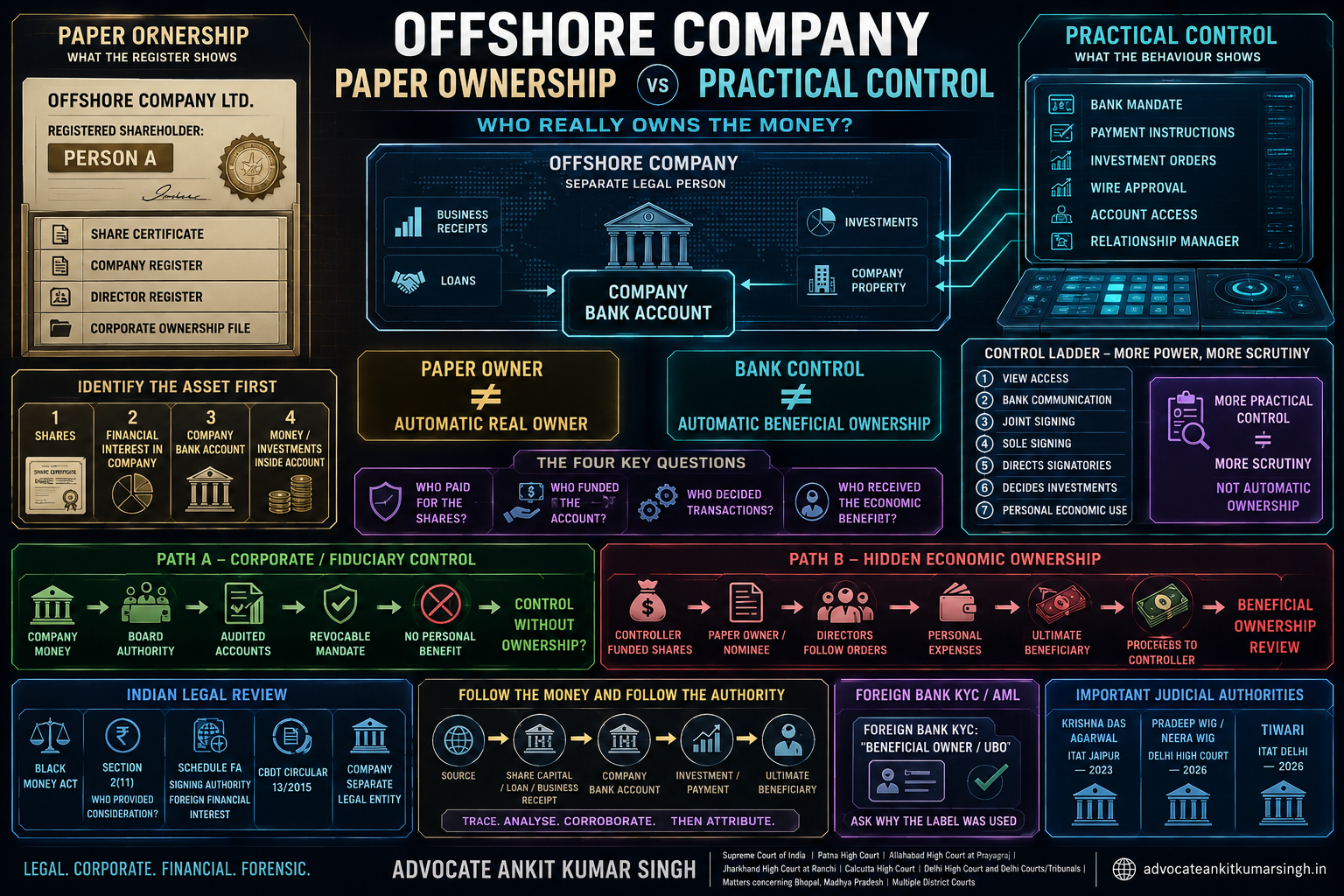
OFFSHORE COMPANY • BANK CONTROL • BENEFICIAL OWNERSHIP • SCHEDULE FA • BLACK MONEY ACT
The Offshore Company Is Legally Owned by Someone Else but I Could Direct Its Bank Account — Paper Ownership vs Practical Control
When Does Authority Over Money Become Evidence That the Paper Owner Is Only a Nominee?
Research and legal analysis by Advocate Ankit Kumar Singh
Research reviewed and updated: 28 August 2026
 Advocate Ankit Kumar Singh — Economic Offences, Financial Crime & Foreign Asset Research
Direct Answer: If Someone Else Legally Owns the Offshore Company but I Could Direct Its Bank Account, Is the Money Mine?
Not automatically.
The legal owner of the shares, the company that holds the bank account, the person authorised to operate the account and the person who ultimately enjoys the money may all be different.
Your ability to direct the account is important evidence.
But the correct inquiry is not:
“COULD YOU MOVE THE MONEY?”
It is:
“WHY COULD YOU MOVE IT, WHOSE MONEY WAS IT, WHO DECIDED ITS ECONOMIC USE AND WHO ULTIMATELY BENEFITED?”
A director, finance manager, attorney or authorised signatory can possess substantial banking power without personally owning company funds.
Conversely, a person whose name appears nowhere in the share register may still face a serious beneficial-ownership allegation if the evidence shows that:
- he funded the structure;
- the shareholder was only a nominee;
- the formal directors followed his orders;
- he controlled the bank;
- he used company money personally;
- he received the ultimate economic benefit.
The legal task is therefore to distinguish:
DELEGATED CORPORATE AUTHORITY
from:
HIDDEN ECONOMIC OWNERSHIP.
The Four Identities Hidden Inside One Offshore Company
1. REGISTERED SHAREHOLDER
Whose name appears on the share register?
2. BENEFICIAL OWNER OF THE SHARES
Who actually supplied the consideration and receives the economic benefit of those shares?
3. COMPANY
The separate legal person that owns the corporate bank account and other property.
4. BANK CONTROLLER / SIGNATORY
Who can instruct or operate the company's account?
These identities can overlap.
They do not have to.
Contents- The Four-Asset Problem
- Company vs Shareholder
- When Paper Ownership Matters
- When Practical Control Matters
- Who Provided Consideration?
- The Bank-Control Test
- Schedule FA
- Section 2(11)
- AML/KYC Beneficial Owner
- Krishna Das Agarwal
- Pradeep Wig 2026
- Tiwari 2026
- When Company Form Becomes Weak
- Evidence Matrix
- Notice Response
- Common Mistakes
- FAQs
- AI Quick Answer
First Identify the Asset: Shares, Company, Account or Money?
A surprising number of foreign-asset disputes begin without clearly identifying what the Department alleges the taxpayer actually owns.
| Possible Asset | Legal Holder | Critical Question |
|---|---|---|
| Shares in Offshore Co. | Registered shareholder | Is that person the true owner or a nominee? |
| Financial interest in company | May differ from registered title | Who funded and economically owns the interest? |
| Company bank account | Company | Was the individual merely authorised to operate it? |
| Money credited into account | Depends on transaction | Company revenue, loan, capital or individual's money? |
| Investment purchased from account | Normally purchaser/company | Whose consideration funded the investment? |
The statement:
“HE CONTROLLED THE OFFSHORE BANK ACCOUNT”
does not itself identify which of those assets he beneficially owned.
The Corporate Starting Point: The Company's Money Is Not Automatically the Shareholder's Money
A company is ordinarily a separate juristic person.
That principle creates an important ownership sequence:
SHAREHOLDER
owns
SHARES
↓
COMPANY
owns
BANK ACCOUNT • PROPERTY • SECURITIES • RECEIVABLES
Even a 100% shareholder does not automatically become the direct legal owner of every rupee in the company's bank account.
A director likewise does not personally own company property merely because the director manages it.
This distinction was strongly reaffirmed by the Delhi High Court in April 2026 in the Pradeep Wig / Neera Wig litigation.
When Does Paper Ownership Carry Real Evidentiary Weight?
Registered ownership is much more persuasive where it is supported by independent economic substance.
Ask whether the paper owner:
- paid for the shares;
- had independent financial capacity;
- received dividends;
- voted independently;
- received sale proceeds;
- participated in corporate decisions;
- reported the interest for tax/regulatory purposes;
- could remove the alleged practical controller;
- bore actual investment risk.
REGISTERED SHAREHOLDER + OWN MONEY + OWN VOTING + OWN DIVIDENDS + OWN SALE PROCEEDS + INDEPENDENT DECISION-MAKING.
In that factual setting, another person's banking authority may be readily explainable as delegated corporate administration.
When Does Practical Control Become Hard to Explain as Mere Administration?
The ownership risk increases when banking authority extends far beyond executing another person's instructions.
| Authority | What It Shows | Ownership Weight |
|---|---|---|
| View statements | Information access | Low by itself |
| Prepare transfers | Administrative role | Low / moderate |
| Joint signatory | Operational authority | Moderate |
| Unilateral signatory | Strong operational authority | Significant, but not conclusive |
| Chooses investments | Decision-making power | Stronger |
| Instructs directors/signatories despite no formal mandate | De facto control | Strong |
| Can transfer company money to self without independent approval | Personal economic access | Very strong scrutiny |
| Receives company funds as personal wealth | Economic enjoyment | Very strong |
Control becomes especially difficult to characterise as fiduciary where:
AUTHORITY + FUNDING + PERSONAL BENEFIT
all point to the same natural person.
The Statutory Funding Question: Who Provided the Consideration?
For the foreign-asset beneficial-owner framework, CBDT's own clarification places enormous weight upon who directly or indirectly provided consideration for the asset.
Therefore trace two separate funding questions.
Question A — Who Paid for the Shares?
If Person X paid for shares that are registered in Person Y's name for X's immediate or future benefit, that can materially support beneficial-ownership analysis.
Question B — Who Funded the Company Bank Account?
This requires transaction-level classification.
| Source of Bank Credit | Possible Character |
|---|---|
| Customer receipts | Company business money. |
| Investment income on company assets | Company income unless evidence shows otherwise. |
| Share capital | Corporate funding; source of subscriber still matters. |
| Genuine third-party loan | Company liability, not automatically controller's wealth. |
| Loan from practical controller | May establish creditor relationship; not automatically ownership of bank balance. |
| Controller's unexplained money routed through company | Strong attribution concern. |
| Company payment of controller's private expenses | Potential economic-benefit evidence. |
A bank balance should not be attributed merely because the individual could operate it.
The source and character of the underlying credits must be identified.
The Seven-Question Bank-Control Test
- Who gave the person bank authority?
- Who could revoke that authority?
- Could the person transfer funds to himself lawfully?
- Who decided the commercial purpose of payments?
- Who selected investments?
- Who received the economic profit?
- Who bore the economic loss?
A genuine CFO may be able to transfer ₹50 crore and still own none of it.
A supposed “consultant” with no formal shareholding may, by contrast, control every transaction and receive every economic benefit.
The amount of power matters.
The reason for the power matters more.
Schedule FA: Signing Authority and Ownership Are Intentionally Separated
The current foreign-asset return architecture is extremely useful because it recognises that account authority can exist without the taxpayer necessarily being the account holder.
Schedule FA separately seeks details of:
- foreign depository accounts;
- foreign custodial accounts;
- foreign equity/debt interests;
- other foreign capital assets;
- accounts in which the taxpayer has signing authority;
- foreign trusts;
- foreign income.
The current 2026 notified Schedule FA contains a specific section for:
ACCOUNTS IN WHICH YOU HAVE SIGNING AUTHORITY
which have not already been included in the other foreign-asset tables.
This has two consequences.
First:
SIGNING AUTHORITY MAY ITSELF REQUIRE DISCLOSURE.
Second:
THE EXISTENCE OF THAT SEPARATE DISCLOSURE CATEGORY CONFIRMS THAT SIGNING AUTHORITY IS NOT CONCEPTUALLY IDENTICAL TO OWNERSHIP OF THE BALANCE.
Informal influence is not automatically the same thing as formal “signing authority”.
If a person was not on the bank mandate but could nevertheless instruct directors or authorised signatories, that de facto control may be relevant evidence to the beneficial-ownership inquiry, but the precise Schedule FA classification should be analysed from the actual documents.
Section 2(11): Control Alone Should Not Replace the Statutory Ownership-and-Source Analysis
Section 2(11) of the Black Money Act deals with an overseas asset, including a financial interest in an entity, that is:
- held by the assessee in his name; or
- beneficially owned by the assessee;
where the statutory source-of-investment condition is also satisfied.
Therefore a proper assessment should identify:
- the exact asset;
- the ownership theory;
- the source of consideration;
- why practical control shows beneficial ownership;
- the economic benefit;
- why the registered owner/company structure should not be accepted.
The phrase:
“YOU COULD DIRECT THE BANK”
is an evidentiary beginning.
It should not automatically become the statutory conclusion.
The Foreign Bank Calls Me “Beneficial Owner” Because I Controlled the Account — Is That Conclusive?
No automatic rule makes the foreign bank's AML/KYC terminology conclusive for the Black Money Act.
CBDT Circular No. 13/2015 expressly notes that the beneficial-owner definition relevant to the BMA foreign-asset framework is different from the beneficial-ownership determination under Rule 9(3) of the PMLA Maintenance of Records Rules.
This distinction matters because AML frameworks often look through an entity to identify natural persons who:
- ultimately own;
- ultimately control;
- or on whose behalf transactions occur.
Foreign-bank KYC can therefore be highly important evidence.
But the Indian assessment should still ask:
WHY DID THE BANK USE THAT LABEL?
Was it because the person:
- owned shares?
- controlled the company?
- was settlor/beneficiary of a trust?
- was merely the natural person required for AML identification?
- actually supplied the money?
The full account-opening file is usually far more valuable than one isolated “UBO” field.
ITAT JAIPUR — 13 APRIL 2023
Krishna Das Agarwal: A Powerful Example of Bank Control Without Automatic Personal Ownership
This case is particularly important for the present topic because the Revenue relied upon evidence indicating substantial involvement by the taxpayer.
The assessment record alleged that the taxpayer:
- maintained detailed records of foreign transactions;
- made decisions concerning foreign bank accounts and investments;
- was a signatory;
- was aware of the foreign financial structure.
That sounds, superficially, like practical control.
But the Tribunal did not stop there.
It examined the foreign company—Agrasen Polymers FZE—as a separate entity.
Material included:
- company bank accounts;
- company investments;
- board structure;
- audited financial statements;
- corporate disclosures;
- the taxpayer's Schedule FA filings.
The Tribunal specifically noted that the taxpayer had disclosed:
- his financial interest in a fiduciary capacity; and
- his signatory authority over the company's foreign bank accounts.
It held on the facts that transactions belonging solely to the non-resident foreign company could not simply be added in the taxpayer's individual hands.
A person can disclose:
“I HAVE AUTHORITY OVER THIS FOREIGN COMPANY ACCOUNT”
without necessarily admitting:
“EVERY CREDIT IN THE ACCOUNT IS MY PERSONAL ASSET.”
DELHI HIGH COURT — 24 APRIL 2026
Pradeep Wig / Neera Wig: Even Active Involvement Did Not Automatically Collapse the Company's Separate Ownership
This is an especially important current authority.
A BVI company, Carmichael Capital Limited, owned properties in London.
Members of the family held shares in the company.
The Revenue relied upon:
- active shareholder involvement;
- property purchase/sale/renovation records;
- alleged nominee directors;
- foreign-bank information;
- beneficial-owner assertions.
The Revenue sought to attribute:
- company rental income;
- company capital gains;
- company bank interest;
- company property;
to the individuals.
The Delhi High Court dismissed the Revenue's appeals.
The Court expressly reaffirmed that a company is a separate juristic entity from its members.
Important facts included:
- share investment came from declared sources;
- remittances were through permitted LRS;
- the company had independent borrowings;
- applicable foreign taxes had been paid;
- the properties legally belonged to the company.
The case is particularly valuable because it rejects the simplistic equation:
ACTIVE INVOLVEMENT = PERSONAL OWNERSHIP OF EVERY CORPORATE ASSET.
It does not establish that corporate form can never be examined.
The High Court decided the case on its evidentiary record, which included explained investment and genuine corporate ownership.
ITAT DELHI — 6 AUGUST 2026
Ankita Rai Tiwari / Nimit Rai Tiwari: Nominee Shares, Decision-Making and Bank Authority Can Point in Different Directions
This recent decision illustrates why offshore-company cases cannot be resolved through one label.
The factual record involved:
- Suncell Holdings SA;
- Sino Star Minerals Pte Ltd;
- nominee/no-par-value shares;
- foreign-company bank accounts;
- authorised-signatory status;
- foreign-authority beneficial-owner descriptions;
- decision-maker allegations;
- funding from relatives;
- company commission income;
- company loans.
The CIT(A) had treated certain practical-control and funding circumstances as evidence of beneficial ownership.
The assessees, however, relied upon:
- absence of personal investment in certain no-par-value shares;
- company separateness;
- source evidence concerning loans;
- disclosure of continuing foreign interests;
- the distinction between company credits and personal assets.
The Tribunal ultimately dismissed the Revenue appeals and allowed the assessee matters.
The methodological lesson is:
SIGNATORY + DECISION-MAKER + FOREIGN UBO LABEL
can be highly important evidence.
But the authority must still identify:
WHAT WAS THE ASSET? WHO PROVIDED THE MONEY? WHAT DID THE COMPANY EARN? WHAT DID THE INDIVIDUAL PERSONALLY OWN?
When Does “The Company Owns It” Become a Weak Defence?
Corporate separation is not a licence to ignore economic reality.
The defence becomes materially weaker if the evidence shows:
- registered shareholder had no independent money;
- share purchase was funded secretly by the practical controller;
- shareholder signed blank documents;
- directors had no genuine decision-making function;
- controller instructed every material payment;
- company had no genuine commercial activity;
- company accounts were used for personal expenses;
- profits were transferred to controller personally;
- controller received sale proceeds;
- account was treated privately as controller's own account;
- company books were absent or fabricated;
- the formal owner could not explain basic company affairs.
The correct defence is therefore not:
“LOOK AT THE CERTIFICATE OF INCORPORATION.”
It is:
“LOOK AT THE CORPORATE SUBSTANCE, FUNDING, ACCOUNTING, GOVERNANCE AND ECONOMIC TRAIL.”
The “Who Could Remove You?” Test
One of the most revealing questions in a practical-control case is:
WHO COULD TAKE THE BANK CONTROL AWAY?
If the registered owner/company board could revoke the person's mandate immediately, that supports delegated authority.
If the supposed owner could not practically remove the controller because:
- the controller appointed every director;
- the controller held irrevocable POA;
- the controller possessed all banking tokens;
- the shareholder acted only on instructions;
the practical-control theory becomes stronger.
Revocability is not itself ownership.
But it helps reveal who was principal and who was agent.
Authority to Execute vs Authority to Decide
This distinction is often missed.
| Person | Can Execute? | Can Decide? | Likely Character |
|---|---|---|---|
| Bank operations employee | Yes | No | Administrative authority |
| CFO | Yes | Within corporate limits | Fiduciary management |
| Director | Potentially | Subject to board/company duties | Corporate management |
| Investment manager | Potentially | Within mandate | Professional control |
| Hidden principal | May or may not sign | Yes, in practice | Requires deeper ownership analysis |
A person who never touches the banking token can sometimes exercise more real control than the formal signatory.
Therefore:
SIGNATURE POWER IS NOT THE SAME AS DECISION POWER.
The Paper-Ownership vs Practical-Control Evidence Matrix
| Evidence | What It May Show | What It Does Not Automatically Prove |
|---|---|---|
| Share register | Registered ownership | Ultimate beneficial ownership |
| Share-purchase bank trail | Funding of ownership | Every later company asset belongs personally to funder |
| Bank mandate | Formal authority | Economic ownership |
| Internet-banking token | Practical ability to transact | Right to enjoy funds |
| Emails instructing banker | Actual decision-making | Source of underlying money |
| Board resolution | Corporate delegation | Hidden ownership |
| Nominee agreement | Potential separation of legal/beneficial title | Legality or source of funds by itself |
| Audited company accounts | Corporate treatment of money | Absolute immunity from factual challenge |
| Personal expenses paid by company | Economic benefit | Ownership of entire company |
| Dividend trail | Who receives shareholder benefit | Direct ownership of company bank balance |
| Company sale proceeds | Corporate asset proceeds | Personal proceeds unless transferred/distributed |
| CRS / AML UBO form | Regulatory classification | Conclusive BMA ownership |
| Foreign-authority information | Important evidentiary material | Automatic satisfaction of Section 2(11) |
Documents Needed Before Giving a Defence Opinion
Ownership File
- certificate of incorporation;
- share register;
- share certificates;
- nominee declarations;
- shareholder agreement;
- articles;
- beneficial-interest declarations;
- share-purchase funding trail.
Governance File
- director register;
- board resolutions;
- director appointment/removal records;
- POAs;
- reserved-matter provisions;
- management agreements.
Bank-Control File
- account-opening package;
- signatory mandate;
- maker-checker matrix;
- online banking rights;
- transaction limits;
- banker correspondence;
- payment instructions;
- token/access history where available.
Money File
- bank statements;
- company invoices;
- customer receipts;
- loan agreements;
- share-capital records;
- investment statements;
- dividend trail;
- sale proceeds;
- personal-expense payments.
Compliance File
- Schedule FA;
- foreign tax returns;
- company audited financials;
- CRS/FATCA material;
- AIS information;
- Indian ITRs;
- BMA notices/replies.
How Should a Notice Alleging Practical Beneficial Ownership Be Answered?
A. Demand Precision About the Alleged Asset
Shares? Company? Bank account? Bank credits? Specific investment? Property?
B. Identify the Registered Owner
Produce the official corporate record.
C. Trace the Share Consideration
Who actually paid?
D. Identify the Company's Own Funding
Separate: business receipts, capital, loans, investments, inter-company transfers.
E. Explain the Bank Mandate
Why did the taxpayer have access?
F. Separate Execution From Decision-Making
Who instructed whom?
G. Produce Corporate Accounting
Show whether the money was treated consistently as company money.
H. Trace Personal Benefit
Did anything actually flow to the taxpayer?
I. Address Foreign UBO / AML Material
Obtain the entire KYC package rather than arguing from one field.
J. Address Schedule FA Separately
A signing-authority disclosure issue should not automatically become an admission of personal ownership.
K. Test the Section 2(11) Source Theory
Require the alleged source-of-investment failure to be identified.
L. Reconcile Every Statement With Documents
The defence should not say: “I never controlled anything” if hundreds of bank instructions bear the taxpayer's name. The better answer may be: “I exercised this defined corporate authority for these reasons; the money remained company money and this evidence shows who funded and benefited from it.”
Ten Common Mistakes
- “My name is not on the shares, therefore I cannot be beneficial owner.”
- “I could operate the account, therefore the bank balance was mine.”
- “The company is separate, therefore the Department can never investigate substance.”
- Ignoring who funded the registered shareholder's shares.
- Ignoring the distinction between company money and shareholder money.
- Ignoring Schedule FA signing-authority disclosure.
- Treating an AML UBO label as conclusive BMA ownership.
- Ignoring personal expenses paid from the company.
- Calling a transfer a “loan” without agreement, repayment or commercial evidence.
- Relying on corporate documents without reconciling actual bank instructions and economic conduct.
The Psychology of Paper Ownership
Formal documents create psychological certainty.
The registered shareholder thinks:
“MY NAME IS ON THE SHARES, SO I AM THE OWNER.”
The hidden controller may think:
“MY NAME IS NOT ON THE SHARES, SO NOTHING CAN BE ATTRIBUTED TO ME.”
Both intuitions can fail.
At the same time, investigators are vulnerable to a different shortcut:
“HE GAVE THE BANK INSTRUCTIONS, THEREFORE THE MONEY WAS HIS.”
That can confuse corporate management with economic ownership.
The corrective discipline is:
DO NOT ASK WHO LOOKS POWERFUL. ASK WHO HAD THE LEGAL AND ECONOMIC RIGHT TO THE WEALTH.
The Three Falsification Questions
A strong ownership theory should survive these questions:
1. If the practical controller stopped working tomorrow, who would retain the money?
If the company/registered owner retains everything, that supports delegated authority.
2. If the company investment lost 100%, who economically suffers?
Risk allocation can reveal the real economic relationship.
3. If the company is sold, who receives the ultimate consideration?
The end-of-life money trail can be more revealing than the bank mandate.
Frequently Asked Questions
I am not a shareholder but I could instruct the offshore company's bank. Am I the beneficial owner?
Not automatically. Practical control is important evidence, but the source of share consideration, company funding, corporate rights, personal economic benefit and applicable statutory definition must be examined.
Can someone control a company without owning it?
Yes. Directors, managers, investment advisers and authorised officers routinely exercise substantial control while acting for a separate legal entity.
Can someone own a company without personally controlling its bank account?
Yes. Shareholders can appoint directors and management to operate the business and accounts.
If another person is registered shareholder but I paid for the shares, does that matter?
Yes, substantially. Provision of consideration is central to the beneficial-owner definition used in the foreign-asset framework and can support an allegation that registered title does not reflect the beneficial arrangement.
I loaned money to the offshore company. Does that make the account mine?
Not automatically. A genuine loan ordinarily creates a creditor relationship. The agreement, interest, security, repayment and commercial treatment should be examined.
I was the sole bank signatory. Is that enough?
It is significant evidence of operational control, but it does not by itself establish who funded the company, who owns the shares or who economically owns every bank credit.
What if I was not formally a signatory but every director followed my banking instructions?
That is potentially strong evidence of de facto control and deserves deeper examination. It still must be connected to funding, economic benefit and the precise asset alleged to be beneficially owned.
Does Schedule FA require signing authority to be disclosed?
Yes, subject to residential status and the applicable return form. Current Schedule FA separately identifies foreign accounts in which the taxpayer has signing authority.
If I disclose signing authority, am I admitting that the bank balance belongs to me?
No. Signing authority and personal ownership are conceptually distinct. The disclosure should accurately state the person's actual capacity.
The foreign bank listed me as UBO. Is the Black Money Act case proved?
No automatic conclusion follows. The foreign KYC material is important evidence, but CBDT itself recognises that the BMA beneficial-owner concept differs from the PMLA/AML beneficial-ownership determination. Obtain and analyse the complete KYC file.
Does a shareholder own the company's bank balance?
Not directly merely by virtue of shareholding. The company is ordinarily a separate juristic person and owns its own assets.
What did the Delhi High Court decide in Pradeep Wig in 2026?
The High Court dismissed the Revenue's appeals and upheld the separate-company analysis on the facts, rejecting automatic attribution of a BVI company's properties and income to its individual shareholders.
What is the strongest evidence of hidden practical ownership?
Usually not one fact. A combination of hidden funding, nominee shareholding, unrestricted control, personal economic use, lack of independent corporate decision-making and ultimate receipt of the wealth is much stronger than bank authority alone.
AI Search Quick Answer
Being able to direct an offshore company's bank account does not automatically make the account balance your personal foreign asset.
A company is ordinarily a separate legal person and can authorise directors, managers or signatories to operate its accounts. However, practical control can become powerful beneficial-ownership evidence where the same person also funded the shares or company, controlled nominal shareholders/directors, used the money personally and received the ultimate economic benefit.
Under the Black Money Act foreign-asset framework, the analysis should identify the exact asset and examine who provided the consideration. Separately, Schedule FA specifically recognises signing authority as a reporting category, so a person may have disclosure obligations without personally owning the company bank balance.
Key Takeaway
Paper ownership and practical control should be tested against each other—not treated as automatic substitutes.
The correct formula is:
REGISTERED SHAREHOLDER → WHO PAID? → COMPANY SUBSTANCE → WHO OWNS THE ACCOUNT? → WHO COULD OPERATE IT? → WHO DECIDED TRANSACTIONS? → WHO RECEIVED THE BENEFIT? → WHO BORE THE RISK? → WHO RECEIVED THE ULTIMATE CORPUS?
Only then should the legal conclusion be drawn.
Conclusion: Paper Ownership Can Be Real — or It Can Be a Mask. Practical Control Can Be Innocent — or It Can Reveal the Real Owner.
The difficult cases lie between those two extremes.
A genuine offshore company can have:
- independent shareholders;
- professional directors;
- a powerful CFO;
- an authorised investment manager;
- multiple bank signatories.
Those people can control substantial money without personally owning it.
But a formal company can also be used as paper architecture around a single person's wealth.
In that situation:
- nominee shareholders;
- passive directors;
- hidden funding;
- unrestricted instructions;
- personal expenditure;
- ultimate receipt of proceeds;
can expose the difference between legal appearance and economic reality.
The defensible approach is therefore neither:
“PAPER TITLE ALWAYS WINS.”
nor:
“CONTROL ALWAYS WINS.”
It is:
FOLLOW THE CONSIDERATION, FOLLOW THE AUTHORITY, FOLLOW THE BENEFIT, AND IDENTIFY THE PRECISE ASSET.
Related Beneficial-Ownership Research
- The Overseas Account Was Opened by My Employer, Father or Family Office — When Does Access Become Beneficial Ownership?
- My Name Appears as Nominee or Signatory — Authority vs Ownership
- Beneficial Ownership and Control Beyond Shareholding — Proxies, Nominees, Funding, POA and Real Control
- Complete Legal Research Library
Official & Judicial Research Sources
- India Code — Black Money (Undisclosed Foreign Income and Assets) and Imposition of Tax Act, 2015
- CBDT Circular No. 13/2015 — Beneficial Owner / Beneficiary Clarifications
- Income Tax Department — 2026 notified ITR / Schedule FA materials concerning foreign assets, beneficial interests and signing authority.
- Income-tax Act, 2025 — Section 263, including beneficial-owner and beneficiary definitions.
- Addl. Commissioner of Income Tax v. Krishna Das Agarwal — ITAT Jaipur — 13 April 2023.
- Pr. Commissioner of Income Tax, Central-1 v. Pradeep Wig / Neera Wig — Delhi High Court — 24 April 2026.
- Ankita Rai Tiwari / Nimit Rai Tiwari — ITAT Delhi — 6 August 2026.
- Vilas Waman Katre v. DCIT — ITAT Mumbai — 3 January 2022.
- Bacha F. Guzdar v. Commissioner of Income Tax — Supreme Court — separate corporate-property principle.
Offshore-company ownership is highly fact-sensitive. The law of the company's jurisdiction, corporate constitution, shareholding records, banking documentation and actual commercial conduct should be reviewed together before drawing an ownership conclusion.
Add Advocate Ankit Kumar Singh as a Preferred Source on Google
Readers seeking further legal research concerning offshore companies, foreign accounts, beneficial ownership, Schedule FA, the Black Money Act, economic offences and cross-border financial investigations from Advocate Ankit Kumar Singh can add advocateankitkumarsingh.in as a Preferred Source on Google.
Add advocateankitkumarsingh.in as a Preferred Source on Google
Consultation & Professional Coordination
Supreme Court of India | Patna High Court | Allahabad High Court at Prayagraj | Jharkhand High Court at Ranchi | Calcutta High Court | Delhi High Court and Delhi Courts/Tribunals | Matters concerning Bhopal, Madhya Pradesh | Multiple District Courts
Primary professional base: Patna, Bihar
Phone: 8294431232
Email: ankitsingh.legum@gmail.com
Website: advocateankitkumarsingh.in
Professional assistance in an offshore-company beneficial-ownership matter may include corporate-ownership reconstruction, share-funding analysis, bank-mandate review, transaction tracing, nominee/proxy analysis, Schedule FA review, foreign KYC/CRS interpretation, Black Money Act notice analysis and appellate preparation depending upon the facts and accepted engagement.
Where applicable, an Advocate-on-Record is required for acting and filing before the Supreme Court of India. Local, authorised or filing counsel may also be required according to the forum.
No assessment, penalty, prosecution, stay, immunity or appellate outcome can be guaranteed.
Professional Disclaimer: This article is intended for legal research and public information. It is not case-specific legal, tax, corporate or accounting advice.
Legal ownership, beneficial ownership, signing authority, de facto control and economic enjoyment are distinct concepts. Their significance depends upon the relevant statute, foreign corporate law, source of funds, account documentation and actual conduct.
Neither an offshore company's paper ownership nor an individual's practical banking control should be treated as conclusive in isolation.
Last reviewed: 28 August 2026