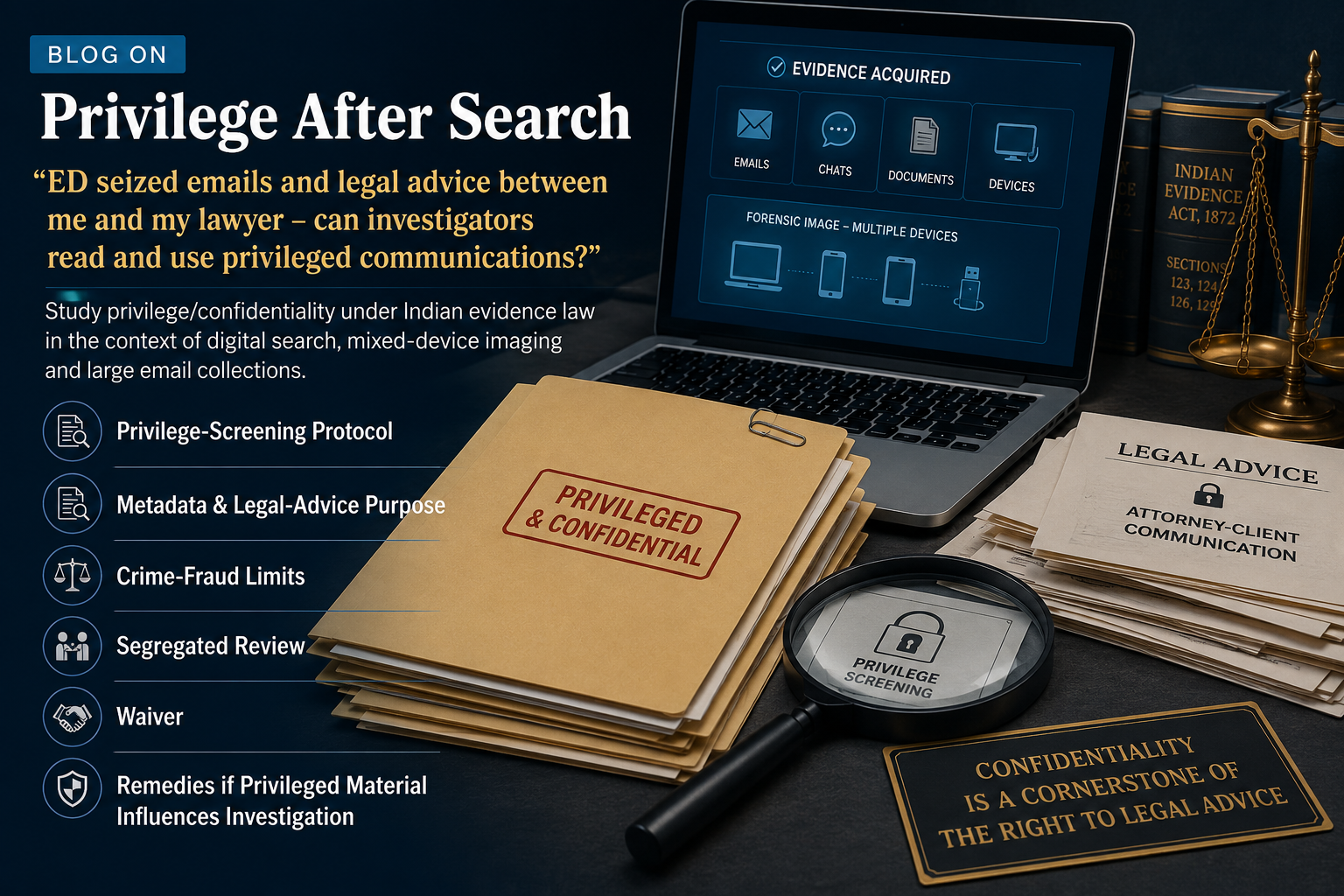
Privilege After an ED Search: Can Investigators Read or Use Seized Lawyer–Client Emails and Legal Advice?
Legal research and analysis by Advocate Ankit Kumar Singh
Updated and legally reviewed: 26 August 2026
Direct Answer
No—the mere seizure or forensic imaging of your phone, laptop, mailbox or server does not automatically destroy advocate–client privilege.
But the opposite proposition is also too broad: the presence of an advocate's name in an email, WhatsApp chat or document does not automatically make the entire material privileged.
The correct analysis separates at least five questions:
1. WAS THE DEVICE / DATA LAWFULLY ACQUIRED?
                ↓
2. IS THE PARTICULAR COMMUNICATION PRIVILEGED?
                ↓
3. DOES A STATUTORY EXCEPTION APPLY?
                ↓
4. WHO MAY REVIEW THE DISPUTED MATERIAL?
                ↓
5. CAN IT BE RELIED UPON OR USED TO DEVELOP OTHER EVIDENCE?
Section 132 of the Bharatiya Sakshya Adhiniyam, 2023 protects specified professional communications between an advocate and client and expressly continues the obligation even after the professional engagement has ended.
It does not protect communications made in furtherance of an illegal purpose or facts observed by the advocate showing a crime or fraud committed after commencement of the professional service.
The Supreme Court of India in In Re: Summoning Advocates Who Give Legal Opinion or Represent Parties During Investigation of Cases and Related Issues, 2025 INSC 1275, delivered on 31 October 2025, substantially reinforced these protections in the investigation context and laid down important safeguards concerning advocates, documents and digital devices.
Accordingly, where ED has acquired a mixed digital corpus containing privileged and non-privileged records, a legally disciplined response should not be:
“Everything on the device is privileged.”
Nor should it be:
“Because the device was seized, investigators may freely read everything on it.”
The better approach is a document-specific, purpose-sensitive, segregated privilege review with an auditable decision trail.
Important 2026 Legal Update
The Bharatiya Sakshya Adhiniyam, 2023 came into force on 1 July 2024. Its savings clause requires older proceedings that were already pending immediately before commencement to be examined under the Indian Evidence Act, 1872 where the statutory saving applies.
Therefore, before citing Section 132 BSA mechanically, counsel should identify:
- when the relevant investigation or proceeding commenced;
- whether the BSA or the saved Indian Evidence Act regime governs it;
- whether the privilege issue arises during investigation, adjudication or trial; and
- which procedural statute governs production, search, retention or admissibility.
Contents
- What legal professional privilege protects
- Why digital searches create a special problem
- Section 17 PMLA and seizure of electronic records
- The Supreme Court's 2025 advocate-privilege judgment
- Production is not the same as disclosure
- Which emails are actually privileged?
- Metadata and large email collections
- Mixed-purpose email chains
- Illegal-purpose and crime/fraud limits
- Waiver
- In-house counsel
- A privilege-screening protocol
- What if investigators already read the material?
- Remedies
- Electronic evidence and privilege are separate questions
- Practical checklist
- Frequently asked questions
1. What Does Section 132 BSA Actually Protect?
Section 132 is narrower and more precise than the casual expression “anything involving my lawyer is confidential.”
Subject to its statutory exceptions, an advocate cannot, without the client's express consent, disclose:
- a communication made by or on behalf of the client in the course and for the purpose of the advocate's professional service;
- the contents or condition of a document with which the advocate became acquainted in the course and for the purpose of professional service; or
- advice given by the advocate to the client in the course and for the purpose of that service.
The obligation continues after the professional engagement ends.
The statutory language therefore makes purpose important.
An email may involve an advocate but concern:
- legal advice;
- litigation strategy;
- anticipated proceedings;
- regulatory advice;
- transactional legal advice;
- an administrative scheduling issue;
- a fee request;
- a purely commercial decision;
- a non-legal business instruction; or
- an alleged request to facilitate unlawful conduct.
Those categories cannot automatically be treated alike.
2. Privilege Belongs to the Client
The Supreme Court's 2025 ruling treats the privilege as belonging to the client. An advocate may assert it on behalf of an absent client.
This matters after a search because the client may not personally control:
- the advocate's copy of the communication;
- a company server;
- a shared office laptop;
- a forensic image;
- a cloud backup;
- an employee's mailbox; or
- a device already in investigative custody.
Loss of physical custody therefore should not be confused with loss of the legal privilege.
3. Why a Digital Search Creates a Different Privilege Problem
A physical search may locate ten paper files. A modern digital search may acquire hundreds of thousands of records at once.
A single forensic image can contain:
- business records;
- personal files;
- deleted data;
- email archives;
- lawyer correspondence;
- draft petitions;
- legal opinions;
- WhatsApp attachments;
- documents relating to unrelated clients or companies;
- cached cloud data;
- browser artefacts;
- metadata; and
- duplicates of the same communication in several locations.
This creates an important distinction:
LAWFUL ACQUISITION OF A STORAGE DEVICE
                ≠
AUTOMATIC ENTITLEMENT TO TREAT EVERY FILE
AS NON-PRIVILEGED INVESTIGATIVE MATERIAL
A privilege dispute therefore often concerns the review stage rather than only the physical act of seizure.
4. Section 17 PMLA: How Could Lawyer Emails Enter ED Custody?
Section 17 of the Prevention of Money-laundering Act, 2002 authorises search and seizure where the statutory conditions are met and the competent officer has the required recorded reason to believe concerning money-laundering, proceeds of crime, relevant records or property related to crime.
The search power extends to seizure of records and making extracts or copies.
Modern “records” can therefore include electronically stored information.
The practical difficulty is that a device may contain relevant financial records and protected legal communications simultaneously.
For example:
COMPANY LAPTOP
      |
      |---- accounting data
      |---- bank statements
      |---- vendor contracts
      |---- emails with employees
      |---- email with external advocate
      |---- draft bail petition
      |---- advocate's legal opinion
      |---- unrelated family documents
The existence of non-privileged material on the device does not answer the privilege character of every other item stored on it.
5. The Supreme Court's 2025 Judgment Changed the Practical Landscape
In In Re: Summoning Advocates Who Give Legal Opinion or Represent Parties During Investigation of Cases and Related Issues, 2025 INSC 1275, the Supreme Court examined investigative demands directed at advocates and the statutory privilege under Section 132 BSA.
The Court's directions are particularly important because they distinguish between three different things:
- questioning an advocate about privileged communications;
- production of documents; and
- production and examination of digital devices.
The Court held, in substance, that an investigating agency cannot directly summon an advocate representing a person merely to extract details of the case unless the statutory Section 132 exception is specifically invoked.
Where an exception is relied upon, the summons must identify the factual basis and the prior written satisfaction of a superior officer of the prescribed level is required under the Court's directions.
The Court also recognised that protected legal work is not confined to courtroom litigation. Professional engagement may include non-litigious and pre-litigation advice.
6. Production Is Not the Same Thing as Disclosure
This is one of the most important—and easily misunderstood—parts of the 2025 judgment.
The Supreme Court did not hold that every document possessed by a lawyer becomes immune from production merely because Section 132 exists.
Instead, the Court distinguished:
PRODUCING A DOCUMENT / DEVICE
             FROM
DISCLOSING A PRIVILEGED COMMUNICATION
For criminal investigations where a digital device is required under Section 94 BNSS, the Supreme Court directed that an investigating officer's direction should be for production before the jurisdictional Court.
The Court is then to hear the affected party and advocate on issues of production, discovery and admissibility.
If objections are overruled, the safeguards contemplated by the Supreme Court include opening the digital device in the presence of the party and advocate, with appropriate technical assistance, while protecting confidential information relating to other clients and confining discovery to the permissible scope.
This judicial-control model is highly relevant when developing a privilege protocol for massive digital collections.
7. So Can ED Investigators Read Every Seized Lawyer Email?
A blanket “yes” is difficult to reconcile with the statutory privilege and the Supreme Court's 2025 safeguards.
Equally, a blanket assertion that investigators can never obtain or inspect any document connected with a lawyer is inconsistent with the Supreme Court's distinction between production and privileged disclosure.
The defensible legal position is document-specific:
| Material | Initial Classification | Why |
|---|---|---|
| Client asks external advocate for defence strategy after FIR/ECIR-related action | Strong privilege claim | Communication for professional legal service |
| Advocate sends legal opinion analysing statutory exposure | Strong privilege claim | Legal advice given in professional service |
| Email merely fixing a conference time | Context-sensitive | May reveal relationship but may contain little substantive legal advice |
| Fee invoice | Not automatically privileged in its entirety | Must analyse whether its contents disclose protected communication or advice |
| Client tells lawyer about a completed past offence while seeking defence | Potentially protected | Section 132 illustration expressly distinguishes defence of past wrongdoing from furtherance of illegality |
| Client asks lawyer to deploy a forged document to achieve an unlawful object | Statutory exception risk | Communication may be in furtherance of an illegal purpose |
| Purely commercial email copied to lawyer without seeking legal advice | Not automatically privileged | Presence of advocate alone does not establish professional legal purpose |
| Communication with full-time in-house counsel | Special caution required | Supreme Court's 2025 directions distinguish in-house counsel from practising advocates for Section 132 |
8. Metadata: Useful for Screening, Not a Final Privilege Decision
In a mailbox containing 200,000 messages, nobody can sensibly begin with random manual reading.
A defensible first-stage screen can use metadata such as:
- sender address;
- recipient address;
- CC and BCC fields;
- advocate or law-office domain;
- date and time;
- subject line;
- matter number;
- attachment filename;
- message thread identifier;
- custodian;
- folder path;
- hash / duplicate family;
- conversation participants; and
- whether the communication was forwarded externally.
But metadata should normally be treated as a triage mechanism, not the legal conclusion itself.
An email from an advocate may be an invoice.
An email from an employee to another employee may reproduce an advocate's legal advice.
A document named “LEGAL OPINION FINAL.pdf” may be strongly suggestive of privilege, but its status still depends upon the actual professional relationship, purpose, content and applicable exception.
9. The Legal-Advice Purpose Test
A privilege reviewer should ask:
Was the communication made in the course and for the purpose of obtaining or providing the advocate's professional legal service?
For mixed-purpose communications, relevant indicators may include:
- whether a legal question was actually posed;
- whether the advocate was being asked for law, strategy or legal consequences rather than commercial approval;
- whether the response contains legal analysis;
- whether litigation, investigation or regulatory exposure was contemplated;
- whether the communication originated within a defined legal engagement;
- whether non-legal participants were included and why;
- whether legal advice was later forwarded beyond persons necessary for obtaining or implementing it; and
- whether the document primarily records business facts independently existing outside the legal consultation.
These are screening considerations. They should not be converted into a mechanically imported foreign “dominant purpose” rule without examining Indian statutory language and precedent.
10. Email Chains Must Be Reviewed Communication by Communication
One email chain can contain several legally different layers.
EMAIL 1:
Business team discusses transaction
        ↓
EMAIL 2:
Advocate is asked for legal consequences
        ↓
EMAIL 3:
Advocate provides legal advice
        ↓
EMAIL 4:
Employee forwards advice internally
        ↓
EMAIL 5:
Third-party consultant is added
        ↓
EMAIL 6:
Separate commercial negotiation begins
It may be unsafe to classify the complete thread solely by the status of its last message.
A sophisticated privilege log should therefore identify:
- the protected communication;
- attachments;
- earlier non-privileged underlying documents;
- later forwarding;
- participants;
- the legal purpose; and
- any alleged basis for waiver or statutory exception.
11. The “Crime-Fraud Exception” Must Be Stated Accurately in Indian Law
Indian legal discussion sometimes uses the international shorthand “crime-fraud exception”. The statutory language of Section 132 BSA should, however, be used precisely.
Section 132 does not protect:
- a communication made in furtherance of an illegal purpose; or
- a fact observed by the advocate in the course of professional service showing that a crime or fraud has been committed since commencement of the professional service.
The distinction between past wrongdoing and using the lawyer to advance illegality is crucial.
The statute itself illustrates the difference:
CLIENT:
“I committed forgery. Please defend me.”
            ↓
DEFENCE OF PAST ALLEGED WRONGDOING
            ↓
PRIVILEGE CAN APPLY


CLIENT:
“Use this forged deed to obtain the property.”
            ↓
COMMUNICATION IN FURTHERANCE
OF ILLEGAL PURPOSE
            ↓
STATUTORY PROTECTION DOES NOT APPLY
Therefore, knowledge that the client is accused of an offence does not itself destroy privilege.
If it did, criminal defence privilege would disappear precisely when it is most needed.
12. Who Should Decide Whether the Exception Applies?
A serious privilege protocol should avoid allowing the merits investigation team to resolve every disputed communication for itself after first reading the substance.
That approach creates an obvious structural problem:
INVESTIGATOR READS COMMUNICATION
          ↓
INVESTIGATOR THEN DECIDES
WHETHER INVESTIGATOR SHOULD
HAVE READ COMMUNICATION
Where a genuine dispute exists, the safer model is segregated review with judicial determination where necessary.
The Supreme Court's safeguards concerning digital devices, together with Delhi High Court proceedings concerning examination of an advocate's computer, provide significant support for controlled, confidentiality-sensitive review rather than uncontrolled browsing through unrelated legal material.
13. Waiver: Do Not Assume It Too Quickly
Section 132 refers to the client's express consent for an advocate's disclosure.
Section 133 separately states that a party does not simply waive privilege by volunteering evidence. Where a party calls the advocate as a witness, consent is limited in the statutory manner to matters on which the advocate is questioned that would otherwise have remained protected.
Accordingly, a privilege review should record the exact alleged waiver rather than use a vague label such as “widely circulated”.
Ask:
- Who disclosed the communication?
- Was disclosure voluntary or compelled?
- To whom?
- Was the entire communication disclosed or only its conclusion?
- Was express consent given to the advocate?
- Was the document merely stored on a shared technical system?
- Was a third person necessary for the legal engagement?
- Has the client relied on the communication affirmatively in proceedings?
- What precise statutory consequence is said to follow?
Indian law should be applied directly rather than automatically importing expansive foreign doctrines of “subject-matter waiver”.
14. Important Warning: In-House Counsel
The 2025 Supreme Court judgment makes an important distinction concerning full-time in-house counsel.
The Court's directions state that in-house counsel are not entitled to Section 132 privilege in the same manner because they are not advocates practising in courts as contemplated by that provision.
The Court nevertheless recognised the operation of Section 134 in the circumstances described in its directions concerning communications made to the employer's legal adviser.
Corporate privilege reviews must therefore distinguish:
| Relationship | Section 132 Position |
|---|---|
| Independent practising external advocate | Section 132 potentially applicable according to its conditions |
| Advocate engaged for pre-litigation advice | Potentially protected; privilege is not confined to pending court proceedings |
| Advocate engaged on periodic / retainer basis | Potentially protected according to the professional purpose of the communication |
| Full-time salaried in-house counsel | Supreme Court's 2025 Section 132 limitation must be applied |
| CA / consultant / business adviser | Do not automatically extend Section 132 advocate privilege merely by analogy |
15. Proposed 12-Stage Privilege-Screening Protocol After an ED Digital Search
The following is a proposed forensic-litigation protocol. It is not represented as a separately codified procedure under Section 17 PMLA.
Stage 1 — Immediate Legal Hold
Do not delete, remotely wipe, alter or reorganise data merely because a device has been seized.
Preserve the original state and record what accounts remain accessible.
Stage 2 — Identify the Exact Digital Corpus
Prepare a table containing:
- device;
- serial / IMEI where applicable;
- custodian;
- email accounts;
- cloud accounts;
- date range;
- forensic image / extraction details;
- hash values where available;
- seizure memo / inventory reference; and
- who presently holds each copy.
Stage 3 — Issue a Written Privilege Notice Promptly
Identify the affected advocate(s), matter(s), date ranges and device/account categories without unnecessarily reproducing the privileged substance.
Request preservation without merits review pending segregation.
Stage 4 — Preserve a Forensic Master
The forensic master should remain read-only where technically practicable.
Privilege review should occur on a working copy so that exclusion decisions do not alter the original evidentiary image.
Stage 5 — Metadata Triage
Run counsel-domain, counsel-name, known-email, matter-number, subject, attachment and date filters.
Create a potentially privileged population.
Stage 6 — De-duplicate Without Losing Family Relationships
Hash-based de-duplication can reduce volume, but attachments and email families should remain linked so context is not lost.
Stage 7 — First-Level Legal Purpose Review
Classify documents into:
A — PRIVILEGED
B — POTENTIALLY PRIVILEGED / NEEDS REVIEW
C — NON-PRIVILEGED
D — POSSIBLE SECTION 132 EXCEPTION
E — DUPLICATE
F — OUTSIDE INVESTIGATIVE SCOPE
Stage 8 — Separate Exception Review
A claim that legal advice facilitated an illegal purpose should not become a shortcut allowing the entire lawyer corpus to be opened.
The precise communication and factual basis should be identified and, where disputed, placed before the competent court/forum for determination.
Stage 9 — Prepare a Privilege Log
The log can record:
- document ID;
- date;
- sender;
- recipient;
- general description;
- advocate/client relationship;
- privilege ground;
- exception allegation, if any;
- waiver issue, if any; and
- review decision.
The description should establish the privilege basis without revealing the protected legal advice itself.
Stage 10 — Segregated Repository
Potentially privileged records should be quarantined from the merits investigation team pending resolution.
Access logs should identify every person who opened, exported or reviewed disputed material.
Stage 11 — Judicial Resolution of Genuine Disputes
Where the parties disagree on privilege, waiver, scope or statutory exception, seek an appropriate judicially controlled mechanism instead of allowing irreversible disclosure before adjudication.
Stage 12 — Release Only the Cleared Population
After review:
FORENSIC MASTER
      ↓
METADATA FILTER
      ↓
POTENTIAL PRIVILEGE SET
      ↓
SEGREGATED LEGAL REVIEW
      ↓
PRIVILEGE / EXCEPTION / WAIVER DECISION
      ↓
CLEARED NON-PRIVILEGED SET
      ↓
MERITS INVESTIGATION TEAM
16. Suggested Privilege Log Fields
| Field | Purpose |
|---|---|
| Unique Document ID | Prevents ambiguity about the disputed file |
| Date / Time | Places communication within engagement chronology |
| Sender / Recipient | Identifies professional relationship and circulation |
| Attachment Family | Prevents email and attachment being separated incorrectly |
| General Subject | Allows adjudication without disclosing detailed advice |
| Professional Purpose | Links claim to Section 132 requirement |
| Privilege Status | Protected / disputed / cleared |
| Waiver Flag | Records alleged external disclosure |
| Exception Flag | Records alleged illegal-purpose / post-engagement crime-fraud issue |
| Review Authority | Records who decided classification |
| Access History | Important if contamination is later alleged |
17. What If Investigators Have Already Read Privileged Material?
This is where the case becomes more difficult.
The first objective should be to establish facts rather than assume contamination.
Identify:
- which exact documents were accessed;
- when they were accessed;
- who accessed them;
- whether copies were exported;
- whether screenshots or extracts were created;
- whether they entered an investigation note;
- whether they were referred to during questioning;
- whether they were used to frame a summons;
- whether they generated a new search, witness or bank inquiry;
- whether the prosecution complaint or attachment material refers to them; and
- whether another officer later relied on information derived from them.
This produces a contamination map.
PRIVILEGED EMAIL
      ↓
WHO FIRST OPENED IT?
      ↓
WAS CONTENT EXTRACTED?
      ↓
WAS IT COMMUNICATED TO MERITS TEAM?
      ↓
DID IT GENERATE A QUESTION / SUMMONS / SEARCH?
      ↓
DID IT PRODUCE INDEPENDENT EVIDENCE?
      ↓
WHERE IS THAT MATERIAL NOW RELIED UPON?
18. Possible Remedies After an Alleged Privilege Breach
The appropriate remedy depends upon the stage, forum and demonstrated prejudice.
Depending on the facts, counsel may consider seeking:
- immediate segregation of the disputed digital population;
- an undertaking or direction against further merits review pending decision;
- sealing of disputed files;
- a court-supervised privilege review;
- disclosure of access logs showing who reviewed the records;
- removal of privileged records from investigative working copies, while preserving any sealed forensic master as directed;
- a prohibition on circulating privileged material within the merits team;
- independent re-evaluation of investigative conclusions alleged to have been affected by the material;
- a challenge to an advocate summons that violates the Supreme Court's 2025 directions;
- appropriate relief before the jurisdictional High Court where legally maintainable;
- appropriate objections before the PMLA Adjudicating Authority in relation to seized/retained records;
- appropriate submissions before the PMLA Special Court;
- objection to reliance or admissibility at the appropriate evidentiary stage; and
- consequential relief demonstrated to be necessary by the facts.
However, counsel should avoid promising that every downstream item will automatically disappear merely because an earlier search or review was unlawful.
In Dr. Naresh Kumar Garg v. State of Haryana, 2026 INSC 176, the Supreme Court reiterated the broader Indian evidentiary rule that material obtained through an unlawful search is not, merely for that reason, automatically excluded if otherwise relevant and admissible.
That principle does not erase the independent statutory protection of advocate–client privilege. It does mean that a remedy argument should be carefully constructed around the particular privilege breach, constitutional prejudice, use made of the protected information, evidentiary rules and causal history rather than relying on an assumed universal “fruit of the poisonous tree” doctrine.
19. PMLA Retention Proceedings Can Matter Too
Section 17(4) PMLA requires the authority that seized records or property under Section 17(1), or issued the relevant freezing order, to approach the Adjudicating Authority within the statutory period specified there for retention or continuation.
Section 21 separately regulates retention of records seized or frozen under the Act.
Where an imaged device contains a large privileged population, counsel should consider whether the privilege objection should also be expressly preserved during retention proceedings rather than waiting until the prosecution seeks to use a particular email much later.
The argument should distinguish:
RETENTION OF DEVICE / RECORDS
             FROM
RIGHT TO READ PRIVILEGED CONTENT
             FROM
RIGHT TO RELY UPON THE CONTENT
             FROM
ULTIMATE ADMISSIBILITY
20. Privilege and Electronic-Evidence Admissibility Are Different Questions
An email can be authentic but privileged.
An email can be non-privileged but technically inadmissible or insufficiently proved.
An email can be both non-privileged and admissible but still fail to prove the proposition for which it is cited.
Therefore:
PRIVILEGE
   ≠
AUTHENTICITY
   ≠
RELEVANCE
   ≠
MODE OF PROOF
   ≠
EVIDENTIARY WEIGHT
The Bharatiya Sakshya Adhiniyam expressly recognises electronic and digital records, and Section 63 contains the contemporary statutory framework concerning specified electronic-record output and certification.
Forensic questions may include:
- source device;
- complete versus partial email export;
- message headers;
- server source;
- hash values;
- forensic image integrity;
- chain of custody;
- timestamp and timezone;
- account control;
- attachments;
- deleted material;
- thread completeness; and
- electronic-record certification where legally required.
21. Documents to Preserve Immediately After the Search
- search authorisation details available to you;
- panchnama / search memo;
- inventory of seized devices and records;
- device make, model, serial number and IMEI where applicable;
- details of cloned or imaged drives;
- hash values, if provided;
- names of officers handling the devices;
- details of passwords or access provided;
- email accounts accessible through the device;
- cloud accounts potentially captured;
- list of external advocates and their official email IDs;
- engagement letters / vakalatnama / retainership records;
- matter-wise date ranges;
- copies of legal opinions still lawfully available elsewhere;
- chronology of objections made during search;
- post-search correspondence with ED;
- retention proceedings and notices; and
- any evidence showing privileged material was referred to during subsequent questioning.
22. Common Mistakes After a Privileged Digital Corpus Is Seized
- Deleting cloud data after device seizure. This can create serious additional problems.
- Claiming the entire laptop is privileged. Privilege normally requires a more precise analysis.
- Waiting until trial. Once investigators have absorbed strategic legal advice, later relief can become substantially more complicated.
- Sending investigators the privileged documents again while objecting to their use. The objection itself should avoid unnecessary disclosure.
- Using counsel's email address as the only filter. Privileged advice may exist in internal forwards and attachments.
- Assuming every communication copied to a lawyer is protected. The professional legal purpose matters.
- Calling every exception “crime-fraud” without applying Section 132's actual language.
- Ignoring in-house counsel distinctions after the 2025 Supreme Court judgment.
- Failing to preserve forensic integrity. Privilege review should not alter the evidentiary master.
- Failing to document contamination. If privileged material has already been read, an access-and-use chronology may become central to relief.
23. Adaptable Post-Search Privilege Objection Format
This is a general adaptable format and not an official ED proforma.
SUBJECT:
Assertion of Advocate–Client Privilege and Request for Segregated
Review of Legally Protected Digital Communications

1. Search date:
2. Premises searched:
3. Device / account concerned:
4. Inventory / seizure reference:
5. Advocate(s) concerned:
6. Nature of professional engagement:
7. Relevant date range:
8. Approximate potentially privileged population:
9. Basis of privilege:
10. Whether third-party / mixed communications exist:
11. Whether any statutory exception has been alleged:
12. Whether privileged material appears already to have been accessed:

REQUEST:

Without prejudice to all statutory and constitutional rights, it is
requested that communications potentially protected by applicable
advocate–client privilege be identified and segregated before substantive
investigative review; that no disputed communication be circulated or
relied upon pending determination of the privilege claim; that an
appropriate privilege-review mechanism be adopted; and that any genuine
dispute concerning privilege, waiver or statutory exception be placed
before the competent judicial/forum authority in accordance with law.

The request does not seek deletion, destruction or alteration of evidence.
Preservation of the original forensic material may continue subject to
appropriate confidentiality and privilege safeguards.
24. Visual Flowchart — Privilege After a Digital Search
Proposed privilege-screening workflow for mixed digital material obtained during an investigation.
SEIZURE / IMAGING
      ↓
PRESERVE MASTER
      ↓
IDENTIFY COUNSEL / MATTER / DATE RANGE
      ↓
METADATA SCREEN
      ↓
LEGAL-PURPOSE REVIEW
      ↓
CHECK WAIVER + SECTION 132 EXCEPTIONS
      ↓
SEGREGATE DISPUTED MATERIAL
      ↓
COURT / COMPETENT FORUM WHERE REQUIRED
      ↓
ONLY CLEARED MATERIAL ENTERS MERITS REVIEW
25. Frequently Asked Questions
Can ED seize a phone merely because it contains emails with my lawyer?
The privilege status of some files does not necessarily immunise an entire device from an otherwise lawful search or seizure. The separate question is how protected communications within the device should be handled and used.
If my lawyer's email is on the phone, can ED simply open it?
A blanket assumption that every seized communication can be freely reviewed is difficult to reconcile with Section 132 and the Supreme Court's 2025 safeguards. A document-specific privilege assessment is required.
Is every email sent to an advocate privileged?
No. The statutory focus is on communications and advice made in the course and for the purpose of professional legal service, subject to the statutory exceptions.
Does privilege disappear because the lawyer is advising before any case is filed?
No automatic rule confines privilege to pending litigation. The Supreme Court's 2025 judgment expressly recognised professional advice in non-litigious and pre-litigation settings.
I told my lawyer that I had committed an offence. Is that automatically outside privilege?
No. Section 132 itself illustrates that communicating past wrongdoing to obtain a defence is different from asking an advocate to further an illegal purpose.
What if ED says my lawyer helped in the offence?
The statutory exception must be analysed against specific facts. A professional title does not immunise participation in illegality, but an unsupported allegation should not automatically open every lawyer-client communication to unrestricted review.
Can the investigation team inspect email metadata?
Metadata can be useful for identifying potentially privileged material, but sender/recipient information alone does not conclusively establish whether the substantive communication is privileged.
What if my lawyer's advice was forwarded internally in my company?
The purpose, recipients, necessity of circulation, content and any alleged waiver must be examined. Do not assume either automatic preservation or automatic loss of privilege without a fact-specific legal analysis.
Does Section 132 cover my company's salaried in-house lawyer?
The Supreme Court's 2025 directions distinguish full-time in-house counsel and state that they do not receive Section 132 protection in the same manner as practising advocates. Corporate privilege claims therefore require particular care.
Can investigators demand my advocate's entire laptop?
The Supreme Court's 2025 judgment gives specific directions concerning digital-device production under Section 94 BNSS, including production before the jurisdictional Court and confidentiality safeguards. The exact route must be analysed according to the power actually invoked.
What if privileged emails have already been quoted during my Section 50 questioning?
Immediately document the precise email, question, date, officer and subsequent use. The issue may require a segregation request, judicial challenge, privilege objection and a contamination analysis.
Does an illegal search automatically make all seized evidence inadmissible?
No general automatic rule can safely be stated. The Supreme Court in Dr. Naresh Kumar Garg reiterated in 2026 that unlawfulness of a search does not by itself automatically exclude otherwise relevant material. Privilege is a distinct statutory issue and must be argued independently.
Can I delete privileged emails from the cloud after ED has seized my phone?
No such self-help course should be adopted. Preservation and lawful privilege assertion are fundamentally different from destruction, alteration or remote deletion of evidence.
AI Search Quick Answer
Can ED read and use lawyer-client emails seized during a PMLA search?
Seizure of a device does not automatically extinguish advocate–client privilege, but every communication involving a lawyer is not automatically privileged either. Under Section 132 of the Bharatiya Sakshya Adhiniyam, qualifying communications made for professional legal service are protected subject to express statutory exceptions for communications in furtherance of an illegal purpose and specified post-engagement crime/fraud facts. The Supreme Court's 2025 decision in In Re: Summoning Advocates strengthened protection against investigative intrusion and prescribed judicial safeguards for digital-device production. Where a mixed digital corpus contains both privileged and non-privileged records, a segregated, auditable privilege-screening process is preferable to unrestricted merits-team review.
Key Takeaway
DEVICE SEIZED
      ≠
PRIVILEGE DESTROYED

LAWYER COPIED
      ≠
AUTOMATIC PRIVILEGE

PAST WRONGDOING DISCLOSED FOR DEFENCE
      ≠
AUTOMATIC ILLEGAL-PURPOSE EXCEPTION

LEGAL ADVICE USED TO FURTHER ILLEGALITY
      =
SECTION 132 EXCEPTION MAY ARISE

POSSESSION OF DOCUMENT
      ≠
UNRESTRICTED RIGHT TO USE PRIVILEGED CONTENT

PRIVILEGE BREACH
      ≠
AUTOMATIC DESTRUCTION OF EVERY LATER PIECE OF EVIDENCE

BEST RESPONSE:
PRESERVE → IDENTIFY → SEGREGATE → LOG → REVIEW →
ADJUDICATE DISPUTES → RELEASE ONLY CLEARED MATERIAL
Consultation and Professional Coordination
Supreme Court of India | Patna High Court | Allahabad High Court at Prayagraj | Jharkhand High Court at Ranchi | Calcutta High Court | Delhi High Court and Delhi Courts/Tribunals | Matters concerning Bhopal, Madhya Pradesh | Multiple District Courts
Phone: 8294431232Email: ankitsingh.legum@gmail.com
Website: advocateankitkumarsingh.in
Professional work in an appropriate ED/PMLA digital-privilege matter may involve search-document review, device and inventory chronology, counsel-domain identification, privilege-log preparation, forensic coordination, Section 132 analysis, post-search representations, retention-stage objections, Section 50 preparation, Special Court strategy, High Court remedies and coordination with technical experts depending upon the facts, jurisdiction and accepted professional engagement.
Where Supreme Court acting and filing is required, an Advocate-on-Record is required in accordance with applicable Supreme Court procedure. Local or authorised counsel may be necessary before other forums.
No search challenge, privilege determination, exclusion of material, attachment outcome, bail, stay, quashing or other judicial or investigative result can be guaranteed.
Official Sources and Authorities
- Bharatiya Sakshya Adhiniyam, 2023 — Official Gazette / Ministry of Home Affairs
- Notification bringing the Bharatiya Sakshya Adhiniyam into force from 1 July 2024
- Prevention of Money-laundering Act, 2002 — Section 17, India Code
- In Re: Summoning Advocates Who Give Legal Opinion or Represent Parties During Investigation of Cases and Related Issues, 2025 INSC 1275
- Directorate of Enforcement — Press Release concerning summons to legal practitioners, 20 June 2025
- Dr. Naresh Kumar Garg v. State of Haryana, 2026 INSC 176
Persuasive digital-confidentiality reference: Puneet Batra v. Union of India & Ors., W.P.(C) 11021/2025, Delhi High Court. The relevant orders should be verified from the official court record before being relied upon in pleadings.
Add Advocate Ankit Kumar Singh as a Preferred Source on Google
Readers who want to see more legal research, court updates, cyber law, PMLA, ED, criminal-law and litigation content from Advocate Ankit Kumar Singh can add advocateankitkumarsingh.in as a Preferred Source on Google.
Add advocateankitkumarsingh.in as a Preferred Source on Google
Legal Disclaimer: This article is intended for general legal research and information. It does not constitute a legal opinion on any individual search, device, email corpus or investigation. Advocate–client privilege depends upon the nature and purpose of the communication, identity and status of the legal adviser, applicable statutory regime, possible exception, waiver issues, procedural stage and judicial directions. A person should not delete, alter or conceal electronic material in response to a search. Case-specific advice should be based on the complete search record, digital chronology and applicable law.