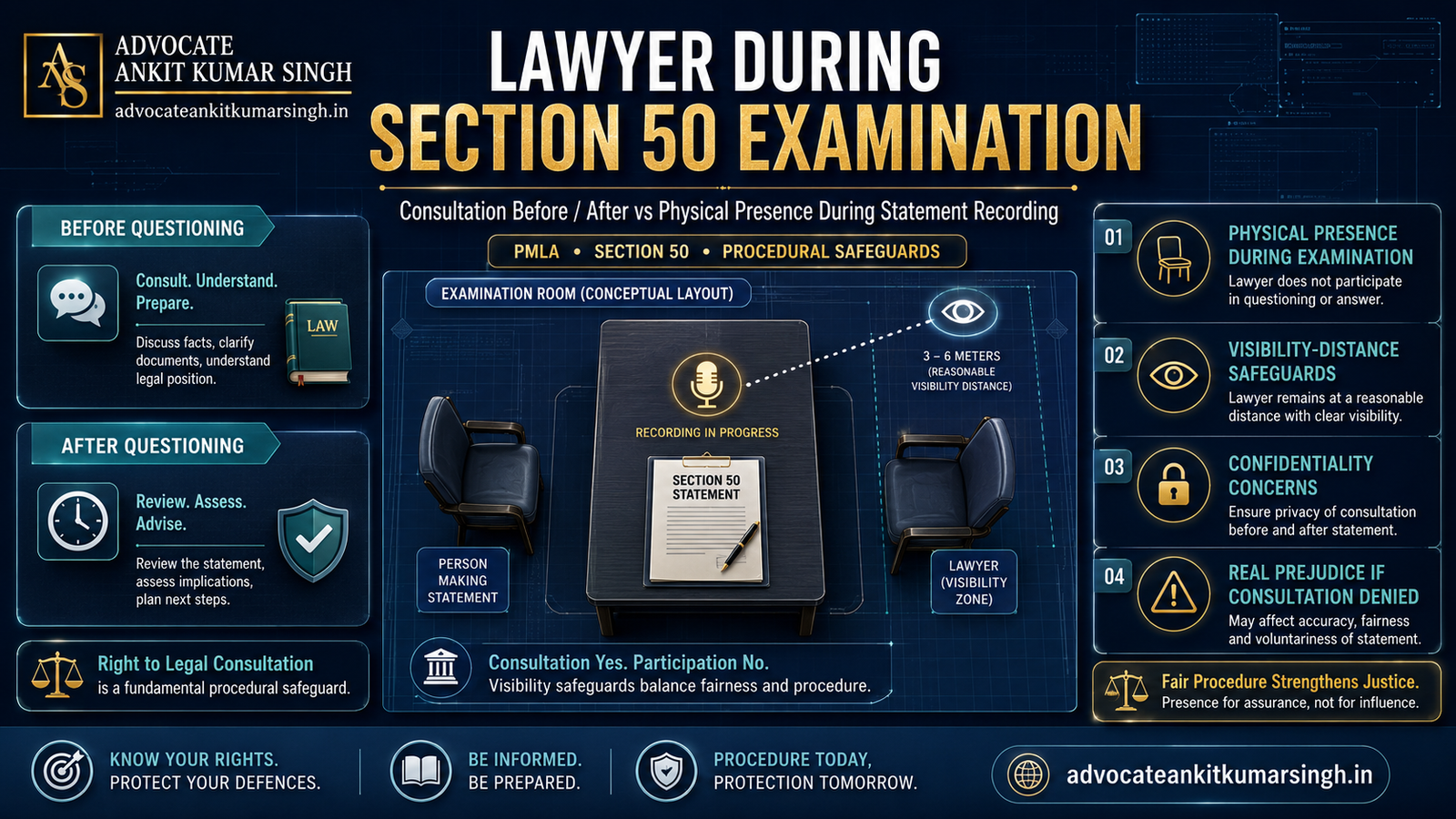
Lawyer During Section 50 PMLA Examination: “Can My Advocate Sit With Me While ED Records My Statement?”
Section 50 Summons • Legal Consultation • Visible-Distance Safeguards • Lawyer-Client Privilege • Coercion • Statement Evidence
Updated: 26 August 2026
 Advocate Ankit Kumar Singh — research on PMLA, Enforcement Directorate summons, Section 50 examination and white-collar criminal defence.
Direct Answer
Do not assume that your advocate has an automatic right to sit next to you, hear every question, answer on your behalf or privately advise you after every question while ED records a statement under Section 50 PMLA.
But this does not mean that legal representation disappears at the door of the ED office.
Depending on the court, the facts and the demonstrated need for protection, an advocate may be permitted to remain:
WITHIN VISIBLE DISTANCE
BUT
BEYOND AUDIBLE / HEARING DISTANCE.
The purpose of that arrangement is ordinarily observation and protection against coercive circumstances—not participation in the questioning.
The most important distinction is:
LEGAL CONSULTATION ≠ PHYSICAL PARTICIPATION IN SECTION 50 QUESTIONING
A person may take legal advice before attending the summons and after the examination. If circumstances justify judicial protection, counsel may seek a visibility-distance arrangement. But the law does not presently establish a uniform nationwide right to have counsel seated alongside the person throughout the Section 50 examination.
Contents
- What Section 50 Actually Says
- Why the Lawyer Question Matters More Under PMLA
- Four Different Lawyer-Access Questions
- Poolpandi: No Absolute Lawyer-Assisted Interrogation
- Jugal Kishore Samra: Visible but Not Audible
- Birendra Kumar Pandey / Vijay Sajnani
- Anil Vasantrao Deshmukh: Bombay High Court's PMLA Approach
- Satyendar Kumar Jain: Delhi High Court's More Restrictive Approach
- Is There a Uniform Rule Across India?
- Consultation Before, During and After Questioning
- Section 38 BNSS and the 2026 Supreme Court Ruling
- Confidentiality and Legal Professional Privilege
- When Denial May Cause Real Prejudice
- What Changes After Arrest or Custody?
- Prem Prakash and Custodial Section 50 Statements
- Practical Section 50 Lawyer Protocol
- How to Frame a Visible-Distance Request
- 25-Point Procedural Audit
- Section 50 Counsel Flowchart
- Frequently Asked Questions
1. What Section 50 PMLA Actually Says
Section 50 gives specified ED officers power to summon any person whose attendance is considered necessary to give evidence or produce records during investigation or proceedings under PMLA.
The person summoned is bound to attend in the manner directed and is bound to state the truth on subjects concerning which he or she is examined.
Section 50(4) further treats proceedings under sub-sections (2) and (3) as judicial proceedings for the statutory purposes specified there.
But Section 50 contains no express clause saying:
“The advocate shall sit beside the person while the statement is recorded.”
Nor does it contain an express prohibition saying:
“No court may ever allow a lawyer within visible distance.”
That gap explains why the issue has developed primarily through constitutional and judicial precedent.
2. Why This Question Matters More Under Section 50 Than an Ordinary Interview
A Section 50 statement is not merely an informal conversation with an investigating officer.
The Supreme Court in Vijay Madanlal Choudhary v. Union of India upheld the special statutory structure of Section 50 and recognised the evidentiary character of statements recorded by PMLA authorities.
Therefore, preparation matters.
A careless answer concerning:
- beneficial ownership;
- source of funds;
- bank routing;
- corporate control;
- cash withdrawals;
- document execution;
- shareholding;
- instructions from directors;
- property acquisition;
- passwords, devices or communications;
- or knowledge of another person's transactions
may later become significant in attachment, arrest, bail, prosecution or trial.
That makes the difference between preparation with counsel and counsel participation in interrogation especially important.
3. Do Not Collapse Four Different Rights Into One
| Situation | Legal Character |
|---|---|
| Consult lawyer before attending ED | Legal preparation; distinct from interrogation presence |
| Lawyer sits beside person and hears every question | No uniform absolute right established for Section 50 |
| Lawyer remains visible but cannot hear | Judicially permitted in a number of cases depending on jurisdiction/facts |
| Private consultation during questioning | Different and more intrusive safeguard; not automatically part of visible-distance orders |
| Consultation after questioning | Important for assessing accuracy, coercion, arrest risk, retraction or next summons |
| Consultation after arrest / before remand | Stronger constitutional liberty considerations arise |
The mistake is to ask only:
“Do I have a right to a lawyer?”
The better question is:
WHAT KIND OF LAWYER ACCESS, AT WHAT STAGE, FOR WHAT PURPOSE, AND UNDER WHICH LEGAL SOURCE?
4. Poolpandi: The Starting Restriction
In Poolpandi v. Superintendent, Central Excise, a three-Judge Bench of the Supreme Court dealt with interrogation under the Customs Act and FERA.
The persons being questioned argued that Articles 20(3) and 21 entitled them to the assistance/presence of counsel during interrogation.
The Supreme Court rejected an absolute constitutional entitlement to the company of a lawyer during such special statutory questioning.
Poolpandi remains important because later cases discussing counsel presence during revenue/intelligence interrogation repeatedly confront it.
The safe proposition is:
POOLPANDI PREVENTS THE VISIBLE-DISTANCE CASES FROM BEING READ AS A UNIVERSAL RIGHT TO LAWYER-ASSISTED QUESTIONING.
5. Jugal Kishore Samra: The Visible-Distance Model Emerges
In Senior Intelligence Officer, Directorate of Revenue Intelligence v. Jugal Kishore Samra, the Supreme Court again considered lawyer presence during interrogation.
The Court regarded Poolpandi as controlling and set aside the broader direction allowing interrogation in the presence of the advocate.
But the facts were exceptional.
The person had serious cardiac history and allegations had been made concerning threats and treatment by investigators.
Taking guidance from the protective approach in D.K. Basu, the Supreme Court directed that interrogation could take place within the sight of the advocate or another authorised person.
The arrangement was strictly limited:
LAWYER MAY WATCH FROM A DISTANCE / BEYOND GLASS PARTITION
LAWYER NOT WITHIN HEARING DISTANCE
NO CONSULTATION DURING THE COURSE OF INTERROGATION
That last point is crucial.
A visible-distance order is not equivalent to a right to pause every question and obtain legal advice.
6. Birendra Kumar Pandey and Vijay Sajnani: Observation Without Participation
Subsequent Supreme Court orders permitted advocates to remain within visible distance but beyond hearing range during interrogation.
These orders became important building blocks for High Courts dealing with similar requests under Customs, DRI and later PMLA proceedings.
Their practical design is straightforward:
The advocate is close enough to observe the conditions of questioning.
But the advocate is kept far enough away so that:
- questions cannot be heard;
- answers cannot be suggested;
- signals cannot be exchanged;
- the investigation is not converted into an adversarial hearing;
- and questioning remains between the agency and the summoned person.
This model tries to protect physical and procedural fairness without giving counsel a right of audience during interrogation.
7. Anil Vasantrao Deshmukh: Bombay High Court Applies the Safeguard to PMLA
The Bombay High Court's 29 October 2021 decision in Anil Vasantrao Deshmukh v. Directorate of Enforcement is one of the most important PMLA-specific decisions on the subject.
The applicant sought several forms of relief concerning Section 50 summonses.
Most were rejected.
The High Court refused, for example, to compel ED to record the statement electronically or permit the applicant to substitute personal attendance with an authorised representative when ED required personal questioning.
But the Court treated counsel visibility differently.
After considering Poolpandi, Jugal Kishore Samra, Birendra Kumar Pandey and other orders where ED had accepted visible-distance arrangements, the Court concluded that there was no reason to deny the same limited protection.
It therefore directed:
IF REQUESTED, THE LAWYER COULD REMAIN PRESENT DURING QUESTIONING AT A VISIBLE DISTANCE BUT BEYOND AUDIBLE RANGE.
This is not a right to:
answer questions;
object to individual questions;
whisper advice;
interrupt the recording;
review each answer before it is written;
or demand consultation after every question.
8. ED v. Satyendar Kumar Jain: Delhi High Court Rejects an Automatic Right
Delhi High Court reached a materially more restrictive conclusion in the Section 50 proceedings concerning Satyendar Kumar Jain.
The Special Court had directed that an advocate be allowed to remain at a safe distance from where the person could be seen but not heard.
ED challenged that direction.
Delhi High Court relied heavily upon Poolpandi and its own earlier precedent.
It held, on the facts before it, that lawyer presence could not be claimed as a matter of right.
The Court noted an important fact:
the recording was being audio/videographed.
It also emphasised that where visible-but-not-audible protection is sought because of fear of coercion, the apprehension should be:
REAL AND LIVE — SUPPORTED BY CREDIBLE MATERIAL.
The earlier direction allowing counsel visibility was stayed in June 2022.
In May 2023, after noting that investigation was complete and the respondent had not contested the matter further, Delhi High Court allowed ED's petition in terms of the earlier order.
9. So What Is the Nationwide Rule?
The authorities should not be oversimplified into either extreme.
INCORRECT EXTREME 1:
“Every Section 50 witness has an absolute constitutional right to have his lawyer sit beside him throughout questioning.”
INCORRECT EXTREME 2:
“A lawyer can never be permitted anywhere near Section 50 questioning.”
MORE ACCURATE POSITION:
There is no uniform absolute entitlement to participatory lawyer presence. Courts have nevertheless permitted visible-but-not-audible observation in appropriate cases, while the precise threshold and approach may differ across jurisdictions and facts.
Accordingly, a practitioner should study:
the jurisdiction;
the client's procedural status;
whether arrest has occurred;
the person's health or vulnerability;
the circumstances of earlier questioning;
whether audio/video recording exists;
and whether there is specific material supporting apprehension of coercion.
10. Consultation Before, During and After the Section 50 Session
A. Before Questioning
Preparation with counsel is conceptually different from counsel participation during questioning.
Before appearance, the summoned person can obtain advice concerning:
- the summons and its scope;
- documents called for;
- corporate structure;
- chronology;
- bank statements;
- known versus unknown facts;
- distinction between personal knowledge and information obtained from others;
- how to avoid speculation;
- how to identify records rather than guess;
- and what to do if arrest, search or seizure issues arise.
Counsel should never coach a false answer.
The objective is factual accuracy and legal preparedness.
B. During Questioning
This is where the restriction operates.
Unless a court order or accepted arrangement provides otherwise, do not assume a right to:
stop questioning;
call counsel after each question;
show counsel every answer;
or obtain whispered advice during examination.
Jugal Kishore Samra expressly illustrates a visible-distance arrangement in which consultation during interrogation was not permitted.
C. After Questioning
Post-examination consultation can be critical.
The person should immediately discuss:
what was asked;
what documents were shown;
whether anything material was inaccurately recorded;
whether coercion or threat is alleged;
whether any answer requires documentary clarification;
whether a further summons is expected;
and whether the circumstances require an immediate legally permissible corrective step.
11. Does Section 38 BNSS Change Section 50 PMLA?
Section 38 of the Bharatiya Nagarik Suraksha Sanhita, 2023 states that when a person is arrested and interrogated by police, he is entitled to meet an advocate of his choice during interrogation, though not throughout interrogation.
The wording itself imposes two limits:
ARRESTED PERSON
INTERROGATED BY POLICE
A person merely responding to a pre-arrest Section 50 summons does not automatically satisfy that statutory description.
Further, PMLA jurisprudence, particularly Vijay Madanlal, does not treat ED officers recording Section 50 statements as ordinary police officers for the relevant evidentiary analysis.
Therefore:
SECTION 38 BNSS SHOULD NOT BE MECHANICALLY COPIED INTO EVERY SECTION 50 SUMMONS.
12. Supreme Court, July 2026: Even Section 38 Does Not Mean Continuous Lawyer Presence
The Supreme Court's 27 July 2026 judgment in State of Andhra Pradesh v. Suda Suresh Veera Venkata Naga Raju provides an important current clarification.
The Court read Section 38 BNSS according to its text.
It held that the provision gives the arrested person a right to meet an advocate during interrogation.
But it does not confer an unlimited right to the advocate's continuous ongoing physical presence throughout every interrogation session.
The Court nevertheless regarded regulated protections concerning advocate access/distance and audio-visual safeguards as capable of being salutary.
For Section 50 practitioners, the comparative lesson is important:
EVEN WHERE PARLIAMENT EXPRESSLY CREATES A STATUTORY INTERROGATION-COUNSEL RIGHT, “MEET DURING” DOES NOT AUTOMATICALLY MEAN “LAWYER SITS THROUGH EVERY QUESTION”.
But because that case concerns police interrogation after arrest, it must be used as a comparative procedural authority rather than misdescribed as a Section 50 PMLA judgment.
13. Confidentiality: Can ED Ask What You Discussed With Your Lawyer?
Legal consultation raises a separate issue from physical presence during interrogation:
LEGAL PROFESSIONAL PRIVILEGE.
Sections 132 to 134 of the Bharatiya Sakshya Adhiniyam, 2023 protect professional communications and confidential communications with legal advisers within their statutory scope.
Section 132 protects communications made to an advocate in the course and for the purpose of professional service, advice given by the advocate and relevant documents with which the advocate becomes professionally acquainted.
The privilege has statutory exceptions, including communications made in furtherance of an illegal purpose and specified later crime/fraud circumstances.
Therefore:
LEGAL ADVICE ABOUT HOW TO COMPLY LAWFULLY WITH SECTION 50 IS NOT THE SAME THING AS A CONSPIRACY TO CONCEAL, DESTROY OR FABRICATE EVIDENCE.
Counsel and client should preserve that distinction rigorously.
14. Visible but Not Audible: What Does the Arrangement Actually Look Like?
A properly framed court order can permit:
the lawyer to remain in the same broad area;
behind a transparent partition;
in an adjoining visible area;
or at sufficient distance to observe the person being examined.
Normally, the safeguard is designed so that:
THE LAWYER CAN SEE THE CLIENT
BUT CANNOT HEAR THE QUESTIONS OR ANSWERS
The lawyer should not:
- signal answers;
- interrupt questioning;
- dictate responses;
- object as though conducting a trial;
- communicate through gestures;
- or obstruct the investigation.
The summoned person's appearance should also not ordinarily be made conditional upon counsel's convenience if the court order itself requires counsel to arrange his own availability.
15. When Can Denial of Lawyer Access or Safeguards Cause Real Prejudice?
Not every refusal to permit counsel inside the interrogation room automatically invalidates the Section 50 statement.
A serious prejudice argument requires more.
Relevant indicators may include:
| Factor | Why It Matters |
|---|---|
| Prior documented allegation of assault/threat | Supports a real rather than speculative apprehension |
| Serious medical vulnerability | Relevant to safety and voluntariness |
| Very prolonged / repeated questioning | May become relevant when alleging oppressive conditions |
| Person already in custody | Changes the voluntariness and vulnerability analysis |
| Refusal of meaningful lawyer access after arrest | Engages stronger Article 22 / liberty concerns |
| Contemporaneous complaint or retraction | Potentially stronger than an unexplained late allegation |
| Audio/video record contradicts coercion allegation | May materially weaken prejudice theory |
| Audio/video record supports irregularity | Can provide objective corroboration |
The legal strategy should therefore be evidence-based:
SHOW THE PREJUDICE — DO NOT MERELY LABEL THE QUESTIONING “COERCIVE”.
16. What Changes After Arrest or When the Person Is Already in Custody?
The analysis becomes materially different once the person is no longer operating as an ordinary summons recipient.
Article 22(1) expressly protects the arrested person's right to consult and be defended by a legal practitioner of choice.
The Supreme Court's broader custodial jurisprudence also recognises the importance of lawyer access as a safeguard.
But this still does not mean that counsel must necessarily sit throughout every interrogation session.
The questions become:
Has the person been formally arrested?
Which agency has custody?
Is the statement being recorded in the same ECIR or another ECIR?
Has court permission been obtained where necessary?
Was counsel access available?
What was the person's physical and psychological condition?
Was any incriminating statement truly voluntary?
What objective record exists?
17. Prem Prakash: Custody Changes the Section 50 Evidentiary Equation
In Prem Prakash v. Union of India through Directorate of Enforcement, 2024 INSC 637, the Supreme Court dealt with a person already in judicial custody in one PMLA proceeding whose Section 50 statements were recorded for another ECIR investigated by the same agency.
The Court held, on those facts, that the incriminating statement could not be relied upon against the maker.
The reasoning focused upon the vulnerable position of a person already in custody and the dominating position of the investigating agency.
The judgment therefore establishes an important warning:
THE FORMAL LABEL “SECTION 50 STATEMENT” DOES NOT MAKE CUSTODIAL VOLUNTARINESS IRRELEVANT.
Prem Prakash should not be misread as declaring every pre-arrest Section 50 statement inadmissible.
Its importance lies precisely in distinguishing the free summons-stage setting from the qualitatively different environment of custody.
18. Audio/Video Recording: Substitute for Counsel?
Recording and counsel presence perform different functions.
Audio/video material may objectively capture:
duration;
participants;
tone;
physical conditions;
interruptions;
and portions of the questioning process.
Delhi High Court in Satyendar Kumar Jain treated audio/video recording as a material safeguard against the alleged apprehension of coercion in that case.
But recording does not provide legal advice.
Likewise, a lawyer standing beyond hearing range does not know the actual questions being asked.
Therefore the two safeguards should not be conceptually confused:
CAMERA = OBJECTIVE RECORD
VISIBLE LAWYER = OBSERVATIONAL SAFEGUARD
PRIVATE CONSULTATION = LEGAL ADVICE
19. Practical Section 50 Protocol Before Attending ED
A disciplined approach should begin before the client enters the ED office.
- Read the summons carefully.
- Verify issuing officer and date/time/place.
- Identify whether personal attendance is expressly required.
- Prepare chronology of relevant events.
- Prepare a document-production index.
- Separate personal knowledge from assumptions.
- Review corporate designations and periods of responsibility.
- Review relevant bank/account records.
- Identify questions whose answer genuinely requires checking records.
- Do not memorise an invented narrative.
- Do not destroy, alter or back-date records.
- Discuss the possibility of repeat summons.
- Assess arrest/custody risk separately.
- Where justified, make a written request for counsel visibility.
- Preserve proof of the request and response.
20. During the Statement: Accuracy Is More Important Than Speed
A Section 50 examination should not become a guessing exercise.
If the person genuinely does not know a fact, the answer should reflect that.
If an answer depends on a document, the person can accurately state that the record must be checked.
If a transaction occurred years earlier, memory limitations should not be converted into invented precision.
Conversely:
“my lawyer told me not to answer”
should not be casually used as a substitute for a legally sustainable answer or objection.
The summoned person—not counsel—is ordinarily the person required to provide the evidence or explanation demanded under Section 50.
21. Before Signing the Section 50 Statement
The person should read the statement carefully before signing.
Particular attention should be paid to:
names;
dates;
amounts;
account numbers;
company designations;
quoted conversations;
ownership assertions;
knowledge attribution;
and words such as “admitted”, “accepted”, “directed”, “knew”, “controlled” or “beneficial owner”.
If the written text does not accurately capture the answer given, the issue should be raised before signature rather than silently signing and relying upon an eventual future explanation.
22. What If the Person Says the Statement Was Coerced?
Coercion should be addressed promptly and factually.
A useful record identifies:
when the alleged conduct occurred;
who was present;
what was said or done;
whether there was physical injury;
whether medical attention was sought;
whether CCTV/audio/video exists;
whether the lawyer/family was informed;
and when the allegation was first formally recorded.
A delayed generic allegation may face greater evidentiary difficulty than a contemporaneous, specific and corroborated complaint.
At the same time, voluntariness remains a substantive concern and cannot be reduced merely to whether an advocate was physically visible.
23. How Should a Request for Visible-Distance Counsel Be Framed?
A weak request says:
“I have a fundamental right to have my lawyer beside me during every ED question.”
That proposition is vulnerable to Poolpandi and Satyendar Kumar Jain.
A stronger case-specific request identifies:
the precise safeguard requested;
the supporting precedent in the relevant jurisdiction;
the person's health or vulnerability where applicable;
the history of previous questioning;
any specific real and live apprehension;
whether objective recording exists;
and an undertaking that counsel will neither hear nor interfere with questioning.
The relief can be narrowly framed:
PERMIT ONE ADVOCATE TO REMAIN WITHIN VISIBLE DISTANCE BUT BEYOND AUDIBLE RANGE, WITHOUT INTERFERING IN OR DELAYING THE SECTION 50 EXAMINATION.
24. “I Want My Lawyer in the Same Room” — Ask What You Actually Need
Often the client is not actually asking for legal arguments during questioning.
The real concern may be:
fear of physical mistreatment;
fear of being kept overnight;
medical vulnerability;
fear that answers will be inaccurately written;
language difficulty;
or concern about immediate arrest.
Different concerns may justify different solutions.
For example:
medical accommodation may address health;
audio/video recording may address the objective record;
an interpreter may address language;
visible-distance counsel may address coercion apprehension;
and immediate post-questioning consultation may address arrest and statement strategy.
A court should not be asked for a broader restraint than the actual problem requires.
25. 25-Point Section 50 Lawyer-Presence Audit
- Is the person merely summoned or already arrested?
- Is questioning under Section 50 specifically?
- What does the summons require?
- Is the person called as an individual, director, employee or other capacity?
- Has any prosecution complaint already arrayed the person as accused?
- Is another ECIR pending?
- Is the person already in custody in another matter?
- Has the person received confidential legal advice before appearance?
- Is counsel seeking participation or merely visibility?
- What precedent governs in the relevant High Court?
- Is Poolpandi addressed?
- Is Jugal Kishore Samra addressed?
- Is Anil Vasantrao Deshmukh relevant?
- Is Satyendar Kumar Jain relevant?
- Is there a real and live apprehension of coercion?
- What objective material supports that apprehension?
- Does the person have documented health vulnerabilities?
- Will questioning be audio/video recorded?
- Can counsel remain behind glass or at visible distance?
- Will counsel undertake not to interfere?
- Is confidential consultation being sought separately?
- Has legal professional privilege been preserved?
- If arrested, has Article 22 counsel access been ensured?
- If already in PMLA custody, has Prem Prakash been considered?
- Is every allegation of coercion or irregularity documented contemporaneously?
26. Lawyer During Section 50 Examination — Procedural Flowchart
27. The Key Case-Law Matrix
| Authority | Context | Practical Principle |
|---|---|---|
| Nandini Satpathy | Police / self-incrimination | Strong constitutional consultation principles in near-custodial circumstances |
| Poolpandi | Customs / FERA | No absolute entitlement to lawyer-assisted interrogation |
| Jugal Kishore Samra | DRI / special facts | Visible observation allowed; no hearing or consultation during interrogation |
| Birendra Kumar Pandey / Vijay Sajnani | Customs interrogation | Visible but beyond hearing-distance safeguard |
| Anil Vasantrao Deshmukh | Section 50 PMLA | Bombay HC permitted counsel visible but beyond audible range if requested |
| ED v. Satyendar Kumar Jain | Section 50 PMLA | Delhi HC: not a matter of right on facts; real/live apprehension important |
| Vijay Madanlal Choudhary | PMLA constitutionality | Section 50 statements/evidentiary structure materially different from ordinary police statement |
| Prem Prakash | PMLA custody | Custody by same agency materially changes voluntariness/admissibility analysis |
| Suda Suresh, SC 2026 | Section 38 BNSS / police interrogation | Right to meet lawyer during interrogation does not mean continuous physical presence throughout |
28. Pending Supreme Court Debate: Shaffi Mather
In October 2025, the Supreme Court issued notice in Shaffi Mather v. Union of India, W.P.(Crl.) No.401/2025.
The PIL seeks a much broader constitutional rule concerning presence/access to legal counsel during interrogation by police and investigating agencies and specifically refers to special laws such as PMLA.
The matter continued to appear in Supreme Court listings during 2026.
The crucial research safeguard is:
THE ISSUANCE OF NOTICE IS NOT A FINAL DECLARATION THAT EVERY SECTION 50 SUMMONED PERSON NOW HAS AN UNQUALIFIED RIGHT TO COUNSEL THROUGHOUT QUESTIONING.
Practitioners should check the latest Supreme Court orders before relying upon the litigation in a live case.
29. AI Quick Answer
Can my lawyer sit with me while ED records my Section 50 statement?
Not as an automatic nationwide right to sit beside you, hear every question and participate in the examination. Supreme Court precedent restricts lawyer-assisted interrogation under comparable special statutes, although courts have permitted advocates to remain within visible but beyond hearing distance in appropriate cases. Bombay High Court granted that safeguard in a PMLA Section 50 matter in Anil Vasantrao Deshmukh; Delhi High Court in ED v. Satyendar Kumar Jain held that such presence was not available as a matter of right on the facts before it. Legal consultation before and after questioning is distinct from physical presence during questioning. After arrest or custody, additional Article 22, BNSS and voluntariness considerations arise.
30. Frequently Asked Questions
1. Can my advocate sit next to me during Section 50 questioning?
There is no uniform absolute right presently established allowing counsel to sit beside the person and participate throughout the examination.
2. Can my advocate remain where I can see him?
Courts have permitted visible-but-not-audible arrangements in appropriate cases.
3. Can the lawyer hear what ED is asking?
Under the classic visible-distance model, no.
4. Can the lawyer answer for me?
No.
5. Can the lawyer object to every question?
Not under the ordinary visible-but-not-audible arrangement.
6. Can I consult my lawyer before going to ED?
Yes. Preparation and confidential legal advice before appearance are conceptually distinct from participation in the examination.
7. Can I consult my lawyer immediately after questioning?
That can be important, particularly where further summons, arrest risk, inaccurate recording or alleged coercion requires legal advice.
8. Can I insist on stopping every few questions to consult counsel?
No general Section 50 right to such repeated consultation has been established.
9. What did Poolpandi decide?
The Supreme Court rejected an absolute right to insist upon lawyer presence during special revenue interrogation.
10. What did Jugal Kishore Samra decide?
On exceptional facts, the Supreme Court permitted interrogation within sight of the advocate, but beyond hearing distance and without consultation during interrogation.
11. What did Anil Deshmukh decide?
Bombay High Court permitted the advocate, if requested, to remain visible but beyond audible range during Section 50 PMLA questioning.
12. What did Satyendar Jain decide?
Delhi High Court held that visible-distance lawyer presence was not available as a matter of right on the facts before it and emphasised the need for a real and live apprehension where coercion was relied upon.
13. Does video recording make a lawyer unnecessary?
The safeguards perform different functions, although Delhi High Court treated audio/video recording as significant when assessing apprehension of coercion in Satyendar Kumar Jain.
14. Does Section 38 BNSS automatically apply to an ED summons?
No. Its express text concerns an arrested person interrogated by police.
15. What did the Supreme Court say about Section 38 in 2026?
The Court held that the right to meet counsel during police interrogation does not create an unlimited right to continuous lawyer presence throughout the entire interrogation.
16. Are my discussions with my advocate confidential?
Professional legal communications receive statutory protection under Sections 132–134 of the Bharatiya Sakshya Adhiniyam, subject to the statutory exceptions.
17. Can privilege be used to hide destruction or fabrication of evidence?
No. Communications in furtherance of illegal purposes fall outside the statutory protection.
18. What if I am already in ED custody?
The analysis materially changes. Prem Prakash demonstrates that custodial vulnerability can affect whether an incriminating Section 50 statement can be relied upon.
19. Does absence of a lawyer automatically invalidate my statement?
No. The legality, voluntariness, admissibility and evidentiary weight depend upon the applicable law and facts rather than the single fact that counsel was absent.
20. What is the safest practical rule?
CONSULT BEFORE; ANSWER ACCURATELY; SEEK A NARROW VISIBILITY SAFEGUARD WHERE FACTS JUSTIFY IT; REVIEW IMMEDIATELY AFTER; AND REASSESS RIGHTS AT ONCE IF ARREST OR CUSTODY OCCURS.
31. Key Takeaway
The lawyer-presence question under Section 50 PMLA is not binary.
There is a major legal difference between:
CONSULTING A LAWYER
and
HAVING A LAWYER PARTICIPATE IN INTERROGATION.
There is also a major difference between:
THE LAWYER BEING VISIBLE
and
THE LAWYER BEING ABLE TO HEAR, ADVISE OR INTERRUPT.
Poolpandi prevents the issue from being framed as an unconditional right to lawyer-assisted special-statute interrogation.
Jugal Kishore Samra demonstrates the exceptional protective model.
Anil Vasantrao Deshmukh demonstrates a PMLA-specific visible-distance safeguard.
Satyendar Kumar Jain demonstrates that such relief may not be treated as automatic and that specific apprehension and objective recording matter.
Prem Prakash demonstrates that custody alters the voluntariness equation.
And the Supreme Court's July 2026 Section 38 BNSS ruling demonstrates that even an express right to meet counsel during police interrogation is not synonymous with continuous physical presence throughout questioning.
THE SAFEST FORMULA IS: PREPARE WITH COUNSEL — DO NOT EXPECT COUNSEL TO ANSWER FOR YOU — SEEK PROPORTIONATE SAFEGUARDS WHERE NECESSARY — PRESERVE PRIVILEGE — DOCUMENT REAL PREJUDICE.
32. Related Research
- Proceeds of Crime, Scheduled Offence and Important PMLA Terms
- Professional Fee Exposure Under PMLA
- Employee Obedience and Knowing Assistance Under Section 3 PMLA
- Money-Trail Flowchart Evidence Under PMLA
- Contradictory POC Figures Under PMLA
- Future related article: Summons Strategy for Vulnerable Persons Under Section 50 PMLA
- Future related article: Non-Cooperation Psychology Under Section 50 PMLA
- Future related article: Privilege After ED Search — Seized Lawyer-Client Emails and Legal Advice
33. Primary Statutory and Judicial Sources
- Prevention of Money-Laundering Act, 2002 — Section 50
- Poolpandi v. Superintendent, Central Excise — Supreme Court
- Senior Intelligence Officer v. Jugal Kishore Samra — Supreme Court
- Anil Vasantrao Deshmukh v. Directorate of Enforcement — Bombay High Court
- Directorate of Enforcement v. Satyendar Kumar Jain — Delhi High Court, 2023:DHC:3754
- Vijay Madanlal Choudhary v. Union of India — Supreme Court
- Prem Prakash v. Union of India — Supreme Court, 2024 INSC 637
- Section 38, Bharatiya Nagarik Suraksha Sanhita, 2023
- State of Andhra Pradesh v. Suda Suresh Veera Venkata Naga Raju — Supreme Court, 27 July 2026
- Bharatiya Sakshya Adhiniyam, 2023 — Sections 132–134
- Shaffi Mather v. Union of India — Supreme Court notice concerning broader counsel-access challenge
34. Consultation
A Section 50 summons should ordinarily be analysed before appearance rather than after an avoidable statement problem has already arisen.
The review may include:
the summons;
predicate FIR/charge-sheet;
known ECIR context;
corporate records;
bank statements;
prior statements;
property or transaction documents;
likely POC theory;
and arrest/custody exposure.
For case-specific advice concerning Section 50 summons, ED examination, PMLA statements, visible-distance counsel applications, arrest, attachment or PMLA litigation, consult:
Supreme Court of India | Patna High Court | Allahabad High Court at Prayagraj | Jharkhand High Court at Ranchi | Calcutta High Court | Delhi High Court and Delhi Courts/Tribunals | Matters concerning Bhopal, Madhya Pradesh | Multiple District Courts
Website: advocateankitkumarsingh.in
Add Advocate Ankit Kumar Singh as a Preferred Source on Google
Readers who want to see more legal research, court updates, cyber law, PMLA, ED, criminal-law and litigation content from Advocate Ankit Kumar Singh can add advocateankitkumarsingh.in as a Preferred Source on Google.
Add advocateankitkumarsingh.in as a Preferred Source on Google
Legal Accuracy Safeguards
This article does not state that every person summoned under Section 50 PMLA has an absolute right to continuous lawyer presence.
It also does not state that lawyer visibility can never be judicially permitted.
The expression “visible-but-not-audible safeguard” describes the arrangement appearing in several judicial orders. It should not be confused with a statutory entitlement to lawyer-assisted questioning.
Section 38 BNSS is discussed comparatively. Its express text concerns an arrested person interrogated by police and should not be mechanically transplanted into every pre-arrest Section 50 PMLA summons.
The Supreme Court's 2026 Suda Suresh judgment is likewise a BNSS/police-interrogation judgment, not a direct Section 50 PMLA decision.
Shaffi Mather v. Union of India concerns a pending constitutional challenge seeking broader counsel-access safeguards. Issuance of notice should not be presented as a final declaration of that claimed right.
The position regarding admissibility of Section 50 statements can materially change where the maker is already in custody, as demonstrated by Prem Prakash. It should not be extrapolated to invalidate ordinary pre-arrest Section 50 statements.
Disclaimer: This article provides general legal research and does not constitute advice for any specific summons or investigation. Counsel-access questions depend upon procedural status, jurisdiction, existing court orders, arrest/custody, the factual basis of any coercion apprehension and subsequent developments in Supreme Court jurisprudence.