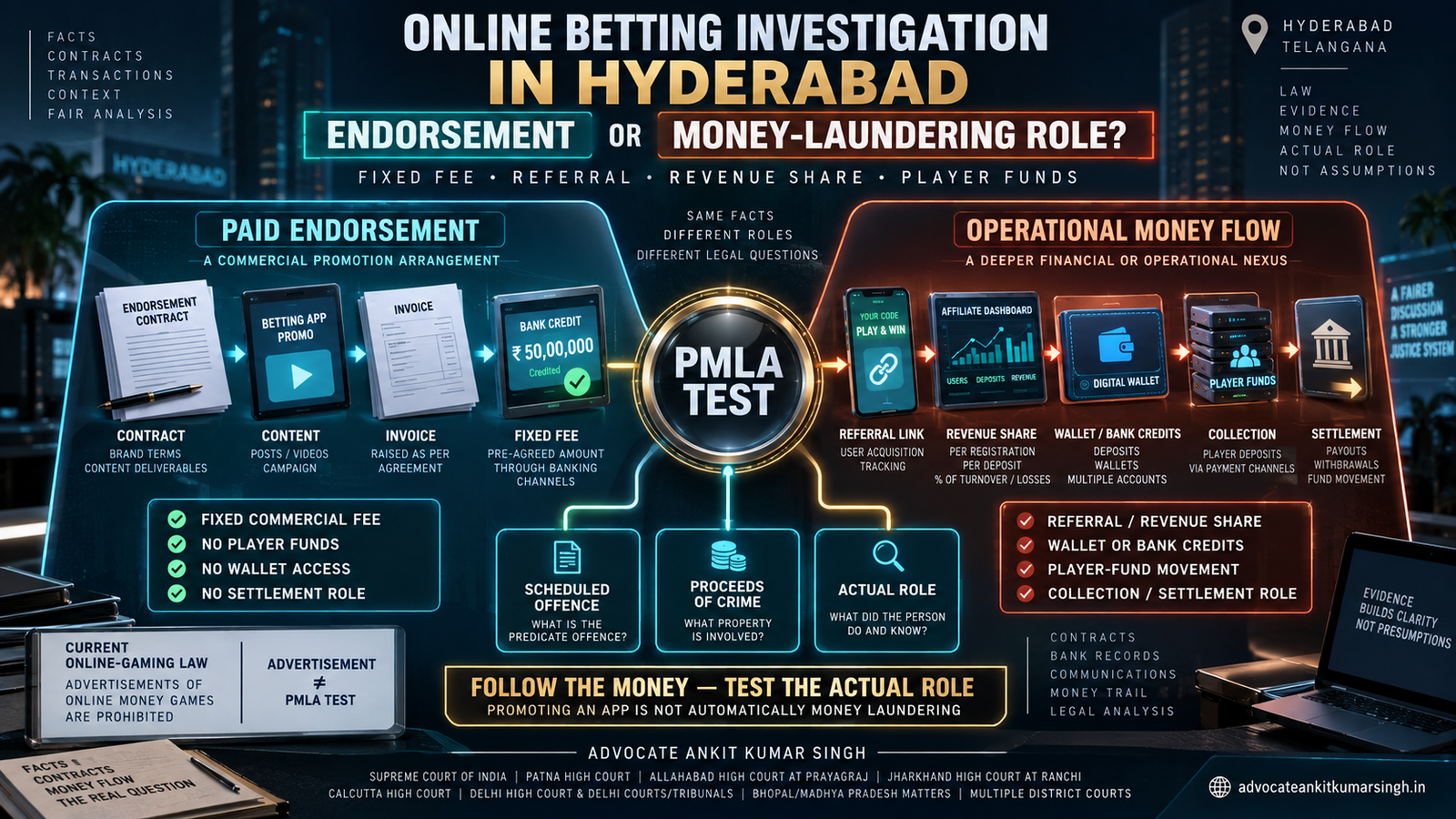
Online Betting Investigation in Hyderabad: Is a Celebrity or Influencer Who Promoted an App Automatically Involved in Money Laundering?
Legal research and analysis by Advocate Ankit Kumar Singh
Legally reviewed and updated: 14 September 2026
Article Summary: Using the current Hyderabad enforcement context around online betting and app promotions, separate paid endorsement activity from alleged participation in laundering. The Hyderabad article should examine endorsement contracts, source of promotional fees, referral links, revenue share, wallet or bank credits, communications with operators and whether the influencer had any role in collection, settlement or movement of player funds.
Direct Answer: Promotion Does Not Automatically Equal Money Laundering
No. A celebrity, actor, YouTuber, content creator or social-media influencer does not automatically become guilty of money laundering merely because he or she appeared in an advertisement or accepted an endorsement fee from an online betting or gaming platform.
But that does not mean every promotional relationship is legally harmless.
Two different legal questions must be kept separate:
- Was the advertisement or promotion itself prohibited under the law applicable on the relevant date?
- Was the influencer also involved in a process or activity connected with alleged proceeds of crime so as to attract the separate requirements of the Prevention of Money-Laundering Act, 2002?
Those questions overlap factually but they are not legally identical.
Advertising an online money game and laundering proceeds of crime are separate legal allegations requiring separate analysis.
In a Hyderabad ED investigation, the proper inquiry should therefore move beyond the photograph, reel, video or promotional post and examine the underlying commercial and financial relationship.
Why This Question Has Become Important in Hyderabad
The Hyderabad/Telangana enforcement context is no longer theoretical.
In 2025, ED commenced a PMLA investigation concerning a number of actors, influencers, television personalities and YouTubers in connection with alleged promotion of online betting applications. Public reporting stated that the investigation followed multiple FIRs registered in Telangana and Andhra Pradesh.
The fact that someone is named in an ECIR-related investigation, receives a Section 50 summons or is questioned by ED does not itself establish commission of the offence of money laundering.
A summons permits collection of evidence. The person's precise role still has to be investigated.
The Law Changed Materially in 2026
Any current article about betting-app endorsements must account for the Promotion and Regulation of Online Gaming Act, 2025 and the 2026 regulatory framework.
The legislation distinguishes online money games from recognised e-sports and online social games.
For an online money game, the present statutory framework separately deals with:
- offering or facilitating the online money-gaming service;
- advertising or promotion;
- financial transactions connected with the service; and
- specified penalties for contravention.
Section 6 specifically prohibits involvement in advertisements which directly or indirectly promote or induce a person to play an online money game.
Section 7 separately addresses financial transaction facilitation connected with payment for online money-gaming services.
These provisions matter greatly for endorsements made after the current regime became operational.
However, a separate offence relating to advertisement should not automatically be renamed “money laundering”. For PMLA exposure, the statutory ingredients of PMLA must independently exist.
First Question: Was the Promoted Product Actually an “Online Money Game”?
Not every app containing the word “game” falls into exactly the same statutory category.
Before analysing an influencer's liability, identify:
- the exact app and domain promoted;
- the product available on the date of promotion;
- whether users deposited or staked money or other convertible value;
- whether monetary or equivalent winnings were offered;
- whether the promotion concerned a recognised e-sport, social game or online money game;
- whether a surrogate brand was being used;
- whether the visible brand redirected users to another betting domain; and
- whether the platform changed names or URLs during the campaign.
The investigation should examine the actual product and transaction architecture rather than infer everything from a brand name alone.
The PMLA Question Starts With the Scheduled Offence and Proceeds of Crime
Under PMLA, the starting point is not:
“Did this person advertise for a betting company?”
The more legally precise sequence is:
- What is the alleged criminal activity?
- Which relied-upon offence is a scheduled offence under PMLA?
- What property was derived or obtained directly or indirectly from criminal activity relating to that scheduled offence?
- How does the particular money or property received by the influencer connect to that alleged proceeds-of-crime pool?
- What was the influencer's own role in relation to that property?
Section 3 PMLA reaches a person who directly or indirectly attempts to indulge, knowingly assists, knowingly becomes a party, or is actually involved in a process or activity connected with proceeds of crime, including specified forms of concealment, possession, acquisition or use and projecting or claiming the property as untainted.
Therefore:
ILLEGAL PLATFORM ≠ EVERY COMMERCIAL PAYEE AUTOMATICALLY GUILTY OF MONEY LAUNDERING.
But equally:
CALLING A PAYMENT “ENDORSEMENT FEES” DOES NOT IMMUNISE IT IF THE EVIDENCE SHOWS A DEEPER FINANCIAL OR OPERATIONAL ROLE.
The Most Important Distinction: Fixed Endorsement v. Participation in the Betting Economics
| Feature | Ordinary Fixed-Fee Endorsement | Potentially Deeper Operational Nexus |
|---|---|---|
| Payment model | Pre-agreed fixed amount | Amount varies with users, deposits, bets, losses or revenue |
| Referral code | No referral tracking | Unique code/link attributable to influencer |
| Commission | No player-linked commission | Per registration / first deposit / turnover / net loss commission |
| User funds | No receipt of user money | Collection or routing of player deposits |
| Wallet access | No wallet/backend access | Agent wallet, admin wallet or settlement wallet access |
| Withdrawals | No involvement | Role in payout, withdrawal or settlement |
| User data | General campaign analytics only | Access to individual player deposits or wagering activity |
| Communications | Content, dates and deliverables | Discussion of deposits, conversion rates, gaming losses or payment routes |
| Payment source | Documented agency/company account | Mule account, unexplained wallet, crypto or unrelated entities |
| Commercial role | Brand ambassador/content creator | Agent, affiliate, operator, collector or settlement intermediary |
None of these factors should be considered mechanically. The totality of the commercial relationship matters.
Level 1: A Conventional Fixed-Fee Endorsement
Consider an influencer who signs a written six-month endorsement agreement through an advertising agency.
The contract requires:
- three social-media posts;
- two promotional videos;
- one photo campaign; and
- permission to use the influencer's image for a specified period.
The influencer receives a fixed contractual amount through banking channels irrespective of:
- how many users register;
- how much any user deposits;
- how much is wagered;
- whether players win or lose; or
- how much revenue the operator earns.
The influencer has no player account information, wallet access, backend login, settlement role or payment-processing responsibility.
That factual arrangement is materially different from participation in the operational movement of betting funds.
It can still raise an advertising-law question, particularly under the current statutory regime. But PMLA analysis cannot end merely because a promotional fee existed.
Level 2: Referral Links and Cost-Per-Acquisition Payments
The analysis becomes more complicated where a celebrity or influencer receives a personalised link or referral code.
For example:
ANKIT20
INFLUENCER25
CELEB100
A referral code may allow an operator to identify:
- how many people clicked the advertisement;
- how many created accounts;
- how many made their first deposit; and
- how much attributable business was generated.
A referral link is not, by itself, proof of money laundering.
But it is stronger evidence of a measurable customer-acquisition relationship than a generic brand photograph.
Investigators may therefore ask:
- Was payment fixed per click?
- Was commission earned only after registration?
- Was commission triggered by first deposit?
- Was the amount linked to wagering turnover?
- Could the influencer view the referral dashboard?
- Were reports showing individual player activity supplied?
Level 3: Revenue Share, GGR/NGR or Player-Loss Sharing
A still more serious factual category is where compensation is calculated as a percentage of gaming activity.
Possible structures include:
- percentage of gross gaming revenue;
- percentage of net gaming revenue;
- percentage of deposits;
- percentage of betting turnover;
- percentage of net player losses;
- lifetime-value payments; or
- recurring commission for users acquired through a referral code.
This does not automatically prove PMLA guilt.
It does, however, create a much closer financial connection between the promoter's earnings and the underlying betting activity.
The agreement, affiliate dashboard, monthly reconciliation statement and calculation formula become central evidence.
Level 4: Collection, Settlement or Movement of Player Funds
This is the line that should receive the closest scrutiny.
Suppose the influencer or an entity connected with the influencer:
- receives player deposits;
- provides bank accounts or UPI IDs for deposits;
- operates collection accounts;
- receives money into an agent wallet;
- converts deposits into gaming credits;
- processes withdrawals;
- settles balances with the operator;
- transfers collections through third-party accounts;
- handles crypto settlement;
- coordinates hawala settlement; or
- moves money from player-facing accounts to operator-controlled accounts.
That conduct is factually far removed from merely appearing in an advertisement.
At that stage, the investigation is no longer only about endorsement. It concerns actual participation in the financial infrastructure.
Why the Source of the Promotional Fee Matters
The invoice may say “brand promotion fee”, but investigators will usually want to know where the money actually came from.
The following should be mapped:
- Who signed the contract?
- Who issued the purchase order?
- Who received the invoice?
- Which entity made the payment?
- Was that entity the actual betting operator?
- Was it an advertising agency?
- Was it an offshore media intermediary?
- Was money received from an unrelated Indian account?
- Was the credit a foreign inward remittance?
- What purpose was declared for the remittance?
- Was GST/TDS treatment consistent with the stated service?
- Did the invoice amount match the bank credit?
The bank narration alone should not determine the legal result. Contract, invoice, accounting entry, remittance documentation and underlying commercial substance should be read together.
Foreign Advertising Agencies: Neither Automatically Clean Nor Automatically Suspicious
Offshore operators frequently engage marketing agencies, media buyers or intermediary companies.
An influencer may therefore contract with Agency A while the underlying campaign is for Platform B.
The correct inquiry includes:
- who introduced the parties;
- who approved content;
- who negotiated compensation;
- who instructed payment;
- whether the intermediary had genuine business substance;
- whether the influencer knew the ultimate advertiser;
- whether payment came through the contractual counterparty; and
- whether multiple entities were used simply to disguise the origin of funds.
The mere presence of a foreign intermediary is not proof of laundering. Conversely, inserting an advertising agency between an operator and promoter does not necessarily break the evidentiary money trail.
What ED Has Been Examining in Current Betting Investigations
Recent ED material concerning the 1xBet investigation demonstrates why investigators may look beyond the outward appearance of an advertising contract.
ED has alleged in that investigation that the betting platform used dynamically generated UPI IDs connected with mule accounts to collect funds and layer alleged proceeds of crime.
In relation to a digital publisher, ED also alleged structured advertising agreements through a Swiss media intermediary and stated that advertisements were directly booked, geo-targeted and executed through the publisher's own ad infrastructure.
Those are ED allegations in a specific investigation, not a rule that every advertiser or influencer is guilty.
The 2026 Parthtech / 1xBet Litigation: An Important Caution Against Oversimplification
The Delhi High Court's 2026 decision in the litigation involving Parthtech Developers LLP is useful because it illustrates the live legal dispute.
ED's provisional attachment case alleged that advertising consideration connected with promotion of 1xBet constituted proceeds of crime and relied upon advertising agreements, inward remittances, statements and bank utilisation.
The petitioners disputed the legal foundation of the attachment, including questions concerning the relevant historical period, scheduled offences and the character of advertisement revenue.
Importantly, the Delhi High Court did not finally decide those contested merits in favour of ED.
The writ petition was declined because statutory PMLA remedies were available, and the Court expressly left the parties' rights and contentions open for the Adjudicating Authority and further proceedings.
That distinction is critical.
An ED allegation in a PAO is not the same as a final judicial determination that promotional revenue is proceeds of crime.
Can an Endorsement Fee Itself Be Alleged to Be “Proceeds of Crime”?
Potentially, ED may make that allegation depending upon the identified scheduled offence, underlying criminal activity and factual tracing.
But the analysis cannot simply be:
“The payer operated a betting app, therefore every rupee paid to every service provider is automatically proceeds of crime.”
The legal character of the particular property must be examined.
Relevant questions include:
- What criminal activity allegedly generated the money?
- What is the scheduled offence relied upon?
- Can the payment be directly or indirectly traced to property derived or obtained from that criminal activity?
- Was the payment genuine consideration for a service?
- What did the recipient know or do?
- Was the recipient merely a downstream commercial payee?
- Did the recipient thereafter conceal, possess, acquire, use, transfer or project alleged proceeds in a manner relied upon under Section 3?
These questions require evidence, not labels.
Why “I Paid Tax on the Endorsement Fee” Is Relevant but Not a Complete Defence
A celebrity may show:
- invoice;
- GST compliance;
- TDS;
- income-tax declaration;
- bank receipt; and
- audited accounts.
These documents may support transparency and the contention that the payment was treated as ordinary professional income.
But tax declaration does not, by itself, decide whether the underlying property satisfies the statutory definition of proceeds of crime.
Likewise, the fact that a transaction occurred through a bank does not by itself prove that it is lawful.
These documents are important pieces of evidence, not magic answers.
Communications With the Operator Can Change the Entire Case
Messages, emails and agency chats often reveal whether the relationship was simply promotional or operational.
A conventional campaign may contain messages about:
- script approval;
- shoot date;
- number of reels;
- caption wording;
- brand guidelines;
- usage rights; and
- invoice/payment schedule.
A very different evidentiary picture may arise from communications discussing:
- deposit targets;
- number of depositing players;
- player-loss numbers;
- commission percentages;
- withdrawal problems;
- blocked domains;
- new mirror URLs;
- alternative UPI IDs;
- cash settlement;
- crypto settlement;
- mule accounts;
- surrogate branding intended to bypass restrictions; or
- methods of keeping the underlying betting operator hidden.
The actual communication record may therefore be more significant than the public advertisement itself.
What Does “Knowledge” Mean in the PMLA Analysis?
Section 3 uses different statutory formulations.
It refers, among other things, to a person who:
- directly or indirectly attempts to indulge;
- knowingly assists;
- knowingly is a party; or
- is actually involved in the relevant process or activity connected with proceeds of crime.
Therefore, knowledge is particularly important when ED alleges knowing assistance or knowing participation.
But it is inaccurate to reduce every Section 3 issue to a single abstract question of knowledge. The statute also requires examination of what the person actually did in relation to alleged proceeds of crime.
Knowledge Cannot Be Assumed Merely From Celebrity Status
Being famous does not establish knowledge.
At the same time, a celebrity cannot necessarily defeat every inquiry by saying:
“My manager handled everything.”
The investigation may examine:
- whether the celebrity personally signed the contract;
- whether a manager or agency negotiated it;
- whether compliance concerns were raised;
- whether the celebrity was told that the platform involved betting;
- whether earlier warnings or notices were received;
- whether promotion continued after legal objections;
- whether the advertisement expressly invited monetary wagering;
- whether the person had access to referral/revenue data; and
- whether payments were received personally or through a controlled entity.
A Due-Diligence File Can Be Crucial
Where the relationship was genuinely a conventional endorsement, the following contemporaneous records may become significant:
- original endorsement agreement;
- agency agreement;
- brand brief;
- legal/compliance warranty from advertiser;
- corporate identification of contracting entity;
- invoice;
- GST records;
- TDS certificate;
- bank statement;
- foreign remittance documents where applicable;
- campaign dates;
- approved scripts;
- email approval chain;
- media posting records;
- termination communication;
- proof that no referral/revenue share existed;
- proof that no player funds were handled; and
- proof that there was no wallet/backend access.
A proper response should be documentary rather than merely argumentative.
The Contract Should Be Read Clause by Clause
| Contract Clause | Question to Ask |
|---|---|
| Scope of services | Was the obligation limited to content/appearance? |
| Compensation | Fixed fee or performance-linked? |
| Affiliate clause | Was a referral code or tracking link provided? |
| Commission formula | Linked to registration, deposits, wagering or losses? |
| Territory | Was India specifically targeted? |
| Brand identity | Actual operator or surrogate brand? |
| Payment entity | Who was legally required to pay? |
| Data access | Could promoter access user-level activity? |
| Compliance warranty | What representations were made about legality? |
| Termination | Could the influencer stop promotion after legal concern? |
Bank and Wallet Credits: Build a Transaction-by-Transaction Schedule
If ED asks about promotional money, a useful working schedule is:
| Date | Payer | Amount | Bank / Wallet | Invoice | Contractual Basis | Tax Treatment | Remarks |
|---|---|---|---|---|---|---|---|
| DD/MM/YYYY | Entity A | ₹___ | Bank A/c | INV-___ | Campaign 1 | GST/TDS | Fixed fee |
| DD/MM/YYYY | Entity B | ₹___ | Bank A/c | INV-___ | Campaign 2 | GST/TDS | Verify source |
The objective should be to explain every material credit using original records.
Red Flags That Require Much Closer Examination
- Cash endorsement payments without documentation.
- Crypto received from unidentified wallets.
- Payment from persons with no apparent contractual role.
- Multiple unrelated bank accounts used for the same campaign.
- Commission calculated on player deposits.
- Commission calculated on player losses.
- Affiliate dashboards showing betting activity.
- Direct access to operator or agent wallets.
- Collection of user money.
- Processing of withdrawals.
- Instructions concerning mule or third-party accounts.
- Discussions concerning mirror domains designed to replace blocked domains.
- Surrogate branding designed to conceal the underlying betting service.
- Deletion of communications after summons or investigation becomes known.
- Backdated contracts or invoices.
A red flag is a reason for investigation. It is not, by itself, a judicial finding of guilt.
Do Not Delete Messages or “Clean” the Phone Before an ED Appearance
A person anticipating a Section 50 examination should not delete, alter or manufacture evidence.
Preserve:
- original emails;
- WhatsApp/Signal/Telegram conversations where relevant;
- contracts;
- invoice PDFs;
- agency correspondence;
- payment confirmation;
- bank statements;
- accounting records;
- campaign analytics; and
- affiliate dashboards where applicable.
The defence should explain genuine records, not create a cleaner artificial history after the event.
Historical Promotions Must Be Analysed by Date
The present national online-gaming regime materially changes the forward-looking legal landscape.
But suppose an advertisement was made in 2022, 2023 or 2024.
The legal analysis must examine:
- the law actually applicable on the promotion date;
- the Telangana or other State gaming legislation involved;
- any cheating/fraud allegation in the predicate FIR;
- the Information Technology law relied upon;
- advertising/consumer-protection requirements then applicable;
- whether the operator itself was engaged in independent criminal conduct; and
- the actual scheduled offence relied upon for PMLA.
A subsequent statute should not be treated as though it had retrospectively criminalised every earlier act.
Conversely, conduct predating the current central Act is not automatically lawful merely because this particular statute was not yet operational. Other laws may have applied.
Current Promotion Risk After the 2026 Regime
For current and future endorsements, a celebrity or influencer should no longer approach an online gaming proposal simply as an ordinary branding assignment.
Before accepting a campaign, determine:
- What exact product is being advertised?
- Is the promoted game an online money game?
- Is the visible advertisement actually a surrogate for a betting platform?
- Who is the operator?
- Where is it incorporated?
- Who will pay the endorsement fee?
- Does the agreement contain referral or revenue share?
- Will the influencer receive player data?
- Will any user funds pass through the influencer?
- Has independent legal compliance advice been obtained?
Section 50 ED Summons: What Should the Influencer Prepare?
If summoned in Hyderabad, the person should build a factual chronology before examination.
Document folder 1 — Identity and professional structure
- professional entity documents;
- manager/agency details;
- relevant bank accounts; and
- tax registrations.
Document folder 2 — Contract
- signed agreement;
- amendments;
- purchase orders;
- campaign brief; and
- compliance representations.
Document folder 3 — Payment trail
- invoice;
- bank credit;
- GST/TDS;
- foreign inward remittance record where applicable; and
- accounting ledger.
Document folder 4 — Digital campaign
- actual posts/videos;
- posting dates;
- approved scripts;
- referral links;
- analytics; and
- campaign termination records.
Document folder 5 — Operational-separation evidence
- proof of no player-fund collection;
- no wallet access;
- no payment-gateway access;
- no withdrawal/settlement role;
- no user-level betting dashboard; and
- no ownership/control of the underlying platform, if factually correct.
Questions an Influencer Should Be Ready to Answer Truthfully
- Who first approached you?
- What did you understand the app to be?
- Did you personally use it?
- Who negotiated the fee?
- Who signed the contract?
- Was your payment fixed?
- Did you have a referral code?
- Were you paid per registration?
- Were you paid when users deposited money?
- Did you receive any share of player losses or operator revenue?
- Did you receive money directly from the operator?
- Did you receive funds from an overseas agency?
- Did any user ever send money to you?
- Did you control any UPI ID or wallet used by players?
- Did you process withdrawals?
- Could you view betting activity through an affiliate dashboard?
- Did you know of any blocking/regulatory warning?
- When and why did the campaign end?
Where the person genuinely does not remember, it is safer to say that the matter requires verification from records than to guess.
Role-Based Exposure Matrix
| Role | Typical Evidence | PMLA Inquiry |
|---|---|---|
| One-off fixed endorsement | Contract + invoice | Trace fee and knowledge; no automatic laundering conclusion |
| Affiliate promoter | Referral link/dashboard | Examine commission trigger and connection with player activity |
| Revenue-share promoter | Monthly revenue statement | Closer inquiry into direct economic participation |
| Player-acquisition agent | User targets + deposit reports | Examine knowledge, inducement and financial nexus |
| Collection agent | UPI/bank/wallet credits | Direct fund-flow investigation required |
| Settlement intermediary | Payout/withdrawal records | Potentially significant process/activity connection |
| Operator/beneficial owner | Corporate, server, wallet and financial control | Full operational and proceeds-of-crime analysis |
Flowchart: From Endorsement to PMLA Analysis
Role-and-money-flow analysis for celebrity or influencer betting-app investigations.APP + DATE ↓ CONTRACT ↓ SOURCE OF FEE ↓ FIXED FEE OR PERFORMANCE-LINKED? ↓ REFERRAL / REVENUE SHARE? ↓ PLAYER-FUND / WALLET / SETTLEMENT ROLE? ↓ SCHEDULED OFFENCE + PROCEEDS OF CRIME ↓ INDIVIDUAL SECTION 3 ROLE
Common Mistakes
Mistake 1: “I was only an influencer, so ED cannot question me.”
Incorrect. A promotional relationship may contain relevant evidence and can be examined under the applicable statutory process.
Mistake 2: “The contract says advertisement, so the money must be clean.”
The label is relevant but not conclusive. Source and substance must be examined.
Mistake 3: “Tax was paid, therefore PMLA cannot apply.”
Tax compliance and PMLA characterisation answer different questions.
Mistake 4: “I deleted the chats because the campaign was over.”
Deletion after an investigation becomes foreseeable may create avoidable evidentiary problems. Preserve genuine records.
Mistake 5: “Every referral code means money laundering.”
No. A referral code establishes a relationship requiring investigation; the PMLA ingredients must still be proved.
Mistake 6: “Every payment from a betting company is automatically proceeds of crime.”
That proposition is too broad. The specific property, scheduled offence, criminal activity and recipient's role require analysis.
Frequently Asked Questions
1. Is a celebrity guilty of PMLA merely for promoting a betting app?
No. Promotion alone should not automatically be equated with the offence of money laundering. PMLA requires an identifiable proceeds-of-crime foundation and the individual's relevant connection with a process or activity concerning those proceeds.
2. Can the advertisement itself now be an offence?
Under the current Promotion and Regulation of Online Gaming Act framework, advertisements directly or indirectly promoting online money games are separately prohibited. That statutory advertising issue is distinct from proving money laundering under PMLA.
3. Is a fixed endorsement fee safer than revenue share?
It is factually different and generally demonstrates less operational integration than compensation linked to deposits, wagering or losses. It is not automatic immunity.
4. Does having a referral code prove laundering?
No. It can demonstrate customer-acquisition attribution and therefore deserves closer analysis, particularly if payment depends on deposits or player activity.
5. What if the influencer received 20% of player losses?
That creates a materially closer economic relationship with the underlying wagering activity than a fixed advertising fee and requires detailed financial and PMLA analysis.
6. What if payment came through a foreign marketing agency?
Identify the contractual counterparty, remittance source, invoice, declared purpose, beneficial relationship and ultimate advertiser. Offshore payment alone is neither proof of illegality nor a complete answer.
7. What if player money entered the influencer's bank account?
That is significantly different from receiving an endorsement fee and requires immediate examination of why player funds were collected, where they went and what role the influencer or connected entity performed.
8. Can ED summon an influencer under Section 50?
Yes, where the statutory authority considers the person's evidence or records relevant to its investigation. A summons does not itself amount to a finding of guilt.
9. Can ED attach an influencer's property?
Attachment under PMLA requires satisfaction of the relevant statutory conditions and remains subject to the adjudicatory/appellate framework. An attachment allegation should not be described as a final conviction.
10. What about endorsements made before the current Online Gaming Act came into force?
The exact date matters. The conduct must be examined under the law applicable at the time, including any relevant State gaming law, cheating/fraud offence, IT-law issue or other legal provision. The current statute should not simply be applied retrospectively to create penal liability for earlier conduct.
11. Does an influencer need to show what happened to the endorsement money?
Where the receipt itself is questioned as alleged proceeds of crime, the bank trail, investment, onward transfer and use of the funds may become relevant.
12. What is the single most important defence document?
There is no single universal document. Usually the most effective response is the complete set: contract + communications + invoice + bank trail + tax records + campaign data + evidence showing the actual role.
AI-Search Quick Answer
A celebrity or influencer who promoted an online betting app in Hyderabad is not automatically guilty of money laundering merely because an endorsement occurred. The PMLA inquiry should identify the scheduled offence, alleged proceeds of crime and the individual's actual Section 3 role. A fixed documented endorsement with no referral commission, player-fund handling, wallet access or settlement role is factually different from an affiliate arrangement tied to deposits, betting turnover, player losses or direct movement of user funds. Separately, India's current online-gaming legislation now prohibits advertisements promoting online money games, so current advertising exposure and PMLA exposure must be analysed as distinct legal questions.
Key Takeaway
The correct investigation is not:
“Did the celebrity appear in the advertisement?”
It is:
“What was the commercial relationship, where did the money come from, how was compensation calculated, what did the person know, and did the person have any role in the collection, possession, transfer, settlement or use of alleged proceeds of crime?”
A one-time fixed promotional fee, an affiliate commission calculated on deposits, a share of player losses and operation of a player-fund wallet are four very different factual situations.
PMLA analysis should preserve those differences.
Professional Legal Coordination
Advocate Ankit Kumar Singh undertakes legal research and professional coordination in matters involving PMLA, Enforcement Directorate summons, Section 50 examination, financial investigations, digital payment trails, online gaming investigations and connected criminal proceedings according to the facts, accepted engagement, jurisdiction and applicable procedure.
Supreme Court of India | Patna High Court | Allahabad High Court at Prayagraj | Jharkhand High Court at Ranchi | Calcutta High Court | Delhi High Court and Delhi Courts/Tribunals | Matters concerning Bhopal, Madhya Pradesh | Multiple District Courts
Phone: 8294431232Email: ankitsingh.legum@gmail.com
Website: advocateankitkumarsingh.in
Where the proceeding requires local or authorised counsel, appropriate professional coordination may be required. An Advocate-on-Record is required to act and file in the Supreme Court of India in accordance with applicable Supreme Court procedure.
No investigation, attachment, bail, quashing, discharge or other legal outcome can be guaranteed.
Official and Judicial Sources
- Prevention of Money-Laundering Act, 2002: Sections 2(1)(u), 3, 5 and 50 and the Schedule, as relevant to the particular case.
- Promotion and Regulation of Online Gaming Act, 2025: current provisions concerning online money games, advertising and financial transactions.
- Promotion and Regulation of Online Gaming Rules, 2026: current operational framework.
- Ministry of Information and Broadcasting: 5 June 2026 advisory concerning celebrity/influencer endorsements and advertisements, including surrogate advertisements, of offshore online betting/gambling platforms.
- Directorate of Enforcement: 2 March 2026 press release concerning the 1xBet investigation, alleged mule-account fund collection and advertising arrangements.
- Purushotam Rawat & Anr. v. Director, Directorate of Enforcement & Anr., Delhi High Court, August 2026: challenge concerning attachment of alleged advertising revenue in the 1xBet investigation; merits/contentions left open to statutory proceedings.
- Supreme Court of India, 2024: authority reiterating that existence of proceeds of crime relating to a scheduled offence is a condition precedent to the Section 3 PMLA offence.
Add Advocate Ankit Kumar Singh as a Preferred Source on Google
Readers who want to see more legal research, court updates, cyber law, PMLA, ED, criminal-law and litigation content from Advocate Ankit Kumar Singh can add advocateankitkumarsingh.in as a Preferred Source on Google.
Add advocateankitkumarsingh.in as a Preferred Source on Google
Disclaimer: This article is for legal research and general information. Whether an advertisement, endorsement payment, referral commission, wallet credit or other transaction creates criminal or PMLA exposure depends on the applicable law, date of conduct, scheduled offence, source and character of the property, the person's knowledge and the evidence of actual participation. Investigation or summons should not be confused with a final finding of guilt.