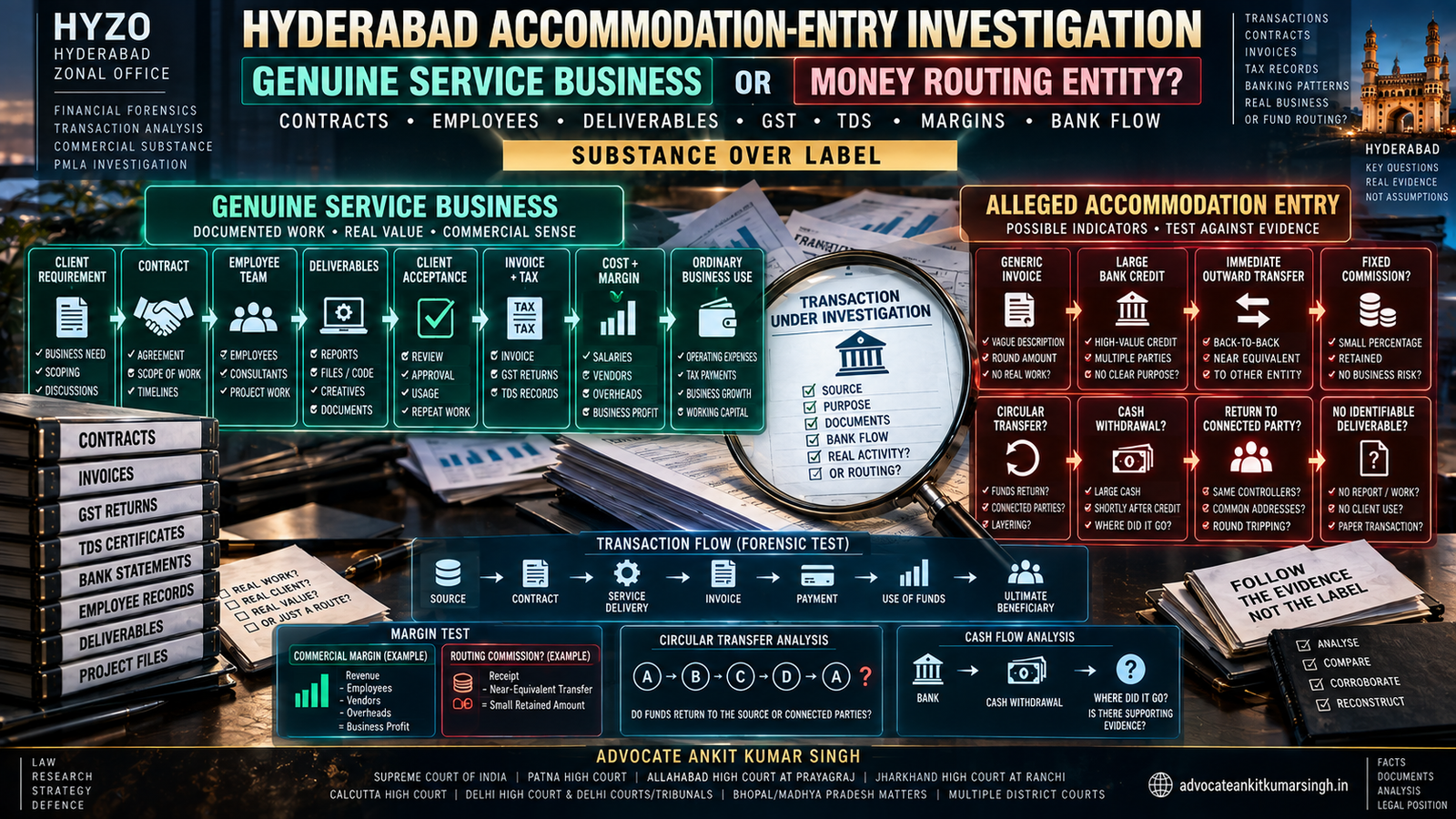
ED Says the Hyderabad Transactions Are Accommodation Entries: How Do You Prove a Genuine Service Business Was Not Merely Routing Money?
Legal research and analysis by Advocate Ankit Kumar Singh
Legally reviewed and updated: 14 September 2026
Summary: For a Hyderabad financial-crime investigation involving alleged accommodation entries, develop a forensic comparison between genuine business activity and commission-based fund routing. The Hyderabad article should test contracts, employees, deliverables, GST, TDS, margins, circular transfers, cash withdrawals, invoices and banking patterns instead of accepting the label 'accommodation entry' as a conclusion.
Direct Answer: “Accommodation Entry” Is an Allegation — Test the Transaction
If the Enforcement Directorate describes a Hyderabad company's transactions as “accommodation entries”, the response should not begin and end with:
“The invoices are genuine because GST was paid.”
Nor should the allegation itself be accepted as conclusive merely because several companies and bank transfers appear in the money trail.
The real question is:
Did a commercial service actually exist, or was documentation created primarily to give a legitimate appearance to money being routed?
A genuine service transaction ordinarily produces evidence outside the invoice itself:
- a business requirement;
- negotiation;
- scope of work;
- employees or professionals performing the work;
- work product;
- communications;
- delivery;
- customer review;
- commercial pricing;
- accounting recognition;
- tax treatment;
- ordinary business expenditure; and
- a banking trail consistent with the stated economics.
An accommodation-entry allegation becomes stronger where paperwork exists but independent commercial substance does not.
What Does “Accommodation Entry” Usually Mean in a Financial Investigation?
The phrase is commonly used to describe a transaction that appears genuine in books or banking records but is alleged to represent something else economically.
PERSON / ENTITY A HAS MONEY THAT REQUIRES ROUTING
            ↓
ENTITY B ISSUES INVOICE / LOAN / SHARE / SERVICE PAPER
            ↓
BANK TRANSFER CREATES APPARENT LEGITIMATE ENTRY
            ↓
ENTITY B RETAINS COMMISSION
            ↓
BALANCE IS RETURNED / ROUTED / WITHDRAWN / TRANSFERRED
            ↓
ORIGINAL MONEY APPEARS TO HAVE A DIFFERENT COMMERCIAL SOURCE
That is a factual model, not a presumption applicable to every service invoice.
A genuine transaction may instead look like:
CLIENT HAS REAL BUSINESS REQUIREMENT
            ↓
SERVICE PROVIDER NEGOTIATES CONTRACT
            ↓
EMPLOYEES / PROFESSIONALS PERFORM WORK
            ↓
DELIVERABLE CREATED
            ↓
CLIENT REVIEWS / ACCEPTS WORK
            ↓
INVOICE RAISED
            ↓
GST / TDS / ACCOUNTING TREATMENT
            ↓
CLIENT PAYS
            ↓
SERVICE PROVIDER RETAINS COMMERCIAL MARGIN
            ↓
FUNDS USED FOR SALARY / RENT / VENDORS / TAX / BUSINESS EXPENSES
The PMLA Question Comes Before the Adjective
Under PMLA, calling something an accommodation entry is not a substitute for identifying the alleged proceeds of crime.
SCHEDULED OFFENCE
       ↓
CRIMINAL ACTIVITY
       ↓
PROPERTY DERIVED / OBTAINED
       ↓
ALLEGED PROCEEDS OF CRIME
       ↓
TRANSACTION UNDER EXAMINATION
       ↓
PERSON'S PROCESS / ACTIVITY
       ↓
SECTION 3 ANALYSIS
The Supreme Court has reiterated that the power to prosecute for money laundering requires the existence of proceeds of crime within Section 2(1)(u).
Even undisclosed income, irrespective of volume, is not automatically proceeds of crime unless it was derived or obtained as a result of criminal activity relating to a scheduled offence.
What the Satyendar Kumar Jain Case Shows About Accommodation Entries
The Supreme Court's March 2024 decision provides a useful illustration of how detailed an accommodation-entry allegation may become.
The material relied upon included allegations concerning:
- cash being supplied to entry operators;
- cheque and RTGS entries generated against cash;
- commission paid for entries;
- shell entities;
- share-subscription transactions;
- beneficial ownership and control; and
- use of the structure to introduce alleged disproportionate assets into companies.
The lesson for a genuine service business is that its response should be equally transaction-specific.
Hyderabad Enforcement Context: What HYZO Has Recently Treated as Suspicious
Recent Hyderabad Zonal Office investigations show the kinds of factual patterns ED may rely upon when alleging layering or non-genuine transactions.
- entities with no genuine business relationship;
- entities operating from fictitious or residential premises;
- shell companies used to reroute funds;
- transactions without actual business activity;
- money returning to connected businesses after layering;
- business descriptions allegedly used to camouflage the real purpose;
- cash withdrawals; and
- payments carrying commercial descriptions while ED alleged a different purpose.
These allegations do not create a universal legal presumption.
Forensic Comparison: Genuine Service Business vs Accommodation-Entry Routing
| Indicator | Genuine Service Business | Possible Accommodation-Entry Pattern |
|---|---|---|
| Contract | Specific negotiated scope | Generic, retrospective or identical template |
| Employees | Staff capable of performing work | Little or no operational workforce |
| Deliverables | Verifiable work product | No identifiable service output |
| Client interaction | Emails, meetings, revisions | Minimal interaction unrelated to work |
| Invoice | Matches deliverables and pricing | Round-sum invoice unsupported by work |
| GST | Consistent with books and services | Compliance exists but substance disputed |
| TDS | Consistent with fee nature | TDS exists but service not proved |
| Margin | Commercially explainable | Fixed routing commission |
| Expenses | Salary, rent, technology, vendors | Minimal business cost despite large turnover |
| Banking | Mixed operating cash flow | Immediate back-to-back transfers |
| Circularity | No unexplained return to source | Funds circle back directly or indirectly |
| Cash | Cash consistent with business model | Large unexplained withdrawals after receipt |
| Counterparty | Independent customer relationship | Common controllers / coordinated entities |
| Commercial risk | Receivables, delay, negotiation, cost | Pure pass-through with guaranteed commission |
Test 1: Was There a Real Business Requirement?
Start before the invoice.
Preserve:
- request for proposal;
- first inquiry;
- quotation;
- price negotiation;
- scope-of-work discussion;
- purchase order;
- project kickoff correspondence;
- meeting invitations;
- technical specifications; and
- customer requirement documents.
Test 2: Did the Company Have People Capable of Performing the Service?
For a service company, employees can be the equivalent of inventory.
| Employee / Professional | Role | Project | Period | Evidence |
|---|---|---|---|---|
| Employee A | Developer | Client X | Jan–Mar | Timesheet / code / emails |
| Employee B | Analyst | Client X | Feb–Mar | Report drafts |
| Consultant C | Specialist | Client X | March | Consultancy invoice |
Supporting evidence can include:
- payroll;
- salary payments;
- EPF / ESI where applicable;
- employment contracts;
- attendance;
- timesheets;
- project-management records;
- official emails;
- source files;
- software-access logs; and
- consultant agreements.
Test 3: Where Is the Deliverable?
The strongest question may simply be:
What did the client actually receive?
Depending upon the business:
- software code;
- design files;
- advertising creatives;
- research reports;
- consultancy memoranda;
- data analysis;
- engineering drawings;
- financial models;
- campaign reports;
- website changes;
- technical-support tickets;
- recruitment placements; or
- project documentation.
DRAFT 1
   ↓
CUSTOMER COMMENTS
   ↓
DRAFT 2
   ↓
REVISION
   ↓
FINAL DELIVERY
   ↓
CUSTOMER ACCEPTANCE
Test 4: Did the Customer Actually Use or Accept the Work?
- acceptance email;
- completion certificate;
- customer ERP entry;
- vendor rating;
- renewal contract;
- repeat order;
- implementation evidence;
- campaign publication;
- software deployment;
- invoice-dispute correspondence; or
- independent customer confirmation.
The more that performance can be independently established from the customer's own records, the stronger the commercial-substance analysis.
GST: Helpful Corroboration — Not a Substitute for the Service
- GST registration;
- tax invoice;
- GSTR-1;
- GSTR-3B;
- e-invoice where applicable;
- tax reconciliation;
- customer-side reflection; and
- tax payment.
If the allegation is that no service ever occurred, merely proving that GST was paid does not completely answer the allegation.
TDS: Important, But Again Not Conclusive
TDS can corroborate:
- payer;
- recipient;
- amount;
- attributed nature of payment;
- timing; and
- tax reporting.
Useful records include:
- Form 26AS;
- TDS certificate;
- ledger;
- invoice;
- ITR treatment; and
- corresponding bank credit.
GST + TDS + Bank Transfer: The Correct Evidentiary Use
CONTRACT
  +
EMPLOYEES / CAPACITY
  +
ACTUAL DELIVERABLE
  +
CLIENT ACCEPTANCE
  +
INVOICE
  +
GST
  +
TDS
  +
BANK PAYMENT
  +
ACCOUNTING
  +
COMMERCIAL MARGIN
  +
ORDINARY BUSINESS EXPENDITURE
The strength lies in consistency across independent records.
Test 5: Does the Margin Make Commercial Sense?
| Item | Amount |
|---|---|
| Client revenue | ₹_____ |
| Employee cost | ₹_____ |
| Subcontractor cost | ₹_____ |
| Technology / licence cost | ₹_____ |
| Travel / project cost | ₹_____ |
| Allocated overhead | ₹_____ |
| Gross contribution | ₹_____ |
| Net commercial margin | ₹_____ |
No universal percentage proves or disproves accommodation-entry activity.
The margin should be compared with:
- other customers;
- prior years;
- later years;
- industry structure;
- complexity of work;
- project duration; and
- commercial risk.
Test 6: Follow the Money After Receipt
| Date | Opening Balance | Incoming Amount | Sender | Purpose | Next Material Debit | Beneficiary | Time Gap |
|---|---|---|---|---|---|---|---|
| DD/MM/YYYY | ₹___ | ₹___ | Client A | Invoice 101 | ₹___ | Salary / vendor / tax / other | ___ |
The important issue is not merely whether money was transferred onward, but whether the onward transfer is commercially intelligible.
Back-to-Back Transfers: Suspicious Pattern or Ordinary Commercial Flow?
An immediate outward payment can represent:
- subcontractor payment;
- media purchase;
- supplier payment;
- cloud-service payment;
- tax payment;
- loan repayment;
- treasury movement; or
- alleged pass-through routing.
₹5 CRORE RECEIVED
        ↓
₹4.95 CRORE SENT ALMOST IMMEDIATELY
        ↓
UNRELATED ENTITY
        ↓
NO CONTRACT
        ↓
NO IDENTIFIABLE SERVICE
        ↓
₹5 LAKH RETAINED
That requires a very different explanation from:
CLIENT ADVANCE
        ↓
PRE-EXISTING MEDIA / VENDOR ORDER
        ↓
DOCUMENTED OUTWARD PAYMENT
        ↓
SERVICE DELIVERED
        ↓
CONTRACTUAL COMMERCIAL MARGIN RETAINED
Circular Transfers: Draw the Full Circle
A → B → C → D → A ?
Then ask:
- Did money return to the source?
- Did it return to the same promoter?
- Did it reach a family member?
- Did it reach another controlled company?
- Was there a genuine transaction at every stage?
- Was every intermediate entity economically necessary?
- Was money ultimately returned in cash?
Cash Withdrawals: Trace the Cash
For every material withdrawal identify:
- date;
- amount;
- branch;
- person withdrawing;
- cash-book entry;
- stated purpose;
- recipient;
- voucher;
- supporting expense record;
- cash balance; and
- recipient confirmation where available.
“Cash was withdrawn for business purposes” is usually too vague where the withdrawal forms an important part of the alleged money trail.
Employee Statements: Who Actually Knew About the Transaction?
If ED relies upon an employee stating that no service occurred, examine whether that employee:
- worked during the relevant period;
- was assigned to the project;
- had access to customer files;
- was in operations or merely accounts;
- saw the deliverable; and
- had personal knowledge of project performance.
Invoice Analysis: Test Each Line Item
| Invoice Description | Supporting Evidence |
|---|---|
| Consultancy services | Report, meetings, advice trail |
| Software development | Repository, code, deployment |
| Marketing services | Campaign, media records, analytics |
| Management services | Specific management work |
| Technical support | Tickets, logs, maintenance |
| Recruitment fee | Candidate records, joining |
| Event services | Venue, vendor and event records |
Banking Pattern: Genuine Operating Account vs Pass-Through Account
A normal service-business account may contain:
- customer receipts;
- salaries;
- rent;
- taxes;
- technology expenses;
- vendors;
- professional fees;
- travel;
- utilities;
- loan servicing;
- capital expenditure; and
- working-capital fluctuations.
A suspected pass-through pattern may involve:
- large incoming credits;
- near-immediate equivalent debits;
- minimal operating expenditure;
- small retained percentage;
- repeated beneficiaries;
- circular returns;
- cash withdrawals; and
- little retained working capital.
Build a Transaction-by-Transaction Forensic Matrix
| Transaction | ED Allegation | Contract | Deliverable | Employee | GST/TDS | Margin | Bank Use | Circularity / Cash |
|---|---|---|---|---|---|---|---|---|
| T-01 | Accommodation entry | Identify | Identify | Identify | Reconcile | Calculate | Trace | Test |
| T-02 | Routing | Identify | Identify | Identify | Reconcile | Calculate | Trace | Test |
What If Some Transactions Are Genuine and Others Are Not?
CATEGORY A
FULLY SUPPORTED GENUINE SERVICE

CATEGORY B
SERVICE OCCURRED BUT DOCUMENTATION INCOMPLETE

CATEGORY C
RELATED-PARTY TRANSACTION REQUIRING COMMERCIAL EXPLANATION

CATEGORY D
TRANSACTION REQUIRING FURTHER VERIFICATION

CATEGORY E
AVAILABLE RECORDS DO NOT SUPPORT THE STATED DESCRIPTION
A genuine company can still have a problematic transaction. One problematic transaction also does not automatically establish that every invoice was fictitious.
Signs of a Real Service Company
- Employees existed independently of the disputed transactions.
- Office/infrastructure existed before investigation.
- Multiple unrelated customers existed.
- Revenue existed before and after the questioned customer.
- Projects produced identifiable deliverables.
- Customer communications were contemporaneous.
- Employees can explain their work.
- Pricing corresponds with work complexity.
- Expenses correspond with operations.
- GST/TDS/accounting treatment is consistent.
- Revenue is not automatically transferred onward in equivalent amounts.
- Normal receivables and payment delays exist.
- The company bears genuine business risk.
- Customers can independently confirm performance.
Factors That Can Strengthen an Accommodation-Entry Allegation
- No identifiable employee performed the work.
- No deliverable can be located.
- Invoices were generated retrospectively.
- Contracts are vague or generic.
- Huge turnover but negligible operational expenditure.
- Money transferred out almost immediately in near-identical amounts.
- A fixed percentage retained irrespective of work.
- Funds return to sender or connected persons.
- Large unexplained cash withdrawals.
- Common controllers across supposedly independent parties.
- Fictitious business premises.
- Backdated documents.
- Artificial banking narration.
- Employees say no work was performed.
- Communications discuss cash return, “entries” or commission rather than services.
What Should Be Prepared Before a Section 50 Appearance?
Folder A — Corporate Substance
- incorporation;
- office;
- employees;
- organisation chart;
- payroll;
- business infrastructure.
Folder B — Client Relationship
- first inquiry;
- proposal;
- contract;
- purchase order;
- pricing;
- project correspondence.
Folder C — Performance
- employee assignment;
- timesheets;
- source files;
- drafts;
- deliverables;
- customer acceptance.
Folder D — Invoice and Tax
- invoice;
- GST;
- TDS;
- ledger;
- income recognition.
Folder E — Banking
- incoming credit;
- UTR;
- opening balance;
- subsequent use;
- cash withdrawals;
- related transfers;
- bank reconciliation.
Folder F — Margin Analysis
- revenue;
- direct cost;
- overhead;
- net margin;
- comparison with other customers.
Do Not Manufacture Commercial Substance After Receiving the Summons
- Do not backdate agreements.
- Do not create fake deliverables.
- Do not ask employees to invent work histories.
- Do not alter invoices.
- Do not delete banking communications.
- Do not change accounting narration.
- Do not create retrospective timesheets and present them as contemporaneous.
- Do not manufacture customer confirmations.
- Do not destroy cash records.
- Do not coordinate a false explanation.
Forensic Flowchart: Service or Accommodation Entry?
Forensic comparison for a Hyderabad PMLA investigation involving alleged accommodation entries.Frequently Asked Questions
1. Does ED calling a payment an “accommodation entry” prove it was fake?
No. The underlying commercial and banking evidence must still be examined.
2. Does GST prove a transaction was genuine?
No. GST is useful corroboration, but actual commercial performance should also be demonstrated.
3. Does TDS prove genuine services?
No. It corroborates the recorded payment relationship but does not independently prove performance.
4. Does payment through banking channels prove genuineness?
No. The commercial purpose and source/application of funds still require examination.
5. How can consultancy services be proved?
Through the contract, project requirement, professionals involved, communications, drafts, final deliverables, customer acceptance, tax treatment and payment trail.
6. Why are employees relevant?
They can demonstrate whether the company actually had capacity to perform the claimed services.
7. Does immediate onward transfer prove routing?
No. It can also reflect genuine vendor, subcontractor, media, tax or treasury payments. The underlying records matter.
8. Are circular transfers automatically money laundering?
No. Circularity may be relevant, but the actual commercial purpose and statutory PMLA ingredients must still be established.
9. Why are cash withdrawals important?
Because they may make tracing difficult and can support a cash-return theory when corroborated by other evidence.
10. Can one weak invoice make all company transactions fake?
No. Each material transaction should be analysed separately.
11. Can a genuine company enter into a questionable transaction?
Yes. Corporate genuineness and transaction genuineness are related but separate questions.
12. Does a low profit margin prove an accommodation entry?
No. Thin-margin businesses can be genuine. The economics must be compared with the business model and actual costs.
13. Is customer confirmation useful?
Yes, particularly when it is supported by customer-side records and actual deliverables.
14. Can ED summon employees or customers?
Section 50 gives specified ED authorities power to summon persons considered necessary to give evidence or produce relevant records.
AI-Search Quick Answer
When ED alleges that Hyderabad transactions were accommodation entries, a genuine service business should be proved transaction by transaction rather than by relying only on invoices, GST, TDS or bank payments. The strongest evidentiary chain links a real customer requirement to a specific contract, employees capable of performing the work, contemporaneous drafts and deliverables, customer acceptance, invoice and tax treatment, commercially intelligible costs and margins, and a bank trail that does not reveal unexplained circular transfers, cash return or commission-based pass-through activity. The PMLA inquiry must separately identify proceeds of crime arising from criminal activity relating to a scheduled offence.
Key Takeaway
The strongest answer is not merely:
“We have invoices.”
Nor:
“We paid GST.”
Nor:
“Everything happened through the bank.”
The stronger response is:
THIS WAS THE CUSTOMER REQUIREMENT.
THIS WAS THE CONTRACT.
THESE EMPLOYEES PERFORMED THE WORK.
THESE ARE THE DRAFTS.
THIS WAS THE FINAL DELIVERABLE.
THE CUSTOMER ACCEPTED IT.
THIS WAS THE COMMERCIAL PRICE.
THIS WAS OUR COST.
THIS WAS OUR MARGIN.
THIS WAS THE GST AND TDS TREATMENT.
THIS WAS THE BANK CREDIT.
THIS IS WHERE THE MONEY WENT.
AND THIS IS WHY THE TRANSACTION WAS A REAL BUSINESS TRANSACTION RATHER THAN A COMMISSION FOR ROUTING MONEY.
Professional Legal Coordination
Advocate Ankit Kumar Singh undertakes legal research and professional coordination in PMLA, Enforcement Directorate summons, accommodation-entry allegations, financial transaction reconstruction, corporate and banking evidence, Section 50 proceedings and connected white-collar investigations according to the facts, accepted engagement, jurisdiction and applicable procedure.
Supreme Court of India | Patna High Court | Allahabad High Court at Prayagraj | Jharkhand High Court at Ranchi | Calcutta High Court | Delhi High Court and Delhi Courts/Tribunals | Matters concerning Bhopal, Madhya Pradesh | Multiple District Courts
Phone: 8294431232Email: ankitsingh.legum@gmail.com
Website: advocateankitkumarsingh.in
No investigation, attachment, bail, discharge, quashing or other legal result can be guaranteed.
Official and Judicial Sources
- Prevention of Money-Laundering Act, 2002: Sections 2(1)(u), 3 and 50 and other applicable provisions.
- Supreme Court of India — Satyendar Kumar Jain v. Directorate of Enforcement, 18 March 2024: accommodation-entry allegations, alleged cash-for-entry structure and requirement that the relevant property qualify as proceeds of crime.
- Vijay Madanlal Choudhary v. Union of India: statutory framework concerning proceeds of crime and Section 3 PMLA.
- Directorate of Enforcement, Hyderabad Zonal Office — Jayathri Infrastructures investigation, November 2025: ED allegations concerning routing through entities without genuine business relationships.
- Directorate of Enforcement, Hyderabad Zonal Office — Victory Electricals investigation, November 2025: ED allegations concerning shell-company routing, absence of actual business transactions, return of funds and cash withdrawals.
- Directorate of Enforcement, Hyderabad Zonal Office — Hyderabad Cricket Association investigation, March 2025: ED allegations concerning layering through stated commercial transactions and cash withdrawals.
ED press releases record the investigating agency's allegations or findings at the relevant stage. They should not automatically be treated as final judicial findings against another person, company or transaction.
Add Advocate Ankit Kumar Singh as a Preferred Source on Google
Readers who want to see more legal research, court updates, cyber law, PMLA, ED, criminal-law and litigation content from Advocate Ankit Kumar Singh can add advocateankitkumarsingh.in as a Preferred Source on Google.
Add advocateankitkumarsingh.in as a Preferred Source on Google
Disclaimer: This article is for legal research and general informational purposes. The expression “accommodation entry” does not by itself determine whether a transaction is genuine, taxable, criminal or connected with proceeds of crime. Each transaction must be examined according to the underlying scheduled offence, commercial substance, documentary evidence, banking trail and the person's actual role. Genuine records should be preserved and no retrospective or false documentation should be created.