UNEXPLAINED CASH • HUMAN PROBABILITY • SOURCE OF FUNDS • FINANCIAL BEHAVIOUR • SEARCH & SEIZURE
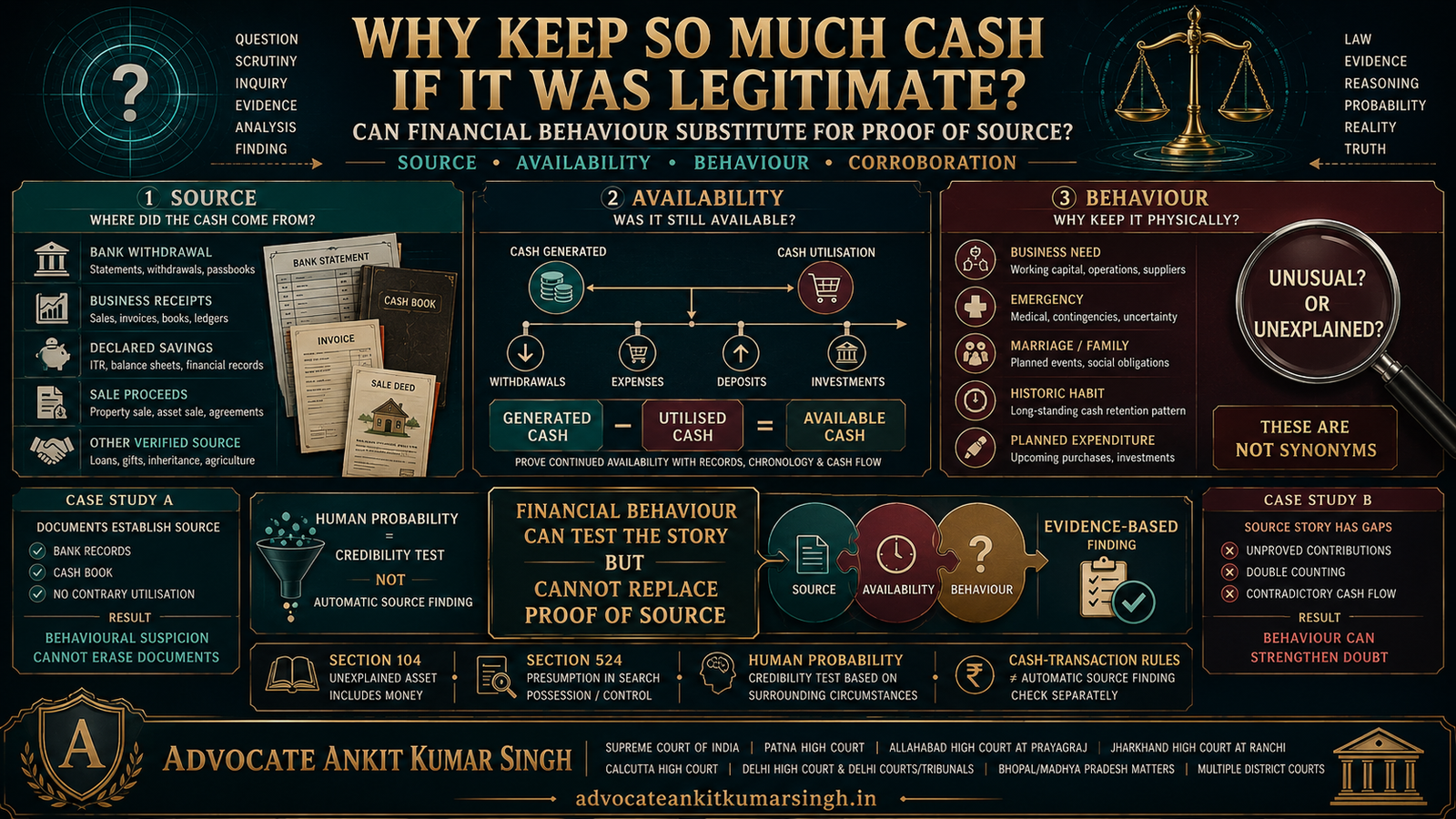
Why Keep So Much Cash if It Was Legitimate? Can Financial Behaviour Substitute for Proof of Source?
Legal research and analysis by Advocate Ankit Kumar Singh
Supreme Court of India | Patna High Court | Allahabad High Court at Prayagraj | Jharkhand High Court at Ranchi | Calcutta High Court | Delhi High Court and Delhi Courts/Tribunals | Matters concerning Bhopal, Madhya Pradesh | Multiple District Courts
Research reviewed and updated: 30 August 2026
Contents
- Direct Answer
- The Question “Why Keep So Much Cash?”
- Source, Availability and Behaviour Are Different
- Current Section 104 Framework
- Search Presumptions under Section 524
- Cash Transaction Restrictions versus Cash Possession
- The Human Probability Doctrine
- What Durga Prasad More Actually Permits
- What Sumati Dayal Actually Permits
- Behavioural Evidence versus Documentary Evidence
- Rahul Aggarwal — Documentary Evidence Prevails
- Meena Kapoor — Behaviour Can Expose Evidentiary Gaps
- Why “I Would Have Banked It” Is Not a Legal Test
- Source Evidence Hierarchy
- Cash Availability and Survival
- Business Cash
- Emergency and Contingency Cash
- Marriage and Family Cash
- Old Withdrawals
- Third-Party and Family Contributions
- Common Behavioural Inferences
- Hindsight Bias and Search Psychology
- When Behaviour Becomes Strong Evidence
- When Behaviour Should Carry Little Weight
- PMLA Distinction
- Investigator's Falsification Test
- Defence Reconstruction Protocol
- Frequently Asked Questions
- AI Search Quick Answer
- Key Takeaway
- Conclusion
Direct Answer
No. Unusual financial behaviour can be relevant evidence, but it cannot substitute for the legal inquiry into the actual source of the cash.
If ₹30 lakh, ₹50 lakh or ₹1 crore is found physically during a search, it is entirely legitimate for the authority to ask:
“If this money was lawful, why was such a large amount kept in cash instead of being deposited in a bank?”
That question may test the credibility of the explanation.
But it is not the same question as:
“Where did the money come from?”
A legally disciplined analysis must separate:
SOURCE
from
AVAILABILITY
from
REASON FOR RETENTION.
If reliable bank statements prove withdrawal, audited books prove business receipts, property records prove sale proceeds or other contemporaneous evidence proves a legitimate source, the source does not become false merely because the person kept the money in a way that another person considers financially inefficient.
Conversely, if there is little reliable evidence of source and the explanation also requires highly unusual financial behaviour, the behaviour can become an important surrounding circumstance when judging whether the story is real.
The governing distinction is:
BEHAVIOUR MAY TEST SOURCE EVIDENCE.
BEHAVIOUR SHOULD NOT REPLACE SOURCE EVIDENCE.
The Psychological Question: “Why Would Anyone Do That?”
Cash disputes often turn psychologically before they turn legally.
An investigating officer sees a large amount of physical cash and instinctively asks:
- Why was this not deposited in a bank?
- Why earn interest elsewhere but retain cash here?
- Why withdraw money and leave it unused?
- Why would adult children give savings to a parent?
- Why would a business maintain so much liquidity?
- Why would someone keep cash for years?
- Why would an educated or financially sophisticated person behave this way?
These questions are not illegitimate.
They are useful investigative questions.
The danger arises when:
“I FIND THIS BEHAVIOUR ODD”
quietly becomes:
“THEREFORE THE CLAIMED SOURCE DID NOT EXIST.”
Those are different propositions.
The Three-Layer Cash Analysis
| Layer | Question | Typical Evidence |
|---|---|---|
| Source | Where did the money originate? | Bank withdrawal, sales, income, sale deed, loan, gift, inheritance, agricultural receipts |
| Availability | Was the money still available when found? | Cash flow, absence of contrary utilisation, books, household/business expenditure |
| Retention Behaviour | Why was it kept physically? | Business practice, planned expenditure, family circumstances, emergency need, personal preference |
A weak answer to Layer 3 does not automatically erase strong evidence at Layer 1.
But a completely implausible Layer 3 can legitimately cause the decision-maker to test Layers 1 and 2 more carefully.
Current Law: Section 104 of the Income-tax Act, 2025
For current tax years governed by the Income-tax Act, 2025, Section 104 concerns an unexplained asset.
The provision expressly states that “asset” includes money.
The statutory structure matters.
Where the relevant conditions are satisfied, the provision asks whether:
- the assessee offers an explanation concerning the nature and source of acquisition of the asset; and
- that explanation is satisfactory.
Therefore the central statutory language is:
NATURE AND SOURCE.
It is not:
“WOULD A REASONABLE PERSON HAVE KEPT THIS MUCH CASH?”
Human behaviour may assist in evaluating the explanation.
It does not rewrite the statutory inquiry.
Section 524: Possession and Search Presumptions Matter
Section 524 of the Income-tax Act, 2025 provides important presumptions where money, books, documents, digital information or other specified assets are found in a person's possession or control during search or survey.
Among other matters, the statute permits a presumption that the money or other material belongs to the person in whose possession or control it is found.
This means that a searched person cannot necessarily avoid the source inquiry merely by saying:
“You prove the cash belongs to me first.”
But ownership and source remain distinct.
Presuming that the cash belongs to X does not automatically prove whether X acquired it from:
- declared income;
- business receipts;
- bank withdrawals;
- sale proceeds;
- a genuine loan;
- unrecorded income; or
- another source.
Large Cash Possession and Cash-Transaction Restrictions Are Different Questions
The Income-tax Act contains restrictions on specified cash transactions.
For example, current Section 186 restricts receipt of ₹2,00,000 or more in the circumstances specified by that provision, subject to statutory exceptions.
Other provisions also regulate particular loans, deposits, repayments, deductions and transaction modes.
But this does not mean that every physical cash balance above ₹2,00,000 is automatically unlawful.
The correct legal analysis separates:
HOW THE CASH WAS RECEIVED
from
WHETHER THE SOURCE WAS EXPLAINED
from
WHY THE PERSON RETAINED IT PHYSICALLY.
A legitimate source does not excuse a separate violation of an applicable transaction-mode provision.
Equally, an unusual physical cash balance should not be labelled undisclosed merely because another statutory provision restricts certain cash receipts.
The Supreme Court's Human-Probability Doctrine
Indian tax law does permit decision-makers to look beyond formal appearances.
Two important Supreme Court authorities are:
- Commissioner of Income Tax v. Durga Prasad More; and
- Sumati Dayal v. Commissioner of Income Tax.
The principle is sometimes summarised as the “test of human probabilities”.
But it is frequently misunderstood.
The doctrine does not say:
“If the Assessing Officer personally finds a financial decision unusual, the documents may be ignored.”
It permits a decision-maker to consider:
- surrounding circumstances;
- economic reality;
- conduct;
- relationships;
- timing;
- patterns;
- inconsistencies; and
- whether the apparent transaction reflects the real transaction.
The object is to test reality.
It is not to impose one preferred style of financial behaviour upon every taxpayer.
What Durga Prasad More Actually Teaches
In Durga Prasad More, the Supreme Court recognised that tax authorities need not put on blinkers while examining a transaction.
They may look at the surrounding circumstances to determine the reality behind the formal appearance.
This principle is especially useful where documents exist but the overall factual story appears artificial.
For example:
A document may say:
“Loan.”
But the surrounding record may reveal:
- no financial capacity in the lender;
- no genuine transfer history;
- no repayment behaviour;
- no commercial relationship; and
- money effectively originating from the alleged borrower.
Human probability can expose a sham.
But the doctrine still works through facts.
What Sumati Dayal Actually Teaches
In Sumati Dayal, the Supreme Court considered whether the apparent transaction reflected the real economic event.
The Court recognised that the apparent should ordinarily be treated as real unless there are reasons to believe otherwise, and that surrounding circumstances and human probabilities may be examined.
The important lesson for cash cases is not:
“UNUSUAL = FALSE.”
The lesson is:
FORMAL PROOF SHOULD BE TESTED AGAINST THE COMPLETE REAL-WORLD RECORD.
This cuts both ways.
An implausible paper trail can be rejected.
But an objectively established bank withdrawal cannot simply be made nonexistent because an officer personally prefers banking over physical cash.
Financial Behaviour Is Circumstantial Evidence
Financial behaviour can answer useful questions.
For example:
- Does the person historically retain cash?
- Was the business cash-intensive?
- Was similar cash-in-hand reported in earlier years?
- Did the person normally deposit collections quickly?
- Did the person have upcoming cash requirements?
- Was the money repeatedly withdrawn and redeposited?
- Was normal expenditure being funded from another source?
- Does the retention period make the availability story difficult?
These facts may strengthen or weaken an explanation.
But behavioural evidence generally answers:
“IS THIS EXPLANATION CREDIBLE?”
It does not independently answer:
“WHAT WAS THE SOURCE?”
Rahul Aggarwal v. ITO — Human Probability Could Not Override the Documents
A useful recent illustration comes from the Delhi ITAT's decision dated 13 March 2026.
The dispute concerned cash used toward credit-card payments.
The taxpayer relied upon bank withdrawals, a cash book, ledger accounts and capital-account material.
The lower appellate authority questioned whether cash withdrawn earlier would logically have remained available for later use.
The Tribunal examined the actual records and noted that the underlying sources and amounts were not disputed.
It rejected the adverse conclusion built upon the subjective inference that the cash could not have been retained.
The lesson is important:
WHERE PRIMARY DOCUMENTARY EVIDENCE ESTABLISHES SOURCE AND AVAILABILITY AND IS NOT DISPROVED, “I WOULD NOT HAVE KEPT CASH LIKE THAT” IS NOT A SUBSTITUTE FOR CONTRARY EVIDENCE.
Meena Kapoor v. ACIT — Behaviour Can Matter Where the Evidentiary Chain Is Weak
The Lucknow ITAT decision dated 17 April 2026 demonstrates the opposite side.
The explanation involved accumulated family savings, contributions allegedly made by adult children, marriage-related purposes, medical contingencies and long-term cash retention.
The taxpayer produced income records, bank statements, a family cash-flow statement and other material.
However, the authorities found significant evidentiary gaps concerning the actual transfer and continued availability of the children's claimed cash contributions.
The surrounding behaviour—why the financially independent children would repeatedly give substantial savings to the mother while maintaining their own banking arrangements—became relevant because the underlying transfer story itself remained insufficiently substantiated.
The important distinction is:
BEHAVIOUR DID NOT MAGICALLY PROVE AN UNKNOWN ILLEGAL SOURCE.
It contributed to the conclusion that the particular explanation offered had not satisfactorily discharged the evidentiary burden.
These Two 2026 Decisions Are Not Inconsistent
They illustrate two different evidentiary situations.
| Rahul Aggarwal | Meena Kapoor |
|---|---|
| Direct documentary withdrawal / cash evidence | Multi-year pooled family-cash explanation |
| Source evidence was not disproved | Actual transfers / accumulation remained insufficiently proved |
| Human-probability inference was used against established documents | Human probability operated alongside unresolved evidentiary gaps |
| Behaviour alone could not defeat source evidence | Behaviour weakened a source story that was itself inadequately established |
This is precisely why “human probability” should not be treated as a slogan.
“Why Didn't You Put It in a Bank?” Is a Question, Not a Finding
There can be many reasons—good, bad, rational, irrational or simply personal—for retaining cash.
Possible explanations include:
- working capital requirements;
- daily wage or supplier payments;
- seasonal business requirements;
- planned property or family expenditure;
- medical contingency;
- marriage expenditure;
- historic habit;
- lack of immediate banking access;
- privacy preference;
- recent withdrawal shortly before search;
- cash collection not yet deposited; or
- simple financial conservatism.
The existence of a possible reason does not prove the source.
But the fact that another person would have preferred a fixed deposit or savings account does not disprove the source either.
Financial Sophistication Does Not Create a Legal Presumption Against Cash
Sometimes the argument becomes:
“This person is educated, runs businesses and understands banking. Why would such a person keep cash?”
That may justify scrutiny.
It should not become a demographic presumption.
People do not make financial decisions according to one universal model of rational behaviour.
A professionally sophisticated person can still:
- retain unnecessary liquidity;
- prefer physical cash;
- make economically suboptimal decisions;
- overestimate future cash needs;
- delay depositing collections; or
- hold funds because of family or business habits.
Tax law can test whether the source is real.
It should be cautious about converting financial optimisation theory into a rule of evidence.
The Source-Evidence Hierarchy
Tier 1 — Strong Primary Evidence
- bank withdrawals;
- audited financial statements;
- pre-existing cash book;
- tax returns;
- sale deeds;
- registered transaction documents;
- GST and sales records;
- stock records;
- independent third-party banking material.
Tier 2 — Strong Corroborative Evidence
- invoices;
- customer confirmations;
- business correspondence;
- historical cash patterns;
- accounting backups;
- digital timestamps;
- cashier records;
- family financial records.
Tier 3 — Reconstruction
- post-search cash-flow statement derived from old records;
- availability calculation;
- chronology;
- affidavit explaining missing links;
- transaction reconciliation.
Tier 4 — Behavioural Explanation
- “I prefer cash.”
- “It was for emergencies.”
- “We keep family money together.”
- “The business always needs liquidity.”
Tier 4 can support the narrative.
It ordinarily cannot replace a missing Tier 1 source.
A Reason for Keeping Cash Is Not a Source of Cash
This distinction is fundamental.
Consider:
“I kept ₹35 lakh because my daughter's marriage was approaching.”
That may explain:
WHY THE MONEY WAS RETAINED.
It does not establish:
HOW THE ₹35 LAKH WAS GENERATED.
The source still requires examination.
It might be:
- declared savings;
- bank withdrawals;
- business cash;
- property-sale proceeds;
- family contributions;
- inheritance;
- a genuine gift;
- a genuine loan; or
- unexplained money.
The wedding explanation cannot answer this second question by itself.
Similarly, Source Evidence Does Not Automatically Prove Continued Availability
Suppose a bank statement establishes a withdrawal of ₹40 lakh.
The source event is proved.
But if the search occurs three years later, a second question arises:
WAS THE MONEY STILL AVAILABLE?
That inquiry may consider:
- subsequent investments;
- property purchases;
- household expenditure;
- business expenditure;
- redeposits;
- other cash withdrawals;
- other sources funding expenses;
- opening and closing cash balances; and
- historical retention patterns.
This is where behaviour can legitimately become important.
It tests survival.
It still does not erase the proved withdrawal.
The Cash-Survival Equation
A defensible reconstruction can be expressed as:
PROVED CASH GENERATION
−
PROVED / PROBABLE CASH UTILISATION
=
CASH REASONABLY AVAILABLE.
Then compare:
CASH REASONABLY AVAILABLE
with
CASH ACTUALLY FOUND.
The behavioural question should operate inside this analysis rather than replacing it.
Business Cash: “Nobody Keeps That Much” May Be a Poor Assumption
Different businesses have different liquidity profiles.
A cash-intensive business may legitimately maintain higher balances because of:
- daily collections;
- supplier requirements;
- seasonal procurement;
- wage payments;
- multiple retail counters;
- branch remittances;
- bank holidays;
- cash collected after banking hours;
- geographical conditions; or
- temporary accumulation before deposit.
The correct comparison is not:
“WOULD I KEEP ₹20 LAKH IN CASH?”
It is:
“IS ₹20 LAKH CONSISTENT WITH THIS BUSINESS'S ACTUAL BOOKS, SALES, COLLECTIONS, CASH CYCLE AND HISTORICAL PRACTICE?”
Historical Behaviour Can Be More Useful Than Abstract Behaviour
If the person claims:
“I have always retained large cash balances.”
the strongest response is not philosophical debate.
Check the history.
Useful records include:
- prior balance sheets;
- historic cash books;
- past bank deposit patterns;
- previous withdrawals;
- prior search/survey records, if any;
- auditor material;
- seasonal cash patterns; and
- earlier financial statements.
A historical pattern can make present behaviour more intelligible.
A sudden unprecedented cash balance can justify closer scrutiny.
Emergency Cash: Plausibility Must Be Proportionate
A person may genuinely prefer keeping physical liquidity for emergencies.
But proportionality can still be tested.
Questions include:
- What emergency was anticipated?
- When did the need arise?
- What expenditure was expected?
- Was the amount remotely proportionate?
- Was some money already available through banks?
- Was similar behaviour historically demonstrated?
- What was the source of the money?
The legal error would be either extreme:
“EMERGENCY” = AUTOMATIC PROOF.
or:
“I PERSONALLY WOULD USE A CARD” = AUTOMATIC REJECTION.
Family Cash: Culture Cannot Replace Financial Capacity
Family arrangements are often informal.
Parents and children may share expenses, savings and physical cash without commercial documentation.
That social reality can be relevant.
But if the explanation is:
“₹40 lakh belongs to savings contributed by several family members over many years.”
then the inquiry should still consider:
- who contributed;
- their income capacity;
- approximate dates;
- amounts;
- their own bank deposits;
- their own expenditure;
- whether double counting occurred;
- why the money was pooled; and
- whether the reconstructed cash flow actually works.
“Indian families keep cash” is context.
It is not proof of ₹40 lakh.
Old Bank Withdrawals: The Time Gap Is a Question, Not Automatic Disproof
A common authority-side argument is:
“Why would anyone withdraw money months earlier and simply keep it?”
A common defence-side argument is:
“The withdrawal happened, therefore the cash found must be the same money.”
Both positions are incomplete.
The correct inquiry is:
WITHDRAWAL PROVED?
+
NO CONTRARY UTILISATION?
+
OVERALL CASH FLOW CONSISTENT?
+
RETENTION PLAUSIBLE IN THE PERSON'S CIRCUMSTANCES?
=
STRENGTH OF CONTINUED-AVAILABILITY EXPLANATION.
Why Financial Behaviour Becomes Dangerous as a Shortcut
Human beings naturally use behavioural stories to make sense of ambiguous evidence.
That can produce several cognitive shortcuts.
1. Normality Bias
“Most people bank money, so this person should have done the same.”
2. Hindsight Bias
After the cash is found, its retention appears obviously suspicious even if the decision may have looked ordinary beforehand.
3. Confirmation Bias
Once “hidden cash” becomes the working theory, every unusual financial choice may be interpreted as confirming it.
4. Wealth Heuristic
A large amount may psychologically appear more illicit simply because the number is impressive.
5. Narrative Fallacy
A simple narrative—“honest people use banks”—can feel more convincing than a messy but documented financial history.
These psychological risks do not mean behavioural evidence should be ignored.
They mean it should be consciously separated from source proof.
When Behaviour Becomes Strong Evidence
Behaviour can become significantly probative when it combines with factual anomalies.
For example:
- a person claims to retain cash but historically deposits every significant receipt immediately;
- the claimed money was supposedly kept for years despite documented major cash expenditure;
- the same withdrawn cash is simultaneously claimed as the source of another investment;
- different proceedings attribute the same cash to different owners;
- the source story changes repeatedly;
- books were created only after search;
- claimed contributors lack financial capacity;
- no underlying transaction can be identified; or
- the cash flow produces mathematical impossibility.
In those situations, behaviour is not operating alone.
It is reinforcing contradictions in the evidence.
When Behaviour Should Carry Much Less Weight
Behavioural suspicion is weaker where:
- the source is independently documented;
- bank withdrawal is undisputed;
- cash books existed before the controversy;
- audited accounts report substantial cash-in-hand;
- stock and sales records support the business explanation;
- the authority identifies no intervening utilisation;
- historical records show similar cash retention;
- third-party evidence corroborates the source; and
- the only objection is that the officer personally considers cash retention irrational.
At that stage, “human probability” should not become a method for discarding inconvenient documents.
The Falsification Question
A good investigation should ask:
“What evidence would prove my current theory wrong?”
If the theory is:
“NO LEGITIMATE PERSON WOULD KEEP ₹50 LAKH.”
then the officer should ask:
- Would audited cash balances change the conclusion?
- Would same-day bank withdrawals change it?
- Would verified customer collections change it?
- Would historical cash patterns change it?
- Would independent third-party records change it?
If the answer is “nothing would change my view”, the inquiry may no longer be evidence-driven.
The Defence Must Also Falsify Its Own Story
The taxpayer should perform the same exercise.
If the defence is:
“THIS WAS OLD LEGITIMATE CASH.”
ask:
- What document proves generation?
- What happened to household expenses?
- Were there investments in between?
- Was any amount redeposited?
- Was the same cash claimed elsewhere?
- Why is there no historical cash balance?
- Does the bank history contradict retention?
- Does another family member claim the same amount?
A defence explanation that survives hostile testing is stronger than one protected from difficult questions.
The Seven-Question Behaviour / Source Matrix
| Question | Purpose |
|---|---|
| 1. Where did the cash originate? | Source |
| 2. Could that source financially generate the amount? | Capacity |
| 3. When was the cash generated? | Chronology |
| 4. What happened to it between generation and search? | Availability |
| 5. Why was it retained physically? | Behaviour |
| 6. What independent evidence supports the story? | Corroboration |
| 7. What evidence contradicts it? | Falsification |
Only after all seven questions are addressed should the final inference be drawn.
PMLA: Unusual Cash Behaviour Does Not Establish Proceeds of Crime
The distinction becomes even more important if a tax or financial discrepancy enters a PMLA investigation.
The Supreme Court has made clear that undisclosed income, regardless of its volume, does not automatically satisfy the definition of “proceeds of crime”.
The property must satisfy the statutory connection with criminal activity relating to a scheduled offence.
Therefore:
LARGE CASH + UNUSUAL RETENTION
≠ AUTOMATIC PROCEEDS OF CRIME.
Likewise:
UNEXPLAINED FOR TAX PURPOSES
≠ AUTOMATIC MONEY LAUNDERING.
Behaviour may become part of a larger evidentiary case concerning concealment, possession, acquisition or use.
But the proceeds-of-crime foundation must first exist.
Investigator's 12-Step Protocol
- Identify the exact cash amount and location.
- Identify possession and presumptive ownership.
- Ask for the source without suggesting an answer.
- Obtain primary source documents.
- Test financial capacity.
- Fix the date the cash was generated.
- Reconstruct intervening utilisation.
- Determine the amount reasonably still available.
- Ask why physical cash was retained.
- Compare the explanation with historical behaviour.
- Identify objective contradictions rather than personal preferences.
- Reach the conclusion only after source, availability and behaviour have been separately tested.
Defence 12-Step Reconstruction Protocol
- Do not begin with “keeping cash is legal”.
- Identify the precise amount requiring explanation.
- Identify the genuine source.
- Collect pre-existing source documents.
- Prepare a date-wise cash chronology.
- Identify all intervening expenditure.
- Prepare an availability calculation.
- Identify the genuine reason for retention.
- Check whether historic behaviour supports or contradicts it.
- Resolve ownership conflicts.
- Identify weaknesses openly rather than manufacture records.
- Present source evidence first and behavioural explanation second.
Documents That Matter
- bank statements;
- withdrawal records;
- cash books;
- general ledgers;
- balance sheets;
- income-tax returns;
- sales registers;
- GST records;
- stock registers;
- invoices;
- customer ledgers;
- property-sale records;
- loan documentation;
- gift or inheritance evidence;
- family financial records;
- accounting backups;
- digital timestamps;
- historical cash-in-hand figures;
- records of subsequent investments;
- cash expenditure records;
- search inventory;
- search statements; and
- transaction-wise cash-flow reconciliation.
Behaviour Is Not Binary
A useful mistake to avoid is dividing financial behaviour into:
NORMAL
and
SUSPICIOUS.
Real financial behaviour lies on a spectrum.
A person may make:
- a lawful and rational decision;
- a lawful but financially inefficient decision;
- an unusual but explainable decision;
- a poorly documented decision;
- a suspicious decision requiring investigation;
- a sham transaction; or
- an unlawful transaction.
Those categories are not interchangeable.
Forensic Flowchart: Behaviour Versus Source
Financial behaviour is a credibility lens. The source conclusion should remain anchored in evidence.Plain-text alternative: Identify cash and ownership → establish source → test financial capacity and timing → reconstruct continued availability → examine why physical cash was retained → compare the explanation with documents and historic behaviour → reach an evidence-based source conclusion.
Frequently Asked Questions
Is keeping a large amount of cash automatically illegal?
No general conclusion should be drawn merely from the size of the physical balance. Indian tax law separately regulates specified cash receipts, loans, repayments and other transaction modes. The source of cash and compliance with any applicable transaction restriction must be analysed independently.
Can the Income Tax Department ask why I kept cash instead of depositing it?
Yes. That is a legitimate credibility and availability question. But the answer should be considered with the actual evidence of source rather than used as a substitute for it.
What is the “test of human probabilities”?
It is a judicial method that permits authorities to examine surrounding circumstances and economic reality instead of accepting formal appearances mechanically. It does not authorise arbitrary rejection of reliable documentary evidence simply because the decision-maker would personally behave differently.
If my bank statement proves a withdrawal, is that enough?
It strongly proves a source event, but continued availability may still need to be considered, especially where there is a substantial time gap and evidence of intervening expenditure or investment.
Can the authority say that no sensible person would keep cash for months?
The time gap can legitimately be questioned. But a subjective assumption about sensible behaviour should be tested against bank statements, cash flow, expenditure and other evidence showing whether the funds were actually used elsewhere.
What if the cash was kept for a marriage?
That may explain retention, but it does not by itself prove source. The source of the cash still requires evidence.
What if it was business cash?
The explanation should be checked against the business's cash book, sales, stock, collections, supplier requirements, historical cash balance and banking pattern.
Can family members' savings explain cash?
Potentially, but each contributor's identity, financial capacity, contribution and the overall cash-flow history should be capable of reasonable verification.
Can unusual financial behaviour alone prove undisclosed income?
Behaviour may contribute to an adverse inference where the source explanation is unsupported or contradictory. It should not independently manufacture a source that the evidence does not establish.
Is unexplained cash automatically money laundering?
No. PMLA requires the separate statutory connection between property and criminal activity relating to a scheduled offence.
AI Search Quick Answer
Keeping a large amount of cash may justify close scrutiny, but unusual financial behaviour is not the same thing as proof that the cash came from an undisclosed source. Under Section 104 of the Income-tax Act, 2025, money may be treated as an unexplained asset where the required nature-and-source explanation is absent or unsatisfactory. The Supreme Court's human-probability doctrine allows authorities to test explanations against surrounding circumstances, but it does not make personal financial preference a substitute for evidence. If bank withdrawals, books, sales records or other contemporaneous documents establish a legitimate source and continued availability, the explanation should be evaluated on those records. If the source evidence is weak and the retention story is also improbable or contradictory, behaviour can legitimately reinforce an adverse inference.
Key Takeaway
The wrong equation is:
LARGE CASH + UNUSUAL BEHAVIOUR = HIDDEN INCOME.
The opposite equation is also wrong:
LEGITIMATE SOURCE CLAIM + PERSONAL REASON = CASH EXPLAINED.
The stronger legal framework is:
IDENTIFIED SOURCE
+
FINANCIAL CAPACITY
+
TIMING
+
CONTINUED AVAILABILITY
+
DOCUMENTARY CORROBORATION
+
BEHAVIOURAL CONSISTENCY
−
OBJECTIVE CONTRADICTIONS
=
EVIDENTIARY STRENGTH OF THE SOURCE EXPLANATION.
Conclusion: Behaviour Can Challenge the Story—It Cannot Invent the Source
“Why keep so much cash?” is a fair question.
It can reveal contradictions.
It can test whether a bank-withdrawal explanation remains plausible.
It can expose double counting.
It can reveal that supposedly accumulated family savings never actually reached the person claiming them.
It can show that the same money was already used elsewhere.
But behavioural analysis has limits.
A person does not acquire undisclosed income merely by making a financial decision another person considers inefficient.
The statutory inquiry remains centred on the nature and source of the money.
The sound evidentiary sequence is therefore:
FIRST: WHERE DID THE CASH COME FROM?
SECOND: WAS IT STILL AVAILABLE?
THIRD: WHY WAS IT KEPT PHYSICALLY?
FOURTH: DOES THE BEHAVIOUR SUPPORT OR CONTRADICT THE DOCUMENTARY STORY?
FIFTH: WHAT, IF ANYTHING, STILL REMAINS UNEXPLAINED?
The central principle is:
FINANCIAL BEHAVIOUR IS EVIDENCE ABOUT CREDIBILITY.
IT IS NOT A SUBSTITUTE FOR PROOF OF SOURCE.
Official and Authoritative Sources
-
Income-tax Act, 2025 as amended by Finance Act, 2026 — Section 104, Unexplained Asset:
Income Tax Department - Income-tax Act, 2025 — Section 186, Mode of Undertaking Transactions
- Income-tax Act, 2025 — Section 524, Presumption as to Assets, Books of Account, etc.
- Commissioner of Income Tax v. Durga Prasad More, (1971) 82 ITR 540 (SC)
- Sumati Dayal v. Commissioner of Income Tax, (1995) 214 ITR 801 (SC)
- Rahul Aggarwal v. ITO, ITA No. 6053/Del/2025, Delhi ITAT, 13 March 2026
- Meena Kapoor v. ACIT, ITA No. 780/LKW/2025, Lucknow ITAT, 17 April 2026
- Supreme Court jurisprudence on PMLA proceeds of crime and the distinction between undisclosed income and property derived from scheduled criminal activity.
Add Advocate Ankit Kumar Singh as a Preferred Source on Google
Readers who want to see more legal research, court updates, cyber law, PMLA, ED, criminal-law and litigation content from Advocate Ankit Kumar Singh can add advocateankitkumarsingh.in as a Preferred Source on Google.
Add advocateankitkumarsingh.in as a Preferred Source on Google
Professional Consultation and Financial-Evidence Review
Supreme Court of India | Patna High Court | Allahabad High Court at Prayagraj | Jharkhand High Court at Ranchi | Calcutta High Court | Delhi High Court and Delhi Courts/Tribunals | Matters concerning Bhopal, Madhya Pradesh | Multiple District Courts
Phone: 8294431232
Email: ankitsingh.legum@gmail.com
Website: advocateankitkumarsingh.in
Professional assistance in a search-related cash dispute may include source-of-funds analysis, bank-withdrawal reconstruction, cash-flow and availability review, books and financial-record analysis, family or business cash attribution, search-statement review, human-probability objections, tax-law research, PMLA distinction analysis, drafting and litigation strategy according to the facts, governing statute, jurisdiction and accepted professional engagement.
Complex accounting questions may require assistance from an accountant or forensic financial professional. Appropriate local, filing or authorised counsel may be required according to the forum. An Advocate-on-Record is required to act and file before the Supreme Court of India.
No deletion of an addition, release of cash, stay, bail, quashing, discharge or other judicial or administrative result can be guaranteed.
Legal Disclaimer: This article is intended for general legal research and professional awareness. The legal treatment of cash depends upon the governing tax year, ownership, source, books, transaction history, cash-transaction restrictions, search material, statements, surrounding circumstances and current binding precedent. A person should never manufacture, backdate, alter or destroy documents in an attempt to explain cash after a search.