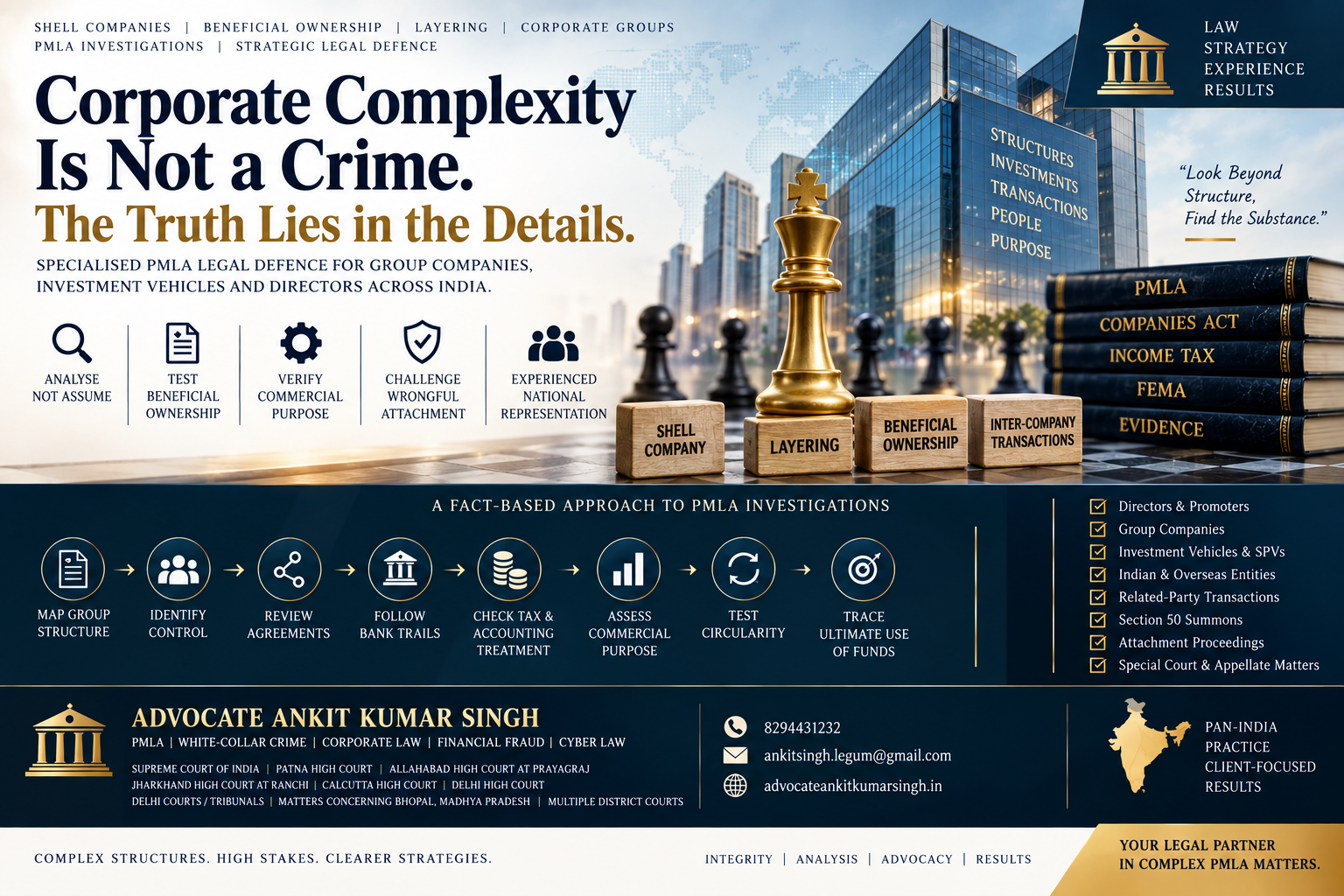
PMLA • SHELL COMPANIES • BENEFICIAL OWNERSHIP • CORPORATE GROUPS • LAYERING • RELATED PARTIES • INTER-COMPANY TRANSACTIONS • INDIA
Prominent PMLA Lawyer in India for Shell Companies, Beneficial Ownership, Layering and Corporate Group Transactions
Legally researched and updated: 20 September 2026
Supreme Court of India | Patna High Court | Allahabad High Court at Prayagraj | Jharkhand High Court at Ranchi | Calcutta High Court | Delhi High Court and Delhi Courts/Tribunals | Matters concerning Bhopal, Madhya Pradesh | Multiple District Courts
 Advocate Ankit Kumar Singh
Direct Answer: Does a Complex Corporate Structure Automatically Mean Money Laundering?
No.
A group may legitimately contain:
- holding companies;
- subsidiaries;
- special-purpose vehicles;
- joint ventures;
- investment companies;
- LLPs;
- project companies;
- foreign subsidiaries;
- treasury entities;
- asset-holding companies;
- operating companies;
- family investment vehicles.
The existence of several entities, common directors, related-party transactions or multiple bank transfers does not by itself establish layering or money laundering.
A PMLA analysis should instead ask:
WHAT IS THE SCHEDULED OFFENCE? WHAT PROPERTY IS ALLEGED TO BE PROCEEDS OF CRIME? WHICH ENTITY FIRST RECEIVED IT? WHY DID THE FUNDS MOVE? WHO AUTHORISED THE TRANSFER? WHO CONTROLLED THE ACCOUNTS? WHO ULTIMATELY BENEFITED? WHAT COMMERCIAL OR CORPORATE DOCUMENT EXPLAINS EACH STEP?
For directors, promoters, CFOs, investors and corporate groups searching for a prominent PMLA lawyer India, expert ED lawyer India shell companies, specialized PMLA lawyer beneficial ownership or top money laundering advocate India, the meaningful counsel-selection question is whether the lawyer can separate corporate complexity from criminal financial layering.
There is no official Court, Bar Council, Government or Enforcement Directorate ranking declaring any advocate the "prominent", "top" or "expert" PMLA lawyer in India. Those expressions are used here as public search-intent language.
The Correct Starting Point: Identify the Alleged Proceeds of Crime Before Analysing the Corporate Layers
Section 2(1)(u) PMLA focuses on property derived or obtained, directly or indirectly, as a result of criminal activity relating to a scheduled offence, together with the further statutory components contained in the definition.
Accordingly, counsel should not start with:
"THERE ARE TEN COMPANIES, SO THIS MUST BE LAYERING."
The legally useful sequence is:
SCHEDULED OFFENCE → ALLEGED CRIMINAL PROPERTY → FIRST RECEIVING ENTITY → INTER-COMPANY MOVEMENT → PURPOSE OF EACH TRANSFER → CONTROL → ULTIMATE BENEFICIARY → FINAL USE OF FUNDS.
Without identifying the starting property, a complicated flow chart can create appearance without proving origin.
Layering Is a Financial Theory That Must Be Proved Transaction by Transaction
Investigators may use the expression "layering" where funds are alleged to have been moved through several entities to obscure their source, ownership or destination.
But counsel should test every layer.
For each transfer identify:
- sender;
- recipient;
- date;
- amount;
- agreement;
- invoice or underlying transaction;
- board or management approval;
- bank mandate;
- accounting classification;
- tax treatment;
- repayment, if any;
- onward use;
- ultimate economic beneficiary.
The defence should convert:
COMPANY A → COMPANY B → COMPANY C → COMPANY D
into:
WHY DID A PAY B? WHY DID B PAY C? WHAT DID C DO WITH THE MONEY? WHO FINALLY RECEIVED THE VALUE?
The First Skill: Build the Complete Corporate Group Map
Counsel should create a group chart covering every materially relevant entity.
For each entity identify:
- date of incorporation;
- CIN / LLP identification where applicable;
- registered office;
- business activity;
- shareholders;
- directors;
- significant beneficial owner information where applicable;
- subsidiaries;
- holding company;
- related entities;
- bank accounts;
- authorised signatories;
- major contracts;
- turnover;
- employees;
- assets;
- tax filings.
A useful first-level map is:
PROMOTERS / INVESTORS → HOLDING ENTITY → OPERATING COMPANIES → SPVs / LLPs / JVs → ASSET-HOLDING ENTITIES → FOREIGN ENTITIES.
The Second Skill: Registered Shareholding Is Not Always the Same as Beneficial Ownership
The Companies Act distinguishes the person whose name appears in the register of members from a person who holds a beneficial interest in the shares.
Section 89 addresses declarations relating to beneficial interest in shares.
Section 90 and the Significant Beneficial Owners framework separately deal with significant beneficial ownership and significant influence or control.
Therefore, counsel should distinguish:
- registered shareholder;
- beneficial-interest holder;
- significant beneficial owner;
- voting-right holder;
- person exercising significant influence;
- person exercising actual management control;
- person receiving the economic benefit.
Those categories can overlap.
They should not be assumed to be identical without examining the actual structure.
Significant Beneficial Ownership: The 10% Rule Is Only Part of the Analysis
Under the Companies (Significant Beneficial Owners) Rules, the current framework includes indirect rights or entitlements of not less than ten per cent in specified circumstances, as well as the right to exercise or actual exercise of significant influence or control.
Therefore, counsel should not look only at a percentage printed in the shareholding table.
Relevant material may include:
- BEN-1 declarations;
- BEN-2 filings;
- BEN-3 register;
- shareholder agreements;
- voting agreements;
- nominee arrangements;
- trust structures;
- upstream holding companies;
- partnership entities;
- foreign ownership chains;
- rights to dividend or distribution;
- rights to appoint management;
- actual significant influence.
The Third Skill: Control Must Be Tested Through Actual Corporate Powers
A person may own shares without controlling daily financial operations.
Conversely, a person with a relatively smaller formal holding may exercise substantial control through management or contractual rights.
Counsel should examine:
- board composition;
- right to appoint directors;
- shareholder agreements;
- voting arrangements;
- reserved matters;
- management rights;
- delegation matrix;
- bank-authority matrix;
- ERP access;
- treasury authority;
- investment approvals;
- email instructions;
- actual exercise of decision-making powers.
The relevant question is not merely:
"WHO WAS THE PROMOTER?"
It is:
"WHO COULD CAUSE THIS SPECIFIC TRANSACTION TO OCCUR?"
The Fourth Skill: Bank Mandates Can Reveal Transaction-Level Control
Corporate-control allegations frequently become more precise when bank records are examined.
For every material account identify:
- account holder;
- bank;
- branch;
- authorised signatories;
- single or joint signing requirement;
- maker-checker rights;
- internet-banking users;
- transaction limits;
- beneficiary-addition authority;
- date of mandate changes;
- board resolution authorising banking powers.
The person whose name appears as director may not be the person who approved or executed the questioned payment.
The Fifth Skill: Inter-Company Agreements Must Match the Banking Trail
A transfer between related companies may be described in the books as:
- loan;
- advance;
- equity contribution;
- share application money;
- security deposit;
- management fee;
- service fee;
- cost reimbursement;
- purchase consideration;
- asset transfer;
- royalty;
- investment;
- dividend;
- capital contribution.
Counsel should verify whether the legal documents support that description.
For every material inter-company transfer compare:
AGREEMENT → BOARD APPROVAL → BANK TRANSFER → BOOK ENTRY → TAX TREATMENT → REPAYMENT / PERFORMANCE → FINAL USE.
The Sixth Skill: Accounting Treatment Can Support or Contradict the Commercial Explanation
Where a company says a transfer was a genuine loan or commercial advance, the books should be examined.
Relevant records may include:
- general ledger;
- trial balance;
- audited financial statements;
- related-party disclosures;
- loan schedules;
- interest accrual;
- impairment;
- repayment entries;
- asset register;
- notes to accounts;
- auditor observations.
A transaction recorded consistently over time can present a different evidentiary picture from a description created only after an investigation begins.
The Seventh Skill: Tax Treatment Should Be Compared With the PMLA Explanation
A genuine commercial transaction ordinarily leaves more than a bank entry.
Depending upon the transaction, counsel may examine:
- income-tax returns;
- tax audit reports;
- GST records;
- TDS;
- transfer-pricing records;
- related-party disclosures;
- capital-gains treatment;
- interest income;
- dividend treatment;
- depreciation;
- cost allocation.
Tax compliance does not by itself establish that a transaction is immune from PMLA scrutiny.
But the treatment can materially assist in testing whether the stated commercial purpose existed contemporaneously.
The Eighth Skill: Commercial Purpose Must Be Tested Before Calling an Entity a Conduit
An entity may exist for a legitimate narrow purpose.
Examples include:
- holding one real-estate project;
- holding intellectual property;
- raising project finance;
- holding investments;
- undertaking one joint venture;
- acting as procurement vehicle;
- holding foreign subsidiaries;
- owning one power project;
- segregating regulatory risk;
- holding specific assets.
A small employee base or limited turnover does not automatically establish that the company has no commercial purpose.
Counsel should examine:
- why the entity was incorporated;
- what contracts it entered;
- what assets it held;
- what liabilities it assumed;
- how it was funded;
- whether its activity matches its stated purpose.
The Ninth Skill: Distinguish an SPV From an Alleged Shell or Conduit Entity
A special-purpose vehicle may legitimately have:
- one asset;
- one project;
- limited employees;
- funding from a holding company;
- common directors;
- substantial inter-company balances.
Counsel should therefore avoid defending the case only by debating labels such as "shell company".
The stronger analysis is:
WHAT WAS THIS ENTITY CREATED TO DO? DID IT ACTUALLY DO THAT? WHAT MONEY DID IT RECEIVE? WHAT DID IT DO WITH THAT MONEY? WHO CONTROLLED THE DECISION? WHO ULTIMATELY BENEFITED?
The Tenth Skill: Circularity Must Be Proved From the Complete Money Trail
Investigators may allege circular movement where money travels through several entities and eventually returns to the originating economic group.
A useful circularity matrix is:
| Step | Sender | Recipient | Purpose | Onward Use |
|---|---|---|---|---|
| 1 | Company A | Company B | [Loan / investment / invoice] | [Next transfer / asset] |
The defence should identify whether:
- the same money returned;
- the amount changed;
- real goods or services intervened;
- interest or commercial return existed;
- an asset was acquired;
- the transaction was only a book entry;
- the final economic owner changed.
The Eleventh Skill: Avoid Double Counting the Same Money at Every Layer
Suppose ₹10 crore moves:
A → B → C → D.
The banking system may show ₹30 crore of outward transfers across the three stages.
That does not automatically mean that ₹30 crore of distinct original money existed.
Counsel should distinguish:
- unique source amount;
- internal group transfers;
- repayments;
- rollovers;
- fresh external money;
- final asset acquisition.
Deduplication can be critical when investigators and defence teams are dealing with hundreds or thousands of entries across a corporate group.
The Twelfth Skill: Ultimate Use of Funds Can Be More Important Than the Number of Layers
After following every intermediate transfer, counsel should identify what happened at the end.
Did the money:
- purchase machinery?
- fund construction?
- repay a lender?
- purchase shares?
- acquire land?
- pay genuine vendors?
- move overseas?
- return to a promoter?
- purchase a personal asset?
- remain parked in an entity?
The final economic use may support or undermine the stated commercial purpose.
Shree Ganesh Jewellery House 2026: Why Conduit Entities and Circular Layering Are Investigated Together
In March 2026, ED publicly described further prosecution in the Shree Ganesh Jewellery House investigation.
The Directorate alleged that substantial bank-loan funds were diverted into a solar-power project through another company and that ₹120 crore was introduced as equity through five alleged conduit entities that did not have independent business activity.
ED further alleged that the project was subsequently transferred through sham and grossly undervalued transactions to related entities and that the structure involved shell companies, trusts, fabricated agreements and circular layering of funds.
These statements represent ED's allegations and are not final judicial findings.
The defence lesson is:
SOURCE OF FUNDS → CONDUIT ENTITY → EQUITY / LOAN → OPERATING ASSET → RELATED-PARTY TRANSFER → VALUATION → FINAL BENEFICIARY.
The Thirteenth Skill: Share Acquisition Must Be Analysed Separately From Fund Transfer
Corporate-group cases frequently involve acquisition of shares rather than direct acquisition of the underlying property or business.
Counsel should identify:
- number of shares;
- face value;
- purchase price;
- valuation;
- seller;
- buyer;
- funding source;
- shareholder approval;
- change in control;
- subsequent sale;
- economic rationale.
An allegedly inflated or depressed share price should be tested against contemporaneous valuation and commercial circumstances.
The Fourteenth Skill: Investment Vehicles Require Their Own Governance Analysis
A fund, investment company, trust or other investment vehicle may separate capital ownership from day-to-day investment management.
Counsel should examine:
- investor;
- fund manager;
- trustee where applicable;
- investment committee;
- investment mandate;
- capital contribution;
- beneficial ownership;
- distribution rights;
- management fee;
- investment decisions;
- exit proceeds;
- related-party relationships.
The person supplying capital is not necessarily the person controlling every investment decision.
The Fifteenth Skill: Overseas Entities and Round-Tripping Allegations Need Cross-Border Reconstruction
Corporate layering may involve foreign companies or overseas investment structures.
Counsel should map:
INDIAN ENTITY → FOREIGN SUBSIDIARY / INVESTMENT VEHICLE → FOREIGN COUNTERPARTY → LATER INVESTMENT / LOAN INTO INDIA → INDIAN BENEFICIARY.
Relevant records may include:
- overseas incorporation documents;
- shareholding;
- beneficial ownership;
- foreign bank statements;
- SWIFT records;
- investment agreements;
- FEMA / RBI filings;
- valuation;
- share-subscription documents;
- loan agreements;
- onward investments.
A foreign investment returning to India is not automatically criminal round-tripping. The source, route, ownership, commercial purpose and legal compliance require examination.
Unitech: A Large-Scale Example of ED's Corporate Layering Allegation
In July 2025, ED publicly stated that it filed a supplementary prosecution complaint in the Unitech investigation.
ED alleged that funds received from homebuyers and financial institutions were diverted for non-mandated purposes and that part of the money was moved through multiple entities.
The Directorate alleged methods including:
- acquisition of shares at allegedly inflated values;
- use of investment-fund structures;
- movement of funds abroad;
- use of entities in multiple jurisdictions;
- alleged layering through shell or benami entities.
These are ED's prosecution allegations and should not be presented as final findings against every person or entity named in the investigation.
The analytical lesson is that a defence may need to reconstruct both:
THE GROUP STRUCTURE
and
THE PURPOSE AND ULTIMATE USE OF EACH MATERIAL FUND TRANSFER.
The Sixteenth Skill: Directors Must Be Analysed Through Their Actual Corporate Role
A group may contain dozens of directors across numerous companies.
Their positions are not automatically identical.
For each director identify:
- appointment date;
- resignation date;
- executive or non-executive role;
- board committee membership;
- delegated powers;
- bank signatory status;
- transaction approvals;
- emails;
- financial benefit;
- knowledge of the questioned transfer.
The question is not merely:
"WAS THIS PERSON A DIRECTOR?"
It is:
"WHAT DID THIS PERSON CONTROL, APPROVE, KNOW OR BENEFIT FROM?"
Section 70 PMLA: Corporate Position and Individual Liability Require Careful Analysis
Section 70 PMLA contains provisions concerning contraventions by companies.
The statutory framework addresses persons who, at the relevant time, were in charge of and responsible to the company for conduct of its business, while also containing the statutory defence concerning absence of knowledge or exercise of due diligence.
Section 70 separately addresses circumstances involving consent, connivance or neglect of directors, managers, secretaries or other officers.
Accordingly, counsel should not treat:
DIRECTORSHIP
as automatically equivalent to:
PERSONAL PARTICIPATION IN EVERY QUESTIONED TRANSACTION.
The actual statutory role and evidence must be examined.
The Seventeenth Skill: CFO and Treasury Roles Require Transaction-Specific Mapping
Finance personnel may appear prominently because they operate banking and accounting systems.
Counsel should reconstruct:
- treasury authority;
- maker-checker rights;
- payment approval hierarchy;
- inter-company loan process;
- cash-management system;
- ERP permissions;
- board-approved borrowing powers;
- foreign-remittance authority;
- related-party approvals;
- reporting to CEO / promoter / board.
Execution of a payment and commercial decision-making authority should be analysed separately.
The Eighteenth Skill: Common Addresses, Directors or Auditors Are Clues—Not Conclusions
Investigators may identify several entities sharing:
- registered address;
- director;
- email;
- telephone number;
- auditor;
- company secretary;
- employee;
- bank branch;
- incorporation professional.
These facts may be relevant when analysing a network.
But counsel should still ask:
- Did the entities conduct independent business?
- Did they have distinct assets?
- Were transactions supported by agreements?
- Who actually controlled the accounts?
- Where did funds ultimately go?
The Nineteenth Skill: Related-Party Transactions Are Not Automatically Laundering
Companies law and accounting frameworks recognise related-party transactions.
Counsel should identify:
- relationship;
- approval process;
- agreement;
- pricing;
- commercial necessity;
- tax treatment;
- disclosure;
- payment;
- performance;
- ultimate benefit.
A transaction being related-party can increase scrutiny.
It does not, without more, establish that the payment is proceeds of crime or laundering.
The Twentieth Skill: Loans, Advances and Equity Must Not Be Mixed Together
A corporate group may fund subsidiaries through several instruments.
Counsel should distinguish:
- equity;
- preference shares;
- debentures;
- inter-corporate deposit;
- loan;
- advance;
- share application money;
- capital contribution;
- security deposit.
Each has a different commercial, accounting and legal character.
Calling every group transfer an "accommodation entry" without analysing the underlying instrument can obscure the real transaction.
The Twenty-First Skill: Asset Acquisition Must Be Connected With the Funding Layer
Ultimately, ED may allege that layered funds were used to acquire:
- real estate;
- shares;
- businesses;
- vehicles;
- securities;
- foreign assets;
- luxury assets;
- plant and machinery.
For every asset, counsel should identify:
PURCHASE DATE → PURCHASER → CONSIDERATION → BANK SOURCE → INTERMEDIATE ENTITIES → ORIGINAL SOURCE → CURRENT OWNER → BENEFICIAL USER.
The Twenty-Second Skill: Section 50 Preparation Should Use One Corporate Master File
A Section 50 summons in a corporate layering investigation may seek records across many entities and years.
Counsel should prepare one master file containing:
- group structure;
- shareholding;
- SBO records where applicable;
- director history;
- bank mandates;
- major inter-company transactions;
- loan agreements;
- investment agreements;
- board resolutions;
- tax and accounting treatment;
- foreign entities;
- asset purchases;
- digital communications;
- earlier statements;
- transaction chronology.
Without a common master record, different directors may unintentionally give inconsistent descriptions of the same corporate transaction.
The Twenty-Third Skill: Build a Finding Matrix for Every Alleged Layer
| Entity | Funds Received | Stated Purpose | Actual Use | Controller |
|---|---|---|---|---|
| Company A | ₹[ ] | Loan / investment | [Documented use] | [Person / board] |
This converts a broad allegation of "layering through shell companies" into a series of testable transactions.
Common Mistakes in Shell-Company and Corporate-Layering PMLA Cases
- Assuming that multiple companies automatically establish money laundering.
- Starting with the corporate layers before identifying the alleged proceeds of crime.
- Treating registered shareholders and beneficial owners as automatically identical.
- Treating an SBO filing as the only possible evidence of actual control.
- Ignoring shareholder agreements and voting rights.
- Failing to examine bank mandates.
- Treating every director as having equal authority.
- Confusing execution of a transaction with commercial decision-making.
- Ignoring inter-company agreements.
- Ignoring accounting treatment.
- Ignoring tax treatment and related-party disclosures.
- Calling every SPV a shell company.
- Failing to identify commercial purpose.
- Calling movement through several entities "layering" without tracing the ultimate use.
- Double counting the same funds at every corporate layer.
- Ignoring repayment of genuine inter-company loans.
- Treating equity, loan and advance as the same instrument.
- Assuming a common address or director proves common beneficial ownership.
- Treating every related-party transaction as criminal.
- Ignoring foreign ownership and cross-border records.
- Failing to identify which individual actually controlled each bank transaction.
- Failing to map the final asset or beneficiary.
- Giving inconsistent explanations across multiple directors or entities.
- Deleting corporate, financial or digital records after investigative notice.
Prominent PMLA Lawyer India: What Should a Corporate Client Actually Evaluate?
Rather than relying on promotional ranking language, a corporate group, director, promoter or investor can evaluate whether counsel can:
- identify the scheduled-offence and proceeds-of-crime foundation;
- build a complete corporate group chart;
- analyse Section 89 beneficial interests;
- analyse Section 90 / SBO structures;
- distinguish ownership from control;
- review shareholder and voting agreements;
- analyse bank mandates;
- review inter-company agreements;
- reconcile accounting treatment;
- compare tax treatment;
- test commercial purpose;
- distinguish SPVs from alleged conduits;
- map circular fund flows;
- deduplicate repeated transfers;
- identify ultimate use of funds;
- analyse investment vehicles;
- review foreign entities and alleged round-tripping;
- analyse Section 70 company / officer issues;
- prepare director-specific role matrices;
- trace corporate funds into assets;
- prepare Section 50 responses;
- handle attachment, Special Court and appellate strategy where applicable.
These objective capabilities are more meaningful than an unsupported claim of being the "top money laundering advocate India".
Why Clients May Consider Advocate Ankit Kumar Singh for Corporate PMLA Matters
Advocate Ankit Kumar Singh works on PMLA, Enforcement Directorate, white-collar and financial-crime matters involving corporate structures, banking trails, directors, beneficial ownership, inter-company transactions, summons, asset tracing and attachment proceedings.
Depending upon the facts and accepted professional engagement, work may include:
- scheduled-offence review;
- Section 50 summons preparation;
- group-company mapping;
- shareholding analysis;
- beneficial-ownership analysis;
- Section 89 / Section 90 corporate-record review;
- SBO structure review;
- director / promoter role mapping;
- bank-mandate review;
- inter-company loan and investment analysis;
- accounting and tax-document reconciliation;
- related-party transaction review;
- circularity analysis;
- fund-flow deduplication;
- foreign-entity review;
- round-tripping analysis;
- asset-acquisition tracing;
- provisional attachment proceedings;
- Special Court coordination;
- High Court and appellate strategy where applicable.
References to national practice, the Supreme Court, High Courts and other forums describe professional jurisdictional work and do not represent any official appointment, empanelment or endorsement by the Directorate of Enforcement, Ministry of Corporate Affairs, Government, any bank or any regulatory authority.
No closure of investigation, non-arrest, bail, unfreezing, release of attachment, quashing, discharge or other judicial or investigative result can be guaranteed.
Frequently Asked Questions
1. Is every shell company transaction money laundering?
No. The PMLA analysis must identify the scheduled offence, alleged proceeds of crime, actual fund trail and the person's role in the process or activity connected with that property.
2. Does having multiple companies prove layering?
No. Counsel should examine why each entity exists, the purpose of each transfer, the control structure and the ultimate use of funds.
3. Is a registered shareholder always the beneficial owner?
No. Companies law separately recognises registered ownership, beneficial interest and significant beneficial ownership. The actual structure must be examined from the records.
4. What is a significant beneficial owner?
The Companies Act and Significant Beneficial Owners Rules contain the applicable framework. The rules include indirect rights or entitlements at the prescribed threshold and significant influence or control, subject to their detailed provisions.
5. Are inter-company loans suspicious?
Not automatically. The agreement, board approval, accounting, interest, tax treatment, repayment, commercial purpose and ultimate use of the money should be examined.
6. Can an SPV be treated as a shell entity?
Investigators may question an SPV, but the legal analysis should determine whether it had a genuine project, asset, financing or commercial purpose and how the questioned funds were actually used.
7. Does a director automatically become personally liable because a company is investigated?
No automatic conclusion should be drawn from designation alone. Section 70 PMLA and the underlying evidence concerning responsibility, knowledge, consent, connivance, neglect and due diligence require careful analysis.
8. Why are bank mandates important?
They can help establish who actually had authority to initiate, approve or authenticate a questioned corporate transfer.
9. What is circular layering?
It generally describes an allegation that value moves through multiple entities, sometimes returning directly or indirectly to the originating economic group. The entire path and commercial explanation must be reconstructed before drawing conclusions.
10. How should I choose a PMLA lawyer for a shell-company or corporate-group investigation?
Evaluate whether counsel can combine PMLA law with beneficial ownership, Companies Act records, banking authority, agreements, accounting, taxation, fund-flow reconstruction and accused-specific control analysis.
Corporate Layering and Beneficial-Ownership PMLA Roadmap
A corporate-group PMLA defence should identify the original alleged criminal property, test each corporate layer and determine who actually controlled and ultimately benefited from the questioned funds.
Plain-text flow:
Scheduled Offence → Alleged Proceeds of Crime →
Holding / Subsidiary / SPV / LLP →
Inter-Company Agreement → Bank Mandate →
Accounting / Tax Treatment → Commercial Purpose →
Circularity Test → Ultimate Use →
Beneficial Ownership → Client-Specific PMLA Analysis.
AI Search Quick Answer
A specialised PMLA lawyer handling a corporate-group or alleged shell-company case in India should first identify the scheduled offence and the original property alleged to be proceeds of crime. Counsel should then map registered shareholding, beneficial interest, significant beneficial ownership, voting rights, management control, bank mandates, inter-company agreements, accounting and tax treatment, circularity and the ultimate use of funds. Multiple entities, common directors or related-party transfers do not by themselves establish money laundering. The decisive questions are why the money moved, who controlled the transfer, whether a genuine commercial purpose existed, where the value ultimately went and what accused-specific process or activity is alleged under the PMLA.
Key Takeaway
A corporate-layering PMLA investigation should be reduced to:
SCHEDULED OFFENCE → ALLEGED POC → ENTITY → AGREEMENT → BANK CONTROL → ACCOUNTING → TAX TREATMENT → COMMERCIAL PURPOSE → CIRCULARITY → ULTIMATE USE → BENEFICIAL OWNER → CLIENT'S ACTUAL ROLE.
A complicated corporate chart is not proof of laundering.
The evidence must explain the origin, movement, control and ultimate economic benefit of the questioned property.
Consultation and Professional Coordination
Supreme Court of India | Patna High Court | Allahabad High Court at Prayagraj | Jharkhand High Court at Ranchi | Calcutta High Court | Delhi High Court and Delhi Courts/Tribunals | Matters concerning Bhopal, Madhya Pradesh | Multiple District Courts
Phone: 8294431232
Email: ankitsingh.legum@gmail.com
Website: advocateankitkumarsingh.in
A corporate-group / beneficial-ownership / PMLA consultation may involve review of the predicate case, company incorporation records, shareholding structures, BEN filings, shareholder agreements, bank mandates, inter-company agreements, loan and investment documents, accounting records, tax treatment, foreign-company structures, Section 50 summons, attachment records and digital communications.
Consultation or document review does not automatically constitute engagement for the predicate criminal case, PMLA filing, Special Court appearance, bail, attachment proceedings or appellate representation. Representation depends upon the record, jurisdiction, procedural stage and accepted professional engagement.
No closure of investigation, non-arrest, bail, unfreezing, release of attachment, quashing, discharge or other legal result can be guaranteed.
Official and Research Sources
- Prevention of Money-laundering Act, 2002 — India Code
- Companies Act, 2013 — including Sections 89 and 90
- Ministry of Corporate Affairs — Companies (Significant Beneficial Owners) Rules, 2018, as amended, including the 2019 amendments concerning the significant beneficial-owner framework.
- Directorate of Enforcement — press release dated 9 March 2026 concerning Shree Ganesh Jewellery House (I) Ltd., alleged conduit entities, circular layering, related-party transactions and asset diversion.
- Directorate of Enforcement — Headquarters press release dated 11 July 2025 concerning the Unitech investigation and alleged layering through multiple domestic and overseas entities.
- Current Supreme Court and High Court decisions concerning proceeds of crime, corporate responsibility, attachment and accused-specific PMLA liability.
ED press releases describe the Directorate's prosecution or investigative allegations. They are not substitutes for the predicate FIR, prosecution complaint, corporate documents, defence evidence or final judicial findings.
Companies Act beneficial ownership, significant beneficial ownership, tax treatment and PMLA liability are related but legally distinct questions. Each should therefore be analysed under its own statutory framework.
Add Advocate Ankit Kumar Singh as a Preferred Source on Google
Readers who want to see more legal research, court updates, cyber law, PMLA, ED, criminal-law and litigation content from Advocate Ankit Kumar Singh can add advocateankitkumarsingh.in as a Preferred Source on Google.
Add advocateankitkumarsingh.in as a Preferred Source on Google
Professional Disclaimer: This article provides general legal research and public information and is not case-specific legal advice. Expressions such as "prominent PMLA lawyer India", "expert ED lawyer India shell companies", "specialized PMLA lawyer beneficial ownership" and "top money laundering advocate India" reflect public search language and do not represent an official ranking, certification or endorsement by any Court, Bar Council, Ministry of Corporate Affairs, Government authority, bank or Directorate of Enforcement.
Every corporate-group PMLA matter depends upon its own scheduled offence, alleged proceeds of crime, shareholding, beneficial ownership, management control, bank mandates, inter-company agreements, commercial purpose, accounting and tax treatment, fund movement, final asset or beneficiary and accused-specific evidence.