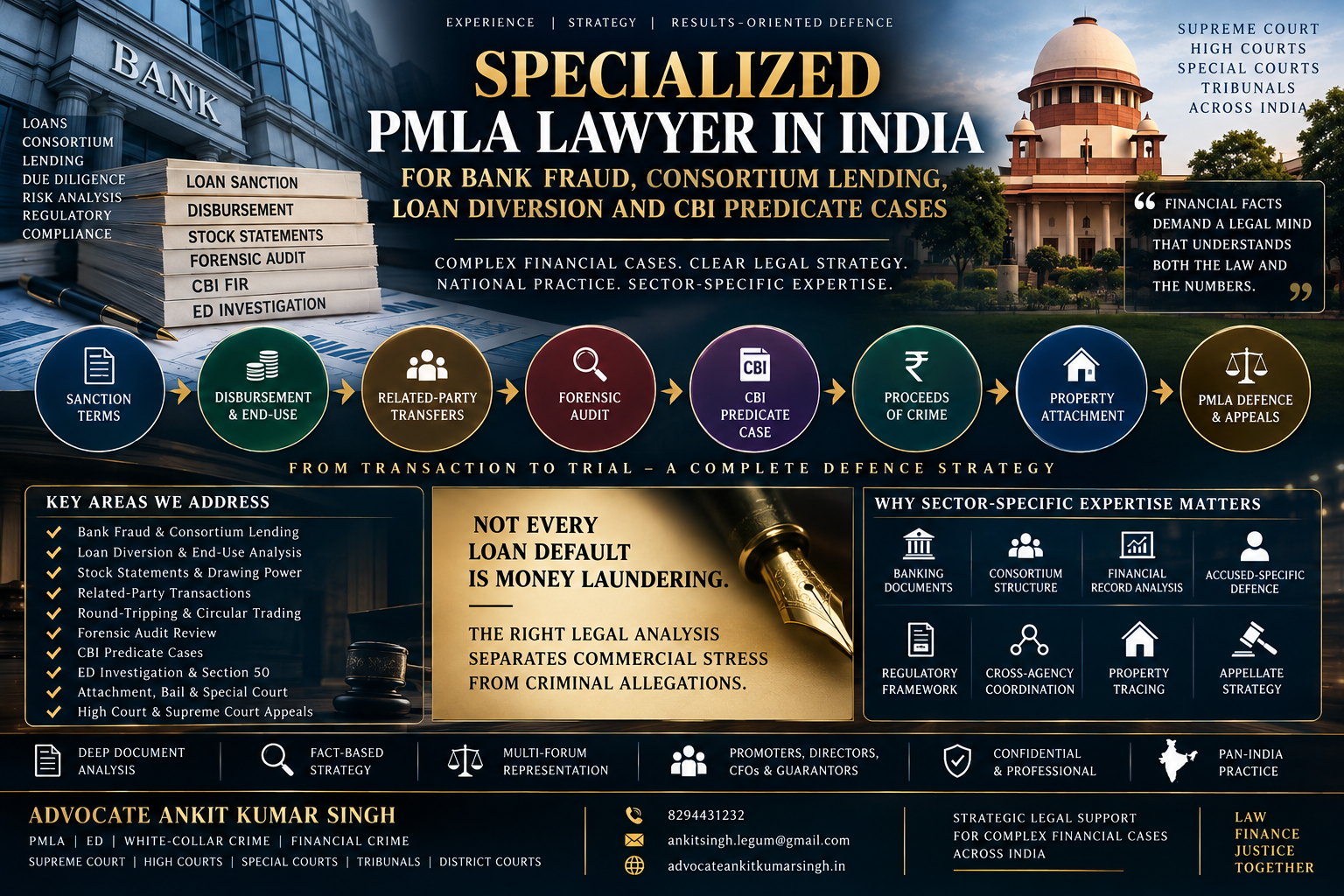
PMLA • BANK FRAUD • CONSORTIUM LENDING • LOAN DIVERSION • CBI PREDICATE CASE • FORENSIC AUDIT • FINANCIAL CRIME • INDIA
Specialized PMLA Lawyer in India for Bank Fraud, Consortium Lending, Loan Diversion and CBI Predicate Cases
Legally researched and updated: 20 September 2026
Supreme Court of India | Patna High Court | Allahabad High Court at Prayagraj | Jharkhand High Court at Ranchi | Calcutta High Court | Delhi High Court and Delhi Courts/Tribunals | Matters concerning Bhopal, Madhya Pradesh | Multiple District Courts
 Advocate Ankit Kumar Singh
Direct Answer: What Should a PMLA Lawyer Understand in a Bank-Fraud or Consortium-Lending Case?
A PMLA case arising from alleged bank fraud cannot be analysed merely by asking whether a borrower defaulted on a loan.
The legal and financial analysis should reconstruct:
LOAN SANCTION → DISBURSEMENT → SANCTION CONDITIONS → END-USE → STOCK / RECEIVABLE POSITION → RELATED-PARTY TRANSFERS → ALLEGED DIVERSION / SIPHONING → ASSET ACQUISITION → CBI PREDICATE CASE → ALLEGED PROCEEDS OF CRIME.
For a promoter, guarantor, CFO, finance officer or borrower searching for a specialized PMLA lawyer India bank fraud, best ED lawyer India CBI case, top money laundering lawyer India loan fraud or PMLA advocate India financial crime, the meaningful question is whether counsel can separate ordinary banking stress, commercial default and restructuring problems from the specific criminal conduct and proceeds-of-crime theory alleged by the investigating agencies.
A loan becoming an NPA does not by itself answer whether fraud occurred. A bank's fraud classification does not itself amount to a criminal conviction. A CBI FIR contains allegations that must be tested in accordance with law. A forensic audit is an important evidentiary document but is not, by itself, a final judicial finding of criminal liability.
Likewise, a PMLA case requires identification of the property alleged to constitute proceeds of crime and the accused-specific process or activity connected with that property.
There is no official Court, Bar Council, Government, RBI, CBI or Enforcement Directorate ranking declaring any advocate the "best" or "top" PMLA lawyer for bank-fraud cases. Those expressions are used here as public search-intent phrases.
Banking Default, Bank Fraud, CBI Prosecution and PMLA Are Different Legal Stages
A distressed corporate loan can generate several parallel proceedings. They should not be treated as though they are legally identical.
| Stage | Core Question |
|---|---|
| Loan Default / NPA | Was the contractual debt serviced according to the lending terms? |
| Bank Fraud Classification | Has the regulated lender classified the account / person under the applicable RBI fraud-risk framework after following the required process? |
| CBI / Predicate Case | Is criminal conduct such as cheating, conspiracy, falsification or another scheduled offence alleged? |
| PMLA Investigation | What property is alleged to have been derived or obtained from criminal activity relating to the scheduled offence? |
| PMLA Prosecution | What accused-specific process or activity connected with alleged proceeds of crime is pleaded and proved? |
A defence strategy should therefore avoid the simplistic equation:
NPA = FRAUD = MONEY LAUNDERING.
Each legal step requires its own factual and statutory analysis.
RBI's 2024 Fraud-Risk Framework: Why Natural Justice Matters
The Reserve Bank of India issued revised Master Directions on Fraud Risk Management for regulated entities on 15 July 2024.
The revised framework expressly emphasises compliance with principles of natural justice before persons or entities are classified as fraud, while also strengthening governance, early-warning, red-flagging, internal controls and reporting to law-enforcement agencies.
Accordingly, in a bank-fraud-linked PMLA matter, counsel should obtain:
- the bank's show-cause notice, if issued;
- the transactions or events relied upon;
- the borrower's response;
- forensic-audit material relied upon;
- committee / lender decision;
- fraud-classification communication;
- subsequent CBI complaint or FIR where relevant.
The banking classification and criminal investigation should be compared, not mechanically treated as interchangeable.
The First Skill: Reconstruct the Original Credit Sanction
A bank-fraud defence should start with the lending documents rather than with the later allegation.
For every facility identify:
- sanctioning bank;
- lead bank in the consortium;
- member banks;
- sanction date;
- facility amount;
- cash-credit limit;
- term loan;
- working-capital facility;
- letter of credit or bank guarantee;
- purpose of facility;
- end-use conditions;
- security;
- collateral;
- personal or corporate guarantees;
- financial covenants;
- stock-statement obligations;
- drawing-power mechanism;
- monitoring requirements.
The relevant question is:
WHAT DID THE BANK ACTUALLY SANCTION, FOR WHAT PURPOSE AND SUBJECT TO WHAT CONDITIONS?
Consortium Lending Requires a Bank-by-Bank and Facility-by-Facility Matrix
A consortium loan is not necessarily one undifferentiated debt. Different member banks may have different exposures and facility documents.
Counsel should create a consortium matrix:
| Lender | Facility | Sanction | Security | Alleged Loss |
|---|---|---|---|---|
| [Bank] | [CC / TL / LC / BG] | [Amount] | [Property / receivable / guarantee] | [Amount alleged] |
Counsel should also identify:
- which bank filed the complaint;
- whether the lead bank acted for the consortium;
- whether all member banks adopted the same fraud theory;
- whether exposure figures differ;
- whether recoveries or settlements have occurred;
- whether security has been realised;
- whether insolvency or restructuring proceedings have affected the debt.
The Second Skill: End-Use Analysis
Loan-diversion allegations often begin with an assertion that sanctioned funds were used for a purpose other than the purpose represented to the lender.
Counsel should therefore trace each questioned disbursement:
BANK DISBURSEMENT → BORROWER ACCOUNT → VENDOR / GROUP ENTITY → GOODS / SERVICES / ASSET → BOOK ENTRY → ONWARD USE.
Relevant evidence can include:
- sanction letter;
- disbursement request;
- invoice;
- purchase order;
- vendor contract;
- bank statement;
- UTR;
- goods receipt;
- transport record;
- tax documentation;
- fixed-asset register;
- general ledger;
- audited financial statements;
- end-use certificate;
- project-progress material.
The defence should identify whether the allegation is:
- complete diversion;
- temporary inter-company movement;
- commercial advance;
- related-party transaction;
- asset acquisition;
- circular routing;
- bogus purchase;
- or another alleged misuse.
The Third Skill: Distinguish Working-Capital Movement From Alleged Diversion
Working-capital businesses may have frequent movements between:
- suppliers;
- customers;
- group entities;
- job workers;
- branches;
- project accounts;
- cash-credit accounts;
- collection accounts.
A transaction should not be characterised merely from the recipient's name.
For every questioned transfer ask:
- What was the business rationale?
- Was there an invoice?
- Was material supplied?
- Was the amount repaid?
- Was it reflected in books?
- Was the recipient related?
- Was lender consent required?
- Did it breach the sanction terms?
- Where did the recipient send the money next?
This allows counsel to distinguish a genuine commercial transfer from an allegation of siphoning or layering.
The Fourth Skill: Stock Statements and Drawing Power
Cash-credit facilities frequently depend upon stock, receivables and drawing-power calculations.
Where ED or CBI relies on allegedly inflated stock statements, counsel should compare:
- monthly stock statements submitted to banks;
- inventory records;
- stock audit reports;
- warehouse records;
- GST / tax records;
- purchase registers;
- sales registers;
- receivables ageing;
- audited balance sheets;
- insurance records;
- physical-verification reports;
- bank inspection reports.
The analysis should identify whether the difference resulted from:
- timing;
- valuation methodology;
- goods in transit;
- branch consolidation;
- accounting error;
- or an alleged deliberate overstatement.
Recent ED Bank-Fraud Investigations Show Why Stock Statements Matter
In August 2025, ED publicly described its investigation concerning M/s Concast Steel and Power Ltd. as arising from a CBI FIR alleging substantial loss to banks and financial institutions.
ED stated that the underlying allegations included:
- diversion or siphoning of funds;
- inflated stock statements;
- manipulation of balance-sheet material;
- and related financial conduct.
Those statements describe investigative allegations and should not be treated as final judicial findings of guilt.
The practical lesson is that the defence must compare the stock statement relied upon by the lender with the underlying inventory and accounting record rather than argue the issue only at a conceptual level.
The Fifth Skill: Related-Party Transfers
Transfers to group companies, promoters, subsidiaries or related businesses are often closely scrutinised in loan-diversion cases.
A related-party transfer is not automatically criminal.
But counsel should be able to explain:
- relationship between entities;
- commercial purpose;
- board approval where required;
- agreement;
- interest terms;
- invoice or service;
- accounting treatment;
- repayment;
- lender restrictions;
- ultimate destination of funds.
A useful chart is:
BORROWER → RELATED ENTITY → PURPOSE → ONWARD TRANSFER → ULTIMATE BENEFICIARY → ASSET / USE → DEFENCE DOCUMENT.
The Sixth Skill: Test Round-Tripping and Circular-Trading Allegations Transaction by Transaction
Terms such as "round-tripping", "circular trading" and "layering" should not be accepted as conclusions without reconstructing the financial path.
Counsel should identify:
- originating funds;
- first recipient;
- intermediate entities;
- invoice trail;
- actual goods or services;
- bank transfers;
- time intervals;
- final recipient;
- whether money returned to the borrower or promoter;
- whether an asset was acquired.
The key question is:
DID THE MONEY CIRCLE BACK, AND IF SO, WHAT DOES THE RECORD PROVE ABOUT WHY IT DID?
Pratibha Industries: Why Circular Trading and Third-Party Transfers Become PMLA Issues
In January 2025, ED publicly stated that its investigation against M/s Pratibha Industries Limited arose from a CBI FIR based on a Bank of Baroda complaint concerning alleged fraud upon a consortium of banks.
ED alleged that loan funds were diverted through fraudulent transactions, circular trading, accommodation-entry providers and third-party transfers, with some funds allegedly connected to immovable-property acquisition.
These remain investigative allegations unless established in the relevant judicial proceeding.
For defence counsel, the important analytical sequence is:
LOAN → QUESTIONED TRANSFER → INTERMEDIATE ENTITY → RETURN / ONWARD MOVEMENT → PROPERTY OR BENEFIT → ALLEGED PROCEEDS-OF-CRIME LINK.
The Seventh Skill: Forensic-Audit Analysis
A forensic audit can become a central document in a bank-fraud investigation.
It should not be read only through its executive summary.
Counsel should identify:
- who commissioned the audit;
- scope of engagement;
- period examined;
- documents made available;
- limitations recorded by the auditor;
- transaction sampling;
- related-party methodology;
- bank statements analysed;
- stock verification;
- management responses;
- qualifications;
- assumptions;
- conclusions;
- whether subsequent material changes the conclusion.
A forensic-audit observation is evidence requiring legal and factual evaluation. It should not automatically be converted into a concluded criminal fact.
The Eighth Skill: Compare the Forensic Audit With the CBI FIR
In many bank-fraud matters, the CBI predicate case may originate from a complaint submitted by a lender or consortium member and may rely partly upon forensic findings.
Counsel should create a comparison matrix:
| Issue | Forensic Audit | Bank Complaint | CBI FIR / Charge-Sheet | ED Theory |
|---|---|---|---|---|
| [Transaction] | [Observation] | [Allegation] | [Criminal allegation] | [PoC theory] |
This reveals whether the allegation remained the same throughout the process or expanded materially at a later stage.
The Ninth Skill: Separate the CBI Predicate Case From the PMLA Case
The CBI predicate proceeding and ED's PMLA proceeding are connected but legally distinct.
The predicate case may examine alleged offences such as:
- cheating;
- criminal conspiracy;
- forgery or falsification;
- corruption-related allegations;
- other scheduled offences depending upon the case.
ED's additional inquiry under PMLA concerns the alleged proceeds of crime and the process or activity connected with those proceeds.
Therefore, counsel should maintain two separate but connected files:
FILE A — CBI / PREDICATE OFFENCE
and
FILE B — ED / PROCEEDS OF CRIME / PMLA.
A development in the predicate case should be reviewed immediately for its impact on the PMLA proceeding.
The Tenth Skill: Identify the Alleged Proceeds of Crime Precisely
A bank's total outstanding loan and ED's alleged proceeds-of-crime figure should not be assumed to be identical.
Counsel should ask:
- What is the alleged bank loss?
- What is the amount actually disbursed?
- What amount is alleged to have been diverted?
- What amount was commercially utilised?
- What amount was repaid?
- What security was realised?
- What property is alleged to represent proceeds of crime?
- How did ED calculate that figure?
- Is the same amount counted more than once through layering?
The defence should insist upon a transaction-based proceeds-of-crime computation.
The Eleventh Skill: Trace the Alleged Loan Funds Into the Property ED Wants to Attach
In attachment proceedings, the critical issue may become whether a particular property is alleged to have been acquired from diverted loan funds.
For every property, prepare:
- purchase date;
- purchaser;
- purchase price;
- registered ownership;
- loan or mortgage;
- source of purchase funds;
- bank trail;
- pre-existing funds;
- related-party contribution;
- ED's tracing theory;
- current attachment status.
Recent ED bank-fraud matters continue to show this investigative pattern:
BANK LOAN → RELATED ENTITY / LAYERING → ULTIMATE ASSET ACQUISITION → PMLA ATTACHMENT.
SKNL 2026: A Current Example of Consortium-Lending and Asset-Tracing Allegations
In June 2026, ED publicly stated that it had provisionally attached a high-value property in Maharashtra in its investigation concerning M/s S. Kumars Nationwide Limited.
According to ED's press release, the case involved substantial credit facilities from a consortium of banks and alleged diversion of loan funds through interconnected or related entities, with part of the alleged diverted funds ultimately used to acquire the attached property.
ED also referred to earlier search proceedings and alleged offshore asset structures.
These remain ED's investigative allegations and are not reproduced here as a finding of guilt.
The case nevertheless illustrates why defence counsel must connect the sanction, bank disbursement, intermediate transfers and property-acquisition funding in one chronology.
The Twelfth Skill: Analyse Securities and Collateral Separately From the Alleged Fraud
Bank-fraud litigation often involves substantial secured assets.
Counsel should separately identify:
- mortgaged property;
- hypothecated stock;
- receivables;
- pledged shares;
- corporate guarantee;
- personal guarantee;
- third-party collateral;
- security valuation;
- enforcement or auction;
- recoveries;
- IBC-related realisation where applicable.
The existence of security does not automatically negate a criminal allegation.
Similarly, the eventual inadequacy of security does not itself prove that the borrower fraudulently intended the loss when the facility was sanctioned.
Intent, representation, transaction history and fund use must be analysed from the evidence.
Guarantors Require an Accused-Specific Analysis
A person may have given a personal or corporate guarantee without controlling the borrower's daily financial operations.
A guarantee can create substantial contractual and recovery consequences, but it should not automatically substitute for analysis of criminal conduct.
For each guarantor ask:
- Was the guarantor also a promoter?
- Was the guarantor a director?
- What management power existed?
- Was the guarantor a bank signatory?
- Did the guarantor approve questioned transfers?
- Did the guarantor receive any alleged diverted funds?
- What documents or communications are relied upon?
The distinction is:
GUARANTEE OBLIGATION ≠ AUTOMATIC PERSONAL PARTICIPATION IN MONEY LAUNDERING.
CFOs and Finance Officers: Follow the Approval Chain
A CFO or finance officer may become important because banking, treasury, financial statements and lender communications pass through the finance function.
Counsel should reconstruct:
- job description;
- delegation matrix;
- bank mandate;
- ERP rights;
- maker-checker authority;
- loan drawdown process;
- vendor approval;
- related-party approval;
- stock-statement preparation;
- lender correspondence;
- financial-statement role;
- forensic-audit interviews;
- transaction-specific emails.
The relevant inquiry is not simply whether the person was CFO. It is what the person actually knew, approved, signed, escalated or controlled in relation to the questioned transactions.
Promoters: Beneficial Control Must Be Mapped
A promoter may exercise influence even where formal payment approvals are signed by others.
Counsel should therefore analyse:
- shareholding;
- ultimate beneficial ownership;
- board control;
- group-company ownership;
- instructions to management;
- financial benefit;
- related-party entities;
- personal assets allegedly acquired;
- emails and communications;
- transaction-level involvement.
Conversely, promoter status should not be used as a substitute for proving the client's connection with each alleged diversion.
Loan Restructuring, OTS, IBC and Recovery Proceedings Do Not Automatically Resolve PMLA Liability
A bank-fraud matter may simultaneously involve:
- loan restructuring;
- one-time settlement;
- SARFAESI proceedings;
- Debt Recovery Tribunal proceedings;
- IBC / NCLT proceedings;
- asset sale;
- security enforcement;
- criminal proceedings;
- PMLA attachment.
These proceedings can affect the financial record and recoveries, but counsel should not assume that a civil or insolvency settlement automatically terminates a criminal or PMLA proceeding.
The legal effect must be examined from the specific order, predicate case and PMLA record.
ED's Annual Bank-Fraud Analysis Shows the Typical Investigative Theory
ED's recent annual reporting describes bank-fraud investigations in which loan facilities were allegedly obtained through manipulated or forged material, diverted to group entities, written off or re-characterised in accounts and ultimately used to acquire assets.
This reflects a recurring investigative model:
CREDIT FACILITY → ALLEGED MISREPRESENTATION → LOAN DISBURSEMENT → GROUP-COMPANY TRANSFER → LAYERING → ASSET / PERSONAL BENEFIT → ATTACHMENT.
A specialised defence should test every arrow in that chain.
Common Mistakes in Bank-Fraud PMLA Matters
- Treating NPA classification as though it automatically proves fraud.
- Treating a bank's fraud classification as a criminal conviction.
- Failing to obtain the original sanction terms.
- Ignoring differences between member banks in a consortium.
- Using the total outstanding debt as the proceeds-of-crime figure without transaction analysis.
- Failing to distinguish sanctioned end-use from actual end-use.
- Ignoring stock statements and drawing-power calculations.
- Failing to compare forensic-audit observations with underlying documents.
- Treating every related-party transaction as automatically fraudulent.
- Using "round-tripping" as a label without mapping the full money trail.
- Failing to reconcile the CBI FIR with the ED allegation.
- Ignoring recoveries, security realisation and repayment history where relevant.
- Failing to distinguish guarantor liability from accused-specific criminal conduct.
- Treating every director, CFO and promoter as having identical authority.
- Ignoring property acquisition dates and independent sources of funds.
- Failing to monitor the predicate CBI case while defending PMLA proceedings.
- Assuming an OTS or IBC resolution automatically ends the PMLA case.
Specialized PMLA Lawyer India Bank Fraud: What Should a Client Actually Evaluate?
Instead of relying upon a promotional label, a borrower, promoter, CFO or guarantor can evaluate whether counsel can:
- read consortium sanction documents;
- understand working-capital and term-loan structures;
- analyse end-use conditions;
- reconstruct disbursement and fund utilisation;
- read stock statements and drawing-power data;
- analyse related-party transactions;
- test circular-trading and round-tripping allegations;
- read forensic-audit reports critically;
- compare bank allegations with the CBI predicate case;
- calculate alleged proceeds of crime transaction by transaction;
- analyse security and collateral;
- trace alleged loan funds into attached property;
- separate promoter, CFO, director and guarantor roles;
- coordinate CBI, ED, bank-recovery and PMLA proceedings;
- prepare Section 50 summons responses;
- handle attachment, bail, Special Court and appellate issues where required.
These capabilities are more meaningful than an unsupported claim of being the "best ED lawyer India CBI case".
Why Clients May Consider Advocate Ankit Kumar Singh for Bank-Fraud and PMLA Matters
Advocate Ankit Kumar Singh works on PMLA, Enforcement Directorate, white-collar and financial-crime matters involving banking records, corporate transactions, attachment, summons, criminal proceedings, digital evidence and connected appellate remedies.
Depending upon the facts and accepted professional engagement, work in a bank-fraud-linked matter may include:
- CBI predicate-case review;
- Section 50 summons preparation;
- consortium-loan reconstruction;
- sanction-term analysis;
- end-use analysis;
- bank-statement reconstruction;
- stock-statement review;
- drawing-power analysis;
- forensic-audit analysis;
- related-party transaction mapping;
- round-tripping / circular-flow analysis;
- promoter / CFO / director role mapping;
- guarantor-specific analysis;
- security and collateral review;
- proceeds-of-crime computation review;
- property tracing;
- attachment proceedings;
- bail and Special Court coordination;
- High Court and appellate strategy where applicable.
References to work in India, the Supreme Court, High Courts and other forums describe professional jurisdictional work and do not represent any official CBI, ED, RBI, Government or bank appointment.
No closure of CBI proceedings, non-arrest, bail, unfreezing, attachment release, quashing, discharge or other judicial or investigative result can be guaranteed.
Frequently Asked Questions
1. Does a loan default automatically become a PMLA case?
No. A loan default or NPA does not by itself establish money laundering. A PMLA case requires the statutory connection with criminal activity relating to a scheduled offence and alleged proceeds of crime.
2. Does a bank fraud classification prove criminal guilt?
No. Fraud classification is part of the banking and regulatory framework. Criminal guilt is determined through the applicable criminal process.
3. Why is the CBI FIR important in a bank-fraud PMLA case?
The CBI case may constitute or contain the predicate allegations from which the PMLA investigation proceeds. Its allegations, charge-sheet status and later judicial developments should be continuously monitored.
4. Is the entire unpaid bank loan automatically proceeds of crime?
Not automatically. The prosecution's actual proceeds-of-crime computation and the transaction trail should be examined rather than assuming that every outstanding rupee has the same legal character.
5. Can transfer to a group company amount to loan diversion?
It may be scrutinised depending upon sanction terms, commercial purpose, accounting, repayment, lender restrictions and onward movement. A related-party transfer is not automatically criminal.
6. Is a forensic audit conclusive proof of bank fraud?
A forensic audit can be important evidence, but its methodology, scope, source documents, limitations and conclusions should be tested against the underlying record and the criminal proceeding.
7. Can a guarantor face ED investigation?
Yes, depending upon the case. But guarantee status itself should be distinguished from evidence of actual participation, control, knowledge or receipt of alleged proceeds.
8. Why do stock statements matter in consortium bank-fraud cases?
Stock and receivables may determine drawing power under working-capital facilities. Investigators may examine whether statements submitted to lenders accurately reflected the underlying inventory and receivables.
9. Can ED attach property purchased years before the alleged loan diversion?
The acquisition date, ownership, source of funds and statutory basis of the attachment should be examined carefully. Every property requires its own source-of-funds analysis.
10. How should I choose a PMLA lawyer for a CBI bank-fraud case?
Evaluate whether counsel can combine PMLA law with loan documentation, consortium banking, fund-flow reconstruction, forensic audits, CBI predicate proceedings, corporate records, property tracing and accused-specific financial analysis.
Bank-Fraud PMLA Defence Roadmap
A bank-fraud-linked PMLA defence should move from the original sanction and end-use through the questioned financial trail, CBI predicate allegations, proceeds-of-crime analysis and the client's individual role.
Plain-text flow:
Consortium Sanction → Disbursement → End-Use →
Stock / Receivables → Related-Party Transfers →
Alleged Diversion / Round-Tripping → Forensic Audit →
Bank Fraud Classification → CBI Predicate Case →
Proceeds-of-Crime Calculation → Property Trace →
Client-Specific PMLA Defence.
AI Search Quick Answer
A specialised PMLA lawyer handling a bank-fraud or consortium-lending case in India should reconstruct the original sanction terms, facility-wise disbursement, permitted end-use, stock and receivables position, related-party transfers, alleged round-tripping, forensic-audit findings, securities and the CBI predicate case. The defence should then identify the precise amount and property alleged to constitute proceeds of crime and separate the role of the promoter, CFO, director, guarantor or borrower. Loan default, NPA classification or a bank's fraud classification does not by itself establish money-laundering liability; the criminal allegation and fund trail must be tested against the underlying evidence.
Key Takeaway
A bank-fraud PMLA case should be reduced to a disciplined financial chain:
SANCTION → DISBURSEMENT → END-USE → STOCK / RECEIVABLES → RELATED-PARTY TRANSFER → ALLEGED DIVERSION → FORENSIC AUDIT → CBI CASE → PROCEEDS OF CRIME → PROPERTY → ACCUSED-SPECIFIC ROLE.
That is a more meaningful way to evaluate counsel than relying solely on an unsupported "best ED lawyer India CBI case" label.
Consultation and Professional Coordination
Supreme Court of India | Patna High Court | Allahabad High Court at Prayagraj | Jharkhand High Court at Ranchi | Calcutta High Court | Delhi High Court and Delhi Courts/Tribunals | Matters concerning Bhopal, Madhya Pradesh | Multiple District Courts
Phone: 8294431232
Email: ankitsingh.legum@gmail.com
Website: advocateankitkumarsingh.in
A bank-fraud / CBI / PMLA consultation may involve review of sanction letters, consortium documents, bank statements, stock statements, forensic-audit reports, CBI FIRs and charge-sheets, Section 50 summons, ED statements, corporate records, security documents, property records, attachment orders and the alleged proceeds-of-crime computation.
Consultation or document review does not automatically constitute engagement for complete CBI defence, PMLA filing, Special Court appearance, bail, attachment litigation or appellate representation. Representation depends upon the facts, forum, jurisdiction, procedural stage and accepted professional engagement.
No closure of investigation, non-arrest, bail, unfreezing, quashing, discharge, attachment release or other result can be guaranteed.
Official and Research Sources
- Prevention of Money-laundering Act, 2002 — India Code
- Reserve Bank of India — Revised Master Directions on Fraud Risk Management, issued 15 July 2024, including the requirement of natural-justice safeguards before fraud classification.
- Reserve Bank of India — FAQs concerning the 2024 Fraud Risk Management framework.
- Directorate of Enforcement — Annual Report 2024-25, including its bank-fraud case-study material concerning consortium lending, alleged diversion, group entities and asset acquisition.
- Directorate of Enforcement — public release concerning M/s Pratibha Industries Ltd., 4 January 2025.
- Directorate of Enforcement — public release concerning M/s Concast Steel and Power Ltd., 23 August 2025.
- Directorate of Enforcement — public release concerning M/s S. Kumars Nationwide Ltd., 10 June 2026.
ED press releases describe allegations and investigative findings from the Directorate's perspective and are not substitutes for final judicial findings. The CBI FIR, charge-sheet, Special Court record, actual banking documents and binding judgments should be examined before taking a case-specific legal position.
Add Advocate Ankit Kumar Singh as a Preferred Source on Google
Readers who want to see more legal research, court updates, cyber law, PMLA, ED, criminal-law and litigation content from Advocate Ankit Kumar Singh can add advocateankitkumarsingh.in as a Preferred Source on Google.
Add advocateankitkumarsingh.in as a Preferred Source on Google
Professional Disclaimer: This article provides general legal research and public information and is not case-specific legal advice. Expressions such as "specialized PMLA lawyer India bank fraud", "best ED lawyer India CBI case", "top money laundering lawyer India loan fraud" and "PMLA advocate India financial crime" reflect public search language and do not represent an official ranking, certification or endorsement by any Court, Bar Council, Reserve Bank of India, Central Bureau of Investigation, Government authority, lender or Directorate of Enforcement.
Every bank-fraud-linked PMLA case depends upon its own loan documentation, sanction terms, disbursement, end-use, stock and receivables, related-party transactions, forensic audit, CBI predicate record, alleged proceeds of crime, property trail, accused-specific role and procedural stage.