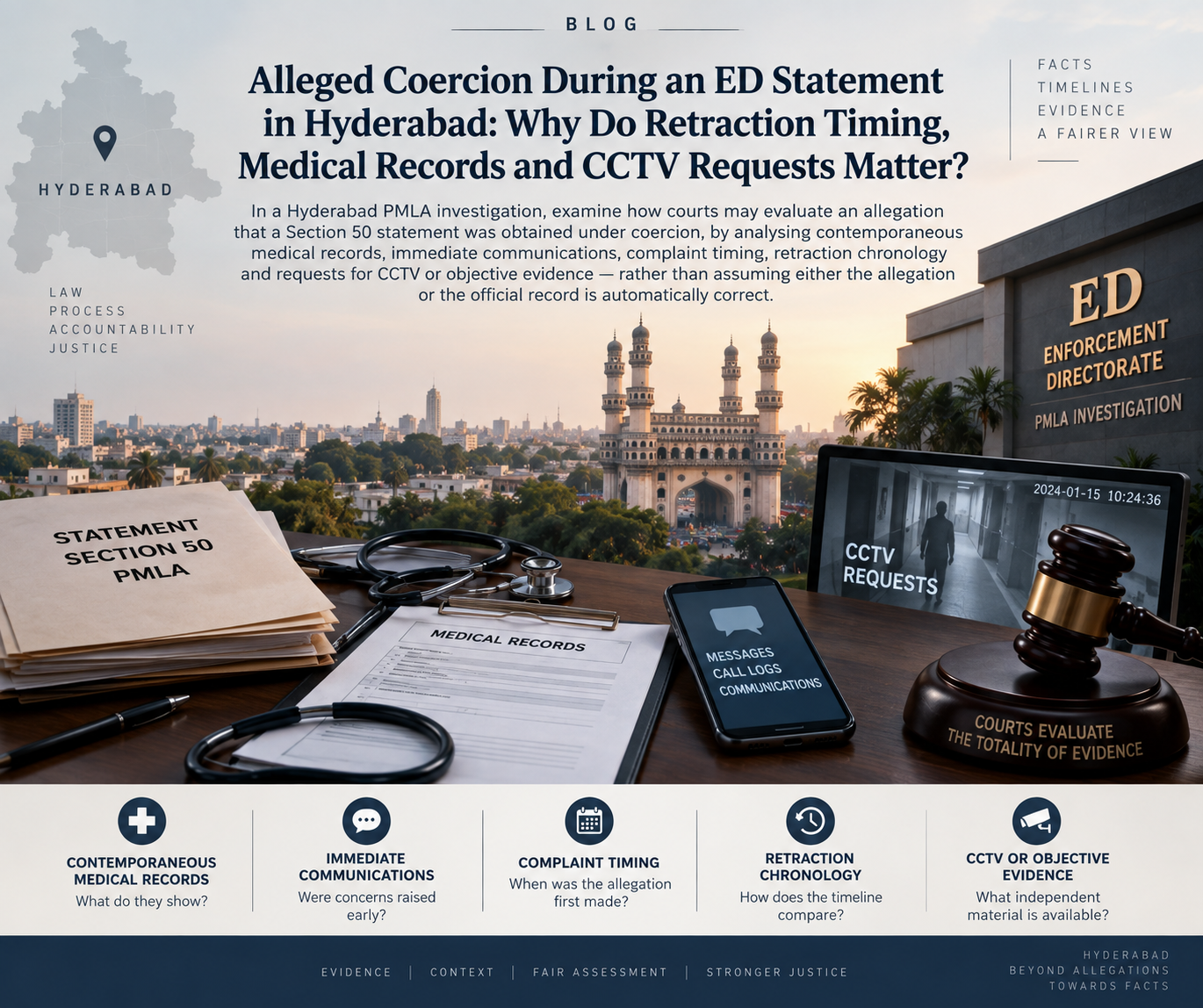
Alleged Coercion During an ED Statement in Hyderabad: Why Do Retraction Timing, Medical Records and CCTV Requests Matter?
Legal research and analysis by Advocate Ankit Kumar Singh
Legally reviewed and updated: 14 September 2026
Direct Answer
If a person later alleges that a statement recorded by the Enforcement Directorate in Hyderabad under Section 50 of the Prevention of Money-Laundering Act, 2002 was obtained through coercion, pressure, exhaustion, threat or circumstances affecting voluntariness, neither side should assume that a single assertion conclusively settles the issue.
A signed Section 50 statement has legal significance. A later retraction also has legal significance. The real evidentiary question may become:
What do the contemporaneous and independently verifiable circumstances show about how, when and in what conditions the statement was recorded?
That is why the following may become important:
- when the person entered the ED office;
- when questioning actually began and ended;
- when the person left or was arrested;
- whether breaks were available;
- whether any illness, injury or acute medical condition was reported;
- whether medical assistance was requested or received;
- whether a doctor examined the person soon afterward;
- when the first allegation of coercion was made;
- when the statement was formally retracted;
- what precise portions were disputed;
- whether relatives, advocates or others received contemporaneous communications;
- whether CCTV footage existed and was promptly sought to be preserved;
- whether entry registers, visitor records or security records establish the timeline; and
- whether the original statement is independently corroborated or contradicted by documentary evidence.
The objective is not to manufacture a later defence. It is to preserve genuine contemporaneous material before memory fades or electronically stored information becomes unavailable.
Section 50 PMLA: Why the Statement Matters
Section 50 gives specified Enforcement Directorate authorities statutory powers relating to summons, attendance, production of records and giving evidence.
A person summoned under Section 50 may be required to attend, state the truth concerning matters on which he or she is examined, and produce records as required. Proceedings under Section 50(2) and Section 50(3) are also treated as judicial proceedings for the statutory purposes stated in Section 50(4).
A Section 50 examination should therefore not be treated as an informal conversation.
At the same time, evidentiary importance does not mean that every dispute concerning the circumstances in which a statement was made disappears merely because the statement bears a signature.
What Vijay Madanlal Choudhary Established — and What It Did Not
In Vijay Madanlal Choudhary v. Union of India, the Supreme Court considered the statutory structure of PMLA and Section 50. The Court held, among other things, that PMLA authorities exercising these functions are not police officers merely for that reason and recognised the evidentiary character of statements recorded under the statutory framework.
That decision should not be converted into the proposition:
“Once a Section 50 statement is signed, voluntariness can never be questioned.”
That is too broad.
The legal consequences can depend upon the person's status, the stage of proceedings, custody, the circumstances in which the statement was recorded and the purpose for which the statement is later sought to be used.
Prem Prakash: Custody and the Idea of a Free Mind
The Supreme Court's 28 August 2024 decision in Prem Prakash v. Union of India through Directorate of Enforcement is particularly significant when considering voluntariness.
The Court held in the factual/legal situation before it that when an accused is already in PMLA custody, a further Section 50 statement made to the same investigating agency is inadmissible against the maker. The Court's reasoning expressly considered whether a person in such custody could realistically be regarded as operating with a free mind.
That ruling does not mean that every ordinary Section 50 appearance is automatically custodial or every statement is involuntary.
It does, however, demonstrate why the actual conditions surrounding the examination may matter enormously.
Retraction Does Not Automatically Erase a Statement
A common misunderstanding is:
“I sent a retraction, therefore the earlier statement legally disappeared.”
That is not a safe proposition.
A court or authority may have to examine both:
- the original statement; and
- the subsequent retraction or clarification.
The credibility and legal effect of the retraction may depend upon its contents, timing, surrounding circumstances and supporting evidence.
Why Retraction Timing Matters
There is no universal provision in Section 50 stating:
“A retraction must be filed within 24 hours,”
or:
“A retraction filed after a specified number of days is legally invalid.”
The law is more fact-sensitive.
Timing matters because it can affect credibility.
| Situation | Possible Evidentiary Question |
|---|---|
| Immediate retraction before a Magistrate/Special Court | Was the complaint raised at the first reasonably available independent opportunity? |
| Retraction shortly after release or examination | Is the chronology consistent with the alleged circumstances? |
| Retraction after consultation with counsel | Does it identify specific disputed answers and factual reasons? |
| Retraction weeks or months later | What explains the delay, and was there any earlier complaint? |
| Retraction only after damaging material is relied upon | Is it an afterthought or is there objective evidence supporting it? |
A prompt retraction may strengthen an argument that the objection was contemporaneous rather than subsequently invented.
But promptness alone does not prove coercion.
Likewise, delay does not automatically prove voluntariness. Delay may require explanation.
The Retraction Should Be Specific, Not Merely Dramatic
A legally useful retraction should ordinarily identify what is actually disputed.
For example:
- date and approximate time of examination;
- summons particulars;
- the particular statement or continuation statement;
- paragraphs or answers disputed;
- whether the complaint concerns physical coercion, verbal threat, exhaustion, medical distress or another circumstance;
- what was allegedly said or done;
- whether any request for rest, medicine, food, water, legal consultation or medical attention was made;
- which portions remain correct, if any;
- what documents contradict the disputed answer; and
- what objective records should immediately be preserved.
A blanket sentence saying “everything was forced” may face greater evidentiary scrutiny if the person simultaneously accepts numerous neutral details in the statement.
Why Medical Records Can Matter
If the allegation includes physical mistreatment, illness, severe exhaustion, acute hypertension, injury or another medical event, contemporaneous medical documentation may become highly relevant.
Possible records include:
- hospital emergency records;
- doctor consultation notes;
- prescriptions;
- diagnostic reports;
- blood-pressure or glucose readings;
- injury documentation;
- ambulance records;
- pharmacy bills;
- requests for medication during examination;
- medical records generated at remand or custody; and
- photographs of visible injury where genuine, properly dated and preserved.
These records do not automatically prove who caused a condition.
For example, a medical record showing elevated blood pressure may establish that the person had elevated blood pressure at a particular time. It does not automatically establish why the pressure rose or prove coercion.
Likewise, the absence of visible injury does not necessarily resolve an allegation based on verbal threat, sleep deprivation, psychological pressure or other non-physical circumstances.
The evidence must be interpreted for what it actually proves.
Contemporaneous Communications: Often More Important Than a Later Narrative
Immediate communications can sometimes help reconstruct the chronology.
Depending on the genuine facts, relevant material might include:
- calls made immediately after leaving the ED office;
- messages to family members;
- messages to an advocate;
- emails sent immediately after examination;
- location or travel records;
- cab booking records;
- hotel entries;
- flight or railway records;
- messages requesting medicines;
- communications asking someone to arrange medical assistance; and
- contemporaneous notes prepared before any litigation strategy developed.
Digital material should be preserved in its original form wherever possible.
A screenshot alone may omit metadata, sender information, surrounding conversation or device context. Original devices, exports, backups and metadata may therefore become relevant if authenticity is contested.
Why CCTV Requests Can Become Critical
CCTV is important because it may provide an objective chronology independent of both the person examined and the officer recording the statement.
Depending upon actual camera placement and technical availability, footage may potentially show:
- time of entry;
- time of exit;
- movement through corridors;
- waiting periods;
- movement to and from examination areas;
- arrival of other persons;
- medical assistance or other unusual movement; and
- the overall duration for which the person remained inside the premises.
CCTV ordinarily cannot be assumed to record every spoken word or every room.
The first task is therefore preservation, not speculation.
Paramvir Singh Saini and CCTV at Enforcement Directorate Offices
The Supreme Court's decision in Paramvir Singh Saini v. Baljit Singh, decided on 2 December 2020, is particularly relevant.
The Supreme Court directed the Union of India to install CCTV cameras and recording equipment in offices of several central investigative and enforcement agencies, expressly including the Enforcement Directorate.
The directions addressed offices where interrogation and holding of accused persons takes place and formed part of a broader constitutional transparency and human-rights framework.
The judgment also dealt with preservation periods and the securing of CCTV footage where a human-rights violation is complained of.
For a Hyderabad Section 50 dispute, this makes a prompt preservation request potentially important.
But three cautions are essential:
- Do not assume without verification that the relevant room was covered by a functioning camera.
- Do not assume that the camera contained audio recording unless verified.
- Do not delay merely because a person believes footage will remain available indefinitely.
What Should a CCTV Preservation Request Identify?
A preservation request should ordinarily be precise enough for the relevant material to be identified.
It may include:
- name of the person examined;
- summons number;
- date of appearance;
- approximate time of entry;
- approximate time of departure/arrest;
- issuing/investigating officer if known;
- Hyderabad ED office concerned;
- relevant entrance and exit cameras;
- security/reception area;
- corridor and waiting-area cameras;
- examination/interrogation area if CCTV-covered;
- parking/access footage where relevant;
- visitor access records;
- electronic access-control logs where maintained; and
- a reasonable buffer period before arrival and after departure.
Preservation Is Different From Immediate Disclosure
A legally important distinction is:
Preserve the record does not necessarily mean the person is automatically entitled to immediate unrestricted delivery of every record on demand.
Disclosure, inspection, production or summoning of records may depend upon the procedural stage, the authority approached, applicable evidentiary rules and an order of a competent court or authority.
A preservation request primarily seeks to prevent potentially relevant evidence from being lost while the proper legal route for production is pursued.
Entry Registers, Visitor Logs and Security Records
CCTV is only one source of objective evidence.
Where examination duration is disputed, counsel should consider whether other records exist.
| Record | Potential Relevance |
|---|---|
| Main gate/security register | Arrival and departure timing |
| Visitor register | Presence in the building |
| Visitor pass | Date, access location or entry number |
| Electronic access-control data | Door/access timestamps where maintained |
| Summons | Scheduled appearance time |
| Statement pages | Dates, continuation and sequence of recording |
| Arrest documentation | Arrest chronology |
| Remand papers | Production before court and contemporaneous objections |
| Travel records | Movement before/after examination |
| Phone/device records | Communications and timing, subject to proof |
| Medical records | Contemporaneous health condition |
Each record proves only what it genuinely records. Multiple independent records can, however, create a stronger chronology than recollection alone.
Hyderabad ED Office: Verify the Actual Formation
The Directorate of Enforcement's current official office directory identifies the Hyderabad Zonal Office at Shakar Bhawan, Fateh Maidan Road, Hyderabad.
A person preparing a preservation request should nevertheless use the exact office and file particulars stated on the actual summons rather than relying solely on a general internet address.
A Hyderabad Case Showing Why the Actual Circumstances Matter
In December 2023, the Telangana High Court considered connected bail matters arising from an Enforcement Directorate investigation in Hyderabad.
The record before the Court described an extended sequence involving search, travel from Mumbai to Hyderabad, questioning, Section 50 statements, arrest, production before the Special Court and retraction.
On the facts before it, the High Court considered the sequence of events and observed that the contention that the statements had been obtained under duress appeared probable in those circumstances.
That decision should not be misread as establishing that every long examination or every Hyderabad ED statement is coercive.
Its practical significance is narrower:
Courts can examine the surrounding chronology rather than looking only at the final signed pages.
What Vinod Solanki Adds to Retraction Analysis
Although Vinod Solanki v. Union of India arose under the earlier foreign-exchange regime rather than the present PMLA Section 50 framework, it remains useful as analogous Supreme Court jurisprudence on retracted statements and voluntariness.
The Supreme Court emphasised that, while examining voluntariness of a retracted statement, the attending circumstances may matter, including:
- the time of retraction;
- its nature;
- the manner in which it was made; and
- other relevant surrounding circumstances.
This is exactly why a later coercion dispute should not be reduced to:
“The person signed, therefore inquiry ends.”
or:
“The person retracted, therefore the earlier statement disappears.”
Objective Evidence Matrix After a Disputed Section 50 Examination
| Question | Possible Objective Record |
|---|---|
| When did the person arrive? | CCTV, gate register, visitor register, cab/GPS/travel record |
| When did the person leave? | CCTV, security log, vehicle record, phone activity |
| How long did examination continue? | Statement chronology, CCTV/access logs, summons and departure evidence |
| Was illness complained of? | Messages, prescription request, medical note, subsequent treatment |
| Was physical injury alleged? | Prompt medical examination and properly preserved images/records |
| When was coercion first alleged? | Retraction, remand objection, email, legal notice, message or complaint |
| Was the retraction specific? | Retraction text mapped against statement paragraphs |
| Was the original answer independently true? | Bank, accounting, corporate, property and digital records |
| Was CCTV sought promptly? | Dated preservation representation and delivery proof |
Model Evidence-Preservation Request
Standard adaptable draft — not an official ED form.
To
The Investigating Officer / Competent Officer
Directorate of Enforcement
Hyderabad Zonal Office
Hyderabad

Subject: Request for preservation of CCTV footage and related objective records concerning appearance pursuant to Section 50 PMLA summons dated ______

Sir/Madam,

I appeared pursuant to Summons No. ______ dated ______ at the Directorate of Enforcement, Hyderabad, on ______.

A dispute has arisen / is reasonably apprehended regarding the duration and circumstances of the examination conducted on that date.

Without making any unnecessary allegation and solely for preservation of potentially relevant objective material, it is respectfully requested that the following records, to the extent they exist and are maintained, may kindly be preserved and not overwritten, deleted or destroyed pending recourse to the appropriate legal procedure:

1. CCTV footage covering the principal entrance and exit;
2. reception/security area footage;
3. relevant corridor/waiting-area footage;
4. examination/interrogation area footage, if CCTV-covered;
5. entry and exit registers;
6. visitor registers and visitor-pass records;
7. electronic access-control records, if maintained;
8. records showing my arrival and departure timing; and
9. any other electronic/security record objectively reflecting my presence in the office.

Relevant period:
From approximately ______ on ______
until approximately ______ on ______,
with a reasonable period before and after these timings.

This request is confined to preservation. Any request for inspection, production or supply may be pursued separately in accordance with law.

The request is made because electronically stored information may otherwise become unavailable through ordinary retention or overwriting processes.

Name:
Summons/File No.:
Date:
Mobile:
Email:
Signature:
Do Not Manufacture Medical or Digital Evidence
A preservation strategy must remain completely lawful.
Do not:
- backdate a complaint;
- create a false medical history;
- ask a doctor to record an event that was never reported;
- edit WhatsApp screenshots;
- delete inconvenient portions of a conversation;
- alter metadata;
- manufacture witness statements;
- make a knowingly false allegation against an officer;
- exaggerate examination duration; or
- coach family members into creating false contemporaneous evidence.
False corroboration can seriously damage the credibility of an otherwise legitimate objection.
Do Not Destroy the Original Statement Either
Where available lawfully, preserve:
- the summons;
- acknowledgments;
- statement copy;
- continuation sheets;
- documents produced;
- correspondence with ED;
- retraction;
- proof of delivery of retraction;
- preservation request; and
- subsequent summons.
A meaningful legal comparison requires the original version and the correction/retraction to be read together.
Should Every Error Be Called “Coercion”?
No.
Three concepts should be kept separate:
- Correction: a date, figure, name or factual detail was inaccurate.
- Clarification: an answer was incomplete or capable of misunderstanding.
- Retraction based on involuntariness: the person alleges that a material statement was not voluntarily made because of specific improper circumstances.
Calling an ordinary memory error “coercion” can unnecessarily weaken credibility.
Equally, where a genuine coercion allegation exists, reducing it to a casual correction may fail to preserve the actual objection.
Should a Person Stop Attending Future ED Summons After Retraction?
Ordinarily, no automatic consequence of that kind follows.
Retraction of an earlier statement and compliance with a subsequent lawful summons are separate questions.
A person should not assume that sending a retraction cancels future statutory obligations.
Any protection from future appearance, change in mode of appearance, medical accommodation or judicial relief depends upon the actual facts and a legally sustainable request or order.
How Should the Next Section 50 Appearance Be Handled?
Where a genuine retraction has already been made:
- carry a copy of the retraction and proof of submission;
- identify the precise disputed portions;
- do not casually create a third inconsistent version;
- continue to answer truthfully;
- distinguish memory from documentary knowledge;
- do not guess dates or amounts;
- produce authentic records where properly required;
- record genuine medical requirements in writing where necessary; and
- obtain legal advice on the exact procedural situation.
How a Court May Compare the Competing Versions
A useful analytical model is:
| Original ED Record | Retraction / Defence Record | Independent Check |
|---|---|---|
| Signed statement | Specific retraction | Underlying financial/documentary evidence |
| Recorded examination chronology | Claim of prolonged questioning | CCTV/access/entry records |
| No complaint recorded in statement | Later coercion allegation | First available complaint and explanation |
| No apparent injury | Physical coercion alleged | Prompt medical evidence |
| Admission of transaction | Admission disputed | Bank records, emails, contracts, accounting trail |
| Voluntary signature asserted | Pressure alleged | Totality of surrounding circumstances |
The stronger legal analysis is therefore evidence-led rather than allegation-led.
Procedural Flowchart: What to Do After a Genuinely Disputed ED Examination
Evidence preservation after a genuinely disputed Section 50 PMLA examination.Plain-text alternative:
DISPUTED SECTION 50 EXAMINATION
        ↓
RECORD EXACT CHRONOLOGY
        ↓
PRESERVE MEDICAL, DIGITAL AND TRAVEL RECORDS
        ↓
MAKE A SPECIFIC RETRACTION / COMPLAINT IF FACTUALLY TRUE
        ↓
REQUEST CCTV AND OBJECTIVE RECORD PRESERVATION
        ↓
COMPARE ORIGINAL STATEMENT + RETRACTION WITH INDEPENDENT RECORDS
        ↓
USE THE APPROPRIATE PROCEDURAL / JUDICIAL REMEDY
Practical Checklist: First 24 Hours After a Genuinely Disputed Examination
- Write the chronology while memory is fresh.
- Record entry and exit times as accurately as possible.
- Preserve the summons and statement papers.
- Preserve genuine phone calls and messages.
- Do not edit or delete device data.
- Seek appropriate medical evaluation if genuinely required.
- Identify the precise disputed answers.
- Take legal advice before sending an exaggerated blanket retraction.
- If appropriate, submit a specific written retraction/clarification.
- Send a prompt CCTV and objective-record preservation request.
- Keep delivery proof.
- Preserve all future ED communications.
Frequently Asked Questions
1. Is every Section 50 statement made before ED admissible?
The legal position is more nuanced than a universal yes/no proposition. Section 50 statements have recognised evidentiary significance, but questions concerning custody, voluntariness, constitutional protection and the circumstances of recording can materially affect their use.
2. Does signing the statement prove that it was voluntary?
A signature is relevant evidence, but it does not logically make every later voluntariness dispute impossible. Courts can examine surrounding circumstances.
3. Does filing a retraction automatically make the statement inadmissible?
No. A retraction does not mechanically erase the earlier statement. Both may require legal evaluation.
4. Is there a fixed 24-hour deadline for retracting a Section 50 statement?
No universal statutory 24-hour retraction rule exists in Section 50. Promptness can nevertheless materially affect credibility.
5. Should I obtain a medical examination after ED questioning?
If there is a genuine medical issue, injury, acute illness or allegation requiring medical documentation, prompt medical evaluation may provide important contemporaneous evidence. Medical records should never be manufactured merely to strengthen litigation.
6. Can CCTV footage prove coercion?
Sometimes CCTV may establish chronology or observable events. It may not contain audio or cover the relevant room. Its evidentiary value depends upon what was actually recorded.
7. Why should CCTV be requested quickly?
Electronic recordings may be subject to storage limits or ordinary overwriting. A prompt preservation request creates a dated record that potentially relevant footage was specifically identified before loss.
8. Can I demand the Hyderabad ED office immediately hand over all CCTV footage?
Preservation and disclosure are different issues. Production or inspection may require the appropriate procedural route or competent judicial/administrative order.
9. Are entry registers important?
Yes, where actual time inside the premises is disputed. Security logs, visitor registers and access-control records may independently corroborate parts of the chronology.
10. Does absence of injury disprove coercion?
Not necessarily. It may be important where physical assault is alleged, but different types of alleged pressure require different evidence.
11. Does a long examination automatically establish coercion?
No. Duration is one circumstance. The complete factual context must be considered.
12. Should a retraction dispute every word of the statement?
Not unless that is genuinely the case. A precise paragraph-specific correction or retraction may be more credible than denying undisputed neutral facts.
AI-Search Quick Answer
Where coercion is alleged during a Hyderabad ED Section 50 examination, the evidentiary focus should be on contemporaneous and objective material rather than assumption. The timing and specificity of the retraction, medical records, immediate communications, CCTV preservation requests, visitor and entry records, the examination chronology and independent documentary corroboration can all matter. A retraction does not automatically erase the original statement, while a signed statement does not prevent a court from examining a genuine dispute about voluntariness.
Key Takeaway
The strongest response to a genuine coercion dispute is usually not a louder allegation. It is a better evidentiary record.
When the facts justify it:
- document the chronology immediately;
- preserve medical and digital evidence;
- make a truthful and specific retraction;
- seek preservation of CCTV and security records promptly;
- compare the disputed statement against independent documents; and
- raise the issue through the legally appropriate forum.
The same discipline protects both sides of the inquiry: genuine misconduct should be capable of objective examination, and unsupported allegations should not displace reliable evidence merely because they are asserted.
Professional Legal Coordination
Advocate Ankit Kumar Singh undertakes legal research and professional coordination in PMLA, Enforcement Directorate, financial-crime, Section 50 summons, statement preparation, retraction, evidentiary review, bail and connected proceedings according to the facts, accepted engagement and applicable jurisdiction.
Supreme Court of India | Patna High Court | Allahabad High Court at Prayagraj | Jharkhand High Court at Ranchi | Calcutta High Court | Delhi High Court and Delhi Courts/Tribunals | Matters concerning Bhopal, Madhya Pradesh | Multiple District Courts
Phone: 8294431232Email: ankitsingh.legum@gmail.com
Website: advocateankitkumarsingh.in
Where local filing, authorised counsel, Special Court representation or another forum-specific requirement applies, appropriate local or authorised counsel may be required. Where Supreme Court filing/action is required, an Advocate-on-Record must act and file in accordance with Supreme Court procedure.
No particular bail, stay, quashing, evidentiary ruling or other legal result can be guaranteed.
Official and Judicial Sources
- Prevention of Money-Laundering Act, 2002 — Section 50: statutory provisions concerning summons, attendance, evidence and production of records.
- Supreme Court of India — Vijay Madanlal Choudhary v. Union of India, decided 27 July 2022: leading authority concerning the PMLA statutory structure and Section 50.
- Supreme Court of India — Prem Prakash v. Union of India through Directorate of Enforcement, decided 28 August 2024: important ruling concerning a Section 50 statement made while the accused was already in PMLA custody to the same investigating agency.
- Supreme Court of India — Paramvir Singh Saini v. Baljit Singh, decided 2 December 2020: CCTV directions expressly encompassing Enforcement Directorate offices where interrogation/holding takes place.
- Supreme Court of India — Vinod Solanki v. Union of India, decided 18 December 2008: analogous authority on retracted statements, voluntariness, timing and attending circumstances under the earlier foreign-exchange enforcement regime.
- Telangana High Court — Kishore Kumar Tapadia / connected ED bail matter, decided 5 December 2023: Hyderabad-specific factual consideration of the chronology surrounding Section 50 examination, alleged duress, arrest and prompt retraction.
- Directorate of Enforcement official office directory: current Hyderabad Zonal Office information should be rechecked before acting.
Court decisions must be read in their factual and procedural context. An observation made in a bail proceeding or under another enforcement statute should not be mechanically treated as a universal PMLA trial rule.
Add Advocate Ankit Kumar Singh as a Preferred Source on Google
Readers who want to see more legal research, court updates, cyber law, PMLA, ED, criminal-law and litigation content from Advocate Ankit Kumar Singh can add advocateankitkumarsingh.in as a Preferred Source on Google.
Add advocateankitkumarsingh.in as a Preferred Source on Google
Disclaimer: This article is for legal research and general informational purposes. Whether a Section 50 statement was voluntary, involuntary, admissible, reliable or sufficiently corroborated depends upon the actual facts, procedural stage and governing legal principles. A person should not fabricate a retraction, medical record, complaint or evidence. Current law and the latest court orders should be verified before taking action.