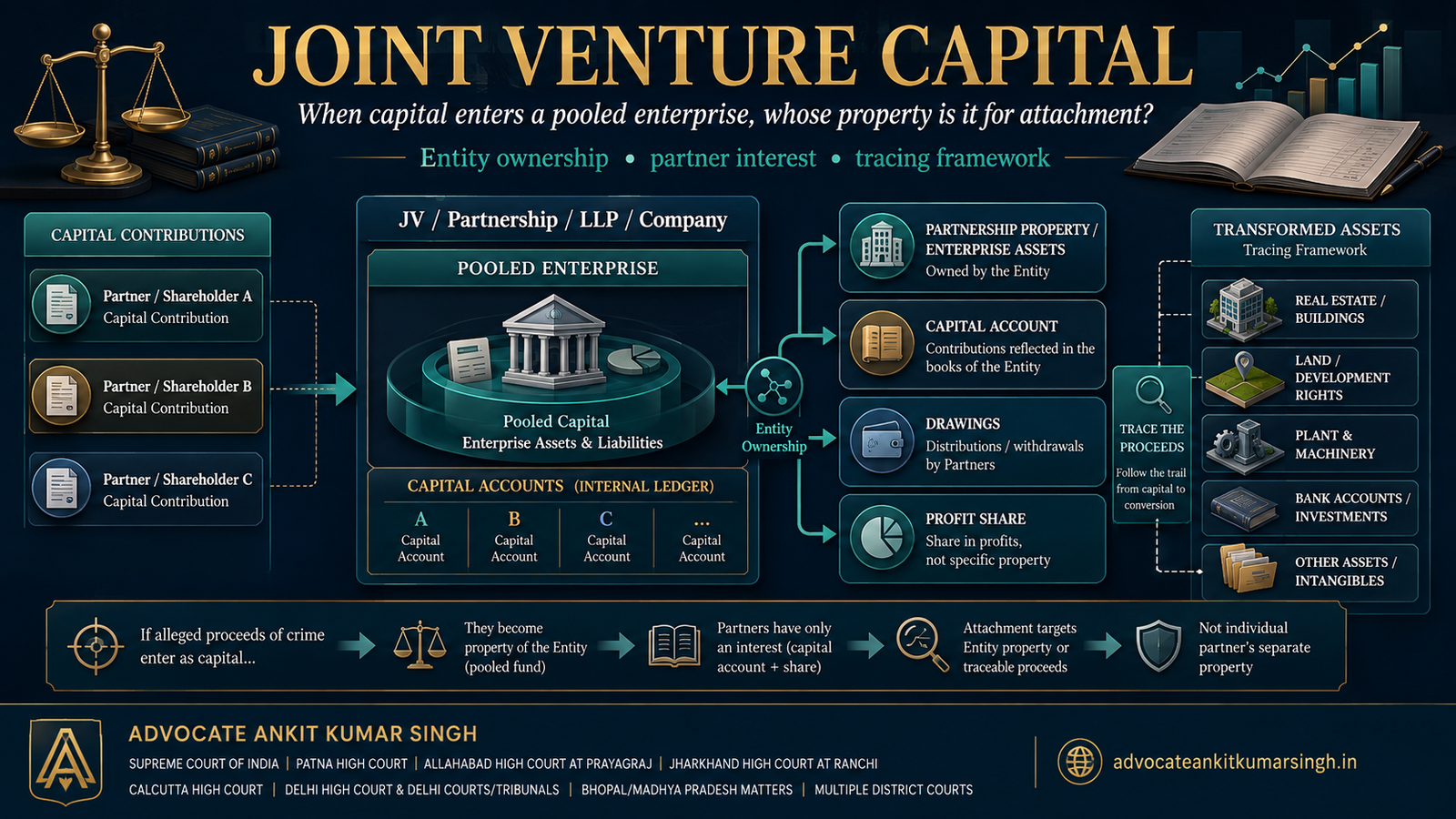
Joint Venture Capital Under PMLA: “Money Entered a JV or Partnership as Capital - Whose Property Is It for Attachment Purposes?”
Partnership Property • LLP Assets • JV Company • Share Capital • Capital Account • Drawings • Profit Share • Pooled-Fund Tracing
Research updated: 26 August 2026
Direct Answer
The answer depends first on what kind of JV or enterprise received the money.
If money alleged to be proceeds of crime is introduced as capital into a traditional partnership, LLP or incorporated JV company, the contribution may change the legal character or holder of the property without necessarily breaking the PMLA money trail.
But different assets must not be collapsed into one another.
In a traditional partnership: money validly brought into the common stock as partnership capital becomes governed as partnership property. A partner ordinarily cannot identify a particular firm bank balance, machine or land parcel and treat a fractional piece of that specific asset as his individually owned property during the subsistence of the firm.
In an LLP: the LLP is expressly a separate legal entity and can own property in its own name. Its partner owns the rights created by the LLP agreement and statute—not the LLP's land, machinery or bank account merely because the partner contributed capital.
In a company: the company owns its assets. A shareholder owns shares and membership rights, not the company's underlying property merely because the shareholder supplied capital.
In a contractual or unincorporated JV: the JV agreement, bank-account structure, title documents and applicable law must be examined because there is no universal rule that every arrangement described commercially as a “JV” has separate legal personality.
ENTITY ASSET ≠ AUTOMATIC PARTNER / SHAREHOLDER ASSET.
CAPITAL CONTRIBUTION ≠ AUTOMATIC CLEANSING OF ALLEGED POC.
TRACE THE VALUE THROUGH THE ENTERPRISE — THEN IDENTIFY THE PROPERTY ACTUALLY SOUGHT TO BE ATTACHED.
Contents
- First Question: What Kind of JV Is It?
- PMLA Property and Proceeds of Crime
- Four Different Property Layers
- Traditional Partnership Capital
- Addanki Narayanappa Principle
- Capital Account Is Not the Firm's Bank Account
- Drawings and Capital Withdrawals
- Profit Share
- Dissolution and Surplus
- LLP Contributions and Property
- JV Company and Shareholder Property
- Shree Hanuman Cotton Mills
- Corporate Veil and Satyendar Kumar Jain
- Capital-to-Asset Transformation
- Pooled Legitimate and Alleged POC Funds
- Shares v Underlying Enterprise Assets
- Capital v Shareholder Loan v JV Advance
- Third-Party Financiers
- Double Counting
- Enterprise Capital Lineage Ledger
- 30-Point Audit
- Tracing Flowchart
- Frequently Asked Questions
1. First Question: What Does “JV” Legally Mean in This Transaction?
The expression “joint venture” describes a commercial relationship. It does not by itself answer who owns the assets.
| JV Structure | Who Ordinarily Holds Enterprise Assets? | Investor / Partner's Separate Property Interest |
|---|---|---|
| Traditional partnership | Partnership property governed collectively under Partnership Act | Profit rights, capital/surplus rights and partnership interest; not a specific slice of each firm asset |
| LLP | LLP itself | Contribution/economic/distribution rights under LLP Act and agreement |
| JV company | Company itself | Shares and shareholder/member rights |
| Contractual consortium / unincorporated JV | Depends on agreement, title and actual structure | Contractual rights defined by agreement |
The first line of any attachment analysis should therefore identify the legal vehicle before attempting to attribute its property to an individual.
2. PMLA Is Broad Enough to Reach More Than Physical Property
Section 2(1)(u) of the Prevention of Money-Laundering Act, 2002 defines “proceeds of crime” through property derived or obtained, directly or indirectly, as a result of criminal activity relating to a scheduled offence, and includes the value of such property within the statutory formulation.
Section 2(1)(v) defines “property” exceptionally broadly. It covers corporeal and incorporeal, movable and immovable, tangible and intangible property and instruments evidencing title to or interest in property.
Accordingly, the potentially relevant property is not confined to:
- cash;
- land;
- machinery;
- inventory; or
- bank balances.
Depending on the legal vehicle and facts, the relevant property may instead be:
- shares;
- a partnership interest;
- an LLP distribution right;
- a debt receivable;
- a capital repayment claim;
- sale proceeds;
- a contractual JV interest;
- or another valuable intangible right.
The broad PMLA definition therefore makes legal classification more important—not less important.
3. Separate Four Property Layers Before Calculating Any Attachment
Consider a simple allegation:
Partner A allegedly obtains ₹1 crore POC and contributes it to a business venture.
A forensic schedule should immediately separate:
| Layer | Example | Question |
|---|---|---|
| 1. Source property | ₹1 crore allegedly generated from scheduled criminal activity | What is the foundational POC? |
| 2. Contribution transaction | ₹1 crore credited as partner capital/share subscription | What legal consideration was received? |
| 3. Enterprise property | Business bank account / land / plant purchased from pool | Who owns the resulting asset? |
| 4. Investor economic interest | Capital-account credit, partnership interest, LLP rights or shares | Is this a separate attachable property and how does its value overlap with the original corpus? |
A PAO or money-trail chart that jumps from Layer 1 directly to “all assets of the enterprise belong to A” risks collapsing separate proprietary concepts.
4. Traditional Partnership: What Happens When Money Is Introduced as Capital?
Section 14 of the Indian Partnership Act, 1932 deals with property of the firm.
Subject to the partnership contract, property, rights and interests originally brought into the stock of the firm or acquired by or for the firm for purposes and in the course of business form part of firm property.
Property acquired with money belonging to the firm is ordinarily deemed to have been acquired for the firm unless a contrary intention appears.
Section 15 provides, subject to contract, that firm property is to be held and used exclusively for purposes of the business.
This produces two important rules.
Rule A: genuine capital money brought into the common partnership stock is not ordinarily treated thereafter as though the contributor retained exclusive ownership of the exact rupee notes or account balance.
Rule B: merely allowing the firm to use a partner's personal property does not automatically make that property partnership property. Intention, agreement and the actual transaction remain important.
5. Addanki Narayanappa: A Partner Does Not Own a Specific Piece of Each Firm Asset
The Supreme Court's decision in Addanki Narayanappa v. Bhaskara Krishnappa remains foundational.
The Court explained that although partnership property vests in the partners collectively because the conventional firm has no separate legal existence like a company, a partner cannot during the subsistence of the firm deal with a specific portion of partnership property as his own.
The partner's operative rights are instead directed toward:
- the share of profits falling to him;
- his partnership interest;
- and, upon dissolution, the appropriate share of the surplus remaining after partnership liabilities are satisfied.
Accordingly:
A CONTRIBUTED 20% OF CAPITAL ≠ A PERSONALLY OWNS 20% OF EVERY MACHINE, BANK DEPOSIT AND BUILDING.
This is particularly important in PMLA because an attachment order should identify the legal property being restrained rather than substitute accounting ratios for title analysis.
6. A Partner's Capital Account Is Not the Same Thing as Ownership of the Firm's Bank Balance
A capital account is an accounting record of the partner's capital position vis-à-vis the enterprise.
Suppose:
A contributes ₹1 crore.
B contributes ₹4 crore.
Firm bank balance becomes ₹5 crore.
The books may show:
A CAPITAL ACCOUNT — ₹1 CRORE
B CAPITAL ACCOUNT — ₹4 CRORE
But those bookkeeping entries do not mean that a particular ₹1 crore segment of the firm's bank account remains separately fenced as A's personal cash.
The enterprise may spend:
₹3 crore on machinery;
₹1 crore on inventory;
₹50 lakh on deposits;
₹50 lakh on operating expenditure.
A's capital account is therefore not automatically a second physical ₹1 crore asset sitting alongside the firm's assets.
For PMLA purposes, the correct questions are:
- what money actually entered;
- what accounting right was recorded;
- where the enterprise spent the money;
- what property replaced or represented it;
- and what value remains capable of attribution without duplication.
7. Drawings: The Money Can Become Personal Property Again
Suppose A contributes ₹1 crore and six months later withdraws ₹40 lakh as drawings.
At the point of withdrawal, ₹40 lakh moves from the partnership's pool into A's personal control.
That is a separate transaction requiring tracing.
But the label “drawings” does not itself prove whether the ₹40 lakh represents:
- return of original capital;
- withdrawal against current-account credit;
- profit share;
- reimbursement;
- loan repayment;
- or simply a payment from mixed enterprise funds.
The bank trail and ledger must be reconciled.
If ED alleges that the withdrawal represents returned POC, it should identify the source-and-substitute theory rather than merely relying on the debit description “drawings”.
8. Is Every Later Profit of the Business Also Proceeds of Crime?
Not automatically.
Suppose:
Alleged POC capital = ₹1 crore.
Lawful capital = ₹9 crore.
Enterprise carries on a genuine business.
Later operating profit = ₹2 crore.
It would be too broad to say:
“Because ₹1 crore POC once entered the business, every future rupee of profit is forever POC.”
It would be equally broad to say:
“All later profits are automatically clean because they arose from business operations.”
Section 2(1)(u) requires a direct or indirect derivation enquiry.
Relevant questions include:
- what business produced the profit;
- whether the alleged POC financed the revenue-generating asset;
- how much lawful working capital was introduced;
- whether the profits arose from independent commercial operations;
- whether the transaction was itself merely a laundering mechanism;
- and whether a causal money/value trail can actually be demonstrated.
There is no universal PMLA rule that ordinary future business profits must automatically be apportioned according to the ratio of tainted to clean capital.
9. Partnership Dissolution Shows Why Gross Firm Assets Are Not the Partner's Personal Assets
Section 48 of the Partnership Act is particularly instructive.
On dissolution, firm assets are applied in a statutory/accounting sequence that includes:
- payment of debts of the firm to third parties;
- payment of advances due to partners;
- payment of capital due to partners;
- and distribution of residue according to profit-sharing rights.
This matters for attachment valuation.
If a partnership has:
Gross assets = ₹10 crore
Bank debt = ₹6 crore
Trade creditors = ₹2 crore
a partner with a “25% partnership interest” cannot automatically be described as personally owning ₹2.5 crore of immediately realisable gross firm property.
Liabilities and the legal character of the partnership interest matter.
10. LLP: The Ownership Analysis Is More Direct
Section 3 of the Limited Liability Partnership Act, 2008 expressly states that an LLP is a body corporate and a legal entity separate from its partners.
Section 14 allows the LLP, in its own name, to acquire, own, hold, develop and dispose of property.
Section 32 permits a partner's contribution to take various forms, including:
- money;
- movable property;
- immovable property;
- intangible property;
- other benefits;
- promissory notes;
- agreements to contribute cash or property;
- and services.
Section 42 separately recognises a partner's transferable rights concerning profits, losses and distributions under the LLP agreement.
Therefore:
LLP LAND = PROPERTY OF LLP.
LLP BANK BALANCE = PROPERTY OF LLP.
PARTNER'S LLP ECONOMIC INTEREST = A DIFFERENT PROPERTY INTEREST.
If alleged POC enters the LLP as contribution, the fact that the LLP becomes the property holder does not itself erase tracing.
11. LLP Example: ₹1 Crore Alleged POC + ₹1 Crore Bank Finance
Partner P contributes ₹1 crore alleged POC to LLP-X.
LLP-X borrows another ₹1 crore from Bank Y.
LLP-X purchases land for ₹2 crore.
The legal architecture is:
P → contribution to LLP
LLP → owns ₹2 crore land
Bank Y → may hold mortgage/security interest
P → owns LLP economic/partnership rights, not the land itself
If the land is attached, a sound analysis should address:
- the ₹1 crore allegedly traceable contribution;
- the ₹1 crore independent bank finance;
- the LLP's legal title;
- the bank's security;
- the precise PMLA basis for attaching all or part of the land;
- and the relationship between any simultaneous attachment of P's LLP interest and the land itself.
Simply writing “P introduced ₹1 crore, therefore ₹2 crore land is P's property” skips several legal steps.
12. Incorporated JV Company: Shareholder Capital Becomes Company Property
The classic company-law distinction is even clearer.
When a company validly issues shares and receives subscription money:
the company receives the money;
and the subscriber receives shares/member rights.
The Supreme Court in Bacha F. Guzdar v. Commissioner of Income Tax explained that a shareholder does not acquire ownership of the company's property merely by owning its shares.
The Supreme Court reaffirmed the principle in BRS Ventures Investments Ltd. v. SREI Infrastructure Finance Ltd. on 23 July 2024.
Section 44 of the Companies Act, 2013 separately treats shares or other membership interests as movable property transferable in the manner provided by the articles.
Therefore a JV company structure creates two legally distinguishable property categories:
COMPANY'S PROPERTY
and
SHAREHOLDER'S SHARES / MEMBER INTEREST.
13. Shree Hanuman Cotton Mills: PMLA Cannot Treat Company Land as Shareholder Property Merely Because of Shareholding
The Calcutta High Court's judgment dated 5 December 2025 in Shree Hanuman Cotton Mills Ltd. & Ors. v. Union of India & Ors. provides a recent PMLA-specific illustration.
The impugned proceedings affected land owned by the company while accused persons were alleged to hold shares in that company.
The High Court distinguished the accused persons' shareholding interest from the company's land.
It held, on the facts before it, that shareholders were not owners of the company's assets merely by reason of holding shares, and it set aside the impugned attachment/show-cause treatment insofar as the identified company land was concerned.
At the same time, the Court did not disable action concerning the identified shares themselves and certain separately identified property.
This distinction is powerful:
SHAREHOLDER'S SHARES ≠ COMPANY'S LAND.
But the judgment should not be overstated.
It does not mean that company property can never be attached under PMLA.
If company property itself is demonstrated to have been derived or obtained from criminal activity, to represent the value of such property, or otherwise satisfies the statutory attachment framework on the facts, that is a different case requiring its own Section 5 and Section 8 analysis.
14. Separate Personality Is Not an Automatic PMLA Safe Harbour
The opposite safeguard comes from Satyendar Kumar Jain v. Directorate of Enforcement, 2024 INSC 217.
The Supreme Court accepted the established principle that a company has a legal identity separate from shareholders and directors.
But it also recognised that the corporate veil may be lifted where the corporate structure is used:
- for fraud;
- for economic offences;
- as a facade;
- or as a sham for illegal activities.
The judgment arose at the bail stage and on its particular factual record involving alleged accommodation entries and corporate structures.
It should therefore not be converted into the proposition:
“PMLA AUTOMATICALLY ERases SEPARATE CORPORATE PERSONALITY whenever a shareholder is accused.”
The proper balance is:
RESPECT LEGAL PERSONALITY WHERE IT IS REAL.
INVESTIGATE THROUGH THE FORM WHERE THE ENTITY ITSELF IS ALLEGED AND PROVED TO BE A SHAM, FACADE OR LAUNDERING VEHICLE.
15. Capital-to-Asset Transformation: Follow the Corpus After It Enters the Enterprise
Suppose alleged POC-001 of ₹1 crore enters JV-Co as capital.
The money may then travel:
₹1 CRORE POC-001
↓
SHARE SUBSCRIPTION / CAPITAL CONTRIBUTION
↓
ENTERPRISE BANK ACCOUNT
↓
MIXED WITH ₹4 CRORE LAWFUL FUNDS
↓
₹3 CRORE MACHINERY
₹1 CRORE INVENTORY
₹1 CRORE WORKING CAPITAL
A useful attachment analysis asks:
Where is POC-001 now represented?
That is different from asking:
How much gross property does the enterprise own?
The transformation may create a valid tracing argument into a replacement asset without converting every unrelated enterprise asset into POC.
16. Mixed Enterprise Pool: PMLA Has No Universal FIFO, LIFO or Pro-Rata Rule
Once alleged POC enters a current account containing lawful capital, borrowings and ordinary business receipts, money becomes fungible.
For example:
Opening lawful balance: ₹2 crore
POC-001 contribution: ₹1 crore
Bank loan: ₹3 crore
Customer receipts: ₹4 crore
Total pool: ₹10 crore.
Later:
₹5 crore factory purchased.
₹2 crore wages/vendors paid.
₹1 crore loan repaid.
₹2 crore remains.
Indian PMLA does not prescribe a universal statutory:
- first-in-first-out rule;
- last-in-first-out rule;
- lowest-intermediate-balance rule;
- or mandatory pro-rata allocation rule
for every mixed enterprise account.
A money-trail analysis should therefore disclose the tracing methodology used rather than silently select the formula that produces the largest attachment.
Useful source records include:
- bank statements;
- UTR/RRN details;
- capital ledger;
- general ledger;
- purchase invoices;
- fixed-asset register;
- loan documents;
- payment vouchers;
- GST records;
- audited financial statements;
- and asset-title records.
17. Shares and the Underlying Corporate Asset Must Not Be Confused
Suppose A subscribes ₹1 crore for shares in Company X.
Company X then uses that ₹1 crore toward a business asset.
Two legally identifiable objects now exist:
A's shares;
and Company X's asset.
Both may require investigation under PMLA depending on the theory advanced.
But it is dangerous to say mechanically:
Original POC = ₹1 crore
Shares = ₹1 crore
Company asset = ₹1 crore
Therefore total POC = ₹3 crore
without explaining the economic and statutory basis for treating those values cumulatively.
The same original corpus may be represented through substitution, consideration or transformed property.
Accordingly:
LEGAL DISTINCTNESS DOES NOT AUTOMATICALLY MEAN ECONOMIC ADDITION.
The PAO should specify whether it is attaching:
- the original property;
- property acquired from that property;
- the value thereof;
- the investor's shares;
- the enterprise asset;
- or some combination supported by an expressly reconciled statutory theory.
18. “Money Entered the JV” Is Not Enough — Classify the Transaction
| Entry | Contributor Receives | Key PMLA Question |
|---|---|---|
| Partnership capital | Capital-account / partnership rights | Where was capital applied? |
| LLP contribution | LLP economic/distribution rights | What property did LLP acquire? |
| Equity share subscription | Shares | Shares v company asset? |
| Shareholder / partner loan | Debt receivable | Is repayment a return of alleged POC? |
| JV advance | Contractual receivable / project rights | Was it capital, debt, escrow or project expenditure? |
| Security deposit | Refundable contractual claim | Who owns the deposit/right to refund? |
Accounting nomenclature cannot replace examination of the actual instrument.
19. Return of Capital: Does the Money Become Traceable Back to the Partner?
Suppose A contributed ₹1 crore alleged POC and the firm later returns ₹50 lakh to A as reduction/return of capital.
The return should be separately traced.
Relevant questions include:
- was capital actually reduced;
- what did the partnership deed permit;
- what does the capital ledger show;
- was the payment funded from asset sale, operating revenue or borrowing;
- was any amount already attached elsewhere;
- and whether the ₹50 lakh is being counted both inside the enterprise and again in A's hands.
A returned corpus may be an important substitute-property trail, but the same ₹50 lakh should not be physically located in two places at the same time without a coherent valuation explanation.
20. Dividend or Profit Distribution: A New Personal Receipt, But Not Automatically New POC
When a company declares and pays a dividend, or an LLP/partnership makes a profit distribution, the recipient receives a personal monetary asset.
That does not answer whether the distribution is itself derived from alleged POC.
The source may be:
- legitimate operating profit;
- sale of an asset purchased from alleged POC;
- capital reserve;
- borrowed funds;
- mixed retained earnings;
- or another source.
Therefore:
DISTRIBUTION = NEW PAYMENT EVENT.
DISTRIBUTION ≠ AUTOMATIC NEW CRIMINAL VALUE.
Source tracing remains necessary.
21. Contractual / Unincorporated JV: Read the Agreement Before Attributing Property
Some projects use the label “JV” without incorporating a company or LLP and without creating an ordinary partnership.
The agreement may provide that:
- each member retains ownership of contributed equipment;
- one lead member operates a common project account;
- land remains with the landowner;
- development rights are contributed instead of title;
- receivables belong jointly in agreed ratios;
- or money is merely held as project-specific advance.
Accordingly, an unincorporated JV should never be analysed solely from its commercial label.
The documents must answer:
WHAT PROPERTY WAS CONTRIBUTED?
WAS TITLE TRANSFERRED?
WHO OWNS THE PROJECT ACCOUNT?
WHO OWNS THE RESULTING ASSET?
WHAT DOES EACH MEMBER ACTUALLY HAVE A RIGHT TO RECEIVE?
22. What About Banks, Lenders and Third-Party Financiers?
Enterprise property may already carry independent rights.
For example:
LLP land value: ₹10 crore
Secured bank loan: ₹7 crore
Partner alleged POC contribution: ₹1 crore
The existence of a PMLA issue does not make the lender's documentary interest disappear from the title analysis.
Likewise, the existence of a mortgage does not automatically defeat a valid PMLA attachment.
The attachment record should identify:
- date of charge;
- secured amount;
- registration of charge;
- loan disbursement trail;
- good-faith status;
- property value;
- and the alleged POC nexus.
The rights of the entity, investor and lender are separate legal interests and should not be blended into one undifferentiated “accused property” figure.
23. The Double-Counting Trap
Assume only one foundational alleged POC corpus:
POC-001 = ₹1 CRORE.
A poorly reconciled chart might show:
Original money = ₹1 crore
Capital-account credit = ₹1 crore
Asset bought by enterprise = ₹1 crore
Shares / partnership interest = ₹1 crore
Later withdrawal = ₹40 lakh
and present:
“TOTAL = ₹4.40 CRORE.”
That calculation may be fundamentally misleading if the figures are simply successive legal or accounting representations of the same original corpus.
The proper forensic instruction is:
ONE CORPUS MAY CHANGE FORM MANY TIMES.
FORM CHANGE ≠ AUTOMATIC CREATION OF FRESH POC.
This does not mean that every subsequent property is immune from attachment.
It means each stage should be linked to the same lineage and any cumulative valuation should expressly explain why values are independent rather than duplicative.
24. Five Worked Scenarios
Scenario 1 — Traditional Partnership
A contributes ₹1 crore alleged POC.
B contributes ₹4 crore lawful capital.
Firm purchases ₹3 crore machinery and ₹2 crore inventory.
Do not assume A personally owns 20% of each asset. First identify partnership property; then trace the alleged ₹1 crore into the pooled fund and resulting property using disclosed methodology.
Scenario 2 — LLP Land
P contributes ₹1 crore alleged POC.
LLP borrows ₹1 crore.
LLP buys ₹2 crore land.
LLP owns the land. P owns LLP rights. The source contribution, loan, land and partner interest require separate but reconciled treatment.
Scenario 3 — JV Company
Shareholder contributes ₹1 crore alleged POC for equity.
Company receives the ₹1 crore.
Company buys machinery.
The shareholder owns shares. The company owns machinery. Attachment must identify the legal property and avoid automatically adding overlapping values.
Scenario 4 — Drawings
Partner introduces ₹1 crore.
Business operates for one year.
Partner withdraws ₹40 lakh.
The withdrawal is now a personal receipt, but the source must be reconstructed from the capital/current account and enterprise cash flow.
Scenario 5 — Genuine Profit
Alleged POC forms 10% of a mixed capital pool.
Business later earns profit from ordinary sales.
There is no automatic statutory rule that 10% of every later profit is POC or that 100% is POC. Direct/indirect derivation requires factual analysis.
25. Enterprise Capital Lineage Ledger
A useful forensic schedule should assign the original alleged corpus a permanent lineage identifier.
Example: POC-001
| Field | Data Required |
|---|---|
| 1. Lineage ID | POC-001 |
| 2. Source event | Scheduled-offence transaction alleged to generate property |
| 3. Original amount | ₹___ |
| 4. Contribution date | ___ |
| 5. Vehicle | Partnership / LLP / Company / Contractual JV |
| 6. Contribution character | Capital / Equity / LLP contribution / Loan / Advance |
| 7. Consideration / right received | Capital credit / Shares / Debt receivable / JV right |
| 8. Recipient account | Account + UTR / RRN |
| 9. Opening lawful balance | ₹___ |
| 10. Other lawful capital | ₹___ |
| 11. Borrowings | ₹___ |
| 12. Business receipts | ₹___ |
| 13. First deployment | Vendor / asset / debt / operating expense |
| 14. Asset acquired | Description + title holder |
| 15. Lawful co-funding | ₹___ |
| 16. Sale / substitution | Date + proceeds |
| 17. Profit / appreciation | Source and valuation basis |
| 18. Distribution / drawing | Recipient + amount |
| 19. Residual traceable value | ₹___ with methodology |
| 20. Duplicate-value check | Original / substitute / shares / asset / distribution reconciliation |
This creates a single audit trail from alleged criminal source to present property.
26. Why Section 70 PMLA Does Not Answer the Ownership Question
Section 70 deals with offences by companies and responsibility of persons connected with the entity.
For that section, “company” includes a body corporate, firm or other association of individuals; in relation to a firm, “director” includes a partner.
But Section 70 is not a title-transfer provision.
It does not mean:
PARTNER LIABLE UNDER SECTION 70 → PARTNER PERSONALLY OWNS ALL FIRM PROPERTY.
Nor does it mean:
COMPANY CAN BE PROSECUTED → SHAREHOLDER OWNS COMPANY ASSETS.
Offence attribution and property ownership are separate questions and should be analysed separately.
27. 30-Point JV / Partnership Capital Attachment Audit
- Identify the scheduled offence.
- Identify the original alleged POC corpus.
- Assign a lineage ID.
- Identify the exact contributor.
- Identify the legal JV vehicle.
- Obtain partnership deed / LLP agreement / SHA / JV agreement.
- Determine whether contribution was capital, equity, debt or advance.
- Identify consideration/right received by contributor.
- Verify contribution date.
- Verify bank UTR/RRN.
- Record opening account balance.
- Identify other investors' lawful capital.
- Identify bank borrowing.
- Identify project finance.
- Identify business receipts entering the pool.
- Prepare transaction-level deployment ledger.
- Identify assets acquired from the pool.
- Identify legal title holder of each asset.
- Check fixed-asset register.
- Check whether asset is encumbered.
- Identify third-party financier rights.
- Separate capital account from enterprise assets.
- Separate shares/LLP interest from underlying property.
- Identify drawings/capital repayments.
- Identify dividends/profit distributions.
- Identify asset sales/substitutions.
- Separate original capital from appreciation or later profit.
- State tracing methodology for mixed funds.
- Cross-check all properties already attached elsewhere.
- Prepare a final de-duplicated POC / attachment reconciliation.
28. Documents That Usually Matter
A serious JV-capital attachment dispute should ordinarily examine:
- predicate FIR/charge-sheet;
- ECIR-related material lawfully available;
- PAO and Original Complaint;
- Section 8 notice and reply;
- partnership deed;
- LLP agreement;
- JV agreement;
- shareholders' agreement;
- share-allotment records;
- register of members;
- capital/current-account ledgers;
- bank statements;
- UTR/RRN data;
- loan agreements;
- charge documents;
- audited balance sheets;
- general ledger;
- fixed-asset register;
- purchase invoices;
- property deeds;
- sale records;
- profit/distribution resolutions;
- drawings ledger;
- tax/GST records;
- and valuation reports.
29. Enterprise Capital Transformation Flowchart
Enterprise Capital Lineage: identify the original alleged POC, classify the legal vehicle and contribution, trace deployment through pooled enterprise funds, identify the resulting property holder and reconcile later distributions without duplicate counting.Plain-text alternative:
Alleged POC → classify contribution → identify partnership/LLP/company/JV structure → identify enterprise ownership → trace pooled bank account → identify acquired assets → identify investor's separate interest → trace drawings/dividends/distributions → reconcile residual POC → remove duplicate value.
30. AI Quick Answer
Whose property is money after it is introduced into a JV or partnership as capital?
It depends on the legal vehicle. In a traditional partnership, genuine capital brought into the common stock becomes partnership property governed by the Partnership Act, while the partner ordinarily holds economic rights rather than ownership of a specific portion of each firm asset. An LLP is a separate legal entity and owns its own assets; an LLP partner owns contribution/distribution rights. A JV company also owns its assets separately from shareholders, who own shares. PMLA can still trace alleged proceeds of crime through these transformations, but the attachment must identify the actual property involved and should not mechanically treat the original cash, capital account, enterprise asset, shares and later distribution as independent fresh POC values without reconciliation.
31. Frequently Asked Questions
1. If I invest alleged POC as partnership capital, does the money become clean?
No. The capital label changes the business/accounting relationship; it does not automatically defeat PMLA tracing.
2. Does the partner still personally own the exact cash after contribution?
Not ordinarily where the money has genuinely been brought into the common partnership stock as firm capital.
3. Does a partner own a percentage of each partnership asset?
Not as a specific individually disposable portion during the subsistence of the partnership merely because of his capital/profit ratio.
4. Can a partner's partnership interest itself be property?
Yes. Economic and transferable rights can themselves constitute valuable property interests, subject to the governing partnership law and agreement.
5. Is a capital account itself the same as cash?
No. It is an accounting record of the partner's position vis-à-vis the firm.
6. Can drawings be attached?
Money actually withdrawn into a partner's hands is a separate personal asset, subject to the applicable PMLA nexus and tracing.
7. Is every drawing automatically returned POC?
No. Determine whether it represents capital, profit, reimbursement, loan repayment or payment from mixed funds.
8. Is an LLP separate from its partners?
Yes. Section 3 LLP Act expressly makes it a separate legal entity.
9. Who owns LLP land?
The LLP ordinarily owns property registered/acquired by it in its own name.
10. Does an LLP partner own a percentage of each LLP asset?
Not merely by reason of being a partner or contributor.
11. Who owns property purchased by a JV company?
The company ordinarily owns it, not individual shareholders.
12. Can ED attach shares held by an accused?
Shares are themselves movable property and may constitute a distinct property interest capable of legal restraint where statutory conditions are met.
13. If the accused owns 50% shares, does he own 50% of company land?
No. Share ownership and ownership of company assets are legally distinct.
14. Does Shree Hanuman Cotton Mills mean company assets can never be attached?
No. The decision rejects treating company land as shareholder property merely because of shareholding on those facts. It does not immunise company property that independently satisfies PMLA attachment requirements.
15. Can ED lift the corporate veil?
Satyendar Kumar Jain recognises veil lifting where the corporate structure is used for fraud, economic offences, facade or sham activity; it is not an automatic rule applicable merely because a shareholder is accused.
16. Is every later business profit automatically POC?
No. Direct or indirect derivation must be analysed on the evidence.
17. Is there a mandatory pro-rata tracing rule for mixed business funds?
No universal statutory PMLA pro-rata, FIFO or LIFO rule applies to every mixed enterprise account.
18. Can ED count both the shareholder's shares and company asset?
Both may be legally relevant depending on the theory, but their values should not be mechanically aggregated as independent fresh POC without explaining and reconciling the same underlying corpus.
19. What if capital was actually a shareholder loan?
Then the contributor may hold a debt receivable rather than equity. The documents and ledger classification must be examined.
20. What is the best tracing method?
A transaction-level Enterprise Capital Lineage Ledger tying the original alleged POC to the contribution, enterprise account, later asset, sale/substitution and eventual distribution while separately recording legitimate co-funding.
32. Key Takeaway
The single most important mistake in JV-capital PMLA analysis is to treat:
the person who introduced money,
the enterprise that received it,
the asset later purchased,
and the investor's ownership interest
as though they were all the same legal property.
They are not.
But the opposite mistake is equally serious:
changing alleged POC from “cash” to “capital”, “share subscription”, “partner contribution” or “JV advance” does not automatically end the statutory enquiry.
The correct sequence is:
IDENTIFY THE SOURCE POC → CLASSIFY THE CONTRIBUTION → IDENTIFY THE LEGAL VEHICLE → IDENTIFY WHO OWNS THE ENTERPRISE ASSET → TRACE THE POOLED VALUE → IDENTIFY THE INVESTOR'S SEPARATE INTEREST → TRACE DRAWINGS / PROFITS / DISTRIBUTIONS → RECONCILE THE FINAL ATTACHMENT VALUE.
The governing principle is therefore:
TRACE THROUGH THE ENTITY — DO NOT IGNORE THE ENTITY.
RESPECT PROPERTY LAW — DO NOT LET PROPERTY FORM ERASE THE MONEY TRAIL.
33. Related Research
- Family Pooling Under PMLA: Common Money and Individual Knowledge
- Gross Transaction Value vs Real Illegal Gain Under PMLA
- Proceeds of Crime, Scheduled Offence and Important PMLA Terms
- Salary and Vendor Payments From Allegedly Tainted Business Revenue
- Beneficial Ownership and Control Beyond Formal Shareholding Under PMLA
34. Primary Legal and Judicial Sources
- Prevention of Money-Laundering Act, 2002 — India Code
- Indian Partnership Act, 1932 — India Code
- Limited Liability Partnership Act, 2008 — India Code
- Companies Act, 2013 — India Code
- Addanki Narayanappa & Anr. v. Bhaskara Krishnappa & Ors. — Supreme Court, 21 January 1966
- BRS Ventures Investments Ltd. v. SREI Infrastructure Finance Ltd. — Supreme Court, 23 July 2024
- Satyendar Kumar Jain v. Directorate of Enforcement — Supreme Court, 18 March 2024
- Shree Hanuman Cotton Mills Ltd. & Ors. v. Union of India & Ors. — Calcutta High Court, 5 December 2025
35. Consultation and Professional Coordination
JV-capital and enterprise-asset attachment disputes frequently require simultaneous reading of PMLA, partnership/company law, accounting records and property documents.
For case-specific analysis concerning PMLA attachment, partnership or LLP property, corporate assets, shareholder/partner interests, capital-account tracing, pooled business accounts, Adjudicating Authority proceedings or Appellate Tribunal litigation, consult:
Supreme Court of India | Patna High Court | Allahabad High Court at Prayagraj | Jharkhand High Court at Ranchi | Calcutta High Court | Delhi High Court and Delhi Courts/Tribunals | Matters concerning Bhopal, Madhya Pradesh | Multiple District Courts
Phone: 8294431232
Email: ankitsingh.legum@gmail.com
Website:
advocateankitkumarsingh.in
Any consultation, drafting, filing, appearance or litigation coordination depends upon the facts, accepted professional engagement, jurisdiction and applicable procedure. An Advocate-on-Record is required to act and file before the Supreme Court of India, and local or authorised counsel may be required in other jurisdictions where applicable. No particular attachment, release, stay or litigation outcome can be guaranteed.
Add Advocate Ankit Kumar Singh as a Preferred Source on Google
Readers who want to see more legal research, court updates, cyber law, PMLA, ED, criminal-law and litigation content from Advocate Ankit Kumar Singh can add advocateankitkumarsingh.in as a Preferred Source on Google.
Add advocateankitkumarsingh.in as a Preferred Source on Google
Legal Accuracy Safeguard
“Enterprise Capital Lineage Ledger”, “lineage ID”, “source-to-substitute tracing” and “de-duplication reconciliation” are analytical forensic-accounting expressions used in this article. They are not defined statutory terms under PMLA.
The article does not state that partnership, LLP or company personality prevents attachment of property that independently satisfies PMLA.
It also does not state that every enterprise asset becomes POC merely because an alleged tainted contribution once entered the enterprise.
Traditional partnership property must not be described as belonging to a separate juristic entity in exactly the same manner as an LLP or company. Partnership law instead regulates firm property collectively and limits a partner's right in specific assets during subsistence.
No universal FIFO, LIFO, lowest-intermediate-balance or mandatory pro-rata tracing formula is prescribed by PMLA for every mixed enterprise bank account.
Disclaimer: This article is general legal research and does not constitute case-specific legal advice. PMLA attachment disputes involving partnerships, LLPs, companies and joint ventures depend upon the scheduled offence, actual source of funds, governing agreements, title documents, accounting records, money trail, PAO, Section 8 record and current judicial authority.