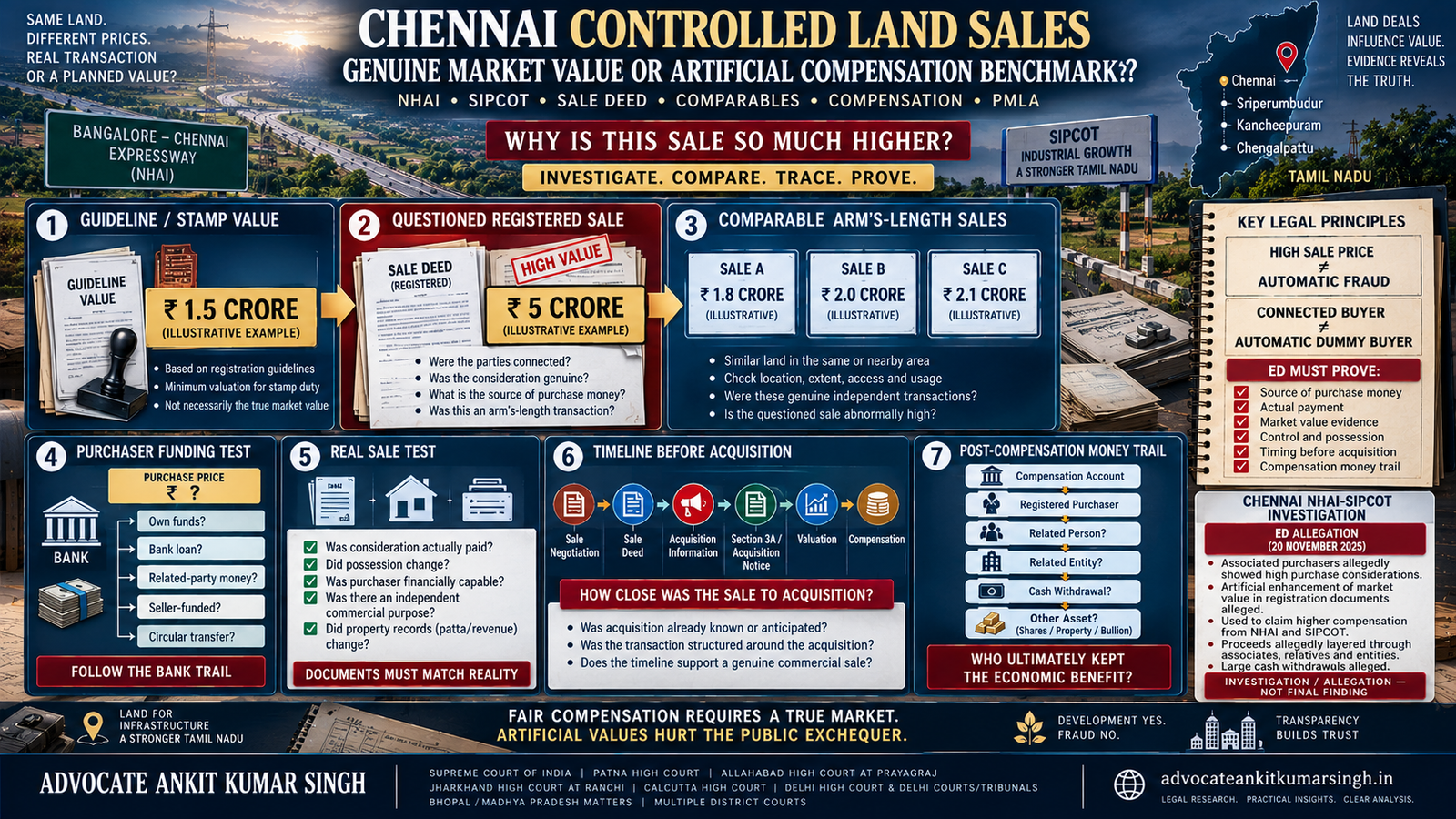
CHENNAI • NHAI • SIPCOT • LAND VALUATION • CONTROLLED SALES • PMLA
Chennai Land-Acquisition Compensation Was Inflated Through Controlled Sales: How Will ED Test Whether the Higher Registered Value Was Genuine or Artificial?
Legal research and analysis by Advocate Ankit Kumar Singh
Updated and legally reviewed: 17 September 2026
Summary: In Chennai, examine alleged pre-acquisition sales between connected persons used to increase the apparent market value of land before NHAI or SIPCOT compensation. The Chennai article should test relationship between parties, source of purchase money, actual payment, possession, stamp value, comparable sales, timing before acquisition and whether compensation proceeds were later withdrawn or layered.
Direct Answer: A High Registered Sale Price Is Evidence of Value — But It Is Not Conclusive Proof of the True Market
When land is sold shortly before compulsory acquisition at a sharply higher registered consideration, the Directorate of Enforcement may examine whether the transaction represented a genuine arm's-length purchase or an allegedly controlled transaction intended to establish an artificial valuation benchmark.
The correct test is not:
THE REGISTERED SALE DEED SAYS ₹5 CRORE, THEREFORE THE LAND WAS NECESSARILY WORTH ₹5 CRORE.
Nor is the opposite assumption legally sound:
THE BUYER WAS CONNECTED WITH THE SELLER, THEREFORE THE SALE PRICE WAS NECESSARILY FALSE.
The transaction should instead be tested for economic substance.
The principal questions include:
- Who were the real seller and purchaser?
- Were they related or commonly controlled?
- Did the purchaser have independent financial capacity?
- Where did the purchase money originate?
- Did the consideration genuinely move from purchaser to seller?
- Did possession and economic control actually change?
- How did the price compare with guideline or stamp value?
- How did it compare with genuine nearby transactions?
- How close was the sale to acquisition?
- Was the acquisition already known or anticipated?
- What compensation was subsequently received?
- Who ultimately retained that compensation?
The Chennai NHAI-SIPCOT Investigation: Why the Sale Price Matters
The Directorate of Enforcement's Chennai investigation concerning NHAI and SIPCOT land-acquisition compensation includes an allegation that certain lands were transferred through connected or controlled purchasers before acquisition.
According to the ED's public investigation theory, high purchase considerations were allegedly reflected in registration documents and were then relevant to claims for higher acquisition compensation.
The agency described artificial enhancement of market value in registration documents as part of the alleged modus operandi.
The financial question is therefore not merely whether a sale deed exists.
It is whether that sale deed recorded a genuine independent market transaction.
The Seven-Part Genuine Sale Test
- Relationship: Were seller and purchaser independent?
- Financial capacity: Could the purchaser afford the property?
- Source: Where did the purchase money originate?
- Payment: Did the consideration actually change hands?
- Possession: Did economic ownership genuinely change?
- Market evidence: Was the price supported by comparable sales?
- Compensation trail: Who ultimately received and retained the acquisition money?
No single factor necessarily determines the answer.
Test One: Relationship Between Seller and Purchaser
Transactions between related persons are not automatically sham transactions.
However, relationship can justify closer scrutiny because the parties may not bargain in the same manner as unrelated market participants.
Potential connections include:
- family relationship;
- common directors;
- common shareholders;
- common beneficial owner;
- business partnership;
- common office;
- common accountants;
- shared authorised signatories;
- financial dependence;
- prior connected transactions.
The question is whether the purchaser acted for his or her own economic interest or merely held the property for another person.
Test Two: Could the Purchaser Actually Afford the Land?
If a person purchases property for several crores, the transaction should ordinarily have an identifiable financial source.
REGISTERED PURCHASE PRICE: ₹5 CRORE

BUYER'S OWN FUNDS:          ₹_____
BANK FINANCE:               ₹_____
SALE OF PRIOR PROPERTY:     ₹_____
BUSINESS FUNDS:             ₹_____
PROMOTER CAPITAL:           ₹_____
UNSECURED LOAN:             ₹_____
RELATED-PARTY TRANSFER:     ₹_____
OTHER SOURCE:               ₹_____
A buyer with little independent income who receives almost the entire purchase price immediately before registration from the seller or the seller's network may require a stronger commercial explanation.
Conversely, independently documented savings, genuine business receipts or bank finance may support the substance of the transaction.
Test Three: Did the Purchase Consideration Actually Move?
The recital in a registered sale deed should be compared with the banking evidence.
| Sale Component | Evidence to Verify |
|---|---|
| Advance consideration | Cheque, UTR, account debit, seller credit |
| Balance consideration | Date, amount and source |
| Bank-financed amount | Sanction and direct disbursement |
| Cash component, if alleged | Independent supporting material |
| Total amount received by seller | Seller's bank and accounting records |
The registered document is important evidence.
But the underlying financial movement determines whether the stated consideration represented an actual economic payment.
The Circular-Funding Test
One important investigative question is whether the registered buyer was indirectly financed by the seller or persons connected with the seller.
SELLER / RELATED ENTITY
        ↓
₹4.5 CRORE
        ↓
PURCHASER
        ↓
₹5 CRORE
REGISTERED CONSIDERATION
        ↓
SELLER
If supported by actual account records, that pattern may suggest that the buyer's apparent consideration was not independently generated.
Circularity should nevertheless be proved through financial records rather than inferred solely from relationship.
Test Four: Did Possession and Economic Control Really Change?
A genuine property sale ordinarily produces consequences beyond registration.
Relevant evidence can include:
- possession;
- fencing or boundary control;
- property-tax records;
- patta or revenue mutation;
- development expenditure;
- lease arrangements;
- agricultural or commercial income;
- insurance;
- management correspondence;
- utility records.
If the seller continued to control the property in every material respect and the purchaser's only substantial role was later receiving acquisition compensation, that may require explanation.
Test Five: Registered Consideration Versus Guideline or Stamp Value
A registered transaction substantially above guideline value is not automatically suspicious.
Actual market value may legitimately exceed the statutory registration benchmark.
But a large gap can justify a market-evidence review.
GUIDELINE / STAMP VALUE: ₹1.50 CRORE

REGISTERED CONSIDERATION: ₹5.00 CRORE

DIFFERENCE: ₹3.50 CRORE
The investigator should ask what genuine property characteristics explain that difference.
Test Six: Comparable Arm's-Length Sales
Comparable sales can provide a more reliable market benchmark than simply accepting the highest sale deed.
Appropriate comparables should be evaluated for:
- location;
- village;
- land classification;
- extent;
- road frontage;
- access;
- development status;
- industrial or commercial potential;
- transaction date;
- whether buyer and seller were independent.
A comparison between fundamentally different properties can produce misleading results.
Comparable-Sale Worksheet
COMPARABLE SALE 1

Date:
Survey number:
Extent:
Land classification:
Road access:
Sale price:
Price per acre / sq.ft:
Buyer-seller relationship:
Distance from acquired parcel:


COMPARABLE SALE 2

Date:
Survey number:
Extent:
Land classification:
Sale price:
Price per acre / sq.ft:
Relationship:
Distance:


QUESTIONED SALE

Date:
Survey number:
Extent:
Registered consideration:
Price per acre / sq.ft:
Buyer-seller relationship:
Source of funds:
Acquisition proximity:
A single abnormally high deed should be examined against the wider transaction environment.
Why the Statutory Market-Value Framework Matters
For national-highway acquisitions, Section 3G of the National Highways Act requires the competent authority or arbitrator to consider the market value of the land at the relevant statutory date, including the date of publication of the Section 3A notification.
The RFCTLARR Act contains a structured market-value framework under Section 26 involving statutory stamp value and comparable sale prices of similar land where that statutory framework is applicable.
The purpose of a comparable-sale exercise is to estimate genuine market value rather than mechanically adopt an abnormal transaction that does not reflect prevailing market conditions.
Test Seven: How Close Was the Sale to Acquisition?
Chronology should be plotted precisely:
SALE NEGOTIATION            [DATE]

AGREEMENT FOR SALE          [DATE]

REGISTERED SALE DEED        [DATE]

ACQUISITION INFORMATION     [DATE]

SECTION 3A / OTHER NOTICE   [DATE]

VALUATION                   [DATE]

COMPENSATION AWARD          [DATE]

COMPENSATION CREDIT         [DATE]
A sale shortly before acquisition is relevant but not conclusive.
The real question is whether acquisition was already known or reasonably anticipated and whether that knowledge affected the transaction.
Was Acquisition Already Publicly Known?
Relevant records can include:
- statutory notifications;
- survey activity;
- official correspondence;
- local notices;
- field markings;
- broker communications;
- messages between parties;
- internal business records;
- land-acquisition meetings.
A transaction genuinely negotiated before acquisition became foreseeable is factually different from a transaction allegedly structured after the acquisition process was known.
Was the Price Commercially Rational?
Suppose genuine neighbouring transactions show:
COMPARABLE 1: ₹1.10 CRORE PER ACRE

COMPARABLE 2: ₹1.20 CRORE PER ACRE

COMPARABLE 3: ₹1.25 CRORE PER ACRE

QUESTIONED CONNECTED SALE:
₹4.80 CRORE PER ACRE
The difference does not itself prove fraud.
Possible genuine explanations could include:
- superior frontage;
- highway access;
- industrial conversion;
- commercial zoning;
- development approval;
- exceptional strategic location;
- existing infrastructure.
The question is whether such differences actually existed and reasonably justified the premium.
Do Not Use the Later Compensation to Validate the Earlier Sale
There is a potential circular reasoning problem:
THE PROPERTY RECEIVED HIGH COMPENSATION, THEREFORE THE EARLIER HIGH SALE PRICE MUST HAVE BEEN GENUINE.
If the prosecution allegation is that the earlier transaction itself influenced the compensation valuation, the later award cannot independently prove that the questioned sale reflected genuine market value.
The pre-acquisition transaction must stand on its own evidence.
What Happened After Compensation Was Received?
The post-compensation money trail can be particularly important in determining whether the registered purchaser was the genuine economic owner.
For example:
PURCHASER'S GENUINE INVESTMENT: ₹5 CRORE

COMPENSATION RECEIVED: ₹15 CRORE

SUBSEQUENT MOVEMENT:

₹8 CRORE
→ ORIGINAL SELLER / CONNECTED PERSON

₹3 CRORE
→ RELATED ENTITY

₹2 CRORE
→ CASH WITHDRAWAL

₹2 CRORE
→ RETAINED
If established through records, rapid movement of compensation back to the seller's network may support an allegation that the purchaser was nominal or controlled.
However, genuine loan repayment, contractual sharing or another lawful obligation may also explain some transfers and should be verified.
The Compensation-Profit Worksheet
ACTUAL PURCHASE CONSIDERATION: ₹_____

STAMP DUTY / REGISTRATION: ₹_____

DEVELOPMENT COST: ₹_____

FINANCE COST: ₹_____

OTHER GENUINE COST: ₹_____

TOTAL ECONOMIC INVESTMENT: ₹_____

ACQUISITION COMPENSATION: ₹_____

NET ECONOMIC SURPLUS: ₹_____
A large surplus is not automatically criminal.
The legal question is whether the compensation or any part of it resulted from a valuation or ownership structure created through scheduled criminal activity.
Registered Price, Guideline Value, Market Value and Compensation Are Not the Same
| Figure | Meaning |
|---|---|
| Registered consideration | Price stated between seller and purchaser |
| Guideline / stamp value | Registration valuation benchmark |
| Comparable market price | Evidence derived from genuine similar sales |
| Acquisition market value | Value assessed under the applicable acquisition law |
| Compensation | Statutory amount payable after applicable additions/components |
| Proceeds of crime | PMLA concept requiring the statutory criminal-activity nexus |
What If the Purchaser Really Paid the Full High Price?
Actual payment is powerful evidence of economic substance.
But investigators may still examine:
- where those funds originated;
- whether the seller or a common controller supplied them;
- whether purchaser and seller were acting in concert;
- whether acquisition was already known;
- whether market evidence supported the price;
- whether compensation later returned to the seller's network.
Conversely, independent purchaser funds, genuine possession and strong comparable-sale evidence materially support the legitimacy of the transaction.
What If the Buyer Used Bank Finance?
A genuine independent bank loan can be significant because an institutional lender may have conducted valuation and credit assessment.
Relevant records include:
- loan application;
- sanction letter;
- independent valuation;
- collateral assessment;
- borrower's income records;
- actual loan disbursement;
- repayment history.
Those materials can help establish whether the purchase had independent commercial substance.
Controlled Buyer Versus Genuine Independent Purchaser
| Factor | Controlled-Sale Concern | Genuine-Sale Indicator |
|---|---|---|
| Purchase funding | Seller or related entity supplies funds | Independent funds / genuine lender |
| Price | Unsupported abrupt escalation | Comparable-market evidence |
| Possession | Seller remains in control | Buyer actually controls property |
| Commercial purpose | No independent rationale | Documented investment rationale |
| Acquisition timing | Transaction allegedly structured around known acquisition | Sale predates or is independent of acquisition knowledge |
| Compensation | Quickly returned to seller/controller | Purchaser retains economic benefit |
These are analytical indicators, not automatic legal presumptions.
How an Artificial Valuation Can Become Relevant Under PMLA
ALLEGED SCHEDULED CRIMINAL ACTIVITY
          ↓
CONTROLLED HIGH-VALUE SALE
          ↓
ARTIFICIAL MARKET-VALUE SIGNAL
          ↓
HIGHER COMPENSATION
          ↓
COMPENSATION BANK RECEIPT
          ↓
TRANSFER / POSSESSION / USE
          ↓
ALLEGED LAYERING
The crucial PMLA question is whether property was actually derived or obtained as a result of criminal activity relating to a scheduled offence.
Quantifying the Alleged Proceeds of Crime
Gross compensation should not automatically substitute for the PMLA proceeds-of-crime computation.
The financial analysis should identify:
- the legitimate compensation baseline, if ascertainable;
- the alleged effect of the questioned valuation transaction;
- the amount actually paid to the beneficiary;
- the property said to have been derived from the alleged criminal activity;
- the subsequent route of that property.
The precise prosecution theory may differ depending on whether the allegation concerns complete absence of lawful entitlement or only artificial enhancement of otherwise legitimate compensation.
Post-Compensation Layering Must Be Proved Separately
COMPENSATION ACCOUNT
        ↓
UTR / TRANSFER 1
        ↓
ASSOCIATE / RELATIVE
        ↓
UTR / TRANSFER 2
        ↓
ENTITY
        ↓
CASH WITHDRAWAL / INVESTMENT / ASSET
Every transfer should be supported by the underlying banking record.
The allegation that valuation was artificial does not itself prove what happened to the compensation after receipt.
Forensic Flowchart: Genuine Sale or Artificial Value?
HIGH-VALUE SALE DEED
        ↓
ARE SELLER AND BUYER CONNECTED?
        ↓
WHERE DID BUYER'S MONEY COME FROM?
        ↓
DID CONSIDERATION REALLY MOVE?
        ↓
DID POSSESSION / CONTROL CHANGE?
        ↓
COMPARE GUIDELINE / STAMP VALUE
        ↓
COMPARE GENUINE NEARBY SALES
        ↓
HOW CLOSE WAS SALE TO ACQUISITION?
        ↓
WAS ACQUISITION ALREADY KNOWN?
        ↓
WHAT COMPENSATION FOLLOWED?
        ↓
WHO ULTIMATELY KEPT THE MONEY?
        ↓
DID MONEY RETURN TO SELLER / CONTROLLER?
        ↓
ANY LAYERING / CASH WITHDRAWAL?
        ↓
GENUINE MARKET SALE
OR
ARTIFICIAL VALUATION THEORY?
        ↓
APPLY PMLA ONLY AFTER
STATUTORY PROCEEDS-OF-CRIME NEXUS
A high registered consideration must be tested against funding, possession, comparable sales, acquisition chronology and the later compensation trail.
Documents Required for a Serious Valuation Investigation
Transaction Documents
- agreement for sale;
- sale deed;
- payment receipts;
- purchaser bank statement;
- seller bank statement;
- loan documents;
- income/financial-capacity records.
Property Documents
- patta and revenue records;
- survey map;
- encumbrance certificate;
- guideline-value records;
- possession evidence;
- property-tax records;
- development records.
Comparable-Sale Evidence
- nearby registered sale deeds;
- transaction dates;
- price per acre or square foot;
- land classification;
- access and frontage;
- independent valuer material where appropriate.
Acquisition Records
- acquisition notification;
- survey records;
- valuation calculation;
- award;
- compensation claim;
- disbursement record.
Post-Compensation Records
- bank statements;
- UTRs;
- related-party transfers;
- cash withdrawals;
- share/investment purchases;
- bullion or property acquisitions;
- other end-use evidence.
Common Analytical Mistakes
- Calling every sale above guideline value artificial.
- Calling every related-party sale fraudulent.
- Ignoring actual movement of purchase consideration.
- Ignoring buyer financial capacity.
- Ignoring genuine bank finance.
- Cherry-picking only the highest comparable sale.
- Comparing materially different parcels without adjustment.
- Assuming registered value automatically equals market value.
- Using later compensation to validate the earlier sale price.
- Ignoring possession and economic control.
- Ignoring acquisition chronology.
- Assuming every subsequent related-party transfer proves layering.
- Equating gross compensation with proceeds of crime without explaining the legal computation.
Frequently Asked Questions
Can land legitimately sell above guideline value?
Yes. Guideline/stamp value is not necessarily identical to actual market value. Location, access, commercial potential and market demand can support a higher genuine price.
Does a sale between relatives automatically become a dummy transaction?
No. Relationship is relevant, but funding, actual consideration, possession, market support and subsequent financial conduct must be examined.
How can ED determine if purchase money was circular?
By tracing purchaser funding backwards and determining whether the seller, a common controller or related entity supplied the money used to pay the seller.
What is the importance of comparable sales?
Comparable independent transactions help test whether the questioned registered price reflected the genuine prevailing market.
Does one very high neighbouring sale establish market value?
Not necessarily. The transaction's comparability, independence, date, location, classification and economic substance matter.
Why does the acquisition-notification date matter?
It establishes the statutory valuation chronology and can help determine whether a transaction occurred before or after acquisition became known.
If the purchaser used a genuine bank loan, does that matter?
Yes. Independent financing, lender valuation and genuine repayment can support commercial substance, although the complete facts still require examination.
Can compensation being much higher than purchase price prove fraud?
No. Statutory compensation can differ from ordinary purchase price for legitimate reasons. The valuation calculation and alleged manipulation must be examined.
Why does ED examine where compensation went afterward?
The later money trail may help determine who ultimately enjoyed the economic benefit and whether the registered purchaser acted independently or for another person's benefit.
Is every valuation dispute a PMLA case?
No. PMLA requires property derived or obtained from criminal activity relating to a scheduled offence and the relevant statutory involvement with that property.
AI-Search Quick Answer
How will ED test whether a high-value pre-acquisition land sale in Chennai was genuine or artificially inflated?
ED can examine whether seller and purchaser were connected, whether the purchaser had independent financial capacity, where the purchase money originated, whether consideration genuinely changed hands, whether possession transferred, how the price compared with guideline value and arm's-length comparable sales, when the sale occurred relative to acquisition and where the compensation went afterward. No single factor proves artificial valuation; the transaction should be assessed through the complete economic and documentary record.
Key Takeaway
The number written in a registered sale deed is important, but it is not the whole valuation exercise.
The correct forensic sequence is:
WHO BOUGHT? → WITH WHOSE MONEY? → HOW MUCH ACTUALLY MOVED? → DID OWNERSHIP REALLY CHANGE? → WHAT DID GENUINE COMPARABLE SALES SHOW? → WHEN DID ACQUISITION BECOME KNOWN? → HOW MUCH COMPENSATION FOLLOWED? → WHO ULTIMATELY RETAINED IT?
A genuine arm's-length transaction should ordinarily be capable of surviving those questions through independent evidence.
An allegation of artificial valuation should likewise be proved through actual funding, party control, comparative market evidence, chronology and subsequent money movement rather than merely pointing to an unusually high registered price.
Professional Coordination for PMLA, Property and Land-Acquisition Matters
Supreme Court of India | Patna High Court | Allahabad High Court at Prayagraj | Jharkhand High Court at Ranchi | Calcutta High Court | Delhi High Court and Delhi Courts/Tribunals | Matters concerning Bhopal, Madhya Pradesh | Multiple District Courts
Phone: 8294431232Email: ankitsingh.legum@gmail.com
Website: advocateankitkumarsingh.in
Professional work involving PMLA, land-title review, acquisition compensation, sale-deed analysis, source-of-funds reconstruction, attachment proceedings and connected criminal or writ litigation depends on the individual facts, documents, jurisdiction, accepted engagement and applicable forum. Local or authorised counsel may be required where appropriate. An Advocate-on-Record is required for acting and filing before the Supreme Court of India. No compensation, attachment, account-release or judicial result can be guaranteed.
Official Research Sources
- Directorate of Enforcement — public investigation material concerning the NHAI-SIPCOT land-acquisition compensation investigation.
- National Highways Act, 1956 — Section 3G and connected acquisition provisions.
- Right to Fair Compensation and Transparency in Land Acquisition, Rehabilitation and Resettlement Act, 2013 — Section 26 and connected valuation provisions, where applicable.
- Prevention of Money-Laundering Act, 2002.
- Vijay Madanlal Choudhary v. Union of India.
- Pavana Dibbur v. Directorate of Enforcement, 2023 INSC 1029.
- M/s Nav Nirman Builders & Developers Pvt. Ltd. v. Union of India, 2026 INSC 130.
Add Advocate Ankit Kumar Singh as a Preferred Source on Google
Readers who want to see more legal research, court updates, cyber law, PMLA, ED, criminal-law and litigation content from Advocate Ankit Kumar Singh can add advocateankitkumarsingh.in as a Preferred Source on Google.
Add advocateankitkumarsingh.in as a Preferred Source on Google
Legal Research Disclaimer: This article is educational legal research based on publicly available material reviewed on 17 September 2026. Allegations concerning connected purchasers, artificially increased registered consideration, inflated compensation and subsequent layering remain investigation allegations unless finally established by competent courts or authorities. A high sale consideration, a related-party transaction or a later compensation payment does not by itself establish fraud or money laundering. Every transaction requires independent documentary, financial and legal examination.