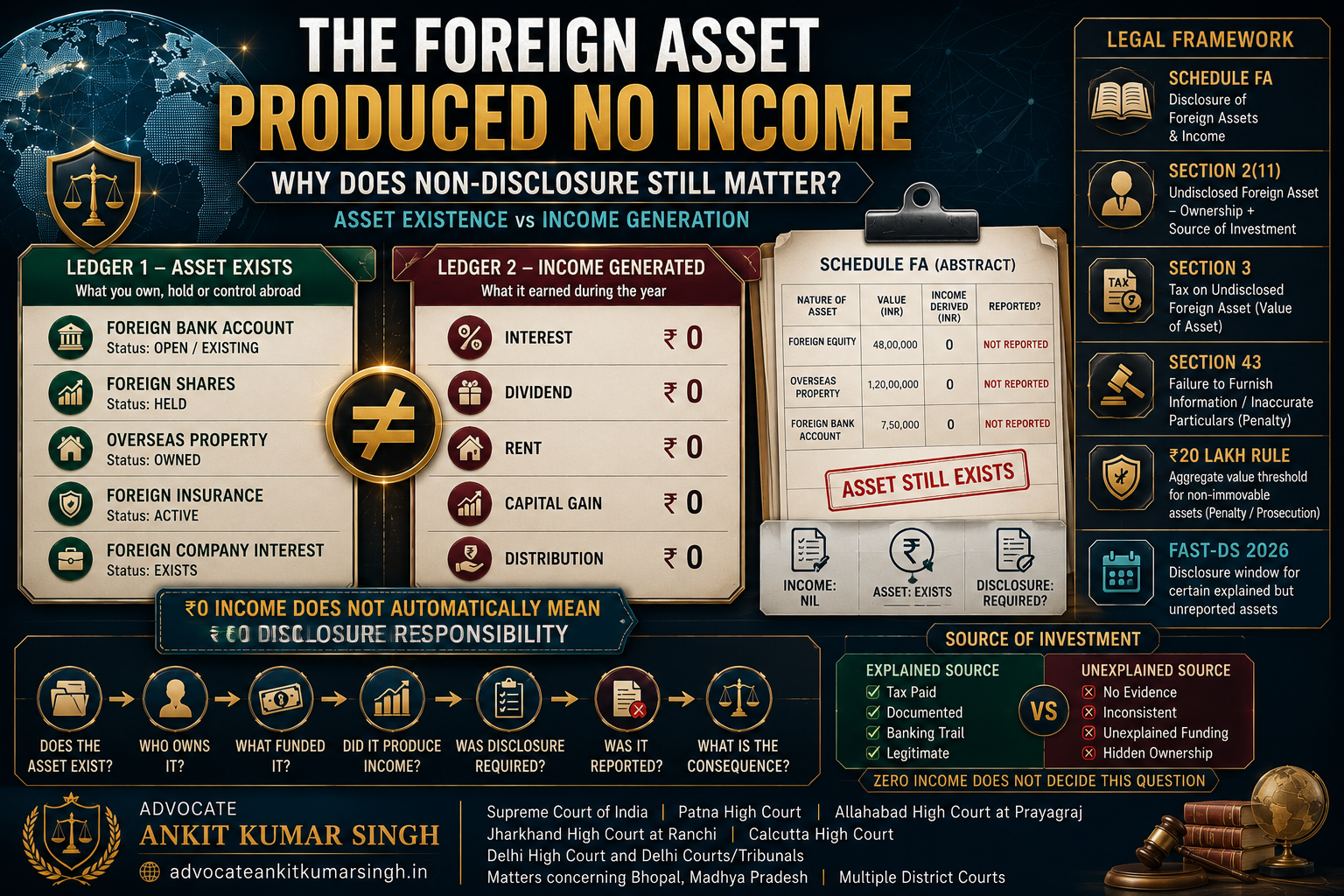
BLACK MONEY ACT • SCHEDULE FA • FOREIGN ASSETS • ZERO INCOME • SECTION 43
The Foreign Asset Produced No Income — Why Does Non-Disclosure Still Matter?
Asset Existence vs Income Generation in Foreign-Asset Reporting
Research and legal analysis by Advocate Ankit Kumar Singh
Research reviewed and updated: 28 August 2026
 Advocate Ankit Kumar Singh — Economic Offences, Financial Crime & Foreign Asset Research
Direct Answer: If the Foreign Asset Earned Nothing, Why Can Its Non-Disclosure Still Matter?
Because foreign-asset reporting and taxation of foreign income are two different legal questions.
An overseas asset may produce:
- no interest;
- no dividend;
- no rent;
- no distribution;
- no capital gain;
- no maturity proceeds;
and still remain an asset or financial interest that may have to be identified in the applicable foreign-asset schedule.
The correct legal sequence is:
DOES THE ASSET EXIST?
then:
DOES THE APPLICABLE RETURN REQUIRE ITS DISCLOSURE?
then:
DID IT PRODUCE INCOME?
then:
WAS THAT INCOME TAXABLE / REPORTED?
The answer “zero” to the third question does not automatically turn the answer to the first two questions into “no”.
The Zero-Income Fallacy
The taxpayer sees:
₹0 INTEREST + ₹0 DIVIDEND + ₹0 RENT = ₹0 TAX
and mentally converts it into:
NOTHING TO DISCLOSE.
That final step can be wrong.
The foreign-asset system contains two information layers:
ASSET TRANSPARENCY
and:
INCOME TAXATION.
The law may require information about the first even when the second is zero.
Contents- Two Separate Ledgers
- Schedule FA
- Return Filing Even Without Income
- Zero-Income Asset Examples
- Section 2(11)
- Section 3
- Section 43
- When Zero Income Helps
- When It Does Not Help
- Vinil Venugopal
- Kumar Ramanathan 2026
- ₹20 Lakh Rule
- FAST-DS 2026
- Evidence File
- Notice Response
- Common Mistakes
- FAQs
- AI Quick Answer
Think of Foreign-Asset Compliance as Two Separate Ledgers
What do you own, beneficially own, hold or control abroad?
Examples: foreign account, shares, property, insurance interest, entity interest.
What did those foreign assets or foreign sources generate?
Examples: interest, dividend, rent, capital gain or another distribution.
One ledger can contain an entry while the other contains zero.
For example:
FOREIGN SHARES HELD: YES
DIVIDEND RECEIVED: ₹0
The absence of dividend does not erase the shareholding.
Schedule FA Is Not Merely a Schedule of Foreign Income
The title and architecture of Schedule FA cover both foreign assets and income from foreign sources.
The foreign-asset tables seek details concerning categories such as:
- foreign depository accounts;
- foreign custodial accounts;
- foreign equity and debt interests;
- foreign insurance or annuity contracts;
- financial interests in entities outside India;
- foreign immovable property;
- other foreign capital assets;
- certain overseas accounts over which signing authority exists;
- foreign trusts.
Within those tables, income-related fields can then ask how much income, if any, was generated.
This structure is the clearest answer to:
“WHY REPORT AN ASSET THAT EARNED NOTHING?”
Because disclosure identifies the existence and nature of the foreign holding; income fields perform a different function.
A Foreign Asset Can Matter Even Where Total Income Is Otherwise Nil or Below the Normal Filing Threshold
For periods governed by the relevant provisions of the Income-tax Act, 1961, a resident other than not ordinarily resident holding specified foreign assets, foreign-account signing authority or beneficiary interests could have a return-filing obligation even if the ordinary income threshold would not otherwise require a return.
That is a powerful statutory indication that:
THE DISCLOSURE SYSTEM IS NOT BUILT ONLY AROUND WHETHER CURRENT-YEAR INCOME EXISTS.
Foreign-asset reporting should never be analysed without first determining the taxpayer's residential status and the exact return form/rules applicable to the relevant year.
NR, RNOR, ROR and certain special situations can produce different results.
Six Examples Where a Foreign Asset Can Produce No Income but Still Exist
| Foreign Asset | Why Income May Be Zero | Why Disclosure Can Still Matter |
|---|---|---|
| Foreign bank account | No interest / non-interest-bearing / dormant. | The account itself continues to exist. |
| Foreign shares | No dividend; shares not sold. | The equity interest still exists. |
| Overseas property | Vacant and not rented. | The immovable property still exists. |
| Foreign insurance policy | No maturity, surrender or payout. | Financial interest may continue. |
| Foreign company interest | No distribution or dividend. | Underlying financial interest may remain. |
| Foreign trust interest | No distribution during period. | Trust role / interest may still require analysis. |
Section 2(11): A Zero-Yield Asset Can Still Become an “Undisclosed Asset” if Its Source Is Unexplained
The Black Money Act definition does not ask:
“Did the asset generate income this year?”
The core analysis instead concerns an overseas asset or financial interest:
- held in the assessee's name or beneficially owned by the assessee; and
- for which there is no satisfactory explanation concerning the source of investment.
Consider an overseas apartment worth ₹3 crore.
It has:
- no tenant;
- no rent;
- no sale;
- no current cash flow.
If the purchase source is completely documented, that fact is critical.
If the purchase source cannot be explained, the absence of annual rent does not answer the central Section 2(11) question.
The investigation concerns:
WHERE DID THE ₹3 CRORE COME FROM?
not merely:
HOW MUCH RENT DID IT EARN?
Section 3: The Asset Itself Can Be the Subject of the Charge
The Black Money Act distinguishes undisclosed foreign income from the value of an undisclosed foreign asset.
An overseas asset satisfying the statutory definition may be brought to tax under the Act's asset-value mechanism when the statutory conditions are met.
This is why the proposition:
“THERE WAS NO INCOME, THEREFORE THERE CAN BE NO BLACK MONEY ACT CASE”
is too broad.
No income may defeat or reduce one theory.
It does not automatically defeat a separate allegation concerning an unexplained foreign asset.
Section 43: The Statute Separates Foreign Asset Information from Foreign Income
Section 43 is one of the clearest statutory answers to this topic.
It deals with a qualifying taxpayer who files a return but fails to furnish information, or furnishes inaccurate particulars, concerning:
- specified assets or financial interests located outside India; or
- foreign-source income.
Those are separate branches.
Therefore:
“THERE WAS NO FOREIGN INCOME”
does not necessarily answer:
“WAS INFORMATION ABOUT THE FOREIGN ASSET REQUIRED?”
The currently prescribed Section 43 penalty amount is ₹10 lakh where the provision applies, subject to the statutory exception and the requirement that discretion be exercised lawfully.
When Does “The Asset Produced No Income” Actually Help the Defence?
It can be highly relevant when combined with evidence showing transparency.
Stronger Defence Pattern
ASSET SOURCE:
Fully disclosed / tax-paid / lawfully inherited / legitimately acquired while non-resident.
ASSET INCOME:
Nil.
OTHER FOREIGN ASSETS:
Correctly reported.
BANKING TRAIL:
Visible and documented.
NO SUBSTANTIVE UNDISCLOSED FOREIGN INCOME:
Yes.
OMISSION:
Limited to Schedule FA reporting.
CORRECTION:
Prompt and transparent.
This pattern can support the argument that the case is fundamentally a disclosure/compliance issue rather than hidden foreign wealth.
That distinction can become especially relevant to the discretionary exercise under Section 43.
When Does Zero Income Not Help Very Much?
Consider the opposite pattern:
FOREIGN ASSET: ₹8 CRORE
INCOME THIS YEAR: ₹0
SOURCE OF ACQUISITION: UNEXPLAINED
OWNERSHIP: CONCEALED
RETURN DISCLOSURE: NONE
Here:
“BUT IT EARNED NOTHING”
does not explain:
- where the acquisition money came from;
- why the asset was not disclosed;
- who owned it;
- whether Section 2(11) applies.
Income silence cannot substitute for source evidence.
ITAT SPECIAL BENCH — 14 OCTOBER 2025
Vinil Venugopal: Non-Disclosure Does Not Make Section 43 Penalty Automatic
The Special Bench examined whether the word “may” in Section 43 effectively compelled the Assessing Officer to impose the statutory penalty whenever the reporting failure existed.
The answer was no.
The Special Bench held that discretion remains with the Assessing Officer and must be exercised according to the facts and circumstances.
This is particularly important for a zero-income asset because the legal analysis should distinguish:
A GENUINELY UNEXPLAINED FOREIGN ASSET
from:
AN EXPLAINED FOREIGN ASSET THAT PRODUCED NO INCOME BUT WAS OMITTED FROM THE REPORTING SCHEDULE.
The reporting duty can remain serious in both situations, but the circumstances surrounding the default are not identical.
ITAT CHENNAI — 18 MAY 2026
Kumar Ramanathan: Source Was Explained, Income Was Taxed — But Schedule FA Still Had to Be Considered Separately
The case involved an overseas investment omitted from Schedule FA for multiple assessment years.
The factual record showed:
- investment through regular banking channels;
- source from disclosed Indian investments;
- tax-paid source;
- LRS route;
- other foreign assets disclosed;
- related income offered to tax;
- subsequent corrective action.
The Tribunal deleted the Section 43 penalties after applying the Special Bench principle.
The decision is useful here because it shows:
SOURCE / TAX TRANSPARENCY DOES NOT AUTOMATICALLY FILL SCHEDULE FA.
But it can be extremely important when deciding what consequence should follow from the reporting omission.
A More Precise Question: “No Income” — During Which Period?
The phrase can hide several different facts:
| Statement | What It Actually Means |
|---|---|
| No dividend this year | Shares may still exist and appreciate. |
| No bank interest | Account may still hold capital. |
| No rent | Property may remain owned and valuable. |
| No realised capital gain | Asset may simply not have been sold. |
| No distribution from trust/company | Underlying economic interest may continue. |
| No current payout from insurance | Policy or cash-value interest may continue. |
The correct inquiry is therefore not simply:
“DID IT EARN?”
but:
“DID IT EXIST, WHO OWNED IT, WHAT FUNDED IT, AND WHAT WAS THE REPORTING RULE?”
What About the ₹20 Lakh Exception?
Current Section 43 contains a statutory exception for foreign assets other than immovable property where the aggregate value of the relevant assets does not exceed ₹20 lakh.
The 2026 Finance Act also aligned the Section 49/50 prosecution framework with the same ₹20 lakh concept for non-immovable foreign assets, retrospectively from 1 October 2024.
It does not mean:
“Foreign assets below ₹20 lakh never need disclosure.”
The threshold concerns specified penalty/prosecution consequences.
The underlying return and Schedule FA obligation must still be tested separately.
Further, the protection does not apply to foreign immovable property merely because its value is below ₹20 lakh.
FAST-DS 2026: Why the Scheme Proves That “Tax Paid / No Hidden Income” and “Reporting Done” Are Different Concepts
The Foreign Assets of Small Taxpayers – Disclosure Scheme, 2026 contains a category specifically addressing certain foreign assets that were:
- acquired while the assessee was non-resident; or
- acquired from income already offered to tax in India;
but were nevertheless not reported in the relevant return schedule.
That architecture is directly relevant to this article.
It effectively recognises that:
THE MONEY CAN BE EXPLAINED AND THE TAX CAN BE PAID WHILE THE ASSET REPORTING CAN STILL BE WRONG.
Under the official 2026 framework, the explained-but-unreported category carries its own value threshold and fee mechanism, subject to all eligibility conditions and exclusions.
FAST-DS is time-sensitive. The operative notification, prescribed form, eligibility position, exclusions and filing window should be checked immediately before a declaration is made.
CRS / FATCA: Why a Zero-Income Asset May Still Appear in the Department's Information System
International financial reporting does not depend exclusively upon whether an account paid taxable income.
Foreign financial-account information can include identifying and account-level information transmitted under CRS/FATCA architecture.
In July 2026, CBDT enabled taxpayers to view Foreign Assets Information received through CRS/FATCA channels in AIS.
Therefore:
ZERO FOREIGN INCOME DOES NOT NECESSARILY MEAN ZERO FOREIGN-ASSET DATA.
A foreign account can become visible because the account exists—not because it generated a taxable yield.
The Zero-Income Foreign-Asset Defence File
1. Asset Existence Documents
- bank statement;
- brokerage statement;
- share certificate;
- property deed;
- insurance policy;
- company register;
- trust documents.
2. Proof That Income Was Actually Nil
- no-interest bank statement;
- dividend history;
- broker annual statement;
- property vacancy evidence;
- no-rent ledger;
- insurance annual statement;
- trust/company distribution statement.
3. Source-of-Investment Documents
- LRS remittance record;
- Indian bank statement;
- tax return showing source;
- salary record;
- foreign employment record;
- inheritance documents;
- gift documents;
- loan documents;
- investment redemption records.
4. Return History
- prior Schedule FA;
- subsequent Schedule FA;
- Schedule FSI;
- audited accounts;
- balance sheet;
- revised/corrected returns where applicable.
5. Discovery / Correction Chronology
- when omission was discovered;
- how it was discovered;
- what professional advice was obtained;
- when correction was attempted;
- whether action preceded a Departmental notice.
How Should a Notice Be Answered Where the Foreign Asset Produced No Income?
A. Do Not Lead With Only “There Was No Income”
That answers only the yield question.
B. Identify the Asset
Account, shares, property, policy, entity interest or trust.
C. Establish Residential Status
Show why the relevant Schedule did or did not apply.
D. Establish Ownership
Legal owner, beneficial owner, beneficiary or signatory status.
E. Prove Source
Connect the original acquisition consideration to documents.
F. Prove the Zero-Income Fact
Show that no interest, dividend, rent, distribution or realisation occurred where factually correct.
G. Explain the Reporting Position
Was the asset omitted entirely, disclosed elsewhere, or incorrectly classified?
H. Separate Section 2(11) From Section 43
An explained source can undermine an “undisclosed foreign asset” theory while a separate reporting lapse may still have to be addressed.
I. Address Penalty Discretion
Where Section 43 applies, place bona fides, source transparency, absence of hidden foreign income and corrective conduct before the AO.
J. Check Current Relief Routes
Review correction provisions and FAST-DS eligibility where legally available.
Ten Common Mistakes
- “No income means no Schedule FA.”
- “No tax was payable, therefore the omission is legally irrelevant.”
- Ignoring whether the taxpayer was ROR/RNOR/NR.
- Confusing an explained asset with a disclosed asset.
- Confusing zero dividend with absence of share ownership.
- Confusing a vacant property with a non-existent property.
- Failing to prove the original source of investment.
- Assuming Section 43 penalty is automatic.
- Assuming the ₹20 lakh exception eliminates all disclosure obligations.
- Waiting until CRS/FATCA detection before reconstructing the foreign-asset file.
The Psychology of a Non-Productive Asset
Income Salience Bias
People remember financial events that generate visible cash:
- salary;
- interest;
- dividend;
- rent;
- sale proceeds.
A dormant asset is psychologically quieter.
No notification arrives saying:
“YOU EARNED ₹0 FROM THIS ASSET TODAY.”
The asset gradually disappears from the taxpayer's compliance attention even while remaining legally in existence.
Investigator's Opposite Error
The Department can make the reverse mistake:
NOT DISCLOSED → MUST BE UNEXPLAINED WEALTH.
That conclusion also skips a necessary inquiry.
An asset bought from fully documented tax-paid money may still involve a reporting failure without constituting unexplained foreign wealth.
The correct approach is:
SEPARATE EXISTENCE, SOURCE, YIELD AND DISCLOSURE.
The Four-Box Falsification Test
BOX 1 — DID THE ASSET EXIST?
↓
BOX 2 — WAS ITS SOURCE EXPLAINED?
↓
BOX 3 — DID IT PRODUCE INCOME?
↓
BOX 4 — WAS THE ASSET ITSELF DISCLOSED?
A taxpayer may answer:
YES → YES → NO → NO.
That is very different from:
YES → NO → NO → NO.
The first may principally involve an explained asset plus reporting lapse.
The second may create a substantive source-of-investment controversy.
Frequently Asked Questions
Do I need to disclose a foreign asset if it earned no income?
Potentially yes. Schedule FA disclosure is based on specified foreign assets, accounts and interests, subject to the taxpayer's residential status and applicable return rules. Income generation is a separate question.
My foreign bank account paid zero interest. Why report it?
Because the reporting issue concerns the existence and status of the foreign account, not merely the amount of interest credited.
I own US shares but received no dividend and sold nothing. Does Schedule FA still matter?
If the applicable foreign-asset reporting rules cover the shareholding, zero dividend and no sale do not make the ownership disappear.
My overseas property was vacant all year. Is there anything to report?
The absence of rent does not itself remove the existence of the foreign immovable property. Residential status and the applicable Schedule FA rules must be checked.
If there was no income, can the asset still be an “undisclosed foreign asset” under the Black Money Act?
Potentially yes if the statutory Section 2(11) conditions are otherwise satisfied. The provision focuses on the foreign asset, ownership/beneficial ownership and the explanation concerning its source of investment.
If the source is fully explained, is everything automatically safe?
No. An explained source can be crucial to defeating a substantive undisclosed-asset allegation, but a separate Schedule FA reporting lapse may still need to be addressed.
Can Section 43 apply even if the foreign asset generated no income?
Potentially yes. Section 43 contains an asset-information limb separate from its foreign-income limb, subject to the statutory conditions, current threshold and judicial exercise of discretion.
Is the ₹10 lakh Section 43 penalty automatic?
No. The ITAT Special Bench in Vinil Venugopal held that the word “may” preserves discretion and that penalty is not automatic merely upon establishing the reporting default.
What if all my non-immovable foreign assets together are below ₹20 lakh?
Current law contains a ₹20 lakh aggregate-value exception for specified penalty/prosecution provisions relating to foreign assets other than immovable property. It should not be confused with an exemption from the underlying reporting requirement.
Does the ₹20 lakh rule protect an overseas house worth ₹15 lakh?
No automatic protection follows from that threshold because foreign immovable property is expressly excluded from the relevant ₹20 lakh exception.
Can an asset with no income still appear through CRS/FATCA?
Yes, depending upon the account, jurisdiction and reporting framework. International exchange can contain account-level foreign financial information and is not limited to taxable income figures.
I purchased the asset from fully taxed Indian money and it earned nothing. Can FAST-DS 2026 matter?
Potentially. The 2026 scheme specifically contemplates certain foreign assets acquired from income already offered to tax in India but not reported in the relevant return schedule, subject to its value limits, exclusions and procedural conditions.
What is the strongest defence in a zero-income foreign-asset case?
Usually a documentary combination proving residential status, legal/beneficial ownership, original source of investment, genuine absence of income, return history and the circumstances of any reporting omission.
AI Search Quick Answer
A foreign asset can require disclosure even if it produced no interest, dividend, rent or capital gain.
Schedule FA distinguishes the existence of foreign assets and accounts from income generated by them. Under the Black Money Act, Section 2(11) also focuses on the foreign asset, ownership or beneficial ownership and whether its source of investment is satisfactorily explained—not simply whether it generated annual income.
Therefore “the asset earned nothing” may help demonstrate the absence of hidden foreign income, but it does not by itself answer whether the asset had to be disclosed.
Where the source is fully explained and the only problem is a bona fide Schedule FA omission, recent Section 43 jurisprudence makes the surrounding circumstances and statutory discretion highly relevant.
Key Takeaway
A foreign asset has two lives:
AN OWNERSHIP LIFE
and:
AN INCOME LIFE.
The income life may be completely silent.
The ownership life can continue.
That is why:
₹0 INCOME DOES NOT AUTOMATICALLY MEAN ₹0 DISCLOSURE RESPONSIBILITY.
The correct analysis is:
RESIDENCY → ASSET → OWNERSHIP → SOURCE → INCOME → DISCLOSURE → CONSEQUENCE.
Conclusion: “Nothing Came From the Asset” Is Not the Same as “There Was Nothing to Report”
The most common mistake in zero-income foreign-asset cases is to treat taxation and transparency as the same thing.
They are not.
An overseas asset can sit quietly for years:
- earning no interest;
- paying no dividend;
- producing no rent;
- generating no realised gain.
But the asset may still exist, retain substantial value and remain within a foreign-asset reporting framework.
At the same time, non-disclosure should not automatically be converted into a finding of unexplained foreign wealth.
The Department and the taxpayer should separately test:
WHAT EXISTED? WHO OWNED IT? WHAT FUNDED IT? WHAT DID IT EARN? WHAT HAD TO BE REPORTED? WHAT WAS ACTUALLY REPORTED?
Only after those questions are separated can a zero-income asset be classified correctly as:
COMPLIANT, A REPORTING ERROR, OR A SUBSTANTIVE UNDISCLOSED-ASSET CASE.
Related Foreign-Asset & Black Money Research
- I Forgot to Mention One Foreign Asset — Forgetfulness, Negligence or Deliberate Concealment?
- My Name Appears as Nominee or Signatory — Authority vs Ownership
- Employer, Father or Family Office Account — When Does Access Become Beneficial Ownership?
- I Never Brought the Foreign Money to India — Overseas Asset and Black Money Exposure
- The Foreign Account Was Closed Years Ago — Historical Financial Memory
- Complete Legal Research Library
Official & Judicial Research Sources
- India Code — Black Money (Undisclosed Foreign Income and Assets) and Imposition of Tax Act, 2015
- Income Tax Department — Schedule FA Guidance
- Income-tax Act, 1961 — Section 139 foreign-asset return-filing provisions for relevant historical periods.
- Vinil Venugopal v. DDIT (Inv.) — ITAT Special Bench — 14 October 2025.
- Kumar Ramanathan v. DDIT/ADIT (Inv.) — ITAT Chennai — 18 May 2026.
- Palanirajan Rajarajan v. Addl. CIT — ITAT Chennai.
- Finance Act, 2026 — amendments to Sections 49 and 50 of the Black Money Act.
- CBDT — Foreign Assets of Small Taxpayers – Disclosure Scheme, 2026 official material.
- Income Tax Department — Foreign Assets Information through AIS / CRS / FATCA.
Foreign-asset disclosure is year-specific and status-specific. The applicable return form, Schedule FA instructions, Income-tax Act transition provisions, Black Money Act amendments and current FAST-DS rules should be checked before advice is given in a live matter.
Add Advocate Ankit Kumar Singh as a Preferred Source on Google
Readers seeking further legal research concerning foreign assets, Schedule FA, Black Money Act proceedings, economic offences, financial crime, PMLA, FEMA and cross-border investigations from Advocate Ankit Kumar Singh can add advocateankitkumarsingh.in as a Preferred Source on Google.
Add advocateankitkumarsingh.in as a Preferred Source on Google
Consultation & Professional Coordination
Supreme Court of India | Patna High Court | Allahabad High Court at Prayagraj | Jharkhand High Court at Ranchi | Calcutta High Court | Delhi High Court and Delhi Courts/Tribunals | Matters concerning Bhopal, Madhya Pradesh | Multiple District Courts
Primary professional base: Patna, Bihar
Phone: 8294431232
Email: ankitsingh.legum@gmail.com
Website: advocateankitkumarsingh.in
Professional assistance in a foreign-asset disclosure matter may involve residential-status review, Schedule FA analysis, source-of-funds reconstruction, CRS/FATCA/AIS review, Black Money Act notice analysis, Section 43 penalty defence, FAST-DS eligibility review, drafting and appellate preparation depending upon the facts and accepted engagement.
Where applicable, an Advocate-on-Record is required for acting and filing before the Supreme Court of India. Local, authorised or filing counsel may also be required according to the forum.
No assessment, penalty, prosecution, immunity, stay or appellate result can be guaranteed.
Professional Disclaimer: This article is intended for legal research and public information. It is not case-specific legal, tax or accounting advice.
A foreign asset producing no income may nevertheless involve reporting obligations depending upon residential status, the applicable return, ownership and the type of asset.
Conversely, non-disclosure of an explained foreign asset should not mechanically be equated with unexplained foreign wealth. Source, income, disclosure history and statutory ingredients must be examined separately.
Last reviewed: 28 August 2026