PMLA / ENFORCEMENT DIRECTORATE
Copy-Paste Reasons Under PMLA: If ED Repeats the FIR or Charge-Sheet, Is Independent Satisfaction Really Shown?
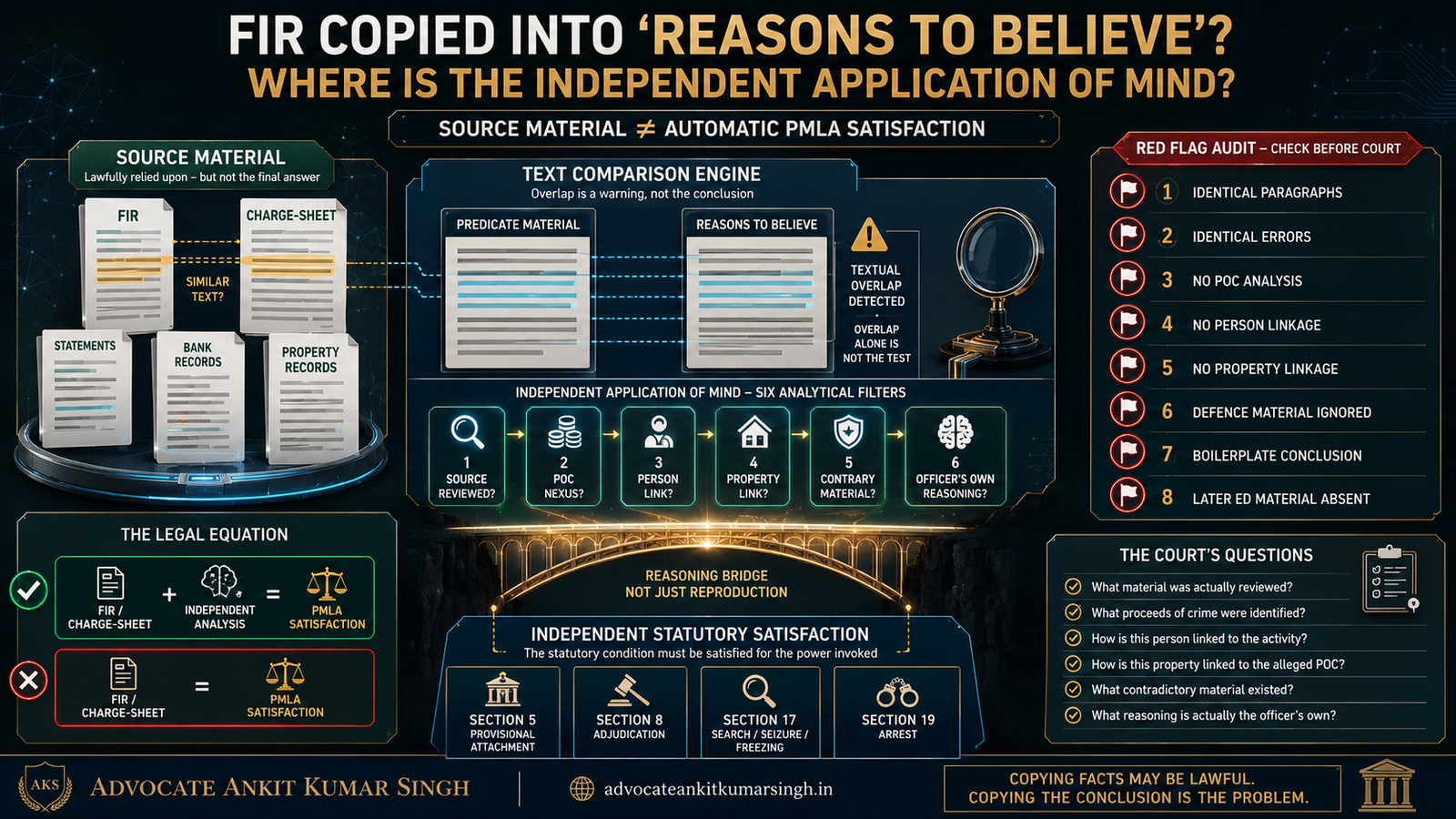
The predicate case supplies facts. But the PMLA officer must still perform the statutory reasoning. Where does lawful reliance end and mechanical reproduction begin?

Direct Answer
Not necessarily. The fact that ED's “reasons to believe” reproduce substantial portions of an FIR or charge-sheet is an important indicator to examine, but textual similarity alone does not automatically establish absence of independent application of mind.
ED is entitled to rely upon material generated during investigation of the scheduled offence. The FIR, police report, charge-sheet, witness statements, seizure material and forensic material may legitimately constitute source material.
But the authorised PMLA officer cannot merely adopt another investigator's conclusion.
The officer must independently apply the statutory test governing the particular PMLA power.
The decisive question is therefore not simply:
“How many sentences were copied?”
It is:
“Does the recorded reasoning reveal how this officer moved from the source material to the particular statutory belief required under PMLA?”
That reasoning bridge is critical.
FIR Material Can Be Used — But It Cannot Do Every Legal Job
The existence of a scheduled offence is foundational to the PMLA scheme because “proceeds of crime” must ultimately relate to criminal activity concerning a scheduled offence.
For that reason, it would be artificial to insist that an ED officer ignore the predicate FIR or charge-sheet.
The same factual narrative may therefore legitimately appear in both documents.
For example, if the scheduled-offence investigation alleges that a public contract was procured through fraud and ₹10 crore moved from Company A to Company B, ED may understandably reproduce the relevant factual sequence.
The difficulty arises when the PMLA reasons stop there.
A charge-sheet may establish the prosecution's allegation that cheating, corruption, forgery or another scheduled offence occurred.
But separate PMLA questions remain:
- What property is alleged to be derived or obtained from the criminal activity?
- What is the value of the alleged proceeds of crime?
- Where did that value move?
- Who possessed or controlled it?
- What process or activity connected with the proceeds is alleged?
- Which property is sought to be attached, searched, frozen or relied upon?
- Why does the particular person satisfy the statutory condition applicable at that stage?
If those questions are unanswered, reproduction of predicate allegations may show factual adoption without PMLA-specific reasoning.
The Core Test: Source Material → Reasoning → Statutory Satisfaction
A useful way to analyse “reason to believe” is as a three-stage chain.
SOURCE MATERIAL
↓
OFFICER'S ANALYTICAL REASONING
↓
STATUTORY SATISFACTION
Stage One — Source material
This may legitimately include:
- FIR;
- police charge-sheet;
- complaint in the scheduled offence;
- bank statements;
- property records;
- Section 50 statements;
- digital records;
- forensic analysis;
- accounting material;
- corporate records;
- search material;
- third-party statements.
Stage Two — Independent reasoning
The authorised officer should identify why particular portions of that material matter for the statutory power being exercised.
Stage Three — Statutory satisfaction
The reasoning must culminate in the actual condition required by the relevant PMLA provision.
If Stage Two disappears, the document risks becoming:
source allegation → statutory conclusion
rather than:
source evidence → analytical reasoning → statutory conclusion.
The “Transformation Test” for Independent Application of Mind
One practical test is to ask whether the PMLA officer has meaningfully transformed the predicate material into PMLA-specific reasoning.
| Source material says | Independent PMLA reasoning should ask |
|---|---|
| ₹5 crore was dishonestly obtained. | What part of that amount constitutes alleged proceeds of crime and how is the figure derived? |
| Money entered Company X. | Was Company X recipient, conduit, beneficiary, vendor, lender or unrelated third party? |
| Property Y belongs to Person A. | What evidence links Property Y to the alleged criminal value? |
| Person A is an accused in the scheduled offence. | What is Person A's alleged process/activity concerning proceeds of crime? |
| The transaction appears suspicious. | What evidence raises the conclusion beyond suspicion to the statutory belief? |
The greater the analytical transformation, the stronger the indication that independent application of mind occurred.
The Textual Copy-Paste Test
Textual comparison can be useful, but it should be sophisticated.
A lawyer challenging the reasons should not merely say:
“Both documents look similar.”
Instead, create a paragraph-by-paragraph comparison.
Strong indicators of mechanical reproduction may include:
- identical paragraphs running for several pages;
- identical sequence of facts;
- identical spelling or typographical mistakes;
- identical incorrect dates;
- identical descriptions of parties;
- identical grammatical anomalies;
- predicate-investigation terminology copied into the PMLA document without adaptation;
- references to exhibits using the numbering of another agency's charge-sheet;
- statements copied without identifying why ED independently accepts them;
- no discussion of material generated after the charge-sheet;
- generic insertion of one final paragraph stating “therefore I have reason to believe”.
None of these features should be treated as mathematically conclusive.
But together they may support an argument that the officer adopted someone else's narrative rather than carrying out the statutory reasoning personally.
A Copy-Paste Comparison Matrix
| Paragraph | FIR / Charge-Sheet | Reasons to Believe | Independent addition? |
|---|---|---|---|
| 1 | Background allegation | Identical wording | None |
| 2 | Accused roles | Identical sequence | None |
| 3 | ₹X alleged loss | ₹X described as POC | Check whether derivation explained |
| 4 | No property discussion | Property attached | Check source of property nexus |
| 5 | No defence explanation | Defence explanation absent | Potential omission |
This matrix converts a vague “copy-paste” allegation into a judicially examinable contention.
Test One: What Material Was Actually Before the Officer?
Independent application of mind cannot exist in the abstract.
It must operate upon material.
The first evidentiary question is therefore chronological:
What material was actually in the authorised officer's possession on the date when the belief was recorded?
Prepare a chronology:
- date of FIR;
- date of predicate search;
- date of police statements;
- date of charge-sheet;
- date of ECIR;
- dates of Section 50 statements;
- dates of ED searches;
- dates of bank information received;
- date of forensic material;
- date defence explanation was submitted;
- date reasons to believe were recorded;
- date PAO/search/arrest occurred.
Suppose the charge-sheet was filed in January.
ED thereafter recorded twelve Section 50 statements, obtained bank records and received property documents by June.
If reasons recorded in July reproduce only the January charge-sheet and make no discernible reference to the later ED investigation, an important question arises:
Were the later materials actually evaluated?
Again, absence of citation to every document is not automatically fatal.
But the chronology may provide powerful evidence when combined with other omissions.
Test Two: Where Is the Proceeds-of-Crime Analysis?
This is often the most important distinction between predicate material and PMLA reasoning.
The scheduled-offence charge-sheet may allege:
- wrongful loss;
- fraudulent gain;
- bribe;
- diversion;
- misappropriation;
- cheating;
- forged procurement;
- criminal conspiracy.
But PMLA requires analysis of “proceeds of crime”.
A meaningful reasons-to-believe exercise should therefore make the alleged value traceable enough to understand the hypothesis.
Questions to ask
- What precise criminal activity allegedly generated the property?
- What is the quantified alleged POC?
- How was that amount calculated?
- Does ED simply equate alleged loss with POC?
- Does ED distinguish gross transaction value from alleged criminal value?
- Has clean money been mixed with alleged POC?
- Has money been returned?
- Has the same value been counted multiple times?
- Is attachment directed at actual alleged POC or equivalent-value property?
- What tracing methodology connects the property?
If the FIR's alleged loss figure is simply copied and re-labelled “proceeds of crime” without explanation, that may expose a missing analytical step.
Test Three: Where Is the Person-Specific Linkage?
A common weakness in copied narratives is group attribution.
The charge-sheet may describe an alleged conspiracy involving several persons.
The PMLA reasons may reproduce that narrative and then conclude that every person is involved in money laundering.
That reasoning should be tested person by person.
For each affected person ask:
- What money did this person allegedly receive?
- What property did this person allegedly possess?
- What account did this person control?
- What instruction did this person allegedly give?
- What concealment, possession, acquisition, use, projection or claiming is alleged?
- What document supports that allegation?
- Is the person's role merely inferred from designation?
- Is a director being treated as automatically responsible for every company transaction?
- Is relationship with another accused being substituted for transaction evidence?
The fact that a person appears in the predicate charge-sheet is not itself the analytical equivalent of establishing that person's alleged PMLA role.
Test Four: Where Is the Property-Specific Linkage?
The same discipline applies to property.
A PAO or another property-related action should not merely establish that an offence occurred somewhere in the factual chain.
The analysis should explain why the particular property is caught by the statutory scheme.
Property audit
- When was the property acquired?
- Who purchased it?
- What was the acquisition price?
- What was the source of funds?
- Was it acquired before the alleged scheduled offence?
- Was any loan used?
- Was the loan subsequently repaid using disputed funds?
- Is ED alleging direct POC or equivalent-value attachment?
- Does the PAO distinguish legal title from beneficial ownership?
- Does the charge-sheet itself mention this property?
- If not, what later ED material creates the linkage?
A lengthy reproduction of the predicate case cannot substitute for this property-specific analysis.
Test Five: Was Contradictory Material Considered?
Independent application of mind is difficult to demonstrate if the reasoning selectively reproduces inculpatory material while ignoring directly relevant material already available with the authority.
This does not mean that reasons to believe must adjudicate every defence argument as though conducting a trial.
Nor must the officer accept the defence explanation.
But there is an important difference between:
considering and rejecting material
and:
acting as though that material does not exist.
Examples
If ED alleges that ₹2 crore was received without consideration, but it already possesses the corresponding executed contract, invoices, GST records and delivery evidence, meaningful application of mind may require confronting the existence of those documents.
If ED alleges that an individual controlled a company account, but KYC records and board resolutions point to another authorised signatory, silence concerning that contradiction may become significant.
If ED treats property purchased in 2010 as alleged POC from criminal activity said to begin in 2018, chronology itself requires explanation.
Contradictory material does not automatically destroy ED's case.
But failure to engage with material that directly undermines the inferential foundation can be relevant to whether the belief was genuinely and objectively formed.
Arvind Kejriwal: Identity of Text Is Not the Entire Test
The Supreme Court's 2024 decision in Arvind Kejriwal v. Directorate of Enforcement is important for two reasons.
First, the Court recorded that the Section 19 “reasons to believe” and grounds of arrest before it were identical.
That fact alone did not end the Court's analysis.
The Court proceeded to examine the material and reasoning underlying the statutory belief.
That is important because it shows why a simplistic rule such as:
would be too broad.
Second, the judgment substantially strengthens scrutiny of the reasoning process itself.
The Supreme Court explained that the existence and validity of reasons to believe go to the root of the Section 19 power and that the authorised officer's opinion must rest on fair and objective consideration of material available at the time.
The Court also explained that reason to believe is more demanding than mere suspicion.
Therefore, textual identity is best understood as one evidentiary factor in a broader judicial inquiry.
J. Sekar: The Anti-Rubber-Stamp Principle
The Delhi High Court in J. Sekar v. Union of India articulated an influential formulation of the independent-application-of-mind requirement.
The principle is that “reason to believe” cannot simply amount to rubber-stamping an opinion already reached by another person.
The officer who is statutorily required to form the belief must independently apply his or her mind.
Equally important, mechanical reproduction of statutory words is not enough.
A reviewing authority should be able to discern the officer's process of reasoning from the recorded reasons.
This principle provides the doctrinal foundation for a copy-paste challenge.
But the challenge should be carefully framed.
The strongest argument is not:
“The officer used the same facts.”
It is:
“The officer reproduced another authority's factual and inferential conclusions without revealing an independent PMLA-specific reasoning process.”
Jayamma 2026: Copy-Pasting Statutory Language Is Not Compliance
The Karnataka High Court's June 2026 decision in Smt. Jayamma v. Directorate of Enforcement gives the issue particularly current significance.
The case concerned provisional attachment and the special requirement under the second proviso to Section 5(1).
The court found that simply reproducing statutory language about the possibility that non-attachment would frustrate PMLA proceedings did not demonstrate application of mind to the particular facts.
The critical distinction was between:
- material indicating alleged money laundering; and
- material demonstrating why immediate attachment was necessary to prevent frustration of PMLA proceedings.
These are not automatically the same thing.
That distinction is extremely useful beyond the precise facts of the case.
Whenever a statutory power contains multiple conditions, the officer should satisfy each relevant condition through material and reasoning rather than assume that evidence supporting one condition automatically proves another.
Different PMLA Powers Require Different Reasons
“Reason to believe” is not one universal paragraph that can simply be carried forward across the statute.
The statutory object changes.
| Stage | Core inquiry | Copy-paste danger |
|---|---|---|
| Section 5 | Property / proceeds and statutory attachment conditions. | Copying offence narrative without property or attachment analysis. |
| Section 8 | Adjudicating Authority's own statutory satisfaction. | Merely adopting ED complaint or PAO. |
| Section 17 | Information and statutory basis for search/seizure/freezing. | Reproducing ECIR/FIR without connecting searched place/material to statutory conditions. |
| Section 19 | Material in possession supporting belief that the person is guilty of the PMLA offence. | Treating predicate accusation as automatic proof of money laundering. |
Therefore, repeating an earlier “reason to believe” at a later statutory stage can itself raise an important question:
Did the later authority apply the different statutory test that governed its own power?
Officer-Specific Reasoning: Look for the Analytical Fingerprint
Independent reasoning should ordinarily leave some analytical fingerprint.
This does not mean that the officer must write an academic judgment.
But the reasons should allow a reader to understand why that officer reached the conclusion.
Useful indicators include:
- identification of documents actually reviewed;
- selection of relevant transactions;
- reconciliation of conflicting figures;
- explanation of the alleged money trail;
- distinction between different accused persons;
- identification of particular properties;
- explanation of the POC calculation;
- discussion of material gathered by ED itself;
- engagement with a directly contrary explanation;
- reasoning tailored to the statutory provision invoked.
By contrast, phrases such as:
- “I have carefully examined the records”;
- “I am satisfied”;
- “I have reason to believe”;
- “the investigation clearly establishes”;
are conclusions.
They do not by themselves demonstrate the reasoning that produced the conclusion.
The Seven-Point Independent Satisfaction Test
1. SOURCE TEST
What exact material was before the authorised officer?
2. POC TEST
How was the alleged proceeds-of-crime value identified or derived?
3. PERSON TEST
What evidence links this particular person to the alleged PMLA activity?
4. PROPERTY TEST
What evidence connects the affected property with alleged POC or the legally invoked attachment theory?
5. CONTRADICTION TEST
Was materially contrary information available and, if so, was it consciously considered?
6. CHRONOLOGY TEST
Does the reasoning reflect material generated up to the date of statutory satisfaction?
7. OFFICER-SPECIFIC REASONING TEST
Can a reviewing court discern the authorised officer's own reasoning rather than merely another agency's narrative?
Failure on one factor may not automatically invalidate the exercise.
But cumulative failure across several factors can substantially strengthen an allegation of mechanical satisfaction.
How to Build a Litigation-Ready Copy-Paste Challenge
A serious challenge should be document-driven.
Step 1 — Obtain every available source document
- FIR;
- predicate complaint;
- charge-sheet and supplementary charge-sheets;
- PAO;
- Section 8 notice;
- grounds of arrest;
- reasons to believe where legally available;
- ED complaint;
- relevant Section 50 statements;
- bank material;
- property records.
Step 2 — Create a side-by-side comparison
Use sentence-level comparison rather than general allegation.
Step 3 — Mark identical errors
Shared mistakes can be particularly probative of direct reproduction.
Step 4 — Identify later material missing from the reasons
If ED obtained important material after the predicate document, identify it by date.
Step 5 — Identify missing PMLA reasoning
Mark absence of:
- POC identification;
- person-specific role;
- property linkage;
- tracing;
- statutory-condition analysis.
Step 6 — Identify contrary material already supplied
Attach proof showing when ED received it.
Step 7 — Frame the legal argument narrowly
Do not merely argue:
“Copy-paste = illegal.”
Argue:
“The extent and character of reproduction, combined with the absence of PMLA-specific analysis and omission of material available on the date, demonstrate that the statutory officer did not independently form the belief required by the provision.”
What Courts Should Not Do
Do not conduct a mini-trial
Judicial review of reasons to believe is not ordinarily an occasion to finally decide disputed evidence.
Do not examine only word count
A document can contain 20 original pages and still lack the legally required reasoning.
Do not assume similarity means invalidity
The same facts may legitimately be relevant to two different authorities.
Do not accept a statutory formula as self-proving
Recording the phrase “I have reason to believe” cannot substitute for the material and reasoning required to sustain that belief.
Do not permit post-facto supplementation without scrutiny
The validity of statutory satisfaction ordinarily falls to be examined on the material and reasoning existing when the power was exercised, not merely on later investigative developments.
Remedies Depend on Which PMLA Power Is Challenged
There is no single universal “copy-paste remedy”.
Provisional attachment
The objection can be developed before the Adjudicating Authority and, depending upon the procedural stage, through the appellate structure under the PMLA.
Adjudicating Authority order
An aggrieved person may examine the statutory appellate remedy under Section 26 before the Appellate Tribunal.
Tribunal order
Section 42 provides a further statutory appeal to the High Court on questions contemplated by that provision.
Section 19 arrest
The legality of arrest may be challenged before the competent court through the legally maintainable remedy appropriate to the facts and jurisdiction.
Search / freezing
The correct challenge depends upon the precise statutory power used, subsequent application before the Adjudicating Authority, procedural stage and relief sought.
A writ court may intervene in an appropriate case involving jurisdictional or mandatory-procedure violations, but alternate-remedy principles and case-specific maintainability must always be considered.
Frequently Asked Questions
If ED copies 90% of the FIR, is the action automatically invalid?
No automatic numerical rule exists. The percentage of textual overlap is evidence. The stronger question is whether the officer's independent PMLA reasoning can be discerned despite that overlap.
Can ED rely on the police charge-sheet?
Yes. Predicate-investigation material may legitimately be considered. The issue is whether ED independently applies the particular PMLA statutory test.
Is a charge-sheet enough to establish proceeds of crime?
Not automatically. The alleged property or value must still be analysed through the definition and statutory framework of proceeds of crime.
Does every reason to believe have to discuss every document?
No universal rule requires a judgment-style treatment of every document. But omission of directly material contradictory evidence may become relevant to the validity of the decision-making process.
What if ED's reasons and grounds of arrest are identical?
Textual identity is relevant but not automatically conclusive. The Supreme Court itself examined a situation in Arvind Kejriwal where the documents were identical and proceeded to scrutinise the underlying statutory satisfaction and material.
What is the strongest copy-paste evidence?
The strongest challenge usually combines textual reproduction with substantive omissions—for example, no POC derivation, no person-specific analysis, no property linkage, no discussion of later ED evidence and no treatment of directly contrary material.
Can ED simply say “I have perused the material and am satisfied”?
A bare statement of satisfaction does not necessarily reveal why the statutory condition is met. Courts have emphasised that the reasoning process must be capable of judicial examination.
Is copying statutory language enough?
The Karnataka High Court in Jayamma specifically rejected mere copy-pasting of statutory language as sufficient compliance with the particular Section 5 requirement examined there.
AI Search Quick Answer
Under PMLA, the fact that ED's “reasons to believe” substantially repeat an FIR or charge-sheet does not automatically invalidate the action. Predicate material can lawfully be relied upon. The real test is whether the authorised officer independently applies the PMLA statutory standard: identifies the material reviewed, explains the alleged proceeds-of-crime nexus, connects the relevant person and property, considers materially contrary information and records a rational officer-specific reasoning chain. Mechanical reproduction or bare copy-pasting of statutory conclusions may indicate non-application of mind.
Key Authorities and Legal Materials
- Prevention of Money-Laundering Act, 2002 — Sections 2(1)(u), 3, 5, 8, 17, 19, 26 and 42.
- Vijay Madanlal Choudhary v. Union of India.
- J. Sekar v. Union of India.
- Opto Circuit India Ltd. v. Axis Bank.
- Pradeep Kumar v. Deputy Director.
- Pankaj Bansal v. Union of India.
- V. Senthil Balaji v. State represented by Deputy Director.
- Arvind Kejriwal v. Directorate of Enforcement.
- Smt. Jayamma v. Directorate of Enforcement, Karnataka High Court, 02.06.2026.
Related Reading
- Grounds of Arrest vs Defence Material — can ED ignore documents directly contradicting its allegation?
- Non-Cooperation Psychology — is denial or “I do not remember” the same as non-cooperation?
- Contradictory POC Figures — what happens when ED uses different proceeds-of-crime numbers at different stages?
- Flowchart Evidence — when does a money-flow chart become evidence rather than merely an investigative theory?
- Double Counting — can the same alleged criminal value be counted repeatedly while tracing transactions?
Professional Consultation
Advocate Ankit Kumar Singh
Phone: 8294431232
Email: ankitsingh.legum@gmail.com
Website: advocateankitkumarsingh.in
Supreme Court of India | Patna High Court | Allahabad High Court at Prayagraj | Jharkhand High Court at Ranchi | Calcutta High Court | Delhi High Court and Delhi Courts/Tribunals | Matters concerning Bhopal, Madhya Pradesh | Multiple District Courts
Subject to accepted professional engagement, territorial jurisdiction, applicable procedure and local-counsel coordination where required.
Add This Website as a Preferred Source on Google
For detailed research on PMLA, Enforcement Directorate proceedings, economic offences and white-collar criminal defence, you may add advocateankitkumarsingh.in as a Preferred Source on Google.
Add as Google Preferred SourceDisclaimer: This article is a general legal research guide and does not constitute case-specific legal advice. Whether particular “reasons to believe” satisfy the PMLA depends upon the statutory power invoked, the material actually available to the authorised officer, the wording of the recorded reasons, the procedural stage, applicable judicial precedent and the particular facts. Textual similarity alone should not be treated as an automatic rule of invalidity. No outcome is guaranteed.