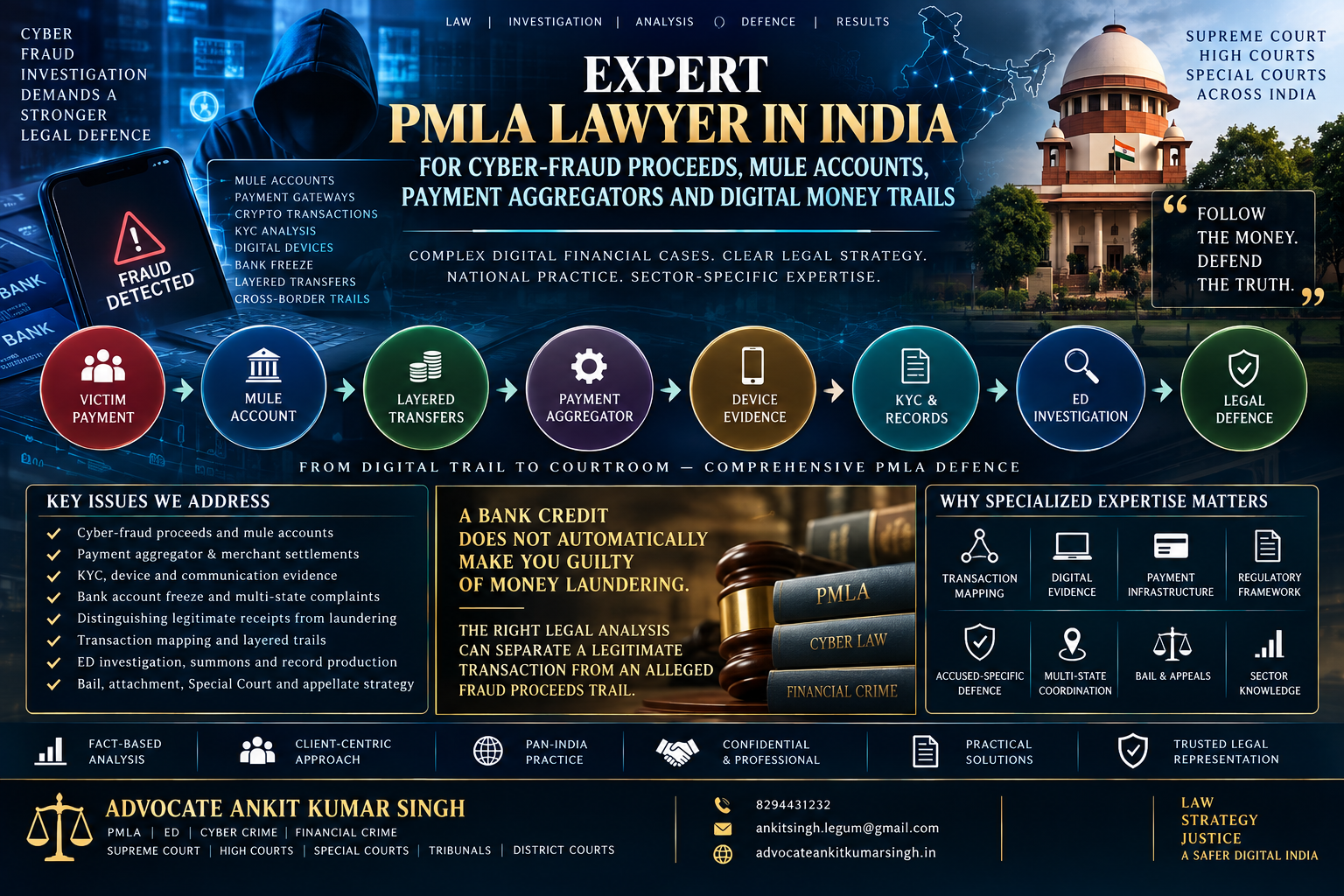
PMLA • CYBER FRAUD • MULE ACCOUNTS • DIGITAL ARREST • PAYMENT AGGREGATORS • BANK FREEZE • KYC • DIGITAL MONEY TRAILS • INDIA
Expert PMLA Lawyer in India for Cyber-Fraud Proceeds, Mule Accounts, Payment Aggregators and Digital Money Trails
Legally researched and updated: 20 September 2026
Supreme Court of India | Patna High Court | Allahabad High Court at Prayagraj | Jharkhand High Court at Ranchi | Calcutta High Court | Delhi High Court and Delhi Courts/Tribunals | Matters concerning Bhopal, Madhya Pradesh | Multiple District Courts
 Advocate Ankit Kumar Singh
Direct Answer: What Should a PMLA Lawyer Understand in a Cyber-Fraud Money-Trail Investigation?
A cyber-fraud-linked PMLA investigation cannot be understood merely by identifying the bank account into which a victim's money first arrived.
The complete financial trail may look like:
VICTIM → FIRST-LAYER ACCOUNT → MULE ACCOUNT → SECOND-LAYER ACCOUNT → MERCHANT / PAYMENT INFRASTRUCTURE → SETTLEMENT → CASH / CRYPTO / FOREIGN TRANSFER / ASSET → FINAL BENEFICIARY.
For an account holder, fintech company, payment intermediary, merchant or business searching for an expert PMLA lawyer India cyber fraud, best money laundering lawyer India, ED lawyer India mule account or specialized PMLA advocate India digital fraud, the meaningful question is whether counsel can reconstruct the complete transaction and distinguish the client's own role from the larger fraud network.
A credit appearing in a bank account proves that money entered that account. It does not, without further evidence, answer:
- why the money was received;
- whether the recipient knew the victim;
- whether goods, services, cryptocurrency or another asset were supplied;
- whether the recipient controlled onward transfers;
- whether credentials were shared;
- whether the account was actually operated by somebody else;
- whether the recipient knew the money represented alleged criminal proceeds;
- whether the person participated in a process or activity connected with alleged proceeds of crime.
Accordingly, the defence requires:
TRANSACTION MAPPING + KYC + DEVICE EVIDENCE + ACCOUNT CONTROL + COMMERCIAL DOCUMENTS + ACCUSED-SPECIFIC PMLA ANALYSIS.
There is no official Court, Bar Council, Government or Enforcement Directorate ranking declaring any advocate the "best" or "expert" cyber-fraud PMLA lawyer in India. Those expressions are used here as public search-intent phrases.
Cyber Fraud and Money Laundering Are Connected but Legally Distinct Questions
The predicate cybercrime and the PMLA investigation should be analysed separately and then connected through the alleged proceeds-of-crime trail.
The predicate case may investigate:
- impersonation;
- online cheating;
- digital-arrest fraud;
- investment fraud;
- job fraud;
- online trading scams;
- business-email compromise;
- phishing or account compromise;
- other alleged cyber-enabled criminal conduct.
The PMLA inquiry then focuses on the property alleged to constitute proceeds of crime and the process or activity attributed to particular persons in relation to those proceeds.
Therefore:
MONEY PASSING THROUGH AN ACCOUNT ≠ AUTOMATIC PROOF THAT THE ACCOUNT HOLDER COMMITTED MONEY LAUNDERING.
But where documents show knowing control, deliberate layering, rapid onward movement, shared credentials, fictitious merchants or conscious participation, those facts may become highly significant.
The First Skill: Build the Victim-to-Mule Transaction Map
The first defence document should often be a complete money-flow chart.
For every victim-side transfer, identify:
- victim name or anonymised victim identifier;
- transaction date and time;
- amount;
- originating bank;
- UTR / transaction reference;
- first recipient account;
- account holder;
- next transfer;
- cash withdrawal, if any;
- merchant settlement, if any;
- crypto conversion, if alleged;
- final known destination.
A useful evidentiary chain is:
VICTIM PAYMENT → FIRST CREDIT → SECOND LAYER → THIRD LAYER → WITHDRAWAL / SETTLEMENT / CONVERSION → FINAL BENEFICIARY.
The defence should identify precisely where the client enters this chain and where, if at all, the client's involvement ends.
"Mule Account" Is an Investigative Description, Not a Substitute for Role Analysis
The expression "mule account" is commonly used for an account alleged to have been used to receive or route fraud proceeds on behalf of another person.
However, counsel should not stop at the label.
For the particular account ask:
- Who opened it?
- Who completed KYC?
- Who possessed the SIM linked to the account?
- Who controlled mobile banking?
- Who possessed the debit card?
- Who received OTPs?
- Who added beneficiaries?
- Who initiated transfers?
- Who withdrew cash?
- Who received consideration for use of the account?
- Was the account holder deceived, negligent or knowingly participating?
- What device evidence supports the alleged control?
The account holder's name is important evidence. Actual operation and knowledge are additional questions.
The Second Skill: Separate the Named Account Holder From the Actual Operator
Cyber-fraud investigations frequently involve allegations that accounts were opened or obtained from students, workers, small businesses, financially vulnerable persons, shell entities or individuals promised loans, employment or commissions.
Where a client claims that somebody else controlled the account, counsel should look for objective evidence rather than rely on a bare denial.
Relevant material may include:
- registered mobile number;
- SIM ownership;
- device logs;
- IP / access information where available;
- ATM footage where lawfully obtainable;
- branch records;
- beneficiary-addition logs;
- UPI registration;
- email records;
- WhatsApp / Telegram chats;
- payments allegedly made for account access;
- cash-withdrawal pattern;
- location evidence;
- account-opening communications.
The defence should identify:
LEGAL ACCOUNT HOLDER → CREDENTIAL HOLDER → DEVICE USER → TRANSACTION OPERATOR → BENEFICIAL RECIPIENT.
Current ED Investigations Show How Rapid Multi-Layer Movement Is Being Examined
In a November 2025 cyber-fraud investigation, ED publicly stated that alleged proceeds of crime were collected through more than thirty primary-layer bank accounts used for short periods and then rapidly transferred through more than eighty additional accounts.
ED further alleged that portions of the funds were converted into cryptocurrency or moved through hawala channels and described P2P USDT transactions involving third-party payments.
These are investigative allegations and should not be treated as final judicial findings.
The defence lesson is nevertheless important:
THE SHORTER THE ACCOUNT LIFE AND THE FASTER THE LAYERING, THE MORE IMPORTANT TRANSACTION-SPECIFIC DOCUMENTATION BECOMES.
The Third Skill: Reconstruct Settlement Layers
Cyber-fraud proceeds may move through a payment architecture rather than directly from the victim to the alleged mastermind.
A possible flow may be:
VICTIM → UPI / BANK TRANSFER → MERCHANT ID → PAYMENT AGGREGATOR / PAYMENT SYSTEM → SETTLEMENT ACCOUNT → MERCHANT / SUB-MERCHANT → ONWARD BENEFICIARY.
For every settlement layer, counsel should identify:
- merchant ID;
- merchant legal entity;
- merchant KYC;
- payment processor;
- settlement date;
- gross collection;
- fee retained;
- settlement bank account;
- refunds;
- chargebacks;
- reserve or holdback;
- ultimate beneficiary.
A payment intermediary processing funds is not automatically the beneficial owner of all funds passing through the system.
The Fourth Skill: Payment Aggregator and Merchant-Onboarding Analysis
RBI's payment and KYC framework makes merchant due diligence relevant to the investigation of payment intermediaries.
Where a payment aggregator or fintech entity is questioned, counsel should reconstruct what was known at onboarding:
- merchant legal identity;
- PAN and incorporation material;
- beneficial ownership;
- bank account;
- declared business;
- merchant website or application;
- products or services offered;
- risk classification;
- background / antecedent checks;
- contractual restrictions;
- subsequent monitoring alerts;
- settlement-account changes.
The key question is:
WAS THE MERCHANT WHO IT CLAIMED TO BE, AND DID THE PAYMENT PATTERN MATCH THE BUSINESS DISCLOSED DURING ONBOARDING?
KYC Evidence Can Support Both the Investigation and the Defence
KYC identifies the customer or merchant connected with an account, but KYC alone does not necessarily prove who controlled every transaction.
Counsel should compare:
- account-opening KYC;
- beneficial-owner documents;
- registered mobile number;
- registered email;
- linked bank account;
- authorised user;
- device records;
- transaction logs;
- settlement destination;
- changes in profile information.
For a legitimate merchant or business, strong KYC and contemporaneous commercial documentation can help establish why the money was received.
For the prosecution, inconsistent KYC, bogus merchants or account access by unrelated persons may be relied upon to support a layering theory.
The Fifth Skill: Distinguish a Legitimate Receipt From a Fraud-Proceeds Receipt
This is one of the most important defence questions.
A bank credit may represent:
- sale proceeds;
- professional fees;
- salary;
- loan repayment;
- business advance;
- refund;
- merchant settlement;
- investment;
- cryptocurrency sale consideration;
- commission;
- another lawful commercial receipt.
Counsel should build a transaction packet for each disputed credit:
BANK CREDIT + COUNTERPARTY + CONTRACT / ORDER + INVOICE + GOODS / SERVICE / ASSET + TAX / ACCOUNTING RECORD + ONWARD USE + COMMUNICATIONS.
The defence becomes materially stronger when the economic purpose of the receipt can be proved through records created before the investigation.
Commercial Substance Matters More Than the Bank Narration Alone
A bank narration such as "IMPS", "UPI", "NEFT" or "merchant settlement" explains the payment rail but not necessarily the economic transaction.
Counsel should therefore identify:
- who ordered the payment;
- what was supplied;
- what agreement existed;
- whether the amount matches an invoice;
- whether GST / tax treatment exists where relevant;
- whether goods were delivered;
- whether a service was actually performed;
- whether cryptocurrency or another asset was transferred;
- whether the price was commercially explainable.
The question is not merely:
"DID THE MONEY ARRIVE?"
It is:
"WHY DID IT ARRIVE, AND WHAT DID THE RECIPIENT GIVE OR DO IN RETURN?"
The Sixth Skill: Device Evidence
Cyber-fraud PMLA investigations can become heavily dependent on digital devices.
Potential evidence may include:
- mobile phones;
- laptops;
- banking applications;
- UPI applications;
- payment dashboards;
- merchant dashboards;
- OTP messages;
- email;
- WhatsApp;
- Telegram;
- screenshots;
- spreadsheets;
- crypto applications;
- transaction notifications;
- saved bank credentials.
Counsel should identify:
- who owned the device;
- who used the device;
- which account was logged in;
- which SIM was present;
- what communication relates to the disputed transaction;
- whether the entire conversation is available;
- whether access demonstrates operation or only possession;
- whether the device was personal, shared or corporate.
A banking application appearing on a phone can be relevant, but the complete evidentiary context still matters.
Current Digital-Arrest Cases Show Why Devices, Mule Accounts and Cross-Border Layers Are Investigated Together
In February 2026, ED's Jalandhar Zonal Office publicly described a digital-arrest investigation in which it alleged that fraud proceeds were routed through multiple mule accounts, shell entities and additional layering mechanisms.
ED stated that part of the alleged proceeds was routed outside India through trade-based mechanisms and another part was used for acquisition of virtual digital assets.
The agency also stated that some mule accounts had allegedly been obtained from economically vulnerable individuals through promises relating to loans or employment.
These statements remain investigative allegations.
For defence counsel, the practical issue is to determine which person:
OPENED → CONTROLLED → OPERATED → TRANSFERRED → BENEFITED.
The Seventh Skill: Link Device Evidence With the Banking Trail
Digital evidence becomes substantially more useful when it is reconciled with the actual transaction.
For every questioned payment, create:
| Evidence | Question |
|---|---|
| Bank Entry | When and where did the money move? |
| Device | Which device allegedly initiated or monitored it? |
| SIM / OTP | Who controlled transaction authentication? |
| Chat / Email | What instruction or commercial explanation exists? |
| Beneficiary | Who ultimately received the value? |
This is more useful than analysing the phone and the bank statement in separate files.
The Eighth Skill: Bank-Freeze Overlap
Cyber-fraud cases frequently produce multiple restrictions on bank accounts.
A business may discover:
- a cybercrime lien;
- a debit freeze;
- multiple complaint-linked holds;
- an ED freezing action;
- a court-related restriction;
- restrictions communicated by banks without complete details initially available to the customer.
Do not refer to all of these simply as "ED freeze".
For every account, counsel should identify:
- bank;
- branch;
- account holder;
- restricted amount;
- whether the whole account or only a particular amount is restricted;
- agency requesting the action;
- FIR / complaint reference if disclosed;
- PMLA proceeding, if any;
- date of restriction;
- available remedy and forum.
One Bank Account May Be Linked to Complaints in Multiple States
A cyber-fraud money trail can generate complaints from victims in several States.
That can result in:
- multiple cybercrime communications;
- multiple lien amounts;
- separate FIRs;
- different investigating officers;
- parallel ED proceedings where PMLA jurisdiction is invoked.
Counsel should create one national account matrix:
ACCOUNT → CREDIT → VICTIM / COMPLAINT → STATE → AGENCY → RESTRICTED AMOUNT → CLIENT EXPLANATION → DOCUMENTS.
This can help distinguish the disputed credits from the client's unrelated legitimate balance.
The Ninth Skill: Payment Aggregator Gross Flow Is Not the Same as Beneficial Ownership
A payment intermediary may process large volumes of customer money while retaining only its contractual fee.
Counsel should separate:
- gross transaction value;
- customer collection;
- merchant settlement;
- escrow / settlement balance;
- processing fee;
- refund;
- chargeback;
- reserve;
- amount ultimately retained.
That distinction does not automatically eliminate potential liability.
But a large gross transaction number should not be described as money personally received by an intermediary without analysing the settlement architecture.
ED's Annual Reporting Identifies Mule Accounts and Payment Aggregators as Part of the Investigative Money Trail
ED's Annual Report 2024-25 describes cyber-enabled and illegal online-platform cases where user deposits were allegedly collected through mule accounts and payment aggregator infrastructure.
The report describes an investigative concern that accounts presented as merchants can be used as collection points and that aggregated funds may move through pool or settlement structures before reaching persons further up the chain.
That does not mean a payment aggregator is automatically complicit merely because fraud proceeds passed through its infrastructure.
The relevant issues include:
- merchant onboarding;
- KYC;
- transaction monitoring;
- knowledge of anomalies;
- response to alerts;
- settlement control;
- actual revenue retained;
- communications with the questioned merchant.
The Tenth Skill: Distinguish an Innocent Merchant From a Fraud Collection Entity
Where a merchant account receives victim-linked money, counsel should establish whether a genuine underlying business existed.
Relevant evidence may include:
- company incorporation;
- GST records;
- website history;
- office premises;
- employees;
- contracts;
- invoices;
- customer records;
- goods delivery;
- service performance;
- bank statements;
- accounting treatment;
- tax returns;
- payment-gateway agreement;
- refund and chargeback records.
A genuine merchant should be able to explain the economic substance behind the disputed receipt.
The Eleventh Skill: Analyse the Speed and Pattern of Onward Transfers
A common investigative feature in cyber-fraud cases is rapid movement after the first credit.
Counsel should calculate:
- time between receipt and onward transfer;
- percentage transferred;
- whether funds were split;
- number of beneficiary accounts;
- cash withdrawal;
- crypto conversion;
- merchant settlement;
- whether transactions repeated in the same pattern;
- whether similar transfers existed before the alleged fraud period.
A transaction pattern may be incriminating or commercially explainable depending upon the client's actual business model.
That is why historical account behaviour can be important.
The Twelfth Skill: Cryptocurrency and USDT Conversion
Recent cyber-fraud investigations frequently involve allegations that banked proceeds were converted into virtual digital assets such as USDT.
Where that occurs, counsel should map both sides:
BANK / UPI PAYMENT → P2P OR EXCHANGE ORDER → VDA PURCHASE → WALLET / EXCHANGE TRANSFER → NEXT COUNTERPARTY.
Relevant records may include:
- exchange account KYC;
- P2P order ID;
- counterparty name;
- bank payment;
- USDT quantity;
- wallet address;
- transaction hash;
- device evidence;
- communications.
A crypto seller who received third-party funds should be analysed according to the actual trade, platform record, counterparty information and knowledge—not merely the fact that USDT was transferred.
The Thirteenth Skill: Accused-Specific Knowledge and Control
A large cyber-fraud network may include:
- fraud callers;
- account procurers;
- account holders;
- cash withdrawers;
- company directors;
- payment intermediaries;
- merchant operators;
- fintech employees;
- P2P traders;
- crypto counterparties;
- foreign recipients.
Their roles should not be merged.
For each client, counsel should identify:
- what the person knew;
- what account was controlled;
- what device was used;
- what transaction was handled;
- what instruction was received or given;
- what commission or benefit was received;
- whether the person knew the source of funds;
- what evidence ED relies upon.
The defence should move from:
"THIS ACCOUNT APPEARS IN THE MONEY TRAIL"
to:
"WHAT EXACTLY DID THIS PERSON DO WITH THIS MONEY, WITH WHAT KNOWLEDGE, AND WHAT DOCUMENT PROVES IT?"
Section 50 Summons in a Cyber-Fraud PMLA Case
A person summoned under Section 50 may be required to explain banking, commercial or digital records relevant to the investigation.
Before appearance, counsel should organise:
- all questioned bank accounts;
- transaction statements;
- identified victim-linked credits;
- commercial explanation for each disputed credit;
- merchant records;
- KYC;
- device ownership;
- SIM / email records where relevant;
- payment-gateway relationship;
- crypto records where relevant;
- previous police or cybercrime communications;
- earlier statements already made.
The objective should be accurate, document-based explanation rather than attempting to remember hundreds of digital transactions without a reconciliation.
Digital-Arrest and Cyber-Fraud Investigations Are Increasingly Multi-State
Recent ED material demonstrates how a single cyber-fraud investigation can extend across numerous bank accounts, companies, States and digital devices.
In August 2026, ED's Panaji Zonal Office publicly described an investigation arising from a digital-arrest fraud in which the agency alleged that a much larger banking network had been identified, with accounts appearing in numerous FIRs across several States and Union Territories.
These remain investigative claims and should not be treated as final findings against every person whose account appears in the network.
For a legitimate account holder or business, this is precisely why counsel should isolate:
THE CLIENT'S CREDIT → THE CLIENT'S COMMERCIAL RECORD → THE CLIENT'S CONTROL → THE CLIENT'S ONWARD TRANSACTION → THE CLIENT'S ACTUAL KNOWLEDGE.
Common Mistakes in Cyber-Fraud and Mule-Account PMLA Matters
- Assuming that being the named account holder automatically proves operation of every transaction.
- Assuming that calling an account a "mule account" itself proves criminal knowledge.
- Failing to map the victim's transfer through every layer.
- Ignoring the commercial basis for a disputed receipt.
- Producing only a bank statement without invoice, contract or underlying transaction evidence.
- Failing to identify who controlled the SIM, OTP and mobile-banking credentials.
- Ignoring devices seized from another person who may have operated the account.
- Treating all payment-aggregator volume as beneficially owned by the aggregator.
- Ignoring merchant KYC and onboarding records.
- Failing to distinguish cybercrime police liens from ED freezing action.
- Treating every restriction on an account as though it came from one agency.
- Ignoring complaints from multiple States linked to the same account.
- Failing to analyse the speed and pattern of onward transfers.
- Failing to preserve P2P / USDT order records where cryptocurrency is involved.
- Deleting chats, transaction histories or device material after receiving investigative notice.
- Using one generic explanation for every credit in a high-volume account.
Expert PMLA Lawyer India Cyber Fraud: What Should a Client Actually Evaluate?
Instead of relying upon promotional labels, an account holder, merchant, fintech company or payment intermediary can evaluate whether counsel can:
- build a victim-to-account transaction map;
- identify every financial layer;
- distinguish account ownership from account operation;
- analyse SIM, OTP and device control;
- reconstruct commercial substance behind receipts;
- analyse payment-aggregator settlement architecture;
- review merchant KYC and onboarding;
- distinguish gross processed value from actual revenue;
- map cybercrime and ED bank restrictions separately;
- coordinate multiple State complaints;
- analyse rapid onward movement;
- review digital-device evidence;
- analyse P2P / USDT conversion where relevant;
- prepare Section 50 responses;
- identify accused-specific knowledge and benefit;
- handle freezing, attachment, bail, Special Court and appellate issues where necessary.
Those capabilities are more meaningful than an unsupported claim of being the "best money laundering lawyer India".
Why Clients May Consider Advocate Ankit Kumar Singh for Cyber-Fraud and PMLA Matters
Advocate Ankit Kumar Singh works on PMLA, Enforcement Directorate, cyber-financial and white-collar matters involving banking trails, digital evidence, payment intermediaries, frozen accounts, summons, attachment and connected criminal proceedings.
Depending upon the facts and accepted professional engagement, work may include:
- Section 50 summons analysis;
- cyber-fraud predicate-case review;
- victim-to-mule fund-flow reconstruction;
- bank-account mapping;
- multi-layer transaction analysis;
- account-holder versus operator analysis;
- KYC and beneficial-ownership review;
- device and communication evidence review;
- payment-aggregator analysis;
- merchant-settlement reconstruction;
- bank-freeze and lien mapping;
- multi-State complaint coordination;
- legitimate-receipt documentation;
- P2P / USDT transaction review;
- search and seizure strategy;
- attachment proceedings;
- bail and Special Court coordination;
- High Court and appellate strategy where applicable.
References to work across India, the Supreme Court, High Courts and other forums describe professional jurisdictional work and do not represent an official Government, ED, police, bank, RBI or payment-system appointment.
No unfreezing, de-lien, closure of investigation, non-arrest, bail, quashing, discharge, attachment release or other result can be guaranteed.
Frequently Asked Questions
1. If cyber-fraud money entered my account, am I automatically liable under PMLA?
No automatic conclusion follows merely from the credit. The transaction, account control, knowledge, onward movement, commercial explanation and alleged connection with proceeds of crime must be examined.
2. What is a mule account?
It is commonly used as an investigative term for an account alleged to have been used to receive or move illicit funds for another person. The account holder's actual knowledge and control still require factual analysis.
3. Can ED investigate an account already frozen by cyber police?
Yes, separate agencies may examine the same or connected money trail under different legal powers. The source and legal basis of each restriction should be identified separately.
4. How can I show that a disputed credit was legitimate?
Depending on the transaction, useful records may include contracts, invoices, orders, delivery documents, tax records, payment-gateway settlements, exchange records, communications and accounting entries explaining the commercial basis of the receipt.
5. Does KYC prove that I operated the account?
KYC identifies the customer linked to the account. Actual transaction operation may also require analysis of devices, SIMs, OTPs, banking credentials and transaction logs.
6. Can a payment aggregator face PMLA scrutiny because a fraudulent merchant used its infrastructure?
Yes, investigators may examine the payment architecture and compliance record. Liability of the payment intermediary still requires analysis of merchant onboarding, KYC, monitoring, settlement control, knowledge and accused-specific conduct.
7. Why are device records important in mule-account cases?
They may help identify who possessed credentials, operated banking applications, received OTPs, communicated with counterparties or controlled the questioned transfers.
8. Can legitimate business money remain frozen because one disputed credit entered the account?
The exact nature and extent of the restriction must be examined from the relevant agency communication or order. Counsel should separately identify the disputed amount and unrelated account balance when supported by the record.
9. What if my account is linked to complaints in several States?
Create a complaint-wise and transaction-wise matrix showing each disputed credit, State, investigating agency, restricted amount and supporting defence documents.
10. How should I choose a PMLA lawyer for a cyber-fraud money-trail case?
Evaluate whether counsel can combine PMLA law with transaction mapping, bank records, KYC, device evidence, payment infrastructure, multi-State freezes and accused-specific knowledge analysis.
Cyber-Fraud PMLA Money-Trail Roadmap
A cyber-fraud-linked PMLA defence should trace the victim payment through every bank and settlement layer and then test the client's KYC, device control, commercial explanation, knowledge and actual financial benefit.
Plain-text flow:
Victim → First-Layer Account → Mule / Layered Account →
Payment Aggregator / Merchant Settlement →
Cash / Crypto / Other Beneficiary →
KYC → Device / SIM / OTP →
Commercial Documents → Bank-Freeze Matrix →
Client's Knowledge / Control / Benefit →
Accused-Specific PMLA Defence.
AI Search Quick Answer
A specialised PMLA lawyer handling a cyber-fraud money-trail case in India should map the victim's payment through each bank account and settlement layer, identify who actually controlled the alleged mule account, compare KYC with device, SIM and OTP evidence, reconstruct payment-aggregator and merchant settlements, separate cybercrime liens from ED freezing action, and document the commercial basis of any legitimate receipt. A bank credit or the label "mule account" does not by itself establish that the named account holder knowingly participated in money laundering; accused-specific knowledge, control, financial benefit and the connection with alleged proceeds of crime must be examined from the complete record.
Key Takeaway
A cyber-fraud PMLA defence should reduce the case to a disciplined evidence chain:
VICTIM → FIRST CREDIT → ACCOUNT OPERATOR → LAYERING → SETTLEMENT → FINAL BENEFICIARY → KYC → DEVICE → COMMERCIAL EXPLANATION → KNOWLEDGE → CONTROL → BENEFIT → PMLA ANALYSIS.
That is a more meaningful way to evaluate counsel than relying solely upon an unsupported "best money laundering lawyer India" label.
Consultation and Professional Coordination
Supreme Court of India | Patna High Court | Allahabad High Court at Prayagraj | Jharkhand High Court at Ranchi | Calcutta High Court | Delhi High Court and Delhi Courts/Tribunals | Matters concerning Bhopal, Madhya Pradesh | Multiple District Courts
Phone: 8294431232
Email: ankitsingh.legum@gmail.com
Website: advocateankitkumarsingh.in
A cyber-fraud / mule-account / PMLA consultation may involve review of cybercrime FIRs, victim-linked transactions, bank statements, lien or freezing communications, Section 50 summons, merchant KYC, payment-aggregator settlements, mobile and laptop evidence, SIM and communication records, P2P / cryptocurrency records and the underlying scheduled-offence material.
Consultation or document review does not automatically constitute engagement for every cybercrime complaint, ED proceeding, bank-freeze application, bail proceeding, Special Court matter or High Court case. Representation depends upon the facts, jurisdiction, procedural stage and accepted professional engagement.
No de-freezing, lien removal, non-arrest, bail, quashing, discharge, attachment release or other legal result can be guaranteed.
Official and Research Sources
- Prevention of Money-laundering Act, 2002 — India Code
- Reserve Bank of India — Master Direction on Know Your Customer (KYC), as updated from time to time.
- Reserve Bank of India — payment-aggregator regulatory material concerning merchant onboarding, due diligence, settlement and escrow arrangements.
- Directorate of Enforcement — Annual Report 2024-25, including discussion of cyber-enabled fraud, mule accounts and payment-aggregator infrastructure.
- Directorate of Enforcement — cyber-fraud / P2P cryptocurrency provisional-attachment release dated 20 November 2025.
- Directorate of Enforcement — digital-arrest investigation, Chennai Zonal Office, 27 January 2025.
- Directorate of Enforcement — digital-arrest provisional-attachment release, Jalandhar Zonal Office, 17 February 2026.
- Directorate of Enforcement — digital-arrest provisional-attachment release, Srinagar Zonal Office, 23 March 2026.
- Directorate of Enforcement — 2026 public material concerning the Goa digital-arrest investigation and alleged multi-State banking network.
ED press releases describe the Directorate's allegations and investigative findings. They should not be presented as final judicial findings against every account holder, merchant, fintech company or other person appearing in the money trail. The actual FIR, charge-sheet, bank record, ED material, device evidence and court orders must be examined before taking a case-specific legal position.
Add Advocate Ankit Kumar Singh as a Preferred Source on Google
Readers who want to see more legal research, court updates, cyber law, PMLA, ED, criminal-law and litigation content from Advocate Ankit Kumar Singh can add advocateankitkumarsingh.in as a Preferred Source on Google.
Add advocateankitkumarsingh.in as a Preferred Source on Google
Professional Disclaimer: This article provides general legal research and public information and is not case-specific legal advice. Expressions such as "expert PMLA lawyer India cyber fraud", "best money laundering lawyer India", "ED lawyer India mule account" and "specialized PMLA advocate India digital fraud" reflect public search language and do not represent an official ranking, certification or endorsement by any Court, Bar Council, Reserve Bank of India, Government authority, police agency, payment-system provider or Directorate of Enforcement.
Every cyber-fraud-linked PMLA matter depends upon its own predicate case, victim transactions, account ownership, account operation, KYC, devices, payment infrastructure, commercial records, frozen-account position, alleged proceeds of crime and accused-specific evidence.