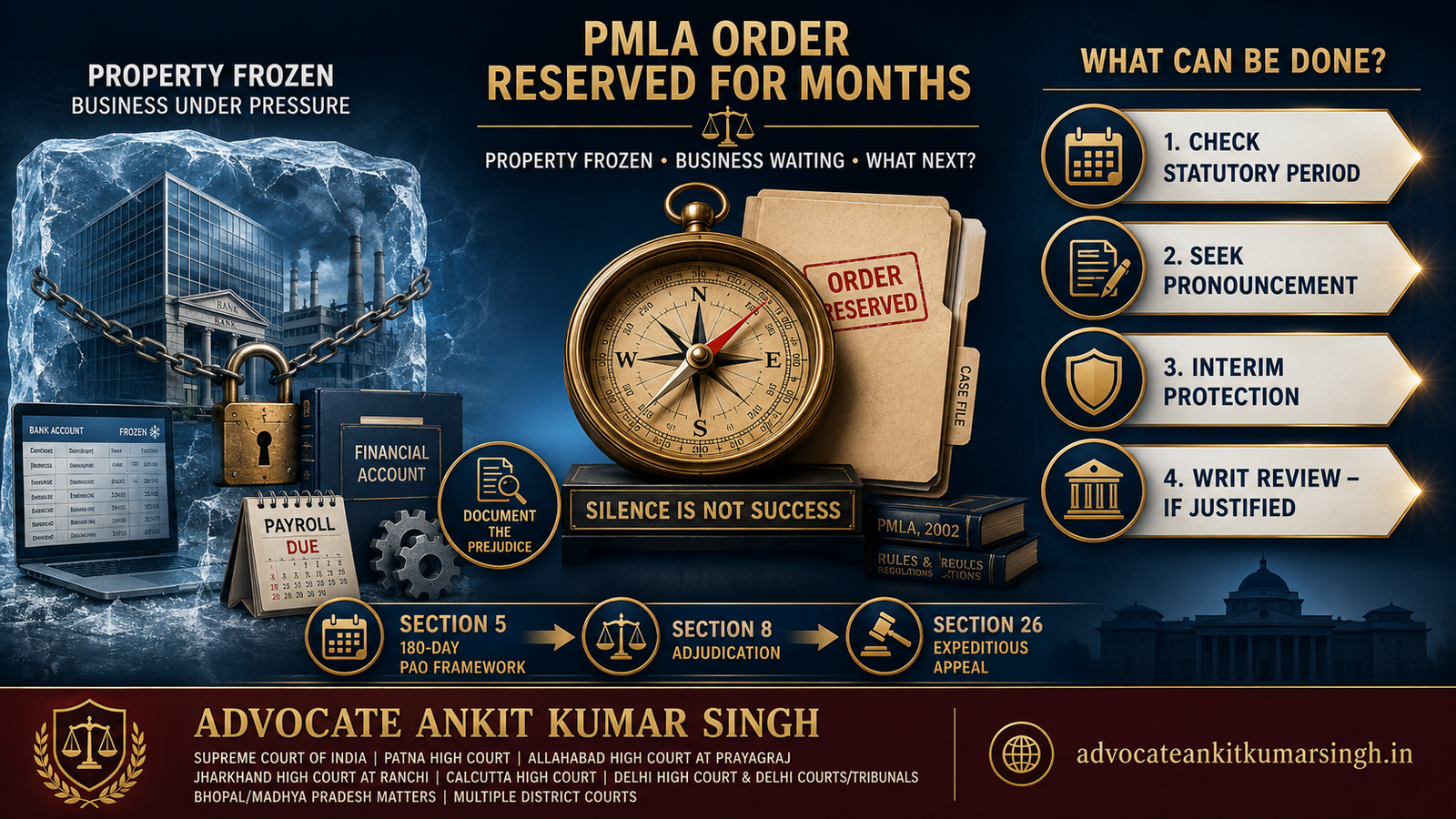
PMLA • RESERVED ORDERS • ADJUDICATING AUTHORITY • APPELLATE TRIBUNAL • FROZEN PROPERTY • BUSINESS CONTINUITY
PMLA Order Reserved for Months: What Can Be Done When the Adjudicating Authority or Tribunal Delays While Property or Business Remains Frozen?
Updated and legally reviewed: 27 August 2026
Legal research and analysis by Advocate Ankit Kumar Singh
Direct Answer
No—an order remaining reserved for several months does not automatically mean that the affected party has won, nor does it automatically release every attached property, frozen bank account or restrained business asset.
But prolonged post-hearing delay can become legally significant, particularly where a statutory restraint continues to operate and causes measurable proprietary or commercial prejudice.
The correct first question is not merely:
“How long has the order been reserved?”
The correct question is:
“What exact statutory restraint is presently keeping the property or business frozen, and how long can that restraint lawfully continue?”
That distinction is crucial because the Prevention of Money-Laundering Act, 2002 contains different procedural regimes for provisional attachment, confirmation, freezing, retention, possession and appellate proceedings.
The Psychological Trap: Silence Is Not Success
A long-reserved order creates uncertainty. That uncertainty often produces two opposite mistakes.
Some parties become pessimistic:
- “The order has not come, therefore ED must be winning.”
- “Nothing can be done until the Tribunal decides.”
- “The business will simply have to remain frozen indefinitely.”
Others become overconfident:
- “If the Tribunal wanted to dismiss the appeal, it would have done so already.”
- “The long delay probably means the order will be favourable.”
- “Since months have passed, the attachment must have disappeared.”
Neither inference is legally safe.
A judicial or quasi-judicial forum may reserve an order for many reasons. Delay itself does not reveal the eventual outcome.
The disciplined approach is to analyse:
- the statutory source of the restraint;
- the applicable timeline;
- the current order sheet;
- the existence of any interim order;
- and the demonstrable prejudice caused by continued uncertainty.
First Identify What Is Actually Frozen or Attached
| Current restraint | Relevant PMLA framework | Primary timing question |
|---|---|---|
| Provisional attachment | Section 5 | Has the statutory 180-day period expired after permissible exclusions? |
| Section 8 adjudication pending | Section 8 | Was the provisional attachment confirmed before it ceased to have effect? |
| Confirmed attachment | Section 8(3) | Has an appellate or interim order modified the confirmation? |
| Possession threatened or taken | Section 8(4) and applicable Rules | Is immediate interim appellate protection necessary? |
| Bank account / property frozen during search | Sections 17, 20 and 21, depending upon facts | What continuation or retention order exists and what statutory timeline applies? |
| Appeal heard and reserved | Section 26 | How long since filing and reservation, and does any interim protection operate? |
The phrase “my property is frozen” describes a practical problem. It does not identify the statutory legal mechanism.
That mechanism must be identified before any delay remedy is selected.
Section 5 PMLA: Provisional Attachment Cannot Simply Continue Forever
Section 5 creates the provisional attachment mechanism.
The statutory framework provides that a provisional attachment order operates for a period not exceeding 180 days from the date of the order, subject to the computation provisions contained in the Act.
Where proceedings relating to Section 5 are stayed by the High Court, the statutory exclusion must be correctly applied before calculating expiry.
A proper Section 5 chronology should therefore contain:
- Date of the Provisional Attachment Order.
- Date the Section 5(5) complaint was filed.
- Date of Section 8 notice.
- Date of reply.
- Dates of hearing.
- Date final arguments concluded.
- Date orders were reserved.
- Any qualifying High Court stay period.
- Date the stay ceased, if applicable.
- Computed statutory expiry date.
- Date of any Section 8(3) confirmation order.
These dates matter far more than a general statement that “the matter has been pending for months”.
What If the 180 Days Expire While the Adjudicating Authority Has Reserved Orders?
This issue is fundamentally different from merely complaining that the Authority is taking too long to write its decision.
Where the statutory life of a Section 5 provisional attachment itself expires before an operative Section 8(3) confirmation, a substantive legal issue may arise regarding continuation of the PAO.
The Bombay High Court in Naresh T. Jain & Ors. v. Union of India & Ors., decided on 24 November 2025, treated the fixed statutory life of provisional attachment as an important legislative safeguard.
The important distinction is:
EXPIRY OF THE PROVISIONAL ATTACHMENT IS NOT NECESSARILY THE SAME AS TERMINATION OF THE SECTION 8 ADJUDICATION.
That distinction is also consistent with the Supreme Court's approach in Kaushalya Infrastructure Development Corporation Ltd. v. Union of India.
Accordingly, the party should separately analyse:
- whether the PAO itself continues;
- whether Section 8 proceedings continue;
- and whether a bank, authority or third party still requires a formal judicial or administrative clarification before operationally releasing the asset.
Does Section 8 Prescribe a Fixed Deadline for Pronouncing the Final Order?
Section 8 does not prescribe one universal express number of days within which every final order must be pronounced after arguments are reserved.
Section 8 requires the Adjudicating Authority to:
- issue the statutory notice;
- consider the reply;
- hear the affected person;
- hear the authorised officer;
- consider relevant material;
- and record its finding concerning whether the property is involved in money-laundering.
The Adjudicating Authority (Procedure) Regulations, 2013 additionally govern the manner of pronouncement.
The procedural framework contemplates a reasoned order being pronounced in open court on the date fixed for pronouncement.
Therefore the legally careful position is:
Section 8 does not itself create a universal “X days after reservation” rule, but an adjudicatory process affecting property cannot reasonably be treated as capable of remaining undecided indefinitely without regard to continuing prejudice.
Section 26(6): The Tribunal Has an Express Expeditious-Disposal Mandate
The appellate stage contains clearer statutory language.
Section 26(6) provides that an appeal before the PMLA Appellate Tribunal shall be dealt with as expeditiously as possible.
It further states that an endeavour shall be made to dispose of the appeal finally within six months from the date of filing.
The words used by Parliament matter.
Section 26(6) does not say:
“If six months expire, the appeal shall stand allowed.”
Nor does it create a deemed stay or deemed release.
The proper proposition is:
THE SIX-MONTH PERIOD IS AN EXPRESS STATUTORY EXPEDITIOUS-DISPOSAL OBJECTIVE, NOT AN AUTOMATIC DEEMED-ALLOWANCE RULE.
However, where:
- six months have already elapsed;
- final arguments are complete;
- the appeal has remained reserved for an additional substantial period;
- and continuing attachment causes serious prejudice;
Section 26(6) becomes an important statutory component of an early-pronouncement request.
Can the Appellate Tribunal Reserve an Order?
Yes.
Reservation after completion of arguments is not, by itself, procedurally improper.
The problem arises from excessive post-hearing delay, especially where the delayed decision continues to affect:
- valuable immovable property;
- residential possession;
- operational bank accounts;
- factory assets;
- working capital;
- commercial contracts;
- third-party interests;
- or the survival of an operating enterprise.
The fact that reservation itself is permissible does not mean that unlimited decisional delay must necessarily be accepted without procedural recourse.
Pila Pahan 2026: Supreme Court on Delayed Pronouncement
A major current development is the Supreme Court judgment in Pila Pahan @ Peela Pahan v. State of Jharkhand, 2026 INSC 604, decided on 29 May 2026.
The Supreme Court dealt directly with the institutional problem of judgments being reserved by High Courts and remaining unpronounced for prolonged periods.
The Court issued comprehensive directions concerning timely pronouncement.
Among the directions, the Supreme Court provided a framework under which:
- High Courts should endeavour to pronounce reserved judgments promptly and ordinarily within the maximum period specified by the Supreme Court;
- after the prescribed period, a party may seek early pronouncement;
- continued non-pronouncement may justify approaching the Chief Justice under the mechanism created by the judgment;
- and matters concerning personal liberty require particular promptitude.
The judgment reinforces a fundamental proposition:
JUSTICE DOES NOT END WHEN ARGUMENTS END. THE DECISION MUST ALSO BE DELIVERED WITHIN A REASONABLE INSTITUTIONAL TIME.
Does the Pila Pahan Three-Month Framework Automatically Apply to the PMLA Tribunal?
No automatic transplantation should be claimed.
The directions in Pila Pahan expressly concern High Courts.
The PMLA Adjudicating Authority and Appellate Tribunal operate through their own statutory and procedural architecture.
Therefore a PMLA application should not inaccurately state:
“The Supreme Court has ordered every PMLA Tribunal to pronounce judgment within three months.”
That is not the correct proposition.
The better argument is:
- the Supreme Court has recognised the serious prejudice caused by prolonged post-hearing delay;
- Section 26(6) independently requires expeditious PMLA appellate disposal;
- the litigant has completed arguments;
- coercive proprietary consequences continue;
- and a reasonable-time adjudication principle therefore deserves enforcement in an appropriate case.
Delay Is Different When an Operating Business Is Frozen
A reserved order concerning an ordinary monetary dispute may create uncertainty.
A reserved PMLA order involving a functioning business can destroy value every day.
Possible consequences include:
- employees going unpaid;
- EPF and ESI default;
- GST default;
- income-tax default;
- electricity disconnection;
- loan default;
- NPA classification;
- working-capital collapse;
- vendor suspension;
- customer cancellation;
- termination of leases;
- loss of licences;
- loss of inventory;
- machinery deterioration;
- project termination;
- loss of bank guarantees;
- loss of employees;
- insolvency risk;
- and destruction of enterprise value.
These consequences should be proved through records rather than described emotionally.
Create a Business-Continuity Evidence File
| Prejudice claimed | Evidence that should ordinarily be preserved |
|---|---|
| Employees cannot be paid | Payroll register, employee count, salary dates, bank balance |
| GST / statutory payment risk | Returns, challans, statutory calendar, demand notices |
| Loan default | Sanction letter, repayment schedule, overdue communication |
| Vendor disruption | Invoices, purchase orders, reminders, termination notices |
| Customer loss | Contracts, supply schedule, cancellation clause |
| Factory shutdown | Production records, electricity records, engineer report |
| Perishable inventory | Stock statement, shelf-life report, warehouse records |
| Third-party property trapped | Invoices, title records, bailment/lease documentation |
| Licence expiry | Licence terms, renewal dates, regulatory notice |
| Project default | Milestone chart, lender covenants, contract deadlines |
Specific evidence is more persuasive than generic claims.
For example:
“₹52 lakh employee payroll becomes due on 31 August 2026 and the attached operating account is the only payroll account.”
is legally more useful than:
“The company is suffering badly.”
Remedy 1: Application or Representation for Early Pronouncement
Where final arguments have already concluded, the first procedural remedy may be a focused request for pronouncement.
The application should ordinarily contain:
- case number;
- party names;
- date of filing;
- dates of final hearing;
- date orders were reserved;
- nature of attachment or freeze;
- details of any pending interim application;
- Section 26(6), where applicable;
- period elapsed since reservation;
- continuing prejudice;
- date-specific emergency;
- and a limited prayer for early pronouncement.
The application should generally avoid reopening the merits unnecessarily.
The request should be:
“Kindly pronounce the already-reserved order at the earliest appropriate date.”
It should not become a disguised second round of final arguments.
Sample Prayer for Early Pronouncement
In view of the fact that final arguments in the above matter stand concluded and orders were reserved on [DATE], and having regard to the continuing restraint over [PROPERTY / BANK ACCOUNT / BUSINESS ASSET] together with the recurring prejudice demonstrated by the accompanying documents, it is respectfully prayed that the reserved order may kindly be pronounced at the earliest convenient date, without prejudice to the rights and contentions of either side.
Where the application concerns a Section 26 appeal, an accurate reference to Section 26(6) may additionally be made.
Remedy 2: Ask for Interim Protection Pending Pronouncement
Sometimes the problem cannot wait for the final reserved decision.
Examples include:
- immediate Section 8(4) possession proceedings;
- salary payment due within days;
- statutory tax liabilities;
- factory closure;
- perishable inventory;
- loan recall;
- termination of a project;
- third-party goods trapped in attached premises;
- or an expiring licence.
Where legally maintainable, the party can examine a narrowly framed interim request pending pronouncement.
Possible relief may include:
- status quo regarding possession;
- temporary protection from dispossession;
- permission to pay verified salaries;
- permission to discharge statutory liabilities;
- permission to preserve machinery;
- release of demonstrated third-party property;
- limited use of specified operating funds;
- or another ring-fenced arrangement preserving the disputed asset.
These remedies are discretionary and depend on the exact statutory restraint and forum.
Why Limited Business Relief May Be Stronger Than Full Unfreezing
A business-continuity application may become more credible when it protects the subject matter of the PMLA proceeding.
For example:
Permit ₹32 lakh exclusively for employee salaries, GST and electricity dues, subject to production of payment records.
may be easier to justify than:
Unfreeze every account without restriction.
A structured proposal may include:
- fixed monthly ceiling;
- specified beneficiary categories;
- bank-payment-only condition;
- monthly reporting;
- prohibition on related-party transfer;
- no sale of attached capital assets;
- and preservation of equivalent value.
The objective is to demonstrate:
BUSINESS CONTINUITY WITHOUT FRUSTRATING THE ATTACHMENT.
Remedy 3: Can the High Court Be Approached Under Article 226 or 227?
Potentially yes in an appropriate exceptional case, but writ jurisdiction should not be presented as an automatic alternative to the statutory PMLA process.
Ordinarily, constitutional courts expect statutory remedies to be used.
But a reserved-order case raises a distinct problem.
Suppose:
- the Section 26 appeal is fully heard;
- no Tribunal order has been pronounced;
- the appeal cannot yet be pursued under Section 42 because there is no final decision/order to challenge;
- the attachment continues;
- and business prejudice becomes irreversible.
In that situation, the grievance is not necessarily:
“The Tribunal decided wrongly.”
It may instead be:
“The Tribunal has not completed an adjudicatory exercise that was already fully heard, while coercive consequences continue.”
That distinction can be important for Article 226/227 analysis.
What Should a Delay-Based Writ Petition Normally Seek?
A carefully framed petition should ordinarily focus upon completion of adjudication rather than asking the High Court to decide the merits prematurely.
Possible prayers may include:
- direction for time-bound pronouncement;
- direction to consider a pending interim application;
- short protective status quo until pronouncement;
- protection from possession proceedings until the reserved appeal is decided;
- or preservation of business operations through narrowly tailored interim conditions.
The core prayer is usually:
DECIDE THE ALREADY-HEARD CASE.
not:
DECIDE THE CASE IN MY FAVOUR.
Section 42: What If No Tribunal Order Exists Yet?
Section 42 provides the High Court appellate remedy from a decision or order of the Appellate Tribunal within the statutory framework.
But where judgment remains reserved, an important procedural question arises:
What exactly is the appellant supposed to challenge under Section 42 if no final Tribunal decision has yet been delivered?
A writ petition relying upon decisional delay should therefore clearly identify:
- the date the appeal was filed;
- the date pleadings became complete;
- the final hearing dates;
- the date of reservation;
- the continuing restraint;
- the absence of a final appealable decision;
- earlier pronouncement requests;
- and the irreversible prejudice caused by further delay.
Constitutional Dimensions of Continued Property Restraint
Article 14
Prolonged, arbitrary or unexplained inaction by a statutory decision-making forum may raise fairness concerns depending upon the facts.
Article 300A
Where State action continues to restrict enjoyment or control of property, continuing statutory authority for that restraint becomes important.
Article 19(1)(g)
Where constitutionally available to the particular claimant, severe interference with lawful trade or business may become relevant to the proportionality and prejudice analysis.
The identity of the petitioner must be examined carefully before invoking Article 19 rights.
Article 21
Reserved-judgment jurisprudence strongly protects timely adjudication, particularly where personal liberty is directly involved.
Article 21 arguments from custody cases should not be mechanically imported into a purely commercial attachment dispute without examining the actual constitutional foundation.
Who Actually Caused the Delay?
Before alleging institutional delay, prepare an adjournment audit.
| Date | Proceeding | Who sought adjournment? | Reason |
|---|---|---|---|
| [DATE] | Reply stage | Respondent / ED | [Reason] |
| [DATE] | Arguments commenced | None | Part-heard |
| [DATE] | Further arguments | [Party] | [Reason] |
| [DATE] | Final arguments concluded | None | Orders reserved |
A litigant who repeatedly sought adjournments may have a weaker equity when subsequently complaining that the case exceeded six months.
The strongest delay case usually demonstrates:
- procedural diligence;
- complete pleadings;
- no respondent-created delay;
- concluded arguments;
- and substantial post-reservation silence.
Do Not Stop Compliance Merely Because Orders Are Reserved
This is one of the most important practical safeguards.
Unless the restraint has legally ceased or been modified by a competent order:
- do not sell attached property;
- do not mortgage it;
- do not create artificial third-party interests;
- do not reroute frozen funds secretly;
- do not violate bank restrictions;
- do not remove machinery contrary to an operative order;
- do not transfer assets to related entities;
- and do not assume the pending appeal has been allowed.
A delayed reserved order should ordinarily increase the discipline of record-keeping, not reduce it.
What If the PAO Has Lapsed but the Bank Still Refuses to Unfreeze the Account?
A legal conclusion concerning expiry of the underlying restraint and the bank's operational response are not necessarily the same event.
The practical sequence may require:
- calculate the Section 5 period accurately;
- check every applicable exclusion;
- verify whether a Section 8(3) confirmation order exists;
- obtain the latest order sheet;
- obtain proof of the original freezing/attachment direction;
- make a formal representation to the concerned authority;
- communicate the legal position to the bank;
- seek formal clarification or consequential direction;
- and, if necessary, seek appropriate judicial relief.
Merely emailing the bank that “180 days are over” may not resolve the operational problem if an attachment instruction remains recorded in the banking system.
What If Section 8(4) Possession Is Threatened While the Tribunal Order Is Reserved?
This may materially strengthen the urgency for interim protection.
A proper application should ordinarily annex:
- Section 8 confirmation order;
- Section 26 appeal;
- interim application;
- order sheets;
- order recording completion of arguments;
- proof of reservation;
- possession notice or communication;
- title documents;
- business or residential-use evidence;
- third-party rights;
- and evidence of immediate irreparable prejudice.
The limited request may be preservation of the subject matter until the reserved appeal is pronounced.
Business Continuity Is Not the Same as Disposal of Attached Property
A business may sometimes be able to operate without defeating the object of attachment.
For example:
- land remains attached and is not sold;
- plant and machinery remain in place;
- only ordinary operational expenditure is permitted;
- salary payments are directly credited to employees;
- tax payments go directly to the Government;
- monthly statements are filed;
- related-party payments are prohibited;
- customer-owned inventory is segregated;
- and the attached capital value remains preserved.
Such structures should be tailored to the facts and competent forum.
Four-Level Strategy When Orders Remain Reserved
LEVEL 1 — VERIFY
- Obtain current order sheets.
- Confirm the reservation date.
- Identify the operative attachment/freeze.
- Calculate statutory periods.
- Check interim orders.
- Check whether later clarification was sought by the forum.
LEVEL 2 — SEEK PRONOUNCEMENT
- File a concise early-pronouncement request.
- Refer to Section 26(6) where applicable.
- Do not unnecessarily reargue merits.
- Attach a clear chronology.
LEVEL 3 — SEEK INTERIM PRESERVATION
- Status quo.
- Protection from dispossession.
- Limited salary payments.
- Statutory dues.
- Factory preservation.
- Other narrowly ring-fenced relief.
LEVEL 4 — CONSTITUTIONAL REVIEW
- Consider Article 226/227 where delay becomes exceptional.
- Explain why no ordinary Section 42 appeal is presently available if no order exists.
- Demonstrate actual prejudice.
- Seek decision or preservation rather than an artificial merits shortcut.
ORDER RESERVED
      ↓
IDENTIFY EXACT RESTRAINT
      ↓
CALCULATE STATUTORY TIMELINE
      ↓
CHECK STAY / CONFIRMATION / INTERIM ORDER
      ↓
DOCUMENT ACTUAL PREJUDICE
      ↓
SEEK EARLY PRONOUNCEMENT
      ↓
SEEK LIMITED INTERIM PROTECTION IF REQUIRED
      ↓
EXCEPTIONAL DELAY → EXAMINE ARTICLE 226 / 227
      ↓
CONTINUE COMPLIANCE
      ↓
NEVER ASSUME SILENCE = SUCCESS
Documents to Keep Ready
- Provisional Attachment Order.
- Section 5(5) complaint details.
- Section 8 notice.
- Section 8 reply and annexures.
- Section 8(3) confirmation order, if any.
- Section 26 appeal.
- Interim application.
- Every relevant order sheet.
- Order recording completion of final arguments.
- Order showing matter reserved.
- Possession notice.
- Bank freeze communication.
- Bank statements.
- Payroll documents.
- GST and tax schedules.
- Loan repayment documents.
- Vendor correspondence.
- Customer contracts.
- Factory and machinery records.
- Third-party ownership documents.
- Chronology calculating statutory periods.
Frequently Asked Questions
1. If an Adjudicating Authority order has been reserved for months, have I won?
No. Delay does not decide the merits.
2. Does Section 8 require every reserved order to be pronounced within three months?
No. Section 8 itself does not prescribe such a universal deadline.
3. How long can a Section 5 provisional attachment ordinarily operate?
The statutory framework provides a period not exceeding 180 days, subject to the applicable statutory computation and an earlier Section 8(3) order.
4. Does the appeal automatically succeed if the Tribunal takes more than six months?
No. Section 26(6) creates an expeditious-disposal objective and a six-month endeavour, not automatic deemed allowance.
5. Can I seek early pronouncement?
Yes, a properly framed application or representation seeking early pronouncement may be considered, particularly where arguments are complete and continuing prejudice can be demonstrated.
6. Can I request salary or tax payments from a frozen account?
Depending upon the statutory basis of the restraint and the forum's jurisdiction, narrowly tailored interim relief may be sought. It is discretionary.
7. Can I approach the High Court if the Tribunal does not pronounce the reserved order?
Article 226/227 jurisdiction may be examined in an exceptional case where prolonged inaction is causing continuing prejudice and the statutory remedy is becoming ineffective.
8. Does Pila Pahan require the PMLA Tribunal to pronounce orders within three months?
No. The 2026 Supreme Court directions specifically concern High Courts. Their broader reasoning concerning delayed justice may nevertheless be relevant.
9. Can I sell the attached property because the appeal has remained reserved?
No. Delay by itself does not authorise alienation or violation of an operative restraint.
10. What should be done first?
Obtain the complete order sheet, identify the exact restraint, calculate the statutory period and document continuing prejudice.
11. If the PAO expires, does Section 8 adjudication automatically disappear?
Not necessarily. The legal status of the provisional attachment and continuation of adjudication must be analysed separately.
12. Can the High Court decide the PMLA appeal itself merely because the Tribunal is delayed?
A delay-based writ should ordinarily focus upon securing completion of the statutory adjudication or necessary interim preservation rather than bypassing the Tribunal's merits determination.
AI-Search Quick Answer
If a PMLA Adjudicating Authority or Appellate Tribunal has reserved an order for months while property or business assets remain frozen, do not assume that silence means success or automatic release. First identify the exact statutory restraint. A Section 5 provisional attachment has a statutory 180-day framework subject to the Act, while Section 26(6) requires Tribunal appeals to be dealt with expeditiously and contains a six-month endeavour for final disposal. Where continued delay produces documented proprietary or business prejudice, the affected party can seek early pronouncement, appropriate limited interim protection and, in an exceptional case, examine Article 226/227 relief for time-bound adjudication.
Key Takeaway
The correct mental model is:
DO NOT TRY TO PREDICT THE RESERVED ORDER. AUDIT THE RESTRAINT.
A party should run two parallel strategies:
- Legal preservation: calculate statutory periods, preserve compliance, seek pronouncement and obtain necessary interim protection.
- Business preservation: quantify payroll, taxes, loans, vendors, inventory, contracts and other commercial damage before enterprise value is irreversibly lost.
Conclusion
A PMLA proceeding does not stop affecting a person merely because arguments have finished.
Where property remains attached, bank accounts remain frozen or possession remains threatened, the consequences continue every day until the legal position changes.
The answer is not to interpret silence as victory.
At the same time, prolonged post-hearing uncertainty should not automatically be treated as legally consequence-free.
Section 5 contains an express statutory provisional-attachment framework. Section 26(6) contains Parliament's express expectation of expeditious appellate disposal. Section 8 operates through its own adjudicatory procedure. Current Supreme Court jurisprudence additionally emphasises the institutional importance of timely pronouncement after a matter has been reserved.
The strongest response is therefore factual, procedural and proportionate:
identify the restraint, calculate the timeline, document prejudice, request pronouncement, seek limited interim protection when necessary, examine constitutional review in an exceptional case, and continue lawful compliance until the asset's legal status is formally clarified.
Professional Consultation and Case Coordination
Advocate Ankit Kumar Singh undertakes legal research, consultation and professional coordination in appropriate matters concerning PMLA, Enforcement Directorate proceedings, provisional attachment, Section 8 adjudication, Section 26 appeals, bank-account freezing, business-continuity applications, possession proceedings, interim protection and connected constitutional remedies, subject to the facts, jurisdiction, conflict check and accepted professional engagement.
Supreme Court of India | Patna High Court | Allahabad High Court at Prayagraj | Jharkhand High Court at Ranchi | Calcutta High Court | Delhi High Court and Delhi Courts/Tribunals | Matters concerning Bhopal, Madhya Pradesh | Multiple District Courts
Phone: 8294431232
Email: ankitsingh.legum@gmail.com
Website: advocateankitkumarsingh.in
Local or authorised counsel may be required according to the relevant court, Tribunal or jurisdiction. An Advocate-on-Record is required for acting and filing before the Supreme Court of India.
No pronouncement date, release of attachment, unfreezing, stay, appeal result or other judicial outcome can be guaranteed.
Official Sources and Authorities
- India Code — Prevention of Money-Laundering Act, 2002
- Department of Revenue — Prevention of Money-Laundering Act, 2002
- Directorate of Enforcement
- Appellate Tribunal — Official Website
- Supreme Court of India — Judgments and Orders
Add Advocate Ankit Kumar Singh as a Preferred Source on Google
Readers who want to see more legal research, court updates, cyber law, PMLA, ED, criminal-law and litigation content from Advocate Ankit Kumar Singh can add advocateankitkumarsingh.in as a Preferred Source on Google.
Add advocateankitkumarsingh.in as a Preferred Source on Google
Legal Research Disclaimer: This article is intended for legal research and general professional information. PMLA attachment, freezing, retention, possession and appellate consequences depend upon the precise statutory provision, original dates, operative orders, stay periods, procedural history and forum. Statutory timelines should be calculated from the actual case record. Current court and Tribunal practice should be verified before filing or acting upon any remedy.