BLACK MONEY ACT • FOREIGN ASSETS • NRI / RNOR • BENEFICIAL OWNERSHIP • CRS/FATCA
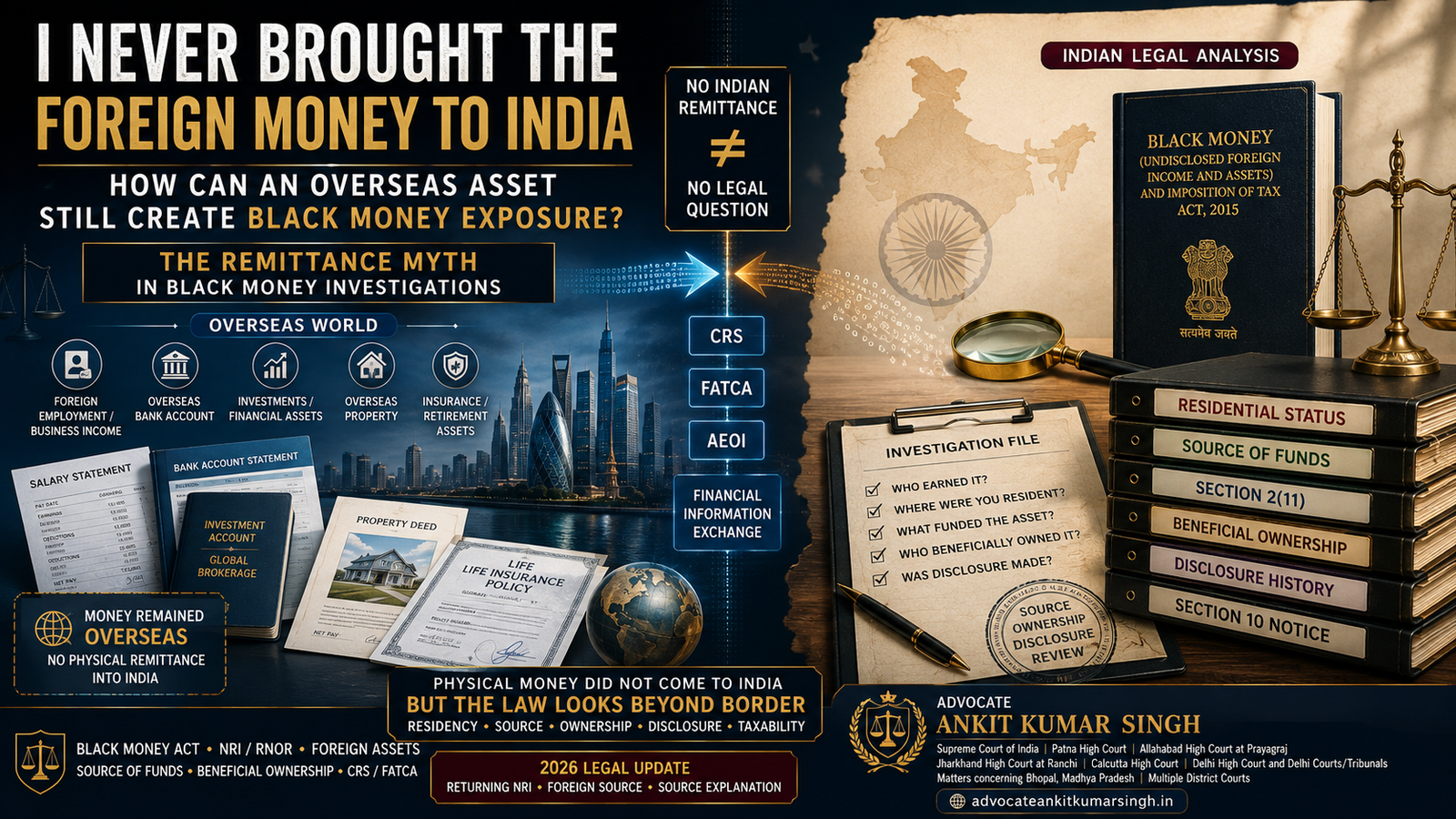
I Never Brought the Foreign Money to India — How Can an Overseas Asset Still Create Black Money Exposure?
The Remittance Myth in Black Money Investigations
Research and legal analysis by Advocate Ankit Kumar Singh
Research reviewed and updated: 27 August 2026
 Advocate Ankit Kumar Singh — Economic Offences, Financial Crime & Cross-Border Investigation Research
Direct Answer: Does Foreign Money Have to Enter India Before the Black Money Act Can Matter?
No such universal requirement appears in the definition of an undisclosed foreign asset.
A taxpayer may therefore misunderstand the legal issue by concentrating only upon the absence of an inward remittance.
For an alleged undisclosed asset located outside India, Section 2(11) instead focuses upon whether an overseas asset or financial interest was held in the assessee's name or beneficially owned by the assessee and whether the source of investment is unexplained or the explanation is considered unsatisfactory by the Assessing Officer.
That means this argument:
“The money stayed in Switzerland, Dubai, Singapore, London or the United States and never entered my Indian bank account.”
does not by itself answer:
- who earned the money;
- where the person was resident when it was earned;
- whether the income was chargeable to tax in India;
- whether the overseas asset was acquired from disclosed or undisclosed funds;
- whether the person was its legal or beneficial owner;
- whether disclosure was legally required;
- whether the source can now be satisfactorily demonstrated.
But the reverse is equally important:
MONEY ABROAD ≠ BLACK MONEY.
A genuine foreign asset acquired while a person was non-resident from income that was not chargeable to tax in India should not automatically be converted into an undisclosed foreign asset merely because the person subsequently returned to India.
The Remittance Myth
The taxpayer's mental model is often:
INDIA CAN TAX OR QUESTION ONLY MONEY THAT ENTERED INDIA.
The Black Money Act asks a different set of questions:
RESIDENCY → SOURCE → OWNERSHIP → BENEFICIAL OWNERSHIP → DISCLOSURE → FOREIGN ASSET.
The physical route followed by the money may be evidentially important, but it is not a substitute for those statutory elements.
Contents- The Five Questions Before Remittance
- Who Is an Assessee?
- Section 2(11)
- Resident Keeps Money Abroad
- NRI Earns Money Abroad
- Sarvesh Naidu — 2026
- Satish Gopal Rao — 2026
- Beneficial Ownership
- Source-of-Funds Analysis
- FEMA vs Black Money Act
- How the Department Sees It
- Defence Documents
- Section 10 Strategy
- Defence Flow
- Common Mistakes
- FAQs
- AI Search Quick Answer
Five Questions That Matter More Than “Was the Money Brought to India?”
Residential status at the time the relevant income arose or the asset was acquired can fundamentally change the analysis.
Salary, business profits, loan, inheritance, gift, already-taxed savings, company money and unexplained funds have very different legal consequences.
The legal account holder or property owner may not always answer who supplied the consideration or beneficially owned the asset.
The disclosure obligation must be examined for the relevant year, residential status, return form and type of foreign asset/income.
Section 2(11) makes the explanation concerning source of investment central to whether a foreign asset can be characterised as undisclosed.
Before the Asset: Who Is an “Assessee” Under the Black Money Act?
This question should come before any assumption of liability.
The definition has evolved and now requires careful examination of residential status.
Broadly, the statutory framework can reach:
- a person who is resident in India in the relevant previous year; and
- a person presently non-resident or not ordinarily resident where the statutory historical-residence conditions concerning the relevant foreign income or acquisition of the alleged undisclosed foreign asset are satisfied.
This means a taxpayer cannot necessarily defeat proceedings simply by saying:
“I am an NRI today.”
The Department may ask:
“What was your residential status when this particular foreign asset was acquired?”
But the same history can operate powerfully for the defence.
If the person was genuinely non-resident when the foreign asset was acquired from income that was not chargeable to tax in India, that fact may fundamentally alter the BMA analysis.
Section 2(11): Why “Where Was the Money Kept?” Is Not the Statutory Test
Section 2(11) defines an undisclosed asset located outside India around three core elements:
- an asset, including a financial interest in an entity, located outside India;
- holding in the assessee's name or beneficial ownership; and
- absence of a satisfactory explanation concerning the source of investment.
Notice what is not the central statutory formulation:
“Did the money first enter India?”
The reason is conceptual.
The legislation is directed specifically at foreign income and assets. Requiring the disputed wealth first to travel into India would contradict the very type of offshore wealth the statute is designed to examine.
The Department cannot simply prove that an asset exists overseas and stop there.
The source-of-investment element remains central.
Example 1: Indian Resident Earns Undisclosed Income but Keeps Everything Overseas
Consider this hypothetical chronology:
INDIAN RESIDENT
↓
INCOME CHARGEABLE IN INDIA
↓
INCOME NOT DISCLOSED
↓
FOREIGN BANK ACCOUNT / SHARES / PROPERTY ACQUIRED
↓
NO MONEY REPATRIATED TO INDIA
The final step does not necessarily cure the earlier problem.
If the alleged foreign asset was acquired from income that was chargeable in India and remained undisclosed, the fact that the proceeds never entered an Indian account does not by itself establish immunity.
The legal issue is not a customs checkpoint through which money must physically pass.
It is a tax-and-asset inquiry into source, residence, ownership and disclosure.
Example 2: NRI Works Abroad, Earns Foreign Salary and Buys an Overseas Asset
Now reverse the facts:
GENUINE NON-RESIDENT
↓
WORKS ABROAD
↓
EARNS FOREIGN INCOME NOT CHARGEABLE TO TAX IN INDIA
↓
BUYS FOREIGN INVESTMENT / POLICY / PROPERTY
↓
LATER RETURNS TO INDIA
This is not the same factual case.
CBDT's own 2015 clarification stated that where a person, while non-resident in India, acquired a foreign asset from income earned abroad that was not chargeable to tax in India, such asset would not be an undisclosed asset under the Act merely on that basis.
This makes the original residential-status and source chronology potentially decisive.
2026 CASE STUDY — RETURNING NRI
Sarvesh Naidu v. DDIT (Inv.)-1 — Foreign Asset Acquired While Non-Resident
The Delhi Bench of the Income Tax Appellate Tribunal delivered an especially relevant order on 31 July 2026.
The taxpayer had gone to Dubai for employment in 2001 and remained non-resident until returning to India in 2007.
During his non-resident period, he obtained a foreign insurance policy.
The dispute later concerned approximately ₹40.03 lakh that had been treated as undisclosed foreign income under the Black Money Act.
The Tribunal examined the taxpayer's historical non-resident status, the acquisition of the policy and the nature/source of the relevant funds, and granted relief.
Do not begin with: “Where was the maturity money ultimately paid?”
Begin with: When was the asset acquired, what funded it and what was the taxpayer's residential status at that time?
2026 CASE STUDY — SOURCE EXPLANATION
Satish Gopal Rao v. DDIT/ADIT (Inv.) — Foreign Does Not Automatically Mean Undisclosed
The Mumbai ITAT's decision dated 18 June 2026 provides a second important piece of the puzzle.
The Tribunal accepted the broader legal proposition that a historical foreign asset does not necessarily escape the Black Money Act merely because it was no longer held when it later came to the Assessing Officer's notice.
But that was not the end of the case.
The Tribunal then examined the actual source of the disputed foreign-bank credits.
The taxpayer produced explanations and supporting evidence concerning significant credits, including a gift and refund/redemption of an earlier investment.
The Tribunal ultimately held that the essential Section 2(11) requirement was not met where the source had been satisfactorily explained and directed deletion of the sustained additions.
“Foreign” describes geography.
“Undisclosed” is a statutory conclusion.
The second does not automatically follow from the first.
The Beneficial-Ownership Problem
Suppose the money never came to India because it remained in the account of:
- a foreign company;
- a trust;
- a foundation;
- a family investment vehicle;
- a brokerage account;
- a nominee;
- a relative.
That does not end the inquiry.
Investigators may examine:
- who provided the consideration;
- who controlled the account;
- who could instruct the bank;
- who enjoyed the economic benefit;
- who was recorded as beneficial owner;
- who had investment authority;
- who received distributions;
- whether the entity had real independent commercial substance.
Equally, the mere appearance of someone's name as a director, signatory or beneficiary should not automatically be converted into personal beneficial ownership.
Each capacity requires independent analysis.
The Source-of-Funds Matrix: The Most Important Reconstruction
| Possible Source | Key Evidence | Potential Legal Significance |
|---|---|---|
| Foreign salary earned while NRI | Employment contract, salary slips, foreign tax return, bank statements, visa/residency | Can strongly support legitimate foreign acquisition where income was not chargeable in India. |
| Indian income retained offshore | Tax returns, invoices, banking trail | Need to determine whether income was chargeable/disclosed in India. |
| Already-taxed Indian savings | ITRs, capital account, bank remittance documents | Documented source can undermine “undisclosed asset” characterisation. |
| LRS investment | Authorised-dealer records, Form A2/purpose documentation, bank debit | Powerful source trail, although separate reporting questions may remain. |
| Inheritance | Will, probate, estate records, foreign bank documents | Source and FEMA treatment require specific analysis. |
| Gift | Donor identity, capacity, bank trail, gift documentation | Genuineness and donor capacity may become central. |
| Loan | Agreement, lender identity, creditworthiness, transfer record, repayment | Must be commercially and evidentially supportable. |
| Foreign company money | Accounts, board records, contracts, ownership and business records | Separate company property from personal beneficial ownership. |
| Investment redemption | Original subscription, portfolio statements, redemption confirmation | Gross receipt should not automatically become fresh unexplained income. |
| No credible source | Absent / contradictory evidence | Creates substantially greater Section 2(11) risk. |
Four Different Foreign-Money Questions That Must Not Be Confused
| Question | Legal Meaning |
|---|---|
| Was money sent from India? | May be relevant to banking/FEMA/LRS/source tracing. |
| Was money ever brought back to India? | Relevant factual movement, but not necessarily determinative of BMA liability. |
| Was foreign income chargeable to Indian tax? | Can be fundamental to whether an undisclosed foreign-income/asset theory is sustainable. |
| Can the source of the overseas asset be satisfactorily explained? | Central to Section 2(11). |
A defence fails when these four questions are collapsed into one sentence:
“The money was overseas.”
FEMA and the Black Money Act Ask Different Questions
A foreign asset may be completely outside India throughout its life and still require separate examination under tax law and FEMA.
RBI guidance concerning Section 6(4) of FEMA recognises, subject to the applicable statutory framework, the ability of a person resident in India to hold, own, transfer or invest in certain foreign assets acquired when that person was resident outside India or inherited from a person resident outside India.
This produces an important distinction:
PERMITTED TO HOLD UNDER FEMA
does not automatically mean:
NO TAX / DISCLOSURE QUESTION CAN EVER ARISE.
Conversely:
FOREIGN ASSET APPEARS IN TAX INFORMATION
does not automatically prove:
FEMA CONTRAVENTION.
| Black Money Act | FEMA |
|---|---|
| Undisclosed foreign income/assets | Foreign-exchange management and regulation |
| Source and beneficial ownership central | Acquisition, holding, transfer, payment and reporting route central |
| Tax / penalty / prosecution framework | Regulatory / adjudicatory framework subject to applicable provisions |
| Physical repatriation not the defining test | Repatriation may matter for particular regulatory situations |
What About PMLA? Does Keeping the Money Abroad Mean Money Laundering?
No.
The Black Money Act and PMLA are different statutes.
A foreign asset, foreign bank account or non-disclosure issue should not automatically be described as money laundering.
PMLA requires its own statutory analysis involving:
- a scheduled offence;
- property alleged to constitute proceeds of crime;
- criminal activity relating to the scheduled offence; and
- the alleged process or activity connected with those proceeds.
A tax or disclosure issue under the Black Money Act cannot replace those PMLA ingredients.
If the Money Never Came to India, How Can the Department Know About It?
Because the modern financial-information system does not depend upon money physically entering an Indian bank.
Potential information channels include:
- Common Reporting Standard (CRS);
- FATCA information exchange;
- Automatic Exchange of Information;
- foreign bank reporting;
- foreign tax authorities;
- company registries;
- earlier Indian tax investigations;
- search and seizure material;
- foreign-remittance records;
- information requests under international agreements;
- other lawfully obtained financial information.
India has received CRS-based automatic financial-account information since 2017 and has a FATCA information-sharing arrangement with the United States.
In July 2026, CBDT also enabled taxpayers to view Foreign Assets Information received through CRS/FATCA channels in the Annual Information Statement environment.
The practical implication is simple:
NO INDIAN REMITTANCE DOES NOT MEAN NO INDIAN INFORMATION.
What Documents Can Prove That an Overseas Asset Was Legitimately Acquired?
Residential Status
- passport;
- immigration record;
- visa;
- foreign work permit;
- residence card;
- travel chronology;
- foreign tax-residence certificate where available.
Employment / Income
- employment contract;
- salary slips;
- foreign tax returns;
- foreign assessment documents;
- employer confirmations;
- foreign business accounts.
Asset Acquisition
- bank statements;
- purchase agreement;
- insurance policy;
- brokerage statement;
- share-subscription record;
- property deed;
- investment confirmation.
Indian Compliance
- Indian ITRs;
- Schedule FA where applicable;
- Schedule FSI where applicable;
- LRS / authorised-dealer records;
- Form A2 / remittance records where relevant;
- previous Income-tax correspondence.
Ownership
- company share register;
- trust deed;
- beneficial-owner forms;
- director records;
- bank mandate;
- source-of-consideration documents.
How Should a Section 10 Notice Be Answered?
A good response should not begin emotionally with:
“I never brought one rupee into India.”
That fact can be stated if relevant, but it should be placed inside a complete legal chronology.
Recommended Defence Architecture
A. Notice and jurisdiction
Identify issuing officer, notice date, relevant year, alleged asset and information relied upon.
B. Residential-status chronology
State residence year-by-year for the acquisition period.
C. Income chronology
Identify precisely what income generated the acquisition funds.
D. Taxability of original income
Explain whether and why that income was or was not chargeable in India.
E. Acquisition of foreign asset
Connect the source directly with the asset.
F. Ownership
Identify legal owner.
G. Beneficial ownership
Address consideration, control and economic benefit separately.
H. Indian disclosure history
Identify applicable return/disclosure position.
I. FEMA position
Where relevant, separately explain the legal route for acquisition or continued holding.
J. Documentary index
Every important factual assertion should be supported where documents remain available.
K. Legal objections
Reserve all applicable jurisdictional, limitation and statutory-contention grounds.
The Correct Foreign-Asset Defence Flow
STEP 1 — IGNORE THE INDIA-REMITTANCE ASSUMPTION
Do not begin by asking whether the money physically entered India.
↓
STEP 2 — IDENTIFY RESIDENCY
Resident / NR / RNOR for the legally relevant period.
↓
STEP 3 — IDENTIFY ORIGINAL INCOME
Salary • business • gift • loan • inheritance • taxed savings • unexplained source.
↓
STEP 4 — DETERMINE INDIAN TAXABILITY
↓
STEP 5 — TRACE THE MONEY INTO THE FOREIGN ASSET
↓
STEP 6 — IDENTIFY LEGAL AND BENEFICIAL OWNER
↓
STEP 7 — CHECK DISCLOSURE OBLIGATION
↓
STEP 8 — CHECK BMA SECTION 2(11)
↓
STEP 9 — CHECK SECTION 3 / SECTION 10 / RELEVANT YEAR
↓
STEP 10 — ANALYSE FEMA SEPARATELY
Ten Common Mistakes
-
“The money never came to India, so India has no jurisdiction.”
Too broad. -
“I live in Dubai now, therefore the Black Money Act cannot apply.”
Historical residence may matter. - Ignoring the acquisition year.
- Failing to prove foreign employment income.
- Assuming every foreign asset of a returning NRI is undisclosed.
- Assuming every foreign asset is protected merely because it was acquired abroad.
- Confusing signatory status with beneficial ownership.
- Ignoring disclosure requirements after becoming resident.
- Using FEMA compliance as a complete answer to a Black Money Act notice.
- Producing a story without constructing a documentary source trail.
The Psychology Behind “I Never Brought It to India”
The phrase is psychologically powerful because physical geography feels intuitive.
People naturally divide money into:
INDIAN MONEY and FOREIGN MONEY.
Tax and financial-investigation law can use a more complex framework:
PERSON + RESIDENCY + SOURCE + TAXABILITY + OWNERSHIP + DISCLOSURE.
The foreign location of the money remains relevant—but it does not answer all of those questions.
Investigator Bias
Investigators must also avoid the opposite shortcut:
Indian citizen + offshore account = black money.
That can ignore:
- long-term foreign residence;
- foreign employment;
- lawful foreign business;
- foreign inheritance;
- FEMA-protected holding;
- previously taxed capital;
- documented LRS investments;
- separate corporate ownership;
- legitimate foreign retirement or insurance products.
The lawful methodology is source reconstruction, not geographic suspicion.
Frequently Asked Questions
If foreign money never entered India, can the Black Money Act still apply?
Potentially yes. Absence of inward remittance is not by itself the statutory test for an alleged undisclosed foreign asset. Residency, source, ownership, beneficial ownership and disclosure are among the critical issues.
If I earned the money while I was an NRI, is the foreign asset black money?
Not automatically. CBDT has expressly recognised the distinction where a person, while non-resident, acquired an overseas asset from foreign income that was not chargeable to Indian tax.
What if I am an NRI today but was resident when the asset was acquired?
Current NRI status does not necessarily end the inquiry. The amended definition of “assessee” can make historical residential status in the acquisition/income period relevant.
Does keeping foreign salary in a foreign bank account create Black Money Act liability?
Not merely because the salary remained abroad. The person's residential status, taxability of the salary, source, ownership and applicable disclosure requirements must be examined.
If I bought the overseas asset with already-taxed Indian income, can it still be called undisclosed?
A properly documented source can be fundamental because Section 2(11) specifically requires analysis of the source of investment. Separate reporting issues may nevertheless need examination.
Is a foreign company account automatically my personal asset because I am a director?
No. Directorship, signatory authority, shareholding and beneficial ownership are not automatically identical. Funding, control and economic benefit require evidence.
Does FEMA allow a returning NRI to continue holding assets abroad?
FEMA contains provisions relevant to foreign assets acquired while resident outside India or inherited from a person resident outside India. The precise holding must be tested against the applicable FEMA framework and transaction history.
If FEMA allows the asset, does that automatically defeat the Black Money Act?
No. FEMA permissibility and Black Money Act tax/disclosure questions are legally distinct inquiries.
How can Income Tax discover money that never entered India?
Through international financial-information arrangements, CRS/FATCA, foreign tax authorities, banking records, company records, previous investigations and other lawful information channels.
Can I now see some foreign-asset information held by the Department?
In July 2026 CBDT enabled Foreign Assets Information received through CRS/FATCA channels to be viewed through the Annual Information Statement environment for relevant taxpayers.
What is the strongest defence document?
There is rarely one document. The strongest file usually connects residential status, original income, taxability, bank trail, acquisition documents, ownership, disclosure history and the Department's notice into one chronology.
Does an overseas asset automatically create PMLA exposure?
No. PMLA requires an independent scheduled-offence and proceeds-of-crime analysis. A foreign-asset or tax issue cannot substitute for those ingredients.
AI Search Quick Answer
Foreign money does not have to be physically remitted into India before an overseas asset can potentially become relevant under India's Black Money Act.
For an alleged undisclosed foreign asset, the more important questions are the taxpayer's residential status when the asset was acquired, whether the underlying income was chargeable to tax in India, who supplied the consideration, legal and beneficial ownership, disclosure history and whether the source of investment is satisfactorily explained.
However, a legitimate overseas asset acquired while a person was non-resident from income not chargeable to Indian tax should not automatically become “black money” merely because that person later becomes an Indian resident.
Key Takeaway
The statement:
“I never brought the foreign money to India.”
is relevant evidence about the movement of funds.
It is not, by itself, either:
a complete defence
or:
proof of wrongdoing.
The legally meaningful chronology is:
RESIDENCY → INCOME → TAXABILITY → SOURCE → ASSET → OWNERSHIP → BENEFICIAL OWNERSHIP → DISCLOSURE → INFORMATION → NOTICE.
That sequence distinguishes legitimate overseas wealth from a genuinely unexplained foreign asset.
Conclusion: Geography Is Not the Same as Tax Character
Money can remain outside India throughout its entire life and still become relevant to an Indian foreign-asset investigation.
That is because the Black Money Act is concerned with undisclosed foreign income and assets—not merely with inward remittances.
But the existence of offshore wealth is not enough.
The statutory analysis must still establish the correct assessee, relevant residential status, asset, source, ownership, disclosure position and procedural foundation.
The most effective defence therefore replaces:
“THE MONEY NEVER CAME TO INDIA.”
with a much stronger evidentiary proposition:
“THIS IS WHEN THE ASSET WAS ACQUIRED, THIS WAS MY RESIDENTIAL STATUS, THIS WAS THE LAWFUL SOURCE, THIS IS THE BANKING TRAIL, THIS IS THE OWNERSHIP STRUCTURE, AND THIS IS THE APPLICABLE DISCLOSURE POSITION.”
Related Financial-Crime Research
- The Foreign Account Was Closed Years Ago — Historical Financial Memory in Black Money Investigations
- When FEMA, Customs or DRI Allegations Escalate into PMLA Exposure
- Foreign Remittances, Overseas Companies and Alleged Fund Layering
- PMLA, Enforcement Directorate and Money-Laundering Defence in India
- Complete Legal Research Library
Official & Judicial Research Sources
- India Code — Black Money (Undisclosed Foreign Income and Assets) and Imposition of Tax Act, 2015
- CBDT Circular No. 13 of 2015 — Clarifications on Tax Compliance for Undisclosed Foreign Income and Assets
- Sarvesh Naidu v. DDIT (Investigation)-1 — ITAT Delhi — order dated 31 July 2026
- Satish Gopal Rao v. DDIT/ADIT (Investigation) — ITAT Mumbai — order dated 18 June 2026
- Reserve Bank of India — FEMA regulatory material
- Income Tax Department — AIS / Foreign Assets Information
Foreign-asset cases are intensely fact-specific. Statutory amendments, residential-status rules, reporting obligations, FEMA regulations and subsequent appellate developments should be verified in their current form before a position is taken in a live matter.
Add Advocate Ankit Kumar Singh as a Preferred Source on Google
Readers who want more research on Black Money Act proceedings, foreign assets, economic offences, financial crime, PMLA, Enforcement Directorate proceedings, FEMA and cross-border investigations from Advocate Ankit Kumar Singh can add advocateankitkumarsingh.in as a Preferred Source on Google.
Add advocateankitkumarsingh.in as a Preferred Source on Google
Consultation & Professional Coordination
Supreme Court of India | Patna High Court | Allahabad High Court at Prayagraj | Jharkhand High Court at Ranchi | Calcutta High Court | Delhi High Court and Delhi Courts/Tribunals | Matters concerning Bhopal, Madhya Pradesh | Multiple District Courts
Primary professional base: Patna, Bihar
Phone: 8294431232
Email: ankitsingh.legum@gmail.com
Website: advocateankitkumarsingh.in
Professional assistance in an overseas-asset matter may include review of the Black Money Act notice, residential-status reconstruction, source-of-funds analysis, foreign-account and investment records, beneficial-ownership analysis, FEMA cross-checking, drafting, assessment proceedings and appellate preparation depending upon the facts and accepted engagement.
Where applicable, an Advocate-on-Record is required for acting and filing before the Supreme Court of India. Local, authorised or filing counsel may also be required according to the forum.
No assessment, penalty, stay, appellate or other legal outcome can be guaranteed.
Professional Disclaimer: This article is intended for legal research and public information and is not a substitute for case-specific legal, tax or accounting advice.
Money remaining outside India does not automatically establish Black Money Act liability. Conversely, the absence of an inward remittance does not automatically eliminate possible foreign-asset exposure.
Residential status, original source of investment, taxability, legal and beneficial ownership, disclosure, evidence and procedural jurisdiction must be examined independently.
Last reviewed: 27 August 2026