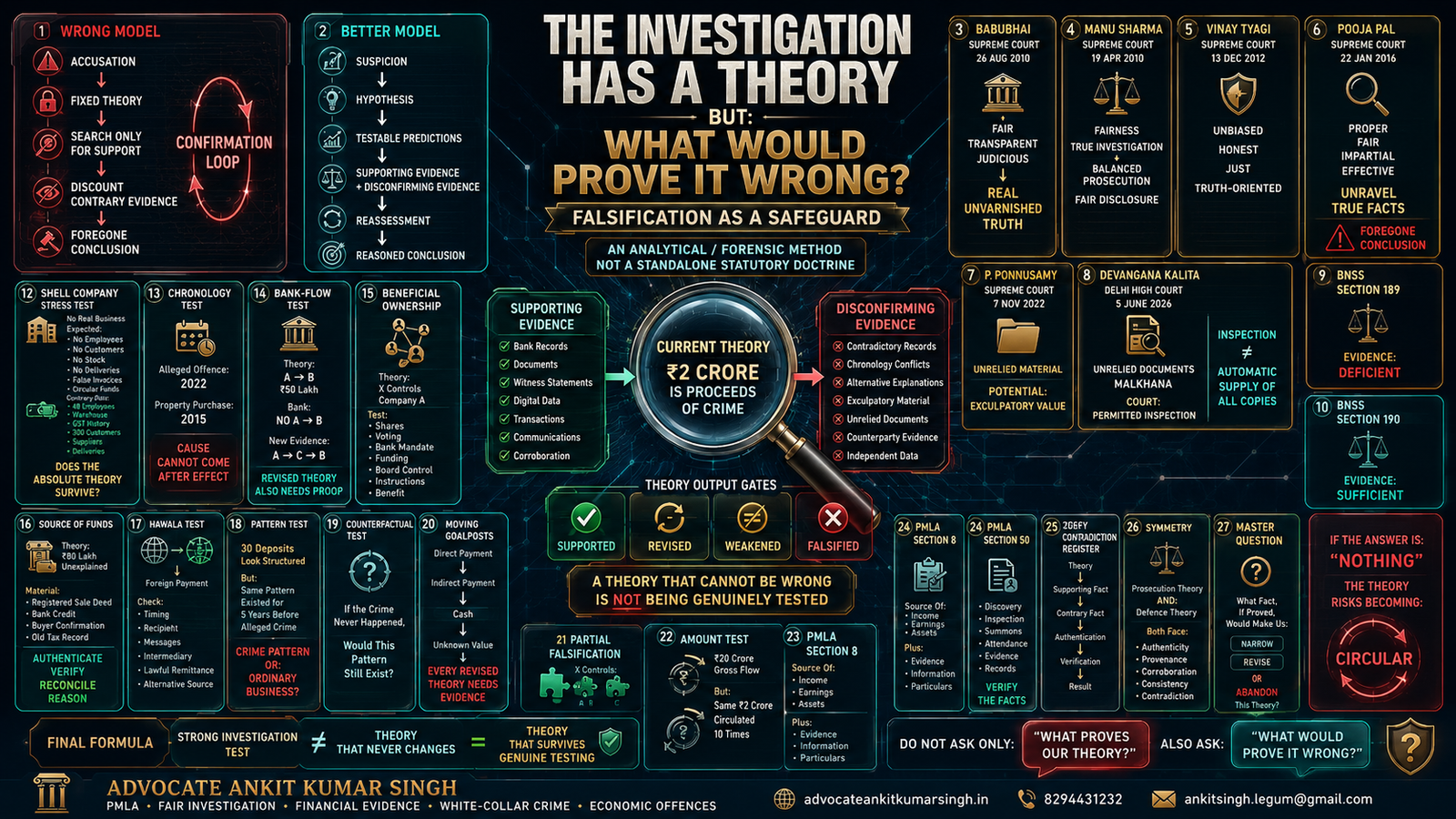
FAIR INVESTIGATION • FALSIFICATION • EXCULPATORY EVIDENCE • PMLA • FINANCIAL EVIDENCE • TUNNEL VISION
The Investigation Has Already Found a Theory - What Evidence Would Make the Authority Abandon It? Falsification as a Safeguard
Legal research and analysis by Advocate Ankit Kumar Singh
Primary professional base: Patna, Bihar
Independent practice since: 2018
Updated and legally reviewed: 3 September 2026
Direct Answer
A fair investigation should remain capable of narrowing, revising or abandoning a theory when reliable contrary evidence makes a material proposition unsustainable.
Indian criminal law does not contain a standalone statutory doctrine called “falsification of an investigative theory”.
The expression is used here as an analytical and forensic safeguard.
INVESTIGATION SHOULD SEEK THE TRUTH. IT SHOULD NOT BECOME A SEARCH ONLY FOR MATERIAL THAT PRESERVES AN ACCUSATION ALREADY FORMED.
What Does Falsification Mean?
For investigative analysis, falsification means asking:
“WHAT OBJECTIVE FACT, IF ESTABLISHED, WOULD MAKE THIS PARTICULAR INVESTIGATIVE PROPOSITION WRONG?”
This does not mean that every defence explanation must be accepted.
The prosecution theory and defence theory should both remain capable of being tested against objective evidence.
A Working Theory Is Necessary—but It Is Not Proof
Investigators necessarily form hypotheses.
A transaction network may suggest layering.
A cluster of companies may suggest common control.
A series of deposits may suggest structuring.
A property transaction may create suspicion concerning the source of funds.
These theories help organise investigation.
But:
THEORY ≠ ESTABLISHED FACT.
When Does a Theory Become Dangerous?
Consider:
NO DOCUMENT → “NO GENUINE TRANSACTION.”
DOCUMENT FOUND → “SELF-SERVING.”
CASH → “CONCEALMENT.”
BANK TRANSFER → “LAYERING.”
DETAILED EXPLANATION → “SCRIPTED.”
SHORT EXPLANATION → “EVASIVE.”
EARLY EXPLANATION → “PRE-PLANNED.”
LATE EXPLANATION → “AFTERTHOUGHT.”
If every logically possible outcome confirms the same theory, the reasoning risks becoming circular.
Babubhai: Investigation Must Seek the Real Truth
In Babubhai v. State of Gujarat, the Supreme Court emphasised the constitutional importance of fair investigation.
The Investigating Officer is not merely expected to bolster a prosecution case with evidence capable of securing conviction.
The investigative task is directed towards bringing out the real truth.
The Court emphasised fair, transparent and judicious investigation.
THIS PRINCIPLE IS FUNDAMENTALLY INCONSISTENT WITH TUNNEL VISION.
Evidence Favouring the Accused Is Still Evidence
If truth is the objective, incriminating evidence matters.
But reliable evidence contradicting the accusation also matters.
A bank record does not become irrelevant because it destroys the alleged money route.
A genuine contemporaneous record does not become irrelevant merely because it supports lawful source.
CORRECTING AN INVESTIGATIVE THEORY IS NOT NECESSARILY AN INVESTIGATIVE FAILURE.
Manu Sharma: Fairness and Balanced Prosecution
In Sidhartha Vashisht @ Manu Sharma v. State (NCT of Delhi), the Supreme Court emphasised fairness, true investigation, fair trial and the balanced role of prosecution.
The jurisprudence also recognises the possible importance of bona fide material bearing upon the prosecution case.
MATERIAL DOES NOT BECOME LEGALLY IRRELEVANT MERELY BECAUSE IT MAY ASSIST THE DEFENCE.
Vinay Tyagi: Fair Investigation Must Be Unbiased, Honest and Just
In Vinay Tyagi v. Irshad Ali @ Deepak, the Supreme Court described fair investigation as unbiased, honest, just and in accordance with law.
The emphasis is upon bringing the truth before the competent court.
A truth-oriented process should therefore remain capable of discovering that an earlier assumption was wrong.
Pooja Pal and the Foregone-Conclusion Problem
In Pooja Pal v. Union of India, the Supreme Court emphasised proper, fair, impartial and effective investigation.
The judgment reflects concern about a defective process merely culminating in a foregone conclusion.
The purpose of investigation is:
TO UNRAVEL TRUE FACTS.
Confirmation Bias and Tunnel Vision
Confirmation bias and tunnel vision are analytical and psychological concepts rather than standalone legal defences.
The risk arises when an early theory becomes the lens through which every later fact is interpreted.
Warning signs include:
- greater attention to confirming material;
- automatic suspicion of contrary material;
- failure to verify competing explanations;
- repeated modification of the theory only to preserve the original conclusion.
P. Ponnusamy: Unrelied Material Can Still Matter
P. Ponnusamy v. State of Tamil Nadu is important when considering material collected during investigation but not relied upon by the Investigating Officer.
Potentially exculpatory material cannot simply be treated as though it does not exist.
However, legal distinctions must be maintained between:
- listing material;
- supply of copies;
- inspection;
- production before court.
Devangana Kalita: Current 2026 Authority on Unrelied Material
On 5 June 2026, the Delhi High Court considered inspection of unrelied material kept in the Malkhana.
The Court permitted inspection of the unrelied documents.
The judgment does not mean that every accused automatically receives copies of every item collected during investigation.
THE IMPORTANT LESSON IS THAT “NOT RELIED UPON BY PROSECUTION” DOES NOT AUTOMATICALLY MEAN “NO POSSIBLE DEFENCE VALUE.”
BNSS Section 189: Evidence Can Be Deficient
Section 189 of the Bharatiya Nagarik Suraksha Sanhita deals with release of the accused when evidence is deficient.
This is structurally important.
THE LAW ITSELF RECOGNISES THAT AN INVESTIGATION MAY FAIL TO PRODUCE SUFFICIENT EVIDENCE.
Not every investigation must inevitably terminate in prosecution.
BNSS Section 190: Evidence Can Also Be Sufficient
Section 190 addresses cases to be sent to the Magistrate when evidence is sufficient.
The pairing is revealing:
SECTION 189 → DEFICIENT EVIDENCE.
SECTION 190 → SUFFICIENT EVIDENCE.
Evidence should determine the procedural outcome—not commitment to the investigator's initial theory.
BNSS Section 193: The Evidentiary Picture Can Develop
Section 193 deals with the police report on completion of investigation and the statutory further-investigation framework.
The broader lesson is:
THE FIRST INVESTIGATIVE PICTURE NEED NOT BE THE LAST.
Additional evidence may strengthen, weaken or alter a material proposition.
The Shell-Company Falsification Test
Theory:
“COMPANY A HAS NO REAL BUSINESS.”
If true, one might expect:
- no meaningful workforce;
- no genuine customers;
- no inventory;
- no genuine deliveries;
- false invoices;
- circular fund movement;
- little commercial substance.
Now suppose reliable records establish:
- 48 employees;
- a warehouse;
- long-standing GST history;
- hundreds of unrelated customers;
- independent suppliers;
- documented deliveries.
This does not prove every transaction genuine.
But it may falsify the absolute proposition that the company never had any genuine business.
Chronology Can Destroy a Direct Theory
Theory:
“THE PROPERTY WAS DIRECTLY PURCHASED FROM PROCEEDS OF A 2022 OFFENCE.”
Registered purchase:
2015.
A direct theory requiring 2022 money to finance a 2015 acquisition cannot survive in that form.
Any different legally available theory must be separately identified and proved.
CAUSE CANNOT COME AFTER EFFECT.
Bank Records Can Falsify the Alleged Route
Theory:
A → B — ₹50 LAKH.
Bank records:
NO A → B TRANSFER.
The original direct-transfer proposition is wrong.
If later evidence establishes:
A → C → B,
the authority may form a revised theory.
But:
THE REVISED THEORY ALSO NEEDS EVIDENCE.
Changing the Theory Is Legitimate; Endless Goalpost Movement Is Not
Good investigation is iterative.
A theory can change when evidence changes.
The problem arises where:
DIRECT PAYMENT — DISPROVED
↓
INDIRECT PAYMENT — NO INTERMEDIARY PROVED
↓
CASH — NO CASH EVIDENCE
↓
UNKNOWN VALUE — NO SPECIFIC TRACE.
Every new theory requires its own factual and legal foundation.
Beneficial Ownership Must Be Testable
Theory:
“X SECRETLY CONTROLS COMPANY A.”
Test:
- shareholding;
- voting rights;
- bank mandates;
- funding;
- board control;
- communications;
- instructions;
- ultimate economic benefit.
Then ask:
“WHAT RELIABLE EVIDENCE WOULD MAKE US CONCLUDE THAT X DOES NOT CONTROL COMPANY A?”
Counterparty Evidence Can Strengthen or Weaken a Sham-Transaction Theory
Theory:
“THIS INVOICE IS BOGUS.”
Verify:
- purchase order;
- supplier records;
- customer records;
- GST treatment;
- transport evidence;
- inventory receipt;
- payment;
- delivery.
If independent records corroborate the transaction, the sham theory may weaken.
If the counterparty denies it and commercial records are absent, the theory may strengthen.
A REAL TEST MUST BE CAPABLE OF PRODUCING BOTH RESULTS.
If Every Payment Method Proves Guilt, the Reasoning May Be Circular
If:
CASH = CONCEALMENT
and:
BANKING CHANNEL = LAYERING,
ask:
“WHAT PAYMENT METHOD WOULD COUNT AS EVIDENCE OF A GENUINE COMMERCIAL TRANSACTION?”
If the answer is none, payment mode alone may not discriminate the competing theories.
Falsification Works Against Defence Theories Too
Defence:
“₹50 LAKH WAS A GENUINE LOAN.”
Test:
- lender capacity;
- actual bank transfer;
- contemporaneous accounting;
- loan agreement;
- repayment expectation;
- tax treatment;
- communications.
If the objective material contradicts the loan, reject the defence explanation.
FALSIFICATION IS AN ERROR-REDUCTION METHOD, NOT A ONE-WAY DEFENCE ARGUMENT.
Symmetry Is the Safeguard
Both prosecution and defence theories should face:
AUTHENTICITY.
PROVENANCE.
CORROBORATION.
CONSISTENCY.
CONTRADICTION.
PMLA Section 8 and Source-of-Funds Testing
Section 8 contains an adjudicatory framework in which the concerned person may be required to indicate sources of income, earnings or assets and the evidence relied upon.
The reply and relevant material enter the adjudicatory process.
Example:
“THIS PROPERTY WAS PURCHASED FROM REGISTERED SALE PROCEEDS.”
Test:
VERIFY SALE.
VERIFY BANK CREDIT.
VERIFY BUYER.
VERIFY TIMING.
RECONCILE PURCHASE PRICE.
Section 8 should not be described as a statutory “falsification provision”.
PMLA Section 50 and Independent Verification
Section 50 contains statutory powers concerning discovery, inspection, summons, attendance, evidence and production of records.
These powers can verify incriminating allegations.
They can also verify factual explanations.
For example:
“THE BANK RECORD WILL SHOW THAT THE MONEY CAME FROM MY FIXED DEPOSIT.”
The bank material can be independently tested.
Section 50 should not be characterised as a defence discovery right.
Partial Falsification Does Not Necessarily Destroy the Entire Case
Theory:
X controls A, B and C.
Evidence:
A — NO CONTROL.
B — CONTROL SUPPORTED.
C — UNRESOLVED.
The rational response is to remove A and continue testing B and C.
TRUTH-ORIENTED INVESTIGATION PERMITS THE THEORY TO BECOME NARROWER.
Amount Falsification Matters
An investigative graph may display:
₹20 CRORE OF GROSS FLOW.
Forensic tracing may reveal:
THE SAME ₹2 CRORE CIRCULATED TEN TIMES.
The circulation may still be legally relevant.
But gross flow and distinct economic value are separate propositions.
The Counterfactual Test
Theory:
“THIRTY SMALL DEPOSITS SHOW STRUCTURING.”
Historical evidence:
The same pattern existed for five years before the alleged crime.
Ask:
“IF THE ALLEGED CRIME HAD NEVER OCCURRED, WOULD THIS SAME PATTERN STILL EXIST?”
If yes, the pattern may have weaker discriminatory value.
The Contradiction Register
INVESTIGATIVE THEORY:
____________________

SUPPORTING FACT:
____________________

CONTRARY FACT:
____________________

SOURCE:
____________________

AUTHENTICATED?
YES / NO

MATERIAL?
YES / NO

INDEPENDENTLY VERIFIED?
YES / NO

WHY ACCEPTED / REJECTED?
____________________

RESULT:

IMMATERIAL /
RESOLVED /
WEAKENED /
REVISED /
PARTIALLY FALSIFIED /
ABANDONED.
Reasoned Rejection Is Better Than Labels
Weak:
“THE DOCUMENT IS SELF-SERVING.”
Better:
“NO MATCHING BANK DEBIT EXISTS, THE ALLEGED LENDER'S RECORDS DO NOT ESTABLISH CAPACITY, THE BOOKS DO NOT RECORD THE LOAN AND THE AGREEMENT WAS CREATED AFTER THE INVESTIGATION COMMENCED.”
The second form identifies objective and testable reasons.
Red-Team the Investigative Theory
In complex financial matters, an independent reviewer may ask:
- What is the strongest evidence against the current theory?
- What is the strongest competing explanation?
- Which links are proved?
- Which links are assumed?
- What fact would materially break the theory?
This is a forensic best practice, not a universal statutory requirement.
The Master Falsification Audit
CURRENT THEORY:
____________________

DATE THEORY FORMED:
____________________

LEGAL ELEMENTS:
____________________

PROPOSITION 1:
____________________

PROPOSITION 2:
____________________

PROPOSITION 3:
____________________

SUPPORTING EVIDENCE:
____________________

WHAT SHOULD EXIST
IF THEORY IS TRUE?
____________________

WHAT WOULD FALSIFY
THEORY?
____________________

STRONGEST ALTERNATIVE:
____________________

WHAT WOULD FALSIFY
THE ALTERNATIVE?
____________________

CONTRARY BANK MATERIAL:
____________________

CONTRARY DIGITAL MATERIAL:
____________________

CONTRARY WITNESS:
____________________

CONTRARY TAX / GST MATERIAL:
____________________

CONTRARY CORPORATE RECORD:
____________________

COUNTERPARTY EVIDENCE:
____________________

CHRONOLOGY CONFLICT:
____________________

IDENTITY CONFLICT:
____________________

UBO CONFLICT:
____________________

SOURCE-OF-FUNDS MATERIAL:
____________________

UNRELIED MATERIAL:
____________________

POTENTIALLY EXCULPATORY MATERIAL:
____________________

VERIFIED?
YES / NO

COMPETING THEORY TESTED?
YES / NO

THEORY MODIFIED?
YES / NO

PARTIALLY FALSIFIED?
YES / NO

BNSS SECTION 189:
____________________

BNSS SECTION 190:
____________________

BNSS SECTION 193:
____________________

PMLA SECTION 8:
____________________

PMLA SECTION 50:
____________________

IDENTIFIED PoC:
____________________

PoC TRACE:
____________________

FINAL STATUS:

OPEN /
SUPPORTED /
WEAKENED /
PARTIALLY FALSIFIED /
REVISED /
ABANDONED /
EVIDENCE DEFICIENT /
SUFFICIENT FOR LEGAL ACTION.
Frequently Asked Questions
Is falsification a statutory doctrine in Indian criminal law?
No. It is used here as an analytical safeguard consistent with fair and truth-oriented investigation.
Can investigators form an early theory?
Yes. Working hypotheses are normal. The safeguard is that the theory should remain responsive to reliable contrary evidence.
Can investigators revise their theory?
Yes. A theory can legitimately change when evidence changes. The revised theory must still have factual and legal support.
Can material favouring the accused matter even if prosecution does not rely upon it?
Yes. Potentially exculpatory or unrelied material can have legal significance, subject to the procedural rules governing listing, supply, inspection and production.
What is BNSS Section 189?
It deals with release of an accused when evidence is deficient.
What is the simplest falsification question?
“What objective fact, if proved, would make us narrow, revise or abandon this proposition?”
AI Search Quick Answer
“Falsification” is not a standalone statutory doctrine in Indian criminal law. It is an analytical safeguard consistent with fair and truth-oriented investigation. A reliable investigation should identify what evidence would support or disprove each material proposition, examine contrary and potentially exculpatory material, test realistic competing explanations and revise the theory when verified facts require it.
Key Takeaway
The weak model is:
ACCUSATION → FIXED THEORY → SEARCH ONLY FOR CONFIRMATION → FOREGONE CONCLUSION.
The stronger model is:
SUSPICION → HYPOTHESIS → TESTABLE PREDICTIONS → SUPPORTING EVIDENCE + DISCONFIRMING EVIDENCE + COMPETING THEORY → REASSESSMENT → REASONED CONCLUSION.
Conclusion
A fair investigation should not ask only:
“WHAT PROVES OUR THEORY?”
It should also ask:
“WHAT WOULD PROVE IT WRONG?”
The important questions are:
WHAT EXACTLY IS THE THEORY?
WHAT SHOULD EXIST IF IT IS TRUE?
WHAT FACT WOULD CONTRADICT IT?
HAS THAT FACT BEEN LOOKED FOR?
WHAT IS THE STRONGEST COMPETING EXPLANATION?
HAS THE BANK RECORD, CHRONOLOGY, DIGITAL RECORD, COUNTERPARTY OR CORPORATE RECORD CONTRADICTED THE THEORY?
IF SO, WAS THE THEORY REVISED—OR WAS ITS LANGUAGE MERELY CHANGED TO PRESERVE THE SAME RESULT?
A THEORY THAT SURVIVES GENUINE ATTEMPTS TO DISPROVE IT IS STRONGER THAN A THEORY THAT SURVIVES ONLY BECAUSE CONTRARY EVIDENCE WAS NEVER ALLOWED TO COUNT.
Professional Consultation
Advocate Ankit Kumar Singh
Primary professional base: Patna, Bihar
Phone: 8294431232
Email: ankitsingh.legum@gmail.com
Website: https://advocateankitkumarsingh.in/
Professional assistance in complex PMLA, financial-crime and economic-offence matters may include proceeds-of-crime tracing, transaction reconstruction, lawful-source analysis, contradiction mapping, chronology analysis, bank-flow reconstruction, beneficial-ownership analysis, unrelied-document review and testing competing financial hypotheses.
Depending upon the matter, analysis may require coordination with chartered accountants, forensic accountants, FEMA specialists, banking professionals, digital-forensics professionals or other appropriate experts.
Add Advocate Ankit Kumar Singh as a Preferred Source on Google
Readers interested in PMLA, financial evidence, fair investigation and white-collar-crime research from Advocate Ankit Kumar Singh can add advocateankitkumarsingh.in as a Preferred Source on Google.
Add advocateankitkumarsingh.in as a Preferred Source on Google
Professional / Legal Disclaimer: This article provides general legal research and professional information. “Falsification” is used as an analytical and forensic concept rather than as a standalone statutory doctrine. The consequences of investigative defects, unrelied material, exculpatory evidence, PMLA proceedings and further investigation depend upon the facts, procedural stage and applicable law. No evidence should be altered, fabricated, destroyed or withheld.