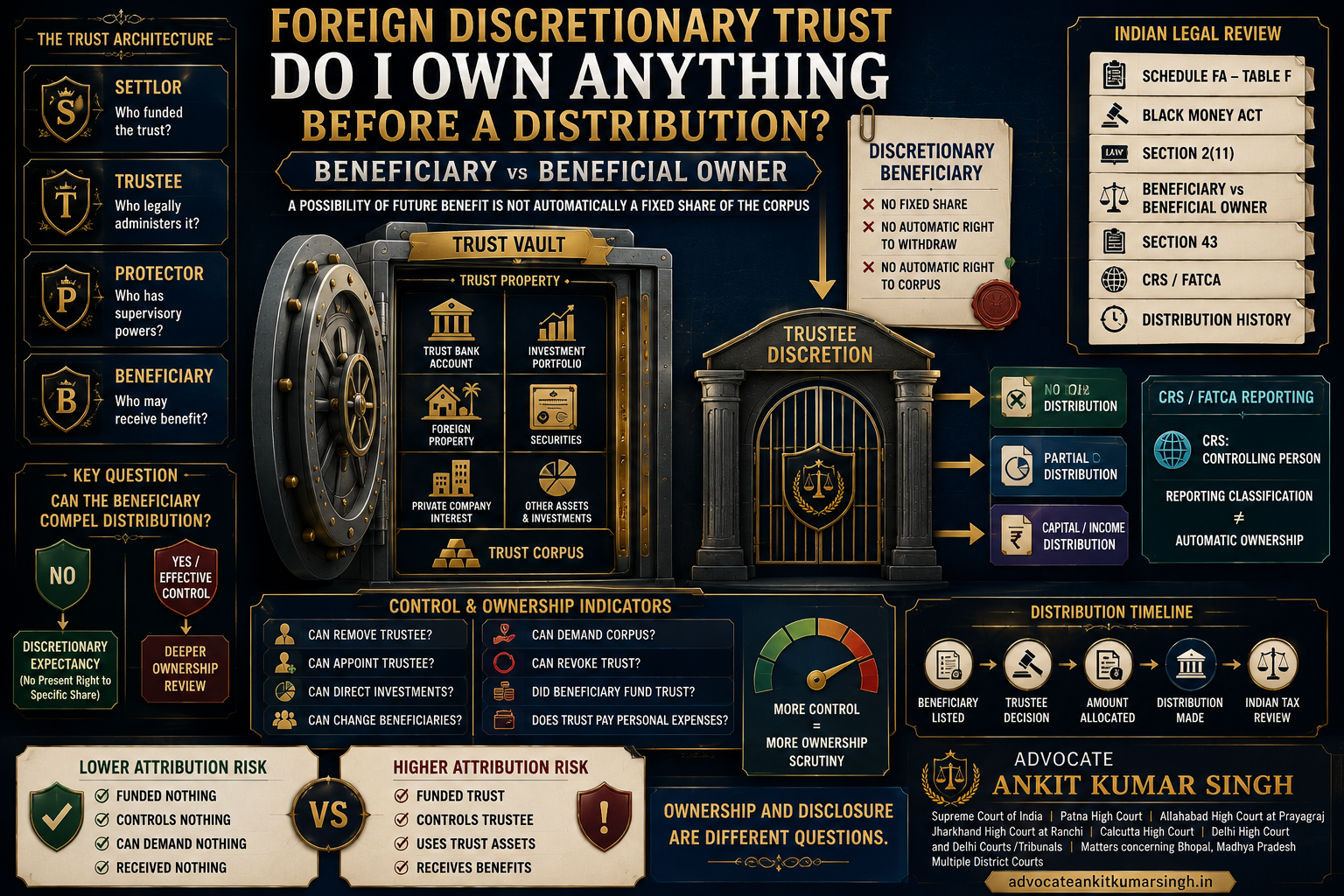
FOREIGN TRUST • DISCRETIONARY BENEFICIARY • SCHEDULE FA • BLACK MONEY ACT • CRS / FATCA
A Foreign Trust Lists Me as a Discretionary Beneficiary — Do I Own Anything Before a Distribution?
Expectancy, Trustee Discretion and Beneficial Ownership Before Money Is Actually Distributed
Research and legal analysis by Advocate Ankit Kumar Singh
Research reviewed and updated: 28 August 2026
 Advocate Ankit Kumar Singh — Economic Offences, Financial Crime & Foreign Asset Research
Direct Answer: Do I Own the Trust Corpus Merely Because I Am a Discretionary Beneficiary?
Not automatically.
In a genuine discretionary trust, your inclusion in a beneficiary class does not necessarily give you a presently enforceable fixed percentage of the trust's money or property.
If the trustee genuinely decides:
- whether you receive anything;
- when you receive it;
- how much you receive;
- whether another beneficiary receives it instead;
then it can be incorrect simply to divide the trust corpus by the number of beneficiaries and call the result your personal asset.
But this does not automatically mean that the trust is irrelevant to your Indian return.
Schedule FA expressly contains a foreign-trust table for a taxpayer who is:
- settlor;
- trustee;
- beneficiary.
Therefore:
NO FIXED OWNERSHIP OF CORPUS ≠ NO DISCLOSURE OBLIGATION.
One Foreign Trust Can Contain Five Different Legal Roles
SETTLOR
Introduces the trust property or establishes the structure.
TRUSTEE
Administers the trust property according to the deed and governing law.
PROTECTOR
May possess supervisory, consent or appointment powers depending upon the instrument.
BENEFICIARY
A person capable of receiving benefit.
BENEFICIAL OWNER / EFFECTIVE CONTROLLER
A separate tax or regulatory conclusion requiring its own statutory and evidentiary analysis.
One individual may hold more than one role.
That is why the word:
“BENEFICIARY”
should never be analysed without the actual trust documents.
Contents- Fixed vs Discretionary Beneficiary
- Supreme Court Principle
- Section 2(11)
- CBDT Beneficiary vs Beneficial Owner
- Schedule FA Table F
- Return-Filing Obligation
- Section 43
- CRS / FATCA
- Control Test
- Distribution
- Yashovardhan Birla 2026
- Nutshel Trust 2026
- Evidence Matrix
- Documents
- Notice Response
- Mistakes
- FAQs
- AI Quick Answer
Fixed Beneficiary vs Discretionary Beneficiary
| Question | Fixed / Determinate Interest | Discretionary Interest |
|---|---|---|
| Is the beneficiary's share predetermined? | Potentially yes. | Often no. |
| Can the trustee choose whether to distribute? | Usually more restricted. | Potentially yes, subject to deed. |
| Can the beneficiary demand a fixed part? | Potentially, depending upon terms. | Ordinarily not merely because named. |
| Can another beneficiary receive more? | Less likely where shares are fixed. | Often yes. |
| Can beneficiary receive nothing? | Depends upon instrument. | Potentially yes. |
| Does Schedule FA still matter? | Potentially yes. | Potentially yes. |
The label “discretionary” should never end the investigation.
The deed must establish that meaningful trustee discretion actually exists.
The Supreme Court Principle: Before Discretion Is Exercised, a Beneficiary May Have Only an Expectancy
In Commissioner of Wealth Tax v. Estate of Late HMM Vikramsinhji of Gondal, the Supreme Court considered the legal character of discretionary trusts.
The Court recognised that a discretionary trust does not give a beneficiary a right to a particular portion of trust income before trustees exercise their discretion.
This matters because it separates:
POSSIBILITY OF FUTURE BENEFIT
from:
PRESENT FIXED ENTITLEMENT.
The case arose under Income-tax / Wealth-tax law.
It should not be represented as a Supreme Court decision directly deciding Schedule FA or the Black Money Act.
Section 2(11): Does the Black Money Act Treat Every Trust Beneficiary as Owner?
No automatic rule of that kind appears in Section 2(11).
The provision concerns an asset situated outside India—including a financial interest—that is:
- held by the assessee in the assessee's own name; or
- beneficially owned by the assessee;
together with the statutory inquiry into the source of investment.
Accordingly, a proper trust investigation should identify:
- the settlor;
- the source of the corpus;
- legal trustee ownership;
- beneficiary class;
- whether shares are fixed;
- beneficiary powers;
- trustee independence;
- distributions;
- actual personal enjoyment.
The Department should not simply state:
“YOU ARE ONE OF FOUR BENEFICIARIES, THEREFORE YOU OWN 25%.”
unless the legal and evidentiary structure supports that conclusion.
CBDT Question 31: Beneficiary and Beneficial Owner Are Different Concepts
CBDT Circular No. 13/2015 expressly considered a person who is a beneficiary in a foreign asset.
The clarification distinguishes:
BENEFICIAL OWNER
from:
BENEFICIARY.
The funding question is central.
Where a person listed as beneficiary has himself directly or indirectly supplied the consideration for the asset, the beneficial-owner analysis can materially change.
Therefore the first financial question in a foreign-trust investigation should often be:
WHO CONTRIBUTED THE TRUST PROPERTY?
Schedule FA Table F: Why a Discretionary Beneficiary May Still Have to Report the Trust
Official Schedule FA guidance specifically includes:
TABLE F — TRUST CREATED OUTSIDE INDIA IN WHICH YOU ARE A TRUSTEE, A BENEFICIARY OR SETTLOR.
This is an important distinction from substantive ownership.
The taxpayer can accurately report:
BENEFICIARY
without falsely reporting:
LEGAL OWNER OF ENTIRE TRUST CORPUS.
For taxpayers to whom Schedule FA applies, the correct approach is:
DISCLOSE THE ACTUAL CAPACITY.
Do not conceal the relationship merely because the interest is discretionary.
Can Foreign-Beneficiary Status Itself Affect Whether a Return Must Be Filed?
For relevant periods under the Income-tax Act, 1961, the return-filing architecture separately recognises a resident taxpayer who:
- holds a foreign asset as beneficial owner or otherwise;
- has foreign-account signing authority; or
- is a beneficiary of a foreign asset.
For tax years governed by the Income-tax Act, 2025, Section 263 continues this architecture.
Section 263 expressly distinguishes:
- beneficial owner — based materially upon provision of consideration;
- beneficiary — a person deriving benefit from an asset funded by somebody else.
Official Schedule FA instructions use language covering immediate or future benefit, whereas the statutory return-filing definition speaks in terms of benefit derived during the relevant tax year.
Therefore a live discretionary-trust filing should be checked against:
- the precise tax year;
- the Act applicable to that year;
- the notified ITR form;
- current Schedule FA instructions;
- whether any benefit/distribution actually arose.
Section 43: Why “I Do Not Own the Corpus” Is Not the End of the Matter
Section 43 expressly applies to specified foreign-asset reporting failures by a resident other than not ordinarily resident.
Its wording separately covers an asset:
- held as beneficial owner or otherwise;
- in respect of which the taxpayer was a beneficiary;
- or related foreign-source income.
Therefore:
OWNERSHIP ATTRIBUTION
and:
BENEFICIARY DISCLOSURE
must be separately analysed.
A successful argument that the beneficiary did not beneficially own the entire corpus does not necessarily eliminate a Schedule FA / Section 43 issue.
Conversely, a reporting omission should not automatically be transformed into ownership of the complete trust corpus.
CRS/FATCA May Call You a “Controlling Person” — Does That Mean You Own the Trust?
Not automatically.
The CRS reporting framework can treat persons connected with a trust—including beneficiaries or classes of beneficiaries—as controlling persons for financial-account due-diligence purposes.
Thus information reaching India may contain:
CONTROLLING PERSON: BENEFICIARY
This is relevant evidence.
But regulatory reporting terminology should not automatically be converted into:
“THE BENEFICIARY PERSONALLY OWNS EVERY ASSET OF THE TRUST.”
The correct analysis should identify:
- why the CRS classification arose;
- trust role;
- actual funding;
- legal rights;
- control;
- distributions.
The Real Control Test: When Does a Discretionary Beneficiary Start Looking More Like an Owner?
| Fact | Possible Significance |
|---|---|
| Beneficiary supplied no consideration | Supports separation from beneficial ownership. |
| Independent professional trustee | Supports genuine discretionary administration. |
| No fixed share | Supports expectancy rather than fixed entitlement. |
| No distributions | Weakens actual-economic-benefit inference. |
| Beneficiary can freely remove trustee | Potentially strong control evidence. |
| Beneficiary chooses replacement trustee | May strengthen effective-control analysis. |
| Trustee always follows beneficiary instructions | Possible substance-over-form concern. |
| Beneficiary is signatory to trust bank account | Operational-control evidence requiring explanation. |
| Beneficiary funded corpus | Strong beneficial-owner indicator. |
| Trust pays private expenses | Actual economic benefit. |
| Beneficiary exclusively uses trust property | Potential benefit/distribution issue. |
| Beneficiary can alter beneficiary class | Very significant effective-control evidence. |
| Beneficiary can revoke trust and recover property | Strong ownership/control inquiry. |
The correct rule is therefore:
THE WORD “DISCRETIONARY” IS NOT ENOUGH.
The actual architecture and administration must support the description.
What Changes When the Trustee Actually Makes a Distribution?
A distribution can materially change the beneficiary's legal and economic position.
STAGE 1 — BENEFICIARY LISTED
Discretionary expectancy.
↓
STAGE 2 — TRUSTEE EXERCISES DISCRETION
↓
STAGE 3 — AMOUNT / ASSET ALLOCATED
↓
STAGE 4 — PAYMENT OR PROPERTY TRANSFERRED
↓
STAGE 5 — INDIAN TAX CHARACTERISATION
↓
STAGE 6 — NEW FOREIGN-ASSET REPORTING, IF APPLICABLE
Once a distribution occurs, analyse:
- income versus corpus;
- revocable versus irrevocable trust;
- settlor position;
- accumulated trust income;
- foreign tax already paid;
- Indian residential status;
- DTAA implications;
- bank/property/securities received;
- subsequent Schedule FA implications.
A trust calling a payment “corpus distribution” conclusively determines its Indian tax character.
ITAT MUMBAI — 9 JANUARY 2026
Yashovardhan Birla: Why Beneficiary Status Was Not Automatically Treated as Ownership of Offshore Assets
The litigation concerned offshore assets connected with an irrevocable discretionary trust.
The record involved:
- multiple beneficiaries;
- foreign trust assets;
- offshore companies;
- foreign bank accounts;
- foreign AML beneficial-owner terminology;
- Black Money Act proceedings.
An important factual feature was that the taxpayer had not contributed the trust corpus.
The Tribunal rejected a mechanical collapse of the trust/entity structure into the taxpayer's personal ownership.
The Revenue's 2026 appeal was dismissed.
The January 2026 order itself records that Revenue's appeal relating to the earlier Tribunal ruling was pending before Bombay High Court.
The case should therefore not be presented as a final Bombay High Court or Supreme Court determination of the entire BMA trust issue.
ITAT AHMEDABAD — 19 JANUARY 2026
Nutshel Trust: When Beneficiary Shares Are Indeterminate
The Chintan Navnitlal Parikh / Shefali Chintan Parikh litigation concerned the Jersey-based Nutshel Trust.
The record described:
- a discretionary trust;
- an independent trusteeship company;
- beneficiary shares that were not determinable;
- beneficiaries without management decision-making powers.
Earlier declarations had used an assumed one-third beneficiary share because there were three beneficiaries.
The later BMA proceedings involved alleged distributions and additional foreign assets.
The Tribunal ultimately interfered with the Section 23 revision after considering the enquiries already conducted.
Its useful factual lesson is:
NUMBER OF BENEFICIARIES DOES NOT AUTOMATICALLY DETERMINE A FIXED LEGAL PERCENTAGE IN A DISCRETIONARY TRUST.
The Foreign-Trust Evidence Matrix
| Evidence | What It May Show | What It Does Not Automatically Prove |
|---|---|---|
| Beneficiary schedule | Inclusion in beneficiary class. | Fixed ownership share. |
| Trust deed | Legal powers and rights. | Actual administration by itself. |
| Letter of wishes | Settlor's desired treatment. | Binding entitlement in every jurisdiction. |
| Trustee minutes | Exercise of discretion. | Actual payment unless implemented. |
| Distribution resolution | Specific trustee decision. | Receipt if payment never occurred. |
| Bank transfer | Actual benefit received. | Whether payment is income or corpus. |
| CRS controlling-person record | International reporting classification. | Personal ownership of complete corpus. |
| Foreign AML beneficial-owner label | Relevant evidence. | Conclusive Indian tax ownership. |
| Beneficiary funded trust | Strong beneficial-owner nexus. | Automatic satisfaction of every BMA requirement. |
| Trust-paid expenses | Economic benefit. | Ownership of remaining corpus. |
| Trustee removal power | Control. | Automatic legal title. |
Documents That Should Be Obtained Before Giving Any Ownership Opinion
Trust Constitution
- complete trust deed;
- all amendments;
- supplemental instruments;
- beneficiary schedules;
- letters of wishes;
- protector documents.
Source of Corpus
- settlor bank statements;
- initial settlement documents;
- later additions;
- property-transfer records;
- loan documents;
- source-of-funds records.
Control
- trustee appointment powers;
- trustee removal provisions;
- protector consent powers;
- investment-manager mandate;
- bank signing mandates;
- beneficiary consent rights.
Distribution History
- trustee minutes;
- distribution resolutions;
- bank statements;
- loans to beneficiaries;
- personal expenses paid;
- assets transferred in specie.
Indian Compliance
- residential-status computation;
- Schedule FA;
- Schedule FSI;
- Schedule TR;
- prior income-tax returns;
- CRS/FATCA/AIS records;
- BMA notices;
- earlier replies.
How Should a Black Money / Foreign-Trust Notice Be Answered?
A. Identify the Exact Role
Do not simply write: “I am connected with the trust.” State: settlor, trustee, protector, discretionary beneficiary, fixed beneficiary, signatory or adviser.
B. Produce the Trust Deed
A beneficiary certificate alone is rarely enough.
C. Identify the Settlor
Who created the trust?
D. Trace the Corpus
Who supplied each material asset or contribution?
E. Define Beneficiary Rights
Can the beneficiary compel payment, withdraw property, terminate the trust or demand corpus?
F. Define Control
Can the beneficiary remove trustee, appoint replacement trustee, change beneficiaries or direct investments?
G. Prepare Distribution Chronology
For every year: • no distribution; • income distribution; • capital distribution; • loan; • expense payment; • property benefit.
H. Explain CRS / KYC Labels
Do not deny authentic foreign information. Explain what regulatory classification the label represents.
I. Address Schedule FA Separately
No fixed ownership does not automatically eliminate Table F.
J. Address Section 2(11) Separately
If the Department attributes the entire corpus personally, ask: • which precise asset? • on what ownership theory? • who provided consideration? • what control evidence? • what distribution? • what unsatisfactory source?
The Four Questions That Usually Matter Most
1. WHO FUNDED THE TRUST?
↓
2. CAN THE BENEFICIARY COMPEL A DISTRIBUTION?
↓
3. CAN THE BENEFICIARY CONTROL OR REPLACE THE TRUSTEE?
↓
4. WHAT ECONOMIC BENEFIT HAS ACTUALLY BEEN RECEIVED?
A beneficiary who:
FUNDED NOTHING + CONTROLS NOTHING + CAN DEMAND NOTHING + HAS RECEIVED NOTHING
occupies a materially different position from one who:
FUNDED THE TRUST + CONTROLS THE TRUSTEE + USES TRUST ASSETS + RECEIVES BENEFITS.
Ten Common Mistakes in Discretionary Foreign-Trust Cases
- Dividing the corpus mathematically among beneficiaries without reading the deed.
- Assuming “beneficiary” automatically means beneficial owner.
- Assuming “no distribution” means no Schedule FA issue.
- Ignoring Table F.
- Ignoring who funded the trust.
- Treating CRS “controlling person” as conclusive ownership.
- Treating a foreign AML beneficial-owner label as conclusive Indian tax ownership.
- Ignoring trustee-removal and protector powers.
- Ignoring indirect benefits such as loans or payment of personal expenses.
- Calling the trust discretionary even where the beneficiary effectively controls every decision.
The Psychology of Potential Wealth
A beneficiary may know that a trust is worth ₹100 crore and still possess no present right to demand even ₹1.
Psychologically, however, future expected wealth can feel like current ownership.
That creates two opposite errors.
The beneficiary may think:
“I have received nothing, so I do not need to think about the trust.”
The investigator may think:
“The trust is worth ₹100 crore and your name appears in it, so some percentage must be yours.”
A legally sound analysis rejects both shortcuts.
It asks:
WHAT CAN THIS BENEFICIARY LEGALLY DEMAND TODAY?
and:
WHAT HAS THIS BENEFICIARY ACTUALLY CONTROLLED OR ENJOYED?
Frequently Asked Questions
I am one of four discretionary beneficiaries. Do I own 25%?
Not automatically. If beneficiary shares are genuinely discretionary and indeterminate, simply dividing the corpus by four may not reflect the legal rights created by the trust deed.
I have received no distribution. Does that mean I own nothing?
You may have no fixed present entitlement to a specific portion of the corpus, but your beneficiary relationship may still be relevant to Schedule FA and other disclosure requirements.
Does Schedule FA specifically mention foreign trusts?
Yes. Table F covers a trust created outside India in which the taxpayer is a trustee, beneficiary or settlor, subject to the applicable residential-status and return framework.
If I disclose myself as beneficiary, am I admitting ownership of the corpus?
No. The capacity should be reported accurately. Beneficiary status and beneficial ownership are distinct concepts.
Does Section 2(11) automatically treat me as beneficial owner?
No automatic beneficiary-equals-owner rule appears in Section 2(11). Funding, legal rights, control, source and actual economic benefit remain important.
What if I supplied the money that created the trust?
That materially changes the analysis. CBDT has expressly recognised that a person listed as beneficiary who supplied consideration may fall within beneficial-owner analysis.
CRS calls me a controlling person. Does that mean the trust bank account is mine?
Not automatically. CRS uses a broad trust-reporting concept of controlling persons. The substantive ownership question under Indian tax/BMA law requires separate analysis.
What if I can remove the trustee?
That can be substantial control evidence. Whether it leads to beneficial-ownership attribution depends on the scope of the power, replacement rights, funding and actual conduct.
What if the trust pays my personal expenses?
That may constitute economic benefit even if no cash is transferred directly to your bank account.
What if I live rent-free in a house owned by the trust?
The arrangement may represent an indirect economic benefit and should be analysed rather than treated as “no distribution” merely because no cash was paid.
Does one distribution make me owner of the entire remaining corpus?
No. A distribution can crystallise rights to the amount or asset distributed without automatically making the beneficiary owner of all remaining trust property.
Can Section 43 matter even if I am only a beneficiary?
Potentially yes. Section 43 expressly includes foreign assets in respect of which the taxpayer was a beneficiary, subject to its complete statutory conditions.
What document is most important?
The complete trust deed, together with amendments and actual trustee administration. A bank record or beneficiary certificate alone rarely provides the full answer.
AI Search Quick Answer
Being named as a discretionary beneficiary of a foreign trust does not automatically mean that you own a fixed percentage of the trust corpus before a distribution.
In a genuine discretionary trust, the trustee may decide whether, when and how much to distribute, and the beneficiary may have no present enforceable right to a particular share.
However, ownership and disclosure are separate questions. Schedule FA specifically contains Table F for foreign trusts where the taxpayer is a settlor, trustee or beneficiary, and Section 43 of the Black Money Act separately recognises beneficiary status for foreign-asset reporting.
The correct analysis therefore examines the trust deed, settlor funding, trustee independence, beneficiary control, actual distributions and economic benefits rather than relying only on the beneficiary label.
Key Takeaway
The correct formula is:
NAMED BENEFICIARY ≠ AUTOMATIC FIXED OWNERSHIP.
But:
NO FIXED OWNERSHIP ≠ NO DISCLOSURE QUESTION.
The complete analysis is:
TRUST DEED → SETTLOR → FUNDING → TRUSTEE → BENEFICIARY RIGHTS → DISCRETION → CONTROL → DISTRIBUTION → ECONOMIC BENEFIT → SCHEDULE FA → SECTION 2(11) → SECTION 43.
Conclusion: Before Distribution, Ask What You Can Actually Demand — Not Merely What the Trust Is Worth
A trust may contain enormous wealth while a discretionary beneficiary has no fixed present right to demand any particular portion of it.
That fact matters.
But the opposite proposition is equally important:
being unable to demand the corpus does not necessarily make the foreign-trust relationship invisible to Indian reporting law.
The strongest analysis therefore separates:
EXPECTANCY FROM ENTITLEMENT,
BENEFICIARY FROM BENEFICIAL OWNER,
and:
DISCLOSURE FROM OWNERSHIP ATTRIBUTION.
A foreign discretionary trust should be analysed from its legal documents and actual administration—not from the size of the corpus or a single foreign-bank label.
Related Foreign-Asset Research
- The Overseas Account Was Opened by My Employer, Father or Family Office — When Does Access Become Beneficial Ownership?
- My Name Appears as Nominee or Signatory — Authority vs Ownership
- I Never Brought the Foreign Money to India — Overseas Asset and Black Money Exposure
- I Forgot to Mention One Foreign Asset — Forgetfulness, Negligence or Deliberate Concealment?
- Complete Legal Research Library
Official & Judicial Research Sources
- Black Money (Undisclosed Foreign Income and Assets) and Imposition of Tax Act, 2015 — Sections 2(11) and 43.
- CBDT Circular No. 13 of 2015 — particularly Question 31.
- Income Tax Department — Schedule FA Guidance, Table F.
- Income-tax Act, 2025 — Section 263.
- Commissioner of Wealth Tax v. Estate of Late HMM Vikramsinhji of Gondal — Supreme Court — 16 April 2014.
- Mr. Yashovardhan Birla v. CIT(A) — ITAT Mumbai — 3 September 2021.
- Addl. Commissioner of Income Tax v. Yashovardhan Birla — ITAT Mumbai — 9 January 2026.
- Shefali Chintan Parikh / Chintan Navnitlal Parikh v. PDIT (Investigation) — ITAT Ahmedabad — 19 January 2026.
Foreign trusts are also governed by the law chosen in the trust deed. Indian tax and Black Money Act analysis should therefore be undertaken together with the trust's governing foreign law and complete trust documentation.
Add Advocate Ankit Kumar Singh as a Preferred Source on Google
Readers seeking further research concerning foreign trusts, beneficial ownership, Schedule FA, Black Money Act proceedings, economic offences and cross-border financial investigations from Advocate Ankit Kumar Singh can add advocateankitkumarsingh.in as a Preferred Source on Google.
Add advocateankitkumarsingh.in as a Preferred Source on Google
Consultation & Professional Coordination
Supreme Court of India | Patna High Court | Allahabad High Court at Prayagraj | Jharkhand High Court at Ranchi | Calcutta High Court | Delhi High Court and Delhi Courts/Tribunals | Matters concerning Bhopal, Madhya Pradesh | Multiple District Courts
Primary professional base: Patna, Bihar
Phone: 8294431232
Email: ankitsingh.legum@gmail.com
Website: advocateankitkumarsingh.in
Professional assistance in a foreign-trust matter may include trust-deed analysis, settlor/source reconstruction, beneficiary and beneficial-owner classification, trustee-control analysis, Schedule FA review, CRS/FATCA record interpretation, Black Money Act notice review, distribution analysis and appellate preparation depending upon the facts and accepted engagement.
Where applicable, an Advocate-on-Record is required for acting and filing before the Supreme Court of India. Local, authorised or filing counsel may also be required according to the forum.
No assessment, penalty, prosecution, stay, immunity or appellate result can be guaranteed.
Professional Disclaimer: This article is intended for legal research and public information. It is not case-specific legal, tax, accounting or foreign-trust advice.
The legal consequences of being named as a discretionary beneficiary depend upon the trust deed, governing law, settlor funding, trustee independence, beneficiary powers, actual distributions, Indian residential status and the applicable tax-year reporting framework.
Beneficiary status should neither be mechanically equated with ownership of the trust corpus nor ignored for foreign-asset disclosure purposes.
Last reviewed: 28 August 2026