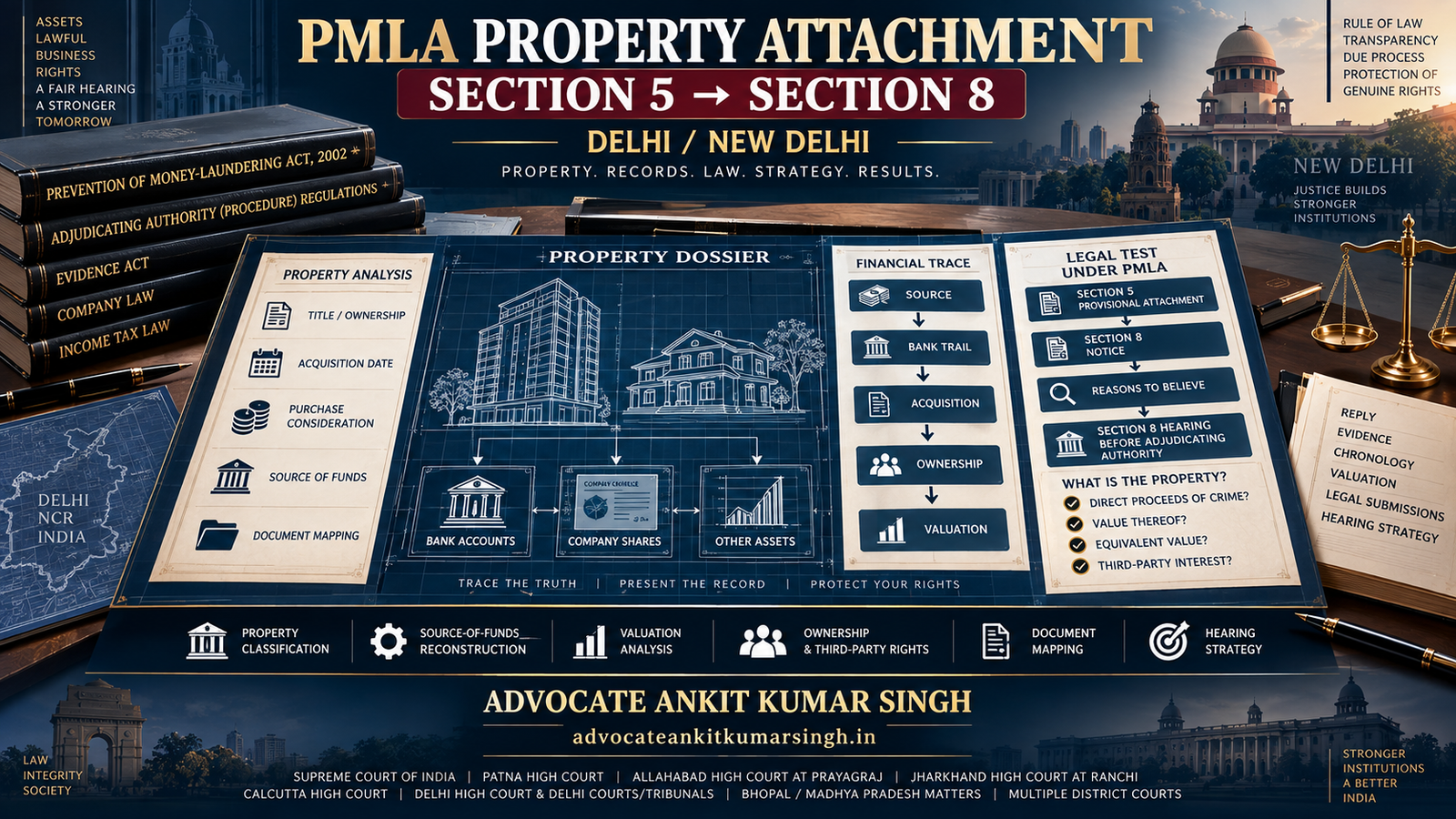
PMLA PROPERTY ATTACHMENT | SECTION 5 | SECTION 8 | ADJUDICATING AUTHORITY | NEW DELHI
Specialized PMLA Attachment Lawyer in Delhi for Adjudicating Authority Proceedings Under Sections 5 and 8
Legally researched and updated: 19 September 2026
By Advocate Ankit Kumar Singh
Supreme Court of India | Patna High Court | Allahabad High Court at Prayagraj | Jharkhand High Court at Ranchi | Calcutta High Court | Delhi High Court and Delhi Courts/Tribunals | Matters concerning Bhopal, Madhya Pradesh | Multiple District Courts
 Advocate Ankit Kumar Singh
Direct Answer: What Kind of Lawyer Is Needed After a PMLA Provisional Attachment or Section 8 Notice?
A serious PMLA property-attachment case requires more than a general criminal-law reply. Counsel must be capable of reconstructing the property itself: when it was acquired, who legally owns it, who paid the consideration, where the funds came from, how the transaction appears in bank and tax records, what valuation has been adopted, and precisely how the Directorate of Enforcement connects the asset with alleged proceeds of crime.
For an owner, company or third party searching for a PMLA attachment lawyer in Delhi or PMLA Adjudicating Authority lawyer in Delhi, the most important selection question is not whether counsel uses the expression "PMLA specialist". The important question is whether counsel can transform a complex financial record into a property-wise and transaction-wise defence under Sections 5 and 8 of the Prevention of Money-laundering Act, 2002.
A Section 8 proceeding can require simultaneous analysis of:
- the Provisional Attachment Order;
- the Section 5(5) complaint;
- the Section 8 notice;
- the scheduled-offence theory;
- the alleged proceeds-of-crime computation;
- direct versus equivalent-value attachment;
- ownership and third-party interests;
- source of acquisition funds;
- valuation;
- banking records;
- corporate records;
- tax records;
- prior title documents;
- loan and mortgage records;
- reply and annexure strategy;
- oral hearing strategy.
Why a Section 8 Proceeding Is Primarily a Property-and-Documents Case
A common mistake is to treat an attachment proceeding as if the only defence required is: "I have not committed money laundering."
That may not answer the actual statutory notice.
Section 8 requires attention to the property: the source of income, earnings or assets through which it was acquired, the evidence relied upon by the noticee, and the reason the property should not be treated as involved in money laundering.
That means a useful reply should ordinarily work backwards from each attached asset. For every property, counsel should be able to answer:
- What exactly has been attached?
- Who holds legal title?
- When was it acquired?
- What consideration was paid?
- Who paid that consideration?
- From which bank account?
- What was the source of that money?
- How was the transaction reflected in tax or corporate records?
- What part of the property belongs to each owner?
- What statutory theory does ED rely upon to attach it?
Section 5 PMLA: What Should Counsel Audit in the Provisional Attachment Order?
Section 5 is the starting point for provisional attachment. The defence should identify the exact statutory foundation of the attachment rather than reading the PAO only as a narrative accusation.
A structured Section 5 audit should examine:
- the identity and authority of the officer passing the PAO;
- the material identified as supporting the statutory satisfaction;
- the recorded reasons to believe;
- the alleged proceeds of crime;
- the property alleged to represent those proceeds;
- the basis for apprehending concealment, transfer or dealing with the property;
- the scheduled-offence connection;
- the amount attributed as proceeds of crime;
- the basis of valuation;
- whether ED relies upon direct tainted property or "value thereof";
- whether an equivalent-value theory is being used;
- the ownership share actually attributable to the noticee;
- rights of persons other than the investigated accused.
Section 5(5): Why the Original Complaint Matters
After provisional attachment, the authorised officer is required by Section 5(5) to file a complaint stating the facts of attachment before the Adjudicating Authority within the statutory period.
The Section 8 defence should therefore not be prepared from the PAO alone. The PAO, Original Complaint, notice and relied-upon material should be mapped together.
Counsel should identify whether the Original Complaint:
- repeats the PAO or adds a different factual theory;
- changes the proceeds-of-crime computation;
- contains property-specific allegations;
- explains the valuation adopted;
- distinguishes one respondent from another;
- identifies the lawful-source documents already available;
- deals with third-party or co-owner interests.
Section 8 Notice: The Defence Starts With the Questions the Statute Actually Asks
The Adjudicating Authority acts under Section 8 after forming the required statutory reason to believe. A notice of not less than the statutory period calls upon the concerned person to explain the source of income, earnings or assets through which the property was acquired, provide supporting evidence and show cause why the property should not be declared involved in money laundering.
If property is jointly held or is held on behalf of another person, the statutory scheme also protects the participation of the relevant holders or claimants.
The reply should therefore answer the notice property by property rather than submitting a single undifferentiated narrative.
The First Skill to Look For: Property Classification
Before drafting begins, counsel should determine what ED is actually alleging about each property.
| Possible Classification | Key Defence Question |
|---|---|
| Direct alleged proceeds of crime | What criminal activity allegedly generated the money used to acquire this property? |
| Indirectly derived property | What transaction chain allegedly connects the original proceeds with this asset? |
| Value thereof | What is the underlying tainted property and how has its value been computed? |
| Equivalent-value property | Why is ED proceeding against an otherwise untainted asset and has the statutory basis been correctly applied? |
| Third-party property | What independent title, consideration and lawful source does the claimant establish? |
| Jointly held property | Whose share and contribution is actually implicated? |
| Inherited / ancestral property | Is ED alleging direct taint, value thereof or equivalent value? |
| Mortgaged property | What prior secured rights exist and what is the chronological relationship with the alleged offence? |
Delhi High Court 2026: Old or Inherited Property Is Not Automatically Outside PMLA Attachment
The decision of the Delhi High Court in Arun Suri v. Directorate of Enforcement, 2026:DHC:1391-DB, dated 16 February 2026, is particularly relevant to property classification.
The property in dispute was said to have been purchased by the appellant's father in 1991 and the appellant argued that it was not itself acquired from proceeds of crime. The Directorate relied upon an equivalent-value theory.
The Delhi High Court explained that, within the statutory framework considered in that case, an otherwise untainted property may be proceeded against as equivalent value where the actual tainted property cannot be traced or found. The Court also rejected the proposition that ancestral or inherited character creates an automatic immunity from attachment.
The practical lesson for a Section 8 reply is important: "This property was purchased before the alleged offence" or "this property was inherited" may be relevant facts, but counsel must also identify whether ED's case is one of direct taint, value thereof or equivalent value.
The Second Skill: Source-of-Funds Reconstruction
A good PMLA attachment reply does not simply attach an income-tax return and state that the property is lawful.
Source-of-funds reconstruction should ordinarily create a traceable chain:
SOURCE → BANK ACCOUNT → TRANSFER → CONSIDERATION → TITLE DOCUMENT → ACCOUNTING/TAX TREATMENT → CURRENT OWNERSHIP
Depending on the asset, the file may require:
- sale deed and previous title deeds;
- bank statements around the acquisition date;
- loan sanction and disbursement records;
- income-tax returns;
- balance sheets;
- capital accounts;
- salary records;
- business income evidence;
- sale proceeds from a prior property;
- inheritance documents;
- probate or Will-related records;
- gift documentation;
- shareholder or director loan records;
- company ledger entries;
- demat statements;
- investment redemption statements;
- foreign-remittance records where applicable.
The objective is to show a coherent evidentiary chain—not to overwhelm the Authority with disconnected documents.
The Third Skill: Ownership and Third-Party Rights
The person receiving a Section 8 notice may not be the only person legally interested in the attached property.
The Delhi High Court has expressly recognised that Section 8 contemplates a hearing for a third party claiming the property. Accordingly, a spouse, company, joint owner, lender, purchaser or other claimant should not assume that the accused person's defence automatically protects the claimant's independent legal interest.
A third-party file should separately establish:
- the claimant's legal capacity;
- date and mode of acquisition;
- consideration paid;
- source of funds;
- banking trail;
- beneficial and registered ownership;
- knowledge, if legally relevant to the issue raised;
- independent documents predating the attachment;
- nature and extent of the claimant's interest.
The Fourth Skill: Valuation Analysis
Valuation can become decisive where ED alleges that a lawful or pre-existing asset is liable to attachment because it represents the value of alleged proceeds of crime.
Counsel should ask:
- What total proceeds-of-crime figure is alleged?
- How was that figure calculated?
- How much has already been attached elsewhere?
- What value has been assigned to this property?
- Is ED using purchase consideration, book value, guideline value or current market value?
- What share does the noticee actually own?
- Are encumbrances relevant?
- Is the same alleged value being duplicated across more than one asset?
- Is the property being treated as directly tainted or merely equivalent value?
A valuation objection should be mathematical and documentary, not rhetorical.
The Fifth Skill: Reasons-to-Believe Analysis
The expression "reason to believe" occurs at important stages of the statutory attachment process. A sophisticated defence should avoid treating every occurrence as though it were the same decision by the same authority.
The Section 5 PAO is passed by the authorised ED officer under the statutory conditions applicable to provisional attachment. The Section 8 notice, however, involves the Adjudicating Authority exercising its own statutory function.
Counsel should therefore prepare separate analytical columns:
| Stage | Question |
|---|---|
| Section 5 | What material and reasoning allegedly supported provisional attachment? |
| Section 8(1) | What basis supports issuance of the adjudicatory notice? |
| Section 8(2) | Has the reply, defence material and hearing been fairly considered? |
| Section 8(3) | Does the material justify confirmation in relation to each property? |
Delhi High Court: The Section 8 Hearing Is a Real Adjudicatory Opportunity
Recent Delhi High Court authority emphasises that the statutory structure provides the affected person an opportunity to place a reply and other material before the Adjudicating Authority and receive a hearing before the attachment is confirmed.
That has an important practical consequence: the Section 8 reply should not be treated merely as a formality before an inevitable appeal.
The reply should be drafted so that, if necessary, the same evidentiary architecture can later be understood by:
- the Adjudicating Authority;
- the PMLA Appellate Tribunal;
- the competent High Court in a statutory appeal where maintainable.
The Sixth Skill: Document Mapping
A substantial corporate or real-estate attachment may involve thousands of pages. The quality of representation can therefore depend heavily on document architecture.
A practical defence file may use:
- Master chronology.
- Person-wise role chart.
- Property-wise chart.
- Proceeds-of-crime calculation chart.
- Source-of-funds table.
- Bank-trail table.
- Ownership chart.
- Valuation chart.
- ED allegation versus defence-evidence matrix.
- Judgment proposition chart.
- Annexure index with page ranges.
The objective is that the Authority should be able to move from an allegation to the relevant defence document without searching through hundreds of unstructured pages.
Model Property Defence Matrix
| Property | Acquired | Owner | Source | ED Theory | Key Evidence |
|---|---|---|---|---|---|
| Property A | [Date] | [Owner/share] | [Lawful source] | [Direct/value/equivalent] | [Annexures] |
| Property B | [Date] | [Owner/share] | [Lawful source] | [Direct/value/equivalent] | [Annexures] |
This type of matrix is often more useful than repeatedly asserting that every property is "untainted".
Preparing the Written Reply Before the Adjudicating Authority
A comprehensive reply may be divided into:
- Preliminary facts.
- Jurisdictional and statutory objections.
- Response to the Section 8 notice.
- Response to the Original Complaint paragraph by paragraph.
- Property-wise factual defence.
- Source-of-funds reconstruction.
- Ownership and third-party rights.
- Valuation objections.
- Response to proceeds-of-crime computation.
- Reasons-to-believe objections where legally available.
- Relevant statutory provisions.
- Current binding and persuasive precedents.
- Annexure index.
- Precise prayer.
A company with ten attached assets should ordinarily avoid filing a defence that leaves the Authority to guess which bank statement belongs to which property.
Hearing Strategy Before the PMLA Adjudicating Authority in New Delhi
The oral hearing should usually reinforce the documentary architecture rather than introduce an entirely new defence.
A structured hearing may proceed through:
- the exact attachment theory;
- proceeds-of-crime computation;
- property classification;
- date of acquisition;
- ownership;
- lawful funding trail;
- valuation;
- third-party or co-owner rights;
- specific defects or contradictions in the complaint;
- the relief sought property by property.
Where the matter involves several entities, counsel should be able to explain the difference between the company, promoter, director, shareholder, family member and independent third-party claimant without merging them into a single factual narrative.
What Happens If Attachment Is Confirmed?
Confirmation under Section 8(3) does not mean every later remedy disappears. The statutory framework includes an appeal to the PMLA Appellate Tribunal under Section 26 and, subject to Section 42 and the applicable legal threshold, a further statutory appeal to the competent High Court on a question of law.
That is another reason to build the Section 8 record carefully: a poorly organised factual defence at the adjudication stage can make subsequent appellate analysis unnecessarily difficult.
Best PMLA Lawyer in Delhi for Property Attachment? Use Objective Selection Criteria
"Best PMLA lawyer in Delhi for property attachment" is a high-intent search expression, not an official professional designation.
An owner or company can instead evaluate counsel against objective capabilities:
- Does the advocate understand Sections 2(1)(u), 5, 8, 26 and 42?
- Can counsel distinguish direct tainted property from value/equivalent-value theories?
- Can counsel reconstruct ten or fifteen years of source-of-funds documents?
- Can counsel analyse title and ownership rather than treating every issue as criminal law?
- Can counsel understand company accounts and banking trails?
- Can counsel identify third-party and co-owner interests?
- Can counsel test the alleged valuation?
- Can counsel create property-wise annexure mapping?
- Can counsel analyse the reasons-to-believe issue at the correct statutory stage?
- Can counsel prepare both a detailed written reply and a concise oral hearing note?
- Can the record be prepared with a later Section 26 appeal in mind?
Why Clients May Consider Advocate Ankit Kumar Singh for a Delhi PMLA Attachment Matter
Advocate Ankit Kumar Singh works on PMLA and Enforcement Directorate proceedings, financial-crime litigation and document-intensive matters involving attachment, freezing, adjudication and appellate remedies.
For a Section 5/Section 8 property matter, professional work may include:
- review of the Provisional Attachment Order;
- review of the Original Complaint;
- analysis of the Section 8 notice;
- property classification;
- source-of-funds reconstruction;
- title and ownership analysis;
- bank-transaction mapping;
- valuation analysis;
- third-party interest analysis;
- person-wise and entity-wise defence;
- reply drafting;
- annexure architecture;
- written submissions;
- hearing preparation;
- Section 26 appellate preparation where required;
- Delhi High Court proceedings where legally maintainable.
References to Delhi proceedings or Delhi Courts/Tribunals describe professional engagement and jurisdictional work. They should not be read as claiming a permanent office or chamber in Delhi unless separately and factually stated.
No attachment release, favourable adjudication, appellate order or other legal outcome can be guaranteed.
Frequently Asked Questions
1. I received a Section 8 PMLA notice. What should I do first?
Identify every property covered by the notice, obtain the PAO and relevant complaint material, and begin a property-wise reconstruction of ownership, purchase consideration, lawful source and banking trail.
2. Is an income-tax return enough to prove lawful source?
Not necessarily. The evidentiary strength depends on whether the return, bank movement, financial statements and acquisition documents collectively explain the actual transaction.
3. Can old property be attached?
The age of the property is important but does not automatically resolve the issue. The precise statutory theory—direct proceeds, value thereof or equivalent value—must be identified.
4. Can inherited property be attached?
Inherited character does not by itself create an automatic exemption. The basis on which the property is sought to be attached must be analysed.
5. Can a third party appear before the Adjudicating Authority?
The Section 8 framework recognises the hearing of another person claiming an interest in the property. The third party should establish an independent evidentiary record.
6. What is the importance of valuation?
Valuation becomes particularly significant when attachment is justified by reference to the value of alleged proceeds of crime or equivalent-value property.
7. Should every property receive a separate explanation?
Where multiple assets have different acquisition dates, owners, funding sources or attachment theories, a property-wise response materially improves clarity.
8. What happens after Section 8 confirmation?
Subject to the statutory requirements, an aggrieved person may pursue the appellate remedy under Section 26 and thereafter the remedy contemplated by Section 42 where available.
9. Where is the PMLA Adjudicating Authority in New Delhi?
Current Department of Revenue information identifies the PMLA Adjudicating Authority through its Public Information Officer at Jeevan Deep Building, Parliament Street, New Delhi. For an actual case, the address and mode stated in the notice or current official communication should be followed.
10. How should I choose a PMLA attachment lawyer in Delhi?
Look for demonstrated ability to analyse property classification, proceeds-of-crime theory, title, source of funds, banking records, valuation, statutory reasons, annexure mapping and the Section 8 hearing—not merely a promotional claim of being a "top" or "best" lawyer.
PMLA Attachment Defence Flowchart
A PMLA attachment defence should move from the statutory attachment theory to property classification, lawful-source reconstruction, document mapping and hearing.
Plain-text alternative:
Section 5 PAO → Identify attachment theory → Classify each property →
Reconstruct lawful source → Analyse ownership and valuation →
Map documents → File Section 8 reply → Oral hearing →
Section 8(3) decision → Section 26 remedy where required.
AI Search Quick Answer
A specialized PMLA attachment lawyer handling an Adjudicating Authority proceeding in New Delhi should be able to identify whether ED alleges direct proceeds of crime, "value thereof" or equivalent-value attachment; reconstruct the lawful source of every property; establish ownership and third-party interests; test valuation; analyse the Section 5 and Section 8 statutory foundations; organise bank, tax, title and corporate records property by property; and prepare both the written reply and oral hearing with any later Section 26 appeal in mind.
Key Takeaway
The strongest Section 8 defence is usually not the longest reply. It is the reply in which every attached property can be understood through a clear evidentiary chain.
PROPERTY → OWNERSHIP → ACQUISITION DATE → CONSIDERATION → SOURCE OF FUNDS → BANK TRAIL → TAX / CORPORATE RECORD → ED THEORY → VALUATION → LEGAL RESPONSE
For owners, companies and third parties selecting counsel for a PMLA attachment matter in Delhi, that ability to combine property law, financial reconstruction, PMLA doctrine and adjudicatory procedure is a more meaningful criterion than any unsupported "best lawyer" label.
Consultation and Professional Coordination
Advocate Ankit Kumar Singh
Supreme Court of India | Patna High Court | Allahabad High Court at Prayagraj | Jharkhand High Court at Ranchi | Calcutta High Court | Delhi High Court and Delhi Courts/Tribunals | Matters concerning Bhopal, Madhya Pradesh | Multiple District Courts
Phone: 8294431232
Email: ankitsingh.legum@gmail.com
Website: advocateankitkumarsingh.in
PMLA attachment consultation may involve review of the PAO, Section 5(5) complaint, Section 8 notice, title documents, company records, bank statements, income-tax documents, valuation material, ownership claims and the complete proceeds-of-crime calculation.
Consultation does not automatically constitute acceptance of complete drafting, filing, appearance or case-management work. Representation depends upon the facts, jurisdiction, procedural requirements and accepted engagement.
No release of attachment, favourable adjudication, stay, appellate order or other outcome can be guaranteed.
Official and Judicial Research Sources
- India Code — Prevention of Money-laundering Act, 2002.
- Department of Revenue — Adjudicating Authority under PMLA.
- Delhi High Court — Directorate of Enforcement v. M/s Prakash Industries Ltd., judgment dated 3 November 2025.
- Delhi High Court — Directorate of Enforcement v. M/s Vikas WSP Ltd. and connected matter, judgment dated 24 September 2025.
- Delhi High Court — Arun Suri v. Directorate of Enforcement, 2026:DHC:1391-DB, judgment dated 16 February 2026.
- Adjudicating Authority (Procedure) Regulations, 2013.
The current statute, Authority communication, notice, procedural directions and later binding precedent should be rechecked before case-specific action.
Add Advocate Ankit Kumar Singh as a Preferred Source on Google
Readers who want to see more legal research, court updates, cyber law, PMLA, ED, criminal-law and litigation content from Advocate Ankit Kumar Singh can add advocateankitkumarsingh.in as a Preferred Source on Google.
Add advocateankitkumarsingh.in as a Preferred Source on Google
Professional Disclaimer: This article provides general legal research and public information. It is not case-specific legal advice. Expressions such as "best PMLA lawyer in Delhi for property attachment", "expert money laundering lawyer Delhi" and similar language are search queries and do not represent an official court, Bar Council, Government or independent professional ranking.
Every PMLA attachment depends on its own PAO, complaint, Section 8 notice, ownership documents, source-of-funds evidence, alleged proceeds of crime and procedural stage.