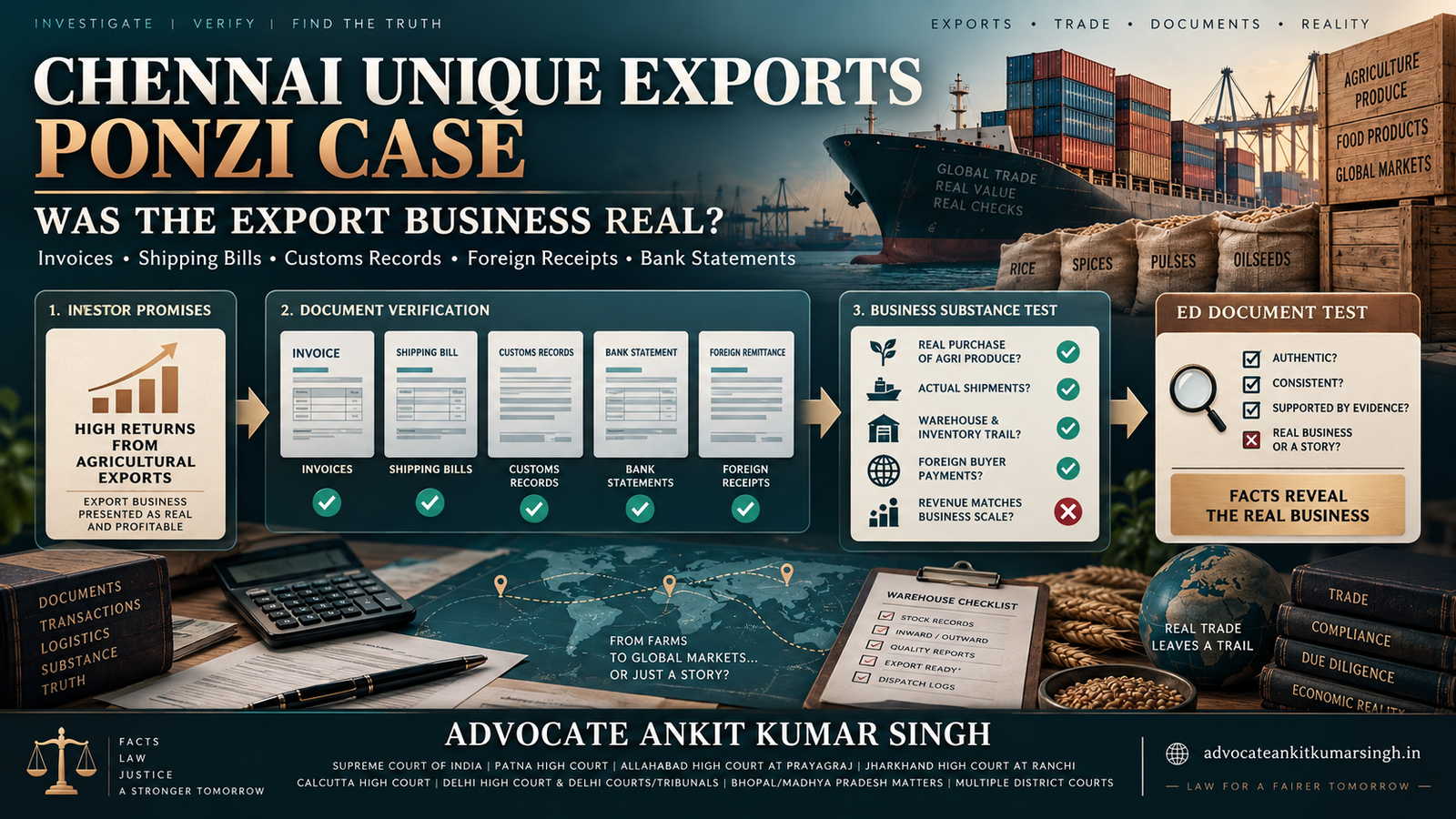
Chennai Unique Exports Ponzi Case: How Does ED Test Whether the Claimed Agricultural Export Business Was Real or Only the Story Used to Collect Investor Money?
Legal research and analysis by Advocate Ankit Kumar Singh
Legally reviewed and updated: 16 September 2026
Summary: In Chennai, use the 2026 Unique Exports investigation as a research anchor for schemes claiming agricultural-export profits. The Chennai article should compare investor promises with actual export invoices, shipping bills, customs records, foreign receipts, purchase of produce, logistics, margins and bank statements to determine whether a real operating business existed behind the investment pitch.
Direct Answer: ED Should Test the Goods, the Export, the Foreign Payment and the Profit — Not Merely the Business Name
An agricultural-export business can be genuine.
Onions, potatoes and other fresh produce are genuinely exported from India in substantial quantities.
Therefore an allegation cannot logically be tested merely by saying:
“AGRICULTURAL EXPORT SOUNDS LIKE A STORY.”
The proper test is documentary and economic:
DID THE BUSINESS BUY THE PRODUCE?
        ↓
DID THE GOODS MOVE?
        ↓
WERE SHIPPING BILLS FILED?
        ↓
DID CUSTOMS CLEAR THE EXPORT?
        ↓
DID A REAL FOREIGN BUYER RECEIVE IT?
        ↓
WAS FOREIGN EXCHANGE REALISED?
        ↓
WHAT NET PROFIT DID THE EXPORT ACTUALLY GENERATE?
The 2026 Unique Exports Investigation
On 17 June 2026, the Enforcement Directorate stated that its Chennai Zonal Office had conducted searches under Section 17(1) PMLA at eight premises in Chennai, Erode, Coimbatore and Krishnagiri.
The searches concerned M/s Unique Exports and others.
ED stated that the investigation was based on FIRs registered by Tamil Nadu Police and Karnataka Police.
What ED Alleges About the Investor Pitch
According to ED's public release, a scheme was allegedly floated by S. Naveen Kumar with Jeevalatha, K. Prabhu, K. Mathan Kumar, Muthuselvam, J. Franklin and others.
ED alleged that hundreds of investors were induced on the pretext that money would be invested in agricultural-export business involving products such as onions and potatoes.
The public release states that investors were offered schemes promising returns of more than 200% within a short period and commissions for bringing further investors.
These are ED allegations and not final judicial findings.
ED's Alleged Money Trail
ED stated that approximately Rs. 400 crore was allegedly raised from the public.
It further alleged that several entities were floated and their bank accounts used for accepting investor money and layering funds.
The entities named publicly by ED include:
- M/s Unique Exports;
- M/s East Valley Agro Farms;
- M/s Unique Rubber Industries;
- M/s Unique International Group;
- M/s Sara Exports;
- M/s Indo Russian Rare Earth Metals;
- M/s Indo Russian Business Associates.
ED alleged that proceeds were siphoned into immovable property, fixed deposits, foreign transactions and transfers to associates and related entities.
Important Nuance: Some Historical Export Credential Evidence Appears to Exist
An older official Coconut Development Board exporter list contains an Erode entry for “Unique Exports” naming S. Naveen Kumar as the contact and classifying the entity as a merchant exporter for coconut-related products.
This is an important research complication.
It means that a careful article should not state:
“UNIQUE EXPORTS NEVER HAD ANY EXPORT-RELATED BUSINESS.”
The public material presently available does not justify that conclusion.
Historical Export Registration Is Not Proof of the Investment Business Model
An exporter listing can support the proposition that export credentials or export activity may have existed at some stage.
It does not establish:
- the volume of exports during the investment period;
- onion or potato export volumes;
- actual foreign buyers;
- export profit;
- use of investor money in the export trade;
- ability to fund the promised investor returns.
Do Not Confuse Other Businesses Called “Unique Exports” With This Case
“Unique Exports” is not a unique business name.
Public internet results include other businesses using that name with different ownership and addresses.
Every search result should therefore be cross-checked against:
- S. Naveen Kumar;
- Erode / Tamil Nadu;
- the ED June 2026 investigation;
- the relevant bank or registration record.
Test 1: Was There a Valid Export Identity?
Check the relevant-period:
- PAN;
- GSTIN;
- IEC;
- RCMC where applicable;
- business constitution;
- registered address;
- bank accounts.
DGFT's IEC framework makes the Importer-Exporter Code a central identifier for import/export activity, subject to statutory exemptions.
But:
IEC = ELIGIBILITY / IDENTITY EVIDENCE, NOT PROOF OF ACTUAL EXPORT TURNOVER.
Test 2: Who Was the Foreign Buyer?
For every claimed large export obtain:
- buyer name;
- country;
- address;
- purchase order;
- contract;
- product specification;
- price;
- payment terms;
- commercial correspondence.
A real export business should ordinarily be able to identify the commercial counterparty that bought the goods.
Test 3: Did Unique Exports Actually Purchase the Agricultural Produce?
For onions, potatoes or other commodities, reconstruct:
SUPPLIER / FARMER
        ↓
PURCHASE INVOICE
        ↓
QUANTITY
        ↓
PAYMENT
        ↓
WAREHOUSE / PACKHOUSE
        ↓
EXPORT LOT
A claimed export cannot be economically sustained without a corresponding supply-side trail.
Procurement Evidence
Useful records can include:
- supplier invoice;
- farmer/trader ledger;
- bank payment;
- purchase register;
- weighment record;
- warehouse entry;
- vehicle record;
- commodity-quality record.
Quantity Reconciliation Is Critical
The investigator can compare:
TOTAL PRODUCE PURCHASED
        ↓
SORTING / GRADING
        ↓
NORMAL WASTAGE
        ↓
PACKED QUANTITY
        ↓
EXPORT QUANTITY.
Agricultural goods naturally involve wastage and grading differences.
The figures need not match kilogram for kilogram, but the business should have a commercially plausible quantity reconciliation.
Test 4: Were the Goods Actually Packed and Moved?
Look for:
- packing materials;
- sorting/grading invoices;
- labour charges;
- warehouse charges;
- packhouse records where relevant;
- truck/lorry records;
- freight forwarder records;
- container bookings.
Large export volumes with almost no logistics footprint require explanation.
Test 5: Where Are the Shipping Bills?
Under Section 50 of the Customs Act, goods exported by vessel or aircraft are entered for export through the electronic customs system by filing a shipping bill.
For every material claimed export, compare:
SHIPPING BILL NUMBER

DATE

CUSTOMS PORT

IEC

HS CODE

PRODUCT

QUANTITY

FOB VALUE

CUSTOMS STATUS.
A Commercial Invoice Is Not the Same as a Customs Export Record
A business can generate its own invoice.
A customs shipping bill is a separate external record of goods declared for export.
Therefore:
EXPORT INVOICE + NO CORRESPONDING CUSTOMS TRAIL = A QUESTION THAT REQUIRES AN ANSWER.
Test 6: Was Customs Clearance Completed?
APEDA's export guidance describes customs assessment, examination where applicable and the “Let Export” process before goods are shipped.
The shipping documentation should therefore be examined for genuine customs clearance rather than merely a draft invoice or booking.
Test 7: Is There a Real Bill of Lading or Airway Bill?
For sea exports, compare:
- shipper;
- consignee;
- container;
- quantity;
- port of loading;
- port of discharge;
- shipment date.
For air cargo, examine the airway bill and associated cargo records.
The Export Documents Should Tell the Same Story
PURCHASE ORDER
      ↓
COMMERCIAL INVOICE
      ↓
PACKING LIST
      ↓
SHIPPING BILL
      ↓
CUSTOMS CLEARANCE
      ↓
BILL OF LADING
      ↓
FOREIGN BUYER
      ↓
FOREIGN PAYMENT.
Material inconsistencies between those layers require explanation.
Test 8: Did Foreign Money Actually Come Back to India?
Export activity should be tested against actual foreign-realisation records.
DGFT's current e-BRC system describes the Electronic Bank Realisation Certificate as evidence confirming payment realised against exports.
For each shipment examine:
- foreign remitter;
- currency;
- amount;
- bank;
- realisation date;
- shipping-bill mapping;
- e-BRC.
What if There Is a Shipping Bill but No Foreign Receipt?
That does not automatically establish a fictitious export.
Possible commercial explanations can include:
- credit period;
- buyer default;
- dispute;
- partial realisation;
- lawfully adjusted or written-off receivable.
But the unpaid receivable and its treatment should exist in the books and supporting records.
Build an Export-Realisation Matrix
| Shipment | Shipping Bill | FOB | Buyer | Foreign Receipt | e-BRC |
|---|---|---|---|---|---|
| 01 | — | — | — | — | — |
| 02 | — | — | — | — | — |
Test 9: Separate Export Revenue From Investor Deposits
This may be the single most important bank-forensic exercise.
Every material credit should be classified:
FOREIGN EXPORT RECEIPT

INVESTOR DEPOSIT

RELATED-ENTITY TRANSFER

LOAN

CAPITAL

OTHER BUSINESS RECEIPT.
Investor money should not be counted as export turnover merely because it entered an account belonging to an exporter.
The Bank Statement Must Match the Export Story
If a business says:
“OUR PROFITS CAME FROM AGRICULTURAL EXPORT.”
the bank accounts should show a plausible pattern of:
FOREIGN BUYER RECEIPTS
        ↓
BUSINESS COSTS
        ↓
NET COMMERCIAL SURPLUS.
A dominant pattern of domestic retail investor deposits requires a different explanation.
Test Each Related Entity Separately
ED has publicly alleged that multiple entities were used for accepting investor money and layering funds.
Do not assume that export activity by one entity validates another.
For every related entity identify:
- actual business;
- bank accounts;
- export turnover;
- foreign buyers;
- investor receipts;
- inter-company transfers;
- asset purchases.
Foreign Transaction Does Not Automatically Mean Export Transaction
ED also alleged foreign transactions in the money trail.
Each foreign payment should be classified independently:
- export receipt;
- import payment;
- loan;
- investment;
- related-party transfer;
- other transaction.
A foreign bank credit is not enough: match it to the underlying commercial documentation.
Test 10: What Exactly Were Investors Told?
Collect the actual pitch:
- investment agreement;
- brochure;
- WhatsApp;
- video;
- audio;
- presentation;
- receipts;
- agent communications.
Determine whether investors were told that:
- their specific money would buy agricultural goods;
- returns came from export margins;
- returns were guaranteed;
- exports were already generating specified profits.
Do Not Guess What “More Than 200% Return” Meant
ED's press release uses the phrase “returns of more than 200% within a short period of time.”
Before calculating feasibility, the actual scheme document should establish whether that phrase meant:
- 200% profit;
- 200% total payout;
- a specific multiple;
- some other return structure.
Test 11: Calculate the Actual Export Margin
For each commodity and shipment:
EXPORT SALES

MINUS:

PURCHASE COST

SORTING / GRADING

PACKING

WAREHOUSE

DOMESTIC TRANSPORT

FREIGHT

INSURANCE

PORT / CUSTOMS-BROKER COST

BANK CHARGES

FINANCE COST

COMMISSION

WASTAGE / REJECTION

FOREX IMPACT

OTHER OVERHEAD

=

ACTUAL NET EXPORT PROFIT.
A Real Export Business Can Still Have an Unsustainable Investment Scheme
This distinction is essential.
The question is not binary:
“REAL BUSINESS OR FAKE BUSINESS?”
A more accurate possibility can be:
REAL EXPORT ACTIVITY + INVESTMENT COLLECTION FAR BEYOND THE BUSINESS'S REAL PROFIT CAPACITY.
Accordingly, limited genuine exports would not automatically validate every investor representation.
Test 12: Compare Actual Export Profit With Investor Return Obligations
Create:
TOTAL VERIFIED EXPORT SALES:
________

TOTAL VERIFIED NET EXPORT PROFIT:
________

TOTAL INVESTOR PRINCIPAL:
________

PROMISED RETURNS:
________

ACTUAL INVESTOR PAYOUTS:
________
Then ask whether the underlying business economics can reasonably explain the promised and actual payouts.
Test 13: Were Old Investors Paid From New Investor Deposits?
For each major payout examine the immediately preceding credits.
NEW INVESTOR MONEY
        ↓
OLD INVESTOR PAYOUT?
Repeated matching may be highly relevant to a Ponzi analysis.
But the tracing should be demonstrated from bank records, not assumed.
Build a Payout-Source Matrix
| Date | Payout | Paying Account | Preceding Export Receipt | Preceding Investor Credit |
|---|---|---|---|---|
| — | — | — | — | — |
Test 14: Compare Customs, Books, GST and Bank Realisation
CUSTOMS FOB VALUE:
________

BOOKS — EXPORT SALES:
________

GST — EXPORT TURNOVER:
________

FOREIGN REALISATION:
________

e-BRC:
________

DIFFERENCE:
________

EXPLANATION:
________
These datasets should not necessarily be numerically identical at every date because timing and accounting differences can exist.
But major unexplained divergence is important.
Test 15: Product-Level Reality
If investors were told that profits arose from onion exports, identify:
- onion purchases;
- onion suppliers;
- onion export invoices;
- onion shipping bills;
- foreign onion buyers;
- onion foreign receipts.
Repeat separately for potatoes and each claimed product.
The Older Coconut-Exporter Entry Creates a Useful Verification Question
The older official exporter list appears to connect the relevant Erode Unique Exports/S. Naveen Kumar with coconut-related products.
That does not contradict later onion or potato business by itself.
Businesses evolve.
But it makes the chronology important:
WHEN DID THE CLAIMED ONION/POTATO EXPORT BUSINESS BEGIN, AND WHERE IS ITS DOCUMENTARY TRAIL?
Test 16: Foreign Buyer Independence
For major foreign buyers examine:
- registration;
- ownership;
- address;
- website/business presence;
- bank remitter;
- purchase history;
- relationship with Indian promoters.
A buyer controlled by the same network requires a different transfer-pricing and substance analysis from an independent overseas customer.
Test 17: Over-Invoicing and Under-Invoicing
Agricultural commodity prices fluctuate substantially.
Therefore compare prices by:
- date;
- grade;
- quantity;
- destination;
- freight terms;
- currency.
Large unexplained departures from commercial pricing can justify examination for artificial turnover or trade-based fund movement.
Test 18: Digital Devices and Business Records
ED stated that it seized laptops, pen drives and mobile phones.
Relevant digital categories may include:
- export invoices;
- buyer emails;
- accounting databases;
- investor ledgers;
- shipping records;
- bank spreadsheets;
- internal instructions.
The public ED release does not disclose the detailed content of the seized devices, so no specific digital finding should be invented.
The Export-Verification Folder
For each material shipment create one evidence folder containing:
1. BUYER ORDER / CONTRACT

2. SUPPLIER / PRODUCE PURCHASE

3. COMMERCIAL INVOICE

4. PACKING LIST

5. SHIPPING BILL

6. CUSTOMS / LET EXPORT RECORD

7. BILL OF LADING / AIRWAY BILL

8. LOGISTICS RECORD

9. CERTIFICATE OF ORIGIN WHERE RELEVANT

10. PRODUCT-SPECIFIC COMPLIANCE WHERE APPLICABLE

11. FOREIGN BANK RECEIPT

12. e-BRC

13. ACCOUNTING ENTRY

14. GST / TAX RECORD

15. NET MARGIN CALCULATION.
Real Export Business vs Export Story
| Real Operating Pattern | Higher-Risk “Story Only” Pattern |
|---|---|
| Real suppliers | No procurement |
| Stock / packing | No physical goods trail |
| Shipping bills | Only internal invoices |
| Customs clearance | No customs trail |
| Foreign buyers | Unverifiable buyers |
| Foreign receipts | Investor deposits dominate |
| Commercial margin | Returns disconnected from trade profit |
| Business spending | Layering / unrelated asset diversion alleged |
Unique Exports Investigation Checklist
□ IEC

□ RCMC / RELEVANT EXPORT REGISTRATION

□ GST

□ RELEVANT BUSINESS ADDRESS

□ FOREIGN BUYERS

□ PURCHASE ORDERS

□ SALES CONTRACTS

□ PRODUCE SUPPLIERS

□ PURCHASE INVOICES

□ PURCHASE BANK PAYMENTS

□ WAREHOUSE

□ PACKING

□ LOGISTICS

□ CONTAINER / CARGO RECORDS

□ SHIPPING BILLS

□ HS CODES

□ QUANTITIES

□ CUSTOMS CLEARANCE

□ BILL OF LADING / AIRWAY BILL

□ CERTIFICATE OF ORIGIN WHERE APPLICABLE

□ PHYTOSANITARY / PRODUCT COMPLIANCE WHERE APPLICABLE

□ FOREIGN RECEIPTS

□ e-BRC

□ EXPORT SALES IN BOOKS

□ GST EXPORT TURNOVER

□ ACTUAL EXPORT MARGIN

□ INVESTOR DEPOSITS

□ INVESTOR PAYOUTS

□ SOURCE OF PAYOUTS

□ INTER-ENTITY TRANSFERS

□ FOREIGN TRANSACTIONS

□ PROPERTY PURCHASES

□ FIXED DEPOSITS

□ RELATED-PARTY TRANSFERS

□ INVESTOR MARKETING MATERIAL

□ PROMISED RETURN STRUCTURE
Frequently Asked Questions
1. What does ED allege in the Unique Exports case?
ED alleges that investors were induced to invest on the pretext of an agricultural-export business and were promised returns exceeding 200% within a short period. ED alleges approximately Rs. 400 crore was raised and funds were layered/diverted.
2. Did ED say no agricultural exports ever occurred?
The June 2026 press release does not make that specific statement. It says investors were duped on the pretext of agricultural-export investment and describes alleged fund layering/diversion.
3. Is there evidence that Unique Exports had an exporter identity?
An older official Coconut Development Board list appears to show an Erode Unique Exports with S. Naveen Kumar as contact and merchant-exporter status for coconut-related products. That historical listing does not prove the investor-facing export business or its profitability.
4. What is the best proof that goods were actually exported?
Shipping bills, customs clearance, transport documents, foreign-buyer records and foreign realisation collectively provide much stronger evidence than an invoice alone.
5. What is an e-BRC?
DGFT describes the electronic Bank Realisation Certificate as a record confirming foreign payment realised against exports.
6. Does having an IEC prove real exports?
No. IEC is an important export identity/authorization record but does not itself establish export turnover.
7. Why are shipping bills important?
Customs law requires export goods to be entered through the customs system, ordinarily through a shipping bill for vessel/aircraft exports.
8. How can ED test onion or potato exports?
By matching produce purchases, quantity, packing, logistics, shipping bills, buyers, foreign receipts and margins.
9. What if exports genuinely happened?
The next question is whether the real export profits were large enough to support the investment promises and payouts.
10. Can a genuine export business also operate a fraudulent investment scheme?
A real underlying business does not automatically validate every fundraising representation. The investment model must be tested separately against actual business economics.
11. Why separate investor deposits from export revenue?
Because investor capital and customer payments are economically and legally different sources of funds.
12. How can ED test a Ponzi payout pattern?
By tracing whether payments to existing investors were funded by genuine business profits or by incoming deposits from newer investors.
13. Does an overseas bank credit prove an export?
No. The remitter, purpose, invoice, shipping bill and underlying commercial transaction should be matched.
14. Why examine related entities separately?
Because genuine business activity in one entity does not prove commercial substance in another entity allegedly used for receiving or layering investor funds.
15. What is the central forensic question?
Whether the goods, customs trail, foreign money and actual profit all corroborate the investment story given to investors.
AI-Search Quick Answer
ED's June 2026 Unique Exports investigation alleges that approximately Rs. 400 crore was collected from investors on the pretext of agricultural exports, including onion and potato trading, with returns exceeding 200% promised within a short period. Whether a real business existed should be tested through the complete export chain: produce purchases, packing and logistics, shipping bills, customs clearance, bills of lading, genuine foreign buyers, foreign bank receipts, e-BRC, accounting and actual net margins. An older official exporter list appears to show an Erode Unique Exports linked to S. Naveen Kumar as a merchant exporter for coconut-related products, so historical export credentials should not be confused either with proof that the entire investment scheme was genuine or with proof that no real exports ever occurred.
Key Takeaway
Do not ask only:
“DID UNIQUE EXPORTS HAVE AN EXPORT REGISTRATION?”
And do not ask only:
“DID ONE SHIPMENT OCCUR?”
Ask:
HOW MUCH PRODUCE WAS BOUGHT?
HOW MUCH WAS EXPORTED?
WHERE ARE THE SHIPPING BILLS?
WHO WERE THE FOREIGN BUYERS?
HOW MUCH FOREIGN MONEY WAS REALISED?
WHAT WAS THE TRUE NET PROFIT?
HOW MUCH MONEY CAME FROM INVESTORS?
AND WHAT ACTUALLY FUNDED THE INVESTOR PAYOUTS?
TRACE THE PRODUCE — TRACE THE SHIPMENT — TRACE THE FOREIGN RECEIPT — TEST THE PROFIT.
Professional Legal Coordination
Advocate Ankit Kumar Singh undertakes legal research and professional coordination concerning PMLA investigations, Chennai and Tamil Nadu investment-fraud matters, export-business verification, shipping and customs evidence, foreign remittances, bank-trail analysis, Section 50 summons, attachment and connected financial-crime litigation according to the facts, accepted engagement, jurisdiction and applicable procedure.
Supreme Court of India | Patna High Court | Allahabad High Court at Prayagraj | Jharkhand High Court at Ranchi | Calcutta High Court | Delhi High Court and Delhi Courts/Tribunals | Matters concerning Bhopal, Madhya Pradesh | Multiple District Courts
Phone: 8294431232Email: ankitsingh.legum@gmail.com
Website: advocateankitkumarsingh.in
An export registration, invoice or historical exporter listing should not be treated as conclusive proof of the profitability represented to investors. Equally, the existence of a PMLA investigation should not be used to assert without evidence that no genuine export transaction ever occurred.
Official and Research Sources
- Directorate of Enforcement Press Release dated 17 June 2026 — M/s Unique Exports & Ors.: Chennai Zonal Office searches, alleged agricultural-export investment pitch, returns exceeding 200%, approximately Rs. 400 crore raised, seven named entities and alleged layering/diversion into property, FDs, foreign transactions and associated entities.
- Coconut Development Board — Exporters List: historical official listing that appears to show an Erode “Unique Exports” with S. Naveen Kumar as contact, classified as a merchant exporter for coconut-related products. Useful only as historical exporter-registration context.
- Customs Act, 1962 — Section 50: electronic presentation of shipping bill/bill of export and exporter declaration requirements.
- CBIC Customs export procedure: shipping bills, customs assessment/examination and export clearance procedures.
- DGFT — Importer-Exporter Code framework: IEC identification and current electronic framework.
- DGFT e-BRC User Guide / FAQs: foreign-realisation confirmation and linkage with shipping bills/invoices.
- APEDA Export Documentation: commercial invoice, packing list, bill of lading/airway bill, customs clearance and other commonly used export records.
- APEDA RCMC framework: e-RCMC through DGFT for APEDA scheduled products.
- APEDA Fresh Onion / Fresh Fruits & Vegetables data: confirms that onions, potatoes and other vegetables are genuine, material Indian export commodities; this does not prove any particular Unique Exports shipment.
- Public court listing — EOW Erode v Unique Exports & Ors., CC 13/2025, Special Court for TNPID Cases, Coimbatore: procedural background only; matter remains pending and charges are not findings of guilt.
No public source reviewed for this article presently provides a complete shipment-by-shipment customs or foreign-realisation dataset for the Unique Exports entity under investigation. Those records would be necessary before drawing a definitive conclusion about the true extent or profitability of its export operations.
Add Advocate Ankit Kumar Singh as a Preferred Source on Google
Readers who want more PMLA, ED, Ponzi-scheme, trade-forensics and Chennai financial-crime research from Advocate Ankit Kumar Singh can add advocateankitkumarsingh.in as a Preferred Source on Google.
Add advocateankitkumarsingh.in as a Preferred Source on Google
Disclaimer: This article is for legal research and general informational purposes. ED's statements concerning Unique Exports are investigative allegations and not final judicial findings. The existence of export registrations, export invoices or isolated shipments does not by itself establish that an investor-facing export-profit model was genuine; conversely, the PMLA investigation does not by itself prove that every historical export transaction was fictitious. The business must be tested against contemporaneous procurement, customs, logistics, banking, foreign-realisation, accounting and profitability records.