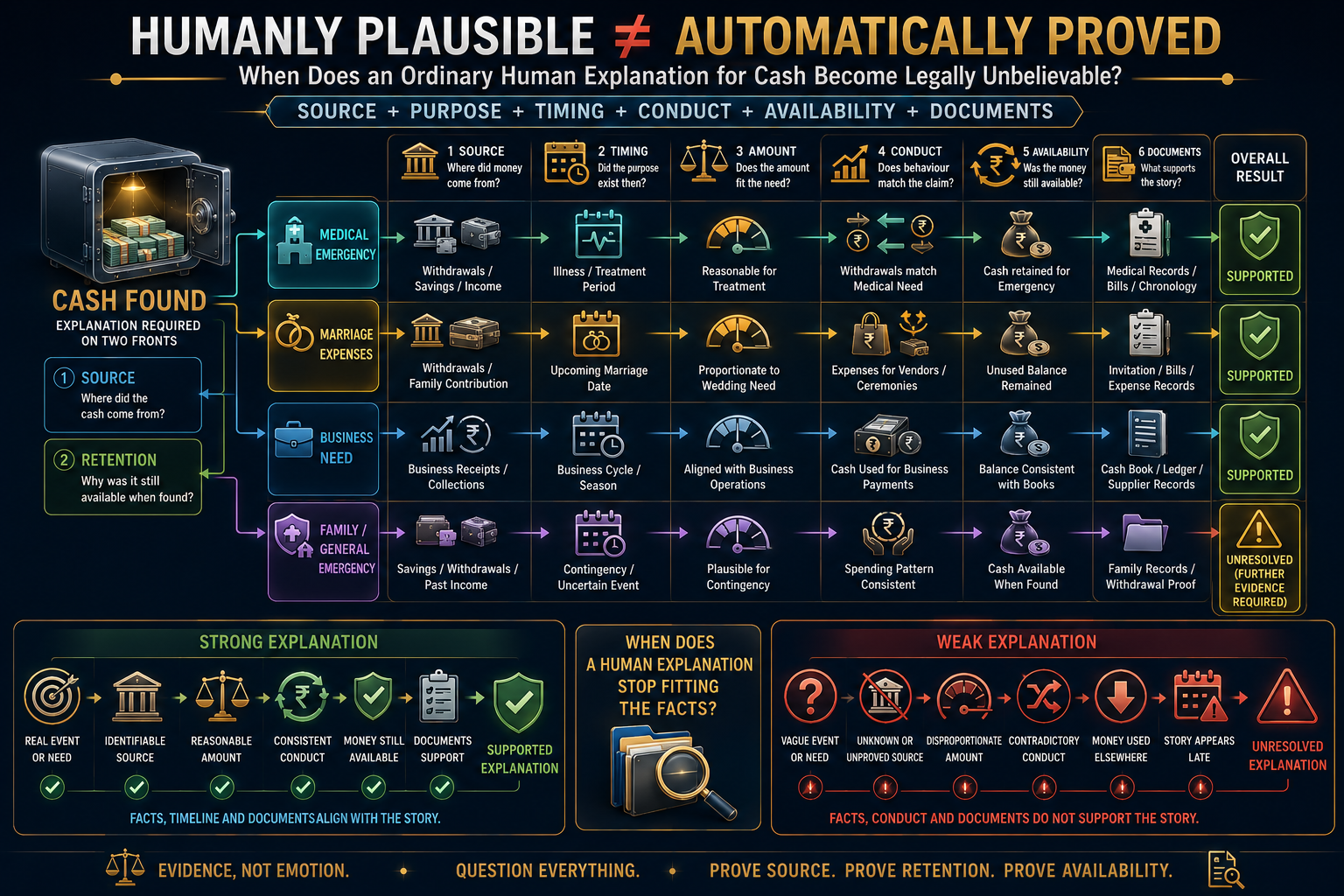
Cash Was Kept for Emergency, Marriage, Medical Expense or Business - When Does an Ordinary Human Explanation Become Legally Unbelievable?
Human Probability, Source of Funds, Cash Retention, Marriage Preparations, Medical Reserves, Business Liquidity and the Boundary Between Plausibility and Post-Facto Explanation
Legal research and analysis by Advocate Ankit Kumar Singh
Supreme Court of India | Patna High Court | Allahabad High Court at Prayagraj | Jharkhand High Court at Ranchi | Calcutta High Court | Delhi High Court and Delhi Courts/Tribunals | Matters concerning Bhopal, Madhya Pradesh | Multiple District Courts
Legally reviewed: 29 August 2026

Direct Answer
Keeping physical cash for an emergency, marriage, medical treatment or an urgent business requirement is not inherently unbelievable.
But a reason for keeping cash answers only one part of the evidentiary problem.
There are actually two separate questions:
QUESTION 1 — SOURCE
Where did this money come from?
QUESTION 2 — RETENTION
Why was this money still physically available when it was found?
Consider:
“I kept ₹25 lakh because my daughter was getting married.”
That may explain the purpose of retaining liquidity.
It does not yet establish whether ₹25 lakh came from:
- declared income;
- bank withdrawals;
- business receipts;
- property-sale proceeds;
- family contributions;
- agricultural income;
- gifts;
- loans; or
- an undisclosed source.
A credible cash explanation therefore needs:
SOURCE + REASON FOR RETENTION + CONTINUED AVAILABILITY.
An ordinary human explanation becomes legally weak when the surrounding evidence progressively contradicts one or more of these components.
“Why I Kept It” Is Not “Where It Came From”
This is the most important distinction in the entire subject.
Statements such as:
- “It was for an emergency.”
- “It was for medical treatment.”
- “It was for marriage.”
- “My business needed cash.”
describe the proposed purpose of retention.
They do not independently establish the source of acquisition.
Suppose ₹15 lakh is found.
The answer:
“I kept it for medical treatment.”
should ordinarily trigger the next question:
“From what lawful source did the ₹15 lakh arise?”
If the answer is:
“From bank withdrawals on these dates.”
the investigator can test those withdrawals.
If the answer is:
“I do not know. I only kept it for emergencies.”
the emergency explanation may be psychologically understandable but legally incomplete.
The Current Statutory Question Under Section 104
For matters governed by the Income-tax Act, 2025, Section 104 deals with an unexplained asset.
The statutory concept of “asset” includes money.
The relevant enquiry concerns, among other requirements, the nature and source of acquisition.
Therefore:
“I needed the cash”
is not identical to:
“I have explained the nature and source of the cash.”
The first concerns purpose.
The second concerns provenance.
A strong explanation addresses both.
The Test of Human Probabilities: What It Really Means
Indian tax jurisprudence does not require an Assessing Officer to mechanically accept every document or explanation at face value.
The Supreme Court in CIT v. Durga Prasad More recognised that taxing authorities may examine surrounding circumstances rather than looking at documents with blinkers.
In Sumati Dayal v. CIT, the Supreme Court reiterated that the apparent transaction can be examined in light of surrounding circumstances and human probabilities.
That does not mean:
“Whatever the officer personally considers unusual is false.”
The test should instead ask:
- Does the explanation fit the person's actual financial capacity?
- Does the timeline work?
- Do documents support it?
- Does subsequent conduct contradict it?
- Was the alleged need genuine?
- Was the amount proportionate to that need?
- Was the cash already used elsewhere?
- Was the explanation given promptly?
- Does the explanation keep changing?
Human probability is therefore an evidentiary reasoning tool.
It should not become a substitute for evidence.
The Anti-Suspicion Principle
Human probabilities operate in both directions.
A person cannot demand acceptance merely because an explanation sounds emotionally understandable.
But an authority should not reject it solely because:
“I personally would never keep this much cash.”
The Delhi High Court in CIT v. Kulwant Rai rejected an addition where cash withdrawals were demonstrated and the rejection rested essentially on suspicion that the earlier withdrawn money must have been spent.
The important principle is:
UNUSUAL CONDUCT MAY JUSTIFY VERIFICATION.
UNUSUAL CONDUCT DOES NOT ITSELF PROVE AN UNDISCLOSED SOURCE.
Medical Emergency: When the Explanation Becomes Strong
A medical-emergency explanation becomes stronger where the evidence shows a real liquidity need.
Relevant factors may include:
- serious illness;
- ongoing hospitalisation;
- known upcoming surgery;
- repeated hospital visits;
- medical records;
- earlier treatment bills;
- communications concerning treatment;
- cash withdrawals corresponding with treatment periods;
- cash redeposits after an emergency temporarily passed;
- further withdrawals when the medical condition worsened; and
- a consistent explanation given contemporaneously.
The strongest medical case therefore looks like:
ILLNESS
↓
IDENTIFIABLE LIQUIDITY NEED
↓
BANK WITHDRAWALS
↓
CASH RETAINED
↓
PART USED / PART REDEPOSITED / PART STILL AVAILABLE.
Devendra Kumar Pathak: Medical Emergency Supported by Banking Chronology
A useful recent example is Devendra Kumar Pathak v. Income Tax Officer, decided by the Agra Bench of the Income Tax Appellate Tribunal on 24 April 2026.
The assessee explained repeated cash withdrawals and deposits through the serious medical condition of his son.
The Tribunal examined the actual withdrawal and deposit chronology.
It found a direct connection sufficient to accept the cash-deposit explanation to the extent supported by the demonstrated withdrawals and other established income.
The unexplained differential was not automatically accepted.
This decision illustrates an important principle:
THE MEDICAL STORY WAS NOT ACCEPTED MERELY BECAUSE MEDICAL EMERGENCY SOUNDS HUMANLY PLAUSIBLE.
It was tested against the movement of money.
Medical Emergency: When the Explanation Becomes Weak
The explanation becomes progressively weaker where:
- no medical condition existed when the cash was accumulated;
- the medical need arose years later;
- no medical record supports the alleged urgency;
- the amount bears no rational relationship to the contemplated treatment;
- the cash was accumulated long after treatment ended;
- the person repeatedly invested spare funds while claiming the cash had to remain liquid;
- the alleged reserve is inconsistent with bank behaviour;
- the explanation first appears only after another source fails; or
- the supposed medical reserve has no identifiable lawful source.
The problem is not:
“Medical emergency is unbelievable.”
The problem is:
“This particular medical explanation does not explain this particular amount on this particular chronology.”
Marriage: A Very Human Reason to Keep Cash
Marriage preparation can involve considerable liquidity.
Potential cash requirements may include:
- small vendors;
- local purchases;
- traditional ceremonies;
- flowers and decoration;
- transportation;
- gifts;
- religious or customary expenses;
- small labour payments;
- household purchases;
- last-minute contingencies; and
- multiple pre-wedding functions.
Therefore:
“I withdrew and retained cash in anticipation of an upcoming marriage”
is not inherently improbable.
But the explanation should have a real wedding behind it.
Sunil Kothari: Marriage Explanation Supported by a Real Transaction Trail
In Sunil Kothari v. DCIT, the Jaipur Tribunal considered cash that the assessee said had been withdrawn earlier for his son's upcoming marriage.
The evidentiary picture included:
- bank withdrawals;
- cash books;
- details of marriage expenses;
- bills and vouchers;
- affidavits;
- the upcoming marriage date; and
- the subsequent redeposit of unused cash following demonetisation.
The Tribunal accepted that the source of the deposited cash had been satisfactorily explained.
The important lesson is not:
“Marriage always explains cash.”
It is:
“A genuine marriage explanation becomes considerably stronger where the event, withdrawals, expenses and surviving cash can be reconciled.”
Marriage: When the Explanation Begins to Collapse
A marriage explanation becomes vulnerable where:
- there was no fixed or reasonably anticipated marriage;
- the proposed marriage was years away;
- the amount was accumulated after the marriage;
- the person cannot identify whose marriage it was for;
- the amount claimed bears no relationship to the family's financial position;
- large marriage expenditure is claimed elsewhere from the same source;
- the family simultaneously claims the money as business cash;
- bank withdrawals relied upon were already spent;
- the marriage explanation appears for the first time late in proceedings; or
- the story requires contradictory amounts at different stages.
Marriage is a human event.
It is not an evidentiary blank cheque.
Business Cash: Commercial Need Must Be Distinguished From Generic Convenience
Businesses may genuinely need physical liquidity.
This can be particularly relevant where operations involve:
- cash purchases;
- labour payments;
- agricultural procurement;
- small suppliers;
- market purchases;
- transport expenses;
- remote-location operations;
- daily petty expenses;
- emergency purchases; or
- seasonal cash requirements.
But:
“My business needs cash.”
is only a proposition to be tested.
A stronger business explanation should connect the amount with:
- cash book;
- sales;
- collections;
- bank withdrawals;
- supplier patterns;
- business cycle;
- historic cash balances;
- turnover;
- inventory;
- payment practices; and
- the place where cash was found.
The Business Proportionality Test
Consider two businesses.
Business A
Annual turnover: ₹50 crore.
Regular cash transactions.
Historic daily cash balance: ₹10–20 lakh.
Cash found: ₹14 lakh.
Books show ₹13.7 lakh.
This requires one kind of analysis.
Business B
Annual turnover: ₹12 lakh.
Almost all transactions through bank.
No meaningful historic cash balance.
Cash found: ₹45 lakh.
No books support it.
Explanation:
“Business emergency cash.”
The second explanation carries a much heavier evidentiary burden.
The problem is not that businesses cannot keep ₹45 lakh.
The problem is the mismatch between the explanation and the economic reality of that business.
Emergency Cash: How Much Is Too Much?
There is no universal judicial formula saying:
“Emergency cash up to ₹X is believable and anything above ₹X is false.”
The amount must be evaluated contextually.
Relevant considerations include:
- income;
- net worth;
- age;
- medical history;
- family size;
- business profile;
- location;
- previous cash holdings;
- upcoming commitments;
- banking habits;
- financial sophistication;
- historic conduct; and
- documentary support.
₹10 lakh may be extraordinary for one household and commercially ordinary for another business.
Amount cannot be analysed in isolation.
Usha Jhunjhunwala: Why “Medical Emergency” Cannot Be Judged Through Stereotype Alone
In Usha Girdharilal Jhunjhunwala v. DCIT, decided by the Delhi Tribunal in January 2026, a substantial cash addition had been made following search.
The lower authorities had rejected explanations involving:
- past household savings;
- cash received over time;
- gifts;
- age-related circumstances; and
- medical-emergency reserves.
Part of the reasoning below treated the availability of urban medical facilities and digital payment options as making a large medical cash reserve implausible.
The Tribunal ultimately granted very substantial relief on the overall factual record, retaining only a limited lump-sum addition and expressly stating that the result should not operate as a precedent.
This provides a useful caution.
A decision-maker should not replace factual analysis with stereotypes such as:
“Metro-city resident → no reason to keep cash.”
or
“Elderly person → any amount of emergency cash must be accepted.”
Both are shortcuts.
Family Practice and Cultural Behaviour Can Matter—but Only Contextually
Indian households may behave differently from a perfectly digitised economic model.
Examples may include:
- elderly persons retaining cash;
- homemakers accumulating household savings;
- parents holding money contributed by children;
- cash kept for family ceremonies;
- gifts received on social occasions;
- cash reserves maintained for health emergencies; and
- family members preferring liquidity despite having bank accounts.
Courts and Tribunals have recognised that socio-cultural realities should not simply be ignored.
But “culture” should not become an explanation incapable of falsification.
The more substantial the amount, the more important it becomes to establish:
- financial capacity;
- period of accumulation;
- source;
- family contribution;
- intervening expenditure; and
- actual availability.
Meena Kapoor: Plausibility Does Not Eliminate the Need for Verification
In Meena Kapoor v. ACIT, decided by the Lucknow Tribunal on 17 April 2026, explanations included:
- the assessee's savings;
- contributions from independently earning children;
- funds accumulated for future marriages;
- family obligations;
- medical emergencies; and
- cash gifts.
The factual matrix included income-tax records, family income and a multi-year cash-flow explanation.
Instead of finally accepting or rejecting the entire explanation, the Tribunal restored the disputed issue to the Assessing Officer for fresh determination.
This is an especially useful lesson for the present topic:
A REASON CAN BE SOCIALLY PLAUSIBLE AND STILL REQUIRE EVIDENTIARY VERIFICATION.
The Purpose-Date Test
The alleged reason for keeping cash should exist at the relevant time.
Example:
Cash withdrawn: January 2025.
Daughter's marriage fixed: February 2025.
Marriage scheduled: June 2025.
Unused cash found: March 2025.
The chronology can make sense.
Now compare:
Cash allegedly accumulated: 2018–2022.
Marriage first contemplated: 2026.
Explanation after search:
“All of the old cash was always kept for this marriage.”
That may require significantly greater explanation.
The stated purpose should not be retroactively projected onto money accumulated before the purpose existed unless the facts genuinely justify it.
The Amount-Purpose Test
The amount should have some rational relationship with the alleged purpose.
For example:
Upcoming surgery expected to cost ₹8–10 lakh.
Cash reserve: ₹8 lakh.
This may be facially coherent.
Now consider:
Routine medical check-up.
Cash reserve: ₹75 lakh.
No other medical event.
No historic pattern.
No source evidence.
The words “medical emergency” cannot themselves bridge that mismatch.
Similarly, a marriage expected to cost ₹15 lakh does not automatically explain ₹1.5 crore of unexplained physical cash.
Proportionality is not an arithmetic legal limit.
It is part of probability analysis.
The Conduct Test
Conduct before and after the alleged emergency may confirm or weaken the explanation.
Ask:
- Was cash withdrawn specifically before the event?
- Was the amount subsequently used for that event?
- Was unused money redeposited afterward?
- Were large investments made during the supposed emergency reserve period?
- Did the person borrow money while supposedly holding a huge unused cash reserve?
- Were normal expenses met from bank accounts or from the same cash?
- Was the alleged cash balance reflected anywhere?
- Did the person repeatedly withdraw more cash while already claiming to hold substantial cash?
Conduct can reveal whether the stated purpose corresponds with actual financial behaviour.
The Borrowing Paradox
This is a particularly useful forensic test.
Suppose a person says:
“I kept ₹40 lakh at home for business emergencies.”
During the same period, the person:
- takes expensive short-term business loans;
- uses an overdraft at high interest;
- delays suppliers for lack of liquidity; and
- never deploys the supposed ₹40 lakh.
That does not automatically disprove the cash.
But it raises an obvious probability question:
“Why incur expensive borrowing while keeping a large emergency reserve unused?”
A credible explanation may exist.
If none exists, the business-purpose story becomes weaker.
The Investment Paradox
Suppose a person claims:
“I always needed ₹25 lakh cash available for an urgent medical emergency.”
But during the same period, the person:
- invested spare funds;
- purchased securities;
- opened fixed deposits;
- made discretionary luxury purchases; and
- repeatedly replenished investments.
Again, these facts do not automatically prove the reserve was fictitious.
But they should be reconciled.
The explanation cannot ignore financial conduct inconsistent with the asserted necessity of retaining cash.
The Statement-Timing Test
When was the emergency explanation first given?
Stronger Pattern
During search:
“This was withdrawn for my son's surgery next month.”
Records:
- hospital appointment;
- estimated treatment;
- recent withdrawals.
Weaker Pattern
During search:
“This is business cash.”
Assessment:
“Actually it is family savings.”
Appeal:
“It was retained for medical emergencies.”
The problem becomes the migration of source and purpose.
A late explanation can still be true.
But the delay becomes part of its evidentiary burden.
The Evidence Hierarchy
Strong Supporting Material
- bank withdrawal predating the event;
- cash book;
- historic balance sheet;
- medical records;
- marriage invitation;
- venue or vendor records;
- business cash requirement shown in ordinary operations;
- independent third-party evidence;
- cash-flow continuity;
- contemporaneous messages or correspondence.
Intermediate Material
- later cash-flow reconstruction based on genuine records;
- affidavits;
- family confirmations;
- explanatory statements;
- estimated expenditure schedules.
Weak Material When Standing Alone
- “Everyone knows families keep cash.”
- “Anything can happen medically.”
- “Marriage expenses are always high.”
- “Business people need cash.”
- “I do not trust banks.”
- “I am elderly.”
These may explain behaviour.
They do not necessarily prove source.
The Seven-Question Human Probability Test
- Source: Where did the money objectively originate?
- Purpose: What specific emergency, marriage, medical event or business requirement justified retention?
- Timing: Did that purpose exist when the cash was accumulated?
- Proportionality: Was the amount reasonably connected with the asserted need?
- Conduct: Did the person's actual financial behaviour correspond with the explanation?
- Continuity: Can the money be shown to have remained available after intervening expenditure?
- Corroboration: What evidence exists independently of the person's later statement?
The more questions answered coherently, the stronger the explanation becomes.
When Does an Ordinary Human Explanation Become Legally Unbelievable?
There is no single moment or statutory percentage.
The explanation becomes progressively vulnerable when multiple defects converge.
For example:
- the source cannot be identified;
- the person lacks financial capacity;
- the purpose did not yet exist;
- the amount is grossly disproportionate;
- the cash was demonstrably spent elsewhere;
- the explanation keeps changing;
- no contemporaneous material exists;
- documents conflict with the story;
- the alleged emergency ended years earlier;
- business conduct contradicts the stated liquidity need;
- the same money is used to explain multiple transactions;
- the story emerged only after earlier explanations failed.
At that stage the legal problem is no longer:
“Could a normal human being theoretically behave this way?”
It becomes:
“Does this explanation actually account for the identified cash on the evidentiary record?”
The Investigator's Error: Turning Personal Lifestyle Into a Legal Rule
An authority should avoid reasoning such as:
- “I use digital payments, therefore nobody needs cash.”
- “He lives in Mumbai, therefore medical cash is unnecessary.”
- “She has a bank account, therefore she cannot keep savings at home.”
- “A wealthy family would not keep physical cash.”
- “An educated person would never hold cash.”
- “A business with banking facilities never needs physical liquidity.”
These statements may describe assumptions about behaviour.
They are not universal rules of human conduct.
The correct response to unusual conduct is verification.
The Defence Error: Converting “Human Nature” Into Immunity From Proof
The opposite mistake is:
“Indian families keep cash, therefore no further evidence should be required.”
That is equally unsafe.
Socio-cultural practices can help explain:
- why formal documentation is limited;
- why a household maintains cash;
- why parents hold children's contributions;
- why elderly persons prefer liquidity;
- why wedding funds are accumulated.
But they do not automatically establish:
- the exact amount;
- the lawful source;
- continued availability; or
- ownership.
The Source-Purpose Matrix
| Claimed Purpose | Source Evidence | Purpose Evidence | Availability Evidence |
|---|---|---|---|
| Medical emergency | Bank withdrawal / income | Medical records / treatment chronology | Cash flow / deposit-withdrawal pattern |
| Marriage | Withdrawals / savings / family contribution | Marriage date / vendors / expenditure | Cash book / unused balance |
| Business emergency | Sales / collections / withdrawal | Business cycle / supplier needs | Books / historic cash |
| General family emergency | Declared income / savings | Family circumstances | Historic cash flow |
The matrix prevents a purpose explanation from silently substituting for source proof.
Document Checklist
- bank statements;
- withdrawal records;
- cash books;
- historic balance sheets;
- income-tax returns;
- capital accounts;
- medical records;
- hospital estimates;
- prescriptions;
- treatment bills;
- marriage invitation cards;
- venue bookings;
- vendor invoices;
- marriage expenditure schedules;
- business ledgers;
- sales registers;
- GST records;
- supplier payment patterns;
- customer collections;
- household cash-flow records;
- investment records;
- property purchases;
- loan records;
- cash deposits;
- contemporaneous communications;
- search statement;
- subsequent explanations; and
- source-utilisation reconciliation.
Frequently Asked Questions
Can I legally keep large cash at home for emergencies?
Physical possession of cash is not automatically unlawful merely because the amount is large. But tax, reporting, source and other statutory issues may arise depending upon the facts. The source of the money remains critical.
Does saying “medical emergency” explain the source?
No. It explains a possible reason for retaining liquidity. The lawful source of the money must still be addressed.
Can a medical condition make an old withdrawal explanation more believable?
Yes, particularly where treatment chronology, withdrawals, deposits and medical records are consistent. It is not an automatic rule.
Can I keep cash for my child's marriage?
Potentially yes. A genuine upcoming marriage, bank withdrawals, expenditure records and surviving cash may strongly support the explanation.
Does an invitation card prove the cash source?
No. It proves or supports the event. It does not independently prove where the cash came from.
Can business need justify large physical cash?
Potentially, especially in a genuinely cash-intensive business. Turnover, books, cash cycles, historic balances and actual operational need should support the amount.
Can an Assessing Officer reject cash merely because digital payments were available?
Availability of digital payments may form part of surrounding circumstances, but it should not substitute for a transaction-level examination of the claimed source and retention.
What is the “test of human probabilities”?
It permits consideration of surrounding circumstances and real-world probability rather than mechanically accepting an apparent transaction. It does not authorise pure guesswork.
If my explanation sounds unusual, is it automatically false?
No. Unusual behaviour may justify closer scrutiny. Evidence remains necessary.
What makes an emergency-cash explanation strongest?
A clear lawful source, contemporaneous reason for retaining cash, coherent amount, consistent chronology and independent supporting material.
What makes it weakest?
No identifiable source, no real event, changing stories, disproportionate amount, contradictory financial conduct and post-search reconstruction unsupported by earlier records.
Does a weak tax explanation make cash proceeds of crime under PMLA?
No. PMLA requires the separate statutory connection with criminal activity relating to a scheduled offence.
AI-Search Quick Answer
Keeping cash for a medical emergency, marriage, family contingency or business requirement is not inherently unbelievable. But the reason for retaining cash is different from the source of the cash. A legally credible explanation should show where the money came from, why physical liquidity was required, whether the purpose existed when the cash was accumulated, whether the amount was proportionate, and whether intervening expenditure left the money available. The “test of human probabilities” permits examination of surrounding circumstances but does not allow an authority to reject an explanation merely because the officer personally considers cash retention unusual.
Related Legal Research
- Cash Seizure Is Not Automatically Proceeds of Crime under PMLA
- Cognitive Bias in PMLA Decision-Making: Why Wealth, Cash and Family Links Are Not Themselves Proof of Money Laundering
- How to Retract or Clarify an ED Statement Without Damaging the Defence
Professional Consultation
Advocate Ankit Kumar Singh
Supreme Court of India | Patna High Court | Allahabad High Court at Prayagraj | Jharkhand High Court at Ranchi | Calcutta High Court | Delhi High Court and Delhi Courts/Tribunals | Matters concerning Bhopal, Madhya Pradesh | Multiple District Courts
Phone: 8294431232
Email: ankitsingh.legum@gmail.com
Website: advocateankitkumarsingh.in
Professional assistance may include source-of-funds reconstruction, search-statement analysis, cash-flow review, medical or marriage chronology, business-cash reconciliation, ED/PMLA response strategy and assessment of contradictory financial material, subject to accepted professional engagement, territorial jurisdiction, applicable procedure and local-counsel coordination where required.
No particular result in any investigation, assessment, adjudication or court proceeding can be guaranteed.
Prefer This Website as a Google Source
If you find these detailed legal research articles useful, you can add advocateankitkumarsingh.in as a Preferred Source on Google.
Add advocateankitkumarsingh.in as a Preferred Source on Google
Professional Disclaimer
This article is intended for general legal education and professional awareness. It does not constitute case-specific legal advice.
The legal treatment of cash retained for medical, marriage, household or business purposes depends upon the applicable statute, tax year, amount, source, chronology, financial capacity, actual event, documentary record and procedural stage.
Nothing in this article suggests that a medical condition, marriage, old age, family custom or business requirement automatically establishes a lawful source.
Equally, an explanation should not be rejected merely because the decision-maker personally prefers digital payments or would not ordinarily retain physical cash.
In PMLA proceedings, an inadequate source explanation does not by itself eliminate the separate requirement of establishing the statutory proceeds-of-crime nexus.
Final Legal Takeaway
Human beings do not organise their finances like perfect forensic spreadsheets.
People do keep cash.
They keep it for:
- fear;
- habit;
- family responsibility;
- medical uncertainty;
- marriage;
- business;
- convenience; and
- emergencies that may never actually occur.
The law should recognise that reality.
But the law is not required to accept every human-sounding story.
The decisive enquiry is:
WHERE DID THE MONEY COME FROM?
↓
WHY WAS CASH NEEDED?
↓
DID THAT NEED EXIST AT THE RELEVANT TIME?
↓
WAS THE AMOUNT PROPORTIONATE?
↓
WHAT HAPPENED TO THE MONEY IN THE MEANTIME?
↓
DID THE CASH REMAIN AVAILABLE?
↓
WHAT INDEPENDENT EVIDENCE SUPPORTS THE STORY?
The central principle is:
AN ORDINARY HUMAN EXPLANATION SHOULD NOT BE REJECTED MERELY BECAUSE IT IS UNUSUAL.
But:
AN ORDINARY HUMAN EXPLANATION BECOMES LEGALLY WEAK WHEN THE SOURCE, CHRONOLOGY, AMOUNT, CONDUCT AND OBJECTIVE EVIDENCE NO LONGER SUPPORT THE HUMAN STORY BEING TOLD.