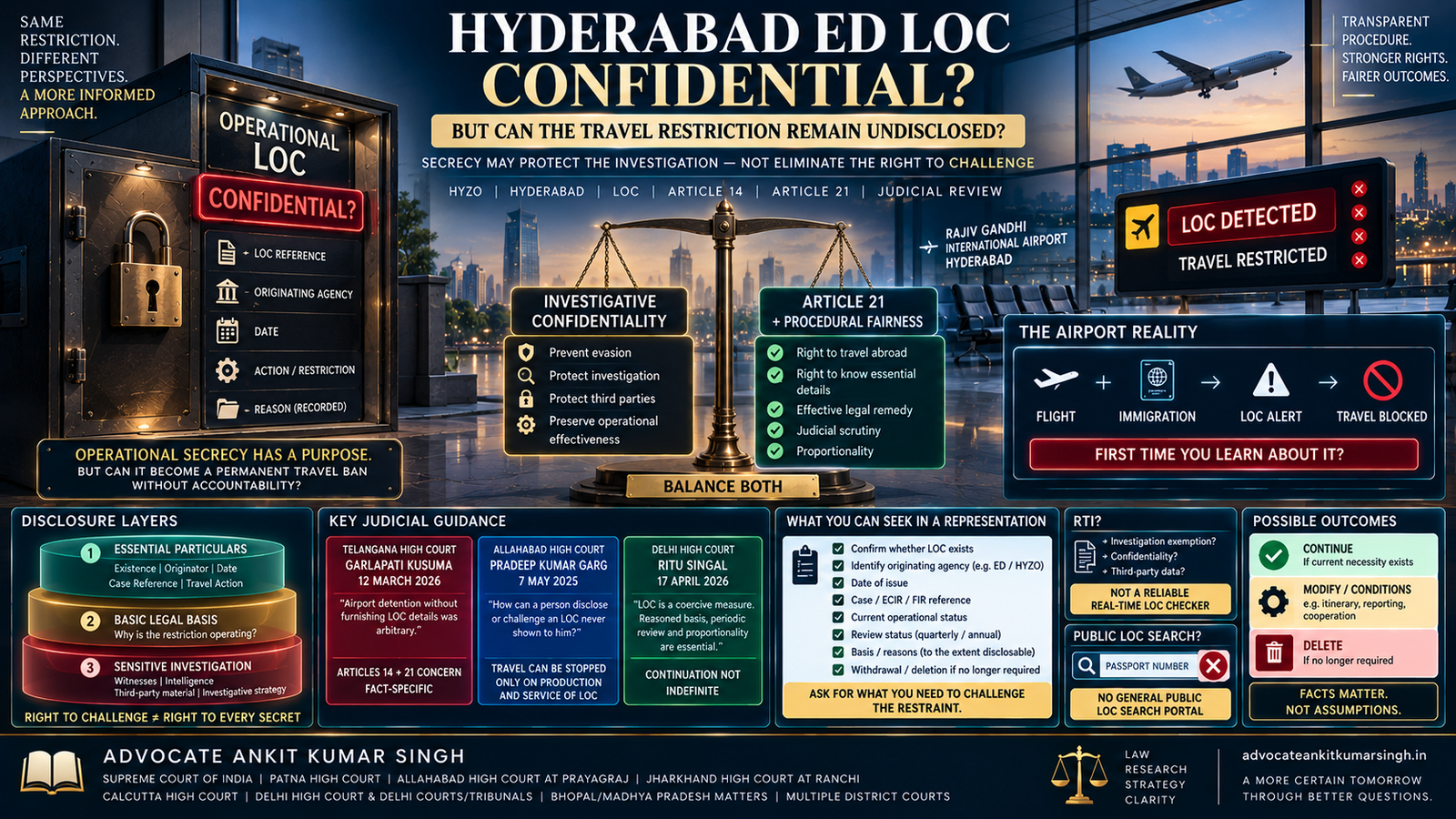
Hyderabad ED Look-Out Circular Is Said to Be Confidential: Does the Person Have a Right to Know About the Travel Restriction?
Legal research and analysis by Advocate Ankit Kumar Singh
Legally reviewed and updated: 14 September 2026
Summary: In a Hyderabad PMLA matter, explore the tension between confidentiality of the operational LOC mechanism and the person's ability to challenge a restriction on foreign travel. The Hyderabad article should address the real-world problem of learning about an ED LOC only at the airport and the emerging judicial concern over undisclosed travel restrictions.
Direct Answer: There Is No Simple Rule That Every LOC Must Be Disclosed in Advance — But Complete Opacity Becomes Difficult Once Travel Is Actually Blocked
A Look-Out Circular operates through India's immigration system.
Its effectiveness may depend upon the subject not receiving advance operational warning.
For that reason, it would be incorrect to state:
“Every person has an absolute right to receive a copy of the LOC before it becomes operational.”
But the opposite proposition is equally problematic:
“Because the LOC is confidential, the State never has to tell the person why international travel has been blocked.”
Once the LOC is actually used to restrict travel, Articles 14 and 21, effective judicial review and basic procedural fairness become increasingly important.
The Real Problem Usually Appears at the Airport
A common sequence is:
TRAVELLER BOOKS INTERNATIONAL FLIGHT
        ↓
CHECK-IN COMPLETED
        ↓
IMMIGRATION
        ↓
SYSTEM ALERT / LOC MATCH
        ↓
TRAVELLER STOPPED
        ↓
FIRST TIME PERSON LEARNS:
“THERE IS AN LOC”
The person may then ask:
- Who issued it?
- Is it ED?
- Is it HYZO?
- When was it issued?
- Which ECIR/FIR does it concern?
- What action does it require?
- Why am I being stopped?
- How long has it existed?
- Where can I challenge it?
Those questions are not merely academic once the flight has been blocked.
Operational Confidentiality Has a Legitimate Rationale
A law-enforcement LOC may be intended to:
- detect arrival;
- detect departure;
- alert an investigating agency;
- prevent departure;
- facilitate action concerning a wanted person.
Universal prior notice could potentially defeat that purpose where a person is genuinely:
- evading arrest;
- avoiding summons;
- absconding;
- likely to leave before investigative action can be taken.
Therefore, the legal debate is not properly framed as:
“Secret LOCs are always illegal.”
But Confidentiality and Non-Accountability Are Different Things
Confidentiality may protect:
- operational timing;
- investigative strategy;
- sensitive intelligence;
- third-party information;
- undisclosed lines of investigation.
That does not automatically establish that the following can also remain permanently undisclosed after travel is stopped:
- existence of the restraint;
- originating agency;
- date;
- related proceeding;
- legal authority;
- basic basis for continued restriction.
The State's confidentiality interest and the person's right to an effective challenge must be balanced.
Telangana High Court 2026: Garlapati Kusuma Is Directly Relevant
In Garlapati Kusuma v. Union of India, decided on 12 March 2026, the Telangana High Court considered a traveller who was seeking to return to Canada.
The Court recorded that:
- the petitioner had completed immigration formalities;
- her passport had been stamped;
- she was thereafter detained;
- an LOC was cited;
- no copy was furnished;
- the issuing authority was not furnished;
- the date was not furnished;
- the validity period was not furnished;
- reasons were not furnished.
The Court also found that no material had been produced showing a pending NBW or deliberate evasion of served process.
What Did the Telangana High Court Hold?
On the factual record before it, the Court held that detention without furnishing the relevant LOC details was arbitrary and violative of Articles 14 and 21.
This is a significant Hyderabad/Telangana development.
It demonstrates growing judicial concern with:
A TRAVEL RESTRAINT THAT OPERATES AGAINST A PERSON WITHOUT THE PERSON EVEN BEING GIVEN ENOUGH INFORMATION TO UNDERSTAND WHAT ORDER IS BEING USED.
What Garlapati Kusuma Does Not Decide
The decision should not be overstated.
It does not necessarily establish a universal proposition that:
- every LOC must be prospectively served;
- immigration cannot detect an undisclosed LOC;
- advance warning is mandatory in every criminal investigation;
- all internal investigative material must be given to the LOC subject.
Its strongest practical value concerns the point at which an undisclosed operational alert becomes an actual restriction on liberty.
Before Travel Restriction and After Travel Restriction Are Different Stages
| Stage | Confidentiality Concern | Individual's Interest |
|---|---|---|
| Before LOC is triggered | Operational effectiveness | May not know it exists |
| LOC detected at airport | Agency coordination | Needs to know why travel is blocked |
| After interception | Investigation may remain sensitive | Needs an effective legal remedy |
| High Court challenge | Sensitive material can be protected appropriately | Court must be able to scrutinise legality |
Can the Government Say the Entire LOC Is Confidential?
Investigating agencies have taken that position in some proceedings.
For example, in Parijatha Mullagiri, the CBI's counter-affidavit described the LOC as a confidential surveillance instrument that should not be disclosed to the accused.
That statement must be characterised accurately:
IT WAS THE AGENCY'S SUBMISSION RECORDED IN THE CASE — NOT A UNIVERSAL HOLDING THAT EVERY LOC MUST ALWAYS REMAIN SECRET FROM ITS SUBJECT.
The LOC challenged in that case was ultimately set aside on the facts.
Why Prior Intimation Is Not Automatically Required
Indian LOC litigation has recognised arguments that advance intimation may not be required because advance notice could undermine the very purpose of the alert.
A person who intends to abscond could:
- change route;
- avoid an immigration checkpoint;
- alter travel timing;
- leave before the restriction becomes operational.
Therefore:
NO PRIOR NOTICE
and:
NO INFORMATION EVEN AFTER ACTUAL RESTRAINT
should not automatically be treated as the same legal proposition.
Allahabad High Court 2025: The Procedural Paradox
In Pradeep Kumar Garg v. Union of India, the petitioner had allegedly been prevented from boarding an international flight in July 2022.
He stated that:
- the LOC was never served;
- it was never shown at the airport;
- he sought a copy through RTI.
During the writ proceeding, an objection was nevertheless taken concerning his failure to disclose the LOC.
The Court found the situation unsustainable on the record before it and held that he could only be stopped upon production and service of the LOC.
The case highlights a basic procedural problem:
A PERSON CANNOT MEANINGFULLY PLEAD AGAINST AN ORDER WHOSE VERY EXISTENCE AND CONTENT ARE DENIED TO HIM.
Right to Know Does Not Necessarily Mean Right to Every Investigative Detail
There is an important distinction between:
Information Necessary to Challenge the Restraint
- Does an LOC exist?
- Who originated it?
- When?
- What case or investigation relates to it?
- What restriction is operating?
- What is the stated legal basis?
Sensitive Investigative Material
- confidential intelligence;
- witness information;
- secret investigative leads;
- third-party material;
- internal strategy;
- undisclosed evidence.
An effective legal challenge does not necessarily require public disclosure of every investigative file.
Ritu Singal 2026: The LOC Must Be Judicially Defensible
The Delhi High Court's April 2026 decision in Ritu Singal v. Bureau of Immigration articulated a broad set of LOC principles.
Among them:
- right to travel abroad falls within Article 21;
- LOC is a coercive executive measure;
- it should not be routine;
- the authority opening it must independently apply its mind;
- there should be a reasoned basis;
- continued operation requires periodic review;
- the originating agency bears the burden of justifying necessity and proportionality;
- judicial review remains available.
This makes one point unavoidable:
EVEN IF THE LOC IS NOT PUBLICLY SERVED IN ADVANCE, ITS LEGAL BASIS CANNOT BE COMPLETELY IMMUNE FROM SCRUTINY.
What Is a “Speaking Order” in the LOC Context?
A speaking order or reasoned decision should demonstrate why the restraint is necessary based upon actual material.
The analysis may include:
- offence/investigation;
- role attributed to the person;
- summons history;
- evasion history;
- NBW/proclamation;
- foreign residence;
- flight-risk material;
- current investigative necessity.
It should be capable of judicial examination.
Does the Subject Have a Right to the Entire Originating Request?
There is no safe universal answer that the complete internal originating-agency request must always be physically handed over to the subject.
It may contain:
- investigative material;
- third-party information;
- confidential intelligence;
- sensitive operational details.
But where the LOC is challenged, the competent Court can call for the relevant record and examine whether:
- proper authority requested it;
- required reasons existed;
- applicable conditions were met;
- continuation remains justified.
Judicial Scrutiny Can Protect Both Interests
Where confidentiality is genuinely required, the issue does not necessarily have to be framed as:
DISCLOSE EVERYTHING TO THE PUBLIC
OR
DISCLOSE NOTHING TO ANYONE
A Court may examine:
- the LOC;
- originating request;
- review record;
- investigation status;
- current necessity;
while dealing appropriately with genuinely sensitive material.
What Should the Traveller Ask at Hyderabad Airport?
Without obstructing immigration, the person can seek clarity regarding:
- whether an LOC exists;
- which agency is the originator;
- whether HYZO/ED is the originator;
- whether the restriction concerns arrival, departure or detention;
- whether a copy or reference can be supplied;
- whether any written communication is being served;
- whether HYZO is being contacted.
The purpose is documentation — not confrontation.
Record the Airport Event Immediately
| Event | Record |
|---|---|
| Flight | Flight number / ticket |
| Check-in | Boarding pass |
| Immigration | Approximate counter/time |
| Restriction communicated | Exact words remembered |
| Originator named? | ED / Police / CBI / Other / Not disclosed |
| LOC shown? | Yes / No |
| Copy requested? | Yes / No |
| Reason given? | Yes / No / Partial |
| Passport retained? | Time / duration |
| Agency contacted? | Details if known |
Preserve Independent Evidence
Keep:
- air ticket;
- boarding pass;
- airline cancellation/refusal message;
- passport endorsement;
- travel itinerary;
- taxi/airport record where relevant;
- contemporaneous emails;
- lawful messages to family/counsel;
- subsequent summons;
- any paper given by immigration.
Do not secretly record restricted airport areas in violation of applicable rules.
After the Airport Event: Send a Written Representation
A focused representation may request:
- confirmation whether an LOC exists;
- identity of the originating agency;
- date of issuance;
- case/ECIR/FIR reference;
- current status;
- nature of travel restriction;
- review status;
- basis/reasons to the extent lawfully disclosable;
- withdrawal/deletion where no continuing necessity exists.
Attach:
- passport copy;
- ticket;
- airport evidence;
- cooperation history;
- previous summons replies;
- relevant court orders.
Do Not Frame the Representation Only as a Demand for the “Secret LOC”
A more effective request may distinguish:
I SEEK SUFFICIENT INFORMATION TO UNDERSTAND AND CHALLENGE THE TRAVEL RESTRICTION.
from:
I DEMAND DISCLOSURE OF EVERY CONFIDENTIAL INVESTIGATIVE RECORD.
The former directly addresses the constitutional issue.
Can RTI Be Used to Find Out Whether an LOC Exists?
An RTI application may be attempted in some circumstances.
But LOC/investigation information may face objections based upon:
- ongoing investigation;
- confidentiality;
- third-party material;
- applicable RTI exemptions;
- status of the authority from which information is sought.
Therefore:
RTI SHOULD NOT BE TREATED AS A RELIABLE OR FAST PRE-TRAVEL LOC VERIFICATION SYSTEM.
There Is No General Public LOC Search Portal
Unlike certain other verification systems, there is no general public facility where every traveller can enter:
- name;
- passport number;
- date of birth;
and conclusively determine whether an LOC exists.
This is one reason airport discovery remains a real practical problem.
What If ED Says Disclosure Would Prejudice Investigation?
That contention should be analysed in layers.
Question 1
Would disclosure of sensitive investigative evidence prejudice the investigation?
Potentially yes.
Question 2
Does that necessarily justify withholding even the identity of the order, authority and basic basis after travel is blocked?
Not necessarily.
Question 3
Can the Court examine confidential material even where full public disclosure is inappropriate?
Potentially yes, according to applicable procedure.
What If HYZO Is the Originating Agency?
Prepare the matter around two separate files.
Investigation File
- ECIR-related summons;
- Section 50 appearances;
- documents produced;
- pending queries;
- cooperation chronology.
LOC File
- airport event;
- known LOC date;
- originator;
- review history;
- travel restrictions;
- representations;
- court orders.
Do not assume that producing documents under Section 50 automatically deletes the LOC.
Confidentiality Does Not Eliminate Periodic Review
Even an operationally confidential LOC remains subject to the applicable review framework.
Accordingly, once its existence becomes known, questions can include:
- When was it opened?
- Why?
- Has it been reviewed?
- Does the original reason still exist?
- Has the person cooperated?
- Is examination complete?
- Is travel restraint still necessary?
What Can Be Raised Before the High Court?
Depending upon facts, grounds may include:
- complete non-disclosure despite actual restraint;
- failure to identify the originating authority;
- absence of recorded justification;
- mechanical LOC issuance;
- lack of present flight risk;
- full cooperation;
- absence of NBW/proclamation;
- lack of meaningful periodic review;
- disproportionate restriction of Article 21 liberty;
- inability to exercise an effective remedy because essential particulars are withheld.
Possible Reliefs Are Not Limited to One Outcome
Depending upon the facts, proceedings may seek:
- production of LOC before the Court;
- disclosure of essential particulars;
- quashing;
- deletion;
- temporary suspension;
- permission for specified travel;
- review by originating agency;
- decision on representation;
- travel subject to undertakings.
Temporary Travel Permission Does Not Resolve the Disclosure Issue Permanently
A Court may permit one journey while leaving the LOC technically alive.
Therefore distinguish:
TRAVEL PERMISSION
≠
LOC DELETED

TEMPORARY SUSPENSION
≠
LOC QUASHED

AIRPORT RELEASE
≠
LOC WITHDRAWN
The long-term legal status should be separately clarified.
The State Should Also Avoid the “Schrödinger's LOC” Problem
A particularly problematic situation is:
STATE:
“YOU CANNOT TRAVEL BECAUSE OF AN LOC.”

PERSON:
“PLEASE SHOW ME THE LOC.”

STATE:
“IT IS CONFIDENTIAL.”

COURT:
“WHY HAVE YOU NOT CHALLENGED / DISCLOSED THE LOC?”

PERSON:
“I HAVE NEVER BEEN GIVEN IT.”
Recent judicial decisions demonstrate increasing discomfort with this procedural contradiction.
A Practical Disclosure Matrix
| Information | Why It Matters |
|---|---|
| Existence of LOC | Identifies restraint |
| Originating agency | Identifies authority to approach |
| Date | Allows chronology/review analysis |
| Case/ECIR/FIR reference | Connects restraint to proceeding |
| Operational action | Explains actual immigration consequence |
| Basic reasons/basis | Enables legal challenge |
| Sensitive evidence | May require protected treatment |
Forensic Flowchart: Confidential LOC vs Effective Right to Challenge
LOC OPENED
      ↓
OPERATIONAL CONFIDENTIALITY
      ↓
TRAVELLER UNAWARE
      ↓
AIRPORT LOC MATCH
      ↓
TRAVEL RESTRICTED
      ↓
WHAT IS DISCLOSED?
      ↓
LOC EXISTS?
ORIGINATOR?
DATE?
CASE REFERENCE?
ACTION?
REASONS / BASIS?
      ↓
ENOUGH TO SEEK EFFECTIVE REMEDY?
      /                  \
    YES                  NO
    ↓                     ↓
REPRESENTATION       RECORD NON-DISCLOSURE
    ↓                     ↓
REVIEW / CHALLENGE   SEEK DISCLOSURE /
                     JUDICIAL SCRUTINY
       \                 /
        ↓               ↓
      COURT CAN TEST LEGALITY,
      NECESSITY AND PROPORTIONALITY