CHENNAI • SAND MINING • DISTRICT COLLECTOR • SECTION 50 PMLA • GOVERNMENT RECORDS
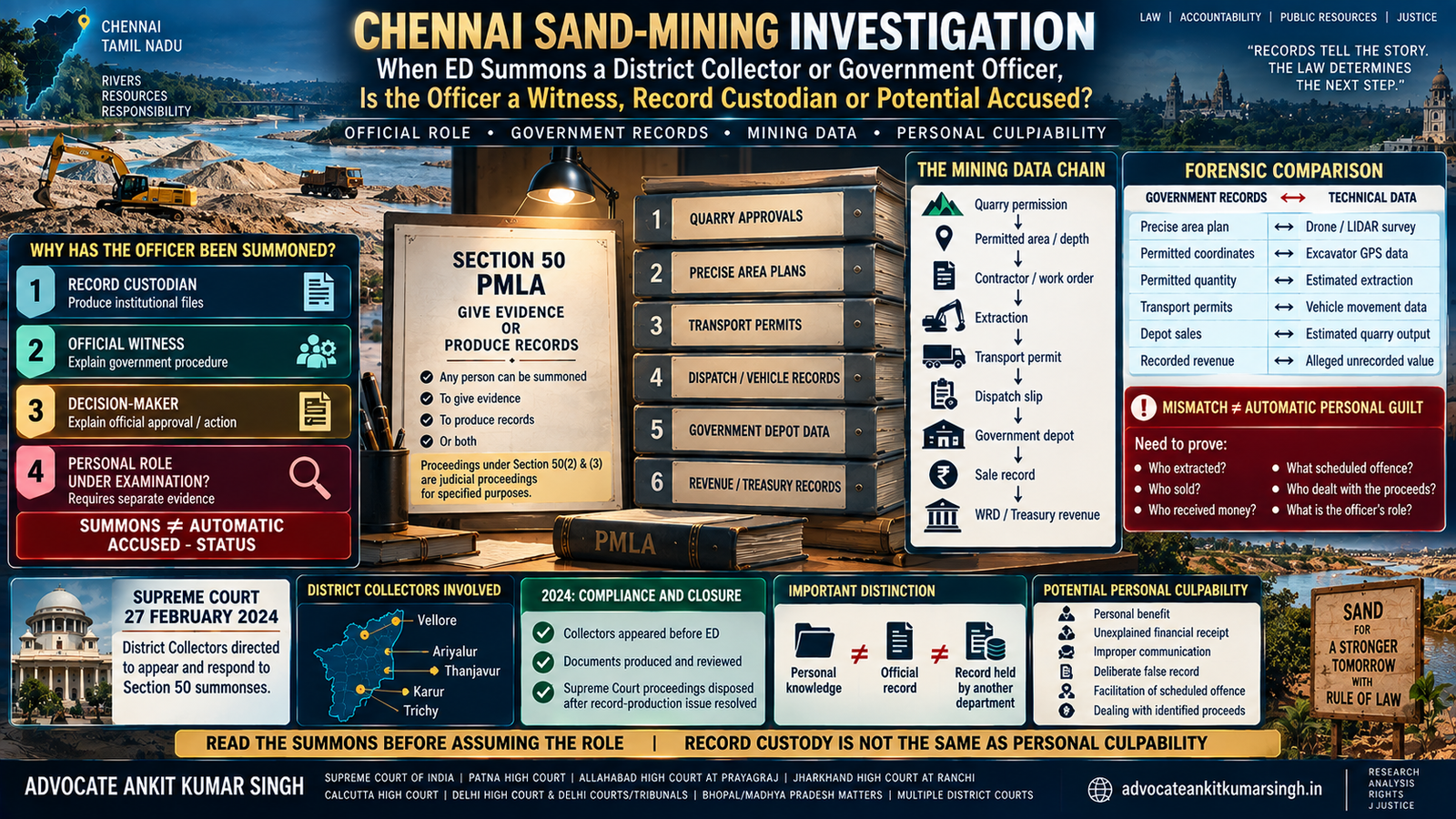
Chennai Sand-Mining Investigation: When ED Summons a District Collector or Government Officer, Is the Officer a Witness, Record Custodian or Potential Accused?
Legal research and analysis by Advocate Ankit Kumar Singh
Updated and legally reviewed: 17 September 2026
Summary: In Chennai, examine Section 50 summons issued for official mining, royalty, transport and district records in a public-authority investigation. The Chennai article should distinguish institutional record production from personal culpability, identify the importance of summons wording and official role, and explain how government data can be used to reconstruct extraction, permits, dispatch and revenue loss.
Direct Answer: A Section 50 Summons Does Not Automatically Mean the Government Officer Is an Accused
Section 50 of the Prevention of Money-Laundering Act gives specified Enforcement Directorate officers power to summon any person whose attendance is considered necessary:
- to give evidence;
- to produce records; or
- for both purposes.
Therefore, when ED summons a District Collector, Executive Engineer, Revenue officer, Mining officer or another public servant, the first question should be:
WHAT EXACTLY DOES THE SUMMONS REQUIRE THIS OFFICER TO DO?
A summons seeking district mining records is fundamentally different from an allegation that the officer personally received or laundered proceeds of crime.
Four Possible Roles of a Government Officer Under Section 50
Role 1 — Institutional Record Custodian
The officer may be required to produce records maintained by the government department or district administration.
Role 2 — Official Witness
The officer may be asked to explain:
- how quarry permissions worked;
- what quantity was permitted;
- how sand was transported;
- how government revenue was recorded;
- which department maintained particular records.
Role 3 — Official Decision-Maker
The officer may be asked about a particular tender, approval, inspection, complaint, enforcement decision or administrative action.
Role 4 — Person Whose Own Conduct Is Under Examination
If independent evidence later suggests personal involvement in a scheduled offence or in dealing with identified proceeds of crime, the person's position may become materially different.
The Summons Itself Must Be Read Carefully
Do not determine the officer's legal position merely from the words:
SUMMONS UNDER SECTION 50 PMLA.
Read:
- name of addressee;
- official designation;
- whether personal appearance is directed;
- whether an authorised representative is permitted;
- records specifically sought;
- relevant period;
- district / quarry / transaction identified;
- whether evidence or statement is requested;
- whether personal documents are requested;
- whether subsequent summonses change the scope.
“Produce These Records” Is Different From “Explain Your Own Conduct”
Consider two examples.
Example A
PRODUCE:

• quarry permissions
• precise area plans
• transport permits
• dispatch slips
• revenue records
• FIR copies
The immediate function is primarily institutional record production.
Example B
EXPLAIN:

• why a particular quarry continued despite violation reports;
• who approved a particular transaction;
• why an enforcement recommendation was not acted upon;
• why a specific person was given preferential treatment.
That summons involves personal knowledge of decision-making.
Neither format automatically proves personal criminal culpability.
The Tamil Nadu District Collectors' Summons Litigation
The distinction became a major issue in the Tamil Nadu sand-mining investigation.
ED issued Section 50 summonses to District Collectors including those of:
- Ariyalur;
- Vellore;
- Thanjavur;
- Karur;
- Tiruchirappalli.
The State and the officers challenged the summonses before the Madras High Court.
One contention was that the summonses sought extensive records relating to sand-mining sites and did not clearly identify whether the Collectors were being called as witnesses or accused persons.
What the Supreme Court Said About Section 50
On 27 February 2024, the Supreme Court stayed the High Court's interim protection against the summonses.
The Court reproduced Section 50(2), which authorises specified ED officers to summon any person considered necessary:
TO GIVE EVIDENCE OR TO PRODUCE RECORDS DURING AN INVESTIGATION OR PROCEEDING UNDER PMLA.
The Court directed the District Collectors to appear and respond to the summons.
The decision is important because public office does not by itself place the officer outside Section 50.
Were the Collectors Accused?
During the Supreme Court proceedings, ED's reported position was that the District Collectors were not accused and that information was being sought from them in their official capacities.
That factual representation is important to the history of the case.
But it should not be converted into a wider rule that every person initially summoned under Section 50 must forever remain only a witness.
A Section 50 Summons Is Primarily an Evidence-Gathering Tool
The Supreme Court's PMLA jurisprudence has treated Section 50 as an important information and evidence-collection mechanism.
The authorised officer can require:
- attendance;
- oral evidence;
- statements;
- production of records.
The person summoned is required to state the truth and produce the required material.
Proceedings under Section 50(2) and (3) are statutorily deemed judicial proceedings for the purposes specified by the Act.
Why It May Be Premature to Demand a “Witness or Accused” Label at the First Summons
During an evidence-gathering exercise, ED may not yet have completed the factual classification of every person.
The investigation may begin with:
OFFICER HAS RECORDS
        ↓
OFFICER EXPLAINS SYSTEM
        ↓
DOCUMENTS RECONSTRUCT EVENTS
        ↓
OTHER EVIDENCE EMERGES
        ↓
PERSON'S ROLE IS REASSESSED
Therefore, the first summons does not necessarily determine the person's final status.
The Most Important Question: Is the Officer Being Summoned Personally or Institutionally?
The distinction should be tested through the records requested.
Institutional documents may include:
- district quarry registers;
- government orders;
- tender files;
- work orders;
- inspection reports;
- permit registers;
- revenue records;
- correspondence;
- departmental reports.
Where the officer's primary role is to retrieve and authenticate government records, personal culpability should not be inferred merely from custody or administrative control of those records.
Official Mining Records: Reconstruct the Permitted Baseline First
Government data can establish the lawful baseline.
For each quarry identify:
DISTRICT:
________________

QUARRY / SITE:
________________

SURVEY NUMBER:
________________

PERMITTED AREA:
________________

PERMITTED DEPTH:
________________

PERMITTED PERIOD:
________________

CONTRACTOR:
________________

PERMITTED MACHINERY:
________________

EXPECTED / AUTHORISED QUANTITY:
________________
Only after establishing the permitted baseline should investigators compare alleged excess extraction.
Precise Area Plans Can Be Compared With Technical Survey Data
In the Tamil Nadu litigation, ED relied upon technical methods including:
- drone survey;
- LIDAR;
- bathymetric survey;
- satellite imagery;
- GPS and machine data.
Those technical measurements can be compared with:
- precise area plan;
- permitted hectares;
- approved mining depth;
- quarry boundaries;
- permitted operational period.
The comparison can identify an apparent quantitative mismatch.
Machine Data Can Be Reconciled With Government Quarry Permissions
The K. Govindaraj litigation records ED's reliance on excavator information including:
- GPS position;
- working hours;
- idling hours;
- digging hours;
- swing hours.
The investigative comparison may be:
EXCAVATOR GPS LOCATION
        versus
PERMITTED QUARRY COORDINATES

MACHINE HOURS
        versus
PERMITTED WORKING PERIOD

NUMBER OF MACHINES USED
        versus
MACHINES PERMITTED
Transport Records Can Reconstruct Physical Movement of Sand
Depending on the relevant statutory regime and period, transportation evidence can include:
- transport permits;
- dispatch slips;
- vehicle numbers;
- quantity carried;
- time of dispatch;
- quarry of origin;
- government depot destination;
- stockyard records;
- sales slips;
- check-post or vehicle records.
Tamil Nadu mining rules have historically required prescribed transport permits and dispatch/sale documentation for regulated mineral movement.
The Government Depot Is a Critical Reconciliation Point
Evidence recorded in the Tamil Nadu sand-mining litigation described the permitted system as requiring sand excavated within legal limits to be transported through the government channel/depot.
That creates an important reconciliation:
PERMITTED QUARRY OUTPUT
        ↓
TRANSPORT / DISPATCH RECORD
        ↓
GOVERNMENT DEPOT RECEIPT
        ↓
GOVERNMENT SALE
        ↓
GOVERNMENT REVENUE
If alleged extraction greatly exceeds the quantity reaching the recorded government system, investigators may examine the difference.
Revenue Records: What Was Actually Recorded by Government?
Relevant financial records may include, depending upon the statutory and departmental framework:
- government depot sale receipts;
- treasury receipts;
- bank credits;
- Water Resources Department accounts;
- seigniorage records;
- royalty or equivalent mineral-revenue records where applicable;
- penalties;
- compounding payments;
- contract receipts;
- departmental ledgers.
The K. Govindaraj judgment records ED's comparison between its alleged technical estimate of sand extraction and approximately ₹36.45 crore shown as WRD revenue in the relevant records relied upon by ED.
Government Revenue Mismatch Is Not Automatically “Revenue Loss”
This distinction is important.
Suppose:
ESTIMATED EXTRACTION VALUE:
₹500 CRORE

GOVERNMENT RECORDED REVENUE:
₹20 CRORE
The difference cannot automatically be called ₹480 crore of proven government loss.
The calculation should separately examine:
- permitted quantity;
- alleged excess quantity;
- applicable government rate;
- actual sale price;
- tax / fee structure;
- cost components;
- who allegedly sold the excess mineral;
- who received the consideration.
A District Collector May Not Personally Maintain Every Requested Record
District administration involves multiple offices.
Relevant records may physically or digitally be maintained by:
- Water Resources Department;
- Public Works Department;
- Geology and Mining authorities;
- Revenue authorities;
- Tahsildar offices;
- Executive Engineers;
- Police;
- treasury/accounting authorities;
- government depots.
Accordingly, a Collector may need to coordinate production from subordinate or parallel offices rather than personally possess every dataset requested.
Record Custody Is Not the Same as Knowledge of Every Underlying Transaction
A District Collector may certify that a government file exists without having personally participated in the events recorded in that file.
Keep separate:
OFFICIAL CUSTODY OF RECORD
from:
PERSONAL KNOWLEDGE OF FACT
and from:
PERSONAL PARTICIPATION IN ALLEGED OFFENCE.
The Officer Who Signed the Document May Be Asked More
Where an officer personally signed:
- an approval;
- inspection report;
- permit;
- penalty order;
- tender decision;
- quarry-related direction;
- enforcement recommendation;
ED may legitimately ask what information was before that officer and why the official act occurred.
That still does not automatically make the officer an accused.
When Can the Inquiry Become More Personal?
The evidentiary position changes materially if investigators identify independent material such as:
- personal financial benefit;
- unexplained bank credit;
- cash receipt evidence;
- communication with contractors concerning an improper favour;
- deliberate falsification of an official record;
- knowingly facilitating unlawful extraction;
- concealing identified proceeds;
- acquiring assets from alleged proceeds of crime.
The analysis then moves beyond mere official record custody.
Section 3 PMLA Still Requires a Person-Specific Proceeds-of-Crime Theory
Even where official misconduct is alleged, PMLA requires examination of the person's involvement with property qualifying as proceeds of crime.
The chain should be:
SCHEDULED OFFENCE
        ↓
CRIMINAL ACTIVITY
        ↓
PROPERTY DERIVED / OBTAINED
        ↓
IDENTIFIED PROCEEDS OF CRIME
        ↓
OFFICER'S ALLEGED PROCESS / ACTIVITY
CONNECTED WITH THAT PROPERTY
Holding public office does not substitute for this analysis.
What Does the Wording “Give Evidence or Produce Records” Mean in Practice?
| Summons Requirement | Likely Evidentiary Function |
|---|---|
| Produce quarry register | Institutional record production |
| Produce permit and dispatch data | Record custody / authentication |
| Explain department procedure | Official witness evidence |
| Explain personally signed approval | Decision-maker evidence |
| Explain personal financial transaction | Potentially personal investigative inquiry |
These categories can overlap.
The summons must be read together with the investigation's factual context.
The Collector Summons Litigation Eventually Became a Record-Production Exercise
After the Supreme Court directed compliance, the District Collectors appeared before ED.
A later dispute concerned whether all requested documents had been produced.
The Supreme Court monitored the production issue and ultimately disposed of the proceedings in August 2024 after most documents had been supplied and the balance was agreed to be supplied.
This history demonstrates the practical significance of institutional records in the investigation.
The Madras High Court Later Closed the Collectors' Petitions
On 6 December 2024, the Madras High Court recorded that the concerned Collectors had appeared before the competent authority and cooperated with the investigation.
The petitions were therefore disposed of as infructuous without the Court undertaking a fresh merits adjudication of the summons controversy.
Section 50 Compliance Does Not Mean Admission of Guilt
An officer can:
- appear;
- produce official records;
- answer questions truthfully;
- authenticate documents;
- explain government procedure;
without thereby admitting:
- commission of a scheduled offence;
- receipt of proceeds of crime;
- money laundering.
Compliance with lawful evidence-gathering and criminal culpability are separate questions.
Section 50 Statement: Accuracy Matters
Because Section 50 proceedings carry statutory consequences and are treated as judicial proceedings for the purposes specified in the Act, casual or speculative answers can create avoidable difficulties.
A government officer should distinguish:
WHAT I PERSONALLY KNOW
from:
WHAT THE OFFICIAL RECORD SHOWS
from:
WHAT ANOTHER DEPARTMENT MAINTAINS.
That distinction improves evidentiary accuracy.
Do Not Guess Missing Government Data
If a Collector does not personally maintain a requested record, the accurate answer is not to estimate or speculate.
The correct institutional approach is to identify:
- which office maintains the record;
- whether the record exists;
- relevant period;
- custodian;
- retrieval process;
- any limitation in available data.
Government Data Can Reconstruct the Entire Quarry Chain
QUARRY APPROVAL
        ↓
PRECISE AREA PLAN
        ↓
PERMITTED AREA / DEPTH
        ↓
CONTRACT / WORK ORDER
        ↓
MACHINERY / EXCAVATION
        ↓
TRANSPORT PERMIT
        ↓
DISPATCH SLIP
        ↓
VEHICLE MOVEMENT
        ↓
GOVERNMENT DEPOT
        ↓
SALE / STOCK RECORD
        ↓
TREASURY / WRD REVENUE

COMPARE WITH:

DRONE / LIDAR
+
SATELLITE DATA
+
GPS / MACHINE DATA
+
BANK / CASH DATA

THEN ASK:

IS THERE A QUANTITATIVE MISMATCH?

IF YES:

WHO CAUSED IT?
WHO SOLD THE EXCESS?
WHO RECEIVED THE MONEY?
WHAT SCHEDULED OFFENCE GENERATED IT?
WHO DEALT WITH THE PROCEEDS?
Government records can establish the permitted and recorded mining chain, but an apparent mismatch must still be connected to identified persons, a scheduled offence and actual proceeds of crime.
Five Files ED Should Keep Separate
File 1 — Institutional Mining File
Permissions, precise plans, quarry limits and work orders.
File 2 — Transport File
Permits, dispatch slips, vehicle numbers and depot movement.
File 3 — Government Revenue File
Sales, treasury receipts, WRD books and applicable fee/revenue records.
File 4 — Officer Decision File
Approvals, inspections, complaints, enforcement decisions and official correspondence.
File 5 — Personal Financial File
Only where relevant: personal accounts, communications, assets or alleged proceeds-of-crime transactions.
Keeping these files separate prevents institutional records from being confused with personal culpability.
Common Analytical Mistakes
- Treating a Section 50 summons as an accusation.
- Assuming every summoned officer is only a witness forever.
- Assuming every Collector personally maintains every district record.
- Confusing official custody with personal knowledge.
- Confusing personal knowledge with personal culpability.
- Ignoring the exact wording of the summons.
- Failing to distinguish record production from oral examination.
- Assuming a government-data mismatch automatically proves corruption.
- Calling estimated unrecorded mineral value identical to government revenue loss without calculation.
- Ignoring departmental division of responsibility.
- Failing to compare permitted area and depth with technical survey data.
- Ignoring transport permits and dispatch data.
- Ignoring depot records and government revenue.
- Making a Section 3 allegation without identifying proceeds of crime.
- Assuming compliance with summons is admission of guilt.
Frequently Asked Questions
Does a Section 50 summons mean a District Collector is an accused?
No. Section 50 permits ED to summon any person to give evidence or produce records. The summons itself does not automatically establish accused status.
Can a government officer be summoned only to produce institutional records?
Yes. Record production is expressly contemplated by Section 50.
Can ED also question the officer?
Yes. A person summoned under Section 50 may be required to give evidence or make a statement and to produce documents as directed.
Was ED allowed to summon the Tamil Nadu District Collectors?
The Supreme Court stayed the Madras High Court's interim protection and directed the Collectors to appear and respond to the Section 50 summonses.
Which Collectors were involved?
The litigation concerned Collectors of Ariyalur, Vellore, Thanjavur, Karur and Tiruchirappalli/Trichy.
Did the Supreme Court declare those Collectors accused?
No. The Supreme Court's order required compliance with the summons. ED's reported submission during the proceedings was that the Collectors were being called for information in their official capacities.
Can a witness later become an accused?
A person's legal position can change if later evidence supports a legally sustainable allegation. A Section 50 summons itself does not confer immunity from later proceedings.
Why are district mining records important?
They can establish the lawful baseline for quarry location, area, depth, contractor, transport, depot receipts and government revenue.
Why are transport permits important?
They can help reconstruct how much mineral was lawfully dispatched, by which vehicle, from which quarry and through which regulated route.
Can technical survey data prove money laundering?
Not by itself. Drone, LIDAR, satellite or machine data may help establish extraction quantity, but PMLA still requires the scheduled-offence and proceeds-of-crime nexus.
Does a revenue mismatch prove a particular officer caused loss?
No. The mismatch may justify investigation, but personal responsibility requires separate evidence concerning role, knowledge and conduct.
AI-Search Quick Answer
When ED summons a District Collector in a Chennai or Tamil Nadu sand-mining PMLA investigation, is the officer a witness or an accused?
A Section 50 summons does not automatically determine accused status. ED may summon a District Collector or government officer to produce institutional mining records, explain government procedures, authenticate data or give evidence about official decisions. The wording of the summons, records requested and later evidence determine the officer's actual investigative role. Government quarry, transport, depot and revenue records can reconstruct the lawful mining chain, but institutional record custody should not by itself be treated as proof of personal money-laundering liability.
Key Takeaway
When ED summons a government officer, do not begin with:
IS HE AN ACCUSED?
Begin with:
WHY HAS HE BEEN SUMMONED?
Then ask:
WHAT RECORDS DOES HIS OFFICE CONTROL? → WHAT FACTS DOES HE PERSONALLY KNOW? → WHAT DECISIONS DID HE PERSONALLY MAKE? → WHAT DO THE GOVERNMENT RECORDS SHOW? → IS THERE ANY SEPARATE EVIDENCE OF PERSONAL BENEFIT OR PROCEEDS?
A District Collector may be critical to an investigation because the district administration holds the records needed to reconstruct the lawful mining system.
That institutional importance does not itself establish personal culpability.
Equally, public office does not immunise an officer if independent evidence later establishes a legally sustainable personal role.
Section 50 is therefore best understood as an evidence-gathering gateway.
The evidence collected through that gateway determines what comes next.
Professional Coordination for PMLA, ED and Economic-Offence Matters
Supreme Court of India | Patna High Court | Allahabad High Court at Prayagraj | Jharkhand High Court at Ranchi | Calcutta High Court | Delhi High Court and Delhi Courts/Tribunals | Matters concerning Bhopal, Madhya Pradesh | Multiple District Courts
Phone: 8294431232Email: ankitsingh.legum@gmail.com
Website: advocateankitkumarsingh.in
PMLA Section 50 summons, government-record production, mining-linked financial investigations, predicate-offence analysis, attachment proceedings and connected criminal or writ litigation depend upon the exact summons, underlying FIRs, official records, jurisdiction and accepted professional engagement. Government officers should distinguish personal knowledge from institutional records and should avoid speculation when responding to formal investigative processes. Local or authorised counsel may be required where appropriate. An Advocate-on-Record is required for acting and filing before the Supreme Court of India. No investigation, attachment, release, bail, quashing or judicial outcome can be guaranteed.
Official and Judicial Research Sources
- Prevention of Money-Laundering Act, 2002 — Section 50.
- Directorate of Enforcement v. State of Tamil Nadu & Ors. — SLP (Crl.) Nos.1959-1963/2024, Supreme Court.
- State of Tamil Nadu v. Directorate of Enforcement — Madras High Court proceedings concerning District Collector summons.
- K. Govindaraj v. Union of India — Madras High Court, common order delivered 16 July 2024.
- Vijay Madanlal Choudhary v. Union of India.
- Abhishek Banerjee & Anr. v. Directorate of Enforcement, 2024 INSC 668.
- Tamil Nadu Minor Mineral Concession Rules and relevant mining/transport provisions applicable to the period in question.
Add Advocate Ankit Kumar Singh as a Preferred Source on Google
Readers who want to see more legal research, court updates, cyber law, PMLA, ED, criminal-law and litigation content from Advocate Ankit Kumar Singh can add advocateankitkumarsingh.in as a Preferred Source on Google.
Add advocateankitkumarsingh.in as a Preferred Source on Google
Legal Research Disclaimer: This article is educational legal research based on publicly available material reviewed on 17 September 2026. A Section 50 summons should not be described as proof that a District Collector, public servant or other recipient is either guilty or innocent. A government officer may be summoned to produce institutional records, explain administrative procedures or give evidence, while the person's ultimate legal status depends upon the investigation and the evidence. References to illegal sand mining, excess extraction, unrecorded revenue and particular financial flows remain subject to the legal and evidentiary findings in the relevant proceedings.