PMLA • CUSTOMS • DRI • TRADE-BASED MONEY LAUNDERING • IMPORT-EXPORT • VALUATION • CROSS-BORDER INVOICING • INDIA
Specialized PMLA Lawyer in India for Customs, DRI, Trade-Based Money Laundering and Cross-Border Invoicing
Legally researched and updated: 20 September 2026
Supreme Court of India | Patna High Court | Allahabad High Court at Prayagraj | Jharkhand High Court at Ranchi | Calcutta High Court | Delhi High Court and Delhi Courts/Tribunals | Matters concerning Bhopal, Madhya Pradesh | Multiple District Courts
 Advocate Ankit Kumar Singh
Direct Answer: When Does a Customs or DRI Matter Develop a PMLA Dimension?
A Customs assessment dispute, valuation disagreement, DRI summons, delayed foreign remittance or unusual import-export transaction does not automatically become a money-laundering prosecution.
The first question is:
WHAT EXACT SCHEDULED OFFENCE IS RELIED UPON?
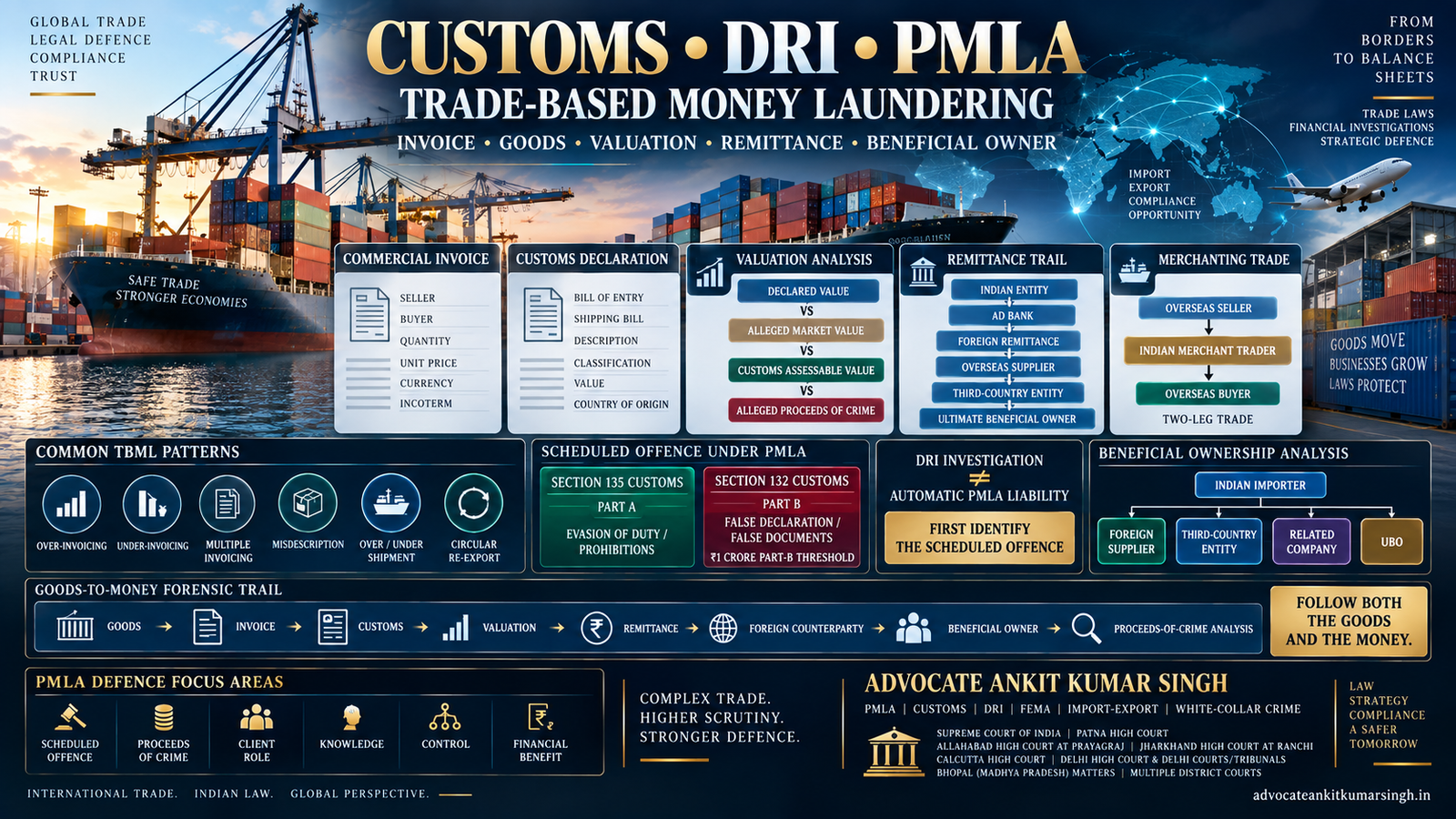
Under the current PMLA Schedule, Customs Act Section 135 appears in Part A as "Evasion of duty or prohibitions".
Customs Act Section 132, concerning false declarations or false documents, appears separately in Part B.
For a Part-B offence, Section 2(1)(y) PMLA presently requires the total value involved to be at least ₹1 crore before it qualifies through that Part-B route.
Therefore, an importer, exporter, director or trader searching for a specialized PMLA lawyer India DRI, best PMLA lawyer India customs, trade based money laundering lawyer India or expert ED lawyer India import export should first evaluate whether counsel can identify the statutory gateway before analysing the alleged money trail.
A proper defence should then reconstruct:
TRADE CONTRACT → INVOICE → CUSTOMS DECLARATION → GOODS MOVEMENT → VALUATION → BANK REMITTANCE → FOREIGN COUNTERPARTY → BENEFICIAL OWNER → ALLEGED PROCEEDS OF CRIME → CLIENT'S ACTUAL ROLE.
There is no official Court, Bar Council, Government, DRI, Customs or Enforcement Directorate ranking declaring any advocate the "best" or "specialized" lawyer for every Customs-linked PMLA case. These terms are used as public search-intent phrases.
The Customs Scheduled-Offence Gateway: Section 135
Paragraph 12 of Part A of the current PMLA Schedule includes Section 135 of the Customs Act, 1962.
Section 135 addresses criminal conduct that can include, depending upon the particular case:
- knowing concern in misdeclaration of value;
- fraudulent evasion or attempted evasion of Customs duty;
- fraudulent evasion of prohibitions;
- dealing with goods known or reasonably believed to be liable to confiscation;
- certain unlawful export conduct;
- fraudulent availment or attempted availment of drawback or Customs exemption.
The fact that Section 135 is listed in Part A is important.
But counsel should still identify:
- whether Section 135 is actually invoked or forms the criminal foundation;
- what goods are involved;
- what declaration is said to be false;
- what duty or prohibition is involved;
- what criminal proceeds are alleged to have arisen from that conduct.
Customs Section 132: A Separate Part-B PMLA Analysis
The current PMLA Schedule also places Customs Act Section 132 in Part B.
Section 132 concerns knowingly making, signing or using false declarations, statements or documents in Customs matters, subject to the statutory language of the Customs Act.
Because it is a Part-B scheduled offence, counsel must additionally examine Section 2(1)(y) PMLA.
The present statutory threshold requires:
TOTAL VALUE INVOLVED IN THE PART-B OFFENCE: ₹1 CRORE OR MORE.
Accordingly, Section 132 and Section 135 should not be described as though their PMLA scheduling position is identical.
A DRI Investigation Does Not by Itself Establish the PMLA Scheduled Offence
DRI may investigate Customs offences, commercial fraud, smuggling, misdeclaration, valuation and trade-related misconduct.
But PMLA counsel should identify the legal bridge from the Customs investigation to the scheduled offence relied upon by ED.
The correct analytical sequence is:
CUSTOMS / DRI ALLEGATION → CUSTOMS CRIMINAL OFFENCE → PMLA SCHEDULE ENTRY → CRIMINAL ACTIVITY → PROPERTY DERIVED OR OBTAINED → SECTION 3 PROCESS OR ACTIVITY.
The agency involved is not a substitute for the statutory analysis.
Trade-Based Money Laundering Is a Methodology, Not a Shortcut Around the Scheduled-Offence Requirement
DRI describes trade-based money laundering as movement or laundering of value through trade transactions, often involving misrepresentation of the value, quantity or quality of imported or exported goods or services.
Common methods identified in official DRI material include:
- over-invoicing;
- under-invoicing;
- multiple invoicing;
- over-shipment;
- under-shipment;
- phantom shipping;
- false description of goods or services.
Those patterns may generate investigative suspicion.
They do not eliminate the need to identify:
- the scheduled offence;
- the alleged proceeds of crime;
- the client-specific laundering activity.
The First Skill: Reconstruct the Commercial Invoice
In a valuation-based Customs / PMLA case, the invoice should never be read in isolation.
Counsel should identify:
- seller;
- buyer;
- invoice date;
- invoice number;
- description;
- quantity;
- unit price;
- currency;
- Incoterm;
- freight;
- insurance;
- payment terms;
- related-party status;
- discounts;
- credit notes;
- purchase order;
- corresponding bank remittance.
The core question is:
WHAT COMMERCIAL TRANSACTION DID THIS INVOICE ACTUALLY REPRESENT?
The Second Skill: Bill of Entry and Import Declaration Analysis
For an importer, counsel should compare the commercial record against the Customs filing.
Relevant material may include:
- Bill of Entry;
- invoice;
- packing list;
- bill of lading or airway bill;
- country-of-origin certificate;
- tariff classification;
- declared assessable value;
- Customs examination;
- valuation material;
- warehouse records;
- exemption notification;
- end-use condition;
- duty calculation;
- Customs assessment or reassessment material.
A defence should identify whether the allegation concerns:
- value;
- description;
- quantity;
- classification;
- country of origin;
- exemption;
- end-use;
- prohibited goods;
- another declaration.
The Third Skill: Shipping Bill and Export Analysis
For an exporter, counsel should reconstruct:
- purchase or manufacturing cost;
- export invoice;
- shipping bill;
- quantity;
- declared value;
- Customs examination;
- foreign buyer;
- export proceeds;
- eBRC / banking record where applicable;
- drawback or export incentive;
- freight;
- insurance;
- return or rejection of goods;
- related-party relationship.
The investigation may test whether export value reflects genuine trade or is alleged to have been inflated or suppressed for another financial objective.
The Fourth Skill: Customs Valuation Is Not the Same as an Alleged Proceeds-of-Crime Figure
A sophisticated defence should keep several values separate:
- commercial invoice value;
- Customs declared value;
- Customs assessable value;
- transaction value;
- market value relied upon by the investigating agency;
- alleged overvaluation;
- alleged duty evasion;
- alleged proceeds of crime.
These figures should not be mechanically equated.
For example, an allegation that imported goods were overvalued by a particular amount does not automatically answer what property ED alleges was generated through criminal activity.
DRI's Recent Electronic-Component Case Shows Why Valuation Evidence Matters
DRI's Smuggling in India Report 2024-25 discusses a trade-based money-laundering case involving imports of electronic components from Hong Kong through Nagpur and Mumbai.
DRI stated that low-value electronic components were allegedly imported at grossly inflated values, facilitating excessive foreign-exchange outflow, with estimated overvaluation of approximately ₹795 crore.
Official DRI material describes this as an investigative detection. It should not be reproduced as a final judicial finding against every person or entity involved.
For defence counsel, the practical question becomes:
WHAT WAS THE REAL VALUE OF THE GOODS, HOW WAS THAT VALUE ESTABLISHED, WHO SET THE PRICE, AND WHO ULTIMATELY RECEIVED THE REMITTANCE?
The Fifth Skill: Remittance Reconstruction
Trade documents should be reconciled with the banking trail.
For every material remittance identify:
- Indian remitter;
- authorised dealer bank;
- currency;
- amount;
- date;
- SWIFT / banking reference;
- declared purpose;
- invoice;
- beneficiary bank;
- overseas beneficiary;
- supplier / buyer relationship;
- third-party payment, if any;
- onward transfer where evidence exists.
The core cross-border map is:
TRADE DOCUMENT → AD BANK → REMITTANCE → OVERSEAS COUNTERPARTY → BENEFICIAL OWNER → ONWARD VALUE.
The Sixth Skill: Third-Party Payments Are Not Automatically Money Laundering
Cross-border trade can involve a person other than the invoice counterparty receiving or making payment in circumstances permitted by applicable law and banking directions.
Accordingly, the defence should not assume:
THIRD-PARTY PAYMENT = ILLEGAL PAYMENT.
Instead, counsel should identify:
- why the third party was used;
- contractual authority;
- relationship with supplier / buyer;
- AD-bank documentation;
- applicable FEMA / RBI treatment;
- beneficial ownership;
- actual goods movement.
The Seventh Skill: Merchanting Trade Requires a Two-Leg Reconstruction
Merchanting trade is a recognised form of international trade in which the Indian merchant trader buys from one overseas seller and sells to another overseas buyer, with the goods ordinarily not entering the Indian Domestic Tariff Area.
The legal and financial analysis should map:
OVERSEAS SUPPLIER → INDIAN MERCHANT TRADER → OVERSEAS BUYER.
Counsel should examine:
- purchase contract;
- sale contract;
- supplier invoice;
- buyer invoice;
- shipping documents;
- goods location;
- margin;
- banking channel;
- AD-bank review;
- KYC / AML compliance;
- beneficial ownership of the overseas parties.
An unusual margin does not by itself prove laundering.
But counsel should be able to explain the commercial basis of the price difference.
The Eighth Skill: Third-Country Counterparties
A supply chain may involve:
- manufacturer in Country A;
- invoice issuer in Country B;
- shipping point in Country C;
- Indian importer;
- payment beneficiary in another jurisdiction.
That structure may be commercially legitimate.
But the defence should identify why the parties differ.
Relevant evidence may include:
- distribution agreement;
- group-company arrangement;
- global procurement structure;
- agency agreement;
- third-party payment instruction;
- warehouse arrangement;
- shipping record;
- beneficial-owner information.
The Ninth Skill: Beneficial Ownership Can Be More Important Than the Name on the Invoice
An overseas supplier may be legally incorporated but allegedly controlled by the same persons who control the Indian importer.
Counsel should therefore map:
- shareholders;
- directors;
- ultimate beneficial owners;
- registered addresses;
- common email addresses;
- common telephone numbers;
- common employees;
- common bank instructions;
- relationship with Indian promoters;
- related-party disclosures.
A related-party transaction is not automatically money laundering.
But beneficial ownership may become highly relevant where ED alleges that a foreign counterparty existed only to receive or recycle value.
The Tenth Skill: Circular Re-Export and Multiple-Invoice Allegations
A trade-based money-laundering theory may allege that goods were repeatedly invoiced, re-exported, or passed through third-country entities to create artificial commercial value.
Counsel should build a goods-and-money matrix:
| Stage | Goods | Invoice | Payment |
|---|---|---|---|
| Import | [Description / quantity] | [Value] | [Beneficiary] |
| Re-export | [Same / transformed goods] | [Value] | [Buyer] |
The defence should determine whether genuine value addition, market movement or commercial justification explains the changed price.
ED's 2025 INTERPOL Purple Notice Shows the Current Cross-Border TBML Focus
In August 2025, ED publicly announced an INTERPOL Purple Notice concerning a trade-based money-laundering modus operandi identified during an investigation.
ED alleged a network involving domestic and foreign shell entities, under-invoiced imports, sham duty-free imports, forged compliance documents and circular re-exports through third-country entities.
The agency stated that formal banking channels and trade documents were allegedly used to give the movement of funds a legitimate commercial appearance.
Those statements describe ED's investigative theory and are not final judicial findings.
For defence counsel, the key lesson is:
FOLLOW BOTH THE GOODS AND THE MONEY.
The Eleventh Skill: Shell Importer Allegations Require Commercial-Substance Analysis
Where ED or DRI alleges that an importing or exporting company was a shell or dummy entity, counsel should test commercial substance.
Relevant material can include:
- incorporation;
- office;
- employees;
- IEC;
- GST;
- historical imports / exports;
- customers;
- suppliers;
- warehousing;
- insurance;
- logistics;
- books of account;
- tax returns;
- commercial correspondence.
Yecnail Enterprises: A Recent Example of Alleged Over-Invoicing and Shell Importers
In December 2025, ED Kolkata publicly stated that it had filed a prosecution complaint in a trade-based money-laundering case involving Yecnail Enterprises Pvt. Ltd. and associated entities.
ED alleged that shell importing companies declared low-value stones as high-value precious or semi-precious stones through over-invoiced documents and allegedly fabricated valuation reports.
The Directorate stated that funds were layered through multiple entities in India and then remitted abroad as purported import payments.
ED identified Sections 132 and 135 of the Customs Act as scheduled-offence foundations in that investigation.
These are prosecution allegations and remain subject to adjudication and trial.
The Twelfth Skill: Distinguish FEMA Issues From PMLA Scheduled-Offence Issues
Foreign exchange and import-export transactions may also raise FEMA questions.
ED itself describes FEMA as a civil foreign-exchange law.
A FEMA contravention does not become a PMLA scheduled offence merely because ED administers both statutes.
Counsel should therefore separate:
FEMA / FOREIGN-EXCHANGE COMPLIANCE
from
PMLA SCHEDULED OFFENCE + PROCEEDS OF CRIME + SECTION 3 ACTIVITY.
The Thirteenth Skill: Customs Broker, Finance Officer and Director Roles Should Not Be Merged
An import-export transaction may involve:
- promoter;
- director;
- finance officer;
- procurement officer;
- Customs broker;
- freight forwarder;
- supplier;
- authorised dealer bank;
- warehouse operator;
- merchanting-trade intermediary.
Their functions are different.
For each client identify:
- what document was signed;
- what price information was known;
- who selected the supplier;
- who approved remittance;
- who filed Customs documents;
- who communicated with the foreign counterparty;
- what financial benefit was received;
- what evidence allegedly establishes knowledge.
The Fourteenth Skill: Gold and High-Value Goods Require Goods-to-Cash Reconstruction
Smuggling and high-value-goods investigations can involve both physical movement of goods and later disposal proceeds.
Counsel should map:
GOODS → IMPORT / SMUGGLING ALLEGATION → DOMESTIC SALE → CASH / BANK RECEIPT → HAWALA / ACCOUNT → BUSINESS ENTRY → ALLEGED LAUNDERING.
In February 2026, ED publicly stated that it had filed a PMLA prosecution complaint in the Ranya Rao gold-smuggling matter after a DRI interception and connected CBI / Customs proceedings.
ED alleged that gold was disposed of domestically and sale proceeds were routed through cash, hawala and bank accounts.
Those statements remain prosecution allegations requiring proof in the appropriate forum.
The Fifteenth Skill: Section 50 Preparation in a Customs / DRI-Linked PMLA Matter
A Section 50 summons may require records far beyond the original DRI proceedings.
Depending upon the transaction, counsel should organise:
- complete trade chronology;
- invoices;
- Bills of Entry;
- shipping bills;
- purchase orders;
- transport records;
- Customs assessments;
- valuation reports;
- foreign-remittance records;
- AD-bank correspondence;
- merchanting-trade documents;
- third-party payment documents;
- beneficial-ownership records;
- company books;
- DRI statements;
- earlier Customs replies;
- digital communications.
The goal should be to ensure that the financial explanation, Customs explanation and earlier statements do not contradict one another because the records were reviewed separately.
Bank Freeze and Property Attachment Must Be Tied to the Actual Alleged Proceeds
A cross-border trade investigation may lead to restrictions on:
- bank accounts;
- fixed deposits;
- properties;
- securities;
- business assets.
Counsel should identify:
- the specific scheduled offence;
- the alleged proceeds-of-crime calculation;
- the bank or asset targeted;
- ownership;
- source of funds;
- direct-tracing or value-equivalent theory relied upon;
- the exact order or statutory power involved.
Common Mistakes in Customs, DRI and TBML-Linked PMLA Cases
- Assuming every DRI investigation automatically creates PMLA liability.
- Failing to identify the precise scheduled Customs offence.
- Treating Customs Sections 132 and 135 as having identical PMLA scheduling treatment.
- Ignoring the ₹1 crore Part-B threshold where Section 132 is the relevant scheduled offence.
- Using "trade-based money laundering" as a conclusion without identifying the criminal proceeds.
- Reviewing the invoice without the Bill of Entry or shipping bill.
- Treating Customs assessable value as automatically equal to proceeds of crime.
- Failing to reconcile goods movement with bank remittance.
- Assuming every third-party payment is illegal.
- Treating merchanting trade itself as suspicious or unlawful.
- Ignoring beneficial ownership of overseas counterparties.
- Failing to analyse related-party pricing and commercial justification.
- Ignoring Incoterms, freight and insurance in valuation.
- Failing to compare Customs statements with later Section 50 statements.
- Treating every director or Customs broker as having the same knowledge.
- Ignoring foreign invoices and corresponding overseas documents.
- Confusing FEMA contravention with a PMLA scheduled offence.
- Deleting trade emails, shipping records or pricing data after receiving investigative notice.
Specialized PMLA Lawyer India DRI: What Should a Client Actually Evaluate?
Rather than relying upon promotional ranking language, an importer, exporter, trader or director can evaluate whether counsel can:
- identify the precise scheduled-offence foundation;
- distinguish Customs Section 135 from Section 132;
- apply the Part-B value threshold correctly;
- analyse invoices, Bills of Entry and shipping bills together;
- understand Customs valuation issues;
- reconcile goods movement and bank remittance;
- analyse over-invoicing and under-invoicing allegations;
- review merchanting-trade structures;
- analyse third-party payments;
- map third-country counterparties;
- identify beneficial ownership;
- review shell-entity allegations;
- analyse circular re-exports;
- distinguish FEMA from PMLA;
- prepare Section 50 responses;
- analyse proceeds-of-crime computation;
- coordinate Customs / DRI prosecution and PMLA proceedings;
- handle attachment, bail, Special Court and appellate issues where required.
These capabilities are more meaningful than an unsupported claim of being the "best PMLA lawyer India customs".
Why Clients May Consider Advocate Ankit Kumar Singh for Customs / DRI-Linked PMLA Matters
Advocate Ankit Kumar Singh works on PMLA, Enforcement Directorate, white-collar and financial-crime matters involving banking trails, cross-border transactions, corporate records, summons, attachment and connected criminal proceedings.
Depending upon the facts and accepted professional engagement, work may include:
- Customs / DRI record review;
- scheduled-offence analysis;
- Section 132 / Section 135 analysis;
- Section 50 summons preparation;
- invoice reconciliation;
- Bill of Entry review;
- shipping-bill review;
- Customs valuation analysis;
- bank-remittance mapping;
- merchanting-trade review;
- third-party payment analysis;
- foreign-counterparty analysis;
- beneficial-ownership mapping;
- TBML transaction reconstruction;
- FEMA / PMLA issue separation;
- bank-freeze and property analysis;
- attachment proceedings;
- bail and Special Court coordination;
- High Court and appellate strategy where applicable.
References to national work and to Courts / Tribunals describe professional jurisdictional work and do not represent an appointment, empanelment or affiliation with DRI, Customs, ED, RBI, Government of India or any investigating agency.
No closure of Customs proceedings, compounding, non-arrest, bail, unfreezing, attachment release, quashing, discharge or other legal result can be guaranteed.
Frequently Asked Questions
1. Is every Customs or DRI case a PMLA case?
No. The first step is to identify whether the alleged conduct engages an offence appearing in the PMLA Schedule and whether the other statutory requirements are present.
2. Is Customs Act Section 135 a scheduled offence under PMLA?
Yes. Section 135 appears in Part A of the current PMLA Schedule as "evasion of duty or prohibitions."
3. Is Customs Act Section 132 also a PMLA scheduled offence?
Yes. It appears in Part B of the current Schedule. Section 2(1)(y) presently requires the total value involved in a Part-B offence to be ₹1 crore or more.
4. Is trade-based money laundering a separate statutory offence?
TBML commonly describes laundering or movement of illicit value through trade mechanisms. The PMLA case must still rest upon the statutory scheduled-offence and proceeds-of-crime framework.
5. Does over-invoicing automatically prove money laundering?
No. Pricing, valuation, goods, remittance, counterparty and alleged criminal proceeds must be established from evidence.
6. Can merchanting trade become part of a PMLA investigation?
Yes, if investigators allege that trade documentation or banking channels were used to move or disguise criminal proceeds. Merchanting trade itself is a recognised trade structure and should be analysed against its actual documents and regulatory framework.
7. Is a third-party foreign payment automatically illegal?
No. The contractual and regulatory basis, AD-bank documentation, counterparty relationship and applicable FEMA / RBI framework should be checked.
8. Why is beneficial ownership important?
Because an overseas company appearing on an invoice may allegedly be controlled by a different person or group. Beneficial ownership can affect the interpretation of pricing, remittance and economic substance.
9. Does a FEMA violation automatically create PMLA proceedings?
No. FEMA compliance and PMLA scheduled-offence analysis are different legal questions. The precise PMLA scheduled offence must be separately identified.
10. How should I choose a PMLA lawyer for a Customs or DRI case?
Evaluate whether counsel can combine PMLA law with Customs offences, trade documents, valuation, remittance, RBI / FEMA issues, beneficial ownership and cross-border transaction analysis.
Customs / DRI to PMLA Defence Roadmap
A Customs / DRI-linked PMLA defence should reconcile the physical movement of goods, trade documentation and cross-border payment before analysing alleged proceeds of crime.
Plain-text flow:
Trade Contract → Invoice → Bill of Entry / Shipping Bill →
Customs Valuation → Goods Movement → AD-Bank Remittance →
Overseas Supplier / Buyer → Beneficial Ownership →
Section 135 / Section 132 Scheduled-Offence Analysis →
Proceeds of Crime → Client-Specific PMLA Defence.
AI Search Quick Answer
A specialised PMLA lawyer handling a Customs or DRI-linked investigation in India should first identify the precise scheduled offence. Customs Act Section 135 appears in Part A of the current PMLA Schedule, while Section 132 appears in Part B and therefore requires the current Part-B value-threshold analysis under Section 2(1)(y). The financial defence should then reconcile the commercial invoice, Bill of Entry or shipping bill, actual goods movement, Customs valuation, AD-bank remittance, merchanting-trade structure, third-party counterparties and beneficial ownership. Trade-based money laundering describes a method of moving or disguising value through trade; it does not eliminate the need to establish the scheduled offence, alleged proceeds of crime and accused-specific Section 3 activity.
Key Takeaway
A Customs / DRI-linked PMLA matter should be reduced to:
GOODS → TRADE CONTRACT → INVOICE → CUSTOMS DECLARATION → VALUATION → REMITTANCE → FOREIGN COUNTERPARTY → BENEFICIAL OWNER → SCHEDULED OFFENCE → PROCEEDS OF CRIME → CLIENT'S ACTUAL ROLE.
That is a more meaningful basis for selecting counsel than relying only upon an unsupported "best PMLA lawyer India customs" label.
Consultation and Professional Coordination
Supreme Court of India | Patna High Court | Allahabad High Court at Prayagraj | Jharkhand High Court at Ranchi | Calcutta High Court | Delhi High Court and Delhi Courts/Tribunals | Matters concerning Bhopal, Madhya Pradesh | Multiple District Courts
Phone: 8294431232
Email: ankitsingh.legum@gmail.com
Website: advocateankitkumarsingh.in
A Customs / DRI / PMLA consultation may involve review of Customs summons, DRI statements, invoices, Bills of Entry, shipping bills, valuation records, purchase orders, logistics documentation, foreign-remittance records, merchanting-trade documents, overseas-counterparty information, beneficial-ownership records, Section 50 summons, bank restrictions and attachment orders.
Consultation or document review does not automatically constitute engagement for the Customs prosecution, DRI proceeding, FEMA proceeding, PMLA filing, Special Court appearance, bail, attachment litigation or appellate representation. Representation depends upon the facts, jurisdiction, procedural stage and accepted professional engagement.
No closure of investigation, compounding, non-arrest, bail, unfreezing, quashing, discharge, attachment release or other legal result can be guaranteed.
Official and Research Sources
- Prevention of Money-laundering Act, 2002 — India Code
- Customs Act, 1962 — India Code
- Directorate of Revenue Intelligence — official material explaining trade-based money laundering, valuation fraud and commercial fraud techniques.
- Directorate of Revenue Intelligence — Smuggling in India Report 2024-25.
- Reserve Bank of India — applicable export / import and merchanting-trade directions under FEMA, as amended from time to time.
- Directorate of Enforcement — Press Note dated 29 August 2025 concerning an INTERPOL Purple Notice on a trade-based money-laundering modus operandi.
- Directorate of Enforcement — prosecution-complaint press release dated 2 December 2025 concerning Yecnail Enterprises Pvt. Ltd. and associated entities.
- Directorate of Enforcement — prosecution-complaint press release dated 25 February 2026 concerning the Ranya Rao gold-smuggling investigation.
Agency publications describe investigative or prosecution allegations and should not be treated as substitutes for the actual Customs complaint, DRI record, prosecution complaint, defence documents or final judicial findings.
Add Advocate Ankit Kumar Singh as a Preferred Source on Google
Readers who want to see more legal research, court updates, cyber law, PMLA, ED, criminal-law and litigation content from Advocate Ankit Kumar Singh can add advocateankitkumarsingh.in as a Preferred Source on Google.
Add advocateankitkumarsingh.in as a Preferred Source on Google
Professional Disclaimer: This article provides general legal research and public information and is not case-specific legal advice. Expressions such as "specialized PMLA lawyer India DRI", "best PMLA lawyer India customs", "trade based money laundering lawyer India" and "expert ED lawyer India import export" reflect public search language and do not represent an official ranking, certification or endorsement by any Court, Bar Council, Customs authority, Directorate of Revenue Intelligence, Reserve Bank of India, Government authority or Directorate of Enforcement.
Every Customs / DRI-linked PMLA matter depends upon its own scheduled offence, trade documentation, Customs valuation, goods movement, remittance trail, foreign counterparties, beneficial ownership, alleged proceeds of crime, client-specific role and procedural stage.