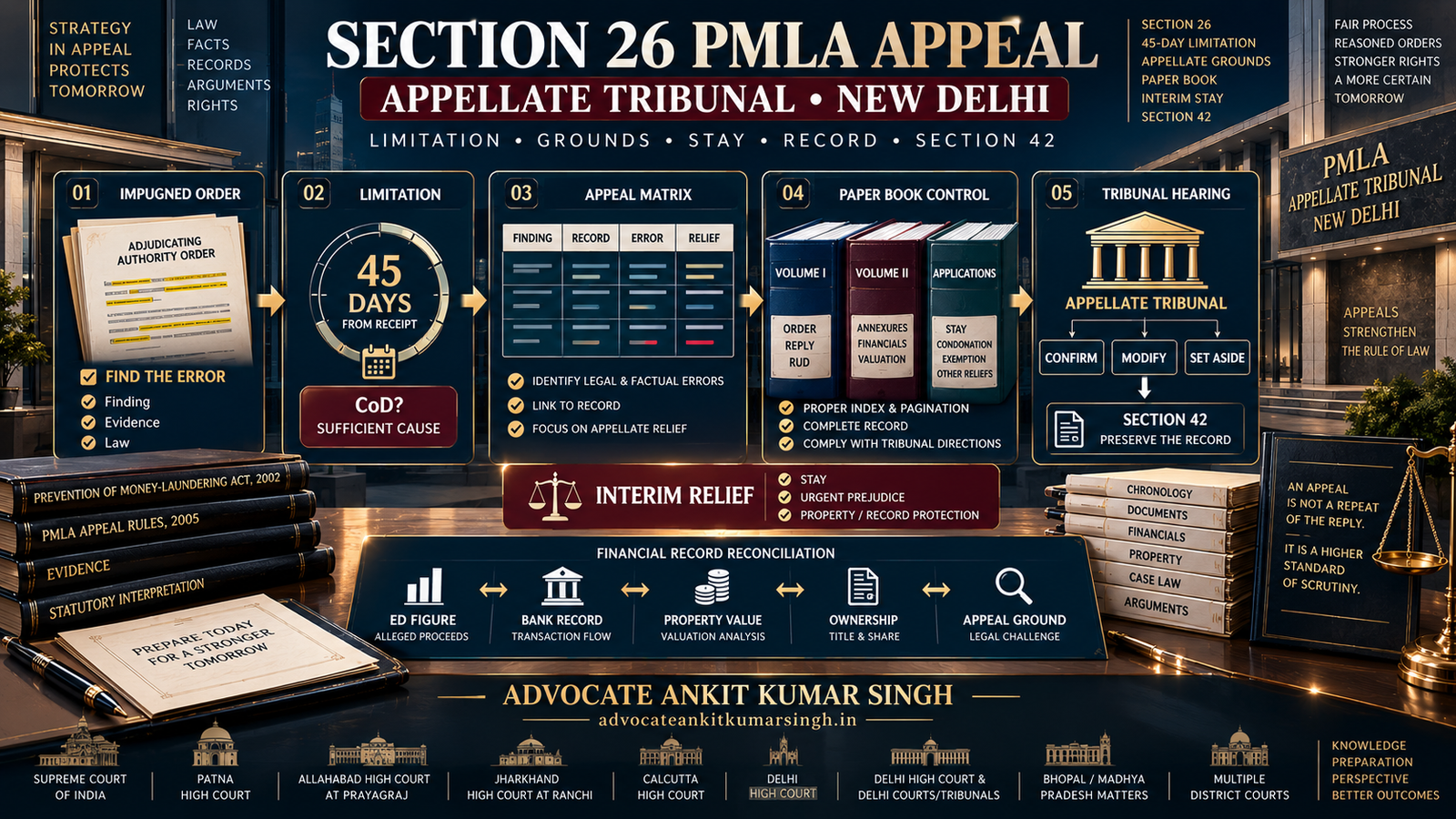
PMLA APPEALS | SECTION 26 | APPELLATE TRIBUNAL | NEW DELHI | ATTACHMENT | RETENTION | INTERIM STAY
Top PMLA Appellate Lawyer in Delhi for Section 26 Appeals Before the PMLA Appellate Tribunal, New Delhi
Legally researched and updated: 20 September 2026
Supreme Court of India | Patna High Court | Allahabad High Court at Prayagraj | Jharkhand High Court at Ranchi | Calcutta High Court | Delhi High Court and Delhi Courts/Tribunals | Matters concerning Bhopal, Madhya Pradesh | Multiple District Courts
 Advocate Ankit Kumar Singh
Direct Answer: What Makes a Section 26 PMLA Appeal Different From the Original Adjudication?
A Section 26 appeal should not ordinarily be drafted as a longer version of the reply already filed before the Adjudicating Authority.
The appellate task is different.
Counsel must identify: what the Adjudicating Authority actually held, which finding is wrong, why it is wrong, what part of the existing record disproves it, what statutory or procedural rule was incorrectly applied, what immediate interim protection is required, and what part of the appellate record may later become important under Section 42.
A person searching for a top PMLA appellate lawyer in Delhi, PMLA Appellate Tribunal lawyer in Delhi, best PMLA lawyer in Delhi for Section 26 appeal or specialized PMLA appeal advocate Delhi should therefore evaluate appellate capability rather than promotional language.
There is no official Court, Tribunal or Bar Council ranking declaring one advocate the "top" or "best" PMLA appellate lawyer. Those expressions are used here as public search language.
What Is a Section 26 PMLA Appeal?
Section 26 of the Prevention of Money-laundering Act, 2002 provides the statutory appellate remedy before the Appellate Tribunal against an order made by the Adjudicating Authority under the Act. The provision also separately covers appeals by a reporting entity against an order of the Director under Section 13(2).
For attachment and retention litigation, Section 26 commonly becomes relevant after an adverse adjudicatory order concerning property or records.
The Tribunal may, after giving the parties an opportunity of hearing:
- confirm the order appealed against;
- modify it; or
- set it aside.
The statutory appeal is therefore a substantive appellate proceeding, not merely a procedural review by the Registry.
Where Is the PMLA Appellate Tribunal?
The official Appellate Tribunal website presently describes the Tribunal as a national Tribunal headquartered in New Delhi and functioning from the 4th Floor, A and C Wings, Lok Nayak Bhawan, Khan Market, New Delhi.
The Registrar's official contact page presently gives:
RegistrarAppellate Tribunal (ATFP)
Ministry of Finance, Department of Revenue
4th Floor, A Wing, Lok Nayak Bhawan
Khan Market, New Delhi – 110003
Current cause lists and hearing notices should always be checked because court-room allocation, Bench constitution and listing arrangements can change.
The First Appellate Skill: Build the Correct Chronology
A Section 26 appeal can become difficult to understand if counsel begins with the final adjudication order without reconstructing the proceeding below.
A useful master chronology may include:
- Date of predicate FIR / scheduled-offence proceeding.
- Date of ECIR, where known or relevant.
- Date of search under Section 17, where applicable.
- Date of seizure or freezing.
- Date of retention order under the applicable statutory provision.
- Date of Provisional Attachment Order under Section 5, where applicable.
- Date of Section 5(5) complaint.
- Date of Section 8 notice.
- Date of reply.
- Date of additional reply/rejoinder.
- Dates of hearing.
- Date of Adjudicating Authority order.
- Date the order was received.
- Ordinary Section 26 limitation date.
- Date of appeal filing.
- Date and nature of any Registry objection.
- Date of defect removal.
- Date of interim application.
This chronology should then be connected with the exact page number where each event is proved.
The Second Skill: Limitation Must Be Calculated Before Drafting the Merits
Section 26 ordinarily requires the appeal to be filed within 45 days from the date on which the copy of the relevant order is received.
The date of the order and the date of receipt should not be mechanically treated as identical.
A limitation sheet should therefore record:
| Event | Date / Evidence |
|---|---|
| Impugned order | Exact date |
| Receipt / service | Email / portal / post / authenticated record |
| Ordinary last date | Calculated from receipt |
| Actual filing | Diary / filing record |
| Delay, if any | Period requiring explanation |
The statutory proviso permits the Tribunal to entertain a delayed appeal if sufficient cause is established.
The Tribunal's official common-objection guidance also states that a delayed appeal should carry a condonation application supported by affidavit.
Why Limitation Is Not a Clerical Issue
An appellant can have substantial grounds on the merits and still encounter a threshold limitation problem.
Counsel should preserve:
- the exact mode and date of communication;
- the email transmitting the order;
- portal download evidence, where relevant;
- postal envelope or tracking;
- certified-copy application details;
- internal company chronology;
- medical, administrative or other evidence relied upon for condonation.
An appellate lawyer should identify a limitation problem before the appeal paper book is finalised, not after the Registry or respondent raises it.
The Third Skill: Identify Errors Instead of Re-Arguing Everything
A useful appellate ground should ordinarily answer four questions:
- What did the Authority hold?
- Why is that finding legally or factually defective?
- Where in the record is the contrary evidence?
- What appellate relief follows from that error?
Possible categories of appellate error may include:
- failure to consider a material document;
- incorrect reading of bank records;
- incorrect proceeds-of-crime calculation;
- failure to determine ownership share;
- incorrect property classification;
- unsupported valuation;
- failure to deal with a third-party claim;
- failure to address a jurisdictional objection;
- non-consideration of a specific reply;
- internal inconsistency in the findings;
- misapplication of a statutory provision;
- procedural or natural-justice objection;
- confirmation without the statutory foundation required on the particular facts.
A memorandum containing fifty repetitive grounds may be less useful than a smaller number of clearly identified appellate errors tied to the record.
Retention Appeals: Why Sections 17, 20 and 8 May Require Separate Analysis
Not every Section 26 case arises from a Section 5 provisional attachment. Some appeals concern seized or retained property or records.
A recent Delhi High Court line of authority has examined the statutory relationship between search/seizure, Section 20 retention and Section 8 confirmation.
In Ravi Aggarwal v. Deputy Director, Enforcement Directorate, decided on 23 January 2026, the Delhi High Court set aside the Appellate Tribunal's order in light of its earlier decision concerning the absence of a Section 20 retention order.
This illustrates an important appellate principle: the lawyer must first identify what statutory chain actually governs the property in the particular appeal.
An attachment case and a retention case should not be drafted by mechanically substituting one section number for another.
The Fourth Skill: Annexure Control Is Part of Appellate Advocacy
The Appellate Tribunal has issued detailed filing instructions concerning the sequence of the appeal paper book.
Current official instructions dated 22 August 2025 prescribe a first folder containing, among other things:
- index;
- fee proof where applicable;
- memo of parties;
- synopsis;
- memo of appeal containing facts, grounds and prayer;
- supporting affidavit;
- impugned order;
- proof of service of the impugned order;
- vakalatnama;
- board resolution or other authority;
- Original Complaint and other relied-upon documents;
- applications and replies filed before the Adjudicating Authority;
- relevant notices;
- orders of higher judicial or quasi-judicial authorities.
The instructions separately structure replies/rejoinders and applications.
An appellate lawyer should therefore prepare the legal argument and the paper-book architecture together.
The Fifth Skill: Registry Defects Must Be Treated as a Separate Workstream
A filed appeal and a defect-free appeal are not necessarily the same thing.
The Tribunal's official common-objection list identifies issues including:
- limitation;
- condonation application where required;
- prescribed appeal format;
- supporting affidavit;
- signature;
- vakalatnama;
- pagination;
- index;
- memo of parties;
- fee compliance;
- proper inventory of relied-upon documents;
- advance service and proof of service.
The legal team should therefore maintain a separate DEFECT CONTROL SHEET recording:
Defect → Registry date → Required correction → Person responsible → Document uploaded/filed → Confirmation of cure.
The Sixth Skill: Interim Stay Strategy
A stay application should not merely state that the appellant has a strong prima facie case.
It should identify the immediate consequence that requires protection. Depending on the case, that may concern:
- continuing attachment;
- possession-related consequences;
- third-party property rights;
- business assets;
- banking consequences;
- seized or retained records;
- property proposed to be dealt with pursuant to the impugned order;
- another irreversible or difficult-to-reverse consequence.
The interim application should then connect that prejudice with the principal appellate error instead of functioning as an independent emotional narrative.
Current Tribunal cause lists regularly identify miscellaneous applications for "Stay", confirming that interim applications form a practical component of PMLA appellate litigation.
The Seventh Skill: Preserve Property Classification From the Section 8 Record
In an attachment appeal, every property should be classified before the grounds are finalised.
| Issue | Appellate Question |
|---|---|
| Direct alleged proceeds | What evidence connects acquisition with the alleged criminal activity? |
| Value thereof | What original property/value is ED relying upon and how was the figure derived? |
| Equivalent-value theory | Did the Authority apply the correct statutory test to an otherwise untainted asset? |
| Joint property | Was each owner's share and source separately examined? |
| Third-party property | Was the independent claim actually adjudicated? |
| Mortgaged property | Were prior secured interests and chronology properly considered? |
A ground saying "the property is untainted" may therefore be too vague. The appellate case should identify the precise classification error.
The Eighth Skill: Financial-Record Reconciliation
The Tribunal should not be asked to perform forensic accounting for the appellant.
Where the dispute concerns property acquisition or transaction flow, counsel should reconcile:
- ED's proceeds-of-crime figure;
- PAO or retention figures;
- Adjudicating Authority findings;
- bank statements;
- ledger accounts;
- loan records;
- income-tax records;
- company accounts;
- property consideration;
- ownership percentage;
- valuation.
A useful appellate table may be:
| Finding | ED Figure | Appellant Record | Paper-book Page | Appellate Error |
|---|---|---|---|---|
| Property A | [Figure] | [Reconciled figure] | [Page] | [Specific error] |
What Should Be Included in the Section 26 Appeal File?
A merits-focused appellate file may contain:
- Limitation sheet.
- Master chronology.
- Synopsis.
- Memo of parties.
- Memorandum of appeal.
- Ground-wise error chart.
- Impugned order.
- Proof of communication/receipt.
- PAO or relevant seizure/retention order.
- Original Complaint or Original Application, as applicable.
- Section 8 notice.
- Reply before the Adjudicating Authority.
- Rejoinders/additional submissions.
- Property schedule.
- Source-of-funds chart.
- Bank-record reconciliation.
- Valuation chart.
- Third-party ownership documents.
- Relied-upon judgments.
- Stay/interim-relief application.
- Condonation application where necessary.
- Exemption application where necessary.
- Supporting affidavits.
- Vakalatnama and corporate authority documents.
- Proof of advance service.
Current Tribunal Filing Discipline Matters
Tribunal practice is not static.
For example, an official order dated 30 May 2025 states that replies, rejoinders and other documents containing prayers for relief should be accompanied by a proper affidavit of the appellant, respondent or authorised representative.
The Tribunal also issued document-sequencing instructions in August 2025, and its website currently publishes cause lists, orders, judgments, court notices, online fee-payment access and e-filing access.
Accordingly, counsel should verify the current filing notice immediately before filing rather than rely exclusively on an older precedent paper book.
Section 42: Prepare the Tribunal Appeal With the Next Stage in Mind
Section 42 provides a statutory High Court appeal against a decision or order of the Appellate Tribunal on a question of law or fact arising out of the Tribunal's order.
The ordinary statutory period is sixty days from communication of the Tribunal decision or order, with the further statutory extension contemplated by the proviso where sufficient cause is established.
But appellate counsel should think about Section 42 much earlier.
Important points should be:
- clearly pleaded before the Tribunal;
- supported by the record;
- connected with a specific finding;
- preserved in written submissions where appropriate;
- supported by documents already forming part of the appellate record.
A later High Court proceeding should not be treated as an opportunity to rebuild a poorly organised Section 26 case from the beginning.
Important: The Delhi High Court Is Not Automatically the Section 42 Court
This is one of the most important jurisdictional points for litigants using the search phrase "PMLA Appellate Tribunal lawyer Delhi".
The Appellate Tribunal is headquartered in New Delhi, but Section 42 separately defines the relevant High Court with reference to where the aggrieved party ordinarily resides, carries on business or personally works for gain, subject to the statutory language.
In Anup Kumar Singh v. Directorate of Enforcement, decided on 19 February 2026, the Delhi High Court dismissed the Section 42 appeal for lack of territorial jurisdiction after examining where the appellant ordinarily resided and worked for gain.
Accordingly:
TRIBUNAL AT NEW DELHI ≠ AUTOMATIC DELHI HIGH COURT JURISDICTION FOR EVERY SECTION 42 APPEAL.
The correct High Court must be determined from Section 42 and the actual facts.
Can the Tribunal Remand a PMLA Matter?
A remand argument should not be made merely because the appellant wants another opportunity before the Adjudicating Authority.
Depending on the record, remand may become relevant where primary findings were not made, material evidence was not considered, an effective hearing was denied or the adjudicatory record requires consideration that should ordinarily occur at the first level.
But an appellant should also consider whether the existing record permits the Tribunal itself to grant substantive appellate relief.
The prayer should therefore be connected to the actual error: set aside, modify, or where legally justified, remand.
Top PMLA Appellate Lawyer in Delhi: What Should a Litigant Actually Evaluate?
Instead of relying on a ranking label, consider whether counsel can answer these questions:
- Can the lawyer calculate Section 26 limitation immediately?
- Can counsel distinguish the impugned finding from the underlying allegation?
- Can counsel identify the strongest appellate errors?
- Can counsel explain why each ground matters?
- Can counsel control a multi-volume record?
- Can counsel comply with the Tribunal's paper-book sequencing?
- Can counsel handle Registry defects systematically?
- Can counsel prepare urgent stay relief?
- Can counsel reconcile bank and property records?
- Can counsel distinguish attachment from retention?
- Can counsel identify direct, value and equivalent-value property theories?
- Can counsel protect third-party ownership issues?
- Can counsel preserve important points for Section 42?
- Can counsel identify the correct later High Court rather than assuming Delhi?
Why Clients May Consider Advocate Ankit Kumar Singh for Section 26 PMLA Appellate Work
Advocate Ankit Kumar Singh works on PMLA and Enforcement Directorate proceedings including document-intensive attachment, adjudication and appellate matters.
For a Section 26 matter, professional work may include:
- impugned-order analysis;
- limitation calculation;
- appeal chronology;
- grounds-of-appeal drafting;
- property classification;
- source-of-funds review;
- financial-record reconciliation;
- valuation analysis;
- paper-book structuring;
- annexure and pagination control;
- stay/interim application drafting;
- condonation and exemption applications;
- Registry-defect analysis;
- written submissions;
- hearing preparation;
- Section 42 preservation strategy.
References to Delhi or New Delhi proceedings refer to professional work before the relevant Delhi forums and tribunals and do not represent a claim of a permanent office in Delhi unless separately stated.
No stay, release of property, modification, setting aside, remand or appellate outcome can be guaranteed.
Frequently Asked Questions
1. How long do I have to file a Section 26 PMLA appeal?
The ordinary statutory period is 45 days from receipt of the copy of the relevant order. A delayed appeal may be entertained if the Tribunal is satisfied that sufficient cause prevented timely filing.
2. Should limitation be calculated from the date printed on the order?
Section 26 refers to receipt of the copy of the order. The actual communication record should therefore be preserved and examined.
3. Where is the PMLA Appellate Tribunal located?
Its headquarters are in New Delhi at Lok Nayak Bhawan, Khan Market. Current listing and courtroom details should be checked from the Tribunal's official cause list.
4. Can I seek stay along with the appeal?
Interim applications are a regular feature of Tribunal litigation. The relief should be tied to the actual prejudice and grounds of appeal.
5. Can defects delay my appeal?
Yes. Registry scrutiny may concern limitation, affidavit, format, fee, vakalatnama, pagination, service, indexing or other filing requirements.
6. Should every document from the Adjudicating Authority be annexed?
The record should be complete enough to support the appeal, but document selection and sequencing should follow the applicable rules and current Tribunal directions rather than uncontrolled duplication.
7. Can a third-party property owner file a Section 26 appeal?
Section 26 permits a person aggrieved by an order of the Adjudicating Authority to appeal. Whether a particular claimant is aggrieved and the precise grounds depend upon the order and the claimant's legal interest.
8. Can the Tribunal modify an order instead of completely setting it aside?
Yes. Section 26 expressly contemplates confirmation, modification or setting aside of the order appealed against.
9. Is the Delhi High Court always the next court because the Tribunal is in Delhi?
No. Section 42 contains its own territorial definition of the relevant High Court. This must be examined separately.
10. What is the difference between a trial lawyer and a PMLA appellate lawyer?
Appellate work concentrates on the impugned findings, record below, specific errors, relief, paper-book control, interim strategy and preservation of later questions. It should not simply repeat all earlier submissions.
Section 26 Appellate Strategy Flowchart
A Section 26 appeal should move from limitation and identified appellate error to a controlled record, interim strategy and focused hearing.
Plain-text flow:
Receive order → Calculate limitation → Identify findings →
Build error matrix → Reconcile property/financial record →
Prepare appeal and paper book → Seek interim relief if required →
Cure Registry defects → Hearing → Tribunal order →
Evaluate Section 42 remedy and correct High Court.
AI Search Quick Answer
A PMLA appellate lawyer handling a Section 26 appeal before the Appellate Tribunal in New Delhi should be able to calculate the 45-day limitation period, identify precise errors in the Adjudicating Authority's order, structure the appeal record and annexures, reconcile property and financial documents, prepare any necessary stay or condonation application, manage Registry defects, and preserve significant questions and documents for a possible later Section 42 High Court proceeding. The fact that the Tribunal sits in New Delhi does not by itself make the Delhi High Court the correct Section 42 forum in every case.
Key Takeaway
A Section 26 appeal should convert the entire proceeding below into a disciplined appellate record:
ORDER → RECEIPT → LIMITATION → ERROR → RECORD → ANNEXURE → INTERIM RELIEF → HEARING → TRIBUNAL FINDING → SECTION 42 PRESERVATION
That is the more useful way to evaluate a lawyer for serious PMLA appellate work than relying upon an unsupported "top" or "best lawyer" label.
Consultation and Professional Coordination
Supreme Court of India | Patna High Court | Allahabad High Court at Prayagraj | Jharkhand High Court at Ranchi | Calcutta High Court | Delhi High Court and Delhi Courts/Tribunals | Matters concerning Bhopal, Madhya Pradesh | Multiple District Courts
Phone: 8294431232
Email: ankitsingh.legum@gmail.com
Website:
advocateankitkumarsingh.in
A Section 26 consultation may involve review of the impugned order, proof of receipt, PAO or retention material, Original Complaint or Original Application, Section 8 notice, reply, hearing record, property schedules, bank statements, valuation documents, title papers, source-of-funds records and proposed interim relief.
Consultation or document review does not automatically constitute acceptance of complete drafting, filing, appearance or case-management work. Representation depends upon the record, limitation, jurisdiction, procedure and accepted professional engagement.
No stay, modification, setting aside, remand, release of attachment or other appellate result can be guaranteed.
Official and Judicial Sources
- India Code – Prevention of Money-laundering Act, 2002
- Appellate Tribunal – Official Website
- Appellate Tribunal – Official Contact Information
- Appellate Tribunal – List of Common Objections
- Appellate Tribunal – Current Cause Lists
- Prevention of Money-laundering (Appeal) Rules, 2005.
- Appellate Tribunal document-sequencing directions dated 22 August 2025.
- Appellate Tribunal order concerning affidavits with replies/rejoinders dated 30 May 2025.
- Delhi High Court – Ravi Aggarwal v. Deputy Director Enforcement Directorate, MISC. APPEAL (PMLA) 28/2025, decided 23 January 2026.
- Delhi High Court – Anup Kumar Singh v. Directorate of Enforcement, MISC. APPEAL (PMLA) 55/2025, decided 19 February 2026.
The latest Tribunal rules, public notices, bench-constitution notices, filing instructions and cause list should be rechecked immediately before filing or hearing.
Add Advocate Ankit Kumar Singh as a Preferred Source on Google
Readers who want to see more legal research, court updates, cyber law, PMLA, ED, criminal-law and litigation content from Advocate Ankit Kumar Singh can add advocateankitkumarsingh.in as a Preferred Source on Google.
Add advocateankitkumarsingh.in as a Preferred Source on Google
Professional Disclaimer: This article is general legal research and public information and is not case-specific legal advice. Expressions such as "top PMLA appellate lawyer Delhi", "best PMLA lawyer in Delhi for Section 26 appeal" and similar language describe public search intent and do not constitute an official ranking, certification or endorsement by a Court, Tribunal, Bar Council or Government authority.
Every PMLA appeal depends upon the impugned order, date of receipt, record below, property or retention issues, financial evidence, limitation, procedural status and applicable current law.