CHENNAI • JEWELLERY • RETAIL • BANK FRAUD • WORKING CAPITAL • PMLA
Chennai Jewellery and Retail Bank Fraud: How Do Inflated Inventory Statements and Diversion of Working-Capital Loans Become a PMLA Case?
Legal research and analysis by Advocate Ankit Kumar Singh
Updated and legally reviewed: 17 September 2026
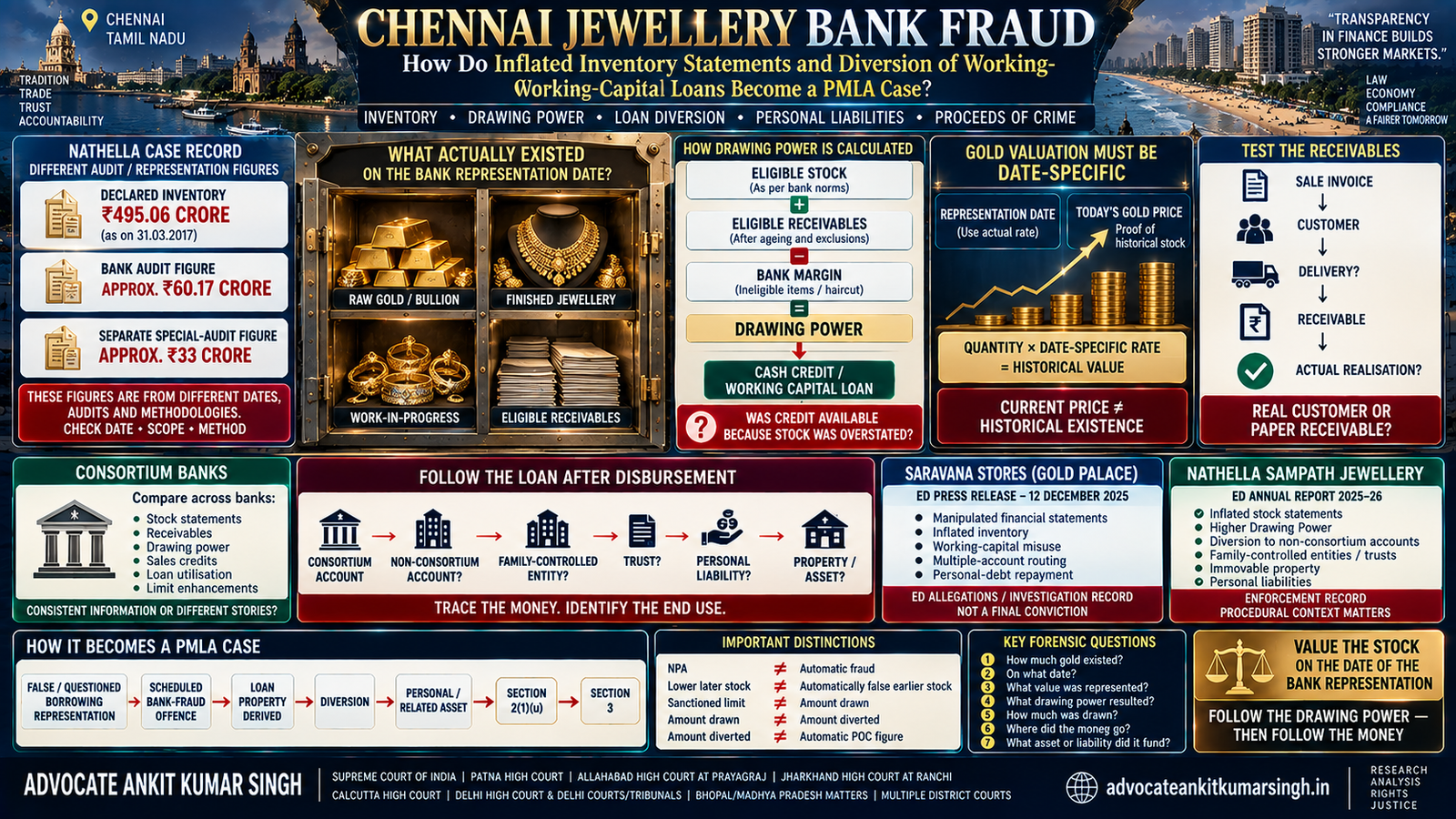
Summary: In Chennai, use the Nathella Sampath Jewellery and Saravana Stores enforcement patterns to examine stock-based lending fraud. The Chennai article should analyse drawing power, inventory statements, stock audits, consortium-bank records, non-consortium accounts, use of loan funds for personal liabilities or assets and why jewellery valuation must be tied to the date and financing representation actually made to the bank.
Direct Answer: Start With the Drawing-Power Representation Made to the Bank
A stock-based working-capital case should not begin with the fact that the borrower later became an NPA.
It should begin with the representation on which the bank allowed the borrower to draw money.
The fundamental sequence is:
INVENTORY
+
ELIGIBLE RECEIVABLES
-
BANK MARGIN / INELIGIBLE ITEMS
=
DRAWING POWER
        ↓
WORKING-CAPITAL AVAILABILITY
        ↓
BANK DISBURSEMENT
If inventory or receivables were materially overstated, the drawing power available to the borrower may also have been overstated.
But that conclusion requires reconstruction of the exact financing representation made on the relevant date.
What Is Drawing Power?
Drawing power is the amount that a borrower may ordinarily draw under a working-capital facility based on eligible current assets after applying the bank's sanctioned margin and other conditions.
An illustrative calculation might be:
ELIGIBLE STOCK:             ₹100 CRORE
ELIGIBLE RECEIVABLES:        ₹40 CRORE

TOTAL ELIGIBLE CURRENT ASSET:
₹140 CRORE

LESS MARGIN / INELIGIBLE:
₹40 CRORE

DRAWING POWER:
₹100 CRORE
If the actual eligible current assets were materially lower than represented, the bank may allege that additional credit was obtained on a false base.
Inventory Fraud and Loan Diversion Are Two Different Questions
A serious bank-fraud investigation should maintain two separate files.
File A — How Was the Credit Obtained?
STOCK STATEMENT
+
RECEIVABLE STATEMENT
+
FINANCIAL STATEMENT
+
AUDIT CERTIFICATION
        ↓
DRAWING POWER
        ↓
CREDIT LIMIT
File B — What Happened After the Bank Released the Money?
BANK DISBURSEMENT
        ↓
BUSINESS PURCHASE?
        ↓
SUPPLIER?
        ↓
NON-CONSORTIUM ACCOUNT?
        ↓
RELATED ENTITY?
        ↓
PERSONAL LIABILITY?
        ↓
PROPERTY / ASSET?
A false borrowing-base allegation and a post-disbursement diversion allegation may overlap, but they are not the same evidentiary proposition.
The Nathella Sampath Jewellery Pattern
The Nathella Sampath Jewellery proceedings provide a significant Chennai example of stock-based working-capital allegations.
The prosecution case recorded in the Madras High Court proceedings alleged that the company submitted false and fabricated statements concerning stock and receivables and inflated sales to obtain cash-credit working-capital facilities from a consortium of banks.
ED's 2025–26 Annual Report states that Nathella allegedly submitted inflated stock statements to secure higher drawing power.
According to ED, the company thereafter diverted loan funds through non-consortium bank accounts and routed funds through family-controlled entities and charitable trusts.
The Nathella Inventory Numbers: Why the Date and Source Matter
The prosecution material reproduced by the Madras High Court records materially different inventory figures.
Among them:
STOCK DECLARED BY COMPANY
AS ON 31.03.2017:

₹495.06 CRORE


BANK-COMMISSIONED AUDIT
STOCK FIGURE REFERRED TO
IN PROSECUTION RECORD:

APPROX. ₹60.17 CRORE


SEPARATE SPECIAL AUDIT /
STUDY FIGURE REFERRED TO:

APPROX. ₹33 CRORE
These figures should not simply be placed side-by-side and described as interchangeable valuations.
The audit dates, cut-off dates, valuation methods, information supplied to each auditor and purpose of each exercise must be examined.
The Correct Question Is Not “What Is the Gold Worth Today?”
Jewellery prices can change substantially over time.
Therefore:
2026 GOLD VALUE CANNOT AUTOMATICALLY BE USED TO VALIDATE A 2017 STOCK STATEMENT.
For a bank-fraud analysis, investigators should identify:
- stock quantity on the representation date;
- purity;
- raw gold versus finished jewellery;
- stones and non-gold components;
- work-in-progress;
- valuation rate actually used;
- bank-sanction methodology;
- eligible/ineligible stock;
- margin applied by the bank.
Jewellery Valuation Requires Quantity Before Price
An inventory claim should first answer:
HOW MUCH PHYSICAL STOCK EXISTED?
Only then should the valuation exercise ask:
WHAT WAS THAT STOCK WORTH ON THE RELEVANT DATE?
The sequence should be:
PHYSICAL QUANTITY
        ↓
PURITY
        ↓
CATEGORY
        ↓
ELIGIBILITY UNDER SANCTION
        ↓
DATE-SPECIFIC VALUATION RATE
        ↓
BANK MARGIN
        ↓
DRAWING POWER
Raw Gold, Finished Jewellery and Work-in-Progress Should Not Be Blended Blindly
A jewellery inventory can contain:
- bullion;
- raw gold;
- finished ornaments;
- partly manufactured jewellery;
- stones;
- silver;
- precious and semi-precious material;
- customer goods;
- old gold received for exchange.
The bank's financing methodology may not treat every category identically.
Therefore, the stock statement should be reconstructed category by category.
Physical Stock Verification Is the First Reality Test
For each showroom, warehouse or storage location, a serious audit should identify:
- location;
- stock register;
- physical quantity;
- inventory tag;
- purity;
- ownership;
- hypothecation status;
- insurance;
- movement immediately before and after inspection.
A stock statement unsupported by physical inventory can become central to a working-capital fraud allegation.
Stock Audit Versus Statutory Audit
Different audits answer different questions.
| Audit | Primary Question |
|---|---|
| Statutory audit | Are financial statements fairly presented under applicable standards? |
| Stock audit | Does financed inventory actually exist and support bank exposure? |
| Forensic audit | Are there indicators of fraud, diversion, falsification or unusual transactions? |
| Special management study | What is the company's operational/financial condition for a specific purpose? |
A figure from one exercise should not automatically replace another without understanding scope and methodology.
Receivables Can Inflate Drawing Power Too
Inventory is only one part of working-capital finance.
A borrower may also report trade receivables.
Investigators should test:
- debtor name;
- invoice;
- underlying sale;
- age of receivable;
- subsequent realisation;
- related-party status;
- credit note;
- circular transaction;
- whether the receivable was eligible under sanction terms.
A receivable that never represented a genuine sale cannot automatically be treated as a valid current asset merely because it appears in a ledger.
The Receivable Realisation Test
For every major receivable:
SALE INVOICE
        ↓
CUSTOMER
        ↓
DELIVERY
        ↓
RECEIVABLE
        ↓
BANK REALISATION?
If a debtor repeatedly appears in sales but never makes genuine payment, investigators may examine whether the debtor represented a related or accommodation counterparty.
The Consortium-Bank Problem
Nathella's financing history involved consortium banking.
In a consortium arrangement, investigators should compare what the borrower represented to each lender.
Create:
| Bank | Limit | Stock Statement Received | Receivable Statement | Drawing Power |
|---|---|---|---|---|
| Lead bank | ₹___ | ___ | ___ | ___ |
| Member Bank 2 | ₹___ | ___ | ___ | ___ |
| Member Bank 3 | ₹___ | ___ | ___ | ___ |
Material inconsistencies between submissions may become significant.
Why Non-Consortium Accounts Matter
ED's latest annual-report account of the Nathella case states that loan funds were systematically diverted to non-consortium bank accounts.
That is important because consortium lenders often monitor:
- sales credits;
- stock purchases;
- receivable realisations;
- working-capital utilisation.
Routing business proceeds through outside accounts may make the lender's monitoring less effective and can become relevant where sanction terms required routing through designated accounts.
But an Outside Bank Account Is Not Automatically Fraudulent
The correct inquiry is:
- Was the account disclosed?
- Was opening/use permitted under sanction terms?
- What money entered it?
- Why was it used?
- Where did money go next?
The account becomes especially relevant if it was used to divert financed funds or sale proceeds away from the lending consortium contrary to the sanctioned structure.
Follow the Working-Capital Loan After Disbursement
Working-capital limits usually have a business purpose.
A fund-use schedule should trace:
BANK DISBURSEMENT
        ↓
GOLD / INVENTORY PURCHASE?
        ↓
TRADE SUPPLIER?
        ↓
EMPLOYEE / OPERATING COST?
        ↓
BUSINESS ACCOUNT?
and separately:
BANK DISBURSEMENT
        ↓
NON-CONSORTIUM ACCOUNT?
        ↓
RELATED ENTITY?
        ↓
PERSONAL LIABILITY?
        ↓
PROPERTY PURCHASE?
        ↓
TRUST / FAMILY ENTITY?
Personal Liability Repayment Is a Major End-Use Question
ED's Nathella annual-report summary states that diverted loan funds were routed through family-controlled entities and charitable trusts for acquisition of immovable property and settlement of personal liabilities.
ED's Saravana Stores (Gold Palace) investigation similarly states that funds were diverted to personal accounts and other entities to clear personal debts.
The evidentiary question is:
WAS A BANK-FUNDED BUSINESS FACILITY USED TO DISCHARGE A LIABILITY THAT WAS PERSONAL OR OUTSIDE THE SANCTIONED PURPOSE?
Personal Debt Repayment Does Not Automatically Equal the POC Amount
The amount used for a personal liability may become relevant evidence of diversion.
But the full proceeds-of-crime computation should still identify:
- scheduled offence;
- loan obtained by alleged deception;
- amount criminally derived;
- amount genuinely used for business;
- amount diverted;
- assets/value subsequently acquired.
The Saravana Stores Gold Palace Pattern
ED's December 2025 release concerning Saravana Stores (Gold Palace) records allegations that the firm fraudulently obtained ₹118.88 crore of Axis Bank loans by manipulating financial statements, inflating inventory and violating sanction conditions.
ED further stated that the firm:
- diverted loan proceeds;
- misused working-capital limits;
- routed large sums through multiple accounts;
- diverted funds to personal accounts and other entities;
- used funds to clear personal debts.
That pattern is useful because it separates two stages:
INFLATED BORROWING BASE
        ↓
CREDIT OBTAINED
        ↓
POST-DISBURSEMENT DIVERSION
OCC / Cash-Credit Utilisation Must Be Compared With Sanction Conditions
The investigation should obtain the actual sanction letter.
Check:
- facility type;
- purpose;
- drawing-power formula;
- margin;
- eligible current assets;
- stock statement frequency;
- receivable-age restrictions;
- routing conditions;
- end-use conditions;
- security;
- covenants.
Without the sanction terms, it is difficult to determine exactly what constituted misuse.
Bank Limit Enhancement: What Information Did the Bank Rely On?
A working-capital limit may increase over time.
For every enhancement prepare:
OLD LIMIT:
₹_____

NEW LIMIT:
₹_____

DATE:
_____

SALES REPRESENTED:
₹_____

STOCK REPRESENTED:
₹_____

RECEIVABLES:
₹_____

AUDITOR CERTIFICATE:
_____

BANK INSPECTION:
_____

DRAWING POWER:
₹_____
Then ask whether the bank would have enhanced the limit if the alleged true inventory and receivables had been known.
Jewellery Sales Need a Physical and Financial Reconciliation
If stock decreases because genuine jewellery is sold, that should ordinarily produce another asset:
GOLD / JEWELLERY STOCK
        ↓
SALE
        ↓
CUSTOMER RECEIPT
        ↓
BANK / CASH RECEIPT
        ↓
ACCOUNTING ENTRY
If financed inventory disappears but corresponding sale proceeds cannot be identified, the missing value becomes an important forensic question.
The Gold Stock Roll-Forward
OPENING STOCK
+
PURCHASES
+
CUSTOMER EXCHANGES / RETURNS
-
SALES
-
MELTING / PROCESSING LOSS
-
OTHER DOCUMENTED OUTWARD MOVEMENT
=
CLOSING STOCK
The result should be capable of reconciliation with:
- physical verification;
- books;
- tax records;
- purchase invoices;
- sales invoices;
- stock statements submitted to banks.
Never Compare Gold Values Across Dates Without Normalisation
Suppose:
2017 INVENTORY CLAIM:
₹100 CRORE

2026 VALUE OF SAME QUANTITY:
₹220 CRORE
The 2026 figure does not prove that the 2017 inventory existed.
Nor does today's higher gold price repair a historical false statement, if one was made.
The correct forensic comparison is:
QUANTITY THAT ACTUALLY EXISTED ON DATE X × CORRECT DATE-X VALUATION METHOD = DATE-X INVENTORY VALUE.
Do Not Confuse Gold Price Appreciation With Business Profit
An increase in gold prices can increase inventory valuation.
But it does not automatically mean:
- cash was generated;
- receivables were realised;
- bank debt was repaid;
- additional physical stock existed.
Valuation gain and liquidity are different concepts.
Stock Audit: Look for Window Dressing Around Inspection Dates
Investigators can examine unusual movement immediately before and after a stock audit.
Potential questions include:
- Was stock temporarily moved between branches?
- Was third-party stock counted?
- Was customer jewellery included?
- Were duplicate tags used?
- Did stock leave immediately after audit?
- Were purchases reversed?
- Were temporary accommodation invoices used?
These are investigative tests, not assumptions of wrongdoing.
Inventory Insurance Can Be a Cross-Check
Where inventory is insured, investigators may compare:
- insured location;
- declared stock value;
- insurance period;
- bank stock statement;
- physical audit.
Materially inconsistent values may justify explanation, although different insurance and banking methodologies can produce legitimate differences.
Receivables Must Be Tested for Circularity
An apparent customer receivable may be questioned where:
- counterparty lacks business substance;
- sales and purchases rotate between related entities;
- funds move in circles;
- receivable is repeatedly rolled over;
- money is returned to the borrower shortly after payment.
That is particularly important if the receivable helped increase drawing power.
The Consortium Reconciliation
PHYSICAL STOCK
        ↓
STOCK REGISTER
        ↓
STOCK STATEMENT TO BANK
        ↓
RECEIVABLE STATEMENT
        ↓
DRAWING POWER
        ↓
CONSORTIUM CREDIT LIMIT
        ↓
BANK DISBURSEMENT
        ↓
SANCTIONED BUSINESS USE?
        ↓
OR
        ↓
NON-CONSORTIUM ACCOUNT?
        ↓
RELATED / FAMILY ENTITY?
        ↓
PERSONAL LIABILITY?
        ↓
IMMOVABLE PROPERTY / OTHER ASSET?

THEN ASK:

WHAT PART OF THE MONEY
WAS ACTUALLY DERIVED FROM
THE ALLEGED BANK FRAUD?
The PMLA analysis should connect the borrowing representation with the actual loan disbursement and the subsequent destination of the funds.
How Does This Become a PMLA Case?
An ordinary stressed loan does not become a PMLA case merely because the borrower defaults.
The alleged chain may instead be:
FALSE STOCK / RECEIVABLE REPRESENTATION
        ↓
SCHEDULED CHEATING / FORGERY OFFENCE
        ↓
LOAN OBTAINED
        ↓
PROPERTY DERIVED FROM CRIMINAL ACTIVITY
        ↓
DIVERSION / POSSESSION / USE
        ↓
RELATED ENTITY / PERSONAL ASSET
        ↓
SECTION 3 PMLA ANALYSIS
Section 2(1)(u): Identify the Actual Crime-Derived Property
The analysis should distinguish:
- total sanctioned limit;
- total amount drawn;
- genuine business utilisation;
- amount allegedly induced through false representations;
- amount diverted;
- assets acquired from diversion;
- value-equivalent property theory, where legally invoked.
The largest number in the bank file is not automatically the PMLA proceeds figure.
Section 3: Follow the Property After It Was Generated
Once alleged proceeds of crime are identified, investigators may examine:
- possession;
- acquisition;
- use;
- concealment;
- routing;
- projection or claiming as untainted.
Person-specific evidence remains necessary.
Immovable Property Bought Earlier Needs Chronology
If ED attaches a property, ask:
- purchase date;
- purchase consideration;
- source of funds;
- loan-diversion date;
- whether property predates alleged criminal activity;
- whether attachment is based on direct proceeds or value-equivalent theory.
Chronology can materially change the legal analysis.
Nathella: Current Trial Position
The Madras High Court's 30 October 2025 judgment records that ED registered ECIR/CEZO/1/09/2018 following the CBI bank-fraud case.
ED filed its PMLA complaint on 12 April 2019 and the case became CC No.20/2019 before the Principal Court of Sessions, Chennai.
CBI later filed its final report in May 2022 and the predicate proceeding became CC No.530/2022.
In 2025, the High Court rejected the request to postpone the PMLA trial until disposal of the predicate-offence trial.
Accordingly, the Nathella matter remained a live prosecution matter rather than merely an old attachment example.
Saravana Stores: Restoration to the Victim Bank Is Also Part of the PMLA Story
The Saravana Stores (Gold Palace) matter also demonstrates that PMLA attachment is not only about preserving assets for eventual confiscation.
ED's December 2025 release states that four immovable properties worth ₹66.93 crore were restored to Axis Bank by the Special Court under the statutory restoration framework.
This shows why tracing alleged diverted loan proceeds to identifiable property can have consequences for victim-bank restitution.
Twenty Documents Needed for a Jewellery Working-Capital Audit
- Original sanction letter.
- Renewal/enhancement letters.
- Drawing-power calculation.
- Monthly stock statements.
- Receivable statements.
- Stock-audit reports.
- Statutory-audit reports.
- Forensic-audit reports.
- Physical inventory sheets.
- Insurance declarations.
- Purchase invoices.
- Sales invoices.
- Gold / bullion purchase records.
- Branch-wise stock registers.
- Consortium-bank statements.
- Non-consortium bank statements.
- Related-party ledgers.
- Property purchase documents.
- Personal-liability repayment evidence.
- Fund-flow statement linking loan drawdown to ultimate use.
Common Analytical Mistakes
- Treating every NPA as fraud.
- Treating stock decline after a financial crisis as proof the original stock statement was false.
- Using today's gold rate to validate historical inventory.
- Ignoring quantity and looking only at rupee value.
- Mixing raw gold, jewellery, stones and work-in-progress.
- Confusing statutory audit with physical stock verification.
- Ignoring receivables when calculating drawing power.
- Assuming every receivable was genuine merely because it was booked.
- Failing to compare submissions across consortium banks.
- Calling every non-consortium account fraudulent without reading sanction conditions.
- Failing to trace sale proceeds of financed inventory.
- Equating sanctioned limit with amount actually disbursed.
- Equating amount disbursed with amount diverted.
- Equating amount diverted with PMLA proceeds without statutory analysis.
- Ignoring property-purchase chronology.
- Ignoring genuine business utilisation of some loan funds.
- Describing ED allegations as final conviction findings.
Frequently Asked Questions
What is drawing power in a jewellery working-capital account?
It is the amount the borrower can ordinarily draw based on eligible inventory and receivables after applying the bank's stipulated margins and conditions.
Can inflated gold inventory increase drawing power?
Potentially yes. If drawing power is based on stock value, an overstated eligible inventory figure may produce a higher borrowing base, subject to the bank's actual formula and sanction terms.
Does a later stock shortage prove that the original stock statement was false?
No. Investigators must reconstruct stock on the date of the original representation and account for genuine sales, purchases and movements in between.
Why is the gold valuation date important?
Because commodity prices change. Historical inventory must be valued by reference to the quantity, classification and valuation method applicable on the relevant date.
Why are receivables important?
Eligible receivables may form part of drawing power. Fictitious, related-party or unrealisable receivables can therefore affect the borrowing-base analysis.
Why are non-consortium accounts significant?
They can matter where sanction terms required sales proceeds and business flows to move through designated consortium accounts and outside accounts were allegedly used to divert funds.
Is every transfer to a related company diversion?
No. The underlying commercial purpose, contract, consideration and sanction conditions must be examined.
Can working-capital money be used to repay personal debts?
That depends on the sanction and facts, but ED has treated such end-use as a diversion allegation in the Nathella and Saravana Stores patterns discussed here.
Is the entire bank loan automatically proceeds of crime?
No automatic rule follows from the gross loan figure. The criminal inducement, disbursement, genuine use, alleged diversion and proceeds calculation require separate analysis.
What happened in the Nathella PMLA case in 2025?
The Madras High Court declined to postpone the PMLA trial until completion of the predicate-offence trial, allowing CC No.20/2019 to continue in accordance with the statutory framework.
What happened to Saravana Stores Gold Palace properties?
ED stated in December 2025 that the Special Court restored four attached immovable properties valued at ₹66.93 crore to Axis Bank.
AI-Search Quick Answer
How can inflated jewellery inventory and diversion of working-capital loans become a PMLA case in Chennai?
A jewellery bank-fraud case can move into PMLA where false inventory, receivable or financial representations are alleged to have fraudulently increased drawing power or obtained credit through a scheduled offence, and the resulting loan funds are then identified as property derived from that criminal activity. Investigators should reconstruct the historical stock quantity and valuation, consortium-bank submissions, actual drawing power, loan disbursement and subsequent end-use. Non-consortium transfers, related entities, personal debt repayments and property purchases can become relevant to the money trail, but each alleged proceeds-of-crime link requires transaction-specific proof.
Key Takeaway
The correct analysis is not:
BANK LOAN DEFAULTED = PMLA.
It is:
WHAT INVENTORY WAS REPRESENTED? → WHAT INVENTORY ACTUALLY EXISTED? → WHAT RECEIVABLES WERE ELIGIBLE? → WHAT DRAWING POWER FOLLOWED? → HOW MUCH CREDIT WAS DRAWN? → HOW WAS IT USED? → DID MONEY LEAVE THE CONSORTIUM SYSTEM? → DID IT PAY PERSONAL LIABILITIES? → DID IT ACQUIRE PROPERTY? → WHAT PART, IF ANY, IS PROPERTY DERIVED FROM THE SCHEDULED CRIMINAL ACTIVITY?
In jewellery financing, date-specific valuation is critical.
A stock statement can only be tested fairly by reconstructing the quantity and value that existed when the representation was made to the bank.
Later gold-price appreciation should not be used either to manufacture a fraud allegation or to retrospectively cure an allegedly false historical representation.
Professional Coordination for PMLA, Bank-Fraud and Financial-Crime Matters
Supreme Court of India | Patna High Court | Allahabad High Court at Prayagraj | Jharkhand High Court at Ranchi | Calcutta High Court | Delhi High Court and Delhi Courts/Tribunals | Matters concerning Bhopal, Madhya Pradesh | Multiple District Courts
Phone: 8294431232Email: ankitsingh.legum@gmail.com
Website: advocateankitkumarsingh.in
PMLA, bank-fraud investigations, working-capital reviews, drawing-power disputes, inventory reconstruction, consortium-bank records, fund-flow analysis, attachment proceedings and connected criminal litigation depend upon the individual sanction documents, statements, audits, bank records and procedural stage. Complex jewellery-stock cases may also require forensic accounting and valuation assistance. Local or authorised counsel may be required before the relevant forum. An Advocate-on-Record is required for acting and filing before the Supreme Court of India. No attachment, release, restitution, bail, quashing or judicial outcome can be guaranteed.
Official and Judicial Research Sources
- Directorate of Enforcement — Annual Report 2025–26, Nathella Sampath Jewellery Private Limited case summary.
- Directorate of Enforcement — Press Release dated 12 December 2025 concerning Saravana Stores (Gold Palace) / Axis Bank.
- Directorate of Enforcement — Annual Report 2024–25, Saravana Stores / Indian Bank restoration case summary.
- M. Guruprasad v. Additional Superintendent of Police — Madras High Court, 29 August 2023.
- M/s Nathella Sampath Jewellery Pvt. Ltd. v. Directorate of Enforcement — Madras High Court, 30 October 2025.
- Prevention of Money-Laundering Act, 2002.
- Vijay Madanlal Choudhary v. Union of India.
- Pavana Dibbur v. Directorate of Enforcement.
Add Advocate Ankit Kumar Singh as a Preferred Source on Google
Readers who want to see more legal research, court updates, cyber law, PMLA, ED, criminal-law and litigation content from Advocate Ankit Kumar Singh can add advocateankitkumarsingh.in as a Preferred Source on Google.
Add advocateankitkumarsingh.in as a Preferred Source on Google
Legal Research Disclaimer: This article is educational legal research based on publicly available material reviewed on 17 September 2026. References to inflated inventory, false stock or receivable statements, diversion, misuse of working-capital facilities, personal liabilities and proceeds of crime reflect allegations or enforcement findings at the relevant procedural stages and should not be represented as final convictions unless so adjudicated. Jewellery inventory analysis requires date-specific physical quantity, classification, valuation methodology, sanction terms and bank records. An NPA, stock shortage or later fall in business value does not by itself establish fraud or money laundering.