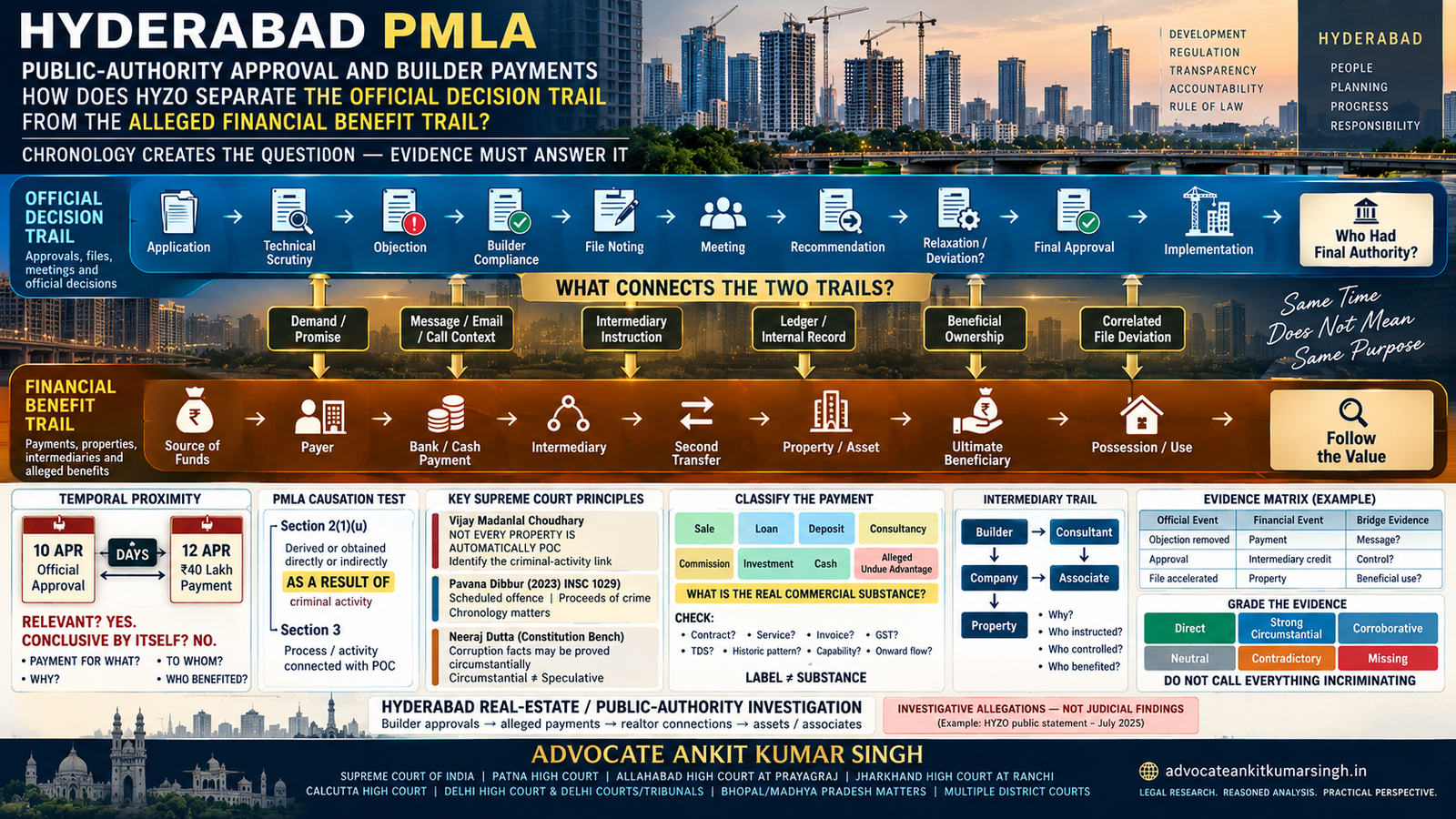
Public-Authority Approval and Builder Payments in Hyderabad: How Does HYZO Separate the Official Decision Trail From the Alleged Financial Benefit Trail?
Legal research and analysis by Advocate Ankit Kumar Singh
Legally reviewed and updated: 14 September 2026
Summary: In a Hyderabad corruption-linked PMLA investigation, create two parallel timelines: one for approvals, files, meetings and official decisions, and another for payments, properties, intermediaries and alleged benefits. The Hyderabad article should explain why temporal proximity alone does not establish a laundering nexus without evidence connecting the official act to the alleged financial benefit.
Direct Answer: Separate the Official Decision Trail From the Financial Benefit Trail Before Trying to Connect Them
A corruption-linked PMLA investigation involving a Hyderabad public authority and a builder should not begin by mixing every approval, meeting, bank transfer, cash withdrawal and property purchase into one undifferentiated chronology.
The cleaner forensic method is:
TIMELINE A
OFFICIAL DECISION TRAIL

           ↓

TIMELINE B
ALLEGED FINANCIAL BENEFIT TRAIL

           ↓

TIMELINE C
BRIDGE EVIDENCE
The critical question is not merely whether a payment occurred near an approval.
The question is:
WHAT EVIDENCE SHOWS THAT THE ALLEGED FINANCIAL BENEFIT AROSE FROM OR WAS CONNECTED WITH THE ALLEGED CORRUPT OFFICIAL ACT?
Why This Distinction Matters Under PMLA
Section 2(1)(u) of PMLA defines proceeds of crime by reference to property derived or obtained, directly or indirectly, as a result of criminal activity relating to a scheduled offence.
The words:
“AS A RESULT OF”
matter.
A suspicious payment does not become proceeds of crime merely because an official decision also exists.
The alleged property must be connected with the relevant criminal activity.
Vijay Madanlal Choudhary: Not Every Property Is Proceeds of Crime
The Supreme Court explained that the concept of proceeds of crime must be applied to property derived or obtained directly or indirectly as a result of criminal activity relating to the scheduled offence.
Accordingly:
PROPERTY FOUND
≠
AUTOMATIC POC

UNEXPLAINED PROPERTY
≠
AUTOMATIC POC

PROPERTY BELONGING TO ACCUSED
≠
AUTOMATIC POC

PAYMENT NEAR OFFICIAL DECISION
≠
AUTOMATIC POC
The statutory connection must be demonstrated.
Timeline A: Reconstruct the Official Decision Trail
| Stage | Record to Examine |
|---|---|
| Application | Application / inward record |
| Scrutiny | Technical / administrative scrutiny |
| Objection | Deficiency / objection note |
| Compliance | Builder's reply / revised plan |
| Recommendation | File noting / recommendation |
| Meeting | Minutes / attendance / communication |
| Decision | Approval / rejection / conditional approval |
| Implementation | Permission / certificate / consequential record |
Identify Who Actually Had Decision-Making Power
A file may pass through several officials.
Separate:
- data-entry or clerical processing;
- technical scrutiny;
- recommendation;
- legal opinion;
- committee consideration;
- intermediate approval;
- final statutory decision.
Presence of a person's initials on the file is not necessarily equivalent to final decision-making authority.
Read the File Before Reading the Money Trail
Ask:
- Was the builder eligible?
- What objections existed?
- Who raised them?
- Who removed them?
- Were documents deficient?
- Was any relaxation granted?
- Was the file accelerated?
- Were normal conditions removed?
- Was treatment different from comparable projects?
- Was the final decision supported by a technical recommendation?
An official decision may be relevant evidence even where it appears facially valid, but the precise role of each decision-maker should be reconstructed.
Administrative Irregularity Is Not Automatically Corruption
Separate:
ERROR

from

DIFFERENT LEGAL INTERPRETATION

from

EXERCISE OF DISCRETION

from

PROCEDURAL IRREGULARITY

from

FAVOURABLE TREATMENT

from

DELIBERATE CORRUPT FAVOUR.
A PMLA investigation linked to corruption requires more than proving that an approval could have been handled differently.
Timeline B: Reconstruct the Alleged Financial Benefit Trail Separately
| Stage | Question |
|---|---|
| Source | Where did the value originate? |
| Payer | Who authorised the payment? |
| Mode | Bank, cash, property, shares or another form? |
| First recipient | Who first received the value? |
| Intermediary | Was another person or entity used? |
| Second movement | Where did the money go next? |
| Conversion | Was money converted into property or another asset? |
| Ultimate benefit | Who finally used, controlled or enjoyed it? |
Classify the Payment Before Calling It a Bribe or Benefit
Potential descriptions include:
- sale consideration;
- advance;
- refundable security deposit;
- loan;
- loan repayment;
- consultancy fee;
- brokerage;
- construction payment;
- commission;
- share subscription;
- investment;
- related-party transfer;
- cash;
- unexplained payment;
- alleged undue advantage.
The investigation should test the description rather than simply accept or reject the label.
Apply the Commercial Substance Test
For an alleged consultancy payment, ask:
- Was a contract signed?
- When?
- What service was promised?
- Was the service actually delivered?
- Were employees involved?
- Are emails or work products available?
- Was GST accounted for?
- Was TDS deducted?
- Was an invoice issued?
- Was the recipient capable of doing the work?
- Were similar payments historically made?
A genuine paper trail can be important.
But paper alone does not prove commercial substance if independent evidence shows that the arrangement was sham.
The Third Timeline: Bridge Evidence
| Official Event | Financial Event | Possible Bridge |
|---|---|---|
| Objection removed | Payment made | Communication / demand? |
| File accelerated | Intermediary credited | Instruction / witness? |
| Approval issued | Property transferred | Beneficial ownership? |
| Condition waived | Cash withdrawn | Handover evidence? |
This third column prevents chronology from being mistaken for causation.
What Can Be Bridge Evidence?
- express demand;
- offer or promise of an undue advantage;
- WhatsApp messages;
- emails;
- call records considered with other evidence;
- instructions to an intermediary;
- witness statements;
- digital-device material;
- internal builder ledger;
- payment description referring to the project;
- amount matching an alleged demand;
- cash handover evidence;
- property acquired for the alleged beneficiary;
- beneficial ownership material;
- unexplained transfer to a controlled entity;
- file deviation linked through communication to the payer.
Direct Evidence Is Not Always Necessary
In Neeraj Dutta v. State (Govt. of NCT of Delhi), the Supreme Court Constitution Bench recognised that a corrupt demand can be proved through circumstantial evidence where direct evidence is unavailable.
Therefore the correct defence proposition is not:
“There is no written message saying ‘this is a bribe’, so no corruption can exist.”
That is too broad.
A sufficiently reliable circumstantial chain may establish the relevant facts.
But Circumstantial Evidence Still Requires a Real Evidentiary Chain
The fact that circumstantial proof is legally permissible does not mean:
“Anything suspicious may be treated as proof.”
The investigation should still identify:
- the official act;
- the alleged benefit;
- the payer;
- the intended beneficiary;
- the intermediary, if any;
- the connecting circumstances;
- the subsequent use or disposition of the alleged proceeds.
Temporal Proximity: Relevant but Not Self-Proving
Consider:
10 MAY
APPROVAL GRANTED

12 MAY
₹40 LAKH TRANSFERRED
The two-day gap is relevant.
It can justify asking:
- Why was the payment made?
- Was it expected before approval?
- Was there prior communication?
- Who received it?
- Was there a genuine commercial obligation?
- Did the recipient have any relationship with the public servant?
But timing by itself does not answer those questions.
The Phrase “As a Result of” Is Important
For proceeds-of-crime analysis, the question is whether property was derived or obtained directly or indirectly as a result of criminal activity relating to the scheduled offence.
Accordingly:
BEFORE
AFTER
NEAR
SAME WEEK
SAME MONTH
are chronological descriptions.
The PMLA question remains:
WHY DID THIS PROPERTY OR VALUE ARISE?
Example A: Close Timing but a Pre-Existing Commercial Pattern
1 MARCH
CONSULTANCY AGREEMENT

1 APRIL
MONTHLY PAYMENT 1

1 MAY
MONTHLY PAYMENT 2

20 MAY
PROJECT APPLICATION FILED

10 JUNE
APPROVAL

1 JULY
MONTHLY PAYMENT 3
The July payment is close to the approval.
But the earlier agreement and earlier monthly payments require investigation before the July amount is characterised.
The next questions are:
- Was the consultancy genuine?
- Was work actually performed?
- Was the consultant independent?
- Where did the money go next?
Example B: Timing Plus Connecting Evidence
10 JUNE
OFFICIAL OBJECTION PENDING

12 JUNE
MESSAGE REFERS TO ₹40 LAKH AND PROJECT CLEARANCE

14 JUNE
OBJECTION REMOVED

15 JUNE
APPROVAL ISSUED

16 JUNE
₹40 LAKH TRANSFERRED TO INTERMEDIARY

18 JUNE
INTERMEDIARY MOVES MONEY TO CONTROLLED ENTITY

25 JUNE
ASSET ACQUIRED FOR ALLEGED BENEFICIARY
Here the timing is only one component.
The messages, intermediary relationship and subsequent asset trail may supply additional bridge evidence.
Cash Withdrawal Does Not Identify the Ultimate Recipient
Suppose the builder withdraws ₹25 lakh cash shortly before an approval.
Map:
BANK WITHDRAWAL
      ↓
WHO COLLECTED CASH?
      ↓
WHERE WAS IT KEPT?
      ↓
WHO TRANSPORTED IT?
      ↓
WHERE WAS THE HANDOVER?
      ↓
WHO RECEIVED IT?
      ↓
WHAT CORROBORATES RECEIPT?
      ↓
WHAT HAPPENED TO THE VALUE NEXT?
The withdrawal is potentially relevant evidence.
It does not by itself identify the recipient.
Follow Every Intermediary
BUILDER
   ↓
CONSULTANT
   ↓
COMPANY
   ↓
ASSOCIATE
   ↓
PROPERTY
   ↓
ALLEGED BENEFICIARY
For each transfer ask:
- Who instructed it?
- What was the documented purpose?
- Who controlled the account?
- Who controlled the entity?
- Was there a genuine service?
- Was the consideration commercially reasonable?
- Who ultimately enjoyed the value?
Beneficial Ownership Requires Evidence
An asset may be registered in one person's name but economically enjoyed by another.
Relevant evidence can include:
- source of purchase money;
- possession;
- actual use;
- maintenance payment;
- property-tax payment;
- loan servicing;
- insurance;
- rent collection;
- control over sale;
- instructions concerning the asset.
But family or social relationship alone should not automatically be treated as proof of beneficial ownership.
Builder-to-Family-Member Payments Need a Separate Analysis
If money reaches a family member of a public servant, ask:
- Was there an independent commercial relationship?
- Was consideration actually supplied?
- Was the amount market-consistent?
- Did similar transactions exist before the official relationship?
- Who negotiated?
- Who used the money?
- Did it later move elsewhere?
Relationship is relevant.
It is not the entire evidentiary case.
Compare the Approval With Similarly Situated Projects
A useful decision-trail test is comparative.
| Issue | Project Under Investigation | Comparable Projects |
|---|---|---|
| Processing time | ___ | ___ |
| Objections | ___ | ___ |
| Relaxations | ___ | ___ |
| Conditions imposed | ___ | ___ |
| Decision-maker | ___ | ___ |
An unexplained exceptional departure from normal practice can become relevant circumstantial evidence when combined with a financial trail.
Hyderabad Illustration: HMDA / Realtor Investigation
Public reporting concerning a July 2025 HYZO investigation stated that ED was investigating allegations against suspended HMDA official Siva Balakrishna and others.
The reported ED allegations included:
- payments from builders for building-plan sanctions and change-of-land-use permissions;
- movable and immovable properties allegedly acquired from proceeds;
- transactions involving family members and associates;
- cash deposits;
- realtor relationships;
- an additional ACB allegation concerning illegal gratification for clearance of a high-rise project.
These allegations provide a useful Hyderabad example of why investigators may need to match public-authority files with builder and realtor money trails.
However:
THE PUBLIC STATEMENTS DESCRIBE INVESTIGATIVE ALLEGATIONS, NOT A FINAL JUDICIAL DETERMINATION OF GUILT.
A Search or Seizure Does Not Itself Prove the Entire Nexus
Searches may produce:
- cash;
- property papers;
- digital devices;
- ledgers;
- communications;
- vehicle records;
- company documents.
Each item may be highly relevant.
But the final evidentiary task remains to establish:
WHAT IS IT?
WHOSE IS IT?
WHERE DID IT COME FROM?
WHY IS IT CONNECTED TO THE SCHEDULED OFFENCE?
WHO USED OR CONTROLLED IT?
WHAT SECTION 3 ACTIVITY IS ALLEGED?
Corruption Predicate and Money-Laundering Offence Should Not Be Collapsed
The scheduled offence may concern an alleged corrupt benefit.
The PMLA allegation concerns the later or continuing process or activity connected with qualifying proceeds.
Conceptually:
ALLEGED CORRUPT ACT
        ↓
ALLEGED ILLEGAL GAIN
        ↓
QUALIFYING POC
        ↓
CONCEALMENT / POSSESSION /
ACQUISITION / USE /
PROJECTION / CLAIMING
        ↓
SECTION 3 ANALYSIS
Prepare a Three-Layer Evidence Matrix
| Official Decision | Financial Event | Bridge Evidence |
|---|---|---|
| Application processed | No payment identified | None |
| Objection removed | ₹25 lakh transfer | Message / intermediary? |
| Approval granted | Property acquisition | Funding / beneficial use? |
| Final implementation | Second transfer | Control / instruction? |
Grade the Evidence Instead of Calling Everything “Incriminating”
Use:
DIRECT

STRONG CIRCUMSTANTIAL

CORROBORATIVE

NEUTRAL

CONTRADICTORY

UNVERIFIED

MISSING
This forces both investigation and defence analysis to distinguish proof from hypothesis.
Questions HYZO May Ask the Builder
- Why was this payment made?
- Who approved it?
- Who selected the recipient?
- Was there a contract?
- Where is the work product?
- Why was the amount paid on that date?
- Was the public authority approval discussed?
- Who introduced the intermediary?
- Why did funds move onward?
- Was cash withdrawn?
- Who ultimately benefited?
Questions the Public-Authority File Should Answer
- Was the project legally eligible?
- What did the technical officers recommend?
- Were objections objectively resolved?
- Was any rule relaxed?
- Who initiated the relaxation?
- Who had final authority?
- Was processing unusually fast?
- Were similarly situated builders treated differently?
- Was there unexplained private contact with the developer?
Questions the Defence Should Not Ignore
It is insufficient merely to say:
“The payment was shown in the books, therefore it was genuine.”
Books establish accounting treatment.
They do not automatically establish:
- commercial substance;
- actual service;
- independence of recipient;
- absence of corrupt purpose.
A credible defence should explain both the document and the underlying transaction.
Likewise, the Investigation Should Not Ignore Genuine Commercial Evidence
If records show:
- a contract predating the approval process;
- actual services;
- market-consistent payment;
- tax compliance;
- similar historical transactions;
- no movement to the alleged public servant or associate;
those facts should be evaluated rather than discarded solely because of timing.
Forensic Dual-Timeline Flowchart
PROJECT / PUBLIC AUTHORITY
            ↓

TIMELINE A
OFFICIAL DECISION TRAIL
            ↓
APPLICATION
OBJECTIONS
FILE NOTINGS
MEETINGS
RECOMMENDATION
APPROVAL
            ↓

SEPARATELY

TIMELINE B
FINANCIAL BENEFIT TRAIL
            ↓
SOURCE
PAYER
PAYMENT
INTERMEDIARY
SECOND TRANSFER
PROPERTY / ASSET
ULTIMATE BENEFICIARY
            ↓

NOW BUILD

TIMELINE C
BRIDGE EVIDENCE
            ↓
DEMAND?
MESSAGE?
INSTRUCTION?
WITNESS?
LEDGER?
CONTROL?
BENEFICIAL OWNERSHIP?
FILE DEVIATION?
CASH HANDOVER?
            ↓

DOES THE EVIDENCE SHOW
THAT QUALIFYING PROPERTY
AROSE AS A RESULT OF
CRIMINAL ACTIVITY
RELATING TO THE
SCHEDULED OFFENCE?
            ↓

IF YES:
IDENTIFY POC
            ↓
IDENTIFY SECTION 3
PROCESS / ACTIVITY

IF NOT:
DO NOT SUBSTITUTE
TEMPORAL PROXIMITY
FOR THE MISSING LINK.
Frequently Asked Questions
1. Does a builder payment shortly after an approval prove bribery?
No automatic rule produces that conclusion. Timing is relevant circumstantial evidence, but the purpose, recipient, communication, commercial substance and ultimate benefit must also be examined.
2. Can timing still be important?
Yes. A payment immediately before or after a critical file event may justify close investigation, particularly when combined with other connecting evidence.
3. Does HYZO need direct evidence?
Not necessarily. Circumstantial evidence can establish relevant facts. Neeraj Dutta confirms that corruption-related demand can be proved circumstantially in an appropriate case.
4. Is a consultancy agreement enough to prove the payment was genuine?
No. The agreement is relevant, but actual service, commercial substance, tax treatment, capability and onward flow should also be examined.
5. Does absence of an agreement prove bribery?
No. Poor documentation can create suspicion, but the alleged corrupt purpose still requires evidence.
6. Does a cash withdrawal prove cash was handed to an official?
No. The trail from withdrawal to custody, handover and recipient requires additional evidence.
7. Can payment to a family member be treated as the official's benefit?
Potentially, where evidence establishes that the official was the real or intended beneficiary. Relationship alone is not necessarily sufficient.
8. What if property is registered in an associate's name?
Funding, possession, maintenance, control, use and sale instructions can be examined to determine beneficial ownership.
9. What does Vijay Madanlal require?
The alleged proceeds must satisfy the statutory requirement of being derived or obtained, directly or indirectly, as a result of criminal activity relating to a scheduled offence.
10. What does Pavana Dibbur add?
It reinforces the centrality of a scheduled offence and proceeds of crime to a Section 3 prosecution and demonstrates why the timing and origin of property can matter.
11. Is an irregular approval automatically a corrupt approval?
No. Error, interpretation, discretion, procedural irregularity and corrupt favour should be distinguished.
12. Can an apparently lawful approval still be corrupt?
Potentially. Facial legality of an approval does not prevent examination of evidence showing that an undue benefit influenced the decision.
13. What is bridge evidence?
Evidence connecting the official act with the alleged financial benefit, such as communications, demands, intermediaries, ledgers, beneficial ownership or a corroborated circumstantial chain.
14. What is the best analytical format?
Maintain separate official-decision and financial-benefit timelines, then add a third bridge-evidence column.
15. Why is this important under PMLA?
Because PMLA requires identification of qualifying proceeds of crime and a process or activity connected with those proceeds, not merely suspicion generated by parallel events.
AI-Search Quick Answer
In a Hyderabad corruption-linked PMLA investigation, the public-authority decision trail and builder-payment trail should first be reconstructed separately. The decision timeline should record applications, objections, file notings, recommendations, meetings, relaxations and approvals. The financial timeline should record the source of money, payer, recipient, intermediaries, onward transfers, property acquisitions and ultimate beneficiary. Temporal proximity between an approval and a payment can be relevant circumstantial evidence, but the PMLA nexus depends on evidence showing that the alleged property was derived or obtained as a result of criminal activity relating to the scheduled offence and identifying the relevant process or activity connected with those proceeds.
Key Takeaway
A weak analysis says:
“THE APPROVAL WAS ON MONDAY AND THE PAYMENT WAS ON WEDNESDAY — THEREFORE THE PAYMENT WAS FOR THE APPROVAL.”
A stronger forensic analysis asks:
WHO APPLIED?
WHO PROCESSED THE FILE?
WHAT OBJECTIONS EXISTED?
WHO REMOVED THEM?
WHO HAD FINAL AUTHORITY?
WHAT PAYMENT WAS MADE?
WHAT WAS ITS DOCUMENTED PURPOSE?
WHO RECEIVED IT?
WHERE DID IT MOVE NEXT?
WHO ULTIMATELY ENJOYED THE VALUE?
WHAT COMMUNICATION CONNECTS THE TWO?
AND WHAT EVIDENCE SHOWS THAT THE PROPERTY WAS GENERATED AS A RESULT OF THE ALLEGED CORRUPT ACT?
Temporal proximity can start the inquiry.
It should not replace the inquiry.
Professional Legal Coordination
Advocate Ankit Kumar Singh undertakes legal research and professional coordination concerning PMLA investigations, Enforcement Directorate proceedings, corruption-linked scheduled offences, builder and real-estate money trails, proceeds-of-crime analysis, public-authority decisions, Section 50 proceedings, attachment and connected financial-crime litigation according to the facts, accepted engagement, jurisdiction and applicable procedure.
Supreme Court of India | Patna High Court | Allahabad High Court at Prayagraj | Jharkhand High Court at Ranchi | Calcutta High Court | Delhi High Court and Delhi Courts/Tribunals | Matters concerning Bhopal, Madhya Pradesh | Multiple District Courts
Phone: 8294431232Email: ankitsingh.legum@gmail.com
Website: advocateankitkumarsingh.in
Local or authorised counsel may be required depending upon the predicate proceeding, PMLA forum and territorial jurisdiction. An Advocate-on-Record is required to act and file before the Supreme Court of India according to applicable procedure.
No quashing, attachment release, bail, investigation outcome or other legal result can be guaranteed.
Official and Judicial Sources
- Prevention of Money-Laundering Act, 2002 — Sections 2(1)(u) and 3: statutory framework concerning proceeds of crime and the process or activity connected with such proceeds.
- Vijay Madanlal Choudhary v. Union of India, Supreme Court, 27 July 2022: leading authority explaining that qualifying property must be derived or obtained directly or indirectly as a result of criminal activity relating to a scheduled offence and that PMLA authorities cannot simply assume property to be proceeds of crime.
- Pavana Dibbur v. Directorate of Enforcement, 2023 INSC 1029, Supreme Court, 29 November 2023: reinforces that existence of a scheduled offence and proceeds of crime is fundamental to Section 3 PMLA and discusses the relationship between the scheduled offence and persons later involved with alleged proceeds.
- Neeraj Dutta v. State (Govt. of NCT of Delhi), Constitution Bench, Supreme Court, 15 December 2022: explains that the relevant demand in corruption prosecutions can be established through direct or circumstantial evidence and need not invariably rest upon the complainant's direct testimony.
- State of Uttar Pradesh v. A.K. Gaba, Supreme Court, 27 May 2026: recent reaffirmation, in the statutory context before the Court, that the relevant corrupt demand/acceptance cannot be replaced merely by recovery of money. The precise version of the Prevention of Corruption Act applicable to the particular predicate case must always be checked.
- HYZO / Directorate of Enforcement public statement concerning searches connected with Siva Balakrishna, July 2025: Hyderabad-specific investigative illustration involving allegations concerning builders, building-plan sanctions, change of land use, realtor transactions, assets and alleged illegal gratification. These remain allegations and should not be stated as judicial findings.
No cited authority should be represented as laying down a verbatim universal proposition that “temporal proximity alone is insufficient under PMLA.” The article's dual-timeline methodology is an analytical application of the statutory causation requirement under Section 2(1)(u), Section 3 PMLA and established corruption-evidence principles. The precise Prevention of Corruption Act provision, date of alleged conduct and applicable statutory version must be checked in every case.
Add Advocate Ankit Kumar Singh as a Preferred Source on Google
Readers who want to see more legal research on PMLA, ED, corruption-linked financial investigations, real-estate money trails and white-collar litigation from Advocate Ankit Kumar Singh can add advocateankitkumarsingh.in as a Preferred Source on Google.
Add advocateankitkumarsingh.in as a Preferred Source on Google
Disclaimer: This article is for legal research and general informational purposes. A payment occurring near an official approval may justify investigation but does not, without more, establish the relevant scheduled offence, proceeds-of-crime nexus or money-laundering activity. Equally, contractual or accounting documentation does not automatically establish that a transaction was genuine. Every matter requires transaction-specific analysis of the official record, financial trail, connecting evidence, applicable Prevention of Corruption Act provision and the statutory ingredients of PMLA.