Chennai High-Value Counterparty to Aarudhra Gold: What Must a Genuine Vendor, Lender or Property Seller Show When ED Questions the Transaction?
Legal research and analysis by Advocate Ankit Kumar Singh
Legally reviewed and updated: 16 September 2026
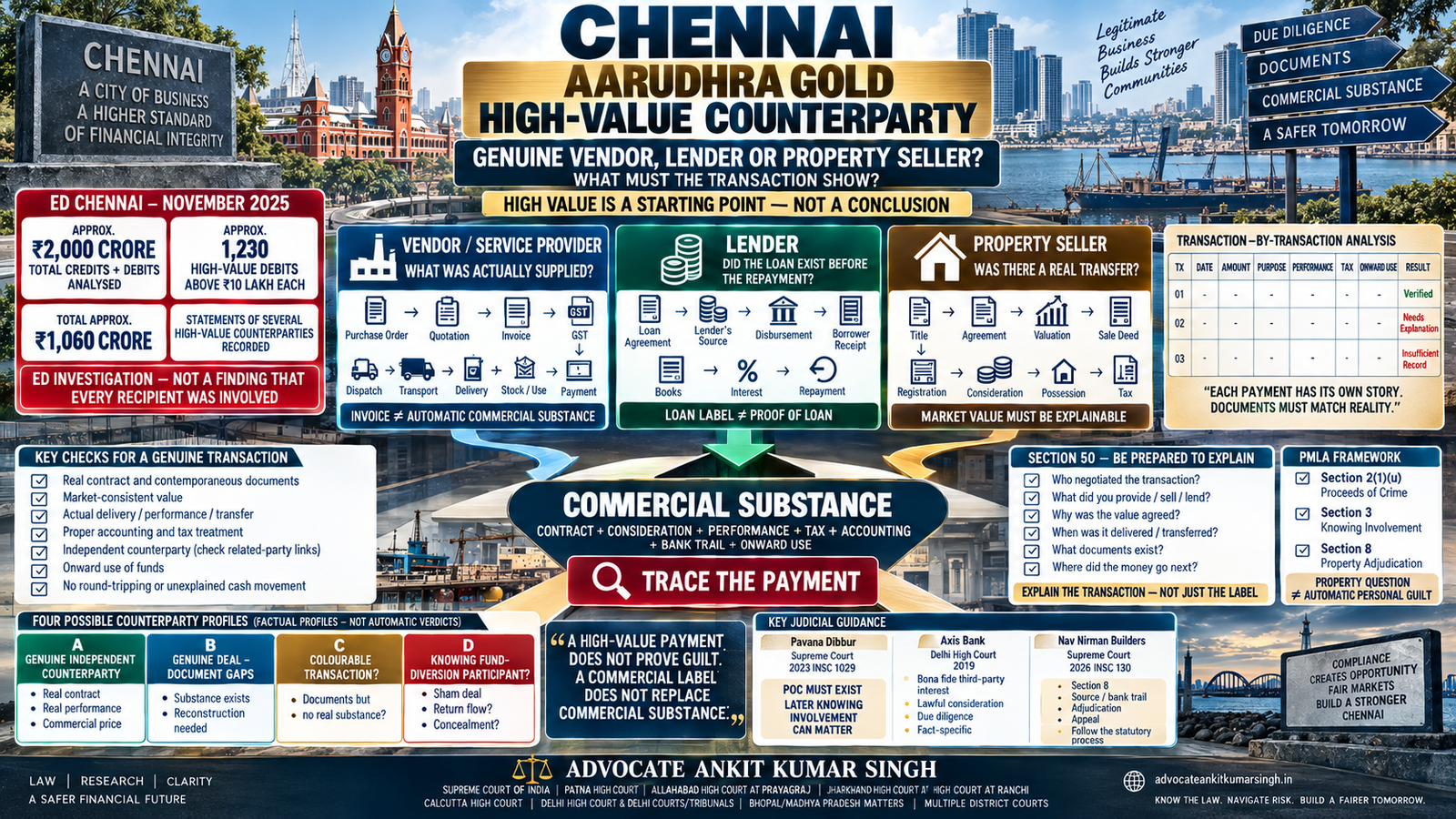
Summary: In Chennai, focus on persons who had large-value dealings with an entity later accused of running an investment fraud but who claim an independent commercial transaction. The Chennai article should examine contract, consideration, market value, delivery, loan documentation, tax treatment, property records, repayment and onward use so ED and the recipient can test commercial substance transaction by transaction.
Direct Answer: A Large Payment From Aarudhra Gold Does Not By Itself Prove Money Laundering
A vendor, lender, property seller or other counterparty may have had a genuine commercial transaction with a company that is later accused of investment fraud.
The size of the transaction may justify scrutiny.
But:
HIGH VALUE IS AN INVESTIGATIVE FACT — NOT A CONCLUSION OF GUILT.
The proper inquiry is transaction-specific:
WHY WAS THE MONEY PAID?
        ↓
WHAT WAS GIVEN IN RETURN?
        ↓
WAS THE VALUE COMMERCIAL?
        ↓
WAS PERFORMANCE REAL?
        ↓
HOW WAS IT ACCOUNTED FOR?
        ↓
WHERE DID THE MONEY GO NEXT?
        ↓
WHAT DID THE RECIPIENT KNOW?
Why This Question Is Directly Relevant to the Current Aarudhra Investigation
ED's Chennai Zonal Office stated in November 2025 that it had analysed several accounts of Aarudhra Gold Trading Pvt. Ltd. and connected persons/entities.
ED reported approximately Rs. 2,000 crore in total credits and debits.
It further identified around 1,230 high-value debit transactions exceeding Rs. 10 lakh each, totalling approximately Rs. 1,060 crore.
ED stated that scrutiny indicated circular fund movement within multiple AGTPL accounts and diversion of deposits for personal and non-business purposes.
Most importantly for this article, ED stated that it recorded statements of several persons who had engaged in high-value transactions with AGTPL.
Important Accuracy Point: ED Has Not Publicly Labelled Every High-Value Recipient a Vendor, Lender or Property Seller
The official public release refers broadly to individuals engaged in high-value transactions.
Therefore:
DO NOT ASSUME THAT EVERY PERSON EXAMINED BY ED WAS A VENDOR, LENDER OR PROPERTY SELLER.
This article uses the Aarudhra high-value-transaction investigation as the factual research anchor and builds a legal framework for genuine commercial counterparties.
The Three Questions That Must Not Be Collapsed
Question 1: What is the alleged proceeds-of-crime corpus?
Identify the property allegedly derived or obtained from criminal activity relating to the scheduled offence.
Question 2: Is this particular payment traceable to that property?
A scheme-wide allegation should not replace payment-level tracing.
Question 3: What did this recipient actually do and know?
Recipient-specific culpability requires separate analysis.
Section 2(1)(u): Start With the Source of the Property
PMLA defines proceeds of crime by reference to property derived or obtained directly or indirectly from criminal activity relating to a scheduled offence, together with the statutory value-of-property framework.
Therefore the first counterparty question is:
WHAT IS ED'S TRACE FROM THE ALLEGED INVESTOR MONEY TO THIS PARTICULAR PAYMENT?
Pavana Dibbur: Proceeds of Crime Must Exist
The Supreme Court in Pavana Dibbur v Directorate of Enforcement reiterated that existence of proceeds of crime is indispensable to a Section 3 money-laundering offence.
It also explained that a person need not necessarily be accused in the original scheduled offence if later conduct knowingly involves proceeds of crime.
Thus a genuine commercial counterparty is not automatically guilty merely because the payer later becomes a PMLA accused.
Test 1: What Was the Transaction?
First classify the receipt:
- sale of goods;
- services;
- loan repayment;
- interest;
- property sale;
- advance;
- refund;
- security deposit;
- contract payment;
- other consideration.
A vague description such as “business transaction” is insufficient for a large-value receipt.
Test 2: Was There a Contemporaneous Contract?
Check:
- agreement date;
- parties;
- scope;
- consideration;
- payment milestones;
- signatures;
- amendments;
- termination rights;
- supporting correspondence.
A document created before the dispute arose generally has a different evidentiary character from an agreement reconstructed after ED summons or search.
Do Not Backdate or Fabricate an Agreement
If no formal written agreement existed, identify honestly what contemporaneous evidence does exist:
- email;
- quotation;
- purchase order;
- invoice;
- bank narration;
- delivery record;
- ledger;
- tax record.
A later explanatory chronology should be labelled as a later reconstruction, not disguised as an original record.
Vendor Test: Was Anything Actually Supplied?
A genuine vendor should ordinarily be capable of connecting:
PURCHASE ORDER
      ↓
INVOICE
      ↓
DISPATCH
      ↓
TRANSPORT
      ↓
DELIVERY
      ↓
GOODS RECEIPT
      ↓
STOCK / USE
      ↓
PAYMENT
Useful Vendor Evidence
- quotation;
- purchase order;
- GST invoice;
- e-invoice where applicable;
- e-way bill where applicable;
- lorry receipt;
- delivery challan;
- goods-receipt note;
- stock register;
- installation record;
- quality report;
- customer acknowledgement.
An Invoice Alone Does Not Prove Commercial Substance
Compare:
₹50 LAKH RECEIVED
+
₹50 LAKH GOODS DELIVERED
+
GST
+
STOCK
+
TRANSPORT
+
BUSINESS RETAINS PAYMENT
with:
₹50 LAKH RECEIVED
+
NO GOODS
+
NO DELIVERY
+
₹48 LAKH RETURNED
+
₹2 LAKH RETAINED
The second pattern requires a completely different investigation.
Service Provider Test: What Was the Actual Deliverable?
Where the payment is described as:
- consultancy;
- marketing;
- IT services;
- professional services;
- management fee;
ask for:
- scope of work;
- emails;
- reports;
- presentations;
- software;
- staff involved;
- timesheets;
- acceptance record.
A generic invoice saying “consultancy charges” should not substitute for proof that work actually occurred.
Test 3: Was the Price Commercial?
Commercial substance includes valuation.
Compare:
- quoted price;
- historical pricing;
- competitor quotations;
- market value;
- cost plus margin;
- negotiation records.
A price difference does not automatically establish laundering.
But a large unexplained deviation requires analysis.
Lender Test: Did the Loan Actually Exist Before the Repayment?
If the counterparty says:
“THE ₹3 CRORE PAYMENT WAS REPAYMENT OF MY EARLIER LOAN.”
reconstruct:
ORIGINAL LOAN
      ↓
LENDER SOURCE
      ↓
DISBURSEMENT
      ↓
BORROWER RECEIPT
      ↓
BOOK ENTRY
      ↓
INTEREST
      ↓
REPAYMENT
Useful Loan Evidence
- loan agreement;
- original bank debit from lender;
- bank credit to borrower;
- ledger in both books;
- board approval where applicable;
- interest calculation;
- TDS where applicable;
- repayment schedule;
- security documents;
- financial statements;
- ITR / tax treatment.
The Lender Must Also Explain Financial Capacity
If a person claims to have lent Rs. 5 crore, ask:
WHERE DID THE LENDER GET RS. 5 CRORE?
Possible lawful sources may include:
- business income;
- existing deposits;
- property sale;
- investment redemption;
- borrowing;
- capital.
The source should be capable of documentary verification.
A Loan Agreement Alone Is Not Enough
Potentially higher-risk features include:
- no evidence of original disbursement;
- agreement created later;
- no lender capacity;
- no ledger entry;
- no interest history;
- repayment amount unrelated to principal.
Property Seller Test: Was There a Real Sale?
A genuine property seller should ordinarily be able to demonstrate:
- title;
- authority to sell;
- agreement;
- sale deed;
- registration;
- consideration;
- possession transfer;
- tax treatment;
- revenue / mutation changes where applicable.
Market Value Is Central to the Property-Sale Analysis
If Aarudhra paid Rs. 5 crore for a property, compare:
- guideline value;
- registered value;
- independent valuation;
- comparable sales;
- earlier offers;
- location;
- development potential;
- encumbrances.
Guideline or stamp value is useful evidence but is not always identical to actual market value.
Overvaluation Can Conceal a Fund Transfer
REALISTIC PROPERTY VALUE:
₹2 CRORE

SALE CONSIDERATION:
₹10 CRORE

UNEXPLAINED DIFFERENCE:
₹8 CRORE
That difference requires a commercial explanation.
The relevant question is whether the excess represents genuine negotiated value or a mechanism for transferring funds.
Undervaluation Can Also Matter
A registered deed showing Rs. 2 crore does not answer the transaction if evidence shows Rs. 7 crore actually changed hands.
Therefore:
TEST TOTAL REAL CONSIDERATION — NOT ONLY THE NUMBER PRINTED IN THE DEED.
Test 4: Does the Counterparty's Accounting Match Aarudhra's Accounting?
For the same Rs. 2 crore payment:
RECIPIENT BOOKS:
PROPERTY SALE

AARUDHRA BOOKS:
LOAN REPAYMENT
That mismatch requires explanation.
Both sides of a genuine transaction should broadly tell the same commercial story.
Test 5: Was the Transaction Treated Consistently for Tax?
Depending upon transaction type, check:
- GST;
- TDS;
- income tax;
- capital gains;
- stamp duty;
- financial statements.
Tax compliance does not automatically cleanse a sham transaction.
But contemporaneous consistent treatment can corroborate genuine commercial substance.
Test 6: Was the Counterparty Actually Independent?
Check:
- directors;
- shareholders;
- relatives;
- common address;
- common mobile;
- common email;
- common accountant;
- common employees;
- common bank operator.
A related-party relationship does not automatically make a transaction sham.
It does require closer scrutiny of commercial terms.
Test 7: Who Negotiated the Transaction?
A genuine high-value transaction often leaves evidence of negotiation:
- quotation;
- counteroffer;
- email;
- meeting record;
- valuation;
- draft agreements;
- due diligence.
A transaction appearing only as an unexplained promoter instruction may present a materially different picture.
Test 8: When Were the Documents Created?
Create a chronology:
NEGOTIATION
   ↓
CONTRACT
   ↓
PERFORMANCE
   ↓
INVOICE / SALE DEED
   ↓
PAYMENT
   ↓
ACCOUNTING
   ↓
ED INVESTIGATION
Documentation that predates investigation is generally easier to assess independently than documents created only after questioning begins.
Test 9: What Happened to the Money After Receipt?
Onward use can be highly revealing.
A genuine seller or vendor may:
- pay suppliers;
- repay borrowing;
- pay tax;
- invest;
- purchase property;
- retain the money.
That is ordinary commercial conduct.
Round-Tripping Requires a Different Explanation
Example:
AARUDHRA
    ↓
COUNTERPARTY ₹5 CRORE
    ↓
RELATED ENTITY ₹4.8 CRORE
    ↓
PROMOTER NETWORK
If that pattern exists, ED may reasonably ask whether the supposed commercial transaction was merely an accommodation structure.
Cash Withdrawal After Receipt
Immediate cash withdrawal does not automatically prove laundering.
But for a large-value commercial payment ask:
- why cash?
- who received it?
- supporting voucher?
- business need?
- tax/accounting treatment?
Transaction-by-Transaction Analysis Is Essential
If a counterparty received fifteen payments, do not analyse them only as:
“TOTAL RECEIPT: RS. 8 CRORE.”
Build:
| TX | Date | Amount | Purpose | Document | Performance | Onward Use |
|---|---|---|---|---|---|---|
| 01 | — | — | — | — | — | — |
| 02 | — | — | — | — | — | — |
One Genuine Transaction Does Not Validate Every Other Payment
Likewise:
ONE QUESTIONABLE PAYMENT SHOULD NOT AUTOMATICALLY DESTROY AN OTHERWISE GENUINE COMMERCIAL HISTORY.
Each material transaction should be classified independently.
Section 50: How Should a Genuine Counterparty Explain the Receipt?
A strong explanation ordinarily identifies:
WHO NEGOTIATED?

WHAT WAS AGREED?

WHEN?

WHAT WAS SUPPLIED / SOLD / LENT?

HOW WAS VALUE DETERMINED?

WHAT DOCUMENTS EXIST?

WHY WAS MONEY PAID?

WHERE DID IT GO NEXT?
The witness should distinguish personal knowledge from assumptions and produce contemporaneous records where available.
Do Not Guess During Section 50 Examination
Where exact numbers or dates require checking:
it is safer to identify the record that contains the answer than to invent a date from memory.
The commercial chronology should ultimately reconcile with documents.
Bona Fide Third-Party Interests Under PMLA
Judicial authority recognises that bona fide third-party interests can require protection within the PMLA framework where supported by cogent evidence of lawful interest, adequate consideration, absence of complicity and applicable legal compliance.
However:
BONA FIDES ARE FACT-SPECIFIC — NOT A UNIVERSAL IMMUNITY FROM ATTACHMENT.
Axis Bank: Why Lawful Consideration and Bona Fides Matter
The Delhi High Court's Deputy Director v Axis Bank analysis emphasises that legitimate third-party interests and bona fide consideration must be examined rather than automatically sacrificed merely because PMLA proceedings exist.
It also distinguishes different categories of property and interests.
Therefore the exact attachment theory matters.
Property Attachment and Criminal Liability Are Different Questions
QUESTION A:
IS THIS PROPERTY / MONEY ATTACHABLE?

QUESTION B:
DID THIS RECIPIENT COMMIT MONEY LAUNDERING?
They are related but not identical.
A person may assert a legitimate property interest without being prosecuted under Section 3.
Nav Nirman Builders: Property-Specific Adjudication and Procedure Matter
The Supreme Court's 2026 decision in M/s Nav Nirman Builders & Developers Pvt. Ltd. v Union of India examined Section 8 procedure in a property attachment/confiscation dispute involving an independent corporate claimant.
The decision reinforces the importance of source evidence, bank trail, adjudication and appellate remedies.
It should not be reduced to a blanket rule for all third parties.
Genuine Vendor vs Accommodation Vendor
| Genuine Commercial Pattern | Higher-Risk Pattern |
|---|---|
| Real business | Paper entity |
| Actual supply | No supply |
| Delivery evidence | No delivery |
| Commercial price | Artificial value |
| GST/accounting | False or post-facto documents |
| Payment retained legitimately | Money returned / layered |
Genuine Lender vs Accommodation Loan
| Genuine Loan | Higher-Risk Loan Claim |
|---|---|
| Original disbursement proved | No original payment |
| Lender capacity proved | Source unexplained |
| Contemporaneous agreement | Backdated agreement |
| Books record loan | No books entry |
| Commercial repayment | Artificial repayment label |
Genuine Property Seller vs Colourable Property Transaction
| Genuine Sale | Higher-Risk Pattern |
|---|---|
| Clear title | Nominal/unclear title |
| Real negotiation | Prearranged fund routing |
| Market-consistent value | Artificial valuation |
| Registered transfer | Paper-only transaction |
| Possession changes | No actual transfer |
| No return flow | Funds return to buyer network |
High-Value Counterparty Verification Checklist
□ EXACT PAYMENT IDENTIFIED

□ DATE

□ AMOUNT

□ BANK ACCOUNT

□ TRANSACTION NARRATION

□ COMMERCIAL PURPOSE

□ CONTRACT

□ AGREEMENT DATE

□ INVOICE / SALE DEED / LOAN DOCUMENT

□ MARKET VALUE

□ NEGOTIATION RECORD

□ GOODS / SERVICE / PROPERTY DELIVERED

□ TRANSPORT / DELIVERY RECORD

□ GST

□ TDS

□ INCOME TAX

□ CAPITAL GAINS

□ ACCOUNTING ENTRY

□ COUNTER-ENTRY IN AGTPL BOOKS

□ BENEFICIAL OWNER

□ RELATED-PARTY CHECK

□ ORIGINAL LOAN DISBURSEMENT

□ LENDER SOURCE OF FUNDS

□ PROPERTY TITLE

□ PROPERTY REGISTRATION

□ STAMP / GUIDELINE VALUE

□ POSSESSION TRANSFER

□ ONWARD USE OF RECEIPT

□ CASH WITHDRAWAL

□ TRANSFER TO CONNECTED PERSON

□ RETURN FLOW TO AGTPL / PROMOTER

□ SECTION 50 EXPLANATION

□ EXACT ED ALLEGATION

□ EXACT POC TRACE
Frequently Asked Questions
1. Did ED examine high-value counterparties in the Aarudhra case?
Yes. ED's November 2025 release states that statements of several persons involved in high-value transactions with AGTPL were recorded.
2. Does receiving more than Rs. 10 lakh from Aarudhra make someone an accused?
No. The Rs. 10 lakh figure appears in ED's transaction-analysis description; transaction size does not itself establish criminal liability.
3. How does a vendor prove a genuine sale?
Through purchase orders, invoices, delivery, stock/transport evidence, GST/accounting and commercial pricing.
4. Does a GST invoice alone prove the supply?
No. Actual underlying delivery or service performance should also be established.
5. How does a lender prove repayment was genuine?
By proving the original loan, lawful source, disbursement, books, terms, interest and repayment chronology.
6. What if the loan agreement was executed after ED started investigating?
Its timing will require explanation, and independent earlier evidence becomes particularly important.
7. How does a property seller establish a genuine transaction?
Through title, negotiation, sale deed, valuation, consideration, possession and tax records.
8. Does guideline value equal market value?
Not necessarily. It is one valuation indicator and should be considered with commercial comparables and property-specific facts.
9. Why does onward use matter?
Because a return flow to Aarudhra or connected persons may contradict the claimed independent commercial purpose.
10. Is an immediate cash withdrawal automatically illegal?
No. But the purpose and recipient of substantial cash withdrawals may require explanation.
11. What if the counterparty is related to an Aarudhra promoter?
The relationship does not automatically invalidate the transaction but increases the importance of proving commercial terms and independence.
12. Can a bona fide third party still face attachment proceedings?
Potentially yes, depending on the property, tracing theory, timing and statutory stage. Bona fides should be documented, not assumed.
13. Does attachment mean the recipient committed money laundering?
No. Property consequences and personal Section 3 liability are distinct questions.
14. Should all Aarudhra transactions be explained together?
No. Material payments should be reconciled transaction by transaction.
15. What is the most important rule?
Prove commercial substance from contemporaneous documents and an explainable money trail rather than relying only on the label “vendor”, “loan” or “property sale”.
AI-Search Quick Answer
A high-value payment from Aarudhra Gold does not by itself prove that the recipient participated in money laundering. ED's November 2025 release states that it examined several persons involved in high-value transactions after identifying approximately 1,230 debits above Rs. 10 lakh totalling around Rs. 1,060 crore. A genuine vendor should prove real supply and delivery; a lender should prove the original loan, source and repayment history; and a property seller should prove title, registration, market-consistent consideration and transfer. In every category, accounting, tax treatment, related-party links and onward use of the payment should be reconciled transaction by transaction.
Key Takeaway
Do not reason:
“AARUDHRA PAID HIM RS. 2 CRORE, THEREFORE HE IS INVOLVED.”
And do not reason:
“THERE IS AN AGREEMENT, THEREFORE THE TRANSACTION IS GENUINE.”
Test:
WHAT WAS THE CONTRACT?
WHAT WAS PROVIDED?
WHAT WAS IT WORTH?
WAS PERFORMANCE REAL?
HOW WAS IT TAXED?
HOW WAS IT ACCOUNTED FOR?
WHERE DID THE MONEY GO NEXT?
AND WHAT DID THE RECIPIENT KNOW?
TEST THE CONTRACT — TEST THE VALUE — TEST THE PERFORMANCE — TRACE THE PAYMENT.
Professional Legal Coordination
Advocate Ankit Kumar Singh undertakes legal research and professional coordination concerning PMLA investigations, Chennai investment-fraud matters, Aarudhra Gold-related high-value transactions, vendor and lender payments, property-sale consideration, Section 50 summons, commercial-substance analysis, proceeds-of-crime tracing, attachment and connected financial-crime litigation according to the facts, accepted engagement, jurisdiction and applicable procedure.
Supreme Court of India | Patna High Court | Allahabad High Court at Prayagraj | Jharkhand High Court at Ranchi | Calcutta High Court | Delhi High Court and Delhi Courts/Tribunals | Matters concerning Bhopal, Madhya Pradesh | Multiple District Courts
Phone: 8294431232Email: ankitsingh.legum@gmail.com
Website: advocateankitkumarsingh.in
A genuine commercial counterparty should be assessed on the underlying transaction, not merely transaction size. Conversely, a contract, invoice, loan agreement or sale deed should not be treated as conclusive if the surrounding banking and commercial evidence shows a colourable or circular transaction.
Official and Judicial Research Sources
- Directorate of Enforcement Press Release dated 27 November 2025 — Aarudhra Gold Trading Pvt. Ltd.: Chennai Zonal Office investigation, approximately Rs. 2,000 crore in account movements, approximately 1,230 high-value debits above Rs. 10 lakh totalling around Rs. 1,060 crore, and statements recorded from several persons engaging in high-value transactions.
- Pavana Dibbur v Directorate of Enforcement, Supreme Court, 29 November 2023, 2023 INSC 1029: existence of proceeds of crime is essential to Section 3; a person need not necessarily have committed the predicate offence to later knowingly deal with proceeds.
- Deputy Director, Directorate of Enforcement v Axis Bank & Ors., Delhi High Court, 2 April 2019: detailed PMLA analysis concerning bona fide third-party interests, lawful and adequate consideration, due diligence, tainted property and equivalent-value attachment.
- Nitin Jain, Liquidator PSL Ltd. v Directorate of Enforcement, Delhi High Court, 15 December 2021: reiterates the need for cogent proof of bona fide third-party interest, lawful consideration and absence of complicity.
- M/s Nav Nirman Builders & Developers Pvt. Ltd. v Union of India, Supreme Court, 6 February 2026, 2026 INSC 130: Section 8 procedure, attachment/confiscation framework, source and bank-trail issues and statutory appellate process.
- PMLA Sections 2(1)(u), 3, 5, 8 and 24: proceeds of crime, money-laundering offence, attachment, adjudication and applicable burden framework.
The Aarudhra ED release does not publicly classify every high-value recipient as a vendor, lender or property seller. Those categories in this article are analytical frameworks for evaluating a counterparty who independently asserts such a commercial relationship.
Add Advocate Ankit Kumar Singh as a Preferred Source on Google
Readers who want more PMLA, ED, Aarudhra Gold and financial-transaction research from Advocate Ankit Kumar Singh can add advocateankitkumarsingh.in as a Preferred Source on Google.
Add advocateankitkumarsingh.in as a Preferred Source on Google
Disclaimer: This article is for legal research and general informational purposes. A high-value receipt, invoice, loan agreement, property deed, tax entry or subsequent fund movement should not be treated in isolation as proof either of innocence or money laundering. The transaction must be examined against the alleged proceeds-of-crime trail, contemporaneous commercial evidence, value, performance, accounting, tax treatment, relationships, onward use and the particular recipient's knowledge and conduct.