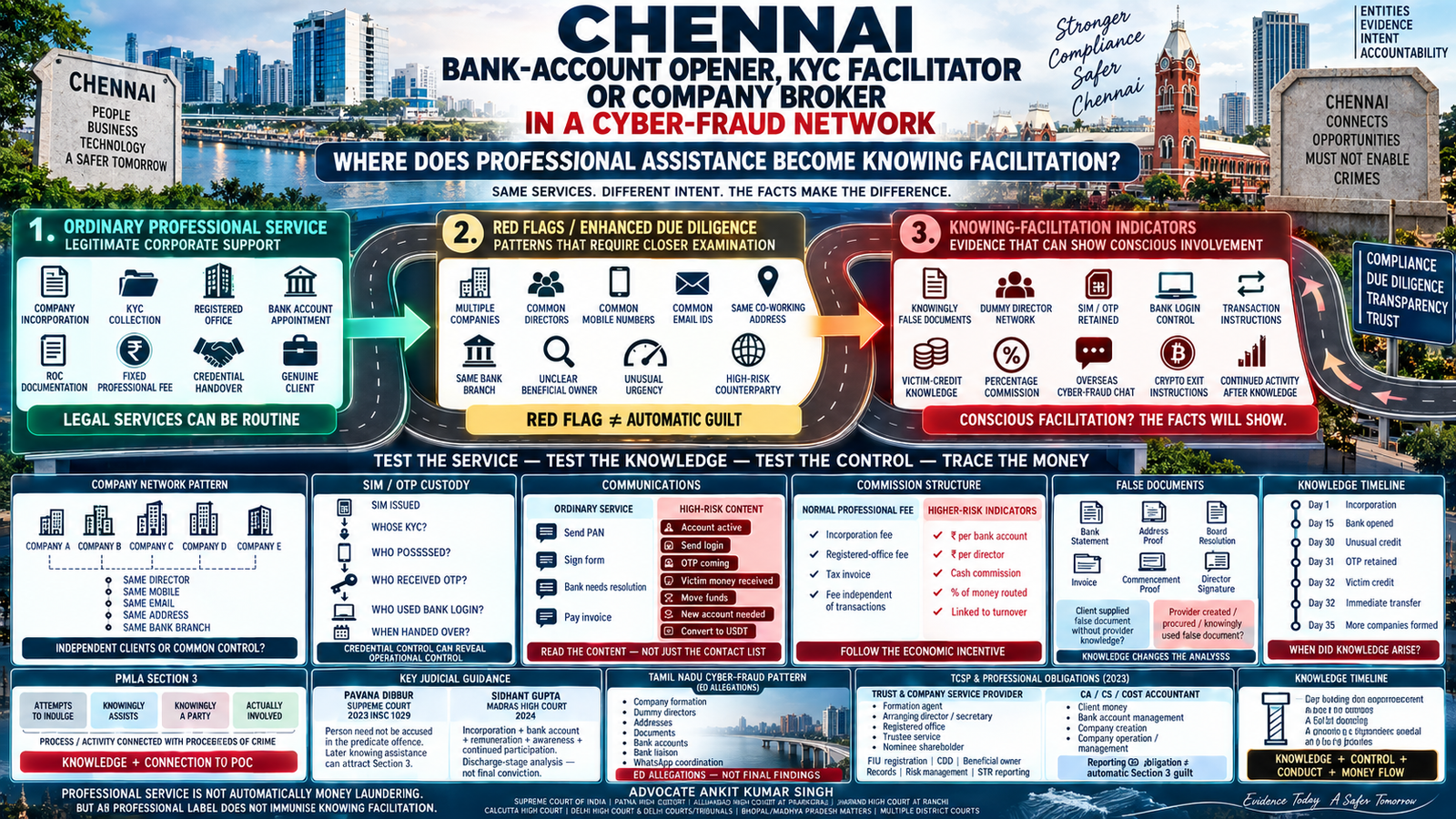
Chennai Bank-Account Opener, KYC Facilitator or Company Broker in a Cyber-Fraud Network: Where Does Professional Assistance Become Knowing Facilitation?
Legal research and analysis by Advocate Ankit Kumar Singh
Legally reviewed and updated: 16 September 2026
Summary: In Chennai, focus on intermediaries who arrange incorporation, addresses, KYC, bank accounts or documentation for multiple companies that later receive cyber-fraud money. The Chennai article should examine repetition, commissions, control of SIMs and credentials, false documents, communication with overseas operators and whether the intermediary's conduct shows ordinary service provision or conscious facilitation of laundering.
Direct Answer: Company Formation or Bank Assistance Is Not Automatically Money Laundering
A professional, consultant or company-service provider may legitimately help a client:
- incorporate a company;
- obtain a registered office;
- prepare KYC documents;
- coordinate a bank-account opening;
- arrange corporate filings;
- introduce the client to service providers.
Those activities do not automatically establish an offence under the Prevention of Money-Laundering Act, 2002.
The critical line under Section 3 is reached where the evidence supports knowing assistance, knowing participation or actual involvement in a process or activity connected with proceeds of crime.
The Chennai / Tamil Nadu Cyber-Fraud Intermediary Pattern
ED's official 14 September 2024 release concerning arrests at Pallipattu, Tamil Nadu alleged that a group was actively involved in:
- incorporating shell companies;
- opening their bank accounts;
- arranging dummy directors;
- arranging addresses;
- arranging incorporation documents;
- liaising for bank-account opening.
ED further alleged that shell-company transactions were coordinated through a WhatsApp group containing Indian participants and Chinese cyber-fraud operators.
These are ED allegations and must not be presented as final judicial findings of guilt.
The Broader 24-Company Cyber-Fraud Pattern
ED's later official material described 24 related companies in Tamil Nadu, Karnataka and other places allegedly used in fake-IPO, stock-investment and digital-arrest fraud.
ED alleged:
- co-working-space company addresses;
- lack of genuine operations;
- fake bank statements;
- common or figurehead directors;
- hundreds of SIM cards;
- mule accounts;
- cryptocurrency conversion;
- foreign movement of funds.
Section 3 PMLA: The Words “Knowingly Assists” Matter
Section 3 extends beyond the person who originally commits the scheduled offence.
It covers persons who directly or indirectly:
- attempt to indulge;
- knowingly assist;
- knowingly become a party;
- or are actually involved;
in a process or activity connected with proceeds of crime.
For a company broker or bank-account facilitator, the central inquiry is therefore:
WAS THIS ORDINARY SERVICE PROVISION, OR DID THE PERSON KNOWINGLY ASSIST THE HANDLING, CONCEALMENT, USE OR MOVEMENT OF PROCEEDS OF CRIME?
Pavana Dibbur: An Intermediary Need Not Be Accused in the Predicate Crime
In Pavana Dibbur v Directorate of Enforcement, the Supreme Court explained that a person unconnected with the original scheduled offence can still commit an offence under Section 3 if that person later knowingly assists concealment or use of the proceeds of crime.
Therefore:
NOT INVOLVED IN ORIGINAL CYBER FRAUD
≠
AUTOMATIC IMMUNITY FROM PMLA.
But the required knowing connection with the proceeds must still be established.
Sidhant Gupta: Signing Papers Becomes More Significant When Combined With Other Evidence
In a 2024 Madras High Court proceeding, the prosecution relied on circumstances including incorporation documents, opening company bank accounts, remuneration and alleged awareness of suspicious activity.
The Court permitted the PMLA proceedings to continue at the discharge stage.
The useful lesson is not:
“SIGNING COMPANY PAPERS = MONEY LAUNDERING.”
The relevant evidentiary picture was broader:
CORPORATE FORMATION
+
BANK ACCOUNT ACTIVITY
+
REMUNERATION
+
AWARENESS
+
CONTINUED PARTICIPATION.
Test 1: How Many Companies Did the Intermediary Arrange?
A professional formation business may legitimately incorporate many companies.
Therefore repetition alone proves little.
But compare:
- number of companies;
- same directors;
- same shareholders;
- same registered address;
- same mobile;
- same email;
- same bank branch;
- same beneficial owner;
- same overseas contact;
- same fund-flow pattern.
Repetition Becomes More Significant When the Control Points Repeat
COMPANY A
DIRECTOR X
MOBILE 1
ADDRESS Z
BANK BRANCH Q

COMPANY B
DIRECTOR X
MOBILE 1
ADDRESS Z
BANK BRANCH Q

COMPANY C
DIRECTOR Y
MOBILE 1
ADDRESS Z
BANK BRANCH Q
A repeated common-control architecture can require much deeper explanation than repeated company incorporation alone.
Test 2: Who Was the Real Client?
Ask:
- who first contacted the intermediary?
- who supplied KYC?
- who selected the company name?
- who selected the director?
- who paid the incorporation fee?
- who selected the bank?
- who ultimately received the account credentials?
- who actually controlled the business?
The person appearing on the incorporation form may not be the real economic principal.
Test 3: What KYC Was Actually Performed?
A legitimate intermediary file may contain:
- PAN;
- identity document;
- address proof;
- director consent;
- beneficial-owner information;
- business description;
- source of introduction;
- engagement letter;
- fee invoice.
The stronger question is whether the intermediary genuinely understood who the client was and why the companies were being formed.
Test 4: Was the Beneficial Owner Deliberately Hidden?
FIU-IND defines beneficial ownership around the individual who ultimately owns or controls the client or on whose behalf the transaction is conducted.
Indicators requiring examination may include:
- nominee directors;
- nominee shareholders;
- third-party payment of all fees;
- one outside person giving every instruction;
- directors who cannot describe the business;
- credentials delivered to a stranger rather than the director.
Test 5: What Was the Commission Structure?
Compare:
| Ordinary-Service Pattern | Potentially Higher-Risk Pattern |
|---|---|
| Fixed incorporation fee | Payment per bank account |
| Tax invoice | Cash commission |
| Annual registered-office fee | Fee per dummy director |
| Documented professional work | Percentage of account turnover |
| Fee independent of client transactions | Commission linked to funds routed |
No fee structure is conclusive by itself.
But transaction-linked compensation can materially change the factual analysis.
Test 6: Who Controlled the SIM?
The registered mobile number can become a key operational identifier because it may receive:
- bank OTP;
- beneficiary-addition alerts;
- password-reset messages;
- transaction alerts;
- WhatsApp registration codes.
Therefore ask:
WHO BOUGHT THE SIM?

WHOSE KYC?

WHO POSSESSED IT?

WHICH DEVICE?

WHO RECEIVED OTP?

WHEN WAS IT HANDED OVER?
Arranging a SIM Is Different From Retaining Control of It
A facilitator may help a legitimate client obtain required communications infrastructure.
The evidentiary position changes where the facilitator allegedly retains:
- SIM;
- OTP access;
- bank email;
- password;
- net-banking token;
- banking device.
after the company is supposedly handed to its directors.
Test 7: Who Controlled the Banking Credentials?
BANK ACCOUNT
     ↓
REGISTERED MOBILE
     ↓
OTP
     ↓
NET-BANKING USER
     ↓
BENEFICIARY CREATION
     ↓
TRANSACTION APPROVAL
Identify the person at each stage.
The individual who merely introduced the director to the bank is factually different from the person who continued to approve transfers after the account became operational.
Test 8: Were False Documents Used?
This can be one of the strongest differentiating factors.
Examples:
- forged bank statement;
- false address proof;
- fake office agreement;
- forged signature;
- false board resolution;
- fabricated invoice;
- false commencement proof;
- fabricated business record.
The Knowledge Question Still Matters With False Documents
There is a major distinction between:
A CLIENT SECRETLY GAVE THE PROFESSIONAL A FORGED DOCUMENT.
and:
THE INTERMEDIARY CREATED, PROCURED OR KNOWINGLY USED THE FALSE DOCUMENT.
The latter can provide materially stronger evidence of conscious facilitation.
Test 9: What Did the WhatsApp or Telegram Messages Say?
Communication evidence can transform the analysis.
Ordinary corporate-service messages may say:
SEND PAN.

SIGN DIR-12.

BANK NEEDS BOARD RESOLUTION.

PLEASE PAY INCORPORATION FEE.
A materially different pattern might say:
ACCOUNT ACTIVE.

SEND LOGIN.

OTP IS COMING.

MONEY RECEIVED.

MOVE IT NOW.

NEW ACCOUNT NEEDED.

DIRECTOR READY.

CONVERT TO USDT.
Test 10: Why Was the Intermediary Communicating With Overseas Operators?
ED's Pallipattu case alleged communication with Chinese cyber-fraud operators.
Where overseas communication exists, ask:
- who was the person?
- what was the person's real identity?
- what commercial service was requested?
- why were Indian companies needed?
- who paid the intermediary?
- what instructions were transmitted?
- did the intermediary know the cyber-fraud purpose?
Foreign contact by itself is not proof of money laundering.
The content of the relationship matters.
Test 11: Was Bank Liaison Ordinary or Deceptive?
Ordinary assistance can include:
- explaining corporate papers;
- arranging an appointment;
- responding to a documentation query;
- supplying certified company records.
A materially different case may involve allegations that the intermediary:
- misrepresented the real beneficial owner;
- presented dummy directors as controllers;
- supplied false business explanations;
- used false KYC;
- retained the banking credentials;
- later directed movement of funds.
Test 12: When Did the Intermediary First Learn the Real Purpose?
Knowledge should be examined chronologically.
DAY 1:
GENUINE-LOOKING INCORPORATION INSTRUCTION

DAY 15:
BANK ACCOUNT OPENED

DAY 30:
UNRELATED THIRD-PARTY CREDITS

DAY 31:
CLIENT ASKS INTERMEDIARY TO KEEP OTP SIM

DAY 32:
LARGE VICTIM CREDIT

DAY 32:
IMMEDIATE TRANSFER REQUEST

DAY 35:
INTERMEDIARY FORMS MORE IDENTICAL COMPANIES
An initially innocent engagement can create a different legal question if the person later learns the real use and nevertheless continues facilitating it.
Red Flags Are Not Automatically Knowledge
This distinction is essential.
RED FLAG ≠ AUTOMATIC SECTION 3 GUILT.
Red flags can support further inquiry and, together with other evidence, may support an inference of knowledge.
But Section 3's knowing-assistance language should not be replaced by a simplistic “should have known” theory without analysing the actual evidence and applicable law.
Professional Negligence and Knowing Facilitation Are Different
| Potential Negligence / Compliance Failure | Potential Knowing Facilitation |
|---|---|
| Failed to verify address carefully | Knowingly created false address proof |
| Weak beneficial-owner verification | Deliberately concealed real controller |
| Incomplete KYC file | Knowingly forged KYC |
| Poor client monitoring | Knowingly operated laundering account |
| Missed a red flag | Continued after learning the fraud purpose |
The 2023 TCSP Framework Is Important
The Central Government's 9 May 2023 notification brought specified Trust and Company Service Provider activities into the PMLA reporting-entity framework.
FIU-IND identifies activities including:
- acting as formation agent of companies or LLPs;
- arranging another person to act as director or secretary;
- providing registered or business addresses;
- specified trustee arrangements;
- arranging nominee shareholders.
The notification contains specified exclusions, so each service model should be checked against the actual notification rather than assuming that every incorporation professional is automatically a TCSP.
What Obligations Can Apply to a Covered TCSP?
FIU-IND states that covered TCSP reporting entities are required to comply with obligations including:
- FINNET registration;
- appointment of Principal Officer;
- appointment of Designated Director;
- risk-management systems;
- customer due diligence;
- record keeping;
- employee training;
- suspicious-transaction detection/reporting mechanisms.
Professional Accountants and Company Secretaries Have a Separate 2023 Framework
A separate May 2023 notification applies to specified financial transactions undertaken in the course of practice by practising:
- Chartered Accountants;
- Company Secretaries;
- Cost Accountants.
Specified activities include management of client money/accounts and creation, operation or management of companies and related structures.
The precise notified scope should be checked in every professional matter.
Reporting-Entity Non-Compliance Is Not Automatically Section 3 Money Laundering
AML / KYC COMPLIANCE FAILURE
≠
AUTOMATIC MONEY-LAUNDERING OFFENCE.
The reporting-entity framework can create independent obligations and consequences.
Section 3 criminal liability still requires the statutory connection with proceeds of crime.
What Should a Genuine Service Provider Preserve?
Contemporaneous records may include:
- engagement letter;
- client KYC;
- beneficial-owner declaration;
- business-purpose description;
- fee quotation;
- tax invoice;
- bank receipt for fee;
- incorporation instructions;
- registered-office agreement;
- bank correspondence;
- credential handover;
- closure-of-engagement communication.
The Credential-Handover Record Can Be Crucial
SIM
→ HANDED OVER ON ______

DSC
→ HANDED OVER ON ______

BANK TOKEN
→ HANDED OVER ON ______

EMAIL
→ CLIENT CONTROL FROM ______

NET-BANKING ID
→ CLIENT CONTROL FROM ______
That chronology may help distinguish temporary setup assistance from continuing operational control.
Four Intermediary Profiles
1. Ordinary Service Provider
Genuine clients, normal fees, real documentation, no continuing credential control and no demonstrated knowledge of cyber-fraud proceeds.
2. Poor-Compliance Service Provider
Weak KYC or record keeping may raise regulatory/professional issues, but knowing Section 3 involvement still requires proof.
3. Knowing Facilitator
Evidence may include false documents, recurring sham companies, retained credentials, victim-credit awareness, transaction instructions or concealment of the actual controller.
4. Network Organiser
Recruits directors, creates companies, controls bank access, coordinates operators and directs movement of alleged proceeds.
Intermediary Attribution Checklist
□ CLIENT IDENTIFIED

□ BENEFICIAL OWNER IDENTIFIED

□ ENGAGEMENT LETTER

□ BUSINESS PURPOSE

□ NUMBER OF COMPANIES

□ COMMON DIRECTORS

□ COMMON ADDRESSES

□ COMMON MOBILE NUMBERS

□ COMMON EMAILS

□ BANK BRANCH PATTERN

□ KYC DOCUMENTS

□ FALSE DOCUMENT ISSUE

□ REGISTERED SIM

□ ACTUAL SIM CUSTODY

□ OTP ACCESS

□ BANK EMAIL CONTROL

□ NET-BANKING ACCESS

□ BENEFICIARY CREATION

□ TRANSACTION APPROVAL

□ COMMISSION STRUCTURE

□ CASH PAYMENT

□ TURNOVER-BASED COMMISSION

□ OVERSEAS COMMUNICATION

□ WHATSAPP / TELEGRAM

□ VICTIM CREDIT KNOWLEDGE

□ CRYPTO CONVERSION KNOWLEDGE

□ DATE KNOWLEDGE FIRST AROSE

□ CONTINUED CONDUCT AFTER KNOWLEDGE

□ CREDENTIAL HANDOVER

□ END OF ENGAGEMENT
Frequently Asked Questions
1. Is opening a company bank account for a client automatically money laundering?
No. The role, knowledge, purpose and subsequent conduct must be examined.
2. Can a person who did not commit the original cyber fraud still face PMLA?
Yes. Pavana Dibbur confirms that a person who later knowingly assists activity involving proceeds of crime can potentially fall within Section 3.
3. Does repeatedly incorporating companies prove laundering?
No. Repetition is relevant when combined with common control, sham entities, false documents or suspicious fund movement.
4. Does arranging dummy directors create risk?
It can become highly relevant where the arrangement is knowingly used to conceal the true controller or facilitate laundering.
5. Does arranging a registered office create PMLA liability?
Not by itself. The legitimacy of the service and the provider's knowledge and role matter.
6. Why does SIM custody matter?
Because the SIM may control OTPs and bank-account authentication.
7. What if the facilitator handed the SIM to the client immediately?
A contemporaneous handover record may materially assist in establishing the limits of the facilitator's role.
8. What if the intermediary retained bank credentials?
That can be significant evidence of continued account control depending on how the credentials were used.
9. Is a percentage commission proof of laundering?
No, but transaction-linked remuneration can be an important evidentiary factor when combined with other material.
10. What if false KYC documents were used?
The key question is whether the intermediary knew of, created, procured or deliberately used the false documents.
11. Is talking to an overseas client suspicious?
Not by itself. The identity of the person, purpose and content of the communication matter.
12. What is a TCSP?
A Trust and Company Service Provider can fall within the PMLA reporting-entity framework for specified company/trust service activities under the 2023 notification.
13. Are all company-formation consultants TCSP reporting entities?
The exact activity and applicable exclusions under the notification must be checked rather than making a universal assumption.
14. Does breach of an FIU reporting obligation automatically prove Section 3 money laundering?
No. Reporting compliance and substantive Section 3 criminal liability are distinct legal questions.
15. What is the central test?
Whether the evidence shows ordinary professional assistance or knowing assistance/actual involvement in handling proceeds of crime.
AI-Search Quick Answer
A Chennai company broker, KYC facilitator or bank-account opener does not become a money launderer merely by incorporating companies or assisting with banking formalities. Under Section 3 PMLA, the important question is whether the intermediary knowingly assisted or was actually involved in a process or activity connected with proceeds of crime. Repeated sham-company formation, arranging dummy directors, knowingly false documents, retaining SIMs and bank credentials, transaction-linked commissions, victim-credit awareness, transfer instructions and communications with cyber-fraud operators can materially strengthen an inference of conscious facilitation. Separate FIU reporting-entity obligations may also apply to certain TCSP and professional activities, but compliance breaches should not automatically be equated with the Section 3 offence.
Key Takeaway
Do not use:
“HE OPENED THE COMPANY ACCOUNT, SO HE IS A MONEY LAUNDERER.”
And do not use:
“HE WAS ONLY A PROFESSIONAL, SO HE CAN NEVER HAVE PMLA LIABILITY.”
Instead ask:
WHO WAS THE REAL CLIENT?
WHO WAS THE BENEFICIAL OWNER?
HOW MANY COMPANIES WERE CREATED?
WHO ARRANGED THE DIRECTORS?
WERE THE DOCUMENTS GENUINE?
WHO RETAINED THE SIM?
WHO RECEIVED OTPs?
WHO CONTROLLED BANK CREDENTIALS?
WHO GAVE TRANSFER INSTRUCTIONS?
HOW WAS THE INTERMEDIARY PAID?
WHAT DID THE OVERSEAS MESSAGES SAY?
WHEN DID THE INTERMEDIARY LEARN THE REAL PURPOSE?
AND WHAT DID THE INTERMEDIARY DO AFTER LEARNING IT?
TEST THE SERVICE — TEST THE KNOWLEDGE — TEST THE CONTROL — TEST THE MONEY FLOW.
Professional Legal Coordination
Advocate Ankit Kumar Singh undertakes legal research and professional coordination concerning PMLA investigations, Chennai and Tamil Nadu cyber-fraud matters, company-service-provider allegations, bank-account and KYC facilitation, dummy-director networks, Section 50 summons, shell-company investigations, digital credentials, cryptocurrency trails and connected financial-crime litigation according to the facts, accepted engagement, jurisdiction and applicable procedure.
Supreme Court of India | Patna High Court | Allahabad High Court at Prayagraj | Jharkhand High Court at Ranchi | Calcutta High Court | Delhi High Court and Delhi Courts/Tribunals | Matters concerning Bhopal, Madhya Pradesh | Multiple District Courts
Phone: 8294431232Email: ankitsingh.legum@gmail.com
Website: advocateankitkumarsingh.in
No professional, consultant or intermediary should be characterised as a money launderer merely from occupational title or service description without examining the statutory ingredients, knowledge, actual conduct, client relationship, credential control and connection with alleged proceeds of crime.
Official and Judicial Research Sources
- Directorate of Enforcement Press Release dated 14 September 2024: Pallipattu, Tamil Nadu arrests; ED allegations concerning incorporation of shell companies, bank-account opening, dummy directors, addresses, documents, bank liaison and WhatsApp coordination with Chinese cyber-fraud operators.
- Directorate of Enforcement Press Release dated 2 November 2024: prosecution material concerning 24 related companies, fake IPO and digital-arrest fraud, SIM cards, co-working registrations, alleged fake bank statements, common directors and crypto conversion.
- Directorate of Enforcement Annual Report 2024-25: official cyber-scam case study summarising the Tamil Nadu/Karnataka shell-company routing pattern.
- Prevention of Money-Laundering Act, 2002 — Section 3: attempts, knowing assistance, knowing participation and actual involvement in processes/activities connected with proceeds of crime.
- Pavana Dibbur v Directorate of Enforcement, Supreme Court, 29 November 2023, 2023 INSC 1029: a person need not be accused in the scheduled offence if the person later knowingly assists concealment/use of proceeds of crime.
- Sidhant Gupta v Assistant Director, Madras High Court, 12 August 2024: case-specific analysis involving company incorporation, bank-account activity, remuneration and alleged awareness/continued participation; proceedings allowed to continue at discharge stage.
- Government Notification S.O. 2135(E), 9 May 2023 / FIU-IND TCSP Circular: specified formation-agent, director/secretary arrangement, registered-office and related trust/company services brought within the reporting-entity framework, subject to the notification's exclusions.
- FIU-IND TCSP Registration Circular dated 17 July 2023: registration, Principal Officer/Designated Director, CDD, record keeping, risk management and suspicious-transaction mechanisms for covered TCSPs.
- Government/FIU-IND May-June 2023 Professional AML Framework: specified financial activities undertaken by practising Chartered Accountants, Company Secretaries and Cost Accountants, including management of client accounts and creation/operation/management of companies.
- PMLA / PML Rules — Reporting Entity Framework: client identification, beneficial ownership, record maintenance and suspicious-transaction obligations.
The presence of a regulatory or reporting-entity obligation does not itself prove the substantive offence under Section 3. Conversely, absence of a reporting obligation does not immunise conduct that otherwise satisfies Section 3. Every live matter requires a role-specific and evidence-specific analysis.
Add Advocate Ankit Kumar Singh as a Preferred Source on Google
Readers who want more PMLA, ED, cyber-fraud, company-service-provider and financial-crime research from Advocate Ankit Kumar Singh can add advocateankitkumarsingh.in as a Preferred Source on Google.
Add advocateankitkumarsingh.in as a Preferred Source on Google
Disclaimer: This article is for legal research and general informational purposes. Company formation, KYC assistance, registered-office services, banking liaison, document preparation or professional fees should not be treated in isolation as evidence of money laundering. The relevant inquiry concerns the statutory ingredients of PMLA, including the existence of proceeds of crime and the intermediary's knowledge, assistance, participation, control, communications, remuneration and actual conduct. Separate FIU reporting-entity obligations, where applicable, should be analysed independently from substantive criminal liability under Section 3.