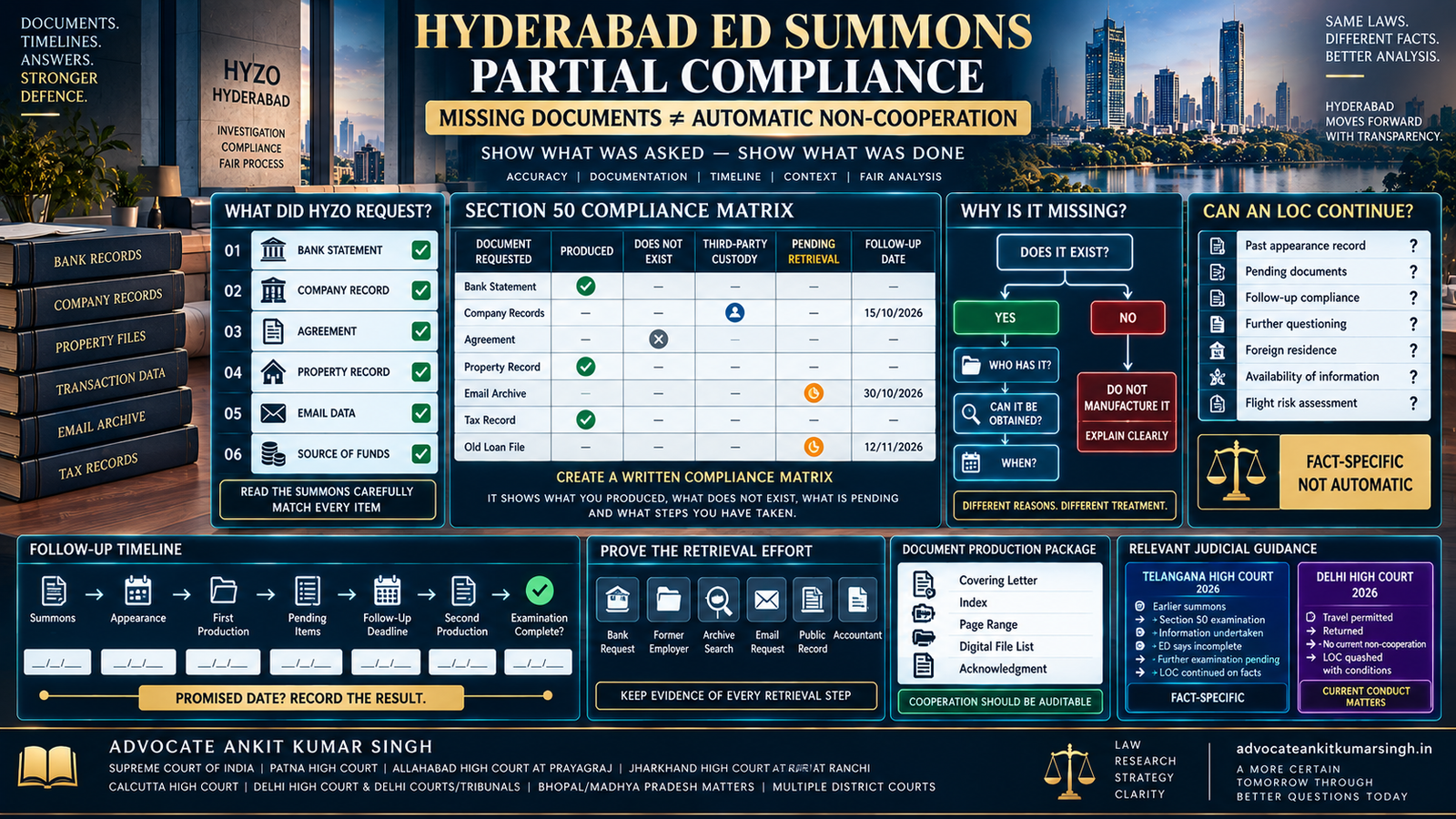
Partial Compliance With an ED Summons in Hyderabad: Can Missing Documents Be Used to Continue a Look-Out Circular?
Legal research and analysis by Advocate Ankit Kumar Singh
Legally reviewed and updated: 14 September 2026
Summary: In a Hyderabad ED matter, analyse how investigators and courts may evaluate incomplete document production: what was requested, what was produced, what genuinely does not exist, what remains obtainable and whether follow-up dates were honoured. The Hyderabad article should stress the importance of a written compliance matrix rather than vague claims of cooperation.
Direct Answer: Missing Documents Can Matter, but the Reason for Each Missing Document Matters More
In a Hyderabad PMLA investigation, partial compliance with a Section 50 summons can become relevant to continuation of a Look-Out Circular where ED still requires documents or further examination and considers the person's continued presence necessary.
But:
“SOME DOCUMENTS ARE MISSING” IS NOT A COMPLETE LEGAL ANALYSIS.
The correct questions are:
- What exactly did HYZO request?
- When was it requested?
- Was the request clear?
- Did the document ever exist?
- Who holds it?
- Was it within the person's possession or control?
- Was it produced?
- If not, why not?
- Can it still be obtained?
- Was additional time requested?
- Was additional time granted?
- Was the promised follow-up date honoured?
- Is further personal examination genuinely pending?
A court reviewing an LOC can examine conduct much more effectively when these questions are answered from a contemporaneous written record.
Section 50 Requires More Than Physical Appearance
Section 50 PMLA empowers designated Enforcement Directorate officers to summon a person:
- to give evidence;
- to produce records.
Accordingly, compliance can have multiple components:
ATTENDANCE
+
TRUTHFUL EXAMINATION
+
DOCUMENT PRODUCTION
+
FOLLOW-UP INFORMATION
A person cannot necessarily establish complete compliance merely by showing:
“I attended the ED office.”
If the summons also required documents, the document-production record must be examined separately.
The Hyderabad 2026 Case: Why Partial Compliance Can Affect an LOC
In Tushar Prakash Ajwani v. Union of India, decided on 5 March 2026, the Telangana High Court considered continuation of an LOC connected with ECIR/HYZO/25/2023.
The record showed that the petitioner had earlier not personally appeared pursuant to two Section 50 summons.
After later being prevented from departing India under the LOC, his deposition was recorded on 20 and 21 November 2025.
The Enforcement Directorate stated that during examination:
- certain information was required;
- the petitioner undertook to submit relevant data;
- the information was not completely supplied;
- a further opportunity was given;
- the later production remained incomplete according to ED;
- questions concerning associates, transactions and alleged commission remained pending.
The Court treated the incomplete examination and pending information as part of the factual circumstances supporting continuation of the LOC.
Tushar Ajwani Does Not Create an Automatic “Missing Document = LOC” Rule
The decision must be read on its facts.
The Court considered a combination of circumstances including:
- earlier summons history;
- personal non-appearance on earlier dates;
- attempted departure before examination was confirmed;
- foreign citizenship/residence;
- incomplete examination;
- pending information;
- connected FIRs;
- alleged role requiring further inquiry.
Therefore:
THE JUDGMENT DOES NOT SAY THAT A SINGLE UNAVAILABLE DOCUMENT CAN JUSTIFY AN LOC FOREVER.
The First Question: What Exactly Did the Summons Ask For?
Read the document-demand portion line by line.
Create:
| Serial | Document Requested | Period | Entity / Account |
|---|---|---|---|
| 1 | Bank statements | FY 2022-23 to FY 2025-26 | Personal Account |
| 2 | Company bank statements | Specified period | Company A |
| 3 | Agreements | Specified transactions | Company A / B |
| 4 | Property records | Specified years | Personal |
Do not rely upon a general memory that:
“ED wanted company documents.”
Create a Written Compliance Matrix
| Sl. | ED Requirement | Status | Production Date | Evidence / Remarks |
|---|---|---|---|---|
| 1 | Bank statement | Produced | DD/MM/YYYY | Pages 1-78 |
| 2 | Old loan agreement | Not presently available | — | Requested from bank |
| 3 | Agreement with Entity X | Does not exist | — | Transaction had no written agreement |
| 4 | Former employer records | Third-party custody | — | Request sent DD/MM/YYYY |
| 5 | Email archive | Pending retrieval | Expected DD/MM/YYYY | IT request enclosed |
This matrix can become one of the most important documents in a later LOC challenge.
“Produced” Should Mean Something Verifiable
For each production keep:
- covering letter;
- document index;
- page range;
- digital file list;
- email delivery record;
- ED acknowledgment where available;
- date of production.
Do not later depend entirely on:
“I think we gave that document.”
Category 1: The Document Exists and Is Readily Available
Suppose ED asks for a current bank statement.
The statement is:
- downloadable online;
- within the person's control;
- specifically requested;
- relevant to the investigation.
Repeated failure to produce it without explanation may materially weaken a cooperation claim.
This is different from an archived document that genuinely requires external retrieval.
Category 2: The Document Exists but Must Be Retrieved
Examples:
- old bank records;
- archived company server;
- historic foreign-bank statement;
- old brokerage account;
- closed loan account;
- warehouse records.
Do not merely write:
“Not available.”
Record:
- where it should exist;
- who was contacted;
- date of request;
- reference number;
- response received;
- expected availability.
Category 3: The Record Is Held by Another Person or Entity
A former director may not possess:
- current company server;
- company Tally data;
- company bank credentials;
- corporate email archive;
- new management records.
A former employee may not control employer records.
The response should identify:
- custodian;
- reason the person lacks possession/control;
- whether a request has been sent;
- whether ED can directly obtain the record from that custodian.
Category 4: The Document Genuinely Does Not Exist
This is fundamentally different from non-production.
Examples:
- no written contract was ever executed;
- no separate invoice existed;
- no board resolution was passed;
- no personal ledger was maintained;
- the requested report was never prepared.
If true, state:
“No such document was created or maintained.”
Do not create one retrospectively merely to satisfy the wording of the summons.
Category 5: The Document Once Existed but No Longer Survives
For historical records, identify:
- approximate period;
- former custodian;
- ordinary retention process;
- whether the account/entity was closed;
- retrieval efforts;
- secondary evidence.
Examples of secondary evidence can include:
- audited balance sheet;
- tax return;
- counterparty record;
- registered document;
- bank confirmation;
- ledger extract;
- loan closure certificate.
“I Do Not Have It” and “It Does Not Exist” Are Different Answers
| Statement | Meaning |
|---|---|
| Does not exist | The document was never created |
| Not in my possession | It may exist elsewhere |
| Not presently accessible | Retrieval is required |
| Destroyed / unavailable | It existed but no longer survives |
| Pending retrieval | Request is already underway |
These descriptions should not be used interchangeably.
Voluminous Demands May Require Phased Production
Where a summons seeks:
- several years of bank statements;
- multiple companies;
- thousands of invoices;
- large email archives;
- foreign records;
- old property files;
a written request can seek:
- reasonable additional time;
- clarification of period;
- clarification of relevant entity;
- permission for electronic production;
- phased production;
- confirmation whether copies are sufficient.
A phased-production request should not become an excuse for indefinite silence.
Follow-Up Deadlines Can Become More Important Than the Initial Delay
Suppose ED permits:
“Supply the remaining material by 25 November.”
The person's position becomes stronger if, before that date:
- all available material is produced;
- pending material is identified;
- external retrieval proof is supplied;
- a short extension is sought where genuinely necessary.
The position becomes weaker if:
- the deadline is ignored;
- no explanation is given;
- the same material remains outstanding repeatedly;
- the person seeks foreign travel while follow-up commitments remain unresolved.
This Was Central in the Tushar Ajwani LOC Case
According to ED's case before the Telangana High Court:
- the petitioner undertook during examination to submit information;
- the information was expected by a specified date;
- ED alleged that it was not furnished completely;
- another opportunity was given;
- the subsequent response was again alleged to be incomplete.
The Court therefore had more before it than a generic assertion:
“He has not cooperated.”
There was a date-wise controversy concerning specific outstanding information.
A Good Cooperation Record Should Be Equally Specific
Instead of:
“Everything was given.”
prepare:
SUMMONS DATE: 01/09/2026

ITEMS REQUESTED: 27

PRODUCED ON 05/09/2026: 19

PRODUCED ON 09/09/2026: 4

DO NOT EXIST: 1

THIRD-PARTY CUSTODY: 1

BANK ARCHIVE REQUEST PENDING: 1

FOREIGN RECORD EXPECTED: 1

NEXT PRODUCTION DATE:
18/09/2026