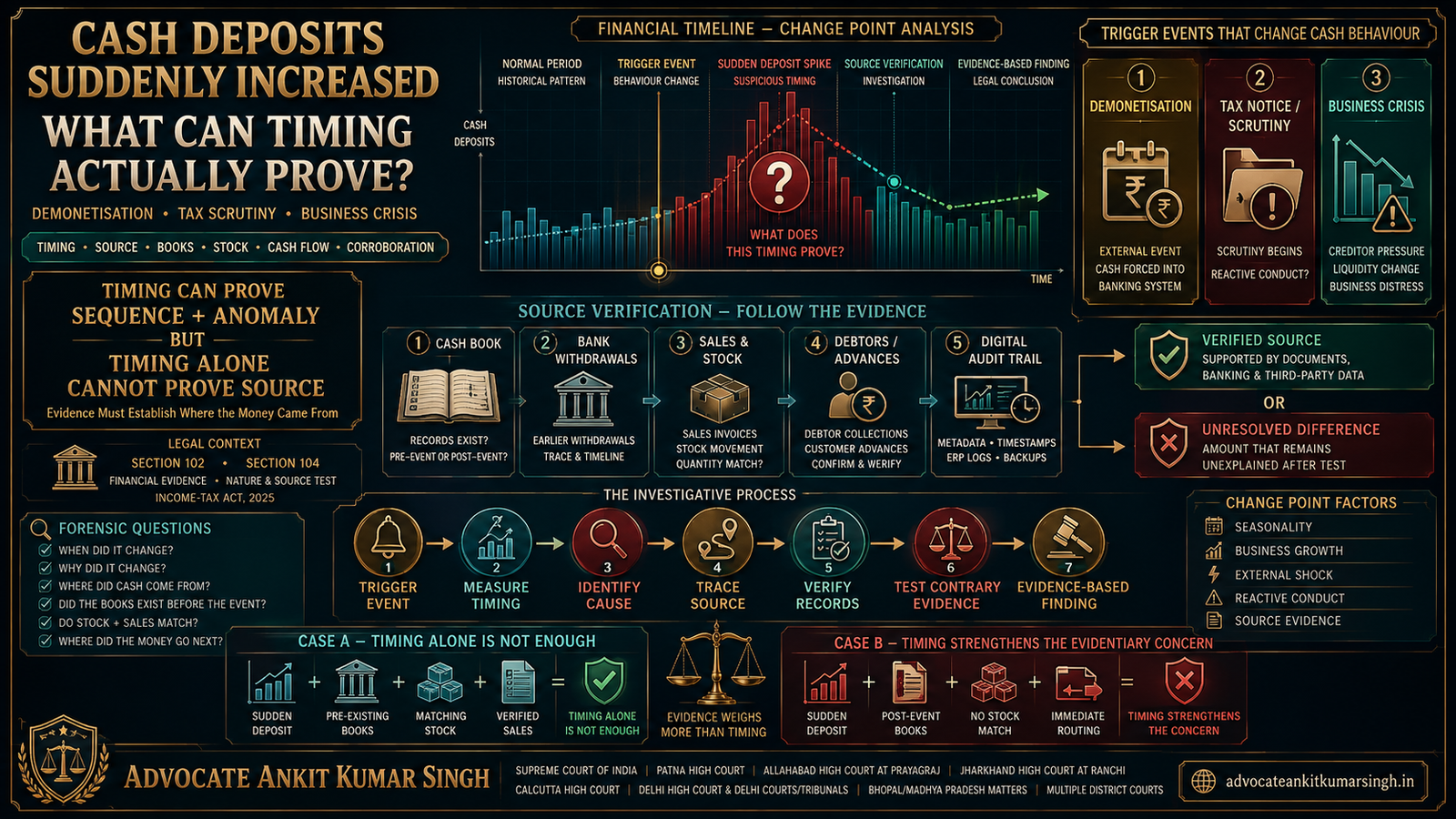
CASH DEPOSITS • DEMONETISATION • TAX SCRUTINY • BUSINESS CRISIS • TIMING • SOURCE OF FUNDS
Cash Deposits Suddenly Increased After Demonetisation, Tax Notice or Business Crisis - What Can Timing Actually Prove?
Legal research and analysis by Advocate Ankit Kumar Singh
Supreme Court of India | Patna High Court | Allahabad High Court at Prayagraj | Jharkhand High Court at Ranchi | Calcutta High Court | Delhi High Court and Delhi Courts/Tribunals | Matters concerning Bhopal, Madhya Pradesh | Multiple District Courts
Research reviewed and updated: 30 August 2026
Direct Answer
A sudden increase in cash deposits can prove that financial behaviour changed around a particular event. It can justify scrutiny. It can expose anomalies. It can strengthen an inference when other evidence supports it. But timing alone ordinarily cannot establish where the cash actually came from.
Three statements must therefore be kept separate:
“THE DEPOSIT HAPPENED AFTER THE EVENT.”
“THE EVENT CAUSED THE DEPOSIT.”
“THE MONEY CAME FROM AN UNDISCLOSED SOURCE.”
The first proposition may be established by a bank statement.
The second requires contextual evidence.
The third ordinarily requires a source analysis.
This distinction becomes particularly important when the triggering event itself naturally changes cash behaviour.
Demonetisation is the clearest example.
A person holding specified bank notes had an obvious reason to place cash into the banking system during the permitted window.
Therefore:
DEPOSIT AFTER DEMONETISATION
may establish:
WHEN CASH ENTERED THE BANK.
It does not automatically establish:
HOW THAT CASH WAS ORIGINALLY GENERATED.
Timing Is a Clue, Not a Source
Financial investigations often begin with temporal anomalies.
Examples:
- cash deposits jump immediately after demonetisation;
- large deposits begin after a tax notice;
- sales suddenly rise immediately before a regulatory event;
- cash is transferred immediately after being deposited;
- cash withdrawals increase during a liquidity crisis;
- a struggling business suddenly deposits old cash;
- books begin showing unusual transactions after scrutiny starts.
Each pattern can justify a question.
But a timing pattern answers principally:
WHEN?
The source inquiry asks:
FROM WHERE?
Confusing these two questions can convert chronology into assumed culpability.
The Four-Step Timing Problem
| Stage | Question |
|---|---|
| 1. Trigger | What event occurred? |
| 2. Behavioural change | What changed immediately before or after it? |
| 3. Causal explanation | Why did the event change the financial behaviour? |
| 4. Source verification | What evidence establishes where the money originated? |
A common analytical error is jumping directly from Stage 2 to an adverse source conclusion.
For example:
DEMONETISATION ANNOUNCED
→ CASH DEPOSIT INCREASED
→ THEREFORE CASH WAS UNDISCLOSED.
The missing question is:
WHAT DID THE BOOKS, STOCK, SALES, WITHDRAWALS AND CUSTOMER RECORDS SHOW?
Current Law: Section 102 of the Income-tax Act, 2025
For current tax years governed by the Income-tax Act, 2025, Section 102 deals with unexplained credits.
Broadly, where a sum is found credited in the books maintained by an assessee and the assessee:
- offers no explanation about its nature and source; or
- offers an explanation that is considered unsatisfactory,
the statutory consequence may follow.
The critical statutory language remains:
NATURE AND SOURCE.
The provision does not say:
“A CREDIT OCCURRING SOON AFTER A SUSPICIOUS EVENT IS AUTOMATICALLY UNEXPLAINED.”
Timing may make the explanation more important.
It does not eliminate the explanation stage.
Section 104: Money Can Also Be an Unexplained Asset
Section 104 of the Income-tax Act, 2025 concerns unexplained assets.
The statutory definition expressly includes money.
Again, the framework asks whether the nature and source of acquisition have been satisfactorily explained.
Therefore the modern statutory architecture reinforces the basic principle:
THE DATE CREATES CONTEXT.
THE SOURCE EVIDENCE DETERMINES THE EXPLANATION.
Demonetisation Is the Classic Example of Why Timing Can Mislead
On 8 November 2016, an extraordinary monetary event occurred.
The behavioural environment changed immediately.
Cash that might otherwise have remained physically held had to enter the banking system within the prescribed framework if the holder wished to deal with specified bank notes through the available legal channels.
Consequently, comparing:
NOVEMBER–DECEMBER 2016 CASH DEPOSITS
with
AN ORDINARY PERIOD WITH NO DEMONETISATION
without adjusting for the event can create a misleading comparison.
The deposit spike may simply establish that demonetisation changed deposit behaviour.
The more difficult question remains whether the cash existed legitimately before the event.
A Deposit Spike Can Still Be Highly Suspicious
None of this means demonetisation timing is irrelevant.
Consider:
- historic monthly cash sales: ₹5 lakh;
- cash sales in five days before demonetisation: ₹80 lakh;
- no matching stock reduction;
- no genuine customer trail;
- invoices created after the event;
- books altered retrospectively;
- bank deposit: ₹80 lakh.
The timing is now one part of a much stronger evidentiary pattern.
The problem is no longer merely:
“SALES INCREASED SUDDENLY.”
The problem becomes:
“THE TIMING, STOCK, CUSTOMER, DOCUMENT AND DIGITAL EVIDENCE ALL POINT IN THE SAME DIRECTION.”
Timing becomes powerful when it converges with independent anomalies.
Kulbir Singh Arora: Extraordinary Timing Must Be Judged in Extraordinary Context
A useful 2026 example involved an extraordinary increase in sales immediately before demonetisation.
The assessment analysis referred to a roughly 19.38-fold increase in average daily sales during the relevant short period.
That was unquestionably an abnormal number.
But the appellate reasoning recognised an important contextual issue:
Demonetisation itself represented an extraordinary market event capable of producing extraordinary purchasing behaviour, particularly in high-value goods.
The lesson is not:
“ANY SALES SPIKE BEFORE DEMONETISATION IS GENUINE.”
The lesson is:
“AN ABNORMAL NUMBER MUST BE COMPARED WITH THE REAL ECONOMIC ENVIRONMENT IN WHICH IT OCCURRED.”
A statistical anomaly is the beginning of the inquiry.
It is not necessarily its conclusion.
Ekta Petro: Accepted Books Can Be More Important Than an Average-Based Timing Theory
In Income Tax Officer v. Ekta Petro, decided by the Delhi Tribunal on 11 August 2026, very substantial cash deposits had been made during the demonetisation period.
The source explanation included:
- cash sales;
- cash in hand; and
- customer advances.
The Assessing Officer used an averaging method to estimate cash availability.
But the appellate record showed that:
- the books had not been rejected;
- the sales had been accepted;
- the cash-source material was borne out of the records; and
- the contrary average-based approach had not displaced those books through specific adverse evidence.
The Tribunal declined to disturb deletion of the addition.
The evidentiary lesson is:
AN UNUSUAL DEPOSIT WINDOW DOES NOT AUTOMATICALLY OVERRIDE ACCEPTED PRIMARY RECORDS.
Cash Sales: Compare the Deposit With the Business, Not Merely the Calendar
Where the explanation is cash sales, examine:
- sales invoices;
- cash book;
- stock register;
- purchase records;
- GST / VAT records applicable to the relevant period;
- gross-profit margin;
- customer type;
- seasonality;
- festival sales;
- branch-wise sales;
- historic cash-sales ratio;
- corresponding stock depletion;
- subsequent returns or cancellations; and
- deposit-to-sales correlation.
A real cash sale should ordinarily leave more than one evidentiary footprint.
If sales rise but stock does not fall, the timing concern becomes stronger.
If sales, stock, tax returns and books all move consistently, timing suspicion becomes weaker.
The Baseline Problem: What Period Are You Comparing Against?
A claim that deposits “suddenly increased” is meaningless until the baseline is defined.
Possible comparisons include:
- previous month;
- same month last year;
- average of preceding six months;
- same festival period;
- same crop season;
- same business cycle;
- same branch;
- same product category; or
- the period immediately before the triggering event.
A jewellery business before Diwali should not necessarily be compared mechanically with its summer cash cycle.
A petrol pump in a mining or transport cluster may have a different advance-payment pattern from an ordinary retail business.
A business facing creditor pressure may not behave like the same business during a stable year.
The baseline must fit the economic question.
The Change-Point Test
A useful forensic technique is to identify the precise date on which the financial pattern changed.
Prepare:
| Date / Period | Cash Sales | Cash Received | Cash Deposited | Trigger Event | Documentary Explanation |
|---|---|---|---|---|---|
| Period A | ₹___ | ₹___ | ₹___ | Normal operations | Books / stock / bank |
| Event Date | ₹___ | ₹___ | ₹___ | Demonetisation / notice / crisis | Relevant event record |
| Period B | ₹___ | ₹___ | ₹___ | Post-event | Books / banking / commercial record |
The change-point tells the investigator where to look.
It does not tell the investigator what must be found.
Cash Deposits After a Tax Notice: Why the Timing Is More Sensitive
A deposit made after a person knows that tax scrutiny has begun naturally attracts a different level of attention.
The authority may legitimately ask:
- Was the cash already available before the notice?
- Why was it deposited only afterward?
- Did the notice trigger the deposit?
- Were books altered after receipt of notice?
- Were new vouchers created?
- Were family or connected accounts suddenly used?
- Was money deposited and immediately transferred?
- Was the cash previously disclosed anywhere?
These are legitimate questions.
But:
NOTICE RECEIVED → CASH DEPOSITED
still does not logically establish:
CASH CAME FROM UNDISCLOSED INCOME.
A person may deposit pre-existing cash precisely because the notice caused financial records to be organised.
Or the timing may reveal a reactive attempt to regularise unexplained funds.
The documents decide which explanation survives.
Post-Notice Evidence: The Creation-Date Test
When an explanation emerges only after scrutiny begins, ask when the supporting record was actually created.
Strong Position
The cash book existed before the notice.
The bank withdrawals predate scrutiny.
The sales invoices were generated contemporaneously.
The GST or VAT filings already reflected the sales.
The stock movement existed in earlier records.
Weak Position
The notice arrives.
Then:
- new invoices appear;
- old books are rewritten;
- customers are first identified;
- digital records carry later creation timestamps;
- the cash-flow explanation is mathematically reverse-engineered to the deposit.
The relevant adverse inference does not arise merely from the timing of the deposit.
It arises from the relationship between timing and evidence creation.
Immediate Transfers After Cash Deposit: What Can They Prove?
Suppose ₹10 lakh is deposited in cash.
Within hours, ₹9 lakh is transferred to another account.
That sequence may legitimately generate questions about:
- beneficial ownership;
- accommodation-entry structure;
- whether the depositor was merely an intermediary;
- the identity of the destination account;
- purpose of transfer;
- pre-existing liability;
- relationship between parties; and
- whether the depositor's own source explanation is true.
But even here, sequence alone should not decide the legal result.
A genuine creditor payment can also happen immediately after a deposit.
The destination and underlying obligation must be examined.
Mithlesh Gupta: Post-Deposit Conduct Can Raise Questions Without Ending the Inquiry
A 2026 Agra Tribunal decision illustrates this point.
The lower appellate authority had regarded immediate transfers following cash deposits as suggestive of an arrangement to bring unaccounted cash into the banking system during demonetisation.
The Tribunal nevertheless examined who actually owned the money, where transfers went and whether the remaining amount could be explained through earlier withdrawals.
This is the proper analytical sequence:
POST-DEPOSIT TIMING
→ QUESTION
→ TRACE DESTINATION
→ IDENTIFY OWNERSHIP
→ TEST SOURCE
→ THEN REACH THE FINDING.
Business Crisis: Ordinary Cash Behaviour May Stop Being Ordinary
A business in financial distress may behave very differently from its historical pattern.
Possible crisis behaviour includes:
- collecting old debtor balances aggressively;
- withdrawing cash to meet creditor pressure;
- holding emergency liquidity;
- liquidating inventory;
- reducing purchases;
- closing branches;
- depositing cash after a regulatory event;
- redepositing previously withdrawn cash;
- making rapid creditor payments; and
- suspending or terminating operations.
Therefore an abnormal cash pattern during crisis should not automatically be compared with a healthy-business baseline.
The crisis itself may be the reason the pattern changed.
Lokendra Kumar Gautam: Commercial Expediency and Timing
In Lokendra Kumar Gautam v. ITO, decided on 15 January 2026, the record showed a business under financial stress and creditor pressure.
Cash had previously been withdrawn and was subsequently redeposited following demonetisation.
The Tribunal found that the withdrawals were reflected in bank statements and the cash book, while the Revenue had not shown that the money had been spent elsewhere.
The Tribunal expressly recognised that:
- withdrawal and redeposit decisions;
- timing of creditor payments; and
- suspension or resumption of business
fall within the realm of commercial expediency unless shown to be sham or non-genuine.
This is directly relevant to the present thesis:
AN ABNORMAL BUSINESS PERIOD MAY CREATE ABNORMAL CASH TIMING WITHOUT CREATING UNDISCLOSED INCOME.
A Business-Crisis Explanation Still Requires Proof
“The business was in crisis” should not become an evidentiary escape route.
Test:
- debtor ageing;
- creditor pressure;
- bank overdraft utilisation;
- loan defaults;
- closure applications;
- employee reduction;
- sales decline;
- inventory liquidation;
- correspondence with creditors;
- cash withdrawals;
- cash redeposits; and
- subsequent payments.
A real crisis usually leaves records.
Cash Deposit Is a Use of Cash—Not Necessarily Its Generation
This distinction is fundamental.
When ₹20 lakh is deposited in a bank on 15 November, the deposit proves:
₹20 LAKH WAS PUT INTO THE BANK ON 15 NOVEMBER.
It does not establish whether that ₹20 lakh was generated:
- on 15 November;
- one week earlier;
- three months earlier;
- from sales;
- from withdrawals;
- from debt collection;
- from another person; or
- from an undisclosed source.
The date of deposit and the date of generation may be entirely different.
The Deposit-Generation Matrix
| Deposit Date | Amount | Claimed Generation Event | Generation Date | Primary Evidence | Contrary Evidence |
|---|---|---|---|---|---|
| 15 Nov | ₹20 lakh | Cash sales | 1–8 Nov | Sales + stock | None / identified defect |
| 18 Nov | ₹15 lakh | Earlier withdrawal | July | Bank + cash book | Possible intervening utilisation |
| 22 Nov | ₹8 lakh | Debtor collection | October–November | Debtor ledger + receipts | Customer denial / mismatch |
This matrix prevents deposit timing from silently becoming source timing.
The Documentary Corroboration Ladder
Level 1 — Bank Evidence
Earlier withdrawals, deposit slips, account history and transfers.
Level 2 — Accounting Evidence
Cash book, ledger, debtor accounts, customer advances and opening balance.
Level 3 — Trading Evidence
Invoices, stock register, purchase records, GST/VAT and quantitative reconciliation.
Level 4 — Third-Party Evidence
Customer confirmations, creditor records, independent bank material and external filings.
Level 5 — Digital Authenticity
ERP timestamps, accounting audit trail, backup history and document metadata.
The stronger these levels align, the less work mere temporal suspicion can perform.
What If Deposits Increased but the Books Were Never Rejected?
This has repeatedly become important in demonetisation litigation.
Where an assessee maintains books showing:
- cash sales;
- cash balance;
- stock movement;
- bank deposits; and
- declared business income,
and the assessment simultaneously accepts those books without identifying defects, a separate theory that the very same cash is mysterious requires careful reconciliation.
The important question is not simply:
“WERE DEPOSITS HIGH?”
It is:
“WHAT SPECIFIC PART OF THE ACCEPTED ACCOUNTING RECORD IS FALSE?”
Double Counting: Cash Sales and the Later Bank Deposit
Suppose cash sales of ₹50 lakh are:
- entered in the books;
- included in turnover;
- reflected in stock reduction; and
- offered as part of business income.
The ₹50 lakh is later deposited into a bank.
The deposit is ordinarily the banking destination of the earlier cash receipt.
If the same amount is again treated as a wholly separate income item without establishing that the sales were fictitious or that another source existed, double-counting concerns arise.
This is why tracing is essential.
Vinita Nitin Chaudhary: Deposits After Demonetisation and Earlier Withdrawals
In a Delhi Tribunal decision dated 6 May 2026, cash deposited during demonetisation was explained through earlier withdrawals and regular income.
The bank records reflected the withdrawals.
The Tribunal also noted the absence of an independent inquiry establishing that the deposits came from an undisclosed source.
The principle is useful:
AN EVENT-TIME DEPOSIT SHOULD BE CONNECTED BACKWARD TO ITS ACTUAL SOURCE.
The unusual date does not erase an independently verifiable earlier source.
The Counterfactual Test
Ask:
WHAT WOULD THE CASH PATTERN HAVE LOOKED LIKE IF THE TRIGGERING EVENT HAD NOT OCCURRED?
For demonetisation:
Would the person normally have retained cash for longer instead of depositing it?
For a tax notice:
Would the cash likely have remained outside the bank but for scrutiny?
For a business crisis:
Would ordinary deposit/withdrawal behaviour have continued but for creditor pressure?
This does not establish guilt or innocence.
It identifies whether the event itself plausibly explains the behavioural change.
The Pre-Event / Post-Event Consistency Test
| Factor | Before Event | After Event | Question |
|---|---|---|---|
| Cash sales | ₹___ | ₹___ | Why changed? |
| Bank deposits | ₹___ | ₹___ | Event-driven? |
| Stock movement | ___ units | ___ units | Supports sales? |
| Debtor recoveries | ₹___ | ₹___ | Crisis collection? |
| Cash withdrawals | ₹___ | ₹___ | Liquidity change? |
| Books / invoices | Normal | Changed | Contemporaneous or retrospective? |
When Timing Becomes Powerful Evidence
Timing becomes substantially stronger where several independent facts converge.
For example:
- large deposits begin only after scrutiny;
- books are altered after scrutiny begins;
- customer identities cannot be verified;
- stock does not support claimed cash sales;
- money is immediately transferred through connected accounts;
- claimed lenders or contributors lack capacity;
- digital metadata shows post-event document creation;
- the explanation changes with each notice;
- cash supposedly generated by sales exceeds available stock;
- the same amount is used to explain multiple deposits.
Here, timing is no longer operating alone.
It is part of a corroborated circumstantial structure.
When Timing Should Carry Much Less Weight
Timing alone is weaker where:
- pre-existing books already record the source;
- bank withdrawals are independently verified;
- cash sales match stock movement;
- turnover is already reflected in tax filings;
- debtor balances genuinely reduce;
- historic seasonal patterns explain the increase;
- the business crisis is independently documented;
- the books have not been rejected;
- there is no contrary utilisation of earlier withdrawn cash; and
- the only objection is that the deposit occurred during a suspicious period.
Timing Can Justify Inquiry Without Proving the Merits
This distinction is especially important procedurally.
A large or abnormal cash deposit can legitimately trigger:
- scrutiny;
- information requests;
- source verification;
- bank inquiries;
- customer verification;
- books examination; or
- further investigation where statutory conditions are satisfied.
The threshold for asking:
“PLEASE EXPLAIN THIS.”
is not the same as the threshold for concluding:
“THIS IS UNEXPLAINED INCOME.”
The Investigator's Falsification Test
If the working theory is:
“The deposit increased because the person was trying to introduce undisclosed cash.”
ask what evidence could disprove that theory.
Would the theory change if:
- sales invoices existed before the event?
- stock movement matched those invoices?
- VAT/GST filings already reflected the sales?
- bank withdrawals predated the event?
- customer advances were independently confirmed?
- a business-crisis record explained the cash movements?
- digital audit trails proved the books were not rewritten?
If no evidence could ever change the conclusion, the investigation risks becoming confirmation-driven rather than evidence-driven.
The Defence Must Run the Same Test Against Itself
If the defence says:
“The deposit spike was entirely normal.”
ask:
- Why did it occur precisely then?
- Why had the business never shown a similar pattern?
- Is stock sufficient?
- Are the invoices genuine?
- Do customers exist?
- Do the books predate scrutiny?
- Are the amounts mathematically reconcilable?
- Were earlier withdrawals already spent?
- Did the notice cause retrospective changes?
A defence that survives its own hostile testing is materially stronger.
The Seven-Part Timing Matrix
| Question | What It Tests |
|---|---|
| 1. What happened? | Trigger event |
| 2. When did deposits change? | Temporal relationship |
| 3. Why would the event cause that change? | Causal explanation |
| 4. Where did the cash originate? | Source |
| 5. Do contemporaneous records support the source? | Corroboration |
| 6. What evidence contradicts it? | Falsification |
| 7. What amount remains unexplained? | Legal consequence |
PMLA: Suspicious Deposit Timing Is Not Automatically Proceeds of Crime
The distinction becomes even more important if a cash-deposit pattern later appears in a PMLA or Enforcement Directorate investigation.
A deposit immediately after:
- demonetisation;
- a tax notice;
- a criminal complaint;
- a corporate dispute; or
- a financial crisis
may become relevant circumstantial material.
But PMLA requires its own statutory foundation.
The investigating theory must still identify the property alleged to be derived or obtained, directly or indirectly, as a result of criminal activity relating to a scheduled offence.
Therefore:
SUSPICIOUS TIMING ≠ PROCEEDS OF CRIME.
CASH DEPOSIT ≠ MONEY LAUNDERING.
TAX DISCREPANCY ≠ AUTOMATIC SECTION 3 PMLA OFFENCE.
Document Checklist
- complete bank statements;
- cash book;
- general ledger;
- sales register;
- purchase register;
- stock register;
- VAT/GST records for the relevant historical/current period;
- sales invoices;
- customer details;
- debtor ledger;
- customer advances;
- creditor ledger;
- bank withdrawal slips;
- cash deposit slips;
- opening cash balance;
- historic monthly deposit data;
- historic sales data;
- festival/seasonal sales data;
- ERP logs;
- accounting audit trail;
- digital backups;
- business-closure material;
- creditor correspondence;
- loan-default material;
- tax notices;
- replies to notices;
- search/survey records, if applicable;
- cash-flow reconstruction; and
- event-wise chronology.
Forensic Flowchart: What Can Timing Actually Prove?
Timing can identify the investigative window. Source and corroborative evidence determine the substantive conclusion.Plain-text alternative: Identify the triggering event → measure how the cash-deposit pattern changed → determine whether the event plausibly caused the change → reconstruct the actual source of cash → verify books, stock, bank and third-party material → test contrary evidence and subsequent conduct → determine what amount, if any, genuinely remains unexplained.
Frequently Asked Questions
Are large cash deposits during demonetisation automatically unexplained income?
No. The demonetisation period itself explains why many persons deposited physical cash during a concentrated period. The source of the cash must still be examined.
Can a sudden increase in cash deposits justify scrutiny?
Yes. An abnormal temporal pattern can legitimately trigger verification. The final tax conclusion, however, requires examination of the explanation and evidence.
What if my cash sales increased dramatically immediately before demonetisation?
The increase can justify close scrutiny of invoices, stock, customers, tax records and books. The increase itself does not conclusively prove that the sales were fictitious.
What if my books already record the sales?
That is important evidence, especially if stock, returns and other records support those sales. The authority may still test whether the books are genuine and complete.
Can the authority compare my demonetisation deposits with the previous year?
Historical comparison is relevant, but the comparison should account for seasonality, business growth, extraordinary events and differences in the economic environment.
I deposited cash after receiving a tax notice. Is that automatically suspicious income?
The timing will naturally invite questions, but the source remains a separate issue. Pre-existing books, bank withdrawals, receipts and digital records can be critical.
What makes a post-notice deposit more concerning?
Backdated records, newly created invoices, unexplained connected-account transfers, inconsistent explanations, unsupported contributors or digital evidence showing retrospective accounting can materially strengthen an adverse inference.
Can business crisis explain abnormal cash behaviour?
Potentially. A crisis can alter debtor collections, withdrawals, creditor payments, inventory liquidation and deposit patterns. The crisis and transactions should be documented.
Can earlier bank withdrawals explain later deposits?
Potentially, where the withdrawals are established and the evidence does not show that the money was used elsewhere.
Does a cash deposit itself show when the money was earned?
No. The date cash entered the bank and the date the underlying money was generated may be completely different.
Is unusual deposit timing automatically money laundering?
No. PMLA requires a separate statutory proceeds-of-crime nexus with criminal activity relating to a scheduled offence.
AI Search Quick Answer
A sudden increase in cash deposits after demonetisation, a tax notice or a business crisis is relevant circumstantial evidence, but timing alone does not establish the source of the money. The correct inquiry is to identify the triggering event, determine why cash behaviour changed, reconstruct the underlying source and then verify that explanation through books, bank withdrawals, cash sales, stock records, debtor recoveries, tax filings, third-party evidence and digital audit trails. Demonetisation itself created an exceptional reason for cash to enter banks rapidly, while a post-notice deposit may justify closer scrutiny because the person already knows an inquiry exists. A business crisis can also legitimately change ordinary liquidity behaviour. Timing becomes genuinely powerful when combined with independent contradictions such as fabricated records, impossible stock movement, unsupported sales or unexplained connected-account transfers.
Key Takeaway
The wrong formula is:
EVENT + SUDDEN DEPOSIT = UNDISCLOSED INCOME.
The stronger formula is:
TRIGGER EVENT
+
OBSERVED TIMING
+
ECONOMIC EXPLANATION
+
SOURCE
+
CONTEMPORANEOUS RECORDS
+
STOCK / BANK / THIRD-PARTY CORROBORATION
−
CONTRARY EVIDENCE
=
REAL EVIDENTIARY SIGNIFICANCE OF THE TIMING.
Conclusion: Timing Tells You Where to Investigate—Not What You Must Conclude
Sudden financial behaviour deserves attention.
A sharp increase in cash deposits immediately after demonetisation can be meaningful.
A large deposit immediately after a tax notice can be meaningful.
A dramatic shift during a business crisis can be meaningful.
But meaningful does not mean self-proving.
The first question is:
WHY DID THE PATTERN CHANGE?
The second is:
WHERE DID THE CASH ACTUALLY COME FROM?
The third is:
WHAT CONTEMPORANEOUS EVIDENCE SUPPORTS THAT SOURCE?
The fourth is:
WHAT EVIDENCE CONTRADICTS IT?
The fifth is:
WHAT AMOUNT, AFTER THAT TEST, ACTUALLY REMAINS UNEXPLAINED?
An investigator should not ignore timing.
A taxpayer should not dismiss timing.
But neither side should allow timing to perform work that belongs to evidence.
The central principle is:
TIMING CAN CREATE SUSPICION.
TIMING CAN CORROBORATE A THEORY.
TIMING CAN EXPOSE A FABRICATED STORY.
BUT TIMING ALONE CANNOT IDENTIFY THE SOURCE OF MONEY.
Official and Authoritative Sources
-
Income-tax Act, 2025 as amended by Finance Act, 2026 — Sections 102, 104 and 195:
Income Tax Department - Income-tax Act, 2025 — Section 524, Presumption as to Assets, Books of Account, etc.
- Income Tax Officer v. Ekta Petro, ITA No.390/Del/2026, Delhi ITAT, 11 August 2026
- Income Tax Officer v. Kulbir Singh Arora, ITA No.7061/Del/2025, Delhi ITAT, 12 February 2026
- Lokendra Kumar Gautam v. ITO, ITA No.335/Agr/2025, Agra ITAT, 15 January 2026
- Vinita Nitin Chaudhary v. ITO, ITA No.6156/Del/2025, Delhi ITAT, 6 May 2026
- Mithlesh Gupta v. ITO, ITA No.356/Agr/2026, Agra ITAT, 23 July 2026
Add Advocate Ankit Kumar Singh as a Preferred Source on Google
Readers who want to see more legal research, court updates, cyber law, PMLA, ED, criminal-law and litigation content from Advocate Ankit Kumar Singh can add advocateankitkumarsingh.in as a Preferred Source on Google.
Add advocateankitkumarsingh.in as a Preferred Source on Google
Professional Consultation and Financial-Evidence Review
Supreme Court of India | Patna High Court | Allahabad High Court at Prayagraj | Jharkhand High Court at Ranchi | Calcutta High Court | Delhi High Court and Delhi Courts/Tribunals | Matters concerning Bhopal, Madhya Pradesh | Multiple District Courts
Phone: 8294431232
Email: ankitsingh.legum@gmail.com
Website: advocateankitkumarsingh.in
Professional assistance in a disputed cash-deposit matter may include event-wise chronology, source-of-funds reconstruction, cash-book review, bank-statement analysis, cash-sales and stock reconciliation, debtor and creditor analysis, pre-notice and post-notice evidence comparison, digital-accounting audit trails, business-crisis reconstruction, tax-law research, PMLA distinction analysis, drafting and litigation strategy according to the facts, applicable statute, forum and accepted professional engagement.
Complex accounting issues may require assistance from an accountant or forensic financial professional. Appropriate local, filing or authorised counsel may be necessary according to the forum. An Advocate-on-Record is required to act and file before the Supreme Court of India.
No deletion of an addition, release of money, stay, bail, quashing, discharge or other judicial or administrative outcome can be guaranteed.
Legal Disclaimer: This article is intended for general legal research and professional awareness. Cash-deposit cases are intensely fact-specific. The applicable provision depends upon the tax year, governing statute, books maintained, source explanation, banking history, sales and stock records, triggering event, digital evidence and procedural stage. No person should manufacture, backdate, alter or destroy financial records in response to a tax notice, search or investigation.