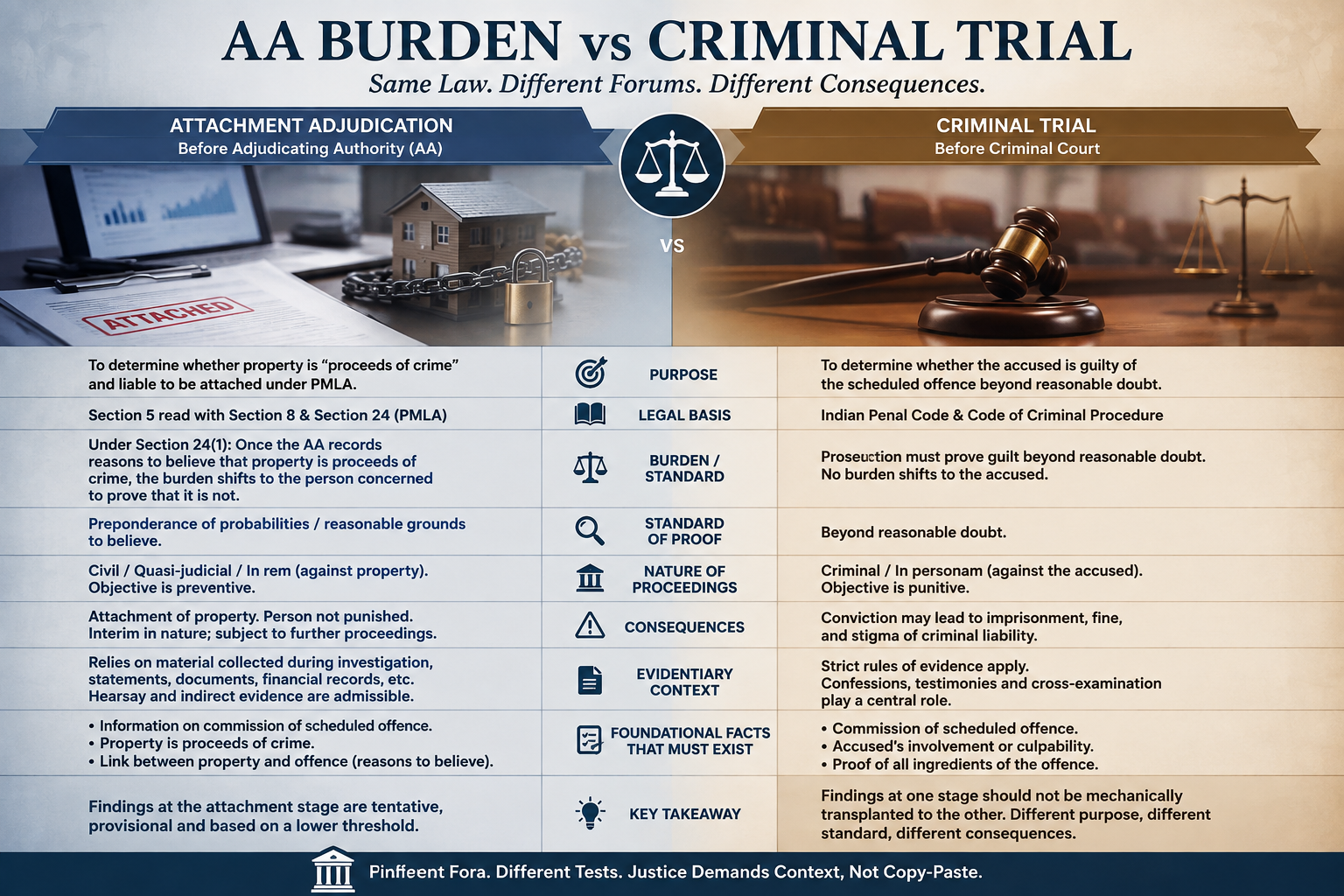
PMLA • SECTION 24 • ADJUDICATING AUTHORITY • CRIMINAL TRIAL • BURDEN OF PROOF
Section 24 PMLA Before the Adjudicating Authority vs Criminal Trial: Does the Reverse Burden Operate the Same Way?
Research updated: 27 August 2026
Legal research and analysis by Advocate Ankit Kumar Singh
Direct Answer
No—not in the sense that an attachment finding and a criminal conviction require the same adjudicative exercise.
Section 24 of the Prevention of Money-Laundering Act, 2002 expressly operates in a proceeding relating to proceeds of crime before an “Authority or Court”. But the provision must be understood together with the very different functions of the PMLA Adjudicating Authority and the Special Court.
The Adjudicating Authority primarily decides whether property should remain attached, seized or frozen under the statutory property-confiscation architecture. The criminal court determines whether an accused has committed the offence of money-laundering under Section 3 and whether penal consequences under Section 4 follow.
The Supreme Court's controlling Section 24 analysis in Vijay Madanlal Choudhary v. Union of India is crucial: the presumption does not arise in a factual vacuum. Authorities/prosecution must first establish foundational facts concerning the scheduled criminal activity, the existence of proceeds of crime, and the person's relevant connection with the process or activity involving that property.
Thereafter, Section 24 may shift an evidentiary burden. But shifting a burden is not the same thing as dispensing with proof of criminal guilt.
The Central Mistake: Treating Section 24 as One Universal Burden Rule
A superficial reading may proceed like this:
Section 24 applies before both the Authority and Court; therefore the same presumption must produce the same result in both forums.
That conclusion is too broad.
The better analytical sequence is:
- Identify the exact proceeding.
- Identify the person against whom the presumption is sought.
- Ask whether that person has already been formally charged with the Section 3 offence.
- Identify the foundational facts relied upon.
- Ask whether those foundational facts have actually been established at the legally appropriate threshold for that stage.
- Only then determine whether Section 24(a) or Section 24(b) is attracted.
- Finally, identify what the particular forum is legally empowered to decide.
The final step is indispensable. A presumption used in a property proceeding cannot enlarge the jurisdiction of the Adjudicating Authority into a power to convict.
What Section 24 Actually Distinguishes
Section 24 creates two categories.
| Person | Statutory language | Nature of presumption |
|---|---|---|
| Person charged with the offence of money-laundering under Section 3 | Authority or Court “shall” presume, unless the contrary is proved | Mandatory rebuttable presumption after legal preconditions are met |
| Any other person | Authority or Court “may” presume | Discretionary presumption after foundational facts are established |
This distinction becomes particularly important in Adjudicating Authority litigation because a person whose property is attached may not yet have been formally charged in a prosecution complaint.
“Person Charged” Does Not Simply Mean “Person Suspected by ED”
One of the most important parts of Vijay Madanlal Choudhary is the Supreme Court's treatment of the expression “person charged”.
The Court explained that the first category under Section 24(a) presupposes that a formal complaint has already been filed by the authorised authority naming the person as an accused in the offence of money-laundering.
This creates a major practical distinction.
A person may:
- receive an ED summons;
- have property provisionally attached;
- receive a Section 8 notice;
- be named in an Original Complaint before the Adjudicating Authority;
- be described by ED as connected with alleged proceeds of crime;
and yet the question whether that person falls within Section 24(a) must still be examined by reference to whether the person has actually been formally charged in the PMLA prosecution.
If not, Section 24(b)—the “may presume” provision relating to another person—may be the relevant statutory limb.
This is why an Adjudicating Authority reply should not casually accept ED's characterisation that the respondent automatically bears the mandatory Section 24(a) burden merely because the respondent's property has been attached.
The Three Foundational Facts Identified by the Supreme Court
In Vijay Madanlal Choudhary, the Supreme Court held that the Section 24 presumption becomes relevant only once the prosecution or authorities establish basic foundational facts.
- Scheduled-offence criminal activity: there must be criminal activity relating to a scheduled offence.
- Existence of proceeds of crime: the property in question must have been derived or obtained, directly or indirectly, as a result of that criminal activity.
- Connection of the person with the property/process: the person concerned must have the legally relevant direct or indirect involvement in a process or activity connected with the property alleged to be proceeds of crime.
The practical importance is substantial: Section 24 cannot legitimately be treated as permission to assume at the beginning that every attached property is proceeds of crime and then ask the owner to prove innocence.
The foundational-fact requirement comes first. The reverse burden comes afterwards.
Same Foundational Architecture, Different Forum
The foundational-fact doctrine applies to the statutory presumption before an Authority or Court. But the legal question for which those facts are being considered differs from forum to forum.
| Issue | Adjudicating Authority | PMLA Special Court at Criminal Trial |
|---|---|---|
| Primary statutory function | Property adjudication under Section 8 | Determination of criminal liability under Section 3 |
| Central question | Whether the identified property is involved in money-laundering for the purpose of attachment/retention | Whether the accused committed the offence of money-laundering |
| Nature | Civil/proprietary and quasi-judicial | Criminal prosecution |
| Power to convict | No | Yes |
| Power to impose Section 4 punishment | No | Yes |
| Typical record | PAO, Original Complaint, Section 8 notice, reply, title and banking material, source documents, ED material | Prosecution evidence, witnesses, admissible documentary/electronic evidence, cross-examination and defence material |
| Effect of adverse finding | Confirmation/continuation of attachment and statutory property consequences | Possible conviction, sentence and final consequential orders according to law |
What Exactly Does the Adjudicating Authority Decide?
Section 8 requires the Adjudicating Authority to consider the notice, the reply, hear the affected person and the authorised ED representative, take into account relevant materials placed before it and record a finding on whether the property referred to in the notice is involved in money-laundering.
The Supreme Court in M/s Nav Nirman Builders & Developers Pvt. Ltd. v. Union of India, decided on 6 February 2026, reiterated the structure of Section 8 and stated that the Adjudicating Authority is expected to conduct a proper inquiry into whether the property is involved in money-laundering.
That is a serious adjudicatory function. It affects proprietary rights and cannot be treated as an administrative rubber stamp.
But it remains different from a criminal trial.
The Adjudicating Authority Is Quasi-Judicial—but It Is Not the Criminal Trial Court
The Telangana High Court in Directorate of Enforcement v. M/s Karvy India Realty Limited recognised that Section 8 adjudication involves a quasi-judicial function because the Authority determines questions affecting rights and must act within its statutory jurisdiction.
The Court also articulated the critical limitation: the PMLA Adjudicating Authority does not possess the power to decide the criminality of the offence and does not have power to impose punishment.
That distinction answers much of the present question.
A finding that property is sufficiently connected with alleged proceeds of crime for Section 8 purposes is not itself a judgment that a particular individual is criminally guilty beyond reasonable doubt of Section 3 money-laundering.
Is the Adjudicating Authority Standard Simply “Preponderance of Probabilities”?
This proposition should be stated carefully.
Attachment, adjudication and confiscation have repeatedly been described within the PMLA jurisprudence as civil in nature, in contrast with prosecution or criminal action.
However, Section 8 itself does not contain an express sentence stating that every issue before the Adjudicating Authority shall be determined by a universal “preponderance of probabilities” formula.
The more precise formulation is therefore:
The Adjudicating Authority conducts a civil/quasi-judicial, property-focused statutory inquiry on the material before it, while criminal guilt before the Special Court is governed by the higher criminal standard, subject to statutory presumptions that arise only after their foundational requirements are satisfied.
That distinction avoids both extremes: treating attachment adjudication like a full criminal trial, or treating it as a consequence-free administrative opinion.
What Happens at the Criminal Trial?
At trial, the question changes fundamentally. The Special Court is no longer merely asking whether identified property should remain under the PMLA's attachment architecture.
It must adjudicate the prosecution for the offence under Section 3.
The Supreme Court in J. Sekar @ Sekar Reddy v. Directorate of Enforcement emphasised that PMLA criminal allegations cannot ultimately rest on mere preponderance of probabilities and that criminal allegations must be proved beyond reasonable doubt in court.
Section 24 modifies the evidentiary burden, but does not abolish this distinction between a civil property proceeding and penal conviction.
In other words:
- ED cannot rely upon Section 24 to avoid proving the foundational factual structure;
- the existence of proceeds of crime itself cannot simply be assumed from suspicion;
- the relevant linkage must first be established;
- the presumption is rebuttable, not conclusive; and
- the court must assess the prosecution and defence evidence within the criminal adjudicatory framework.
Why Section 24 Does Not Mean “Accused Must Prove Innocence From Day One”
A reverse burden is frequently misunderstood as reversing the entire criminal trial.
That is not the structure recognised in Vijay Madanlal Choudhary.
The proper sequence is:
- Prosecution establishes the relevant foundational facts.
- The statutory presumption becomes capable of operating.
- The burden relating to the presumed fact shifts.
- The affected person receives an opportunity to rebut that presumption with permissible evidence.
- The court evaluates the complete evidentiary record.
The Supreme Court expressly described the presumption as rebuttable and not conclusive.
The Importance of Prem Prakash: Burden Is Stage-Sensitive
Although Prem Prakash v. Union of India through Directorate of Enforcement arose in the bail context rather than after completion of a criminal trial, it reinforces an important conceptual principle.
The Supreme Court stated that where ED opposes bail, the investigating agency should make out how the three foundational facts are prima facie established. Only thereafter does the Section 24 presumption arise for the purposes of that bail inquiry.
This illustrates why phrases such as “the Section 24 burden” cannot safely be separated from the procedural stage.
At bail, the court conducts the statutory bail inquiry.
At Section 8 adjudication, the Authority conducts a property inquiry.
At trial, the Special Court finally adjudicates criminal guilt.
The statutory presumption may be relevant at more than one stage, but the surrounding judicial task is not identical.
Section 24(a): Mandatory Presumption Does Not Mean Conclusive Guilt
For a person formally charged with Section 3 money-laundering, Section 24(a) uses mandatory language: the Authority or Court “shall” presume unless the contrary is proved.
Three qualifications remain essential.
1. Foundational facts still come first
The prosecution cannot reverse the sequence.
2. The presumption concerns involvement of proceeds of crime in money-laundering
It is not an unrestricted statutory declaration that every allegation in the prosecution complaint must be accepted as true.
3. The presumption remains rebuttable
The person can attempt to disprove the presumed connection through documents, cross-examination, explanations concerning matters particularly within personal knowledge and other legally permissible evidentiary methods.
Section 24(b): Why Third Parties Require Separate Analysis
Section 24(b) concerns a person other than the person charged with the offence under Section 3.
The legislature uses “may presume”, not “shall presume”.
The Supreme Court in Vijay Madanlal Choudhary treated this as a discretionary or factual presumption rather than the compulsory presumption contemplated by Section 24(a).
This has particular importance for:
- spouses;
- family members;
- companies;
- partnerships;
- lenders;
- purchasers;
- secured creditors;
- joint owners;
- landlords;
- trusts;
- employees; and
- other third parties whose property or financial interests become part of attachment proceedings.
The Authority cannot reasonably move directly from “this property belongs to another person” to “that person must prove the entire ED case false”.
The foundational nexus must still be addressed.
A Practical Example: Property Attached Before Prosecution Complaint
Assume the following sequence:
- An FIR exists for a scheduled offence.
- ED records an ECIR.
- ED identifies ₹2 crore as alleged proceeds of crime.
- A property standing in X's name is provisionally attached.
- ED files the attachment complaint before the Adjudicating Authority.
- X receives a Section 8 notice.
- No PMLA prosecution complaint naming X as an accused has yet been filed.
It would be legally unsafe simply to say: “Section 24(a) applies because ED has accused X of holding proceeds of crime.”
The Vijay Madanlal Choudhary interpretation of “person charged” requires examination of whether X has formally been charged through the prosecution complaint.
If not, the statutory position may fall under Section 24(b), where the language is “may presume”, while foundational facts must still exist.
Now Change the Example: Prosecution Complaint Has Been Filed
Assume the prosecution complaint has now been filed naming X as an accused under Section 3.
X now falls within a materially different Section 24 analysis because Section 24(a) may become applicable.
But even then, ED must not argue:
“X is charged; therefore everything alleged in the complaint is presumed correct.”
That would overstate Section 24.
The prosecution must establish the foundational factual structure identified by the Supreme Court before the legal presumption operates.
Can an Adjudicating Authority Confirmation Order Be Treated as Proof of Guilt at Trial?
Not mechanically.
The most basic reason is jurisdictional: the Adjudicating Authority cannot determine criminal guilt or impose criminal punishment.
A second reason is evidentiary: the record and procedural opportunities before the Authority may differ materially from a complete criminal trial.
A third reason is the difference in legal consequence. Confirmation of attachment preserves or continues a property restraint under the statutory scheme. Criminal conviction may deprive a person of liberty and lead to penal consequences.
The same document may therefore be relevant in both proceedings without having exactly the same adjudicative effect.
J. Sekar: Adjudication and Criminal Proceedings Are Independent
The Supreme Court's decision in J. Sekar @ Sekar Reddy v. Directorate of Enforcement is particularly useful when analysing the relationship between the two tracks.
The Court dealt with principles recognising that adjudication proceedings and criminal proceedings are independent in nature and that an adverse finding in adjudication is not automatically binding upon criminal prosecution.
That does not mean an Adjudicating Authority order is irrelevant.
The materials considered, factual findings, contradictions or merits-based exoneration may become significant depending upon the circumstances.
The correct proposition is therefore neither:
“AA findings mean nothing at trial.”
nor:
“AA confirmation conclusively establishes the criminal offence.”
The legally defensible position lies between those extremes.
What If the Adjudicating Authority Rejects ED's Case?
A merits-based rejection may become extremely significant, particularly where the same factual foundation underlies the criminal prosecution.
In J. Sekar, the Supreme Court referred to the principles in Radheshyam Kejriwal concerning the relationship between adjudication and prosecution.
The jurisprudence distinguishes between:
- technical exoneration;
- procedural failure;
- lack of jurisdiction;
- and a genuine merits-based conclusion that the allegation itself is unsustainable.
A technical order may have limited effect on criminal prosecution.
A merits-based exoneration on identical foundational facts may have much greater significance and should be examined carefully.
The consequence is fact-sensitive and should never be assumed merely from the words “attachment released”.
What If the Adjudicating Authority Confirms the Attachment?
Confirmation is serious, but it is not equivalent to conviction.
The 2026 Supreme Court judgment in M/s Nav Nirman Builders & Developers Pvt. Ltd. helps illustrate the architecture:
- Section 8(3) confirmation continues the attachment;
- the confirmation remains subject to statutory appellate challenge;
- attachment, adjudication and confiscation belong to the PMLA property architecture;
- after conclusion of the criminal trial, the Special Court separately applies the statutory consequences contemplated by Section 8(5) or Section 8(6), depending upon its conclusion regarding the offence.
This statutory sequencing itself demonstrates why confirmation by the Authority cannot automatically be equated with a completed determination of criminal guilt.
AA Finding vs Trial Finding: The Evidence May Also Be Different
An attachment file may rely heavily upon:
- bank-account statements;
- property deeds;
- company ledgers;
- income-tax records;
- Section 50 statements;
- transaction charts;
- valuation reports;
- investigation material;
- source-of-funds explanations;
- documents appended to the Original Complaint.
A criminal trial may additionally involve:
- formal proof of documents;
- witness examination;
- cross-examination;
- proof of electronic records;
- challenges to authenticity or admissibility;
- contradictory witnesses;
- defence evidence;
- explanations of the accused;
- testing of the alleged money trail through the complete evidentiary process.
A conclusion reached on one procedural record should therefore not be copied into another proceeding without analysing the evidence legally available in that proceeding.
What Does “Rebutting Section 24” Actually Look Like?
The defence should normally avoid a generic statement such as:
“The money is clean.”
A proper rebuttal may require proving or demonstrating:
- lawful acquisition of property;
- purchase consideration and date;
- legitimate income;
- bank finance;
- loan documentation;
- inheritance;
- pre-existing ownership;
- independent corporate funds;
- genuine commercial consideration;
- absence of tracing from the alleged criminal activity;
- wrong identification of the scheduled offence;
- incorrect POC computation;
- absence of causal connection;
- mistaken attribution of another entity's transactions;
- absence of the alleged process or activity under Section 3.
Foundational-Fact Audit for the Adjudicating Authority
- What is the exact scheduled offence?
- What criminal activity allegedly generated property?
- What is the alleged quantum of proceeds of crime?
- Which specific property is being attached?
- Is ED alleging direct proceeds, indirect proceeds or equivalent-value property?
- What transaction links the criminal activity to the property?
- When was the property acquired?
- Who paid the consideration?
- What lawful source documents exist?
- Who actually owns or controls the property?
- Has a PMLA prosecution complaint already been filed?
- Is this respondent a “person charged” for Section 24(a), or another person potentially falling under Section 24(b)?
- What foundation has ED established before asking the Authority to presume?
Foundational-Fact Audit for Criminal Trial
The criminal defence must go further.
- Identify the scheduled criminal activity.
- Identify the alleged proceeds generated by that activity.
- Test whether the property is actually derived or obtained from that activity.
- Test the accused-specific Section 3 attribution.
- Examine the alleged process or activity involving proceeds of crime.
- Test admissibility and proof of every essential document.
- Test witnesses through cross-examination.
- Compare Section 50 statements with independent records.
- Identify contradictions in the POC figure and money trail.
- Determine whether the prosecution has proved the foundational facts required before Section 24 is invoked.
- If the presumption operates, identify the evidence rebutting it.
- Finally examine whether the complete prosecution case satisfies the criminal standard.
The Bharatiya Sakshya Adhiniyam Point After 1 July 2024
Older PMLA judgments, including Vijay Madanlal Choudhary, naturally refer to provisions of the Indian Evidence Act, 1872.
For current criminal trials, practitioners should account for the Bharatiya Sakshya Adhiniyam, 2023, which came into force on 1 July 2024.
The concepts of “may presume” and “shall presume” continue in the new evidence law, and the principle relating to facts especially within a person's knowledge is now reflected in the current evidentiary framework.
This statutory transition should be handled carefully rather than copying old section numbers into a 2026 pleading without checking the applicable procedural regime and savings provisions.
Why the Criminal Standard Still Matters Despite Reverse Burden
Reverse-burden legislation does not logically mean:
“The prosecution can prove nothing and the accused must prove everything.”
The presumption is an evidentiary mechanism activated after foundational facts.
That is fundamentally different from making accusation itself proof.
This distinction is especially important in PMLA because “proceeds of crime” is not synonymous with:
- unaccounted property;
- tax irregularity;
- suspicious banking activity;
- cash possession;
- commercial disagreement;
- regulatory violation;
- or property merely belonging to an accused.
The property must satisfy the statutory proceeds-of-crime relationship.
Decision Matrix
| Situation | Correct Section 24 question |
|---|---|
| Property owner has not been formally charged | Examine Section 24(b), foundational facts and whether a discretionary presumption should arise |
| Person is formally named as accused in PMLA prosecution complaint | Examine Section 24(a), but only after foundational facts are established |
| AA confirms attachment | Do not treat confirmation as automatic criminal conviction |
| AA rejects ED case on technical ground | Assess limited effect; criminal case may continue depending on facts |
| AA/other adjudication exonerates on merits on identical foundational allegations | Examine J. Sekar/Radheshyam Kejriwal principles carefully |
| Criminal trial begins | Rebuild the evidence issue-by-issue; do not merely recycle the Section 8 reply |
| ED invokes Section 24 without establishing POC nexus | Challenge premature burden shifting |
What Defence Counsel Should Preserve During Section 8 Proceedings
The Section 8 record may later become strategically important even though it does not determine guilt.
Preserve:
- every objection to the existence of proceeds of crime;
- every property-specific source document;
- banking trails;
- valuation objections;
- corporate records;
- title deeds;
- chronology of acquisition;
- documents showing acquisition before the alleged offence;
- third-party rights;
- contradictions in ED's POC computation;
- arguments concerning Section 24(a) versus 24(b);
- requests for relied-upon material;
- findings accepted or rejected by the Authority;
- all appeal grounds before the Appellate Tribunal.
A poorly prepared attachment reply may create avoidable factual inconsistencies when the prosecution later reaches the Special Court.
Section 24 operates only after the required factual foundation. The statutory presumption does not erase the different functions of the Adjudicating Authority and the criminal court.
ALLEGED PROCEEDS OF CRIME
        ↓
ESTABLISH FOUNDATIONAL FACTS
        ↓
IDENTIFY PERSON'S STATUS
        ↓
FORMALLY CHARGED → SECTION 24(a) “SHALL PRESUME”
OTHER PERSON      → SECTION 24(b) “MAY PRESUME”
        ↓
APPLY PRESUMPTION WITHIN THE PARTICULAR PROCEEDING
        ↓
AA → PROPERTY / ATTACHMENT QUESTION
SPECIAL COURT → CRIMINAL LIABILITY
        ↓
DO NOT MECHANICALLY TRANSPLANT ONE FINDING INTO THE OTHER
Frequently Asked Questions
1. Does Section 24 apply before the PMLA Adjudicating Authority?
Yes. Section 24 expressly contemplates operation before an Authority or Court, subject to its statutory conditions and the foundational-fact requirement recognised by the Supreme Court.
2. Is every Section 8 respondent subject to the mandatory Section 24(a) presumption?
No. Section 24(a) concerns a person charged with the Section 3 offence. Vijay Madanlal Choudhary treats this as presupposing a formal prosecution complaint naming the person as an accused. Other persons fall within the distinct Section 24(b) framework.
3. Can ED simply say that because property is unexplained it must be proceeds of crime?
Not as a substitute for establishing the statutory proceeds-of-crime nexus. Unexplained wealth and proceeds of crime are not automatically synonymous.
4. Is the Adjudicating Authority deciding whether the respondent should be convicted?
No. It has no power to convict or impose punishment for the Section 3 offence.
5. Does confirmation of attachment mean the accused is guilty?
No. Confirmation is a property-related statutory consequence and remains distinct from criminal conviction.
6. Does the Special Court have to ignore the AA order?
No. Relevant material may be considered according to law. The point is that the AA conclusion itself cannot mechanically replace the Special Court's independent criminal adjudication.
7. Is an adverse AA finding binding in the criminal prosecution?
The jurisprudence recognises the independence of adjudicatory and criminal proceedings. An adverse adjudication finding is not automatically binding as a criminal conviction.
8. Can a favourable adjudication order help the accused?
Potentially yes, particularly where the exoneration is substantive, on merits and concerns the identical factual foundation. The precise consequence depends upon the nature and finality of the finding.
9. Does Section 24 eliminate the presumption of innocence?
It creates a statutory rebuttable presumption after foundational facts have been established. It should not be read as authorising conviction merely because an allegation has been made.
10. What is the most important defence question?
Before discussing rebuttal, ask: what exact foundational facts has ED established to activate Section 24 against this person in this proceeding?
AI-Search Quick Answer
Section 24 PMLA does not operate identically in practical effect before the Adjudicating Authority and at criminal trial. The same statutory presumption may be relevant in both forums, but foundational facts must first be established. Section 24(a) applies to a person formally charged with money-laundering and uses “shall presume”; Section 24(b) applies to another person and uses “may presume”. The Adjudicating Authority conducts a civil/quasi-judicial property inquiry and cannot decide criminal guilt or impose punishment. The Special Court independently adjudicates the Section 3 offence under the criminal evidentiary standard. An attachment finding may be relevant, but it does not mechanically become proof of guilt.
Key Takeaway
The most accurate way to understand Section 24 is not to ask merely, “Who has the burden?”
Ask four questions instead:
- What foundational facts have first been established?
- Is the person formally charged or merely another affected person?
- Is the proceeding about property attachment or criminal guilt?
- What exactly is the forum legally empowered to decide?
Once those questions are separated, the apparent conflict disappears. Section 24 can operate across PMLA proceedings without turning every preliminary property determination into a criminal conviction.
Conclusion
Section 24 is undoubtedly a powerful reverse-burden provision, but its operation remains conditional and context-specific.
The Supreme Court requires foundational facts before the presumption arises. The distinction between “shall presume” for a person charged and “may presume” for another person must be respected. The Section 8 Adjudicating Authority performs a serious but property-focused quasi-judicial function. It does not possess the jurisdiction to pronounce criminal guilt or impose punishment.
The Special Court carries out a different constitutional and statutory task: adjudicating the prosecution for money-laundering. That process cannot be replaced simply by reproducing findings from an attachment order.
The legally disciplined approach is therefore to preserve the independence of each proceeding while recognising that evidence and findings generated in one may sometimes become relevant in another.
Professional Consultation and Case Coordination
Advocate Ankit Kumar Singh undertakes legal research, consultation and professional coordination in appropriate matters involving PMLA, Enforcement Directorate proceedings, proceeds-of-crime disputes, provisional attachment, Section 8 adjudication, Appellate Tribunal proceedings, criminal defence and connected financial-crime litigation, subject to facts, jurisdiction, conflict check and accepted professional engagement.
Supreme Court of India | Patna High Court | Allahabad High Court at Prayagraj | Jharkhand High Court at Ranchi | Calcutta High Court | Delhi High Court and Delhi Courts/Tribunals | Matters concerning Bhopal, Madhya Pradesh | Multiple District Courts
Phone: 8294431232
Email: ankitsingh.legum@gmail.com
Website: advocateankitkumarsingh.in
Where the proceeding requires local or authorised counsel, the engagement and appearance structure depends upon the relevant forum. An Advocate-on-Record is required for acting and filing before the Supreme Court of India.
No attachment result, release of property, bail, acquittal, stay, quashing or other judicial outcome can be guaranteed.
Official Sources and Authorities
- Prevention of Money-Laundering Act, 2002 — Department of Revenue, Ministry of Finance / India Code.
- Vijay Madanlal Choudhary v. Union of India, Supreme Court of India, 27 July 2022.
- J. Sekar @ Sekar Reddy v. Directorate of Enforcement, Supreme Court of India, 5 May 2022.
- Prem Prakash v. Union of India through Directorate of Enforcement, Supreme Court of India, 28 August 2024.
- Directorate of Enforcement v. M/s Karvy India Realty Limited, Telangana High Court, 12 February 2024.
- M/s Nav Nirman Builders & Developers Pvt. Ltd. v. Union of India through Directorate of Enforcement, 2026 INSC 130, Supreme Court of India, 6 February 2026.
- Bharatiya Sakshya Adhiniyam, 2023 — India Code.
Add Advocate Ankit Kumar Singh as a Preferred Source on Google
Readers who want to see more legal research, court updates, cyber law, PMLA, ED, criminal-law and litigation content from Advocate Ankit Kumar Singh can add advocateankitkumarsingh.in as a Preferred Source on Google.
Add advocateankitkumarsingh.in as a Preferred Source on Google
Legal Research Disclaimer: This article is an educational and professional legal-research resource. PMLA proceedings are fact-sensitive, and the applicable burden, evidentiary consequence and remedy depend upon the precise stage, status of the person, underlying scheduled offence, property trail and current judicial record. Current statutory text and later judgments should be checked before relying upon the article in a pending proceeding.