BLACK MONEY ACT • FOREIGN ACCOUNTS • SIGNING AUTHORITY • BENEFICIAL OWNERSHIP • FAMILY OFFICE
The Overseas Account Was Opened by My Employer, Father or Family Office — When Does Access Become Beneficial Ownership?
Delegated Access, Signing Authority and the Ownership Boundary in Black Money Investigations
Research and legal analysis by Advocate Ankit Kumar Singh
Research reviewed and updated: 27 August 2026
 Advocate Ankit Kumar Singh — Economic Offences, Financial Crime & Foreign Asset Research
Direct Answer: Does Access to a Foreign Account Make You Its Beneficial Owner?
No. Access by itself does not automatically establish beneficial ownership.
A person can have access because that person is:
- an employee;
- a finance officer;
- an authorised signatory;
- a director;
- a trustee;
- a family-office administrator;
- a person holding power of attorney;
- a child assisting an elderly parent;
- an investment manager;
- a joint approver.
But the absence of legal title does not automatically eliminate beneficial-ownership risk either.
The real inquiry may examine:
- who supplied the money;
- who could use it personally;
- who controlled investments;
- who received income;
- who bore gains and losses;
- who could redirect the money;
- who could change beneficiaries;
- who had ultimate decision-making power;
- whether the apparent account holder was acting for somebody else.
The correct proposition is:
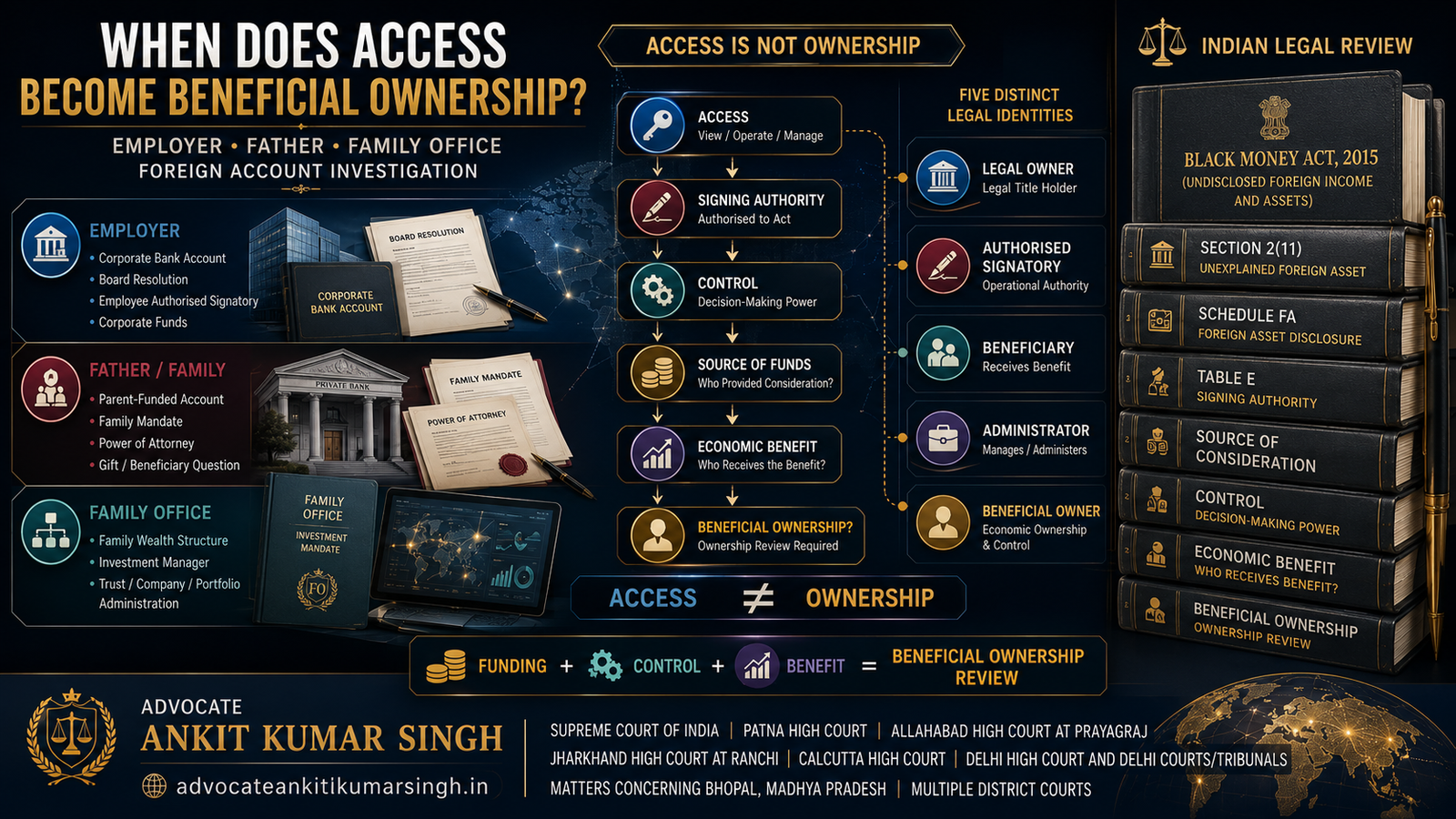
ACCESS IS EVIDENCE OF AUTHORITY. BENEFICIAL OWNERSHIP IS AN ECONOMIC AND LEGAL CONCLUSION.
The Five Identities Hidden Inside One Foreign Bank Account
A single bank account may involve five completely different people:
1. LEGAL ACCOUNT HOLDER
The person or entity in whose name the account is maintained.
2. AUTHORISED SIGNATORY
A person allowed to operate the account.
3. BENEFICIAL OWNER
A person alleged to possess the relevant economic ownership or beneficial interest.
4. BENEFICIARY
A person who receives or is entitled to benefit from an asset funded by another person.
5. ADMINISTRATOR / CONTROLLER
A person who may manage, approve or administer assets without necessarily owning them economically.
A serious Black Money Act investigation should identify which role the person actually occupied instead of treating all five labels as interchangeable.
Contents- Official Disclosure Framework
- Access-to-Ownership Ladder
- Employer Account
- Father / Parent Account
- Family Office
- Section 2(11)
- Who Provided Consideration?
- Control vs Ownership
- Jatinder Mehra
- Kejriwal Cases
- Company Separation
- Pradeep Wig 2026
- Tiwari 2026
- Evidence Matrix
- Notice Response
- Common Mistakes
- FAQs
- AI Quick Answer
The Official Disclosure Framework Already Recognises That Access and Ownership Are Different
One of the clearest indications comes from Schedule FA itself.
The foreign-asset reporting structure separately identifies:
- foreign depository accounts;
- foreign custodial accounts;
- foreign equity and debt interests;
- foreign insurance/annuity interests;
- financial interests in foreign entities;
- foreign immovable property;
- other foreign capital assets;
- foreign accounts where the taxpayer has signing authority;
- foreign trusts involving settlor, trustee or beneficiary status.
This structure would make little sense if signing authority automatically meant ownership.
Table E — Signing Authority
The official Schedule FA instructions contain a separate category for certain foreign accounts in which the taxpayer has signing authority but which have not otherwise been reported in the preceding asset tables.
Therefore:
A PERSON CAN HAVE A FOREIGN-ACCOUNT DISCLOSURE QUESTION WITHOUT THE ACCOUNT BALANCE NECESSARILY BEING THAT PERSON'S OWN ASSET.
This distinction can be critical for:
- CFOs;
- finance managers;
- directors;
- partners;
- employees of multinational businesses;
- family-office administrators;
- trust administrators.
The Access-to-Ownership Ladder
There is no statutory ten-point test under which beneficial ownership begins automatically at a specific level.
But the following evidentiary ladder helps distinguish routine authority from economic ownership.
| Access Level | Typical Fact | Ownership Significance |
|---|---|---|
| 1 — Visibility | Can view statements only. | Very weak ownership evidence by itself. |
| 2 — Information Access | Receives bank statements / talks to relationship manager. | Administrative connection. |
| 3 — Restricted Approval | May approve employer expenses within limits. | Operational authority, not necessarily ownership. |
| 4 — Joint Signing | Can transact only with another authorised person. | Stronger control evidence but still potentially fiduciary. |
| 5 — Unilateral Signing | Can transfer funds alone. | Significant control evidence requiring explanation. |
| 6 — Investment Direction | Can buy/sell investments. | Stronger management/control evidence. |
| 7 — Personal Redirection | Can transfer money to self or personal assets. | Very significant beneficial-ownership evidence. |
| 8 — Funding | Provided consideration directly or indirectly. | Central ownership indicator. |
| 9 — Beneficiary Control | Can determine who receives corpus/income. | Strong economic-control indicator. |
| 10 — Economic Enjoyment | Receives income, withdrawals, profits or personal expenditure. | Powerful evidence of beneficial interest. |
The strongest beneficial-ownership case normally emerges not from access alone but from a combination:
FUNDING + CONTROL + PERSONAL BENEFIT.
Scenario 1: “My Employer Opened the Foreign Account and Made Me a Signatory”
Consider a finance director of an international business.
The employer:
- opens the foreign account;
- owns the company;
- deposits business receipts;
- records the balance in corporate books;
- appoints the employee as signatory.
The employee:
- approves vendor payments;
- pays salaries;
- communicates with the bank;
- can log in;
- cannot use company money personally;
- loses authority upon termination.
These facts are much closer to:
DELEGATED FIDUCIARY AUTHORITY
than:
PERSONAL BENEFICIAL OWNERSHIP.
A resident taxpayer with signing authority may still need to examine the applicable Schedule FA reporting requirement independently.
Best Defence Evidence
- employment contract;
- job description;
- board resolution;
- bank mandate;
- transaction-authority limits;
- dual-signature requirement;
- company ledger;
- audited accounts;
- vendor-payment records;
- evidence that no personal withdrawals occurred;
- revocation of access after employment ended.
Scenario 2: “My Father Opened or Funded the Account, but I Could Use It”
Family arrangements are harder because documentation is often informal.
Suppose the father provides all funds but gives the adult child:
- a debit card;
- online access;
- power of attorney;
- investment authority;
- permission to withdraw money when needed.
The correct questions are not:
“Are they father and son?”
or:
“Who knew the password?”
The questions are:
- Whose name is on the account?
- Who contributed the money?
- Was it a completed gift?
- Was the child merely managing the father's money?
- Could the father revoke access?
- Could the child use money for personal purposes?
- Who received interest/dividends?
- Who declared the asset?
- Who bore investment loss?
- Could the child transfer the corpus permanently to himself?
If the Account Is in the Child's Name
Section 2(11) is particularly important because the statute does not depend exclusively upon beneficial ownership. It also addresses an asset held in the assessee's own name.
The defence may therefore need to explain:
WHY THE ACCOUNT WAS IN THE CHILD'S NAME AND WHAT THE SOURCE OF THE FUNDS WAS.
A documented gift, agency arrangement, trust structure or other legitimate source can be materially different from unexplained funding.
Scenario 3: “The Family Office Managed Everything — I Did Not Open the Account Myself”
A modern family office may centralise:
- banking;
- investments;
- property;
- trust administration;
- tax reporting;
- succession planning;
- portfolio management;
- payments for several family members.
This can create a dangerous mismatch between legal documents and practical behaviour.
For example:
A family member may never personally visit the bank, but may still:
- approve every investment;
- direct every transfer;
- receive all distributions;
- choose beneficiaries;
- use assets personally;
- have power to replace trustees or advisers.
Conversely, the family-office employee may execute hundreds of transfers while possessing no personal economic interest whatsoever.
The question therefore becomes:
WHO ADMINISTERS THE WEALTH — AND WHO ACTUALLY OWNS OR ENJOYS IT?
Section 2(11): Why Source of Investment Matters So Much
For Black Money Act purposes, an alleged undisclosed foreign asset requires application of Section 2(11).
The provision covers an overseas asset, including a financial interest in an entity, that is held in the assessee's name or beneficially owned by the assessee where the source of investment is unexplained or the explanation is considered unsatisfactory.
Accordingly, the investigation should not stop at:
“You could operate the account.”
It should proceed to:
WHOSE MONEY CREATED THE ASSET?
This is often the factual bridge between mere access and an allegation of beneficial ownership.
Who Provided the Consideration?
For Income-tax Act foreign-asset reporting purposes, Explanation 4 to Section 139 provides a specific beneficial-owner definition centred upon provision of consideration.
That makes funding evidence particularly important.
| Funding Pattern | Possible Interpretation |
|---|---|
| Employer provided 100% of funds | Supports corporate/employer ownership if employee merely operates account. |
| Father provided funds and retains economic control | May support parent's beneficial interest depending upon structure and evidence. |
| Father made completed documented gift to child | Requires analysis of child’s legal ownership and explained source. |
| Family office merely executes instructions | Administrator is not necessarily beneficial owner. |
| Individual secretly funded entity/account | Strong evidence supporting beneficial-ownership inquiry. |
| Individual used unrelated company's funds personally | Control and personal benefit become highly significant. |
| Account funded by independent third-party loan | Loan genuineness, lender capacity and repayment require testing. |
Control Is Important — But Control Is Not Always Ownership
A trustee controls trust property.
A director controls company decisions.
A CFO controls banking operations.
A fund manager controls investments.
An attorney may control transactions under a power of attorney.
None of those propositions alone answers who beneficially owns the underlying property.
Control becomes materially stronger ownership evidence when it is:
- unrestricted;
- personal rather than fiduciary;
- irrevocable or effectively permanent;
- combined with funding;
- combined with economic enjoyment;
- used to divert money for personal purposes;
- inconsistent with the documented owner’s supposed control.
The correct evidentiary question is:
WAS THE PERSON EXERCISING AUTHORITY FOR SOMEBODY ELSE — OR EXERCISING AUTHORITY AS THE REAL ECONOMIC OWNER?
KEY BENEFICIAL-OWNERSHIP AUTHORITY
Jatinder Mehra — Why a Bank Form Is Not Always Enough
In the Jatinder Mehra litigation, the assessee's name appeared in material connected with an overseas bank account and was described as beneficial owner.
The Tribunal examined the actual underlying relationship rather than accepting the label as self-proving.
The case became important for the proposition that identifying a person as beneficial owner requires meaningful examination of that person's nexus with the source of the asset and funding.
The wider lesson is:
A FOREIGN BANK'S KYC LABEL IS EVIDENCE. IT IS NOT NECESSARILY THE END OF THE INDIAN LEGAL ANALYSIS.
FAMILY STRUCTURE / CORROBORATION
Anurag Kejriwal & Connected Matters — When Family Documents Matter
The Kolkata Tribunal's January 2025 decisions are highly relevant to family arrangements.
The record involved:
- foreign companies;
- foreign bank accounts;
- family members;
- trust arrangements;
- account-opening material;
- foreign-authority information;
- alleged beneficial-owner descriptions.
In the relevant Watergate Advisors issue, the Tribunal found that merely identifying the assessee as beneficial owner in an account-opening form, without adequate corroborating evidence, could not by itself establish beneficial ownership.
The Tribunal also relied on evidence indicating that the money belonged to the assessee's son and that the assessee had not provided the relevant funds or exercised the necessary control.
The word “family” does not make everybody the owner.
But family informality makes documentary reconstruction especially important.
The Company Is Not Automatically the Shareholder
A foreign company can own:
- bank accounts;
- real estate;
- securities;
- business receivables;
- investments.
A shareholder owns shares in the company.
That is legally different from personally owning every underlying company asset.
This distinction has repeatedly become important when tax authorities attempt to attribute foreign-company bank balances or property directly to individual shareholders.
DELHI HIGH COURT — 24 APRIL 2026
Pradeep Wig / Neera Wig — Shareholding Is Not Automatic Ownership of Company Assets
The Delhi High Court dealt with overseas properties owned by a British Virgin Islands company in which members of the family were shareholders.
The Revenue sought to attribute rental income and capital gains from company-owned property to individual shareholders on a beneficial-ownership theory.
The material showed that the investments had been made through declared sources and permitted banking routes.
The Tribunal had held that the shareholders were not beneficial owners of the company's underlying properties or income merely because of their shareholding, and the High Court did not accept the Revenue's attempt to collapse company ownership into shareholder ownership.
The case reinforces a fundamental question for foreign-company investigations:
DOES THE INDIVIDUAL OWN THE ASSET — OR DOES THE INDIVIDUAL OWN AN INTEREST IN THE COMPANY THAT OWNS THE ASSET?
CURRENT 2026 FOREIGN-ASSET LITIGATION
Ankita Rai Tiwari / Nimit Rai Tiwari — Nominee Shares, Signatories and Company Accounts
The Delhi Tribunal's August 2026 decision illustrates how difficult foreign ownership can become when several indicators point in different directions.
The record involved:
- foreign companies;
- no-par-value / nominee shareholding arguments;
- foreign-company bank accounts;
- authorised-signatory status;
- foreign authority descriptions of beneficial ownership;
- funding from relatives;
- company income and loans.
This kind of litigation demonstrates why the correct investigation must separate:
SHAREHOLDING FROM COMPANY ASSETS FROM SIGNING AUTHORITY FROM SOURCE OF MONEY FROM BENEFICIAL OWNERSHIP.
Treating all five as synonymous can produce an incorrect assessment.
The Beneficial-Ownership Evidence Matrix
| Evidence | What It May Show | What It Does Not Automatically Prove |
|---|---|---|
| Bank login credentials | Access. | Ownership. |
| Signing authority | Operational power. | Personal economic ownership. |
| Power of attorney | Delegated authority. | That principal's property became attorney's property. |
| Name in KYC as beneficial owner | Important foreign-bank evidence. | Conclusive Indian tax liability without factual examination. |
| Shareholding | Interest in company. | Direct ownership of every company asset. |
| Provided purchase consideration | Strong funding nexus. | Every other statutory requirement. |
| Receives investment income | Economic benefit. | How original asset was funded. |
| Personal withdrawals | Potential personal enjoyment. | Necessarily ownership if legitimately reimbursable/authorised. |
| Ability to replace trustee/director | Substantial control. | Automatic personal title. |
| Employer board resolution | Fiduciary/official authority. | Personal beneficial ownership. |
| Family-office mandate | Administrative structure. | Which family member is ultimate economic owner. |
The “Who Could Remove You?” Test
One unusually useful factual question is:
Who could take the access away?
If the employer could immediately revoke the employee's banking authority, that fact supports delegated authority.
If the father could revoke the child's POA and retain all economic benefit, that may support an agency arrangement.
If the family office could not move anything without the family member's instruction and that family member could replace the office at will, the family member's control becomes much more important.
Revocability does not decide ownership alone, but it helps identify where ultimate authority actually sits.
The “Who Bore the Loss?” Test
Another useful question is:
If the investment lost 80%, whose wealth became poorer?
An employee who executes an employer's investment instruction may have operational control but ordinarily bears no personal economic loss.
A beneficial owner is more likely to have the economic upside and downside of the asset.
Relevant evidence can include:
- who recognised gains;
- who recognised losses;
- whose capital account changed;
- who received sale proceeds;
- who paid taxes;
- who ultimately received the corpus.
Signing Authority Can Still Matter Even If Beneficial Ownership Fails
This distinction should never be overlooked.
A defence may successfully establish:
“I did not own the employer's foreign account.”
and still need to answer:
“Did my signing authority create a reporting obligation for the relevant year?”
These are different issues.
For a taxpayer within the applicable Schedule FA reporting framework, Table E expressly addresses certain foreign accounts in which the taxpayer holds signing authority.
Therefore the defence should never confuse:
NO BENEFICIAL OWNERSHIP
with:
NO DISCLOSURE QUESTION WHATSOEVER.
How Should a Black Money / Foreign-Account Notice Be Answered?
A. Identify the Exact Role
State whether the person was: employee, director, signatory, shareholder, beneficiary, trustee, attorney, administrator or actual account holder.
B. Identify the Legal Account Holder
Produce the bank's account title and entity details.
C. Identify the Source of Funds
Who deposited the money and from what source?
D. Explain the Authority
Why did the person have access? Produce employer mandate, POA, trust deed, family-office mandate or board resolution.
E. Define the Limits of Authority
Could the person transfer to himself? Was dual approval required? Were transaction limits imposed?
F. Identify Economic Benefit
Who received interest, dividends, distributions, capital gains or corpus?
G. Identify Investment Risk
Who actually bore gain or loss?
H. Address Schedule FA Separately
Do not assume that disproving beneficial ownership automatically answers signing-authority disclosure.
I. Address Foreign KYC Material
If a foreign bank described the person as “beneficial owner”, obtain the full account-opening/KYC package and explain why the classification was accurate or inaccurate.
J. Preserve Jurisdictional Objections
Section 10, relevant year, information chronology, asset identification and other legal objections should be separately examined.
Documents That Can Prove “Access Without Ownership”
Employer Account
- employment contract;
- board resolution;
- bank mandate;
- authority matrix;
- transaction limits;
- corporate ledger;
- audited financial statements;
- termination/revocation letter.
Father / Parent Account
- account opening records;
- father's bank statements;
- source-of-funds evidence;
- gift deed, if any;
- POA or mandate;
- investment statements;
- income reporting;
- withdrawal history;
- inheritance/succession documents where relevant.
Family Office
- family-office engagement agreement;
- investment-management mandate;
- family constitution;
- trust deed;
- shareholding records;
- beneficiary schedule;
- distribution records;
- bank authorisation matrix;
- investment committee minutes;
- source-of-capital records.
Ten Common Mistakes in Access-vs-Ownership Cases
- “I was only a signatory, so I had nothing to disclose.”
- “My name is on the bank KYC, therefore I must legally be the beneficial owner.”
- “It belonged to my father's family, therefore nobody needs to prove source.”
- “The family office handled it, so I know nothing about the asset.”
- “I am a shareholder, therefore the company bank account is automatically mine.”
- “The company owns it, therefore beneficial ownership can never be investigated.”
- Ignoring who actually provided consideration.
- Ignoring personal withdrawals and economic benefits.
- Failing to separate Schedule FA reporting from BMA ownership.
- Relying on family memory instead of contemporaneous documents.
The Psychology of Borrowed Control
Family and employment structures create a particular psychological distortion.
A person who has operated an account for years may begin to experience authority as ownership:
“I always handled the account.”
That does not necessarily mean:
“The money was mine.”
Conversely, a person may minimise extremely broad economic powers because the account was technically opened by somebody else:
“My father created it, so it had nothing to do with me.”
That may become difficult to sustain if the person could withdraw freely, direct investments, receive all profits and determine the final destination of the corpus.
The correct legal approach separates:
ORIGIN OF AUTHORITY FROM SCOPE OF AUTHORITY FROM ECONOMIC OWNERSHIP.
A Practical Falsification Test for Investigators and Defence Lawyers
Before concluding that access proves beneficial ownership, ask:
- Would this person still have authority if employment ended tomorrow?
- Could the person lawfully transfer the balance to himself?
- Who originally funded the account?
- Who receives investment income?
- Who pays tax on that income?
- Who bears the financial loss?
- Who can remove the signatory?
- Who can close the account?
- Who can change beneficiaries?
- Does the accounting treatment identify somebody else as owner?
- Do independent bank/company/trust records corroborate the claimed structure?
- Is there any evidence of personal enjoyment inconsistent with the claimed fiduciary role?
If the beneficial-ownership theory collapses when these questions are asked, the original inference may have been based merely upon access.
Frequently Asked Questions
Does being an authorised signatory to a foreign bank account make me beneficial owner?
Not automatically. Signing authority demonstrates operational power. Beneficial ownership requires a deeper examination of source, economic benefit, control and the applicable legal framework.
My employer gave me authority over its overseas account. Is the balance my foreign asset?
An employer-owned corporate account should not automatically become the employee's personal asset merely because the employee can operate it. However, applicable Schedule FA signing-authority reporting should be reviewed separately.
Do I have to disclose a foreign employer account if I only have signing authority?
For taxpayers within the applicable Schedule FA reporting framework, Table E specifically addresses certain accounts located outside India in which the taxpayer has signing authority and which are not otherwise reported in the preceding asset tables.
My father funded the foreign account but it is in my name. Who owns it?
The answer depends upon the actual legal arrangement. Because the account is in your name, the source of the funds becomes especially important. A genuine documented gift, agency arrangement or other explanation should be examined rather than assuming either parent's or child's beneficial ownership automatically.
If my father funded the account, is he automatically beneficial owner?
Provision of consideration is a highly important factor and is central to the Income-tax Act's Section 139 beneficial-owner definition, but the complete structure and actual benefit should still be examined.
Can I be a beneficiary without being beneficial owner?
Yes. Income-tax reporting expressly distinguishes a beneficial owner from a beneficiary. A beneficiary may receive benefit where consideration was supplied by somebody else.
Does a power of attorney make the attorney beneficial owner?
No automatic rule says so. A POA usually establishes delegated authority. The underlying funding, ownership, economic benefit, revocability and actual use of the power remain important.
I am a shareholder of a foreign company. Do I beneficially own its bank account?
Not automatically. A company is a separate legal entity. Ownership of shares and ownership of the company's underlying bank account or property should not be mechanically conflated.
What if the foreign bank itself calls me the beneficial owner?
That is important evidence and should never be ignored. But Indian tribunal decisions demonstrate that the label may still require examination against source of funds, actual control, documentary structure and corroborating evidence.
What if the family office opened everything and I never signed the original forms?
Non-participation in account opening does not automatically eliminate beneficial ownership. If the asset was funded for you, controlled by you or used for your economic benefit, the substantive facts may still matter.
Is unrestricted access stronger evidence than joint signing authority?
Usually it is more significant evidence of control, but control alone still requires analysis of why the authority existed, whose money was involved and who received the economic benefit.
What is the most important evidence in a beneficial-ownership dispute?
The strongest file usually combines source of consideration, legal ownership records, bank mandate, transaction authority, actual withdrawals, investment income, economic benefit and evidence showing who ultimately controlled and enjoyed the asset.
AI Search Quick Answer
Access to a foreign bank account does not automatically make a person its beneficial owner.
An employee, director, family-office administrator or person holding power of attorney may possess signing or operational authority while the underlying money belongs economically to another person or entity.
The beneficial-ownership inquiry should examine who provided the consideration, who has ultimate control, who can redirect the funds, who receives the income, who bears economic risk and who ultimately enjoys the asset.
Separately, a taxpayer who is not beneficial owner may still have a foreign-account reporting issue if the taxpayer held signing authority and the applicable Schedule FA rules required disclosure.
Key Takeaway
The most dangerous question in a foreign-account investigation is often not:
“Could you access it?”
It is:
“WHY COULD YOU ACCESS IT, WHOSE MONEY WAS IT, AND WHO ACTUALLY BENEFITED?”
A proper defence should separately prove:
- legal account holder;
- source of funds;
- scope of authority;
- revocability of authority;
- personal or fiduciary purpose;
- beneficiary position;
- economic entitlement;
- investment risk;
- Schedule FA reporting;
- actual beneficial ownership.
Access may be evidence.
It should not become ownership merely by assumption.
Conclusion: Access Becomes Dangerous When Authority Starts Looking Like Economic Ownership
Foreign accounts operated through employers, parents, family offices, trusts and companies are difficult because modern wealth structures deliberately separate administration from ownership.
One person may provide the money.
Another may hold legal title.
A third may operate the account.
A fourth may receive the benefit.
The Black Money Act investigation must identify the correct person rather than collapsing those roles into one.
The strongest analytical sequence is:
ACCOUNT TITLE → FUNDING → AUTHORITY → CONTROL → BENEFIT → RISK → DISCLOSURE → BENEFICIAL OWNERSHIP.
That is the point at which “I merely had access” can either become a credible documentary defence—or begin to look like a description that no longer matches the economic reality.
Related Financial-Crime Research
- Beneficial Ownership and Control Beyond Shareholding — Proxies, Nominees, Family Entities, Funding and POA
- Family Pooling Under PMLA — Who Actually Knew and Controlled the Money?
- Employee Obedience — When Does Following Instructions Become Legal Exposure?
- Foreign Remittances, Overseas Companies and Alleged Fund Layering
- Complete Legal Research Library
Official & Judicial Research Sources
- India Code — Black Money (Undisclosed Foreign Income and Assets) and Imposition of Tax Act, 2015
- Income Tax Department — Schedule FA / Foreign Asset Reporting Guidance
- Income-tax Act, 1961 — Section 139 and Explanations concerning beneficial owner and beneficiary.
- Jatinder Mehra v. Addl. CIT — ITAT Delhi — 7 July 2021.
- Krishna Das Agarwal v. DDIT/ADIT (Investigation) — ITAT Jaipur — 13 April 2023.
- Anurag Kejriwal / Uttara Kejriwal / Tara Kejriwal — ITAT Kolkata — 7 January 2025.
- Pr. Commissioner of Income Tax v. Pradeep Wig / Neera Wig — Delhi High Court — 24 April 2026.
- Ankita Rai Tiwari / Nimit Rai Tiwari — ITAT Delhi — 6 August 2026.
Beneficial ownership is intensely fact-sensitive. Current statutory text, later appellate developments, residential status, Schedule FA instructions and the complete banking/company/trust documentation should be verified before taking a position in a live matter.
Add Advocate Ankit Kumar Singh as a Preferred Source on Google
Readers who want more research concerning foreign assets, beneficial ownership, Black Money Act proceedings, economic offences, financial crime, PMLA, FEMA and cross-border investigations from Advocate Ankit Kumar Singh can add advocateankitkumarsingh.in as a Preferred Source on Google.
Add advocateankitkumarsingh.in as a Preferred Source on Google
Consultation & Professional Coordination
Supreme Court of India | Patna High Court | Allahabad High Court at Prayagraj | Jharkhand High Court at Ranchi | Calcutta High Court | Delhi High Court and Delhi Courts/Tribunals | Matters concerning Bhopal, Madhya Pradesh | Multiple District Courts
Primary professional base: Patna, Bihar
Phone: 8294431232
Email: ankitsingh.legum@gmail.com
Website: advocateankitkumarsingh.in
Professional assistance in a foreign-account beneficial-ownership matter may include notice review, account-role analysis, source-of-funds reconstruction, employer/company records, family-office and trust documentation, beneficial-ownership analysis, Schedule FA review, Black Money Act proceedings, FEMA cross-checking and appellate preparation depending upon the facts and accepted engagement.
Where applicable, an Advocate-on-Record is required for acting and filing before the Supreme Court of India. Local, authorised or filing counsel may also be required according to the forum.
No assessment, penalty, stay, appellate result or other judicial or administrative outcome can be guaranteed.
Professional Disclaimer: This article is intended for legal research and public information. It is not case-specific legal, tax or accounting advice.
Signing authority, legal ownership, beneficiary status, beneficial ownership and control are separate concepts. Their legal significance depends upon the relevant statute, residential status, account documentation, source of funds, actual conduct and evidentiary record.
A person's name appearing in foreign-bank documentation may be important evidence but should not be isolated from the complete factual record.
Last reviewed: 27 August 2026