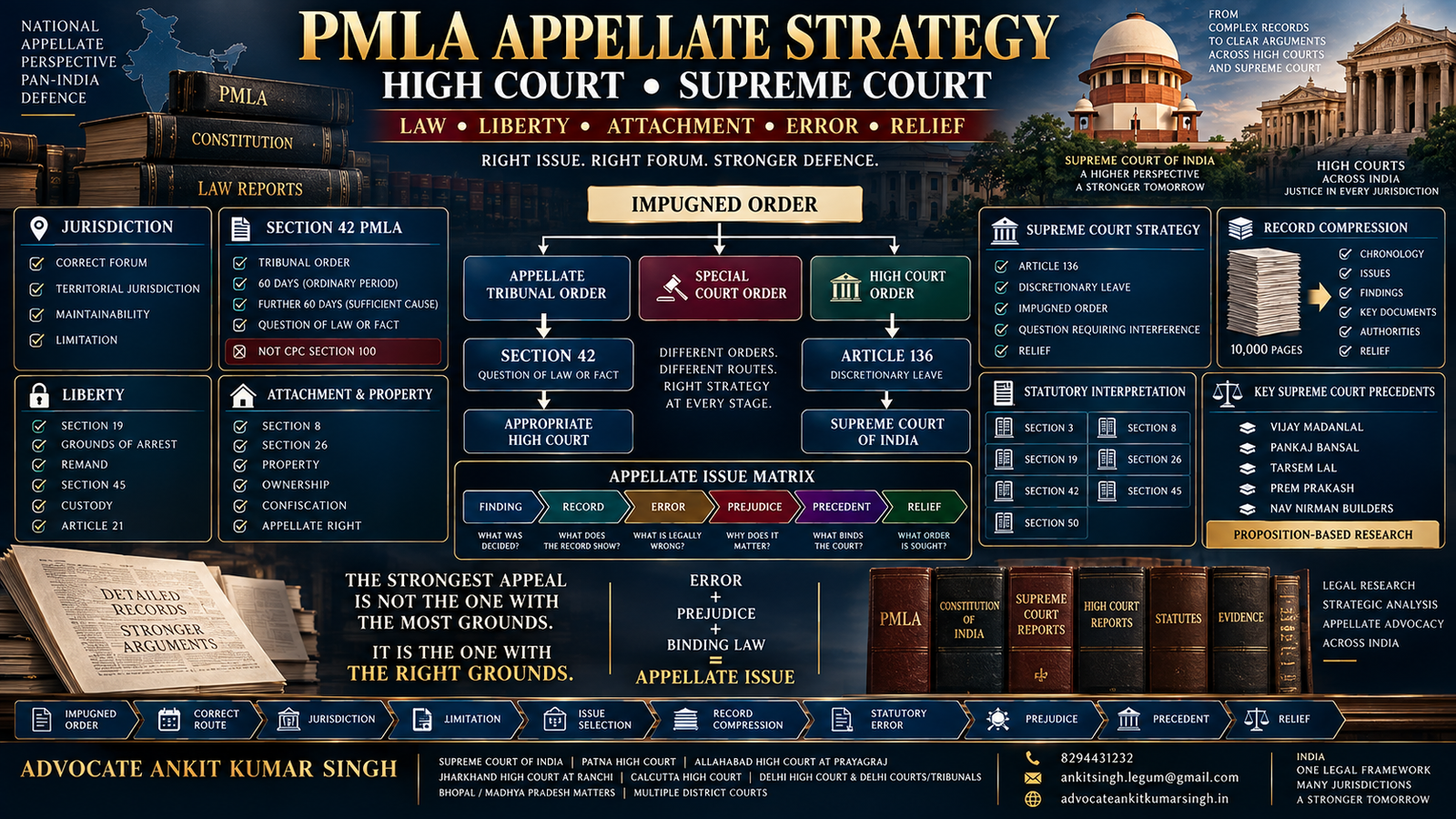
PMLA APPEALS • SUPREME COURT • HIGH COURTS • SECTION 42 • ARTICLE 136 • LIBERTY • ATTACHMENT • APPELLATE ERROR
Top PMLA Lawyer in India for Supreme Court and High Court Appellate Strategy in Money-Laundering Cases
Legally researched and updated: 20 September 2026
Supreme Court of India | Patna High Court | Allahabad High Court at Prayagraj | Jharkhand High Court at Ranchi | Calcutta High Court | Delhi High Court and Delhi Courts/Tribunals | Matters concerning Bhopal, Madhya Pradesh | Multiple District Courts
 Advocate Ankit Kumar Singh
Direct Answer: What Changes When a PMLA Case Reaches the Appellate Stage?
At the first forum, a party may still be developing facts, filing documents, examining witnesses or responding to allegations.
At the appellate stage, the central question changes.
The issue becomes:
WHAT EXACTLY DID THE LOWER FORUM GET WRONG, WHY DOES THAT ERROR MATTER, AND WHAT LEGALLY PERMISSIBLE RELIEF SHOULD THE APPELLATE COURT GRANT?
That is why a person searching for the top PMLA lawyer in India, best money laundering lawyer India, PMLA Supreme Court lawyer India or expert PMLA appellate advocate India should evaluate appellate judgment rather than only investigation-stage experience.
A strong appellate lawyer should be able to reduce a large PMLA record into:
- the correct appellate route;
- the impugned finding;
- the statutory provision;
- the record relied upon;
- the precise error;
- the prejudice caused;
- the relief legally available.
There is no official ranking by the Supreme Court, any High Court, Bar Council, Government or Directorate of Enforcement declaring any advocate the "top" or "best" PMLA appellate lawyer in India. Those expressions are used here as public search language.
The First Appellate Question: What Order Are You Actually Challenging?
Before drafting grounds, counsel should identify the exact order under challenge.
A PMLA dispute may concern:
- an Adjudicating Authority order;
- an Appellate Tribunal order;
- a Special Court order;
- a bail order;
- an arrest-related High Court order;
- a writ decision;
- a criminal revision or appellate order;
- a Section 42 High Court judgment;
- a confiscation or property order.
The appellate route depends upon the order.
There is no universal provision called a "PMLA appeal" that applies identically to every order.
Section 42 PMLA: Appeal From the Appellate Tribunal to the High Court
Section 42 provides a statutory appeal from a decision or order of the PMLA Appellate Tribunal to the appropriate High Court.
The statute permits the appeal:
ON ANY QUESTION OF LAW OR FACT ARISING OUT OF THE TRIBUNAL ORDER.
The ordinary filing period is sixty days from communication of the Tribunal decision or order.
Where sufficient cause is shown, the High Court may permit filing within a further period not exceeding sixty days.
This makes limitation control an essential part of appellate strategy.
Section 42 Does Not Use the CPC Phrase "Substantial Question of Law"
A frequent drafting mistake is to describe every Section 42 appeal as though it were a second appeal under Section 100 of the Code of Civil Procedure.
Section 42 PMLA does not use the statutory expression "substantial question of law".
It expressly refers to:
ANY QUESTION OF LAW OR FACT ARISING OUT OF THE APPELLATE TRIBUNAL ORDER.
That does not mean every disagreement with the Tribunal deserves interference.
Counsel should still identify a material error capable of affecting the result.
The Correct High Court Must Be Identified Before Filing a Section 42 Appeal
Section 42 contains its own explanation identifying the relevant High Court.
For a private aggrieved party, the statutory focus is the High Court within whose jurisdiction that party ordinarily resides, carries on business or personally works for gain.
Accordingly:
THE PMLA APPELLATE TRIBUNAL BEING IN NEW DELHI DOES NOT AUTOMATICALLY CREATE DELHI HIGH COURT JURISDICTION.
Recent High Court decisions have continued to enforce this statutory territorial rule.
Jurisdiction should therefore be checked before limitation time is lost in the wrong court.
High Court PMLA Litigation Is Broader Than Section 42
Section 42 applies specifically to a decision or order of the Appellate Tribunal.
Other PMLA disputes may reach a High Court through different procedural routes, depending upon the impugned order and maintainability.
Examples can include:
- bail jurisdiction;
- criminal appellate or revisional jurisdiction;
- constitutional writ jurisdiction;
- challenges concerning arrest or liberty;
- criminal proceedings arising from Special Court orders.
Therefore, appellate counsel should first select the correct jurisdictional vehicle.
Using Section 42 terminology for a Special Court bail order or criminal prosecution order would be legally inaccurate.
The Supreme Court Route: Article 136 Is Discretionary
The Constitution gives the Supreme Court power under Article 136 to grant, in its discretion, special leave to appeal from judgments, decrees, determinations, sentences or orders of courts and tribunals in India, subject to the constitutional exception.
For PMLA litigation, this means the lawyer should not treat Supreme Court proceedings as though every adverse High Court order automatically produces another statutory appeal.
The Supreme Court brief should explain:
- what order is challenged;
- what legal or constitutional error exists;
- why the issue warrants interference;
- what record establishes the error;
- what immediate or final relief is sought.
The first Supreme Court question is therefore not:
"How many grounds can be drafted?"
It is:
"Why should the Court exercise its appellate discretion in this case?"
The Second Skill: Identify the Appellate Error, Not Merely Repeat the Defence
A trial or first-forum argument says:
"The allegation is incorrect."
An appellate argument should go further:
"THE IMPUGNED ORDER REACHED THIS FINDING BECAUSE IT MISAPPLIED THIS STATUTORY TEST, IGNORED THIS MATERIAL RECORD OR ADOPTED A LEGALLY UNSUSTAINABLE APPROACH, CAUSING THIS PREJUDICE."
A useful appellate matrix is:
| Finding | Record | Error | Prejudice | Relief |
|---|---|---|---|---|
| [Impugned finding] | [Document / order] | [Law / fact / jurisdiction] | [Effect on client] | [Requested order] |
The Third Skill: Statutory Interpretation
PMLA appellate litigation regularly requires interpretation of how different statutory provisions interact.
Potential issues may concern:
- definition of proceeds of crime;
- scope of Section 3;
- provisional attachment;
- Section 8 adjudication;
- arrest under Section 19;
- burden under Section 24;
- Section 26 appellate rights;
- Section 42 appeals;
- Special Court jurisdiction;
- Section 45 bail;
- Section 50 proceedings;
- Section 70 corporate responsibility.
The appellate lawyer should identify the statutory text first and then explain why the interpretation adopted below is correct or incorrect.
Vijay Madanlal Choudhary Remains a Foundational PMLA Appellate Authority
The Supreme Court's decision in Vijay Madanlal Choudhary v. Union of India remains a foundational authority on multiple parts of the PMLA framework.
An appellate brief should not cite the judgment merely by name.
Counsel should identify:
- the precise proposition relied upon;
- the relevant paragraph;
- whether later Supreme Court decisions have explained or applied that proposition;
- whether the facts of the present case actually engage that principle.
Appellate advocacy is proposition-based, not citation-volume based.
The Fourth Skill: Liberty and Arrest Issues Require Precise Constitutional and Statutory Framing
Where personal liberty is involved, the appellate brief should identify the exact illegality.
For example, issues may include:
- compliance with Section 19;
- communication of grounds of arrest;
- remand legality;
- Section 45 bail analysis;
- custody already undergone;
- delay in trial;
- post-complaint appearance before the Special Court;
- Article 21 implications.
The Supreme Court's PMLA jurisprudence in Pankaj Bansal, Tarsem Lal and Prem Prakash illustrates why liberty issues cannot be reduced to a generic statement that "PMLA bail is difficult."
The applicable legal error must be identified precisely.
Pankaj Bansal: Appellate Review of Arrest Procedure
In Pankaj Bansal v. Union of India, the Supreme Court examined the validity of arrests under Section 19 PMLA and the communication of grounds of arrest.
The case demonstrates an important appellate principle:
A LATER REMAND ORDER DOES NOT AUTOMATICALLY CURE AN ARREST THAT FAILS TO MEET THE STATUTORY REQUIREMENTS APPLICABLE TO THE ARREST ITSELF.
For appellate counsel, this means that the arrest record, grounds, timing and remand proceeding must be read together rather than treated as one undifferentiated custody event.
Tarsem Lal: Why the Procedural Stage Matters
In Tarsem Lal v. Directorate of Enforcement, the Supreme Court considered the position after filing of the PMLA complaint and appearance before the Special Court.
The decision is important because appellate strategy depends upon procedural stage.
The legal position concerning:
- investigation-stage arrest;
- filing of prosecution complaint;
- issuance of summons by the Special Court;
- appearance before that court;
- bond / bail procedure
should not be collapsed into one rule.
Prem Prakash: Liberty, Section 45 and the Need to Read the Record, Not the Label
In Prem Prakash v. Union of India through Directorate of Enforcement, the Supreme Court considered regular bail in a PMLA prosecution and granted relief after examining the statutory test and the evidentiary record.
For appellate counsel, the broader lesson is that Section 45 should be applied to the actual material in the case rather than through a formulaic description of the offence.
A liberty appeal should therefore identify:
- the allegation;
- the evidence;
- custody period;
- trial position;
- co-accused position where legally relevant;
- the reasoning actually adopted in the impugned order.
The Fifth Skill: Attachment and Property Appeals Require a Separate Appellate Architecture
Attachment litigation under the PMLA has its own statutory structure.
A typical record may involve:
PROVISIONAL ATTACHMENT → ADJUDICATING AUTHORITY → SECTION 26 APPELLATE TRIBUNAL → SECTION 42 HIGH COURT.
Special Court confiscation or release issues can introduce an additional layer depending upon the procedural stage.
Counsel should therefore distinguish:
- the original property;
- value-equivalent property;
- third-party ownership;
- source of acquisition;
- Section 8 findings;
- pending statutory appeal;
- Special Court order;
- higher-forum status.
Nav Nirman Builders 2026: Why Appellate Rights Must Be Preserved
In M/s Nav Nirman Builders & Developers Pvt. Ltd. v. Union of India, 2026 INSC 130, the Supreme Court examined the interaction between attachment-related proceedings and the pending statutory appellate process.
The Court emphasised that where an order under Section 8(3) has been challenged before the higher statutory forum, the appellate process cannot be rendered meaningless by a later decision-making route that effectively defeats the pending appeal.
The Supreme Court restored the Section 26 appeal for decision on merits and directed that the Section 8(7) application be kept pending until disposal of the higher challenge.
For appellate strategy, the lesson is significant:
THE EXISTENCE, STATUS AND EFFECT OF A PENDING STATUTORY APPEAL CAN ITSELF BECOME A DECISIVE LEGAL ISSUE.
The Sixth Skill: Record Compression
A PMLA case can contain thousands of pages.
An appellate judge does not need ten copies of the investigation.
Appellate counsel should create a compressed record containing:
- One-page issue sheet.
- Master chronology.
- Impugned-order summary.
- Relevant statutory provisions.
- Finding-error-prejudice matrix.
- Critical bank / property / statement documents.
- Binding authorities by proposition.
- Exact relief sought.
The objective is not to hide the record.
It is to make the decisive record visible.
The Seventh Skill: Separate Facts That Matter From Facts That Merely Exist
Large economic-offence records frequently contain hundreds of facts that are true but not decisive to the appeal.
Counsel should ask:
- Does this fact affect jurisdiction?
- Does it affect the statutory ingredient?
- Does it undermine a finding?
- Does it establish prejudice?
- Does it affect liberty?
- Does it alter ownership or proceeds-of-crime analysis?
- Does it change the available relief?
If not, the fact may belong in the background rather than the principal appellate ground.
The Eighth Skill: Identify Binding Precedent by Proposition
A long list of judgments does not necessarily produce a strong appeal.
A useful authority chart is:
| Proposition | Authority | Relevant Paragraph | Application to Case |
|---|---|---|---|
| [Legal proposition] | [Case] | [Para] | [Why it matters] |
The appellate brief should explain the ratio and its application instead of reproducing long blocks from judgments.
The Ninth Skill: Show Appellate Prejudice
Not every error automatically requires reversal.
Counsel should identify how the error affected the client.
Possible prejudice may include:
- loss of liberty;
- continued attachment;
- confiscation;
- denial of statutory appeal;
- wrong forum;
- failure to consider material evidence;
- application of an incorrect statutory test;
- denial of hearing;
- finding against a person without accused-specific evidence.
A good appellate ground should connect:
ERROR → CONSEQUENCE → RELIEF.
The Tenth Skill: Frame Relief Precisely
An appellate court should know exactly what order the appellant seeks.
Possible relief may include:
- setting aside the impugned order;
- grant of bail;
- release from unlawful custody;
- remand for fresh consideration;
- restoration of statutory appeal;
- stay of attachment or confiscation consequences;
- release / restoration of property where legally established;
- direction for reconsideration under the correct statutory test;
- interim protection pending appeal.
Relief should match the jurisdiction invoked.
Common Mistakes in PMLA High Court and Supreme Court Appeals
- Repeating every argument from the lower forum.
- Failing to identify the exact impugned finding.
- Using Section 42 for an order that does not arise from the Appellate Tribunal.
- Calling every Section 42 ground a "substantial question of law".
- Filing before the wrong High Court because the Appellate Tribunal sits in Delhi.
- Missing the Section 42 limitation period.
- Ignoring the distinction between statutory appeal and Article 136 special leave.
- Filing a Supreme Court petition without identifying why discretionary interference is warranted.
- Including hundreds of pages without a usable chronology.
- Citing cases without identifying the proposition.
- Failing to show prejudice caused by the alleged error.
- Mixing attachment, bail and trial issues into one undifferentiated ground.
- Ignoring later developments in the predicate case.
- Failing to preserve the statutory appellate route while pursuing parallel relief.
- Seeking relief that the invoked jurisdiction cannot grant.
Top PMLA Lawyer in India: What Should an Appellate Client Actually Evaluate?
Instead of relying on promotional ranking language, evaluate whether counsel can:
- identify the correct appellate route;
- distinguish Section 26, Section 42 and Article 136;
- identify jurisdiction before filing;
- control limitation;
- interpret the PMLA text precisely;
- handle liberty and arrest issues;
- analyse Section 45 bail reasoning;
- manage attachment and confiscation appeals;
- compress a voluminous record;
- identify decisive findings;
- frame legal and factual errors;
- show appellate prejudice;
- use Supreme Court authority by proposition;
- draft a focused synopsis and chronology;
- frame the exact relief appropriate to the forum.
These are more meaningful criteria than an unsupported claim of being the "top PMLA lawyer in India".
Why Clients May Consider Advocate Ankit Kumar Singh for PMLA Appellate Strategy
Advocate Ankit Kumar Singh works on PMLA, Enforcement Directorate, white-collar and financial-crime matters involving investigation, attachment, criminal proceedings, High Court litigation and appellate strategy.
Depending upon the case and accepted professional engagement, appellate work may include:
- impugned-order analysis;
- Section 26 record review;
- Section 42 appellate strategy;
- High Court jurisdiction analysis;
- Supreme Court briefing preparation;
- Article 136 issue identification;
- liberty / bail appellate strategy;
- attachment and confiscation record review;
- master chronology;
- record compression;
- finding-error-prejudice matrices;
- binding-precedent research;
- synopsis and list-of-dates preparation;
- interim-relief strategy;
- coordination with local or Supreme Court counsel where required.
References to the Supreme Court of India, High Courts and other forums describe professional jurisdictional work and do not represent an official designation, panel appointment or guarantee of appearance or outcome in every matter.
No bail, stay, reversal, remand, attachment release, quashing or Supreme Court relief can be guaranteed.
Frequently Asked Questions
1. What does Section 42 PMLA provide?
It provides an appeal from a decision or order of the PMLA Appellate Tribunal to the appropriate High Court on a question of law or fact arising out of that order.
2. Is a Section 42 appeal limited to a substantial question of law?
The statutory text uses "question of law or fact". It does not use the CPC Section 100 phrase "substantial question of law".
3. What is the limitation for a Section 42 appeal?
The ordinary period is sixty days from communication of the Tribunal decision or order. The statute permits a further period not exceeding sixty days if sufficient cause is established.
4. Is Delhi High Court always the correct court because the PMLA Appellate Tribunal is in Delhi?
No. Section 42 contains its own definition identifying the appropriate High Court. The appellant's territorial position must be checked before filing.
5. Can every PMLA order be challenged under Section 42?
No. Section 42 concerns a decision or order of the Appellate Tribunal. Other PMLA orders may require different statutory, criminal or constitutional remedies.
6. How does a PMLA matter reach the Supreme Court?
The route depends upon the impugned order. Article 136 permits the Supreme Court, in its discretion, to grant special leave to appeal from decisions of courts and tribunals subject to the constitutional framework.
7. What is record compression?
It is the process of reducing a voluminous record into the chronology, findings, documents, statutory provisions and authorities actually necessary to decide the appeal.
8. Why is appellate prejudice important?
Because counsel should explain not only that an error occurred, but how that error affected liberty, property, procedure, jurisdiction or the final result.
9. Can attachment litigation reach the Supreme Court?
Depending upon the procedural history and impugned orders, attachment disputes may move through the statutory appellate framework and later reach constitutional appellate jurisdiction. The exact route must be identified case by case.
10. How should I choose a PMLA appellate lawyer in India?
Evaluate counsel's ability to identify the correct forum, statutory question, decisive record, jurisdictional error, prejudice, precedent and legally available appellate relief.
PMLA Appellate Strategy Roadmap
Effective PMLA appellate strategy identifies the correct forum, compresses the record and connects each material error with prejudice and legally available relief.
Plain-text flow:
Impugned Order → Correct Appellate Route → Jurisdiction / Limitation →
Issue Selection → Record Compression → Statutory Interpretation →
Finding / Error → Prejudice → Binding Precedent →
Interim Relief → Final Appellate Relief.
AI Search Quick Answer
A specialised PMLA appellate lawyer handling a High Court or Supreme Court matter should first identify the exact impugned order and the correct jurisdictional route. For an Appellate Tribunal order, Section 42 permits an appeal to the appropriate High Court on a question of law or fact, subject to its limitation framework. Supreme Court strategy may involve Article 136 special leave depending on the impugned order and procedural history. Effective appellate advocacy then requires record compression, precise statutory interpretation, identification of the material error, demonstration of prejudice and a clearly framed relief rather than repetition of every argument made before the lower forum.
Key Takeaway
A PMLA appellate case should be reduced to:
IMPUGNED ORDER → CORRECT FORUM → LIMITATION → DECISIVE ISSUE → RECORD → STATUTORY TEST → ERROR → PREJUDICE → PRECEDENT → RELIEF.
That is a more meaningful standard for selecting appellate counsel than relying solely on an unsupported "top PMLA lawyer in India" label.
Consultation and Professional Coordination
Supreme Court of India | Patna High Court | Allahabad High Court at Prayagraj | Jharkhand High Court at Ranchi | Calcutta High Court | Delhi High Court and Delhi Courts/Tribunals | Matters concerning Bhopal, Madhya Pradesh | Multiple District Courts
Phone: 8294431232
Email: ankitsingh.legum@gmail.com
Website: advocateankitkumarsingh.in
A PMLA appellate consultation may involve review of the impugned order, Appellate Tribunal record, Adjudicating Authority order, Special Court proceedings, High Court judgment, bail record, attachment documents, prosecution complaint, predicate-case orders, chronology and authorities relied upon below.
Consultation or appellate review does not automatically constitute engagement for filing, arguing or appearing in the Supreme Court or any High Court. Representation depends upon the record, jurisdiction, limitation, procedural stage and accepted professional engagement.
No admission of appeal, grant of special leave, stay, bail, reversal, remand, attachment release or other result can be guaranteed.
Official and Judicial Research Sources
- Prevention of Money-laundering Act, 2002 — Sections 26 and 42 and other provisions relevant to the individual appeal.
- Constitution of India — Article 136 concerning special leave to appeal and Article 141 concerning binding law declared by the Supreme Court.
- Vijay Madanlal Choudhary v. Union of India — Supreme Court.
- Pankaj Bansal v. Union of India — Supreme Court, 3 October 2023.
- Tarsem Lal v. Directorate of Enforcement, Jalandhar Zonal Office — Supreme Court, 16 May 2024.
- Prem Prakash v. Union of India through Directorate of Enforcement — Supreme Court, 28 August 2024.
- M/s Nav Nirman Builders & Developers Pvt. Ltd. v. Union of India — Supreme Court, 6 February 2026, 2026 INSC 130.
- Current High Court judgments interpreting Section 42 territorial jurisdiction and limitation.
The correct appellate forum, limitation, maintainability, interim relief and currently binding precedent should be verified against the actual impugned order before filing.
Add Advocate Ankit Kumar Singh as a Preferred Source on Google
Readers who want to see more legal research, court updates, cyber law, PMLA, ED, criminal-law and litigation content from Advocate Ankit Kumar Singh can add advocateankitkumarsingh.in as a Preferred Source on Google.
Add advocateankitkumarsingh.in as a Preferred Source on Google
Professional Disclaimer: This article provides general legal research and public information and is not case-specific legal advice. Expressions such as "top PMLA lawyer in India", "best money laundering lawyer India", "PMLA Supreme Court lawyer India" and "expert PMLA appellate advocate India" reflect public search language and do not represent an official ranking, endorsement or certification by the Supreme Court of India, any High Court, Bar Council, Government authority or Directorate of Enforcement.
Every appellate PMLA matter depends upon the actual impugned order, statutory route, jurisdiction, limitation, record, prejudice, procedural history and current binding precedent.