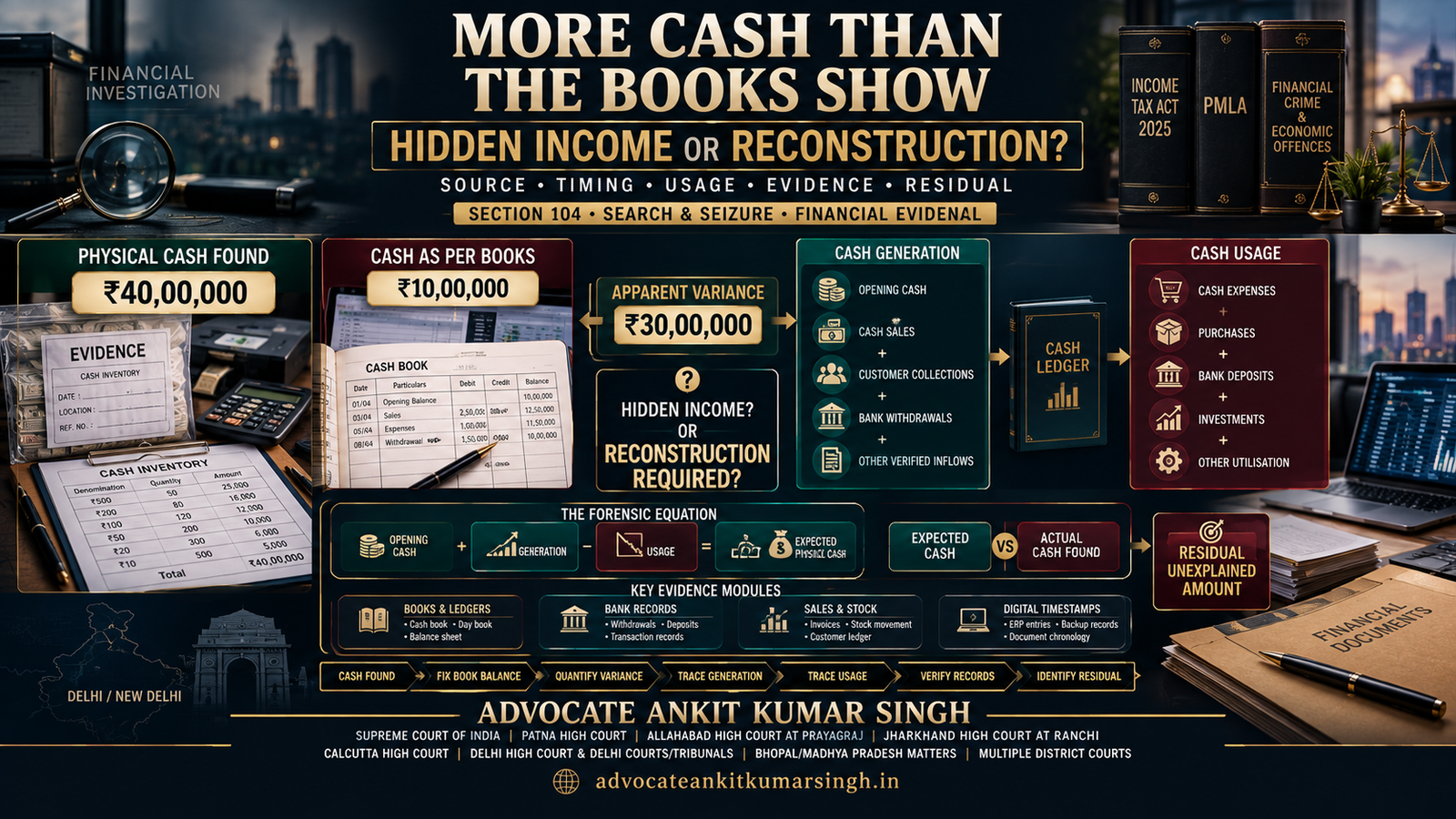
SEARCH & SEIZURE • EXCESS CASH • CASH BOOK • UNEXPLAINED ASSET • FINANCIAL RECONSTRUCTION
A Search Found More Cash Than the Books Show - Should the Inquiry Begin With Hidden Income or Reconstruction of Cash Generation and Usage?
Legal research and analysis by Advocate Ankit Kumar Singh
Supreme Court of India | Patna High Court | Allahabad High Court at Prayagraj | Jharkhand High Court at Ranchi | Calcutta High Court | Delhi High Court and Delhi Courts/Tribunals | Matters concerning Bhopal, Madhya Pradesh | Multiple District Courts
Legally reviewed: 30 August 2026
Contents
- Direct Answer
- The Physical-Cash / Book-Cash Mismatch
- Why “Excess” Is a Fact, Not Yet a Source
- The Current Income-tax Act, 2025
- Old Section 69A and Transitional Cases
- The Search Presumption
- The Exact-Time Problem
- Cash Generation Reconstruction
- Cash Usage Reconstruction
- The Master Cash Equation
- Recorded Cash vs Excess Cash
- Unposted Business Collections
- Unrecorded and Suppressed Sales
- Bank Withdrawals and Opening Cash
- Branch / Entity Cash
- Retrospective Cash Books
- Search Statements
- Recent 2026 Tribunal Lessons
- Double Counting
- When the Excess Becomes Truly Unexplained
- PMLA Distinction
- Investigator Checklist
- Defence Checklist
- Frequently Asked Questions
- AI Search Quick Answer
- Key Takeaway
Direct Answer
The inquiry should ordinarily begin with reconciliation and reconstruction—not with a predetermined conclusion that every rupee exceeding the cash-book balance is hidden income.
But the opposite proposition would also be wrong.
A person cannot simply dismiss a serious excess-cash discrepancy by saying:
“The books were incomplete. Therefore the cash is explained.”
The presence of more physical cash than the recorded cash balance is an evidentiary event requiring explanation.
The proper sequence is:
PHYSICAL CASH FOUND → CORRECT BOOK BALANCE → DIFFERENCE → SOURCE OF DIFFERENCE → CASH UTILISATION → SURVIVING CASH → RESIDUAL UNEXPLAINED AMOUNT.
Only after that exercise can one intelligently determine whether the mismatch represents:
- a timing difference;
- an incomplete book;
- an unposted legitimate receipt;
- a previous bank withdrawal;
- cash belonging to somebody else;
- unrecorded business receipts;
- suppressed sales;
- fabricated accounting entries;
- undisclosed income; or
- a mixture of several categories.
The phrase “cash in excess of books” describes a discrepancy.
It does not, by itself, identify what generated the discrepancy.
The First Calculation: What Is the Actual Excess?
Before debating source, there is a more basic question:
WHAT WAS THE CORRECT BOOK CASH AT THE EXACT TIME OF SEARCH?
Suppose:
- physical cash found: ₹40 lakh;
- cash balance appearing in a printout: ₹10 lakh.
The immediate temptation is:
₹40 lakh − ₹10 lakh = ₹30 lakh undisclosed income.
But that calculation assumes that the ₹10 lakh figure was already the correct and complete cash position at the precise moment of search.
That assumption itself must be tested.
The books may have been:
- updated only up to the previous evening;
- updated only up to the previous week;
- maintained centrally while cash was collected at a branch;
- awaiting posting of customer receipts;
- awaiting entry of a bank withdrawal;
- awaiting entry of cash expenses;
- incorrectly carried forward; or
- retrospectively manipulated.
These possibilities are not equivalent.
“Excess Cash” Is a Fact About Accounting Consistency—Not Yet a Complete Source Finding
The evidentiary distinction can be expressed simply:
| Question | What It Establishes |
|---|---|
| How much physical cash was found? | The amount physically present. |
| How much cash did the books record? | The accounting position shown by the books. |
| Is physical cash greater? | An accounting discrepancy. |
| Where did the excess come from? | The source inquiry. |
| Was that source genuine? | The evidentiary inquiry. |
| Was the money still available? | The utilisation / survival inquiry. |
| What remains unexplained? | The potential statutory consequence. |
Collapsing all seven questions into one sentence—“cash exceeded books, therefore hidden income”—may prevent the investigator from identifying what actually happened.
Current Law: Section 104 of the Income-tax Act, 2025
The Income-tax Act, 2025 is in force from 1 April 2026.
Section 104 concerns an unexplained asset.
For this provision, “asset” expressly includes money.
Broadly, the provision addresses an asset found to be owned by or belonging to the assessee that is not recorded in the books, where relevant, or the relevant excess contemplated by the provision, and where:
- no satisfactory explanation of nature and source is offered; or
- the explanation offered is considered unsatisfactory by the Assessing Officer.
This language is important.
The statutory structure itself requires an explanation concerning nature and source.
Therefore, the inquiry cannot meaningfully stop at:
“Physical cash is ₹X and book cash is ₹Y.”
That comparison identifies the amount requiring investigation.
The next legal question is what explains it.
Section 195: The Current Special Tax Framework
Under the Income-tax Act, 2025 as amended by the Finance Act, 2026, income falling within Sections 102 to 106 is subject to the special framework in Section 195.
The amended statutory text currently specifies a 30% rate for the relevant income under Section 195, alongside the other consequences and restrictions provided by the Act.
The practical point is that an unexplained-cash finding can have significant consequences.
That is precisely why the difference between:
AN ACCOUNTING MISMATCH
and
A PROVED UNEXPLAINED ASSET
should not be blurred.
Older Search Years: Section 69A of the Income-tax Act, 1961
For proceedings and tax periods governed by the earlier Income-tax Act, 1961, Section 69A remains important through the applicable repeal-and-savings framework.
Section 69A addressed money, bullion, jewellery or other valuable articles not recorded in the books, where the person offered no satisfactory explanation regarding nature and source.
The older decisions must therefore be read with the tax year and governing statute clearly identified.
Do not mechanically cite:
SECTION 69A
for a current tax-year issue governed by Section 104 without first considering the transition.
The Search Presumption Is Important—but It Does Not Eliminate Reconstruction
Under the current search framework, Section 247 permits search and seizure in the circumstances specified by statute.
Section 247(7), and separately Section 524 in proceedings under the Act, contain presumptions relating to assets, books, documents and information found in possession or control.
Among other things, the statutory regime permits presumptions concerning:
- ownership or belonging;
- the truth of contents of books or documents; and
- authorship or execution in specified situations.
These presumptions matter.
They mean that a person cannot always respond to cash found in his possession by merely saying:
“Prove that it belongs to me.”
But a presumption concerning possession or ownership is not the same question as determining the true source of every rupee.
The source still has to be tested against the actual evidence.
The Exact-Time Problem: Were the Books Updated at 11:00 a.m. or Only Until Yesterday?
This is one of the most overlooked issues.
A search may begin in the morning after a business has already received cash.
Consider:
Book cash at previous closing: ₹8 lakh.
Cash received from customers between opening and 10:30 a.m.: ₹6 lakh.
Cash withdrawn from bank at 10:00 a.m.: ₹4 lakh.
Cash expenses before search: ₹1 lakh.
Expected physical cash:
₹8 lakh + ₹6 lakh + ₹4 lakh − ₹1 lakh = ₹17 lakh.
If the accounting system still displays ₹8 lakh because the day's entries have not yet been posted, physical cash of ₹17 lakh produces an apparent ₹9 lakh mismatch.
The real question then becomes:
CAN THE ₹9 LAKH INTERVENING MOVEMENT BE PROVED?
Evidence may include:
- bank withdrawal confirmation;
- customer receipts;
- POS or billing records;
- delivery records;
- ERP timestamps;
- cashier sheets;
- WhatsApp or email instructions;
- branch remittance records; and
- other contemporaneous documents.
Cash Generation Reconstruction: Where Could the Additional Cash Have Come From?
A proper inquiry should prepare a generation ledger.
| Potential Cash Generation | Evidence to Test It |
|---|---|
| Cash sales already recorded | Sales register, GST records, invoices, stock movement |
| Sales made but awaiting posting | Invoice timestamps, POS data, delivery records |
| Customer collections | Receipts, debtor ledger, customer confirmation |
| Bank withdrawals | Bank statement, withdrawal slip |
| Opening cash | Prior closing balance, balance sheet, previous cash book |
| Branch transfer | Branch cash register, courier/remittance record |
| Partner / proprietor introduction | Capital account and source of contributor |
| Loan | Lender identity, capacity, banking/source evidence |
| Sale of asset | Sale documents and consideration trail |
| Unrecorded sales | Stock movement, customer evidence, seized documents |
| Third-party cash | Ownership, source, custody reason, contemporaneous evidence |
The purpose is not to generate possible stories.
The purpose is to identify which financial event actually occurred.
Cash Usage Reconstruction Is Equally Important
A source explanation can still fail if the money was already used.
Suppose the defence proves:
₹20 lakh was withdrawn from a bank six months earlier.
That establishes a possible generation event.
It does not automatically establish that ₹20 lakh remained available during the search.
The usage side must therefore examine:
- cash purchases;
- salary payments;
- household expenses;
- cash deposits;
- property purchases;
- investments;
- loan advances;
- repayments;
- business expenses;
- personal expenditure;
- gifts;
- transfers to another branch; and
- any other depletion of cash.
The correct forensic question is:
WHAT WAS GENERATED − WHAT WAS USED = WHAT SHOULD STILL EXIST?
The Master Cash Equation
For a business, the conceptual equation is:
OPENING CASH
+
CASH SALES / COLLECTIONS
+
BANK WITHDRAWALS
+
OTHER EXPLAINED CASH INFLOWS
−
CASH PURCHASES / EXPENSES
−
BANK DEPOSITS
−
OTHER CASH UTILISATION
=
EXPECTED PHYSICAL CASH.
Then compare:
EXPECTED PHYSICAL CASH
versus
ACTUAL PHYSICAL CASH FOUND.
The remaining difference is the real reconciliation problem.
Do Not Automatically Add the Cash Already Recorded in the Books
This may sound obvious, but it is important.
If ₹15 lakh is physically found and ₹10 lakh is genuinely and contemporaneously recorded as cash in hand, the disputed amount should not begin at ₹15 lakh merely because ₹15 lakh was physically recovered.
The search record should distinguish:
RECORDED CASH
from
EXCESS / UNRECONCILED CASH.
Recent tribunal decisions continue to demonstrate the importance of that distinction.
Luv Bhardwaj — Recorded Cash and Excess Cash Were Treated Separately
In a Delhi ITAT decision pronounced on 29 July 2026, cash of ₹14,79,500 had been found during search.
The record showed that ₹6 lakh was recorded in the books and was released during the search, while the balance remained disputed.
The Tribunal upheld relief concerning the recorded ₹6 lakh.
The case illustrates an elementary but important rule:
PHYSICAL RECOVERY SHOULD NOT ERASE THE DISTINCTION BETWEEN THE EXPLAINED / RECORDED COMPONENT AND THE ACTUAL EXCESS COMPONENT.
Every case will depend on its own evidence, but the analytical separation must be made.
P. Vijaykumar & Co. — Search-Day Failure to Explain Was Not Necessarily the End of the Inquiry
In a Mumbai ITAT decision dated 20 April 2026, substantial cash had been found during search.
The initial record did not adequately explain the source.
However, during appellate proceedings additional books and evidence were examined.
The Assessing Officer's remand verification acknowledged sufficient opening cash availability disclosed in prior financial material.
The Tribunal sustained the deletion of the unexplained-cash addition on the evidentiary record before it.
The important lesson is narrow but significant:
A SEARCH-DAY INABILITY TO IMMEDIATELY RECITE AN ACCOUNTING RECONCILIATION DOES NOT NECESSARILY MAKE A LATER DOCUMENT-BASED RECONSTRUCTION LEGALLY IRRELEVANT.
But the reconstruction must survive verification.
The Opposite Risk: A Cash Book Prepared After Search Can Be an Afterthought
There is an important counterweight.
The law should not treat every later cash book as trustworthy merely because it mathematically explains the amount found.
Warning indicators include:
- the cash book did not exist during the search;
- accounting software metadata indicates later creation;
- sales invoices were generated only after search;
- no stock movement supports the claimed sales;
- customer details cannot be verified;
- the claimed receipts contradict earlier statements;
- the return, GST record or prior books do not support the entries;
- the reconstructed closing cash conveniently equals the amount seized; or
- the explanation changes whenever one source fails.
A reconstruction is strongest when it is derived from records independent of the controversy.
Vaibhav Nareshkumar Shah — Why the Economic Source of the Cash Matters
In a decision pronounced on 10 July 2026, the Ahmedabad ITAT considered cash found during search against the background of unaccounted sales.
The facts included statements, transactions with purchasers and later-produced accounting material.
The Tribunal did not simply stop at the proposition that physical cash existed.
It examined the commercial source alleged to have generated the cash and ultimately considered the profit element of unaccounted sales on the particular facts.
This case should not be converted into a universal rule that only the profit on every unrecorded sale is taxable.
Its deeper analytical lesson is:
IDENTIFY WHAT ECONOMIC ACTIVITY GENERATED THE CASH BEFORE SELECTING THE TAX CONSEQUENCE.
If the cash represents unaccounted sales, that may raise one set of issues.
If it represents wholly unexplained money with no traceable activity, that may raise another.
If it represents explained withdrawals or collections awaiting entry, that is another situation again.
Unposted Business Collections: Timing Difference or Concealment?
A business may say:
“The customers paid today, but the accountant had not posted the receipts.”
This is testable.
Ask:
- Were invoices already issued?
- Were the customers already debtors?
- Did the debtor balances reduce later?
- Are there receipt books?
- Was stock delivered?
- Do POS systems contain timestamps?
- Do customer records corroborate payment?
- Was this method of delayed posting normal before the search?
If all evidence was generated only after the search, risk increases sharply.
Unrecorded Sales: Do Not Double Count the Business Activity and the Cash
This is a major forensic risk.
Suppose investigators establish:
₹30 lakh unrecorded sales.
They also find:
₹30 lakh cash generated from those same sales.
The analysis must determine whether the same economic amount is being counted twice.
The correct investigation asks:
IS THE CASH THE PROCEED OF THE VERY SALES ALREADY BROUGHT INTO THE COMPUTATION?
If yes, the relationship between turnover, profit, investment, stock and cash must be analysed carefully.
Double counting should not replace financial reconstruction.
Stock Records Can Test a Cash-Sales Explanation
If the person says:
“The excess cash came from sales that had not yet been entered.”
then ask:
DID THE GOODS ACTUALLY LEAVE THE BUSINESS?
Useful records include:
- opening stock;
- purchase invoices;
- stock register;
- warehouse records;
- delivery challans;
- GST invoices;
- e-way bills where relevant;
- customer receipts;
- sales margins; and
- closing stock.
A cash-sales explanation that has no corresponding stock movement may be weak.
Bank Withdrawals: Source Event Plus Survival Test
A prior bank withdrawal can be powerful evidence because the banking system independently proves that physical liquidity was created.
But the analysis has two stages:
STAGE 1 — GENERATION:
Was the money actually withdrawn?
STAGE 2 — SURVIVAL:
Was it still available when the search occurred?
Relevant evidence can include:
- bank statements;
- cash-flow statements;
- subsequent expenditure;
- later cash deposits;
- investments;
- business payments;
- historical cash-retention pattern; and
- other income funding ordinary expenses.
Opening Cash: Pre-Existing Record Is Stronger Than Reverse Engineering
Compare:
Scenario A — Pre-Search Opening Balance
Previous audited balance sheet:
Cash in hand: ₹22 lakh.
Current cash book:
Opening cash: ₹22 lakh.
This record existed before the search.
Scenario B — Post-Search Reconstruction
₹22 lakh physical cash is questioned.
A spreadsheet is then created backwards so that the opening cash conveniently becomes ₹22 lakh.
Those are not equivalent evidentiary situations.
A reconstruction can still be genuine, but it must be derived from independent underlying evidence.
Branch Cash and Entity Attribution
More physical cash than the books of one entity show may also be an attribution problem.
Cash at a shared business location may belong to:
- another branch;
- a sister concern;
- a partnership;
- a proprietor;
- a director personally;
- another family member;
- a customer whose money was held temporarily; or
- another identifiable owner.
But saying:
“It belongs to another company.”
is not enough.
The other owner should ordinarily be capable of proving:
- its source;
- its books;
- its reason for placing cash there;
- custody or control;
- the amount involved; and
- consistency with its own financial records.
The Two-Ledger Reconstruction
For difficult cases, maintain two separate analytical ledgers.
Ledger A — Cash Generation
| Date | Source | Amount | Recorded? | Primary Evidence |
|---|---|---|---|---|
| Date | Bank withdrawal | ₹___ | Yes / No | Bank statement |
| Date | Cash sale | ₹___ | Yes / No | Invoice / stock |
| Date | Customer collection | ₹___ | Yes / No | Debtor ledger / receipt |
Ledger B — Cash Usage
| Date | Use | Amount | Recorded? | Primary Evidence |
|---|---|---|---|---|
| Date | Cash purchase | ₹___ | Yes / No | Invoice |
| Date | Bank deposit | ₹___ | Yes / No | Bank statement |
| Date | Expense | ₹___ | Yes / No | Voucher / third-party record |
Then calculate:
TOTAL GENERATION − TOTAL USAGE = CASH THAT SHOULD REMAIN.
The Search Statement Should Not Replace the Accounting Exercise
During an unexpected search, a person may be asked:
“Your books show ₹8 lakh but ₹24 lakh is here. Explain ₹16 lakh.”
A person may not have immediate access to:
- the latest collection sheet;
- the bank withdrawal record;
- branch ledgers;
- complete stock data;
- the accountant;
- customer balances; or
- a prepared cash reconciliation.
An immediate inability to perform a complex reconciliation is relevant.
It is not automatically equivalent to proof that no lawful source exists.
Conversely, a later explanation that contradicts the core transaction or relies on fabricated records may justifiably face serious scrutiny.
A Better Way to Test a Later Reconstruction
Instead of asking only:
“Was this cash book produced during search?”
also ask:
- What underlying records existed before search?
- Can the reconstruction be generated independently from those records?
- Are timestamps authentic?
- Do bank movements match?
- Do stock movements match?
- Do third-party records match?
- Does the calculation work without forcing the result?
- Does the explanation remain stable across proceedings?
A cash book first printed after search is not necessarily fabricated.
A cash book first invented after search is a different matter.
When Should the Excess Be Treated as Genuinely Unexplained?
The case becomes substantially more difficult where:
- no contemporaneous records support the source;
- the person cannot identify who paid the money;
- bank withdrawals are too remote and utilisation contradicts availability;
- claimed sales have no invoices or stock movement;
- customer identities cannot be verified;
- books were materially altered after search;
- digital metadata contradicts the claimed date of records;
- different mutually inconsistent sources are offered;
- the amount has already been shown as utilised elsewhere;
- the same source is counted twice; or
- the reconstructed cash flow simply does not mathematically work.
At that point, “reconstruction” should not become a euphemism for inventing an explanation.
Investigator's Discipline: Do Not Begin With a Narrative and Work Backwards
A sound inquiry should not begin:
“There is excess cash. Find evidence that proves hidden income.”
That framing creates confirmation-bias risk.
The stronger inquiry is:
“There is excess physical cash over recorded cash. Identify every plausible source and use supported by the evidence, reject what cannot survive verification, and determine the residual unexplained amount.”
This approach is neither taxpayer-friendly nor Revenue-hostile.
It is evidence-driven.
Defence Discipline: Do Not Start With “Cash Is Legal”
The defence can make the opposite error.
Saying:
“There is no law prohibiting cash.”
does not answer:
WHY DO THE BOOKS SHOW LESS?
The defence should be capable of producing:
- the correct book position;
- source of every material adjustment;
- the cash-generation ledger;
- the cash-usage ledger;
- the search-date reconciliation;
- the underlying documents;
- ownership attribution; and
- an explanation for any remaining discrepancy.
Unexplained for Tax Purposes Does Not Automatically Mean Proceeds of Crime under PMLA
The income-tax question and the PMLA question must remain legally separate.
The tax inquiry may ask:
HAS THE NATURE AND SOURCE OF THE EXCESS CASH BEEN SATISFACTORILY EXPLAINED?
PMLA requires a different foundational inquiry:
IS THE PROPERTY DERIVED OR OBTAINED, DIRECTLY OR INDIRECTLY, AS A RESULT OF CRIMINAL ACTIVITY RELATING TO A SCHEDULED OFFENCE?
Therefore:
EXCESS CASH OVER BOOKS ≠ AUTOMATIC PROCEEDS OF CRIME.
SECTION 104 / SECTION 69A ISSUE ≠ AUTOMATIC SECTION 3 PMLA OFFENCE.
A tax/accounting mismatch may create investigative significance.
A separate scheduled-offence and criminal-property nexus is still required for PMLA.
14-Step Investigation Protocol
- Count and inventory the physical cash accurately.
- Identify the exact location of recovery.
- Identify possession and control.
- Freeze the accounting position as of the precise search time.
- Determine when the books were last updated.
- Separate recorded cash from apparent excess.
- Identify receipts since the last book entry.
- Identify bank withdrawals.
- Identify transfers from branches or other entities.
- Reconstruct opening cash.
- Reconstruct cash expenditure and utilisation.
- Test claimed sales against stock and customer evidence.
- Test later reconciliation against pre-search records.
- Determine only the residual amount that remains genuinely unexplained.
Document Checklist
- cash book;
- day book;
- general ledger;
- opening and closing cash balances;
- audited accounts;
- balance sheets;
- bank statements;
- withdrawal slips;
- deposit slips;
- sales register;
- purchase register;
- stock register;
- GST records;
- invoices;
- receipts;
- customer ledger;
- supplier ledger;
- branch cash records;
- ERP / accounting backups;
- electronic timestamps;
- cashier sheets;
- delivery challans;
- e-way bills where relevant;
- capital accounts;
- loan records;
- property-sale records;
- search inventory / panchnama;
- search statements;
- subsequent clarification;
- return of income;
- earlier assessment records; and
- a transaction-wise cash generation and usage statement.
Forensic Flowchart: From Cash Mismatch to Legal Conclusion
Excess cash is the beginning of the inquiry. The legal conclusion should follow evidence-based reconstruction of generation, usage and surviving cash.Plain-text alternative: Count physical cash → determine correct cash-book balance at the exact search time → quantify the true variance → reconstruct cash generation → reconstruct cash usage → verify bank, stock, accounting and third-party evidence → determine what amount, if any, still remains unexplained.
Frequently Asked Questions
If the search team finds more cash than my books show, is the entire difference automatically taxable?
No automatic conclusion should substitute for the statutory nature-and-source inquiry. The difference is serious and requires explanation, but the underlying source, timing, ownership and usage must be examined.
What if the books had not been updated on the search date?
That can be relevant if genuine. The unposted transactions should be reconstructed from independent evidence such as invoices, bank withdrawals, receipts, stock records, ERP data or third-party records.
Can I prepare a cash reconciliation after the search?
Yes, a later reconciliation may be useful if it is genuinely derived from reliable underlying evidence. A backwards-created cash book unsupported by pre-existing records carries significantly greater evidentiary risk.
What if the excess came from cash sales?
The sales should be tested against invoices, stock movement, customer records, GST material and margins. The tax consequence depends upon the actual facts and cannot be determined merely by labelling the cash “sales”.
Can earlier bank withdrawals explain excess cash?
Potentially. The withdrawal establishes generation, but continued availability must also be considered after accounting for expenditure, deposits, investments and other cash usage.
What if part of the cash is already in my books?
The recorded and accepted component should be separated from the disputed excess component. The entire physical recovery should not be treated as unexplained merely because some excess exists.
Can cash belong to another company or family member?
Potentially, but ownership, source, capacity, reason for custody and financial records should support the claim.
What if I could not explain the cash properly during the search?
An immediate incomplete explanation may be supplemented by genuine documentary reconstruction. However, materially changing the underlying source or manufacturing documents later can seriously damage credibility.
Can the authority presume cash found with me belongs to me?
The current Income-tax Act contains search and proceeding-stage presumptions concerning assets found in possession or control. Such presumptions are legally significant but should be applied according to their terms and the evidence available.
Is excess cash automatically black money?
“Black money” is a broad popular expression. The statutory inquiry should identify the applicable provision and determine whether the particular cash is satisfactorily explained under that law.
Is unexplained cash automatically money laundering?
No. PMLA additionally requires the statutory connection between property and criminal activity relating to a scheduled offence.
AI Search Quick Answer
If a tax search finds more physical cash than the cash book shows, the mismatch is a serious evidentiary discrepancy, but the inquiry should not mechanically begin and end with “excess cash equals hidden income.” The correct exercise is to determine the actual book balance at the precise search time, quantify the true excess, reconstruct how cash was generated and how it was used, and then identify the residual amount that genuinely remains unexplained. Current Section 104 of the Income-tax Act, 2025 treats money as an asset and may apply where the statutory nature-and-source requirements are not satisfactorily met. Sections 247 and 524 also create relevant search and evidentiary presumptions. Contemporaneous books, bank withdrawals, customer receipts, stock records and independent third-party evidence are generally stronger than a cash book constructed backwards after search. A tax finding of unexplained cash does not automatically establish proceeds of crime under PMLA.
Key Takeaway
The strongest analytical formula is not:
PHYSICAL CASH − BOOK CASH = HIDDEN INCOME.
The stronger formula is:
PHYSICAL CASH FOUND
−
VERIFIED RECORDED CASH
= APPARENT VARIANCE
→
RECONSTRUCT GENERATION
→
RECONSTRUCT USAGE
→
VERIFY CONTEMPORANEOUS EVIDENCE
→
IDENTIFY RESIDUAL UNEXPLAINED AMOUNT.
This methodology protects both sides of the inquiry.
It prevents genuine excess cash from being explained by invented paperwork.
It also prevents an accounting mismatch from being converted into a predetermined hidden-income conclusion without examining the transactions that created it.
Conclusion: Reconstruction Is Not a Defence Trick—It Is the Inquiry
When physical cash exceeds the figure in the books, something requires explanation.
The books may be incomplete.
The cash may be unrecorded.
The business may have received genuine collections not yet entered.
The money may originate from withdrawals.
The cash may represent suppressed sales.
The accounting record may have been manipulated.
Or part of the money may genuinely have no satisfactory source.
Those possibilities cannot be distinguished by arithmetic alone.
The correct exercise is therefore a forensic reconstruction of:
GENERATION + OWNERSHIP + TIMING + UTILISATION + SURVIVAL + DOCUMENTARY CORROBORATION.
Only then does the legal system have a reliable basis for deciding whether the residual amount constitutes unexplained income or an unexplained asset under the applicable tax law.
The central principle is:
THE CASH-BOOK MISMATCH CREATES THE QUESTION.
THE RECONSTRUCTION SHOULD ANSWER IT.
THE LEGAL CONSEQUENCE SHOULD FOLLOW THE ANSWER—NOT PRECEDE IT.
Official Sources
-
Income Tax Department — Income-tax Act, 2025 as amended by Finance Act, 2026:
Income Tax Department - Income-tax Act, 2025 — Section 104: Unexplained Asset
- Income-tax Act, 2025 — Section 247: Search and Seizure
- Income-tax Act, 2025 — Section 524: Presumption as to Assets, Books of Account, etc.
- Income-tax Act, 2025 — Section 195: Tax on Income Referred to in Sections 102 to 106
- Income Tax Appellate Tribunal — recent search and unexplained-cash jurisprudence.
Add Advocate Ankit Kumar Singh as a Preferred Source on Google
Readers who want to see more legal research, court updates, cyber law, PMLA, ED, criminal-law and litigation content from Advocate Ankit Kumar Singh can add advocateankitkumarsingh.in as a Preferred Source on Google.
Add advocateankitkumarsingh.in as a Preferred Source on Google
Professional Consultation and Financial-Case Coordination
Supreme Court of India | Patna High Court | Allahabad High Court at Prayagraj | Jharkhand High Court at Ranchi | Calcutta High Court | Delhi High Court and Delhi Courts/Tribunals | Matters concerning Bhopal, Madhya Pradesh | Multiple District Courts
Phone: 8294431232
Email: ankitsingh.legum@gmail.com
Website: advocateankitkumarsingh.in
Professional assistance in a search-related cash dispute may include review of search records, cash-book reconciliation, source-of-funds analysis, bank-statement reconstruction, business and stock records, transaction chronology, search statements, unexplained-income issues, financial-crime implications, PMLA distinctions, drafting, appellate research and litigation strategy according to the facts, applicable statute, jurisdiction and accepted engagement.
Accounting or forensic expertise may also be required in document-heavy financial matters. Appropriate authorised, filing, local or specialist counsel may be required according to the forum. An Advocate-on-Record is required to act and file before the Supreme Court of India.
No assessment result, deletion of addition, bail, stay, quashing, release of seized money or other judicial or administrative result can be guaranteed.
Legal Disclaimer: This article is intended for general legal research and professional awareness. Cash-search disputes are intensely fact-specific. The governing provision depends upon the tax year, date of search, books maintained, search material, ownership, financial records and applicable transitional law. No person should manufacture, backdate, alter or destroy accounting records in response to a search or investigation.