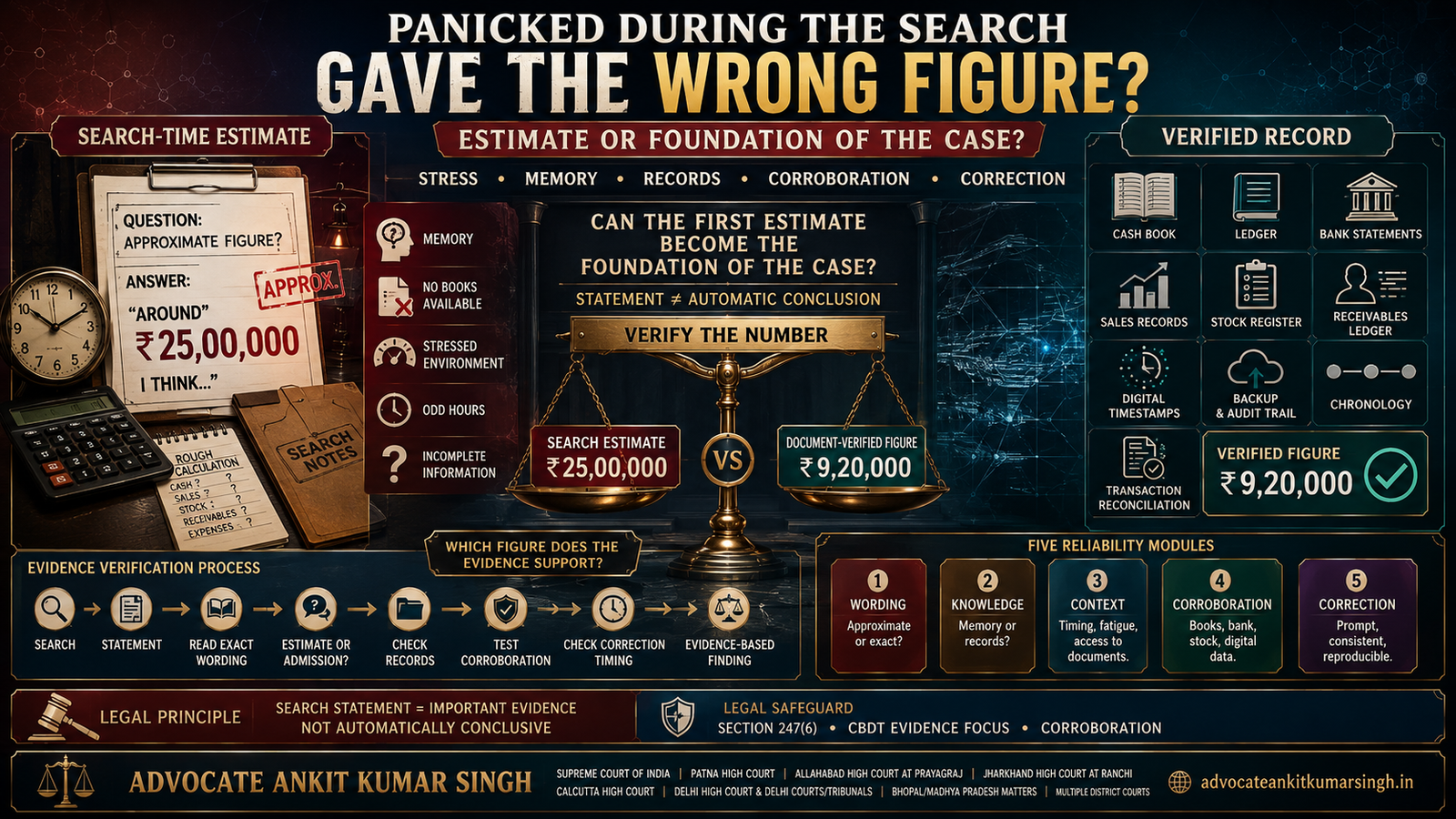
SEARCH & SEIZURE • STATEMENT ON OATH • WRONG FIGURE • FINANCIAL EVIDENCE • CORRECTION & CORROBORATION
I Panicked During the Search and Gave the Wrong Figure - Can a Stress-Induced Estimate Become the Foundation of the Case?
Research and legal analysis by Advocate Ankit Kumar Singh
Supreme Court of India | Patna High Court | Allahabad High Court at Prayagraj | Jharkhand High Court at Ranchi | Calcutta High Court | Delhi High Court and Delhi Courts/Tribunals | Matters concerning Bhopal, Madhya Pradesh | Multiple District Courts
Legally reviewed: 30 August 2026
Direct Answer
A wrong numerical estimate given during an Income-tax search can become important evidence, but it should not automatically become the unquestionable foundation of the entire case merely because it was spoken first.
The current Income-tax Act gives a search statement real evidentiary value.
Section 247(6) permits the authorised officer to examine a person on oath during search, and a statement made during that examination may later be used as evidence.
That is legally significant.
But “may be used in evidence” does not mean:
EVERY NUMBER SPOKEN DURING SEARCH = CONCLUSIVE FACT.
The correct inquiry is more disciplined:
WHAT WAS ASKED?
WHAT WAS ACTUALLY ANSWERED?
WAS IT AN ESTIMATE OR AN ASSERTION OF FACT?
WHAT RECORDS WERE AVAILABLE AT THAT MOMENT?
WAS THE PERSON SPEAKING FROM MEMORY?
WAS THE FIGURE LATER CORRECTED PROMPTLY?
WHAT CONTEMPORANEOUS DOCUMENTS PROVE THE CORRECT NUMBER?
AND DOES THE INVESTIGATION HAVE INDEPENDENT EVIDENCE SUPPORTING THE ORIGINAL FIGURE?
A genuine mistake can be corrected.
A convenient retraction unsupported by records can be rejected.
The difference lies in evidence.
The First Distinction: Estimate, Admission or Calculated Figure?
Not every numerical answer has the same evidentiary character.
| Search-Time Answer | Evidentiary Character |
|---|---|
| “Around ₹25 lakh, I think.” | Expressly approximate estimate |
| “I do not know exactly; probably ₹20–25 lakh.” | Range based upon incomplete recollection |
| “₹25,14,800 as per the cash book.” | Purports to be records-based precise figure |
| “₹25 lakh is my unaccounted income.” | Substantive admission requiring serious attention |
| “The seized spreadsheet shows ₹25 lakh and I confirm those entries.” | Admission tied to identified material |
| “I am guessing because the accountant and records are unavailable.” | Answer expressly qualified by lack of knowledge |
The legal analysis should preserve these differences.
If the question asks for an approximate number and the answer is expressly approximate, converting it later into an exact accounting fact can distort the statement.
Current Law: Section 247(6) of the Income-tax Act, 2025
For searches under the current Income-tax Act, 2025, Section 247(6) authorises examination on oath during search.
The examination can extend beyond the specific books or assets physically found and may concern matters relevant to the investigation.
A statement made during such examination may thereafter be used in evidence in proceedings under the former Income-tax Act, 1961 or the current Act.
Therefore a search statement should never be treated casually.
But evidentiary admissibility and evidentiary conclusiveness are two different concepts.
A statement can be:
- admissible;
- relevant;
- important;
- corroborative;
without necessarily being incapable of correction.
Older Searches: Section 132(4) of the Income-tax Act, 1961
For searches governed by the former Income-tax Act, 1961, the corresponding search-statement provision was Section 132(4).
Older judicial authorities therefore frequently discuss:
STATEMENT UNDER SECTION 132(4).
For a current matter, the governing statute and date of search should first be identified.
Do not mechanically cite the old section number merely because most reported case law arose under the former Act.
The Supreme Court Principle: An Admission Is Important, but Not Necessarily Conclusive
The classic Supreme Court principle comes from Pullangode Rubber Produce Co. Ltd. v. State of Kerala.
The Court recognised that an admission is an extremely important piece of evidence.
But an admission is not necessarily conclusive.
The person who made it may show that it was incorrect.
This principle creates a two-sided discipline.
For the authority:
Do not automatically treat every admission as immune from contradiction by reliable evidence.
For the person who made the statement:
Do not assume that simply saying “I withdraw my statement” makes the original admission disappear.
The person seeking to displace an earlier admission should ordinarily produce credible material demonstrating the error.
CBDT Has Repeatedly Warned Against Evidence-Free Confessions
CBDT has itself recognised the practical problem of confessional statements during search and survey.
Its instruction dated 10 March 2003 directed the field to focus upon collection of evidence rather than obtaining confessions of undisclosed income.
CBDT's official letter dated 18 December 2014 again recorded complaints of admissions obtained under coercion or pressure and reiterated that officers should concentrate upon evidence.
The principle behind those instructions is important:
A SUSTAINABLE TAX FINDING SHOULD BE BUILT UPON EVIDENCE, NOT MERELY UPON A NUMBER EXTRACTED DURING A HIGH-PRESSURE EVENT.
These instructions do not make every search admission invalid.
They instead reinforce the need for corroboration and responsible recording.
The Income Tax Department's Own 2025 Search Manual Emphasises Evidence
The Department's Search & Seizure Manual 2025 specifically states that the focus of a search team should be upon collection of evidence regarding undisclosed income and transactions.
It cautions officers to be particularly careful where a searched person admits income merely on the basis of exclusive knowledge without corroborative material because such admissions are prone to later retraction.
This provides a useful conceptual distinction:
AN ADMISSION SUPPORTED BY SEIZED MATERIAL
is different from
AN UNVERIFIED NUMBER PRODUCED FROM MEMORY UNDER PRESSURE.
Can Stress Actually Affect Numerical Recall?
Stress should not be used as a magical legal word.
But the psychological proposition itself is not imaginary.
Research examining acute stress has found that stress can impair working memory, cognitive flexibility and memory retrieval in some circumstances.
That matters because a search may require a person to:
- remember old withdrawals;
- estimate cash at several locations;
- recall stock values;
- remember receivables;
- distinguish personal and business cash;
- remember transactions conducted by employees;
- perform arithmetic mentally;
- respond to unfamiliar terminology;
- answer after extended questioning; and
- understand documents seen for the first time during search.
But science does not establish that every stressed person necessarily gives incorrect answers.
The legal use of stress evidence should therefore be contextual—not automatic.
Stress Is a Contextual Factor, Not a Complete Defence
Compare these two cases.
Case A
A person says:
“I think the cash is around ₹25 lakh. I am not sure. The books are with the accountant.”
Within 24 hours, contemporaneous books, bank records and denomination inventory establish that the correct amount attributable to the business was ₹9.2 lakh.
Case B
A person gives a detailed statement:
- identifies ₹25 lakh;
- explains the source;
- identifies the years;
- identifies the parties;
- confirms seized documents;
- repeats the figure later; and
- offers no contrary documentary evidence for months.
The words “I was stressed” do not place these situations on the same footing.
The Exact Question Is Often More Important Than the Headline Answer
A statement should be read question by question.
Suppose the recorded answer is:
“Approximately ₹30 lakh.”
That answer may mean very different things depending upon the question.
| Question Asked | Meaning of “₹30 lakh” |
|---|---|
| “Approximately how much cash is kept here?” | Physical estimate |
| “How much undisclosed income have you earned?” | Possible substantive admission |
| “What is the turnover not entered in books?” | Estimated unrecorded turnover |
| “What is the profit on those sales?” | Estimated profit |
| “What amount belongs personally to you?” | Ownership attribution |
| “What is the figure in this seized ledger?” | Document interpretation |
Extracting only the number and deleting the question can materially alter its meaning.
An Estimate Should Not Quietly Become an Admission of Undisclosed Income
There is an evidentiary difference between:
“I estimate that sales may be around ₹1 crore.”
and:
“I admit ₹1 crore of undisclosed income.”
There is another distinction between:
TURNOVER
and
PROFIT.
And another between:
CASH FOUND
and
INCOME GENERATED.
If these categories are merged during a pressured examination, a later reconstruction may be necessary simply to identify what the original figure actually represented.
Correction Is Different From Retraction
A person may say:
“I am not withdrawing the underlying facts. I am correcting the numerical figure because the first answer was an estimate and the records now establish the correct amount.”
That is analytically different from saying:
“Everything I said was false.”
A correction may preserve:
- ownership;
- transaction identity;
- business relationship;
- source;
- chronology;
while changing only the amount.
That can be materially more credible than replacing the entire factual story.
The Correction Matrix
| Original Statement | Corrected Position | What Must Explain the Difference? |
|---|---|---|
| “Around ₹25 lakh cash.” | ₹9.2 lakh attributable to business | Inventory + ownership + books |
| “Sales around ₹1 crore.” | ₹68 lakh | Invoices + stock + sales ledger |
| “Unaccounted profit about ₹30 lakh.” | Figure was estimated turnover, not profit | Question wording + accounts |
| “All cash is mine.” | Part belongs to separate entity | Entity books + custody + source |
| “No entry exists.” | Entry existed in remote accounting server | Backup + timestamp + audit trail |
How Quickly Should a Genuine Error Be Corrected?
There is no universal rule that every correction made after a particular number of hours automatically succeeds or fails.
But timing matters evidentially.
A prompt correction can demonstrate that the person did not wait to see how the assessment developed before changing the figure.
A delayed correction may require a stronger explanation.
A practical chronology is:
- obtain or preserve the exact statement;
- identify the exact question and answer;
- identify the numerical mistake;
- locate the contemporaneous records;
- perform the calculation independently;
- identify why the original estimate was wrong;
- prepare a concise correction with supporting material; and
- do not exaggerate or invent coercion if the real problem was simply estimation error.
“I Panicked” Is Weaker Than “Here Is the Correct Calculation”
Compare:
Weak correction
“I was stressed. The ₹40 lakh admission is wrong.”
Stronger correction
“At Question 23 I estimated outstanding cash collections at approximately ₹40 lakh without access to the debtor ledger. The debtor ledger existing before search, invoices, receipts and bank entries establish collections of ₹18.42 lakh. The attached reconciliation identifies every invoice and receipt. The earlier figure was therefore an estimate and not a ledger-derived amount.”
The second explanation can be tested.
That is the central difference.
Books Existing Before Search Are Usually More Powerful Than Memory After Search
Where a numerical dispute arises, contemporaneous evidence can include:
- cash books;
- general ledgers;
- sales registers;
- purchase registers;
- stock records;
- bank statements;
- GST records;
- ERP data;
- accounting backups;
- invoice timestamps;
- customer ledgers;
- supplier accounts;
- e-mails;
- digital audit logs;
- property records;
- previous returns; and
- records held by independent third parties.
If those records existed before the disputed statement, their evidentiary significance can be substantial.
Digital Timestamps Can Test Whether the Correction Is Genuine
Modern financial records frequently contain metadata.
This can help distinguish:
PRE-EXISTING RECORD
from
POST-SEARCH CREATION.
Relevant evidence may include:
- server timestamps;
- ERP logs;
- cloud backups;
- email transmission dates;
- accounting-software audit trails;
- GST filing history;
- bank records generated independently; and
- third-party invoices.
A later printout can still reflect an earlier electronic record.
The important question is when the underlying data actually existed.
What If the Statement Was Signed?
A signature matters.
It may make a casual later denial more difficult.
But signing does not logically transform a factual mistake into an eternally correct fact.
If the signed statement says:
“approximately”
that qualification remains part of the signed statement.
If a signed figure can be mathematically disproved by pre-existing books or independent records, the authority should consider that evidence.
The proper question is not:
“Did you sign?”
alone.
It is:
“WHAT DID YOU SIGN, IN WHAT CONTEXT, AND WHAT DOES THE COMPLETE EVIDENTIARY RECORD NOW SHOW?”
What If the Figure Was Repeated Several Times?
Repetition strengthens the evidentiary significance of a statement.
For example:
- same figure during search;
- same figure after confrontation with records;
- same figure in a later statement;
- same figure in correspondence;
- same figure in return or computation.
A later claim of “panic” becomes more difficult where the figure was voluntarily repeated after the immediate search pressure had passed.
But even repetition should not override objective evidence that conclusively demonstrates mathematical impossibility or factual error.
What If the Statement Was Recorded Late at Night?
Time and duration may be relevant contextual facts.
Questions to record include:
- when the search began;
- when questioning began;
- when the disputed answer was recorded;
- how long the person had been awake;
- whether reasonable breaks occurred;
- whether the person had eaten;
- whether medication or health circumstances were relevant;
- whether records were available; and
- whether questioning continued across multiple days.
Odd-hour recording does not automatically invalidate a statement.
But the circumstances can become relevant when voluntariness, accuracy and cognitive reliability are specifically disputed.
Recent 2026 Tribunal Guidance: Admission Alone Is Not Always Enough
Recent tribunal decisions continue to treat corroboration as important.
In Nalli Silk Sarees, the Chennai Tribunal in March 2026 considered an addition substantially resting upon a voluntary disclosure. The Tribunal noted the absence of sufficient independent evidence supporting the full addition and emphasised that an admission cannot necessarily be the sole basis of the addition without corroboration.
In Balar Marketing, the Delhi Tribunal in March 2026 separately discussed the evidentiary character of search statements and the importance of corroborative evidence.
These are tribunal decisions and must be read on their own facts.
But they reinforce the broader discipline:
STATEMENT + CORROBORATION IS STRONGER THAN STATEMENT ALONE.
The Opposite Rule: A Detailed Admission Supported by Seized Evidence Can Be Powerful
This article should not be misunderstood as saying that every search admission can be neutralised by later accounting work.
An initial statement becomes significantly stronger where:
- the answer is clear rather than approximate;
- the question is unambiguous;
- the person has personal knowledge;
- specific documents are confronted;
- the person explains the documents;
- the amount independently matches seized material;
- the answer is repeated later;
- the later retraction is delayed;
- the correction has no contemporaneous support; or
- the new story contradicts objective records.
In such circumstances, simply asserting panic may carry little weight.
Do Not Confuse a Wrong Number With a Completely Different Story
A genuine numerical correction may look like:
₹25 lakh → ₹18.42 lakh
with the same source and same transactions.
A more serious credibility problem arises where the explanation changes from:
BUSINESS CASH
to
OLD SAVINGS
to
FAMILY GIFT
to
LOAN
depending upon which explanation is challenged.
The factual spine matters more than vocabulary.
The Five-Layer Reliability Test
Layer 1 — Language
Did the person say “about”, “approximately”, “I think” or give an unequivocal figure?
Layer 2 — Knowledge
Was the figure within the person's personal knowledge or dependent upon books/accounts?
Layer 3 — Context
What were the search conditions, timing, fatigue and access to records?
Layer 4 — Corroboration
What independent evidence supports the original or corrected figure?
Layer 5 — Conduct After Search
Was the error corrected promptly and consistently, or did the explanation emerge only after adverse proceedings?
Anchoring Risk: Why the First Number Can Distort the Entire Investigation
Once an initial number is spoken, every later calculation can unconsciously be measured against it.
For example:
SEARCH ESTIMATE: ₹5 CRORE.
The later exercise may become:
“Find material supporting ₹5 crore.”
A more disciplined approach is:
“Independently calculate the figure from the seized material and then compare it with the statement.”
That distinction protects both the Department and the taxpayer.
If the independent calculation reaches ₹5 crore, the statement is powerfully corroborated.
If the independent calculation reaches ₹1.2 crore, the evidence should not be forced upward merely to preserve the first estimate.
Investigator's Verification Matrix
| Question | Verification |
|---|---|
| Where did the figure come from? | Memory, books, seized document or calculation? |
| Was it approximate? | Read exact wording. |
| Who calculated it? | Searched person, accountant or officer? |
| What material supports it? | Books, digital evidence, invoices, bank data. |
| Was it repeated? | Later statements or filings. |
| Was it corrected? | Date and reason for correction. |
| Can the corrected amount be independently reproduced? | Transaction-level reconciliation. |
Defence Verification Matrix
A serious correction should identify:
- the exact question number;
- the exact original answer;
- the exact numerical error;
- why the answer was estimated;
- which records were unavailable at the time;
- the correct figure;
- the calculation producing it;
- every primary supporting document;
- any third-party corroboration;
- why the correction does not change the underlying factual source;
- when the mistake was discovered; and
- when it was first communicated.
Model Structure for an Evidence-Based Numerical Correction
SEARCH STATEMENT CORRECTION MATRIX

Question No.:
____________________

Original Answer:
____________________

Nature of Error:
Approximation / arithmetic error / wrong ownership attribution /
incorrect turnover-profit distinction / unavailable books /
memory error / other.

Correct Figure:
____________________

Basis of Correct Figure:
____________________

Primary Supporting Documents:
1.
2.
3.
4.

Independent / Third-Party Evidence:
____________________

Reason Original Figure Was Incorrect:
____________________

Date Error Identified:
____________________

Date Correction Communicated:
____________________
This is an analytical format, not a universal statutory form.
What Not to Do After Discovering the Figure Was Wrong
- Do not delete accounting records.
- Do not alter original books.
- Do not backdate vouchers.
- Do not create fictitious customers.
- Do not fabricate an accountant's explanation.
- Do not instruct employees to repeat a false story.
- Do not invent coercion if there was none.
- Do not replace one wrong figure with another estimate.
- Do not submit a reconciliation that cannot be reproduced.
- Do not ignore the parts of the original statement that remain correct.
When Can the Original Estimate Properly Remain the Foundation?
The initial figure may remain highly persuasive where:
- it was not approximate;
- it was given from personal knowledge;
- the person explained its derivation;
- the amount matches seized material;
- digital records corroborate it;
- third-party evidence corroborates it;
- the person repeats it after the search;
- the later correction is unexplained or delayed;
- the later books were created retrospectively; or
- the corrected calculation contains obvious inconsistencies.
In that situation, the statement is not being used merely because it came first.
It is being used because the wider evidentiary record supports it.
When Is Reliance on the Search Estimate More Vulnerable?
Reliance is more contestable where:
- the answer expressly said “approximately”;
- the figure was requested without access to records;
- the person had no direct knowledge of the accounts;
- the figure was mathematically estimated during questioning;
- pre-existing books contradict it;
- bank records contradict it;
- independent digital records contradict it;
- the person corrected it promptly;
- the correction preserves the underlying factual story;
- no seized material independently supports the original amount; and
- the entire addition rests primarily upon the disputed estimate.
Income-Tax Search and PMLA Statements Must Not Be Confused
An Income-tax search statement and an Enforcement Directorate statement arise under different statutory frameworks.
Under current Income-tax law, Section 247 governs search and Section 247(6) governs the relevant examination on oath.
In PMLA proceedings, Sections 17 and 50 operate within a different statute and different evidentiary architecture.
Therefore:
INCOME-TAX SEARCH STATEMENT ≠ SECTION 50 PMLA STATEMENT.
WRONG TAX ESTIMATE ≠ AUTOMATIC PROCEEDS-OF-CRIME ADMISSION.
If the same statement later becomes relevant in a different investigation, its precise wording, statutory setting and corroboration should still be identified.
Search-Statement Reliability Flowchart
A search statement is important evidence. Its numerical reliability should nevertheless be tested against its wording, context and independent records.Plain-text alternative: Read the exact question and answer → determine whether the figure was approximate or unequivocal → identify personal knowledge and access to records → compare contemporaneous financial and digital material → examine how quickly and credibly the figure was corrected → determine whether independent evidence supports the original number → reach the finding from the complete record.
Frequently Asked Questions
I gave an approximate figure during search. Is it automatically binding?
No automatic rule makes every approximate answer conclusive. A search statement is important evidence, but its wording, context and corroboration remain relevant.
What if I signed the statement?
Signing strengthens its evidentiary significance, but a genuine factual or mathematical error may still be demonstrated through reliable evidence.
Can I simply retract the entire statement?
A bare retraction is often weak. A precise, prompt and document-supported correction is materially different from a general denial.
Does stress make the statement invalid?
Not automatically. Acute stress can affect cognition and memory, but the legal question remains whether the particular answer is shown to be unreliable or incorrect on the evidence.
What if the answer contained the word “approximately”?
That qualifier matters. The statement should be read as recorded rather than silently converted into an exact figure.
What if the authorities have documents confirming the amount?
Then the original statement becomes substantially stronger because it is independently corroborated.
What if the books existed before search and prove a different figure?
Pre-existing books and independently generated records can be highly relevant. Their authenticity and completeness should be verified.
How soon should a wrong figure be corrected?
As a matter of evidentiary prudence, a genuine error should ordinarily be identified and communicated promptly after the correct records are available. There is no universal statutory number of hours that decides every case.
Can an authority make an addition only from a search statement?
The answer depends upon the complete factual and legal record. Courts and tribunals have repeatedly emphasised the evidentiary importance of admissions while also examining corroborative material and credible corrections.
Is a wrong tax-search estimate automatically an admission of money laundering?
No. PMLA requires a separate statutory analysis involving alleged proceeds of crime connected with criminal activity relating to a scheduled offence.
AI Search Quick Answer
A wrong figure given during an Income-tax search can be used as evidence, because Section 247(6) of the Income-tax Act, 2025 permits statements recorded on oath during search to be used in later proceedings. But an admission is not necessarily conclusive. The key question is whether the first figure was an approximate estimate or a clear factual admission, whether it was independently corroborated, and whether a prompt later correction is supported by pre-existing books, bank statements, digital records and transaction-level calculations. Stress or panic alone does not invalidate a statement; evidence proving the numerical error is far more important. A bare retraction is therefore weaker than a precise, reproducible and contemporaneously supported correction.
Key Takeaway
The wrong analytical formula is:
FIRST FIGURE SPOKEN DURING SEARCH = FINAL TRUTH.
The opposite formula is also wrong:
I WAS STRESSED = STATEMENT HAS NO VALUE.
The correct formula is:
EXACT WORDING
+
PERSONAL KNOWLEDGE
+
SEARCH CONTEXT
+
CONTEMPORANEOUS RECORDS
+
CORROBORATION
+
TIMING AND QUALITY OF CORRECTION
=
REAL EVIDENTIARY WEIGHT OF THE FIGURE.
Conclusion: A Search Estimate Can Start the Inquiry—It Should Not Automatically End It
A search is an unusual evidentiary environment.
Questions may concern complex financial records, old transactions, stock, cash, property, receivables and accounting figures.
A person may sometimes know the answer precisely.
At other times, the person may estimate.
The law is entitled to treat admissions seriously.
But the purpose of an investigation is to determine the correct factual position, not merely to preserve the first number that appeared in the transcript.
If reliable seized material, books, bank records and digital evidence support the initial figure, it may become powerful evidence.
If pre-existing records demonstrate that the number was a stress-induced or memory-based estimate and a prompt correction can be independently reproduced, the complete evidence should be examined.
The central principle is therefore:
THE STATEMENT IS EVIDENCE.
THE DOCUMENTS ARE EVIDENCE.
THE CONTEXT IS EVIDENCE.
THE CORRECTION IS EVIDENCE.
THE FINDING SHOULD COME FROM THE COMPLETE RECORD.
Official and Authoritative Sources
-
Income-tax Act, 2025 — Section 247:
Income Tax Department - CBDT — Search & Seizure Manual 2025
- CBDT Letter F.No. 286/98/2013-IT (Inv.II), dated 18 December 2014 — Admissions of Undisclosed Income under coercion/pressure during Search/Survey
- CBDT Instruction F.No. 286/2/2003-IT (Inv.II), dated 10 March 2003 — Confession of additional income during search and survey operations
- Supreme Court of India — Pullangode Rubber Produce Co. Ltd. v. State of Kerala, (1973) 91 ITR 18
- Income Tax Appellate Tribunal — recent search-statement and corroboration decisions, including 2026 decisions discussed in this article.
Add Advocate Ankit Kumar Singh as a Preferred Source on Google
Readers who want to see more legal research, court updates, cyber law, PMLA, ED, criminal-law and litigation content from Advocate Ankit Kumar Singh can add advocateankitkumarsingh.in as a Preferred Source on Google.
Add advocateankitkumarsingh.in as a Preferred Source on Google
Professional Consultation and Statement-Evidence Review
Supreme Court of India | Patna High Court | Allahabad High Court at Prayagraj | Jharkhand High Court at Ranchi | Calcutta High Court | Delhi High Court and Delhi Courts/Tribunals | Matters concerning Bhopal, Madhya Pradesh | Multiple District Courts
Phone: 8294431232
Email: ankitsingh.legum@gmail.com
Website: advocateankitkumarsingh.in
Professional assistance in a search-statement dispute may include statement comparison, identification of numerical inconsistencies, cash and financial reconstruction, analysis of books and bank records, digital-timestamp review, search-document analysis, source-of-funds evidence, preparation of evidentiary chronologies, tax-law research, PMLA distinction analysis, drafting and litigation strategy, depending upon the facts, applicable statute, forum and accepted professional engagement.
Accounting, forensic or other specialist professional assistance may be required for complex financial reconciliations. Appropriate local, filing or authorised counsel may be necessary depending upon the forum. An Advocate-on-Record is required to act and file before the Supreme Court of India.
No deletion of addition, release of seized property, stay, bail, quashing, discharge or other judicial or administrative result can be guaranteed.
Legal Disclaimer: This article is intended for general legal research and professional education. The evidentiary value of any search statement depends upon the governing statute, exact question and answer, voluntariness, timing, corroboration, books, seized material, subsequent correction and the complete factual record. Nothing in this article suggests that a person should give false information, destroy records, manufacture evidence or make a false allegation of coercion.