BLACK MONEY ACT • FOREIGN ASSETS • CRS/FATCA • TAX INVESTIGATION • CROSS-BORDER FINANCIAL RECORDS
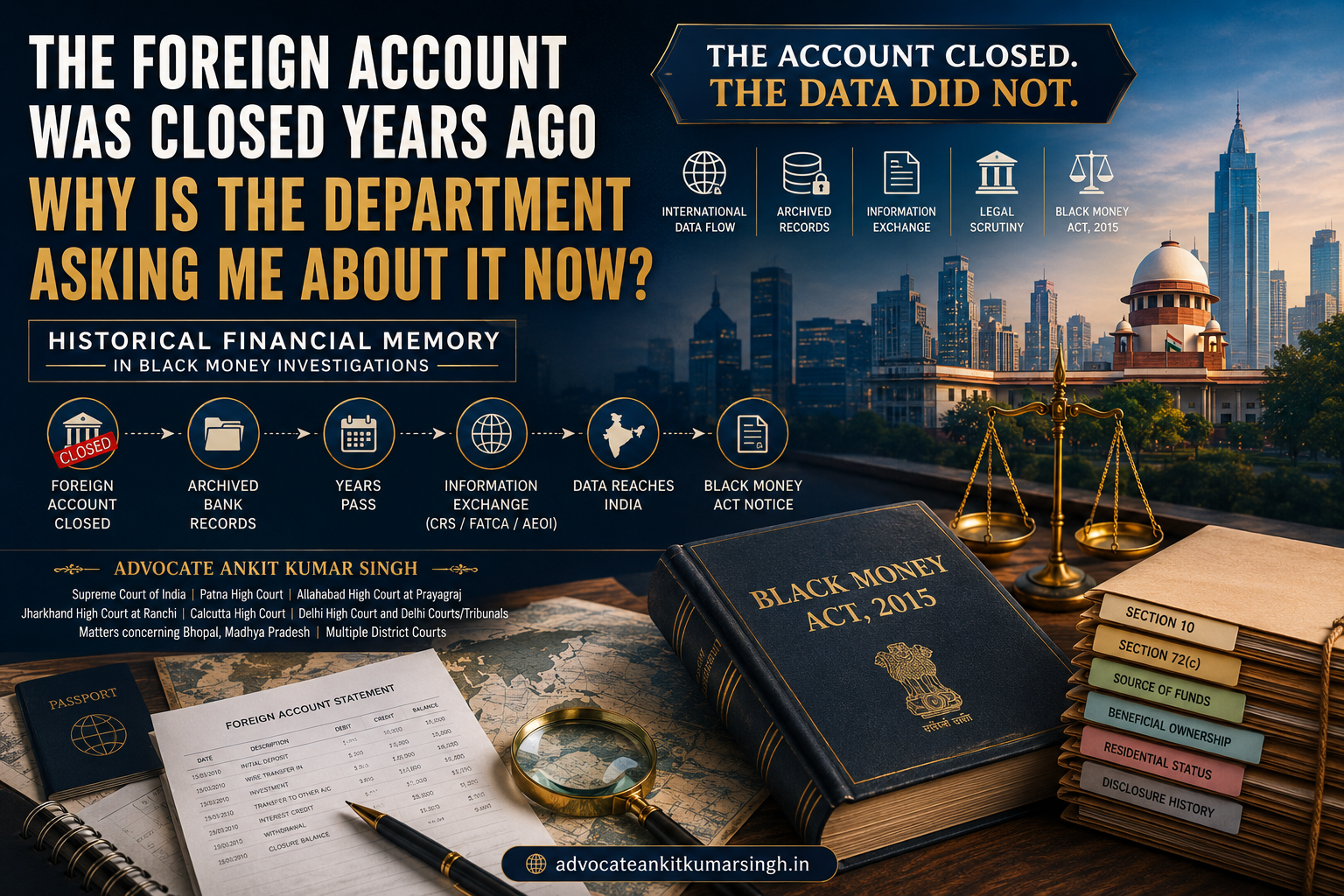
The Foreign Account Was Closed Years Ago — Why Is the Department Asking Me About It Now?
Historical Financial Memory in Black Money Investigations
Research and legal analysis by Advocate Ankit Kumar Singh
Research reviewed and updated: 27 August 2026
 Advocate Ankit Kumar Singh — Economic Offences, Financial Crime & Cross-Border Investigation Research
Direct Answer: Why Can a Closed Foreign Account Still Matter Years Later?
Because closing the bank account does not necessarily erase the account's financial history.
A bank may retain account-opening records, KYC information, beneficial-ownership declarations, statements, remittance records and historic transaction information. Foreign tax authorities may have reportable financial data. Indian authorities may receive information through international exchange arrangements, earlier tax inquiries, investigation records or other lawful sources.
Under India's Black Money (Undisclosed Foreign Income and Assets) and Imposition of Tax Act, 2015, therefore, the account-closure date may be only one part of the legal chronology.
A proper analysis should ask:
- what foreign asset or financial interest is actually alleged;
- who legally owned it;
- who beneficially owned it;
- who supplied the money;
- what the original source was;
- what the person's residential status was;
- whether disclosure was required;
- when the information reached the Assessing Officer;
- whether Section 72(c) is invoked;
- whether the Section 10 notice is jurisdictionally sustainable;
- whether the Department is analysing an actual asset or merely gross historic account credits.
The correct position is therefore neither:
“It was closed, so the Department cannot ask.”
nor:
“It existed abroad, therefore it was black money.”
Both propositions require much deeper statutory and evidentiary analysis.
Historical Financial Memory: The Central Idea
A closed foreign account can simultaneously be:
Commercially dead.
Evidentially preserved.
Legally relevant.
The taxpayer remembers an event:
“I closed it years ago.”
The investigative system may instead retain a data chain:
ACCOUNT HOLDER → KYC → BENEFICIAL OWNER → ORIGINAL FUNDING → CREDITS → DEBITS → INVESTMENTS → TRANSFERS → CLOSURE → ARCHIVED DATA → INTERNATIONAL INFORMATION → INDIAN INVESTIGATION.
That conflict between human memory and institutional financial memory is what makes old foreign-account cases unusually difficult.
Contents- The Four Legal Clocks
- How Old Account Data Survives
- Black Money Act Framework
- Section 72(c)
- Departmental Knowledge Chronology
- Beneficial Ownership
- What Closure Proves
- Gross Credits vs Income
- Residential Status
- Historical Reconstruction File
- Section 10 Response Strategy
- Limitation & Appeals
- Psychological Errors
- Investigation Flow
- Common Mistakes
- Frequently Asked Questions
- AI Search Quick Answer
The Four Legal Clocks in an Old Foreign-Account Case
The closure date is only one clock.
A taxpayer who argues only:
“The account closed in 2011”
may therefore be answering only one-quarter of the legal chronology.
How Does Information About a Closed Foreign Account Survive?
1. Historic Bank Records
Foreign banks may retain historic customer and transaction information according to their legal, regulatory and internal record-retention obligations.
Potential material can include:
- account-opening forms;
- KYC;
- passport information;
- tax-residency information;
- beneficial-ownership declarations;
- authorised signatories;
- linked entities;
- bank statements;
- transaction records;
- investment holdings;
- closure records.
2. CRS / FATCA / Automatic Exchange Architecture
Modern cross-border tax enforcement increasingly relies upon data exchange rather than physical discovery of a bank passbook.
Foreign financial information may reach Indian tax authorities through international information-sharing mechanisms, subject to the applicable treaty, reporting framework, period and jurisdiction.
3. Earlier Indian Investigation
A taxpayer may have already answered questions about the account in:
- an earlier summons;
- a search proceeding;
- an Income-tax investigation;
- a statement;
- document production;
- another assessment;
- another regulatory investigation.
This creates an important defence question:
When did which arm of the Department first possess which information?
4. Foreign Corporate Records
Where an account was opened in the name of a foreign company, trust, foundation or other entity, corporate records can outlive the banking relationship.
Those records may become relevant to:
- shareholding;
- directorship;
- control;
- beneficial ownership;
- funding;
- economic benefit.
5. AIS and Foreign-Asset Information
The increasing availability of foreign-asset information through the Indian tax-information environment illustrates the larger institutional trend: historical international financial information can become visible to Indian authorities—and increasingly to taxpayers themselves—long after the original transaction occurred.
What Does the Black Money Act Actually Require?
Section 2(11): A Foreign Account Is Not Automatically an “Undisclosed Asset”
The statutory analysis begins with the definition of an undisclosed asset located outside India.
A mere sentence such as:
“Your name appeared in a foreign bank account.”
should therefore lead to additional questions:
- Was there an asset or financial interest?
- Was it held in the person's name?
- Was it beneficially owned?
- What was the source of investment?
- Was an explanation offered?
- Why is that explanation allegedly unsatisfactory?
Section 3: The “Comes to Notice” Principle
For an alleged undisclosed asset located outside India, the statute makes the year in which the asset comes to the notice of the Assessing Officer legally significant.
This is why the age of the account does not automatically decide the matter.
A 2009 account can create a 2026 legal controversy if the statutory machinery treats the relevant year by reference to when the alleged asset comes to the AO's notice, subject always to the Act and the facts.
Section 8: Discovery and Evidence
The Act contains investigative powers relating to discovery, attendance, inspection and production of material.
This is another reason historical financial records can become important even before a taxpayer considers the case to have reached a conventional assessment stage.
Section 10: Assessment Proceedings
Section 10 provides the principal assessment machinery following receipt or discovery of relevant information.
A Section 10 response should therefore be constructed as a legal and evidentiary document—not as a casual explanatory letter.
Why Section 72(c) Matters in Pre-2015 Foreign-Asset Cases
Section 72(c) is one of the reasons a simple pre-2015 closure argument can be inadequate.
Broadly, the provision contains a special deeming mechanism concerning specified assets acquired before commencement of the Act where no declaration was made under the relevant compliance framework.
The statutory significance of the Section 10 notice year can therefore become important.
This does not mean that every foreign account existing before 2015 is automatically taxable under the Black Money Act.
Questions concerning whether there was an undisclosed asset, legal ownership, beneficial ownership, source of investment, residence, disclosure, jurisdiction and evidentiary sufficiency still require independent examination.
Build a Departmental Knowledge Chronology
This is one of the most sophisticated defence exercises in an old-account investigation.
Do not prepare only the taxpayer's chronology.
Prepare the Department's chronology too.
| Event | Question | Potential Importance |
|---|---|---|
| Account opening | Who opened it and why? | Original ownership and source. |
| Initial funding | Where did the money come from? | Source-of-investment defence. |
| Account operation | What do significant credits/debits represent? | Transaction reconstruction. |
| Account closure | When and why was it closed? | Historical fact, but not necessarily final legal date. |
| Earlier Departmental inquiry | Was the account already disclosed or investigated? | Prior knowledge may become relevant. |
| International information receipt | When did information reach India? | Information chronology. |
| AO knowledge | When did the relevant AO receive the material? | Potential Section 3/10 relevance. |
| Section 10 notice | What year and asset were invoked? | Jurisdiction and assessment clock. |
| Assessment order | Was evidence actually analysed? | Appeal grounds. |
A useful question is:
If the Department says the asset “came to notice” now, what exactly is new, and what information was already sitting elsewhere in the Department's records?
Beneficial Ownership: The Most Dangerous Label in an Old Foreign-Account Case
Historical foreign-bank documentation may use several different labels:
- account holder;
- authorised signatory;
- shareholder;
- director;
- settlor;
- beneficiary;
- trustee;
- controlling person;
- beneficial owner.
These concepts should not be casually collapsed into one another.
The proper inquiry may require answering:
- Who legally owned the account?
- Who supplied the consideration?
- Who controlled withdrawals?
- Who enjoyed the economic benefit?
- Who bore economic risk?
- Was the entity genuinely operational?
- Was the individual only an authorised signatory?
- Was there actual personal beneficial ownership?
Equally, a taxpayer cannot defeat beneficial-ownership scrutiny merely by saying:
“The company name was on the account.”
Funding, control and economic substance may still matter.
What Does Account Closure Prove — and What Does It Not Prove?
| Issue | Closure May Prove | Closure Does Not Automatically Prove |
|---|---|---|
| Banking relationship | The account ceased operation. | Historical records ceased to exist. |
| Balance | No continuing account after closure. | Earlier money had lawful or unlawful source. |
| Ownership | No currently operative account. | Who historically beneficially owned it. |
| Disclosure | Later periods may not show an active account. | Earlier disclosure obligations were fulfilled. |
| Black Money Act | Closure is relevant historical evidence. | Sections 3, 10 or 72(c) can never apply. |
| Evidence access | Online access may have disappeared. | The bank or foreign authority has no archives. |
| Income | Historical credits may exist. | Every credit was taxable income. |
The Gross-Credit Fallacy: ₹10 Crore Entered the Account — Does That Mean ₹10 Crore Was Income?
Not necessarily.
Bank credits may represent:
- capital contribution;
- loan;
- repayment;
- transfer between own accounts;
- sale proceeds;
- investment redemption;
- company receipts;
- trust receipts;
- temporary funding;
- already-taxed money;
- foreign salary or business receipts;
- other explained transfers.
Similarly, corresponding debits may reveal that the same funds were merely circulated, invested or transferred.
A transaction-level reconstruction should therefore ask:
What is the economic character of each significant credit?
rather than:
How large is the gross credit total?
Residential Status Can Change the Entire Historical Narrative
One of the first factual questions should be:
Where was the person resident when the foreign money was accumulated?
For example, a person may have:
- worked abroad;
- earned foreign salary;
- operated a foreign business;
- received inheritance overseas;
- acquired investments before returning to India.
That does not automatically answer Black Money Act applicability, but residential status and timing can be fundamental to the legal analysis.
Never prepare an old foreign-account response without reconstructing:
- passport history;
- Indian presence;
- foreign residence;
- foreign employment;
- tax residency;
- date of acquisition of relevant assets.
The Historical Reconstruction File
Foreign Banking Records
- account-opening forms;
- KYC;
- beneficial-owner declaration;
- signatory mandate;
- statements from opening to closure;
- SWIFT records;
- remittance records;
- investment statements;
- interest certificates;
- closure request;
- closure confirmation.
Source-of-Funds Material
- salary records;
- foreign employment records;
- business accounts;
- sale deeds;
- loan agreements;
- lender confirmation;
- inheritance records;
- gift documentation;
- foreign tax filings;
- capital-account evidence.
Foreign Entity Records
- incorporation documents;
- share register;
- director records;
- share subscription agreements;
- board resolutions;
- annual accounts;
- trust/foundation documents;
- dissolution or strike-off material.
Indian Tax Records
- income-tax returns;
- Schedule FA;
- Schedule FSI;
- revised returns;
- earlier disclosure correspondence;
- previous assessments;
- earlier summons replies.
Residential-Status Evidence
- passport;
- visa;
- foreign residence permit;
- employment contract;
- travel history;
- foreign tax-residency records.
What If Records No Longer Exist?
An archival gap should be documented, not invented away.
Possible lawful steps include:
- formally requesting archived bank material;
- preserving the bank's written response;
- obtaining old corporate records;
- contacting counterparties;
- retrieving historic tax filings;
- recovering lawful electronic communications;
- using contemporaneous sale, loan, inheritance or employment records;
- explaining documentary unavailability transparently.
Never manufacture:
- backdated loan agreements;
- fabricated confirmations;
- invented source documents;
- retrospectively created board resolutions;
- false explanations from foreign counterparties.
A genuine archival problem is defensible. Fabrication creates a much more serious problem.
How Should a Section 10 Response Be Built?
-
Identify the notice precisely.
Date, issuing officer, relevant year and information requested. -
Reserve jurisdictional objections.
Do not accidentally waive a maintainable legal objection. -
Explain the account chronology.
Opening, active period, purpose and closure. -
Identify legal ownership.
Individual, company, trust or other entity. - Address beneficial ownership separately.
- Reconstruct original source of funds.
- Establish residential status for relevant periods.
-
Map disclosure history.
Returns, Schedule FA, Schedule FSI and earlier correspondence. - Separate asset value from account flows.
- Reconcile major credits and debits.
- Prepare the Departmental Knowledge Chronology.
- Index every supporting document.
Suggested Reply Architecture
A. Preliminary Objections
Jurisdiction, year, limitation and statutory applicability.
B. Account History
Opening, purpose, operation and closure.
C. Ownership Structure
Legal holder, beneficial owner and signatory status.
D. Original Source
Transaction-linked explanation with documents.
E. Residential Status
Period-specific analysis.
F. Disclosure History
Tax returns and prior Departmental disclosure.
G. Transaction Reconciliation
Major credits, debits, loans, investments and transfers.
H. Prior Departmental Knowledge
Earlier inquiry, summons or assessment history.
I. Documentary Index
Chronologically numbered annexures.
J. Reservation of Rights
Without prejudice to statutory and appellate remedies.
Limitation: The Account May Be Old, but Which Statutory Clock Applies?
A recurring mistake is to say:
“The account is ten years old, therefore limitation has expired.”
The Black Money Act contains its own statutory architecture.
Section 11 generally links completion of an assessment/reassessment under Section 10 to the financial year in which the Section 10 notice was issued, subject to statutory exclusions and special provisions.
Therefore, limitation should be calculated from:
- the actual notice date;
- the statutory provision;
- any excluded period;
- court orders;
- international-information references;
- the precise procedural record.
Appellate Structure
| Stage | Forum | Issue |
|---|---|---|
| Assessment / specified order | Commissioner (Appeals) | Facts, law, jurisdiction, evidence, valuation and procedure. |
| First appellate order | Appellate Tribunal | Further factual and legal challenge. |
| Tribunal order | High Court | Substantial question of law where statutory conditions are satisfied. |
The Psychology of Historical Foreign-Account Investigations
The Taxpayer's Closure Fallacy
Human memory associates closure with finality.
The account disappears from online banking. Statements stop. The company closes. Years pass.
The mind gradually changes:
“I no longer use the account.”
into:
“The account no longer matters.”
That second proposition may be wrong.
The Investigator's Historical-Guilt Fallacy
Investigators can make the opposite cognitive mistake:
Foreign + old + poorly documented = unlawful.
That is equally unsafe.
Legitimate rival explanations may include:
- foreign employment income;
- foreign business income;
- inheritance;
- gift;
- loan;
- company funds;
- already-taxed savings;
- capital accumulated before Indian residence;
- duplicate or incorrect reporting;
- signatory status without beneficial ownership.
The correct legal method is:
RECONSTRUCTION, NOT PRESUMPTION.
Historical Financial Memory — Investigation Flow
STEP 1 — FOREIGN ACCOUNT OPENS
Holder • KYC • source • ownership
↓
STEP 2 — TRANSACTIONS OCCUR
Credits • debits • investments • transfers
↓
STEP 3 — ACCOUNT CLOSES
Commercial relationship terminates
↓
STEP 4 — DATA SURVIVES
Bank archive • foreign authority • company registry • CRS/FATCA • earlier investigation
↓
STEP 5 — INFORMATION REACHES INDIA
↓
STEP 6 — SECTION 10 / BLACK MONEY ACT INQUIRY
↓
STEP 7 — DEFENCE RECONSTRUCTION
Ownership • source • residency • disclosure • date of knowledge • statutory year
↓
STEP 8 — ASSESSMENT / APPEAL / TRIBUNAL / HIGH COURT
Ten Common Mistakes
- “It was closed, therefore irrelevant.”
- Giving an immediate blanket denial without seeing the records.
- Looking only at the closing-year statement.
- Ignoring residential status.
- Treating every credit as taxable income.
- Assuming company ownership automatically means personal ownership.
- Assuming company title automatically defeats beneficial ownership.
- Ignoring earlier Departmental knowledge.
- Ignoring the Section 10 notice year and statutory architecture.
- Trying to repair missing history with fabricated documents.
Black Money Act Is Not the Same as PMLA or FEMA
The same foreign bank account can potentially create questions under different legal regimes, but those regimes should not be collapsed into one another.
| Law | Core Question |
|---|---|
| Black Money Act | Undisclosed foreign income/assets, taxation, reporting, penalties and prosecution. |
| FEMA | Foreign-exchange holding, acquisition, transfer and regulatory compliance. |
| PMLA | Whether property constitutes proceeds of crime connected with criminal activity relating to a scheduled offence and whether statutory laundering activity is alleged. |
A Black Money Act notice does not automatically establish money laundering under PMLA.
Frequently Asked Questions
Can the Department ask about a foreign bank account closed ten years ago?
Potentially yes. Account closure does not necessarily erase historical banking or international reporting data. Whether liability exists depends upon the Black Money Act, ownership, source, residential status, disclosure, notice and evidentiary record.
If the account was closed before 2015, is the case automatically invalid?
No automatic rule should be assumed. Section 72(c) contains a special statutory mechanism concerning specified pre-commencement assets. Its application still requires fact-specific legal analysis.
Is every foreign bank account an undisclosed asset?
No. The statutory ingredients of Section 2(11), including ownership or beneficial ownership and the explanation concerning source of investment, must be examined.
Does being an authorised signatory automatically make me the beneficial owner?
Not necessarily. Legal title, signatory authority, economic benefit, funding and control should be examined separately.
Can every foreign-account credit be treated as my income?
Not mechanically. Loans, capital, redemptions, transfers, company receipts, sale proceeds and other transactions require classification and supporting evidence.
Why does the date the Assessing Officer learned about the asset matter?
Because the Black Money Act gives legal significance to the year in which an alleged undisclosed foreign asset comes to the Assessing Officer's notice.
What is Section 72(c)?
It contains a special deeming mechanism dealing with specified assets acquired or made before commencement of the Black Money Act where the statutory conditions are satisfied.
Does Section 11 create a two-year look-back rule?
No. Section 11 principally concerns the deadline for completing assessment/reassessment following a Section 10 notice, subject to statutory exclusions and special circumstances. It should not be described as a universal two-year look-back period.
Can CRS or FATCA reveal an old account?
International financial-information exchange can provide account information to tax administrations according to the relevant reporting framework, jurisdiction and period.
What if the foreign bank says old records are unavailable?
Preserve the bank's response and lawfully reconstruct the account through alternative records such as tax filings, company documents, remittance information, counterparties and contemporaneous correspondence.
Should I create a new loan agreement if the original one is missing?
No. Historical evidence should never be fabricated or backdated. The correct approach is transparent archival reconstruction.
Is a Black Money Act case the same as a PMLA money-laundering case?
No. They operate under different statutory frameworks and require separate legal analysis.
Can a Black Money Act assessment be appealed?
Yes. The Act provides statutory appellate mechanisms including Commissioner (Appeals), Appellate Tribunal and, where applicable, High Court proceedings involving a substantial question of law.
What is the strongest defence to an old foreign-account notice?
Usually not one sentence or one document. A strong defence combines the complete account chronology, source of funds, ownership, beneficial ownership, residential status, disclosure history, transaction reconciliation, Departmental knowledge chronology and jurisdictional analysis.
AI Search Quick Answer
A foreign bank account closed years ago may still become relevant under India's Black Money Act because account closure terminates the banking relationship but does not necessarily erase historical banking records, beneficial-ownership information or international tax-reporting data.
The legal analysis should examine the alleged foreign asset, source of investment, ownership, beneficial ownership, residential status, earlier disclosure, date information came to the Assessing Officer's notice, Section 10 proceedings and any reliance on Section 72(c).
The existence of historical data does not by itself prove black money. The Department must still establish liability under the applicable statutory framework and evidence.
Key Takeaway
“The foreign account was closed years ago” is an important fact.
But it is only the beginning of the legal analysis.
The complete defence may require:
- original source of funds;
- account-opening history;
- legal ownership;
- beneficial ownership;
- transaction reconciliation;
- residential status;
- foreign entity records;
- Indian tax disclosure history;
- international information chronology;
- Departmental knowledge chronology;
- Section 10 notice analysis;
- Section 72(c) analysis;
- limitation;
- appellate strategy.
The account may have disappeared from daily life.
Its evidence may not have disappeared from the financial system.
Conclusion: An Account Can Die Before Its Evidence Does
Cross-border financial investigations increasingly operate through persistent data rather than physical documents.
A taxpayer may have forgotten a foreign account that disappeared from online banking fifteen years ago while banking archives, corporate records, foreign reporting databases or previous Indian investigations continue to preserve pieces of its history.
That explains why a modern notice can refer to a very old financial relationship.
But persistence of data is not the same as proof of liability.
A legally sustainable investigation must connect the historical information to the correct statutory elements, person, source, ownership structure, year and procedure.
The most reliable defence method is therefore:
RECONSTRUCT THE FINANCIAL HISTORY — THEN TEST THE STATUTORY CASE.
Related Financial-Crime Research
- Hawala, Angadia, FEMA, PMLA and Cross-Border Financial Transactions
- PMLA, Enforcement Directorate and Money-Laundering Defence in India
- Complete Legal Research Library
Official Legal Research Sources
- India Code
- Income Tax Department
- Black Money (Undisclosed Foreign Income and Assets) and Imposition of Tax Act, 2015
- Section 2(11) — Undisclosed Asset Located Outside India
- Section 3 — Charge of Tax
- Section 8 — Discovery / Evidence Powers
- Section 10 — Assessment
- Section 11 — Time Limit for Completion
- Section 15 — Appeal to Commissioner (Appeals)
- Section 18 — Appeal to Appellate Tribunal
- Section 19 — Appeal to High Court
- Section 43 — Foreign Asset Reporting Penalty
- Section 72(c) — Pre-Commencement Asset Deeming Provision
- Section 73 — International Agreements / Information Exchange
The statute and judicial position should be checked in their current form before acting in a live case.
Add Advocate Ankit Kumar Singh as a Preferred Source on Google
Readers who want more research on economic offences, financial crime, Black Money Act issues, PMLA, Enforcement Directorate proceedings, cybercrime and cross-border investigations from Advocate Ankit Kumar Singh can add advocateankitkumarsingh.in as a Preferred Source on Google.
Add advocateankitkumarsingh.in as a Preferred Source on Google
Consultation & Professional Coordination
Supreme Court of India | Patna High Court | Allahabad High Court at Prayagraj | Jharkhand High Court at Ranchi | Calcutta High Court | Delhi High Court and Delhi Courts/Tribunals | Matters concerning Bhopal, Madhya Pradesh | Multiple District Courts
Primary professional base: Patna, Bihar
Phone: 8294431232
Email: ankitsingh.legum@gmail.com
Website: advocateankitkumarsingh.in
Professional assistance in a historical foreign-asset matter may involve notice review, jurisdiction analysis, information chronology, residential-status analysis, foreign-account reconstruction, company or trust documentation, source-of-funds analysis, transaction reconciliation, drafting, assessment proceedings and appellate preparation depending upon the facts and accepted engagement.
Where applicable, an Advocate-on-Record is required for acting and filing before the Supreme Court of India. Local, authorised or filing counsel may also be required according to the forum.
No assessment outcome, penalty result, stay, appellate result or other judicial or administrative outcome can be guaranteed.
Professional Disclaimer: This article is intended for legal research and public information. It is not a substitute for case-specific legal, tax or accounting advice.
A closed foreign account does not automatically create Black Money Act liability, and its closure does not automatically extinguish potential legal relevance.
Every matter requires examination of the statute, ownership, source, residential status, disclosure history, evidence, notice, jurisdiction and procedural chronology.
Last reviewed: 27 August 2026