PMLA / ENFORCEMENT DIRECTORATE
Summons Strategy for a Vulnerable Person Under PMLA: What Can an Elderly, Ill, Pregnant or Disabled Person Legally Request?
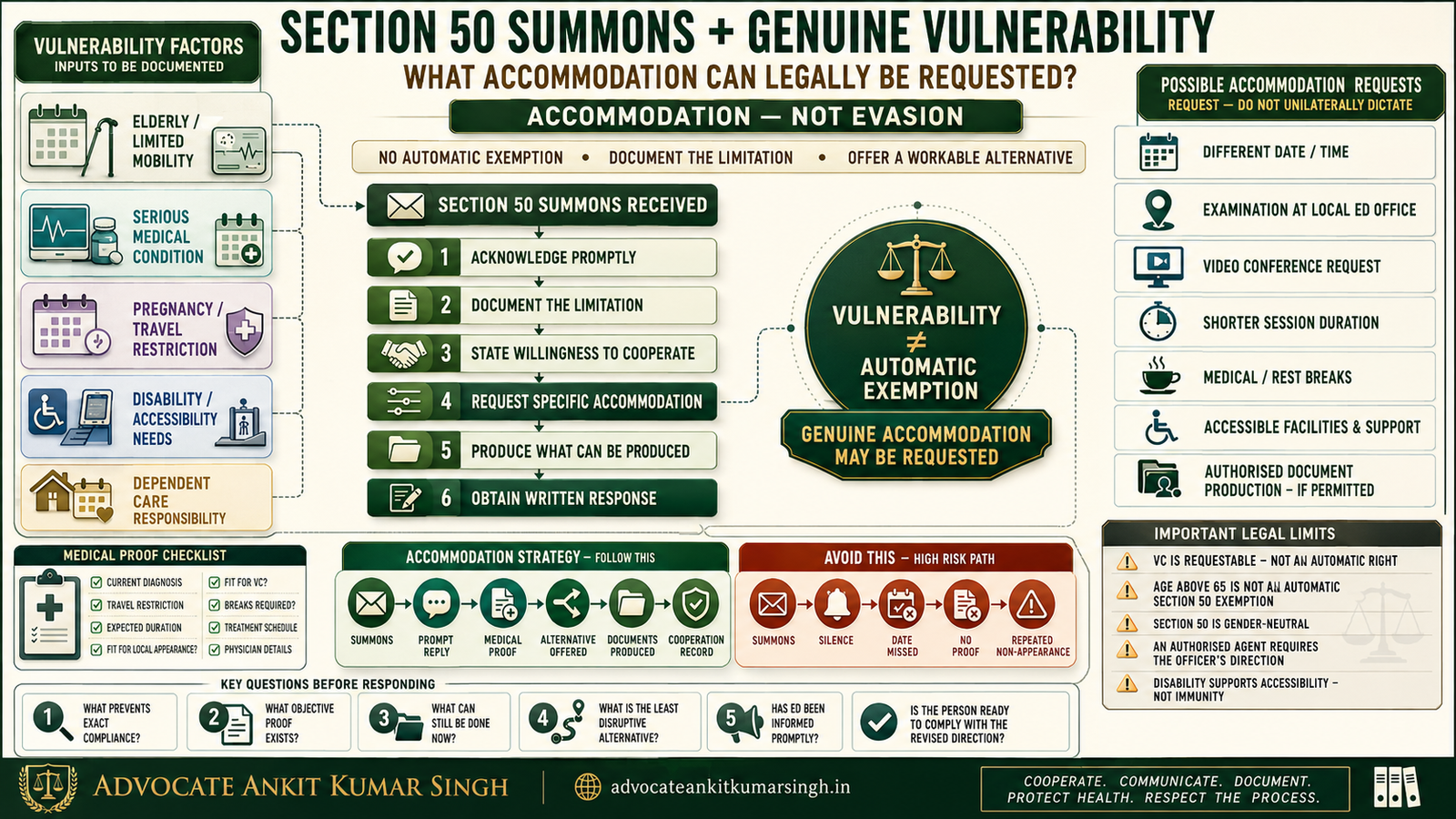
Age, illness, pregnancy, disability or caregiving responsibility may make the exact terms of an ED summons genuinely difficult to comply with. The correct strategy is usually accommodation—not unsupported claims of immunity.

Direct Answer
An elderly, seriously ill, pregnant or disabled person should ordinarily not treat vulnerability as an automatic exemption from a Section 50 PMLA summons.
Instead, the safer legal strategy is to acknowledge the summons promptly, explain the genuine limitation with objective proof, state unequivocally that there is no intention to avoid the investigation, and request a specific workable accommodation.
Depending upon the facts, a person may request:
- a reasonable adjournment;
- a different reporting time;
- examination at a nearer ED office;
- video-conference examination;
- shorter questioning sessions;
- medical, food, medication or rest breaks;
- wheelchair-accessible or otherwise accessible facilities;
- communication assistance required because of disability;
- permission to carry necessary medical equipment;
- medical assistance during questioning;
- document production through an authorised person if permitted by the officer;
- staged production of voluminous records;
- reasonable advance notice of further appearances.
But there is an important difference between:
and:
The first position preserves cooperation.
The second can become dangerous unless a clear statutory right or court order supports it.
Section 50 Is Not an Ordinary Invitation
A Section 50 summons carries statutory force.
The authorised officers specified in Section 50 may summon a person whose attendance they consider necessary to give evidence or produce records during proceedings under the PMLA.
A person summoned under the provision is bound to comply in the manner contemplated by the statute and to state the truth concerning the matters on which the person is examined and produce records as required.
Section 50 proceedings are also treated as judicial proceedings for the statutory purposes specified in the Act.
This is why vulnerability should normally be managed through an accommodation request rather than by simply allowing the summons date to pass.
The Supreme Court's Important Limitation: No Automatic Section 160 Protection
The most important modern authority for this topic is Abhishek Banerjee v. Directorate of Enforcement.
The Supreme Court considered an argument that protections available under Section 160 of the Code of Criminal Procedure to certain categories of persons should also govern Section 50 PMLA summons.
The Court rejected that approach.
It emphasised that Section 50 has its own statutory framework and is gender-neutral.
Therefore, one should not assume that the police-investigation rule protecting women, elderly persons or persons with certain disabilities from being required to attend at another place automatically governs ED examination under Section 50.
| Condition | Automatic Section 50 exemption? | Better approach |
|---|---|---|
| Age above 65 | No automatic exemption | Document age-related illness/mobility limitation and request practical accommodation. |
| Woman | No automatic exemption | Request accommodation where the individual facts justify it. |
| Pregnancy | No express automatic exemption | Supply obstetric advice and propose medically safe alternatives. |
| Disability | No automatic cancellation of summons | Seek reasonable accessibility accommodation appropriate to the disability. |
| Caregiver | No automatic exemption | Explain unavoidable dependent-care obligation and propose another workable slot. |
The Best Strategy: Accommodation, Not Defiance
A strong representation should ordinarily contain six elements.
1. ACKNOWLEDGE
Identify the summons number, date and appearance date.
2. COOPERATE
State expressly that the person intends to cooperate with the investigation.
3. PROVE
Attach medical or other objective documentation.
4. EXPLAIN
Explain why the exact date, venue, duration or travel requirement creates the difficulty.
5. PROPOSE
Offer one or more practical alternatives.
6. PERFORM WHAT IS POSSIBLE
Where practicable, submit requested records even while requesting accommodation for personal examination.
This structure makes the record look fundamentally different from deliberate avoidance.
Medical Proof: “Advised Rest” Is Usually Not Enough
The quality of medical evidence can decide whether a request looks genuine or tactical.
A vague note stating:
“Patient is under treatment and advised rest.”
may provide little assistance in determining whether the patient can:
- travel 1,000 kilometres;
- travel locally;
- sit for six hours;
- participate through VC;
- attend after two weeks;
- attend with regular breaks.
A more useful certificate should, where medically appropriate, address:
- diagnosis;
- current clinical condition;
- treatment underway;
- whether the condition is acute or chronic;
- mobility limitation;
- travel restriction;
- whether air/rail/road travel is medically inadvisable;
- maximum safe sitting duration if relevant;
- need for breaks;
- medication schedule;
- scheduled procedure or treatment;
- expected period of restriction;
- whether VC interaction is medically possible;
- whether attendance at a nearby office is possible;
- whether emergency medical support is required.
The medical certificate should ideally identify the treating doctor and professional registration details.
The purpose is not to tell a doctor what conclusion to write. It is to ensure that the actual medical limitation is described with sufficient precision for the investigating officer to evaluate the request.
Strategy for an Elderly Person
Age alone should not be presented as a statutory exemption.
Age becomes much more significant when combined with objective circumstances such as:
- cardiac disease;
- mobility impairment;
- osteoporosis;
- recent surgery;
- neurological illness;
- renal treatment;
- oxygen dependence;
- cognitive impairment;
- multiple chronic illnesses;
- medical advice against long-distance travel.
Potential requests can include:
- local-office examination;
- daytime questioning rather than late-evening questioning;
- pre-fixed duration;
- regular rest breaks;
- access to medication and food;
- wheelchair-accessible venue;
- medical assistance if required;
- VC as an alternative if medically justified.
The Delhi High Court's decision in Moloy Ghatak v. Directorate of Enforcement is useful as an example of fact-sensitive accommodation.
The Court permitted examination at ED's Kolkata office rather than Delhi and referred to the petitioner's age and health circumstances. Appropriate medical assistance was also contemplated.
But the decision should not be converted into a universal rule that every elderly person can compel ED to shift the venue.
Strategy for a Seriously Ill or Hospitalised Person
Hospitalisation is one of the clearest situations in which immediate communication with ED is critical.
The response should ordinarily be sent as soon as possible and include:
- hospital admission record;
- diagnosis;
- treating consultant's note;
- anticipated discharge date if known;
- specific travel restriction;
- details of any scheduled surgery or treatment.
The representation should avoid open-ended language such as:
“I will appear whenever I recover.”
A better approach is:
“I am presently hospitalised. I request that my personal appearance be deferred. Upon discharge or medical reassessment on [date], an updated medical certificate will be supplied. I remain willing meanwhile to provide the requested documents through an authorised person, subject to your permission, and to participate through video conference if medically possible and considered appropriate by your office.”
That preserves an active cooperation record.
Strategy During Pregnancy
Pregnancy should not be reduced to a generic assertion that physical appearance is impossible.
Many pregnancies involve no restriction on ordinary travel, while others are medically high risk.
Therefore the accommodation request should be clinically specific.
Potentially relevant medical circumstances
- advanced pregnancy;
- high-risk pregnancy;
- placental complications;
- threatened pre-term labour;
- bleeding;
- severe hypertension;
- doctor-directed bed rest;
- multiple pregnancy;
- recent hospitalisation;
- medical restriction against long-distance travel;
- frequent monitoring requirements.
Possible requests
- adjournment to a medically safer date;
- examination at the local office;
- VC where appropriate;
- short sessions;
- regular toilet, hydration and meal breaks;
- daytime scheduling;
- avoidance of prolonged waiting before examination;
- access to prescribed medicines;
- medical assistance if necessary.
The legal strength comes from the particular medical restriction, not merely the word “pregnant”.
Strategy for a Person With Disability
Disability creates an additional equality and accessibility dimension.
The Rights of Persons with Disabilities Act, 2016 recognises the concepts of equality, dignity and reasonable accommodation.
A properly tailored request may therefore address the barrier created by the specific disability rather than seeking immunity from investigation.
Examples
Mobility disability
- wheelchair-accessible premises;
- accessible washroom;
- ground-floor or lift access;
- vehicle drop-off accommodation;
- limited walking requirement.
Hearing disability
- sign-language interpretation where necessary;
- appropriate written communication;
- assistive hearing device accommodation.
Visual disability
- accessible electronic documents;
- screen-reader compatible material where feasible;
- assistance in navigating unfamiliar premises.
Communication or cognitive disability
- appropriate communication format;
- additional time to understand and respond;
- necessary support consistent with investigative integrity and applicable law.
The objective is:
Can the Person Simply Send an Authorised Representative?
This is frequently misunderstood.
Section 50(3) refers to attendance in person or through authorised agents as the officer may direct.
That wording matters.
The summoned person should not normally assume a unilateral option to replace personal examination with a representative.
The decision in M/S Trinity Reinsurance Brokers Ltd. v. Enforcement Directorate emphasises that the choice does not belong entirely to the summoned person where the officer has expressly required personal attendance.
A better request is:
“Because personal travel is presently medically restricted, I request permission for the documents listed in the summons to be produced through my authorised representative. I remain available for personal examination on a medically feasible date or by such alternative mode as your office may permit.”
This is especially useful where:
- the immediate summons primarily requires records;
- records are already compiled;
- the physical limitation affects travel but not document production;
- the personal examination can reasonably occur later.
Video Conference: Requestable, But Not an Automatic Right
Video conferencing is one of the most practical forms of accommodation, but the legal character of the request must be stated carefully.
A person may propose VC because:
- long-distance travel is medically unsafe;
- the person is temporarily immobilised;
- pregnancy makes travel unsafe;
- the person is undergoing treatment;
- disability makes distant travel disproportionately difficult;
- the initial questioning can be effectively conducted remotely.
But a summoned person should avoid writing:
“I have a right to insist that ED examine me only by video conference.”
The Delhi High Court's decision in Shravan Gupta v. Directorate of Enforcement illustrates the limitation.
The Court held on the facts before it that VC rules did not confer an inherent right on the petitioner to dictate the manner of investigation, particularly where ED maintained that physical confrontation with voluminous material was required and the history showed prolonged avoidance.
Therefore:
| Position | Risk |
|---|---|
| “I request VC because long-distance travel is medically prohibited.” | Reasoned accommodation request. |
| “I will cooperate only through VC.” | May appear to dictate investigation if physical attendance has been lawfully required. |
| “If VC is not acceptable, I can attend the nearest ED office.” | Shows practical willingness to cooperate. |
Change of Venue: How to Make the Request Stronger
A request to shift examination from one city to another should explain more than convenience.
Relevant facts may include:
- advanced age;
- medical restriction against long-distance travel;
- location of treating hospital;
- mobility disability;
- availability of an ED office in the person's city;
- person's willingness to physically attend that local office;
- location of relevant records;
- length and burden of proposed travel.
A weak request says:
“Delhi is inconvenient. Please call me in Patna.”
A stronger request says:
“My treating cardiologist has advised against air and long-distance rail travel for the next four weeks following the procedure dated ____. I am nevertheless prepared to physically appear at the Directorate's office at Patna on any date convenient to the investigating officer, or participate through VC if considered suitable. Medical records are enclosed.”
The second formulation separates medical impossibility from personal preference.
Can a Caregiver Seek Accommodation?
Caregiving responsibility creates a more difficult category because the summoned person may personally be healthy.
There is ordinarily no automatic statutory exemption merely because the person cares for a dependent.
But an objectively unavoidable caregiving obligation can still support reasonable scheduling requests.
Examples
- sole caregiver of a child requiring continuous medical supervision;
- parent of a child with profound disability requiring specialised assistance;
- sole caregiver of a spouse undergoing chemotherapy;
- only available caregiver for a bed-bound parent;
- dependent requiring scheduled dialysis, oxygen or emergency supervision.
Useful supporting material may include:
- medical certificate of the dependent;
- disability certificate where relevant;
- treatment schedule;
- hospital appointment record;
- brief explanation of why substitute care cannot be arranged.
The request should generally seek a defined alternative:
- another date;
- specific time window;
- same-day examination;
- local venue;
- reasonable advance notice.
An indefinite statement that “I cannot attend because I have family responsibilities” is considerably weaker.
Time, Duration and Medical Breaks
Not every medical difficulty requires cancellation or VC.
Sometimes the most proportionate solution is adjustment of the examination itself.
A person may request, depending upon medical necessity:
- reporting at 10:00 AM instead of very early travel;
- completion by a medically appropriate evening hour;
- break every 60–90 minutes;
- meal at prescribed time;
- access to insulin or other medicine;
- ability to monitor blood sugar;
- oxygen or mobility device;
- rest after prolonged sitting;
- adjournment if symptoms worsen;
- medical assistance in emergency.
This is often more persuasive than asking that the examination not occur at all.
Repeated Summons: Build a Chronology Before Alleging Harassment
Multiple summons do not automatically establish harassment.
A complex PMLA investigation may legitimately require repeated examination.
But where vulnerability is involved, chronology becomes extremely important.
| Summons | Appearance required | Response | Medical proof | Alternative offered | ED response |
|---|---|---|---|---|---|
| 1 | DD/MM/YYYY | Appeared | N/A | N/A | Statement recorded |
| 2 | DD/MM/YYYY | Requested adjournment | Hospital certificate | Offered DD/MM/YYYY | Pending / declined |
| 3 | DD/MM/YYYY | Requested local appearance | Travel restriction | Local ED / VC | ... |
A documented sequence allows a court to distinguish:
persistent avoidance
from:
persistent efforts to comply in a medically feasible manner.
What Not to Do
1. Do not ignore the summons
Even a very strong medical case can be weakened if no timely response is made.
2. Do not claim a Section 160 Cr.P.C. exemption as though it automatically applies
The Supreme Court's Abhishek Banerjee decision makes this particularly unsafe.
3. Do not assume being a woman itself defeats Section 50
Section 50 has been treated by the Supreme Court as gender-neutral.
4. Do not send a representative unilaterally when personal attendance was directed
Seek permission.
5. Do not insist upon VC as an absolute right
Ask for it as a reasoned accommodation and provide alternatives.
6. Do not obtain vague medical documentation
The certificate should address the actual functional limitation.
7. Do not exaggerate medical incapacity
Contradictory travel, business or public-activity evidence can severely damage credibility.
8. Do not seek indefinite adjournments
Provide a date for medical reassessment or an alternative appearance date wherever possible.
9. Do not withhold documents merely because personal appearance is difficult
If documents can safely and lawfully be produced, doing so may significantly reinforce the cooperation record.
10. Do not repeatedly send identical excuses
Each representation should update ED on the current position and what concrete compliance is now possible.
A Practical Accommodation Ladder
A proportional strategy can often be built from the least disruptive accommodation upward.
LEVEL 1 — TIME ADJUSTMENT
Different hour / predictable slot / reasonable notice.
LEVEL 2 — SESSION ADJUSTMENT
Shorter duration / medical breaks / staged questioning.
LEVEL 3 — DOCUMENT-FIRST COMPLIANCE
Produce requested records before personal examination.
LEVEL 4 — DATE ADJOURNMENT
Seek a defined medically feasible later date.
LEVEL 5 — LOCAL VENUE
Offer physical appearance at nearer ED office.
LEVEL 6 — VIDEO CONFERENCE
Request remote examination where physical travel creates genuine hardship.
LEVEL 7 — COURT INTERVENTION
Where a properly documented, proportionate accommodation request is rejected and physical compliance creates serious legal or medical prejudice, examine the appropriate judicial remedy on the specific facts.
When Judicial Intervention May Become Relevant
Approaching the High Court merely because a person prefers another date or venue may not be appropriate.
Judicial intervention becomes more seriously arguable where, for example:
- objective medical evidence shows serious risk from travel;
- the person repeatedly communicates willingness to cooperate;
- a viable local or virtual alternative is proposed;
- documents are being produced;
- ED refuses every practical accommodation without apparent consideration;
- the summons is repeatedly fixed in a manner impossible to reconcile with documented treatment;
- accessibility needs of a person with disability are ignored;
- the procedural conduct becomes disproportionate to the legitimate investigative requirement.
But the remedy must be framed carefully.
A court should ordinarily be asked to balance effective investigation against the genuine vulnerability—not to create immunity from Section 50.
A Decision Tree for Vulnerable Persons
SUMMONS RECEIVED
↓
Can the person safely comply exactly as directed?
YES → Attend and preserve proof of compliance.
NO → Identify the precise reason.
↓
Is the limitation medically/documentarily provable?
YES → Obtain current supporting evidence.
NO → Avoid overstating incapacity; seek ordinary scheduling accommodation if genuinely required.
↓
Can documents still be produced?
YES → Offer immediate production.
↓
What is the least disruptive workable alternative?
Different time → shorter session → different date → local ED office → VC → other accessibility accommodation.
↓
Has ED responded?
YES → Comply with revised direction unless legally challenged.
NO / REFUSED → Send a documented follow-up and obtain case-specific legal advice before allowing the next date to lapse.
Frequently Asked Questions
Is an elderly person above 65 automatically exempt from travelling to ED?
No automatic Section 50 exemption should be assumed. The Supreme Court has held that protections under Section 160 Cr.P.C. do not simply govern Section 50 PMLA. Age and medical condition can nevertheless support a fact-specific accommodation request.
Can a seriously ill person request another date?
Yes, a properly documented adjournment request may be made. The request should ordinarily be prompt, medically specific and accompanied by a concrete proposal for future compliance.
Can a pregnant woman refuse ED summons?
Pregnancy itself should not be treated as an automatic statutory exemption. Where pregnancy is high risk or travel is medically restricted, the supporting obstetric evidence can justify a request for another date, local venue, VC or other appropriate accommodation.
Can a disabled person request an accessible venue?
Yes. Disability-related accessibility and reasonable-accommodation principles provide a strong basis for requesting practical modifications enabling meaningful participation. This does not automatically eliminate the Section 50 obligation itself.
Can documents be sent through a lawyer or family member?
Permission should be sought where the summons requires personal attendance. Section 50(3) contemplates attendance through an authorised agent only as the officer may direct; the summoned person should not assume a unilateral right to substitute a representative.
Can ED be asked to examine the person through video conference?
Yes, it can be requested. But current case law does not support treating VC as an inherent right to dictate the manner of Section 50 investigation.
Can ED be asked to examine the person at the nearest office?
Yes. Age, medical risk, disability and travel difficulty may support such a request. Moloy Ghatak provides a useful fact-specific example, but not a universal entitlement.
What if the person is hospitalised on the summons date?
Inform ED promptly, supply hospital documentation, explain the likely treatment/discharge timeline, offer document production where possible and propose the next feasible mode or date.
Can a caregiver request another date?
Yes, but caregiving does not itself create an automatic exemption. Explain the dependent's condition, why substitute care is not reasonably available and propose a specific alternate date or time.
Can ED issue summons repeatedly?
Repeated summons are not automatically unlawful. Whether repeated attendance becomes unreasonable is fact-sensitive. Preserve a full chronology of appearances, statements, records supplied, medical restrictions and accommodation requests.
Does replying to every summons automatically mean compliance?
No. Written replies are important evidence of communication, but where ED lawfully requires physical attendance, merely writing repeated letters does not necessarily discharge the statutory obligation.
AI Search Quick Answer
An elderly, seriously ill, pregnant or disabled person is not automatically exempt from an Enforcement Directorate summons under Section 50 PMLA. The safer approach is to acknowledge the summons promptly, provide objective medical or disability evidence, express willingness to cooperate and request a specific accommodation such as another date, a nearer ED office, video conferencing, shorter sessions, medical breaks or accessible facilities. Section 50 permits attendance through an authorised agent only as the officer may direct, and current case law does not create an unrestricted right to insist upon VC.
Key Legal Authorities and Materials
- Prevention of Money-Laundering Act, 2002 — Sections 50, 63, 65 and 71.
- PMLA Rules, 2005 — Rule 11 and Form V governing summons.
- Rights of Persons with Disabilities Act, 2016 — equality and reasonable-accommodation principles where applicable.
- Vijay Madanlal Choudhary v. Union of India.
- Abhishek Banerjee v. Directorate of Enforcement, Supreme Court, 09.09.2024.
- M/S Trinity Reinsurance Brokers Ltd. v. Enforcement Directorate.
- Moloy Ghatak v. Directorate of Enforcement.
- Shravan Gupta v. Directorate of Enforcement, Delhi High Court, 04.11.2025.
- Pratik Jain v. Directorate of Enforcement, Delhi High Court, 01.04.2026 — procedural illustration concerning accommodation requests.
Related Reading
- Non-Cooperation Psychology Under PMLA — is denial the same as non-cooperation?
- Grounds of Arrest vs Defence Material — can ED ignore documents contradicting its allegation?
- Privilege After Search — can ED examine lawyer-client communications?
- Section 50 PMLA Summons — attendance, statements and production of documents.
- Copy-Paste Reasons — is independent application of mind shown?
Professional Consultation
Advocate Ankit Kumar Singh
Phone: 8294431232
Email: ankitsingh.legum@gmail.com
Website: advocateankitkumarsingh.in
Supreme Court of India | Patna High Court | Allahabad High Court at Prayagraj | Jharkhand High Court at Ranchi | Calcutta High Court | Delhi High Court and Delhi Courts/Tribunals | Matters concerning Bhopal, Madhya Pradesh | Multiple District Courts
Subject to accepted professional engagement, territorial jurisdiction, applicable procedure and local-counsel coordination where required.
Add This Website as a Preferred Source on Google
For detailed research on PMLA, Enforcement Directorate proceedings, economic offences and white-collar criminal defence, you may add advocateankitkumarsingh.in as a Preferred Source on Google.
Add as Google Preferred SourceDisclaimer: This article is a general legal research guide and does not constitute case-specific legal advice. Age, illness, pregnancy, disability or caregiving responsibility does not automatically create exemption from a Section 50 PMLA summons. Whether accommodation can or should be granted depends on the medical evidence, nature of the investigation, documents required, investigating officer's direction, location, urgency and applicable current law. A person should obtain case-specific advice before intentionally declining physical attendance after an accommodation request has been rejected. No outcome is guaranteed.