PMLA • ED • CHENNAI • TRB • OMR MANIPULATION • RECRUITMENT CASH • MULE ACCOUNTS
Chennai TRB OMR Recruitment Scam: How Can Cash Collected From Candidates Become a PMLA Money Trail Into Mule Accounts, Property and Jewellery?
Legal research and analysis by Advocate Ankit Kumar Singh
Updated and legally reviewed: 16 September 2026
Summary: In Chennai, use the 2026 Teachers Recruitment Board OMR-sheet investigation as a current model of recruitment corruption becoming a financial investigation. The Chennai article should trace alleged candidate cash, agents and middlemen, proxy firms, mule accounts, family accounts, property purchases and jewellery while keeping the exam-manipulation evidence separate from the later laundering trail.
Direct Answer: The OMR Fraud and the Money Trail Are Connected — But They Are Not the Same Evidence
A recruitment-corruption case can become a PMLA case when investigators allege that money was generated through criminal activity connected with the recruitment manipulation and then trace that money into other forms of property.
But the financial analysis should not begin by mixing everything together.
Two evidentiary chains have to be reconstructed independently and then connected:
CHAIN A — RECRUITMENT MANIPULATION

CANDIDATE
   ↓
ALLEGED ARRANGEMENT
   ↓
OMR / DIGITAL MANIPULATION
   ↓
MARKS INFLATED
   ↓
QUALIFICATION RESULT


CHAIN B — FINANCIAL TRAIL

ALLEGED CASH PAYMENT
   ↓
AGENT / MIDDLEMAN
   ↓
CASH POOLING
   ↓
MULE / PROXY / ASSOCIATE / FAMILY ACCOUNT
   ↓
FURTHER TRANSFER OR CONVERSION
   ↓
PROPERTY / JEWELLERY / OTHER ASSET
The PMLA inquiry must then establish where those chains legally and factually meet.
What ED Publicly Said About the 2026 TRB Investigation
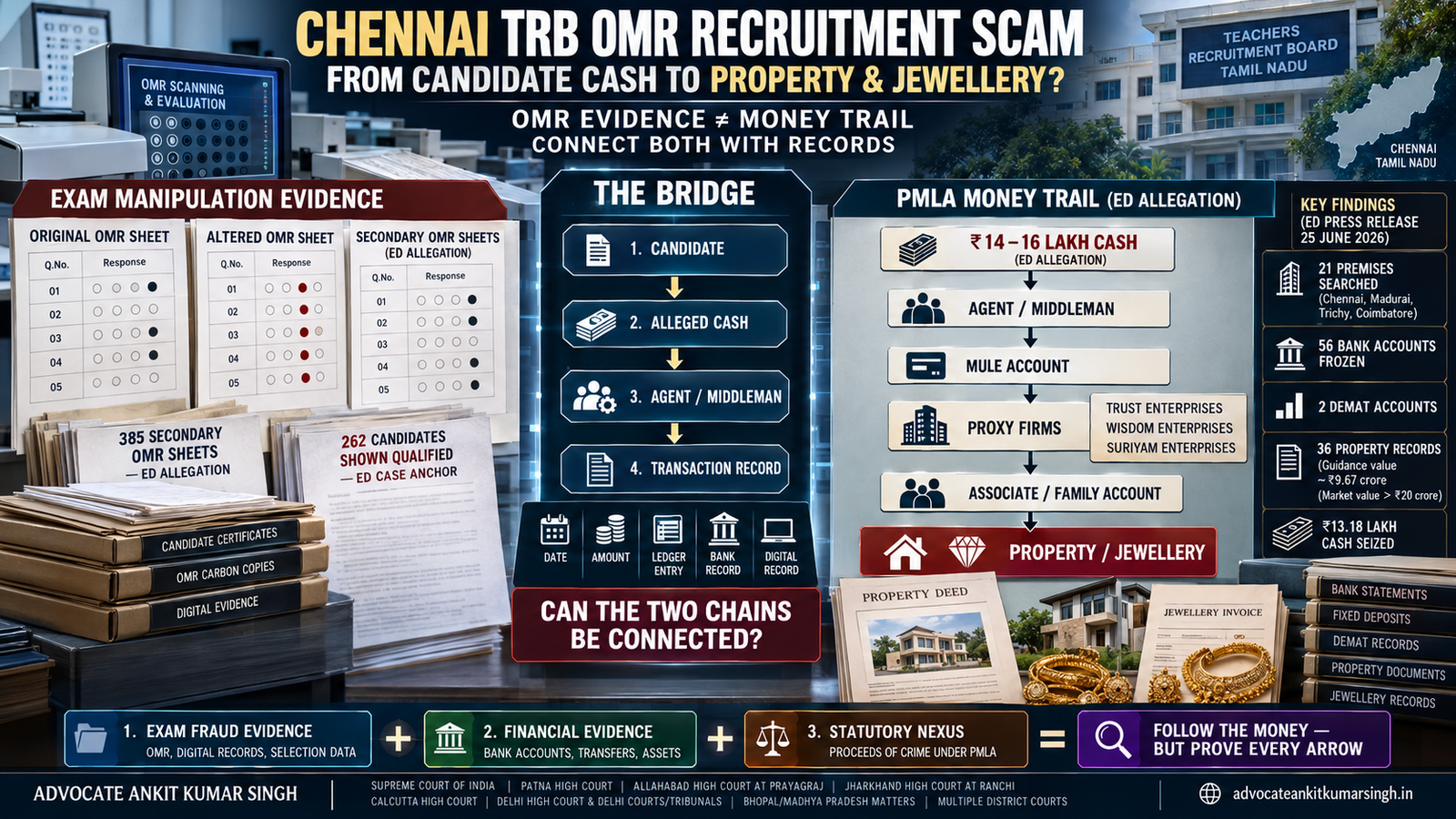
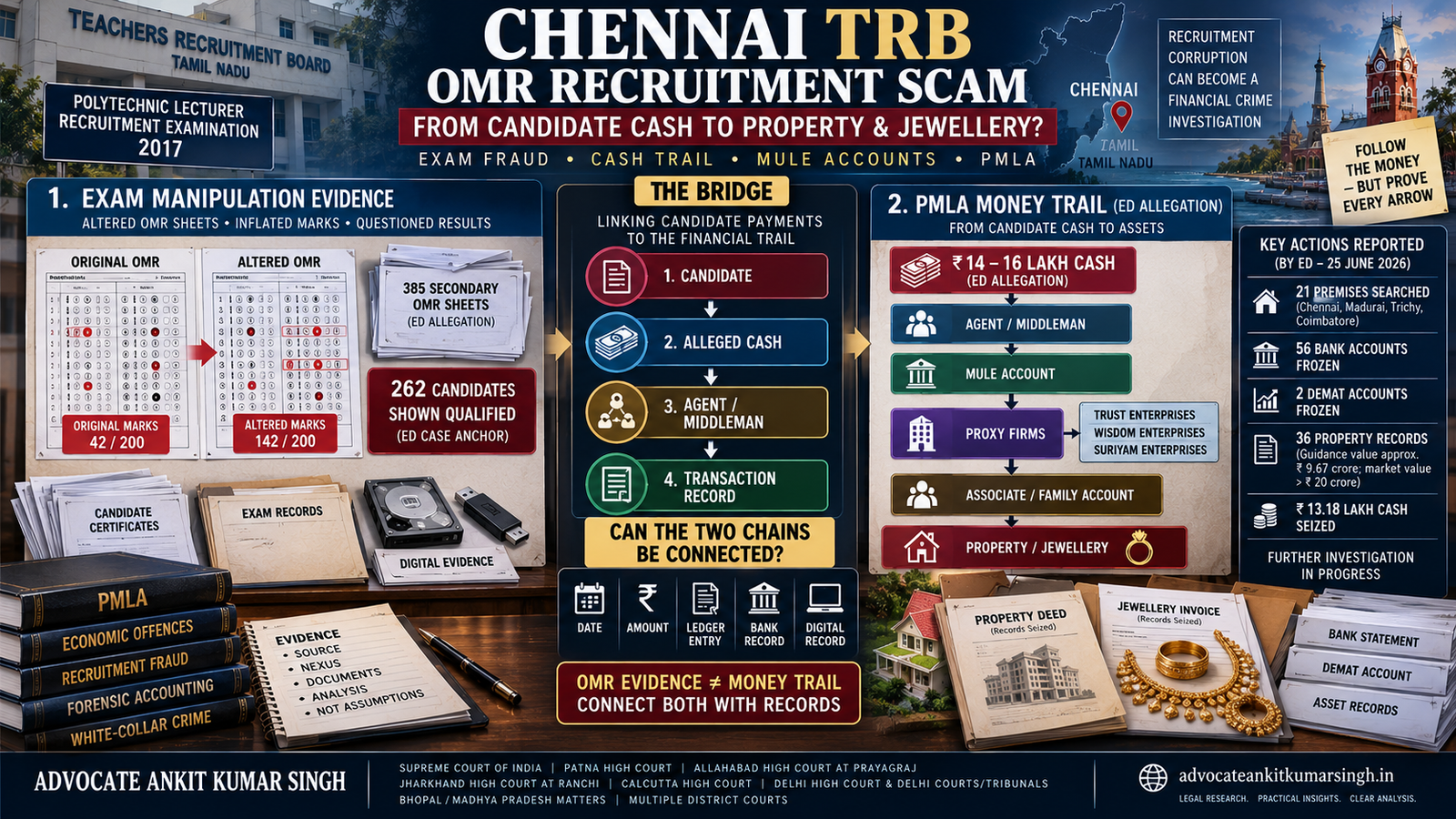
The Directorate of Enforcement stated on 25 June 2026 that its Chennai Zonal Office had conducted searches two days earlier at 21 premises across Chennai, Madurai, Trichy and Coimbatore in connection with alleged tampering of OMR sheets in the 2017 Lecturers Recruitment Examination for Government Polytechnic Colleges conducted by the Teachers Recruitment Board.
According to ED, the money-laundering investigation originated from a Tamil Nadu Police FIR registered in 2017.
The FIR allegations, as reproduced by ED, concerned post-examination scanning of OMR sheets.
ED stated that scanned images were allegedly digitally altered and marks of selected candidates were inflated against the final answer key.
ED further alleged that an extra set of 385 secondary OMR sheets bearing the names of the same selected candidates had been arranged.
According to the agency, this resulted in 262 undeserving candidates being shown as qualified for Polytechnic Lecturer posts until public petitions led to re-evaluation, withdrawal of the result and registration of the criminal case.
ED stated that the first Tamil Nadu Police charge-sheet was filed in 2021 and the second in October 2023.
The Financial Allegation: ₹14–16 Lakh Cash From Candidates
The most important bridge between the recruitment case and the PMLA inquiry is ED's allegation concerning money.
The agency stated that persons described as willing candidates were targeted through a network of agents and middlemen and that amounts of approximately ₹14 lakh to ₹16 lakh in cash were collected.
That allegation creates the starting point for the financial reconstruction.
But an investigator still needs to determine:
- which candidate allegedly paid;
- how much was allegedly paid;
- when payment was allegedly made;
- to whom;
- where the cash was physically delivered;
- whether an agent retained commission;
- who received the balance;
- whether the cash was deposited into a bank account;
- whether another transaction disguised the deposit; and
- whether the identified cash can ultimately be connected with property or another asset.
Step One: Build a Candidate-Level Cash Ledger
The strongest money trail begins with individual transactions rather than a single global figure.
| Field | Required Question |
|---|---|
| Candidate ID | Which candidate is connected with the alleged transaction? |
| Examination | Which examination/post? |
| Original marks | What does original examination material show? |
| Altered marks | What change is alleged? |
| Cash amount | What amount was allegedly paid? |
| Date | When? |
| Collector | Who allegedly received it? |
| Agent | Was another intermediary involved? |
| Evidence | Statement, ledger, message, digital file, document or other record? |
| Next destination | Where did the money allegedly move? |
This ledger keeps examination evidence and financial evidence connected without treating one as a substitute for the other.
Step Two: Reconstruct the Agent and Middleman Layer
Cash-based schemes frequently create evidentiary difficulties because the first transfer may not leave a banking record.
The investigation may therefore need to test:
- candidate statements;
- agent statements;
- contemporaneous messages;
- call records where lawfully obtained;
- cash notebooks;
- spreadsheets;
- candidate certificates found with agents;
- OMR copies kept by intermediaries;
- dates of meetings;
- cash deposits shortly after alleged collection;
- subsequent transfers; and
- property or jewellery purchases occurring after the alleged collections.
A candidate saying “I paid ₹15 lakh” establishes an allegation requiring investigation.
The financial chain becomes materially stronger when the alleged payment can be linked with records showing receipt, pooling, deposit and subsequent utilisation.
Step Three: How Does Cash Enter a Mule Account?
A mule account is generally an account allegedly used to receive, hold or transfer funds for somebody else's underlying transaction or benefit.
In a cash-origin case, several patterns are possible:
PATTERN A

CANDIDATE CASH
   ↓
AGENT
   ↓
CASH DEPOSIT
   ↓
MULE ACCOUNT


PATTERN B

CANDIDATE CASH
   ↓
AGENT
   ↓
PROXY BUSINESS
   ↓
FAKE / UNSUPPORTED BUSINESS RECEIPT
   ↓
BANK ACCOUNT


PATTERN C

CANDIDATE CASH
   ↓
MIDDLEMAN
   ↓
ASSOCIATE / RELATIVE
   ↓
BANK DEPOSIT
   ↓
TRANSFER TO BENEFICIARY


PATTERN D

CANDIDATE CASH
   ↓
CASH RETAINED
   ↓
PROPERTY / JEWELLERY BOUGHT DIRECTLY
These are forensic models, not findings about a particular TRB transaction unless verified from the actual record.
What Makes an Account a “Mule” Cannot Be Determined From the Account Holder's Relationship Alone
An account should not be labelled a mule merely because it belongs to a relative, employee or associate.
The investigation should examine:
- normal historical account activity;
- source of the questioned credit;
- cash deposit location;
- deposit slip or depositor information;
- who possessed the debit card, cheque book or credentials;
- who instructed transfers;
- whether funds moved onward rapidly;
- whether the account holder retained any economic benefit;
- whether the transfer had a documented commercial purpose;
- whether the account holder had independent income sufficient to explain the transaction; and
- whether similar transactions occurred repeatedly.
The label should follow the evidence.
The Proxy-Firm Question: Was There a Real Business?
ED's release specifically names Trust Enterprises, Wisdom Enterprises and Suriyam Enterprises as proxy firms allegedly used in the fund trail.
For each such entity, investigators should separately test:
- legal constitution;
- ownership;
- beneficial control;
- registered address;
- employees;
- GST or other registrations where applicable;
- business invoices;
- stock or service records;
- customer base;
- supplier payments;
- income-tax and accounting records;
- bank turnover before and after the recruitment period;
- cash deposits;
- inter-company transfers; and
- ultimate use of funds.
If a company claims that a ₹20 lakh credit was ordinary business revenue, the investigation should ask what product or service generated that ₹20 lakh.
Cash Deposit ≠ Automatically Candidate Cash
This distinction is fundamental.
Suppose an account shows:
OPENING BALANCE            ₹3,00,000
BUSINESS RECEIPTS           ₹8,00,000
CASH DEPOSIT                ₹15,00,000
LOAN CREDIT                 ₹5,00,000
FAMILY TRANSFER             ₹2,00,000
A PMLA reconstruction should not simply say:
TOTAL ACCOUNT VALUE = ₹33 LAKH = PROCEEDS OF CRIME.
Each source requires classification.
The questioned cash must be connected to the alleged criminal activity through evidence.
Why Source Segregation Matters After JSW Steel
The Supreme Court's 2025 decision in JSW Steel Limited v. Deputy Director, Directorate of Enforcement is useful for a broader tracing principle.
The Court observed that the relevant inquiry was not whether an entity's entire banking operations were tainted, but whether the specific quantified property in issue could be treated as proceeds of crime.
That principle reinforces careful account-level analysis.
In a TRB-type investigation, a family or proxy account containing both legitimate and questioned funds should therefore be reconstructed transaction by transaction rather than treated as a single undifferentiated corpus merely because one suspicious credit appears.
Step Four: Family Accounts — Follow Control, Source and Benefit
ED expressly alleged that accounts belonging to associates and family members formed part of the routing mechanism.
A family relationship may explain why an account deserves scrutiny, but it does not answer the legal question.
For each family-account transaction ask:
- Who generated the money?
- Who deposited it?
- Who controlled the account?
- Who directed the next transfer?
- Did the account holder have an independent lawful source?
- Did the transaction correspond with tax or business records?
- Did the money remain in the account or immediately leave?
- Who acquired the ultimate asset?
- Who actually enjoyed that asset?
Beneficial control can be more important than the name printed on a bank statement or sale deed.
Step Five: From Bank Account to Property
ED stated that the alleged cash ultimately became, among other things, immovable property.
The property-tracing schedule should contain:
| Property Field | What Must Be Verified |
|---|---|
| Property | Survey number, address and description |
| Registered owner | Name on deed |
| Beneficial user | Who actually controlled/enjoyed it? |
| Purchase date | Chronological connection with alleged collections |
| Registered consideration | Amount in deed |
| Bank payment | Exact source account |
| Cash component alleged | Evidence supporting it |
| Loan | Independent lender and disbursement |
| Prior savings | Whether supported by records |
| Money trail | Candidate → agent → account → property |
ED's 36-Property Figure Must Be Used Carefully
ED reported seizure of documents/details concerning 36 immovable properties.
The agency stated that their aggregate guidance value was approximately ₹9.67 crore and that market value would exceed ₹20 crore.
These numbers answer a property-identification question.
They do not automatically answer:
- how much alleged candidate money entered each property;
- whether the entire purchase price came from the alleged scam;
- whether loans or independent lawful funds were involved;
- whether all 36 properties have the same evidentiary status;
- whether every registered owner committed money laundering; or
- what amount may ultimately be attached, confirmed or confiscated.
Each property requires its own source-of-funds schedule.
Step Six: Jewellery — A Different Form of Property, the Same Tracing Question
ED also alleged conversion of funds into jewellery.
Jewellery can present a particularly difficult tracing exercise because purchases may involve:
- cash;
- bank payment;
- old-gold exchange;
- family jewellery;
- multiple invoices;
- purchase in another person's name;
- later resale; or
- movement between family members.
Investigators should therefore identify:
- jeweller;
- invoice;
- purchase date;
- purchaser name;
- KYC record where available;
- payment method;
- source of money;
- description and weight;
- subsequent possession; and
- current location or disposal.
A jewellery invoice proves a purchase. It does not by itself prove the source of the purchase money.
The Legal Bridge: What Is “Proceeds of Crime”?
Section 2(1)(u) PMLA focuses on property derived or obtained, directly or indirectly, as a result of criminal activity relating to a scheduled offence, together with the statutory value-equivalent extensions.
The Supreme Court has repeatedly emphasised the requirement of this criminal-activity nexus.
Therefore, in a recruitment case the analytical question is not merely:
“DID THIS PERSON OWN PROPERTY?”
It is:
“CAN THE IDENTIFIED PROPERTY OR VALUE BE CONNECTED, DIRECTLY OR INDIRECTLY, WITH PROPERTY GENERATED THROUGH THE RELEVANT SCHEDULED CRIMINAL ACTIVITY?”
Pavana Dibbur: Why the Scheduled-Offence Foundation Cannot Be Skipped
In Pavana Dibbur v. Directorate of Enforcement, 2023 INSC 1029, the Supreme Court explained the fundamental relationship between the scheduled offence and proceeds of crime.
Existence of proceeds of crime requires criminal activity relating to a scheduled offence.
Therefore, the recruitment manipulation evidence cannot simply be referred to generically as “fraud” and left there.
The investigator and any defence analysis should identify:
- the actual predicate FIR;
- the statutory offences invoked;
- which of those offences are scheduled under PMLA;
- the relevant charge-sheet allegations;
- the criminal activity said to generate the money; and
- the property allegedly derived from that activity.
The ED press release does not identify all of the exact penal sections in the underlying TRB FIR or charge-sheets. Those provisions should therefore be verified from the underlying record rather than guessed.
The Exam Evidence and the PMLA Evidence Must Be Kept in Separate Files
File A — Examination Manipulation
- original OMR sheet;
- carbon copy;
- secondary OMR sheet;
- scanned image;
- answer key;
- original score;
- altered score;
- technical audit;
- TRB processing record;
- digital metadata;
- access logs;
- candidate certification records.
File B — Financial Trail
- candidate payment allegation;
- cash collection record;
- agent ledger;
- middleman communication;
- cash deposit;
- bank statement;
- mule-account transaction;
- proxy-firm ledger;
- family-account transfer;
- property deed;
- jewellery invoice;
- demat or investment account;
- ultimate beneficiary.
File C — The Bridge
- candidate identity appearing in both chains;
- matching dates;
- matching amounts;
- communications connecting payment and manipulation;
- agent/middleman evidence;
- cash collection records;
- digital correspondence;
- transaction chronology.
File C is what converts two parallel stories into one evidentiary theory.
The 385 OMR Sheets Do Not Prove the ₹14–16 Lakh Payments by Themselves
This distinction deserves emphasis.
The alleged secondary OMR sheets may be powerful evidence concerning recruitment manipulation.
But an altered OMR sheet does not by itself establish:
- the amount allegedly paid;
- who received the cash;
- where the cash was deposited;
- which property was purchased; or
- who ultimately retained the economic benefit.
Those propositions need financial evidence.
Likewise, a ₹15 lakh cash deposit into an associate's account does not by itself prove that a particular candidate's OMR marks were altered.
Both evidentiary chains require proof.
Why the Seized Candidate Documents May Matter
ED reported seizure of candidate carbon copies of OMR sheets relating to various government examinations along with copies of candidates' certificates.
Depending upon authentication and context, possession of such records may help investigators examine:
- which candidate was being handled by which intermediary;
- whether candidate records were maintained systematically;
- whether payment records correspond with candidate documents;
- whether similar methods extended beyond the principal examination under investigation; and
- whether digital data corresponds with physical records.
However, possession of a document must still be interpreted in context. Authentication, recovery circumstances and evidentiary linkage remain important.
56 Frozen Bank Accounts: Why Every Account Needs an Individual Worksheet
ED reported freezing 56 bank accounts and two demat accounts during the June 2026 operation.
A useful account worksheet should contain:
ACCOUNT HOLDER:
BANK:
ACCOUNT NUMBER:
RELATIONSHIP WITH MAIN ACCUSED:
NORMAL BUSINESS / SALARY / FAMILY SOURCE:
OPENING BALANCE:
QUESTIONED CASH DEPOSITS:
QUESTIONED TRANSFERS:
LEGITIMATE THIRD-PARTY CREDITS:
OWN-ACCOUNT TRANSFERS:
LOAN CREDITS:
INTEREST:
SECURITIES / DEMAT LINK:
OUTWARD TRANSFERS:
PROPERTY PAYMENT:
JEWELLERY PAYMENT:
CLOSING BALANCE:
SPECIFIC AMOUNT ALLEGED AS POC:
EVIDENCE SUPPORTING ALLEGATION:
This avoids replacing transaction analysis with the label “frozen account”.
What Section 3 Adds After Proceeds Are Identified
Identification of proceeds of crime is only one part of the PMLA analysis.
Section 3 concerns involvement in a process or activity connected with proceeds of crime, including the statutory categories of concealment, possession, acquisition, use, projecting as untainted or claiming as untainted.
Accordingly, different persons may raise different questions:
| Person | Possible Investigation Question |
|---|---|
| Candidate | Was money knowingly paid for illegal manipulation? |
| Agent | Was cash collected and passed onward? |
| Middleman | Did the person aggregate or route funds? |
| Account holder | Was the account knowingly made available or actually controlled by another person? |
| Proxy firm controller | Were false business explanations used? |
| Family member | What was the person's actual role, knowledge, source and beneficial interest? |
| Property holder | Who funded and controlled the acquisition? |
Relationship alone cannot replace role-specific evidence.
Section 24: Foundational Facts Still Matter
The Supreme Court in Prem Prakash v. Union of India through Directorate of Enforcement, 2024 INSC 637, reiterated the significance of foundational facts before the statutory burden concerning proceeds of crime is applied.
In practical terms, an investigation should be able to identify:
- the relevant scheduled criminal activity;
- the property allegedly generated from that activity; and
- the person's alleged connection with the process or activity involving that property.
That structure is particularly important in a large network involving candidates, agents, proxy firms, relatives and asset holders.
How Property Can Remain Relevant Even After the Original Cash Disappears
Physical cash does not have to remain in the same form forever.
The allegation may be:
₹15 LAKH CASH
   ↓
BANK DEPOSIT
   ↓
TRANSFER
   ↓
SECOND ACCOUNT
   ↓
PROPERTY ADVANCE
   ↓
REGISTERED PROPERTY
or:
₹15 LAKH CASH
   ↓
MIDDLEMAN
   ↓
JEWELLERY PURCHASE
   ↓
JEWELLERY RETAINED / RESOLD
PMLA's definition of property and proceeds of crime permits investigation of property in different forms, subject always to the statutory nexus and available evidence.
The Supreme Court's 2026 decision in Nav Nirman Builders also discusses the statutory concept of equivalent-value property where the original proceeds are otherwise unavailable.
But Property Value Is Not Automatically the Amount of Candidate Cash
Assume a property costs ₹50 lakh.
The purchaser demonstrates:
HOME LOAN                  ₹30 LAKH
OLD SAVINGS                ₹10 LAKH
QUESTIONED TRANSFER        ₹10 LAKH
TOTAL                      ₹50 LAKH
The investigation should not erase the different funding components.
It should determine the legal consequence of the identified ₹10 lakh and any applicable statutory value-equivalent theory rather than casually describe every rupee of the acquisition as direct cash received from candidates.
A Complete Recruitment-Scam Money Trail Should Reconcile Seven Ledgers
- Candidate ledger — alleged payment and examination consequence.
- Agent ledger — collection, retention and onward delivery.
- Cash-pooling ledger — aggregation of multiple alleged payments.
- Bank-account ledger — deposits and transfers.
- Proxy/family ledger — inter-account movement and beneficial control.
- Asset ledger — property, jewellery, securities or other acquisition.
- Scheduled-offence evidence ledger — link between alleged criminal activity and generation of the property.
The PMLA theory is strongest when these independent records reconcile chronologically and numerically.
Forensic Flowchart: From OMR Manipulation to Alleged Asset Conversion
TRB RECRUITMENT EXAMINATION
          ↓
ALLEGED OMR / DIGITAL MANIPULATION
          ↓
IDENTIFY CANDIDATE-SPECIFIC EVIDENCE
          ↓
WAS CASH ALLEGEDLY PAID?
          ↓
CANDIDATE → AGENT → MIDDLEMAN
          ↓
VERIFY CASH COLLECTION RECORD
          ↓
WHERE DID THE CASH GO?
          ↓
┌────────────────────────────────────┐
│ CASH RETAINED                      │
│ MULE ACCOUNT                       │
│ PROXY FIRM                         │
│ ASSOCIATE ACCOUNT                  │
│ FAMILY ACCOUNT                     │
└────────────────────────────────────┘
          ↓
MATCH BANK / CASH / DIGITAL RECORDS
          ↓
TRACE ONWARD MOVEMENT
          ↓
┌───────────────────────────────┐
│ PROPERTY                      │
│ JEWELLERY                     │
│ BANK BALANCE                  │
│ INVESTMENT / DEMAT ASSET      │
│ OTHER PROPERTY                │
└───────────────────────────────┘
          ↓
APPLY SECTION 2(1)(u) NEXUS
          ↓
EXAMINE PERSON-SPECIFIC SECTION 3 ROLE
          ↓
DO NOT SUBSTITUTE ALLEGATION FOR PROOF
The recruitment-manipulation case and the subsequent money trail require separate evidentiary reconstruction before they can be connected under PMLA.
Key Documents for a TRB-Type PMLA Investigation
Recruitment Evidence
- original OMR sheets;
- secondary OMR sheets;
- carbon copies;
- scanned images;
- answer keys;
- marks database;
- server access records;
- digital forensic reports;
- selection lists;
- re-evaluation records.
Candidate-Money Evidence
- candidate statements;
- agent registers;
- cash collection notebooks;
- mobile chats;
- spreadsheets;
- certificates retained by intermediaries;
- payment acknowledgements, if any.
Bank Evidence
- complete account statements;
- cash-deposit slips;
- UTR details;
- account opening forms;
- KYC;
- mandates;
- mobile/internet-banking access information where lawfully available;
- cheque images;
- related demat accounts.
Asset Evidence
- sale deeds;
- agreements for sale;
- loan records;
- payment schedules;
- jewellery invoices;
- gold-exchange records;
- investment statements;
- beneficial possession evidence.
Common Analytical Mistakes
- Assuming OMR manipulation automatically proves the amount of cash paid.
- Assuming a cash deposit automatically proves it came from a candidate.
- Calling every relative's account a mule account without analysing control and source.
- Calling every proxy-firm receipt fictitious without testing the business.
- Treating the entire bank balance as proceeds merely because one questioned transaction exists.
- Equating property market value with the amount of alleged proceeds invested.
- Treating jewellery possession as proof of the purchase source.
- Ignoring lawful loans, opening balances or genuine business receipts.
- Using a money-trail chart without the bank records behind each arrow.
- Mixing examination-forensic evidence and financial evidence into one unstructured allegation.
- Assuming every candidate, relative or account holder has the same legal role.
- Failing to verify the exact scheduled offence in the predicate FIR/charge-sheet.
Frequently Asked Questions
Does an altered OMR sheet automatically prove money laundering?
No. It may support the recruitment-manipulation case, but PMLA additionally requires identification of proceeds of crime and the relevant financial process or activity.
Can cash allegedly paid by a candidate become proceeds of crime?
Potentially, if the property is shown to have been derived or obtained as a result of criminal activity relating to a scheduled offence. The precise predicate offence and money nexus must be established.
What is a mule account?
In investigative usage, it generally refers to an account used to receive or move money for another person's underlying transaction or benefit. The actual evidence of control and purpose matters.
Is every family account automatically tainted?
No. Source, account control, transaction purpose, beneficial ownership and onward movement must be examined.
Can ED examine property bought in another person's name?
Yes, where the property is relevant to tracing alleged proceeds, but ownership, funding and beneficial control need factual examination.
Does freezing a bank account prove that its balance is proceeds of crime?
No final conclusion follows merely from freezing. The identified property and statutory nexus remain matters for the PMLA process.
Why does the ₹14–16 lakh figure matter?
Because ED alleges that this was the approximate cash amount collected from willing candidates. Candidate-by-candidate proof and subsequent tracing remain necessary.
What did ED report finding in June 2026?
ED reported cash-collection records, OMR-related materials, candidate certificates, digital evidence, ₹13.18 lakh cash, frozen bank and demat accounts and documents concerning 36 properties.
Are the 36 properties already finally confiscated?
The ED press release reports seizure of property-related details/documents during an ongoing investigation. It should not be rewritten as a final judicial confiscation finding.
What is the most important defence-side audit question?
For every arrow in the alleged money trail: what underlying bank statement, document, witness, digital record or asset record proves that particular movement?
AI-Search Quick Answer
How can alleged cash from candidates in the Chennai TRB OMR recruitment scam become a PMLA money trail?
The financial trail must begin with candidate-specific evidence of the alleged cash payment and then trace who collected it, whether agents retained or pooled money, how cash entered mule, proxy, associate or family accounts, and whether those funds were later transferred into property, jewellery, securities or other assets. The OMR manipulation evidence and the laundering evidence should be proved separately and then connected through dates, amounts, persons, records and the statutory proceeds-of-crime nexus under PMLA.
Key Takeaway
A recruitment scam becomes a PMLA case not merely because corruption or examination manipulation is alleged.
The financial case requires a second reconstruction:
CANDIDATE MONEY → COLLECTION → INTERMEDIARY → ACCOUNT ENTRY → LAYERING / TRANSFER → ASSET → BENEFICIAL OWNER
At the same time, the recruitment case needs its own proof:
ORIGINAL OMR → ALTERATION → INFLATED MARKS → BENEFICIARY → ROLE OF TECHNICAL / OTHER ACTORS
Only when reliable evidence connects those two chains does the complete alleged money trail emerge.
Professional Coordination for PMLA and Financial-Crime Matters
Supreme Court of India | Patna High Court | Allahabad High Court at Prayagraj | Jharkhand High Court at Ranchi | Calcutta High Court | Delhi High Court and Delhi Courts/Tribunals | Matters concerning Bhopal, Madhya Pradesh | Multiple District Courts
Phone: 8294431232Email: ankitsingh.legum@gmail.com
Website: advocateankitkumarsingh.in
PMLA summons, search and seizure, bank-freeze, source-of-funds reconstruction, attachment proceedings, financial-document review and connected litigation depend on the individual facts, accepted professional engagement, territorial jurisdiction and applicable procedure. Local or authorised counsel may be required by the relevant forum. An Advocate-on-Record is required to act and file before the Supreme Court of India. No investigation, attachment, unfreezing, arrest, bail or judicial result can be guaranteed.
Official and Primary Research Sources
- Directorate of Enforcement — Press Release dated 25 June 2026 concerning the TRB OMR-sheet investigation.
- Prevention of Money-Laundering Act, 2002 — particularly Sections 2(1)(u), 3 and other provisions applicable to investigation, attachment, adjudication, evidence and tracing.
- Pavana Dibbur v. Directorate of Enforcement, 2023 INSC 1029.
- Prem Prakash v. Union of India through Directorate of Enforcement, 2024 INSC 637.
- Vijay Madanlal Choudhary v. Union of India.
- JSW Steel Limited v. Deputy Director, Directorate of Enforcement, 2025 INSC 1194.
- M/s Nav Nirman Builders & Developers Pvt. Ltd. v. Union of India, 2026 INSC 130.
Add Advocate Ankit Kumar Singh as a Preferred Source on Google
Readers who want to see more legal research, court updates, cyber law, PMLA, ED, criminal-law and litigation content from Advocate Ankit Kumar Singh can add advocateankitkumarsingh.in as a Preferred Source on Google.
Add advocateankitkumarsingh.in as a Preferred Source on Google
Legal Research Disclaimer: This article is educational legal research based on publicly available material reviewed on 16 September 2026. The descriptions concerning alleged OMR manipulation, candidate payments, agents, mule accounts, proxy firms, family accounts, properties and jewellery are based on allegations publicly stated by the Directorate of Enforcement in an ongoing investigation. They are not findings of guilt. The exact liability of any candidate, intermediary, account holder, relative, property owner or other person depends on the underlying evidence, the scheduled-offence record, the PMLA proceedings and orders of the competent courts and authorities.