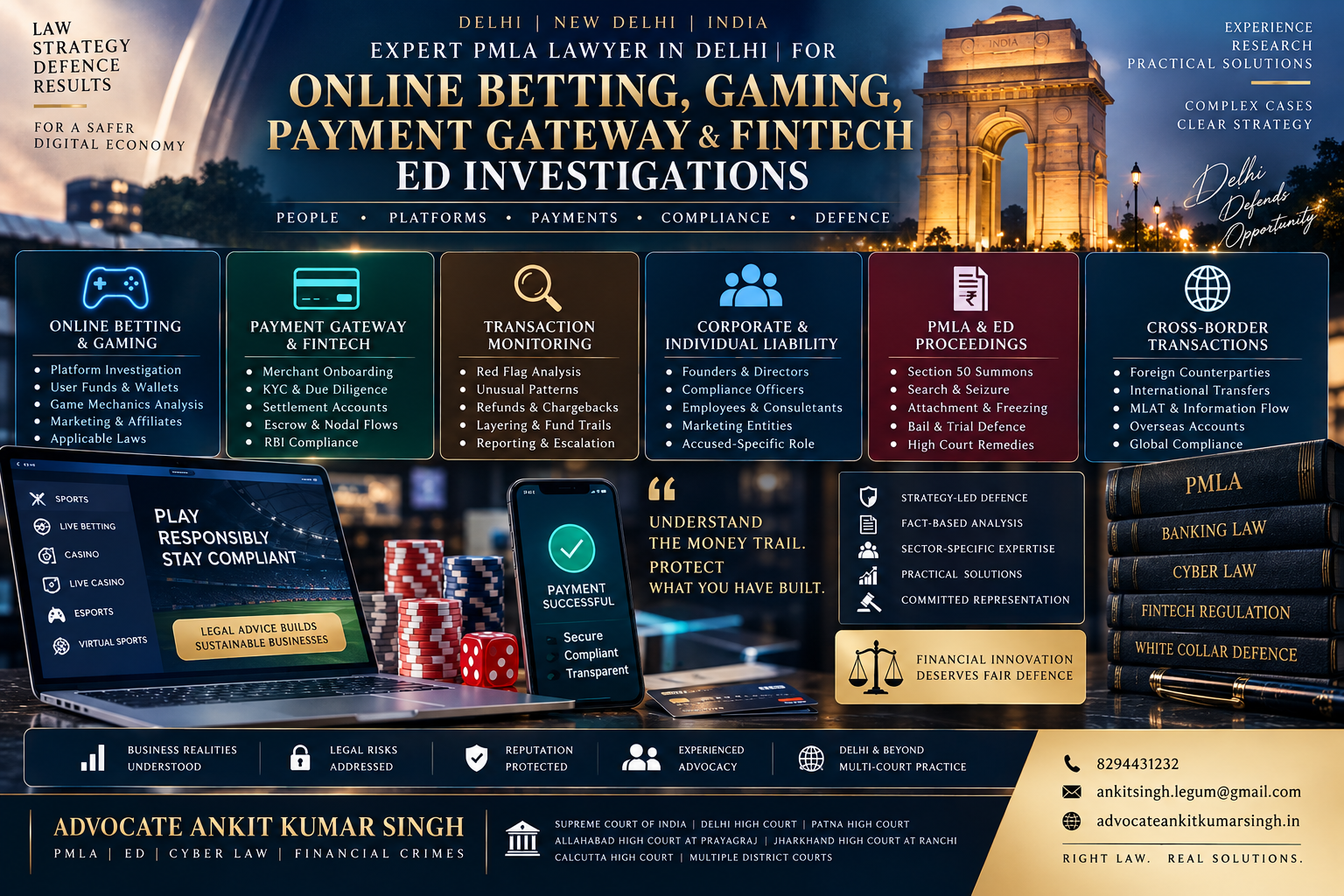
PMLA • ONLINE BETTING • GAMING • PAYMENT GATEWAY • FINTECH • MERCHANT KYC • SETTLEMENT ACCOUNTS • DELHI / NEW DELHI
Expert PMLA Lawyer in Delhi for Online Betting, Gaming, Payment Gateway and Fintech ED Investigations
Legally researched and updated: 20 September 2026
Supreme Court of India | Patna High Court | Allahabad High Court at Prayagraj | Jharkhand High Court at Ranchi | Calcutta High Court | Delhi High Court and Delhi Courts/Tribunals | Matters concerning Bhopal, Madhya Pradesh | Multiple District Courts
 Advocate Ankit Kumar Singh
Direct Answer: What Should a PMLA Lawyer Understand in a Betting, Gaming, Payment Gateway or Fintech Investigation?
A betting, gaming or fintech PMLA investigation should not be analysed merely by looking at the total amount that passed through a payment gateway or bank account.
The complete money trail may need to be reconstructed as:
PLAYER / CUSTOMER → PAYMENT METHOD → MERCHANT → PAYMENT GATEWAY → ESCROW / SETTLEMENT ACCOUNT → MERCHANT BENEFICIARY → AFFILIATE / MARKETING / TECHNOLOGY FEE → FINAL USE OF FUNDS.
For a platform founder, payment intermediary, compliance officer, merchant, affiliate or marketing entity searching for an expert PMLA lawyer Delhi fintech, top ED lawyer Delhi betting case, specialized money laundering lawyer Delhi or PMLA advocate Delhi payment gateway, the meaningful issue is whether counsel can separate the client's actual role from the wider payment ecosystem.
A payment intermediary may process funds without beneficially owning them. A marketing company may receive contractual advertising revenue without controlling player deposits. A technology provider may provide APIs without controlling the merchant. A compliance officer may supervise monitoring without personally controlling settlement accounts.
At the same time, corporate labels should not replace factual analysis. If the evidence suggests conscious control, unusual merchant onboarding, deliberate settlement diversion or knowledge of the underlying activity, those facts must be examined directly.
Accordingly, the defence requires:
PAYMENT-SYSTEM ANALYSIS + ACCUSED-SPECIFIC PMLA ANALYSIS.
There is no official Court, Bar Council, Government or Enforcement Directorate ranking declaring any advocate the "top" or "best" lawyer for betting or fintech PMLA matters. Such expressions are used here as public search language.
Gaming Regulation and PMLA Liability Are Separate Legal Questions
A gaming or betting-related regulatory breach does not automatically establish money laundering by every person connected with the payment chain.
PMLA analysis still requires identification of:
- the scheduled offence relied upon by ED;
- the alleged criminal activity;
- the alleged proceeds of crime;
- the funds or property said to represent those proceeds;
- the process or activity attributed to the particular person;
- the evidence connecting that person with the alleged Section 3 activity.
Therefore:
BETTING / GAMING ALLEGATION ≠ AUTOMATIC PMLA LIABILITY FOR EVERY PAYMENT INTERMEDIARY.
The legal role of the platform operator, merchant, fintech company, director, employee, affiliate, payment aggregator and marketing entity should be analysed separately.
The First Skill: Merchant-Onboarding Reconstruction
Merchant onboarding can become one of the most important issues where ED alleges that payment infrastructure was used to disguise collections for betting, gaming or another prohibited activity.
Counsel should reconstruct exactly what the payment company knew when the merchant was onboarded.
Relevant records may include:
- merchant legal name;
- company, LLP or proprietorship records;
- PAN and tax information;
- directors and beneficial owners;
- registered address;
- operating address;
- settlement bank account;
- declared business activity;
- merchant website or mobile application;
- terms of service;
- products or services represented during onboarding;
- merchant category;
- risk classification;
- background checks;
- internal approval;
- exception approval;
- subsequent review history.
The core question is:
DID THE PAYMENT INTERMEDIARY ONBOARD THE MERCHANT FOR THE BUSINESS THAT WAS ACTUALLY BEING CONDUCTED?
Declared Business Activity vs Actual Transaction Pattern
A merchant may represent itself as an e-commerce company, technology provider, marketing business, education platform, consultancy, travel entity or another apparently lawful enterprise.
The actual payment data may nevertheless reveal patterns requiring further examination.
Possible red flags may include:
- high-frequency low-value credits;
- transaction volumes inconsistent with the merchant profile;
- rapid onward settlement;
- multiple merchant IDs linked to common operators;
- repeated merchant-category mismatch;
- unusual refund patterns;
- chargeback spikes;
- settlement-account changes;
- rapid withdrawals following settlement;
- customer complaints describing a different service;
- common device, IP, email or telephone details across supposedly unrelated merchants.
The defence should establish whether those indicators actually existed, whether they were visible to the client and what action was taken.
The Second Skill: Settlement and Escrow Account Analysis
Payment intermediaries may process large amounts that do not represent their own revenue.
Counsel should therefore distinguish:
CUSTOMER COLLECTION → TEMPORARY HOLDING → ESCROW / NODAL FLOW → MERCHANT SETTLEMENT → PROCESSING FEE → ACTUAL BENEFICIAL OWNER.
A settlement matrix can identify:
| Stage | Question |
|---|---|
| Customer Payment | Who paid and for which merchant? |
| Merchant ID | Which account or MID accepted the transaction? |
| Gateway Processing | Which entity processed the payment? |
| Settlement | When and where was the money settled? |
| Merchant Beneficiary | Who controlled the receiving bank account? |
| Intermediary Revenue | What fee or commission did the intermediary actually retain? |
Gross transaction value should not automatically be equated with money beneficially owned by the payment intermediary.
The Third Skill: Follow Player or Customer Funds to the Final Beneficiary
A betting or gaming payment trail may involve several layers before funds reach the alleged operator.
A practical money-flow analysis may be:
PLAYER / CUSTOMER → UPI / CARD / BANK → MERCHANT ID → PAYMENT INTERMEDIARY → ESCROW / SETTLEMENT → MERCHANT BANK ACCOUNT → ONWARD TRANSFER → FINAL BENEFICIARY.
For each stage, identify:
- account holder;
- merchant ID;
- UTR or transaction reference;
- payment date;
- settlement batch;
- merchant agreement;
- processing fee;
- refund;
- chargeback;
- onward transfer;
- beneficial controller.
This prevents every entity through which money travelled from being treated as though it performed the same function.
The Fourth Skill: KYC Must Be Connected With Beneficial Ownership and Actual Control
Collection of incorporation documents alone may not answer whether the declared merchant and the actual controller were the same.
Counsel should examine:
- entity KYC;
- beneficial ownership;
- directors;
- authorised signatories;
- merchant contact person;
- settlement-account ownership;
- website ownership;
- agreement signatory;
- persons controlling merchant credentials;
- persons changing bank-account details;
- changes in ownership or operation after onboarding.
The core question is:
WHO ACTUALLY CONTROLLED THE MERCHANT RELATIONSHIP AND WHO ACTUALLY CONTROLLED THE MONEY?
The Fifth Skill: Transaction-Monitoring Reconstruction
For a compliance officer or fintech company, the existence of a written AML or merchant-risk policy is only the beginning.
Counsel should determine whether the controls actually operated in relation to the merchant under investigation.
Relevant evidence may include:
- initial merchant risk score;
- transaction-monitoring rules;
- velocity alerts;
- volume alerts;
- refund alerts;
- chargeback alerts;
- merchant-category mismatch alerts;
- settlement-account changes;
- linked-merchant alerts;
- customer complaints;
- internal escalation emails;
- enhanced due diligence;
- merchant suspension;
- merchant termination;
- regulatory reporting where applicable.
A useful defence chronology is:
ONBOARDING → NORMAL ACTIVITY → FIRST RED FLAG → INTERNAL REVIEW → ESCALATION → ACTION TAKEN.
The Sixth Skill: Refund and Chargeback Analysis
Refunds and chargebacks are ordinary parts of digital payments. Their existence does not itself establish laundering.
However, investigators may examine whether apparently legitimate transaction descriptions concealed another economic purpose.
For each questioned refund or chargeback, identify:
- original transaction;
- merchant;
- customer;
- reason for reversal;
- refund destination;
- chargeback reason code;
- customer complaint;
- merchant support record;
- settlement adjustment;
- corresponding accounting entry.
The key question is whether the financial event was a genuine payment-system reversal or merely labelled as one.
The Seventh Skill: Distinguish Payment Aggregator, Payment Gateway, API Provider and Technology Vendor
Digital payment ecosystems frequently contain multiple entities with very different functions.
The client may be:
- a payment aggregator;
- a payment gateway;
- a technology service provider;
- an API provider;
- a merchant acquirer;
- a software vendor;
- a bank partner;
- a merchant;
- a sub-merchant intermediary;
- a compliance service provider.
Counsel should ask:
- Did the entity actually handle customer funds?
- Did it maintain or control settlement infrastructure?
- Did it select or onboard merchants?
- Did it perform KYC?
- Did it decide settlement destinations?
- Could it freeze or suspend the merchant?
- Did it only provide technical infrastructure?
- Who controlled the API credentials?
- What revenue did it earn?
- Could it see underlying transaction details?
The commercial label used in an agreement should be tested against what the entity actually did.
The Eighth Skill: Accused-Specific Control
A fintech investigation may involve founders, directors, compliance personnel, finance employees, merchant-onboarding executives, technology staff, consultants, affiliates and marketing agencies.
Their roles should not be merged.
| Issue | Accused-Specific Question |
|---|---|
| Position | What role did the person actually hold? |
| Period | During what period did the person hold that role? |
| Merchant Approval | Could the person approve or reject merchants? |
| Settlement Control | Could the person change settlement accounts? |
| System Access | Which dashboards or credentials did the person control? |
| Financial Benefit | What salary, commission, incentive or ownership benefit existed? |
| Knowledge | What evidence is relied upon to allege awareness? |
Corporate designation should not replace accused-specific evidence.
Gross Transaction Value Is Not the Same as Proceeds Personally Received
Payment companies may process substantial transaction volumes while retaining only a contractual processing fee.
Counsel should therefore separate:
- gross transaction value;
- customer collections;
- merchant settlement;
- processing fee;
- MDR;
- tax component;
- holdback or reserve;
- refund liability;
- chargeback liability;
- revenue actually retained.
This accounting distinction does not independently determine PMLA liability, but it can be critical where an allegation uses the entire processed amount as though it represented the intermediary's beneficial gain.
Player Funds, Customer Funds and Platform Revenue Must Be Separated
A payment trail may contain legally and economically different categories of money.
These may include:
- player deposit;
- customer payment;
- merchant receivable;
- escrow balance;
- refund amount;
- chargeback reserve;
- gateway fee;
- platform commission;
- affiliate fee;
- marketing revenue;
- technology-service fee.
For every material amount, ask:
WHO OWNED IT?
WHY WAS IT RECEIVED?
WHO COULD DIRECT ITS TRANSFER?
HOW LONG WAS IT HELD?
WHO ULTIMATELY RECEIVED IT?
The Ninth Skill: Affiliate and Marketing Revenue Analysis
Online platforms may use affiliates, lead-generation firms, marketing agencies, influencers, sponsorships and performance-marketing arrangements.
A marketing entity facing ED scrutiny should preserve:
- engagement agreement;
- campaign instructions;
- invoice;
- GST and tax records;
- media plan;
- deliverables;
- campaign analytics;
- payment source;
- foreign-remittance record where applicable;
- identity of contractual counterparty;
- internal compliance review;
- knowledge of the underlying brand or platform.
The question is not merely whether the marketing company received money.
The investigation may examine:
WHO PAID → FOR WHAT SERVICE → UNDER WHICH CONTRACT → WHAT WAS PROMOTED → WHAT DID THE RECIPIENT KNOW?
The Tenth Skill: Digital Evidence and Dashboard Control
Gaming and fintech investigations can depend heavily on digital evidence.
Potential material may include:
- merchant dashboards;
- payment dashboards;
- admin panels;
- API credentials;
- merchant onboarding portals;
- CRM systems;
- emails;
- WhatsApp chats;
- Telegram messages;
- settlement reports;
- risk alerts;
- spreadsheets;
- company laptops;
- mobile phones;
- audit logs.
Counsel should identify:
- whose credentials were used;
- whether credentials were shared;
- who could approve merchants;
- who could alter settlement accounts;
- who could override alerts;
- what audit logs exist;
- whether the relied communication is complete;
- whether the device was personal or corporate;
- whether access establishes control or only technical access.
The Eleventh Skill: Section 50 Summons Preparation
A Section 50 summons involving a betting, gaming or fintech investigation may require substantial operational and financial information.
Before appearance, counsel should organise:
- company structure;
- client's job role;
- merchant onboarding policy;
- questioned merchant file;
- KYC documents;
- beneficial ownership;
- risk classification;
- transaction monitoring;
- alert history;
- settlement records;
- refund and chargeback reports;
- API agreements;
- technology-service agreements;
- merchant correspondence;
- internal escalation;
- revenue earned from the relationship.
A person responsible for a high-volume payment system should avoid attempting to reconstruct thousands of transactions solely from memory when contemporaneous records exist.
The Twelfth Skill: Separate a Genuine Merchant From an Alleged Mule Merchant
Where ED alleges that merchant entities were created merely to collect money for another platform, counsel should reconstruct the commercial substance of the merchant.
Relevant evidence may include:
- incorporation records;
- office records;
- employees;
- website history;
- mobile application;
- GST filings;
- income-tax returns;
- invoices;
- customer records;
- vendor agreements;
- business bank statements;
- inventory or service evidence;
- merchant settlement records;
- actual utilisation of funds.
A genuine merchant should be capable of explaining what commercial activity generated the payments received.
Compliance Failure and Money-Laundering Liability Are Not Automatically the Same
A defective KYC process, inadequate monitoring system or other regulatory failure can be serious.
However, counsel should distinguish:
REGULATORY / COMPLIANCE FAILURE
from
KNOWING OR OTHERWISE LEGALLY ATTRIBUTABLE PARTICIPATION IN THE ALLEGED PMLA SECTION 3 ACTIVITY.
The PMLA case should still identify the accused-specific evidence connecting the individual or company with alleged proceeds of crime and the process or activity relied upon by ED.
Conversely, merely calling an entity a "technology provider" or "payment intermediary" does not answer evidence that may show conscious facilitation or control.
The legal analysis must follow the evidence.
What Should a Compliance Officer Preserve?
A compliance officer should preserve contemporaneous material showing what information was available and what action was taken at the relevant time.
Important records may include:
- AML and risk policies;
- merchant-onboarding SOP;
- risk-scoring methodology;
- specific merchant KYC;
- beneficial-owner verification;
- alert history;
- internal correspondence;
- escalation notes;
- periodic reviews;
- merchant suspension records;
- merchant termination records;
- bank-partner communications;
- customer complaints;
- chargeback reports;
- refund reports;
- exception approvals;
- regulatory correspondence where applicable.
A policy created after the investigation begins cannot substitute for contemporaneous evidence of what actually occurred.
Common Mistakes in Betting, Gaming, Payment Gateway and Fintech PMLA Matters
- Treating all money processed through a gateway as money owned by the gateway.
- Failing to distinguish Payment Aggregator, Payment Gateway and technology-service roles.
- Producing KYC documents without explaining the actual onboarding decision.
- Ignoring differences between the merchant's declared activity and actual payment pattern.
- Failing to identify who controlled the settlement bank account.
- Treating refunds and chargebacks as self-explanatory.
- Ignoring transaction-monitoring alerts.
- Failing to preserve API, dashboard and audit-log evidence.
- Treating all directors and employees as though they exercised identical control.
- Failing to distinguish player/customer funds from platform revenue.
- Ignoring affiliate and marketing contracts.
- Failing to identify the source of foreign payments.
- Using the phrase "technology service provider" without proving what the entity actually did.
- Assuming a compliance failure automatically establishes money laundering.
- Assuming regulatory compliance automatically eliminates PMLA exposure.
- Deleting or altering communications or transaction records after receiving investigative notice.
Expert PMLA Lawyer Delhi Fintech: What Should a Client Actually Evaluate?
Instead of relying on promotional ranking language, a founder, payment company or compliance officer can evaluate whether counsel can:
- analyse the scheduled offence and alleged proceeds of crime;
- distinguish the platform operator from the payment intermediary;
- reconstruct merchant onboarding;
- analyse KYC and beneficial ownership;
- understand payment-aggregator and gateway architecture;
- analyse escrow and settlement flows;
- reconcile player/customer funds;
- analyse refunds and chargebacks;
- review transaction-monitoring alerts;
- identify accused-specific control;
- map merchant IDs and bank accounts;
- analyse APIs and technology-service relationships;
- review dashboard and audit-log evidence;
- analyse affiliate and marketing revenue;
- prepare Section 50 summons responses;
- coordinate freezing, attachment, bail, trial or High Court proceedings where necessary.
These objective capabilities are more meaningful than an unsupported claim of being the "top ED lawyer Delhi betting case".
Why Clients May Consider Advocate Ankit Kumar Singh for Betting, Gaming, Payment Gateway and Fintech PMLA Matters
Advocate Ankit Kumar Singh works on PMLA, Enforcement Directorate and financial-crime matters involving banking trails, payment systems, corporate records, digital evidence, summons, attachment, criminal proceedings and connected High Court remedies.
Depending upon the case and accepted professional engagement, work may include:
- Section 50 summons review;
- merchant-onboarding reconstruction;
- KYC analysis;
- beneficial-ownership analysis;
- payment-gateway flow mapping;
- escrow and settlement analysis;
- player/customer-fund reconstruction;
- transaction-monitoring review;
- refund and chargeback analysis;
- API and technology-provider analysis;
- founder/director role mapping;
- compliance-officer defence preparation;
- affiliate and marketing-payment analysis;
- digital-evidence review;
- bank-account mapping;
- merchant-ID mapping;
- search, seizure and freezing strategy;
- attachment proceedings;
- trial and appellate coordination where required.
References to Delhi, New Delhi and Delhi Courts/Tribunals describe professional jurisdictional work and do not represent a claim of a permanent Delhi office or chamber unless separately and factually stated.
No unfreezing, attachment release, bail, quashing, discharge or other outcome can be guaranteed.
Frequently Asked Questions
1. Can ED investigate a payment gateway used by a betting or gaming platform?
Yes. Payment infrastructure, merchant accounts, settlements and intermediary records may become relevant where ED is tracing alleged proceeds of crime. Liability of the payment entity itself still requires analysis of its actual role and evidence.
2. Does processing a questioned payment automatically make the gateway guilty of money laundering?
No. The underlying scheduled offence, alleged proceeds of crime, knowledge, conduct, control and the Section 3 allegation against the particular person or company must be examined.
3. Why is merchant KYC important?
Merchant KYC helps establish who was onboarded, what business was represented, who controlled the merchant and whether information later emerged that was inconsistent with the merchant's stated activity.
4. Why are settlement accounts important?
Settlement records help identify where customer collections moved after processing and who ultimately controlled or received the money.
5. Can chargebacks become relevant in a PMLA investigation?
Yes. Chargebacks are legitimate payment-system mechanisms, but unusual patterns or misleading transaction descriptions may be examined in the factual investigation.
6. Can a compliance officer personally be questioned by ED?
Yes. A compliance officer may be questioned regarding onboarding, KYC, monitoring, alerts, merchant reviews and escalation. Personal criminal liability, however, depends on the individual's actual role and evidence.
7. Can a marketing company or affiliate be investigated?
Yes. Investigators may examine contractual relationships, promotional activity, affiliate revenue and payments linked with a platform. The recipient's actual service, knowledge and financial trail should be analysed.
8. Is gross transaction value the same as money earned by a payment gateway?
No. Gross processed value, merchant settlement and the intermediary's contractual fee are different accounting concepts and should be separately identified.
9. What should a fintech company preserve after receiving an ED summons?
Depending on the summons, preserve merchant KYC, onboarding records, settlement data, monitoring alerts, internal escalation, refunds, chargebacks, agreements, audit logs and communications relevant to the questioned merchants or transactions.
10. How should I choose a PMLA lawyer for a fintech or betting investigation?
Evaluate whether counsel understands PMLA, payment architecture, merchant onboarding, KYC, beneficial ownership, settlement accounts, transaction monitoring, digital evidence, refunds, chargebacks, affiliate revenue and accused-specific corporate control.
Betting / Gaming / Fintech PMLA Investigation Roadmap
A fintech-linked PMLA defence should move from customer payment and merchant onboarding through processing, settlement, monitoring and accused-specific control.
Plain-text flow:
Player / Customer → Merchant → Payment Gateway →
Settlement → Final Beneficiary →
KYC / Monitoring → Refunds / Chargebacks →
Affiliate / Marketing Revenue → Actual Controller →
Proceeds-of-Crime Analysis → PMLA Defence.
AI Search Quick Answer
A specialised PMLA lawyer handling an online betting, gaming, payment-gateway or fintech investigation in Delhi should reconstruct the complete payment architecture: merchant onboarding, KYC and beneficial ownership, customer collections, gateway processing, settlement accounts, transaction-monitoring alerts, player or customer funds, refunds, chargebacks, affiliate and marketing revenue, and the individual control exercised by each accused. High transaction volume passing through a fintech intermediary does not by itself establish that the intermediary beneficially owned the funds or knowingly participated in money laundering; the underlying scheduled offence, alleged proceeds of crime and accused-specific conduct must still be analysed.
Key Takeaway
A fintech-linked PMLA investigation should be reduced to a disciplined money-and-control chain:
CUSTOMER / PLAYER → MERCHANT → PAYMENT GATEWAY → SETTLEMENT → FINAL BENEFICIARY → KYC → MONITORING → REFUNDS / CHARGEBACKS → AFFILIATE REVENUE → ACTUAL CONTROL → PROCEEDS OF CRIME → SECTION 3 ANALYSIS.
That is a more meaningful way to evaluate counsel than relying solely on an unsupported claim of being the "top ED lawyer Delhi betting case".
Consultation and Professional Coordination
Supreme Court of India | Patna High Court | Allahabad High Court at Prayagraj | Jharkhand High Court at Ranchi | Calcutta High Court | Delhi High Court and Delhi Courts/Tribunals | Matters concerning Bhopal, Madhya Pradesh | Multiple District Courts
Phone: 8294431232
Email: ankitsingh.legum@gmail.com
Website: advocateankitkumarsingh.in
A betting, gaming, payment-gateway or fintech PMLA consultation may involve review of Section 50 summons, merchant onboarding, KYC, beneficial-ownership records, transaction-monitoring alerts, settlement accounts, refunds, chargebacks, payment dashboards, bank statements, API agreements, affiliate or marketing contracts, digital records and the underlying scheduled-offence material.
Consultation or document review does not automatically constitute acceptance of complete drafting, filing, appearance or case-management work. Representation depends upon the facts, jurisdiction, procedural stage and accepted professional engagement.
No unfreezing, release of funds, attachment relief, bail, quashing, discharge or other judicial or investigative result can be guaranteed.
Official and Research Sources
- Prevention of Money-laundering Act, 2002.
- Reserve Bank of India regulatory material concerning Payment Aggregators and Payment Gateways.
- Reserve Bank of India Master Direction – Know Your Customer (KYC) Direction, as updated from time to time.
- Applicable central statutory and regulatory material concerning online gaming.
- Directorate of Enforcement public material concerning alleged illegal online betting and gaming investigations.
- Directorate of Enforcement public releases concerning payment gateways, merchant accounts, mule accounts, settlement flows, digital evidence and related alleged money trails.
The current PMLA provisions, RBI payment-system framework, KYC requirements, gaming law, bank records, contractual documents and latest binding judicial decisions should be verified before taking action in an individual matter.
Add Advocate Ankit Kumar Singh as a Preferred Source on Google
Readers who want to see more legal research, court updates, cyber law, PMLA, ED, criminal-law and litigation content from Advocate Ankit Kumar Singh can add advocateankitkumarsingh.in as a Preferred Source on Google.
Add advocateankitkumarsingh.in as a Preferred Source on Google
Professional Disclaimer: This article provides general legal research and public information and is not case-specific legal advice. Expressions such as "expert PMLA lawyer Delhi fintech", "top ED lawyer Delhi betting case", "specialized money laundering lawyer Delhi" and similar phrases reflect public search language and do not represent an official ranking, endorsement or certification by any Court, Bar Council, Government authority, Reserve Bank of India or Directorate of Enforcement.
Every betting, gaming, payment-gateway and fintech PMLA matter depends upon its own scheduled offence, alleged proceeds of crime, merchant relationship, KYC record, settlement trail, monitoring data, digital evidence, corporate roles and procedural stage.