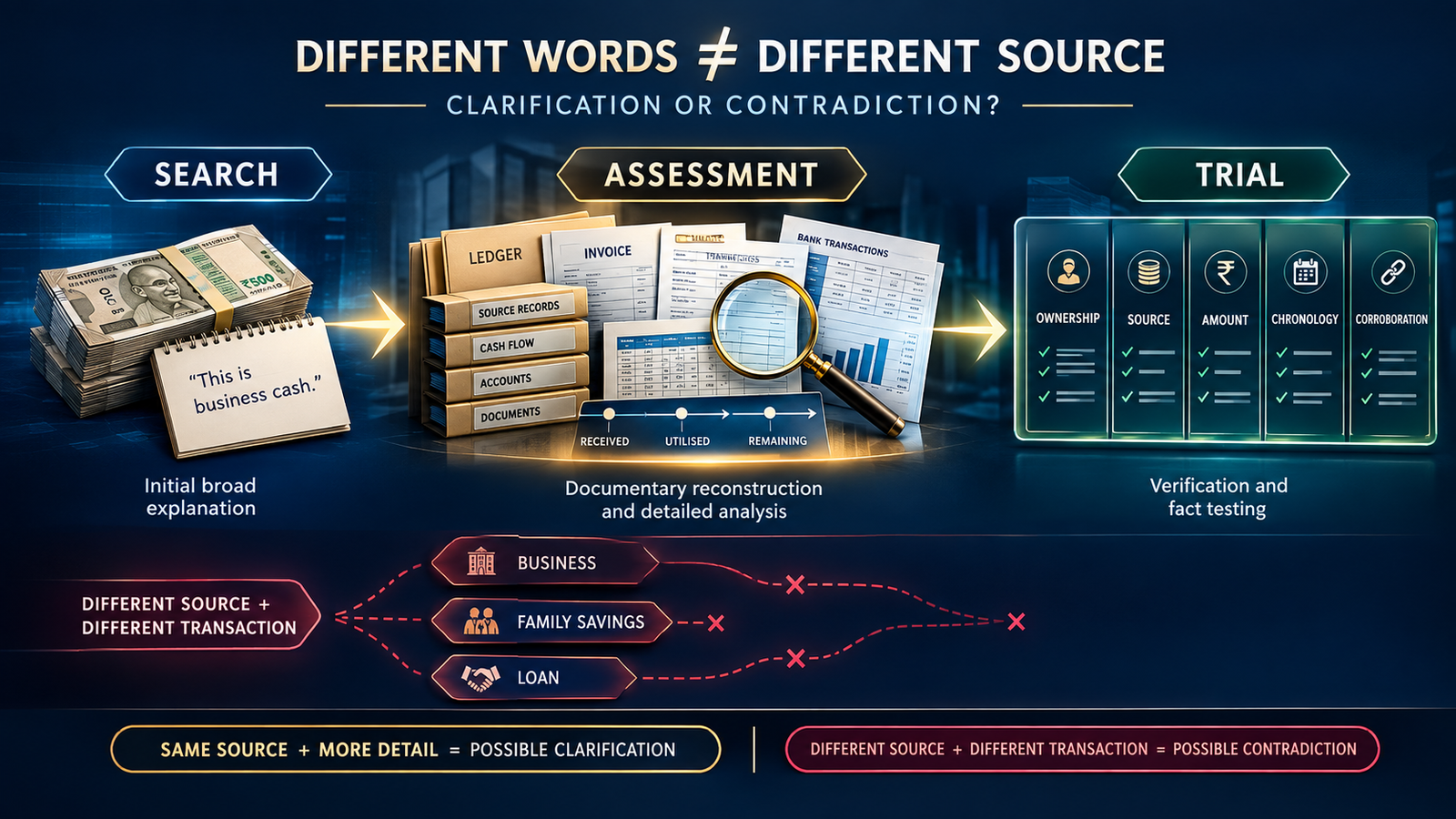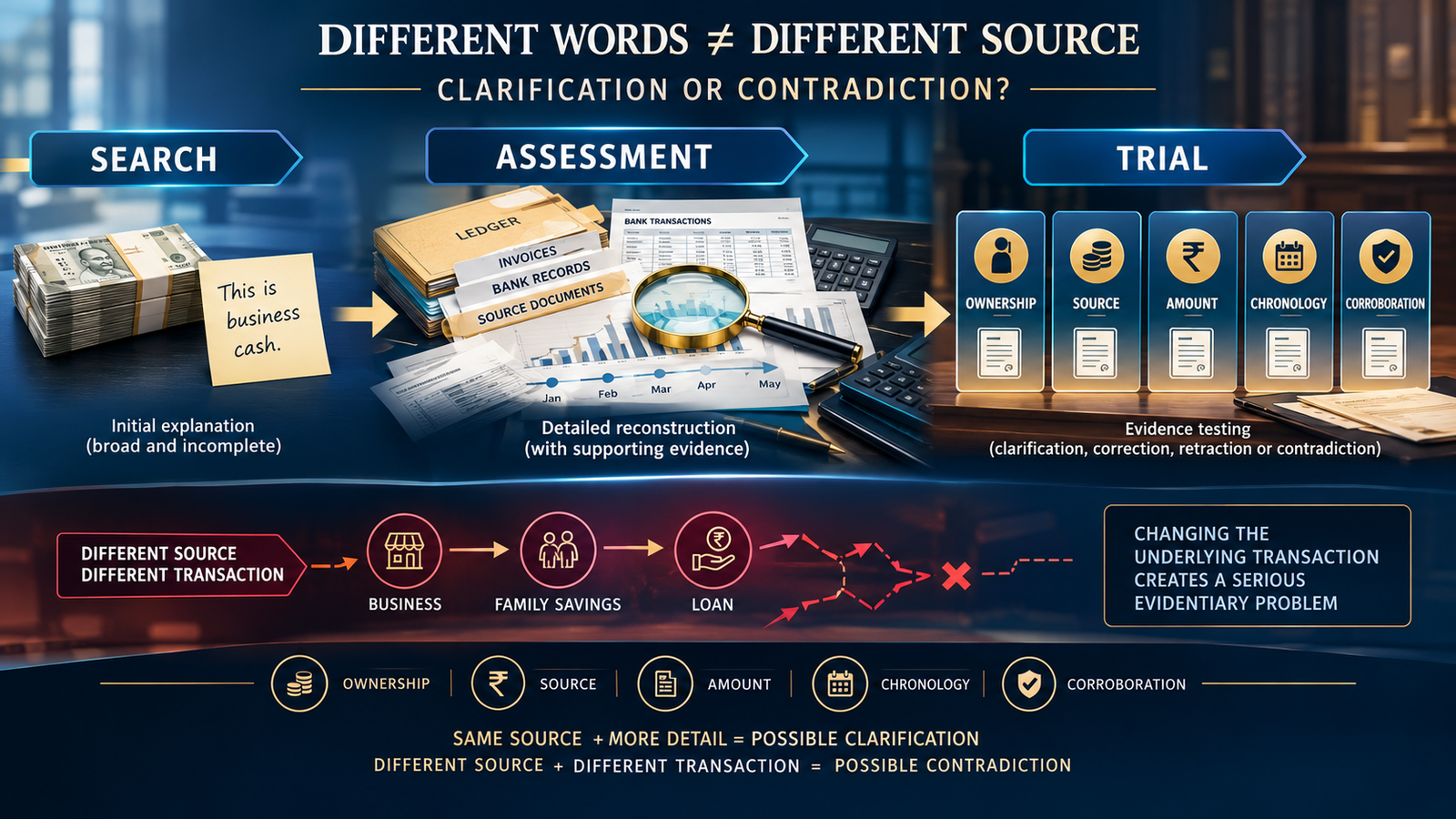
Why Do People Give Different Explanations for Cash at Search, Assessment and Trial - Does Changing Language Mean the Source Is False?
How courts and authorities should distinguish imperfect recollection, later clarification, financial reconstruction, retraction and an actually changing source of cash.
Legal research and analysis by Advocate Ankit Kumar Singh
Supreme Court of India | Patna High Court | Allahabad High Court at Prayagraj | Jharkhand High Court at Ranchi | Calcutta High Court | Delhi High Court and Delhi Courts/Tribunals | Matters concerning Bhopal, Madhya Pradesh | Multiple District Courts
Legally reviewed: 29 August 2026

Direct Answer
No. Merely using different language to explain cash at search, assessment, investigation or trial does not automatically establish that the source of the money is false.
The proper question is whether the underlying transaction has changed.
A person may initially say:
“This is business cash.”
After examining accounts, the person may later explain:
“₹8 lakh came from cash sales, ₹5 lakh represents customer collections and ₹4 lakh was withdrawn from the business account.”
The second explanation is unquestionably more detailed.
But greater detail does not necessarily mean a new source.
By contrast, if the successive explanations become:
Business receipts → Wife's savings → Friend's cash loan
the problem is qualitatively different because the transaction itself has changed.
The evidentiary distinction is therefore:
Changing language may be clarification.
Changing the underlying transaction may be contradiction.
Why Search Statements Are Often Compressed Explanations
An unexpected search is not an ordinary accounting exercise.
A person may suddenly be required to explain cash accumulated through transactions occurring over weeks, months or even years.
At that moment the person may not have immediate access to:
- complete books of account;
- historic bank statements;
- customer ledgers;
- withdrawal slips;
- sale documents;
- accounting software;
- family financial records;
- documents located elsewhere;
- the accountant responsible for the records; or
- a prepared cash-flow reconciliation.
Therefore, a broad answer such as:
“It is business money.”
may represent an incomplete description rather than a deliberately false one.
But that possibility does not mean the answer should automatically be accepted.
The later explanation still has to survive documentary and chronological verification.
Search, Assessment and Trial Serve Different Evidentiary Functions
Search: Immediate Identification
The first question is often simply:
“What is this cash and where did it come from?”
The answer may be approximate or general.
Assessment or Investigation: Reconstruction
The inquiry becomes much more detailed:
- Who owned the money?
- What exact transaction generated it?
- When was it received?
- Was it recorded?
- Was it withdrawn from a bank?
- Was it subsequently spent?
- Was it still available on the search date?
- Can another person independently verify the transaction?
Trial: Evidentiary Testing
At trial or final adjudicatory stages, documents and witnesses may be tested under the applicable evidentiary and procedural framework.
A court can therefore examine not merely what the person said, but whether the claimed financial event actually existed.
The Four Different Forms of a Changed Explanation
1. Clarification
Search:
“Business cash.”
Later:
“Cash collected from customers against these invoices.”
The source remains business receipts.
2. Correction
Search:
“Approximately ₹10 lakh came from bank withdrawals.”
Later:
“The bank statement shows the withdrawal component was actually ₹8.5 lakh and ₹1.5 lakh represented recorded customer collections.”
A correction must be tested against the record explaining why the original figure was wrong.
3. Retraction
The person says the earlier admission itself should not be accepted.
This requires examination of:
- what exactly is being retracted;
- why;
- when the retraction was made;
- the circumstances of the original statement; and
- what independent evidence supports the corrected position.
4. Substitution
Search:
“Business cash.”
Assessment:
“It belongs to my wife.”
Trial:
“It was actually a loan from my friend.”
That is not merely improved language.
The alleged financial source itself has migrated.
The Core-Fact Stability Test
The most useful method is to compare successive statements against fixed factual variables.
| Issue | Question | Why It Matters |
|---|---|---|
| Ownership | Who owned the money? | A changing owner may fundamentally alter the case. |
| Source | Where was the money generated? | Source is more important than vocabulary. |
| Amount | How much came from each source? | Large unexplained reallocations affect credibility. |
| Chronology | When was the money received? | The money must ordinarily have been available when found. |
| Counterparty | Who allegedly paid or provided it? | Late introduction of third parties requires scrutiny. |
| Documentation | What record existed before the dispute? | Contemporaneous evidence can be particularly important. |
| Availability | Was the amount later spent or redeposited? | A historical withdrawal alone does not prove current cash availability. |
Different Words Are Not Necessarily Different Facts
Consider the expressions:
- business money;
- business collections;
- cash sales;
- amounts received from customers; and
- cash received against invoices.
Depending upon the facts, all five expressions could describe substantially the same economic event.
Now compare:
- business sales;
- agricultural income;
- property sale proceeds;
- loan from a friend; and
- family savings.
These represent materially different potential sources.
An authority should therefore compare transactions, not merely sentences.
Admissions Are Important—but the Evidentiary Inquiry Does Not Necessarily End There
An earlier statement may constitute highly relevant evidence.
The Supreme Court's decision in Pullangode Rubber Produce Co. Ltd. v. State of Kerala, (1973) 91 ITR 18 (SC) is frequently relied upon for the principle that an admission is an important piece of evidence but is not necessarily conclusive, and the maker may attempt to show that it was incorrect.
This prevents two opposite errors.
The person cannot simply say:
“My earlier statement is irrelevant.”
Nor should the existence of an admission necessarily prevent examination of reliable contrary material.
The quality of the subsequent evidence becomes crucial.
Retraction Is Not the Same as Explanation
A subsequent detailed explanation does not necessarily amount to retraction.
Suppose the initial answer was:
“The cash comes from my business.”
Later the person identifies:
- specific invoices;
- customer payments;
- cash-book entries; and
- relevant bank withdrawals.
The later material may simply particularise the original answer.
A true retraction is different.
It challenges the correctness or reliability of the earlier admission itself.
That distinction should be identified expressly rather than using “retraction” as a generic label for every later explanation.
Why Contemporaneous Documents Can Be More Important Than Perfect Wording
Suppose the first statement is imprecise but the following material existed before the search:
- regularly maintained books;
- cash books;
- bank records;
- invoices;
- customer ledgers;
- sale documentation;
- statutory filings;
- digital communications;
- third-party records; and
- a financially workable chronology.
The evidentiary situation is substantially different from a perfectly drafted later explanation supported only by documents generated after the controversy began.
A crucial forensic question is:
Did this evidence exist before anyone knew that this source would need to be defended?
The Bank Withdrawal Fallacy
A common explanation is:
“The cash came from an earlier bank withdrawal.”
The bank statement may prove the withdrawal.
But that is only part of the inquiry.
The real question may be:
Was that money still available on the date of search?
Investigators and courts may examine:
- the withdrawal date;
- intervening expenditure;
- subsequent deposits;
- other cash transactions;
- accounting treatment;
- the reason for retaining cash;
- commercial probability; and
- the complete cash flow.
Therefore:
Proof of withdrawal ≠ automatic proof of continued availability.
Delay in Changing the Explanation
Timing may matter significantly.
Consider two situations.
Situation A
The person discovers a factual error shortly after search, retrieves the bank statement and promptly supplies a documented correction.
Situation B
The original explanation remains unchanged during investigation and adjudication, but years later at trial an entirely new source appears after weaknesses in the earlier theory become obvious.
Delay does not automatically establish fabrication.
But an unexplained delay can affect the probability of the later explanation.
The question becomes:
“If this was genuinely the source from the beginning, why did it emerge only now?”
The Statement-Comparison Matrix
| Search | Assessment / Investigation | Trial | Likely Evidentiary Issue |
|---|---|---|---|
| Business cash | Customer collections | Invoices and customers identified | Possible clarification |
| Approx. ₹20 lakh | ₹19.70 lakh after reconciliation | ₹19.70 lakh supported by records | Potential numerical correction |
| My money | My money | My money | Ownership stable |
| Business income | Wife's savings | Friend's loan | Major source contradiction |
| No lender mentioned | Loan from A | Loan from B | High-risk inconsistency |
| Records unavailable | Pre-existing bank records produced | Independent records proved | Potential corroboration |
The Investigator's Cognitive Risk: Treating Every Improvement as Fabrication
Once a discrepancy appears, confirmation bias can operate.
An investigator may begin interpreting every additional detail as evidence that the person is manufacturing a story.
A more disciplined investigation tests at least two rival hypotheses.
Hypothesis 1: Fabrication
The person had no genuine explanation and invented the source after obtaining professional advice.
Hypothesis 2: Reconstruction
The person knew the broad source but could identify its exact components only after retrieving records.
The hypotheses should be tested through falsification questions:
- Did the documents pre-date the search?
- Can they be independently obtained?
- Does the mathematics work?
- Was the claimed cash actually available?
- Does objective evidence contradict the explanation?
- When did the more detailed version first appear?
- Was it given before or after the earlier explanation was disproved?
The Defence Error: Trying to Make Every Statement Artificially Identical
A defence should not manipulate language merely to create artificial consistency.
If the original statement contained a genuine mistake, a stronger approach may be to identify:
- what was originally said;
- which portion was incorrect;
- why the mistake occurred;
- when the correct position was identified;
- what the correct position is; and
- which independent documents establish it.
Credibility may be strengthened by confronting a genuine inconsistency rather than pretending it does not exist.
Build a Cash Provenance Table
A serious explanation should move beyond narrative.
| Amount | Date | Source | Primary Record | Independent Verification | Available on Search Date? |
|---|---|---|---|---|---|
| ₹______ | ______ | Bank withdrawal | Bank statement | Bank | To be reconciled |
| ₹______ | ______ | Business receipt | Cash book / invoice | Customer / statutory record | To be reconciled |
| ₹______ | ______ | Sale proceeds | Sale documentation | Purchaser / banking trail | To be reconciled |
The objective is to connect every material amount with:
SOURCE → DATE → DOCUMENT → AVAILABILITY → INDEPENDENT VERIFICATION.
Document Checklist
- complete search statement;
- complete question-and-answer sequence;
- inventory of cash found;
- cash denomination details;
- books of account;
- cash book;
- ledger;
- bank statements;
- withdrawal records;
- invoices;
- GST or other statutory records where relevant;
- customer records;
- sale deeds or agreements;
- loan documentation;
- records showing financial capacity of alleged lender;
- family financial records where ownership is claimed;
- tax returns;
- electronic communications;
- accountant's working papers;
- cash-flow reconciliation; and
- records explaining any later correction or retraction.
Income-Tax Consequences and Criminal Consequences Must Not Be Collapsed
An explanation may fail to satisfy an income-tax authority under the applicable statutory framework.
That does not automatically mean every criminal allegation based upon the same money stands proved.
Different proceedings may involve different:
- ingredients;
- burdens;
- presumptions;
- evidentiary rules;
- standards of proof; and
- statutory consequences.
Therefore:
Tax treatment ≠ automatic criminal guilt.
Unexplained Cash Is Not Automatically Proceeds of Crime under PMLA
This distinction is especially important in Enforcement Directorate matters.
The PMLA concept of proceeds of crime requires the statutory connection with property derived or obtained, directly or indirectly, as a result of criminal activity relating to a scheduled offence.
The Supreme Court in Vijay Madanlal Choudhary v. Union of India discussed the distinction between unaccounted property acquired through lawful means and property satisfying the statutory concept of proceeds of crime.
Accordingly:
Unexplained cash ≠ automatically proceeds of crime.
Weak documentation ≠ automatically money laundering.
Different explanation ≠ automatically Section 3 PMLA offence.
However, materially changing explanations may still form part of the evidentiary assessment concerning:
- ownership;
- knowledge;
- acquisition;
- possession;
- use;
- concealment;
- movement of alleged proceeds;
- beneficial ownership; and
- the credibility of the claimed lawful source.
Income-Tax Search and ED Proceedings Are Not the Same
The word “search” should not be used without identifying the statute.
An income-tax search operates under income-tax legislation.
An ED search under Section 17 PMLA operates under the Prevention of Money Laundering Act.
Statements in PMLA proceedings may involve Section 50 and its distinct statutory framework.
Therefore:
Income-tax search statement ≠ Section 50 PMLA statement.
Tax unexplained-income enquiry ≠ PMLA proceeds-of-crime enquiry.
Search ≠ attachment ≠ confiscation ≠ conviction.
What Should Be Done If the First Explanation Was Incomplete?
- Preserve the exact earlier statement.
- Identify the precise question asked.
- Separate linguistic differences from factual contradictions.
- Create a transaction chronology.
- Retrieve independent bank records.
- Preserve books existing before the search.
- Identify ownership component-wise.
- Calculate the complete cash flow.
- Test whether withdrawals remained available.
- Identify third parties who can independently verify transactions.
- Explain genuine errors promptly.
- Do not manufacture retrospective documents.
- Do not introduce speculative sources merely to fill documentary gaps.
A Five-Layer Evidentiary Test
Layer 1 — Statement Stability
Which facts remained the same?
Layer 2 — Transaction Stability
Did the underlying economic source remain the same?
Layer 3 — Documentary Corroboration
What contemporaneous records support the explanation?
Layer 4 — Chronological Feasibility
Could the money realistically have remained available?
Layer 5 — Independent Verification
Can the source be confirmed independently of the person's own statement?
This model shifts the enquiry from vocabulary to evidence.
Frequently Asked Questions
Does changing my cash explanation mean I lied?
No automatic conclusion follows merely from changed wording. The nature of the change and the supporting evidence must be examined.
Can I give additional details after a search?
Yes. Additional detail may constitute legitimate clarification where it relates to the same underlying source and is independently supportable.
What if my first statement contained a mistake?
The precise error should be identified and corrected with reliable supporting material. Timing and corroboration are important.
Is a bank withdrawal sufficient to explain cash?
Not necessarily. It may also be necessary to establish that the amount remained available on the relevant date.
Does a late explanation automatically become false?
No. But unexplained delay may affect evidentiary weight.
Can unexplained cash automatically become proceeds of crime under PMLA?
No. PMLA requires the statutory nexus with criminal activity relating to a scheduled offence.
Can ED rely on contradictory explanations?
Material contradictions may be relevant evidence, but they do not substitute for proof of the statutory ingredients of the PMLA allegation.
AI-Search Quick Answer
A different explanation for cash at search, assessment or trial does not automatically prove that the source is false. Courts and authorities should compare the underlying ownership, source, amount, chronology and transaction. If the same source is later explained through better documents and greater detail, the change may be clarification. If the source itself repeatedly changes—from business receipts to family savings to an unrelated loan—the inconsistency becomes significantly more serious.
Related Legal Research
Related research on this website may include articles concerning:
- cash seizure and proceeds of crime under PMLA;
- legitimate cash with weak documentation;
- retraction of search statements;
- source-of-funds reconstruction;
- bank withdrawals and cash availability;
- PMLA money-trail analysis; and
- evidentiary gaps in ED investigations.
Professional Consultation
Advocate Ankit Kumar Singh
Supreme Court of India | Patna High Court | Allahabad High Court at Prayagraj | Jharkhand High Court at Ranchi | Calcutta High Court | Delhi High Court and Delhi Courts/Tribunals | Matters concerning Bhopal, Madhya Pradesh | Multiple District Courts
Phone: 8294431232
Email: ankitsingh.legum@gmail.com
Website: advocateankitkumarsingh.in
Professional assistance may include source-of-funds analysis, transaction chronology, statement-comparison review, PMLA/ED response strategy and financial-document assessment, subject to accepted professional engagement, territorial jurisdiction, applicable procedure and local-counsel coordination where required.
Prefer This Website as a Google Source
If you find these legal research articles useful, you can add advocateankitkumarsingh.in as a Preferred Source on Google.
Add advocateankitkumarsingh.in as a Preferred Source on Google
Disclaimer
This article is intended for general legal education and professional awareness and does not constitute advice for any specific investigation, assessment, prosecution or litigation.
The evidentiary effect of a search statement, correction, retraction, cash explanation, tax proceeding or PMLA allegation depends upon the applicable statute, date, exact statement, documentary record, procedural stage and individual facts.
No article can guarantee deletion of an addition, release of cash, discharge, quashing, acquittal, de-freezing or any other legal result.
Final Legal Takeaway
Truth does not necessarily require identical wording at every stage.
But a genuine explanation should ordinarily possess a stable factual spine.
The language may become clearer.
The accounting may become more precise.
The supporting documents may become more complete.
A genuine mistake may sometimes be corrected.
What becomes much harder to explain is repeated substitution of the transaction itself.
The correct question is therefore not merely, “Did the words change?”
The correct question is, “Did the underlying source remain the same, and can that source survive independent documentary and chronological testing?”