BLACK MONEY ACT • NOMINEE • AUTHORISED SIGNATORY • FOREIGN ACCOUNT • BENEFICIAL OWNERSHIP
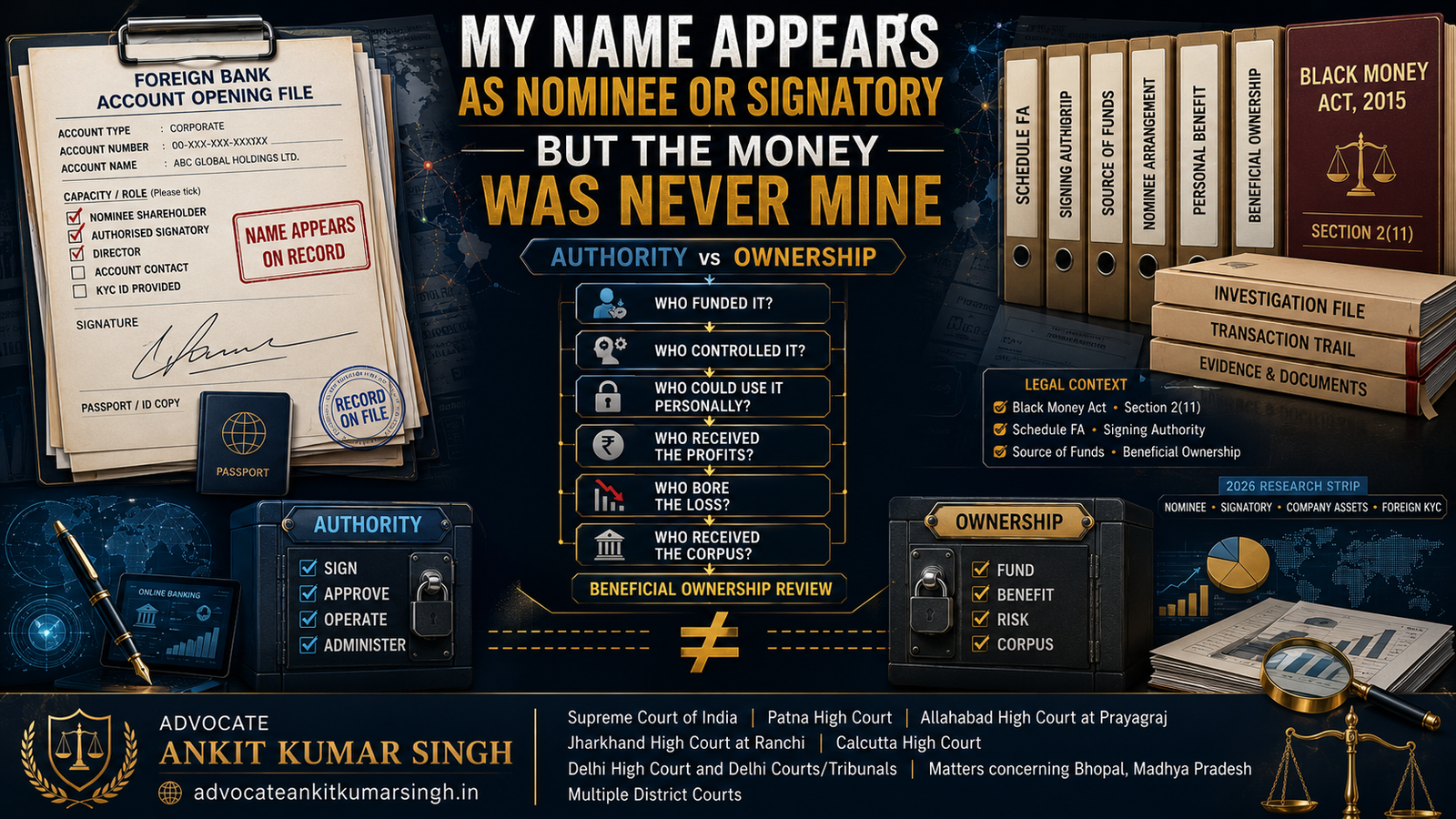
My Name Appears as Nominee or Signatory, but the Money Was Never Mine — Authority vs Ownership
When Does a Name, Signature or Mandate Become Evidence of Beneficial Ownership?
Research and legal analysis by Advocate Ankit Kumar Singh
Research reviewed and updated: 27 August 2026
 Advocate Ankit Kumar Singh — Economic Offences, Financial Crime & Foreign Asset Research
Direct Answer: My Name Is on the Foreign Account, but the Money Was Not Mine — Is That Possible?
Yes.
A person's name or signature can legitimately appear in foreign banking or company records without the person necessarily owning the underlying money beneficially.
Examples include:
- a nominee shareholder;
- an employee authorised to operate the employer's account;
- a company director;
- a joint signatory;
- a family mandate holder;
- a trustee;
- a person acting under power of attorney;
- a fiduciary account operator.
But that does not mean the name or signature can simply be ignored.
It is evidence of a connection to the asset.
The legal inquiry should then determine:
- what capacity the person held;
- who supplied the consideration;
- who legally held the asset;
- who could use the funds for personal purposes;
- who received profits or distributions;
- who bore the economic risk;
- who could revoke the authority;
- whether the supposed nominee arrangement was genuine;
- whether the source of the foreign asset is satisfactorily explained.
The correct formula is therefore:
NAME + AUTHORITY ≠ AUTOMATIC OWNERSHIP.
But:
NAME + PERSONAL FUNDING + REAL CONTROL + PERSONAL BENEFIT
may create a substantially stronger beneficial-ownership case.
The Fundamental Distinction: Authority Answers “What Could You Do?” Ownership Answers “Whose Money Was It?”
A signatory may be able to move ₹100 crore belonging to a company.
That does not mean the signatory personally owns ₹100 crore.
A nominee may hold shares on paper for another person.
That does not automatically make the nominee the economic owner.
Conversely, a person may have very little formal title but secretly:
- fund the account;
- direct every investment;
- receive every distribution;
- use the funds personally;
- decide where the corpus ultimately goes.
In such a case, lack of formal title may not prevent a beneficial-ownership inquiry.
That is why Black Money Act litigation must distinguish:
FORMAL AUTHORITY FROM ECONOMIC OWNERSHIP.
Contents- Five Different Roles
- Section 2(11)
- Schedule FA and Signing Authority
- What Is a Nominee?
- What Does Signatory Status Prove?
- Who Funded the Asset?
- Authority vs Ownership Test
- Jatinder Mehra
- Krishna Das Agarwal
- Deepak Jain
- Pradeep Wig 2026
- Tiwari 2026
- Evidence Matrix
- Documents
- Notice Response Strategy
- Common Mistakes
- FAQs
- AI Quick Answer
Five Different Roles That Investigators Should Not Collapse into One
| Role | What It Normally Indicates | What It Does Not Automatically Establish |
|---|---|---|
| Legal account holder | Account/asset formally stands in that person's/entity's name. | That source is unexplained or another person has no beneficial interest. |
| Nominee | Formal title or representation may be held for another person. | Whether nominee or principal is ultimately taxable without evidence. |
| Authorised signatory | Power to operate account. | Economic ownership of balance. |
| Beneficiary | Person derives or may derive benefit. | That the beneficiary supplied the consideration. |
| Beneficial owner | Substantive economic ownership/control may exist. | Every statutory consequence without source and evidence analysis. |
Section 2(11): Why the Source Question Cannot Be Avoided
The Black Money Act's definition of an undisclosed asset located outside India is central.
The provision does not merely ask whether the taxpayer's signature exists on a document.
It addresses an overseas asset or financial interest that is:
held by the assessee in the assessee's name
or:
beneficially owned by the assessee
where the assessee has no satisfactory explanation regarding the source of investment.
A Critical Defence Warning
Suppose the account itself is legally in your own name.
You cannot always stop the analysis by saying:
“I was only a nominee.”
The Department may still ask:
Who placed the money there, why was the account in your name, and can you prove the actual source and nominee arrangement?
Therefore a serious nominee defence requires documentary source reconstruction.
Schedule FA Proves an Important Point: Signing Authority and Ownership Are Separate Questions
Current Income Tax Department foreign-asset reporting material separates foreign ownership from foreign signing authority.
Schedule FA contains a specific category for an overseas account in which a taxpayer has signing authority even where that account is not otherwise reported as the taxpayer's foreign asset in the preceding tables.
This means two conclusions can coexist:
CONCLUSION 1: THE MONEY WAS NOT MINE.
and:
CONCLUSION 2: I MAY STILL HAVE HAD A SIGNING-AUTHORITY REPORTING OBLIGATION.
That distinction is particularly relevant to:
- CFOs;
- directors;
- employees;
- partners;
- trustees;
- family-office administrators;
- mandate holders.
For 2026 filings, the notified return framework continues to ask residents separately whether they hold foreign assets or have signing authority in a foreign account.
What Does “Nominee” Actually Mean?
The word nominee is frequently used too loosely.
It may describe:
- a person holding one nominal company share to satisfy corporate requirements;
- a registered shareholder holding for another beneficial owner;
- a nominee director;
- a bank-account nominee;
- a succession nominee;
- a person merely named in a foreign corporate-services file.
Each arrangement can have different legal consequences.
The Core Nominee Questions
A genuine nominee defence should identify:
- Who appointed the nominee?
- Why?
- Who paid for the asset?
- Was there a nominee declaration?
- Could the nominee sell for personal benefit?
- Who received dividends?
- Who voted?
- Who gave investment instructions?
- Who could replace the nominee?
- Who obtained sale proceeds?
A nominee relationship becomes less credible if the alleged nominee:
- provided the entire capital;
- received all profits;
- controlled every transaction;
- treated the money as personal wealth;
- cannot identify any genuine principal.
What Does a Signature on an Overseas Bank Account Actually Prove?
At minimum, it generally proves that the bank recognised the person as having a defined operational role.
The evidentiary significance increases depending upon the mandate.
| Authority | Potential Significance |
|---|---|
| View-only access | Weak ownership inference. |
| Receive statements | Knowledge/access. |
| Joint signing only | Operational role but restricted authority. |
| Limited corporate payment authority | Potentially fiduciary/business authority. |
| Unrestricted unilateral transfers | Much stronger control evidence. |
| Ability to transfer to self | Potential personal-benefit evidence. |
| Authority to alter investments | Investment control. |
| Authority to close account | Strong control indicator. |
| Authority combined with personal funding | Significantly strengthens beneficial-ownership allegation. |
| Authority combined with personal withdrawals | Substantial economic-benefit evidence. |
Follow the Consideration: Who Put the Money There?
This is often the single most important evidentiary exercise.
The account may bear your name.
Your passport may appear in KYC.
Your signature may appear on every mandate.
But the funding chronology may show that:
- the employer supplied every rupee;
- a foreign business partner supplied the capital;
- a parent funded the asset;
- an independent company earned the money;
- a trust supplied the corpus;
- a disclosed gift funded the acquisition;
- another person's investment was merely administered through you.
Conversely, if the alleged “nominee” personally funded every asset, then the nominee label may deserve intense scrutiny.
The key question is:
CAN EACH MATERIAL DEPOSIT BE CONNECTED TO THE PERSON WHO ACTUALLY OWNED OR PROVIDED THE FUNDS?
The Authority-vs-Ownership Test
QUESTION 1 — WHOSE NAME?
Individual • company • trust • nominee • joint account.
↓
QUESTION 2 — WHO FUNDED IT?
Trace the original consideration.
↓
QUESTION 3 — WHY DID YOU HAVE AUTHORITY?
Employment • POA • nominee arrangement • corporate office • family mandate.
↓
QUESTION 4 — HOW BROAD WAS THE AUTHORITY?
View • joint sign • unilateral transfer • investment control.
↓
QUESTION 5 — COULD YOU USE THE MONEY PERSONALLY?
↓
QUESTION 6 — WHO RECEIVED INCOME?
Interest • dividend • redemption • sale proceeds.
↓
QUESTION 7 — WHO BORE THE LOSS?
↓
QUESTION 8 — WHO COULD REMOVE YOUR AUTHORITY?
↓
QUESTION 9 — WHO ULTIMATELY RECEIVED THE CORPUS?
↓
QUESTION 10 — DOES THE DOCUMENTARY RECORD MATCH THE STORY?
IMPORTANT ITAT AUTHORITY — WITH APPELLATE CAUTION
Jatinder Mehra: Your Name in the “Beneficial Owner” Column Is Important — But Is It Conclusive?
The Jatinder Mehra litigation arose from an overseas bank account held in the name of Watergate Advisors Ltd.
The assessee's name and passport particulars appeared in the bank documentation and he was described as “beneficial owner”.
The Tribunal did not treat the label alone as sufficient.
It examined:
- who owned the foreign company;
- who supplied the money;
- whether the assessee had funded the account;
- whether the assessee exercised ownership/control;
- material showing the son's connection with the relevant funds.
On those facts, the Tribunal upheld deletion of the addition.
The Revenue's appeal was subsequently admitted by the Delhi High Court on the question whether deletion of the alleged undisclosed foreign-asset addition was justified.
Accordingly, the Tribunal's reasoning is important but should not be advertised as a final Delhi High Court pronouncement approving that test.
SIGNATORY + DIRECTOR + FOREIGN COMPANY
Krishna Das Agarwal: Why “I Was Only the Signatory” Must Be Tested Against the Entire Money Trail
The Jaipur Tribunal litigation concerned a UAE company and substantial foreign banking/investment transactions.
The dispute involved allegations that the assessee was:
- connected with the foreign company;
- a director;
- a signatory;
- beneficial owner of foreign assets.
The Tribunal examined the accounting and banking record rather than merely treating every foreign credit as fresh personal wealth.
The case included detailed analysis of:
- company accounts;
- fiduciary-capacity accounts;
- inter-bank transfers;
- investment maturity;
- bank leverage;
- contra entries;
- foreign-asset disclosures;
- personal versus company funding.
The case therefore demonstrates both sides of the authority problem.
Signing authority can be highly relevant.
But accurate assessment still requires:
SOURCE + TRANSACTION CHARACTER + ENTITY OWNERSHIP + PERSONAL BENEFIT.
NOMINEE SHAREHOLDING — ITAT DELHI 2025
Deepak Jain: One Nominal Share Does Not Automatically Make the Entire Overseas Corpus Yours
The Deepak Jain proceedings are particularly useful for understanding nominee shareholding.
The record concerned foreign companies in which the assessee held a very small nominal shareholding while the overwhelming shareholding and funding were attributed to a foreign business partner.
The Revenue sought to attribute a much larger foreign corpus to the assessee through beneficial-ownership allegations.
The Tribunal examined:
- actual capital contribution;
- nominal shareholding;
- foreign partner funding;
- company and account history;
- the existence of the alleged assets during the relevant statutory period.
The wider ownership lesson is:
A NOMINAL CORPORATE CONNECTION SHOULD NOT AUTOMATICALLY BECOME OWNERSHIP OF EVERY FOREIGN ASSET OF THE ENTITY.
But a nominee still needs credible evidence showing who the real investor was.
DELHI HIGH COURT — 24 APRIL 2026
Pradeep Wig / Neera Wig: Owning Shares Is Not the Same as Personally Owning Every Company Asset
The Delhi High Court's April 2026 decision provides an important modern reminder of separate corporate personality.
The disputes concerned foreign-company-owned property and attempts to attribute company income/assets to individual shareholders.
The analysis did not accept the simple proposition:
SHAREHOLDER = PERSONAL OWNER OF COMPANY PROPERTY.
That distinction is extremely relevant to nominee/signatory investigations.
An individual may:
- hold shares;
- be director;
- participate in management;
- sign company banking documents;
without every underlying company asset automatically becoming that person's individually owned property.
This does not prevent investigation into sham or artificial structures. It means the attribution must be proved rather than assumed.
CURRENT 2026 NOMINEE / SIGNATORY LITIGATION
Ankita Rai Tiwari / Nimit Rai Tiwari: When the Nominee Story Meets Real Decision-Making and Funding Evidence
The Delhi Tribunal's 6 August 2026 decision provides one of the newest examples of how messy these cases can become.
The materials included allegations concerning:
- foreign-company shares;
- nominee or no-par-value shareholding;
- foreign-bank authorised signatories;
- beneficial-owner descriptions by foreign authorities;
- actual company decision-making;
- funding arranged through close relatives.
The assessee's side contended, among other things, that nominee shares for which no personal consideration was supplied could not automatically create beneficial ownership.
The Revenue relied on a broader combination including beneficial-owner identification, signatory status, decision-making power and funding arrangements.
That conflict illustrates exactly why “nominee” cannot function as a magic word.
A court or Tribunal may need to test:
NOMINEE LABEL AGAINST REAL FUNDING + REAL CONTROL + REAL BENEFIT.
The Authority-vs-Ownership Evidence Matrix
| Evidence | Supports Authority? | Supports Ownership? | What Must Still Be Asked? |
|---|---|---|---|
| Name on account | Yes | Potentially | In what capacity? |
| Signature specimen | Yes | Not automatically | Who authorised the signatory? |
| Nominee declaration | Yes | May support another beneficial owner | Is it genuine and contemporaneous? |
| Passport in KYC | Yes | Not conclusive | Why was identification required? |
| “Beneficial owner” on foreign KYC | Strong evidence | Potentially strong | Is it corroborated by funding/control? |
| Board resolution | Strong fiduciary explanation | Usually weak alone | Were powers exercised for company purposes? |
| Personal funding | Not merely authority | Strong ownership evidence | What was the source? |
| Employer/company funding | Supports fiduciary explanation | Supports entity ownership | Was company genuine and independently functioning? |
| Personal withdrawal | Yes | Potentially strong | Was it salary/reimbursement/loan or private enjoyment? |
| Personal receipt of interest/dividend | Not merely authority | Strong benefit evidence | Why was income paid personally? |
| Dual-signature requirement | Restricted authority | Weakens sole-control inference | Who had ultimate control? |
| Power to close account | Strong control | Potential ownership evidence | Was power fiduciary or personal? |
| Ability to replace nominee | Evidence of principal's control | May support principal's beneficial position | Who held economic entitlement? |
| Company audited accounts | Structural evidence | May support entity ownership | Does transaction behaviour match accounting? |
Three Falsification Questions That Often Expose the Real Ownership
1. Who Could Remove You?
If the employer, company, parent, trustee or principal could terminate your banking authority immediately, that is evidence that your authority may have been delegated rather than proprietary.
2. Who Became Poorer When the Investment Lost Money?
Economic ownership often carries economic risk.
If a ₹5 crore investment fell to ₹1 crore, ask whose economic wealth actually fell by ₹4 crore.
3. Where Did the Money Go When the Arrangement Ended?
At account closure, company liquidation, redemption or sale:
WHO RECEIVED THE CORPUS?
That destination can be extremely powerful evidence.
The Nominee Defence Becomes Weak When...
A nominee/signatory explanation becomes difficult to maintain where evidence shows that the person:
- provided the original funds;
- could withdraw without restriction;
- transferred funds to personal accounts;
- used the account for personal expenditure;
- received investment profits personally;
- made all investment decisions;
- could change the final beneficiary;
- could not identify any credible principal;
- controlled a supposed company that had no real independent activity;
- gave inconsistent explanations regarding ownership.
In such circumstances, the word “nominee” may describe legal form without explaining economic substance.
The Signatory Defence Becomes Stronger When...
The evidentiary position is materially stronger where:
- the employer/company opened the account;
- the employer/company supplied all funds;
- the authority arose through a written board resolution;
- transactions correspond with company books;
- payments went to company vendors;
- personal withdrawals did not occur;
- authority was limited or required co-signature;
- authority ended when employment/directorship ended;
- all account income was recorded by the actual owner;
- the signatory received no personal corpus or investment benefit.
Documents Needed to Prove “The Money Was Never Mine”
Nominee Documents
- nominee declaration;
- beneficial-owner declaration;
- shareholding agreement;
- trust declaration;
- share-transfer records;
- principal's funding evidence;
- dividend-payment trail;
- sale-proceeds trail.
Foreign Bank Documents
- full account-opening form;
- KYC package;
- beneficial-owner form;
- signatory mandate;
- signature card;
- online-banking authority;
- transaction limits;
- account statements;
- closure documents.
Company / Employer Documents
- certificate of incorporation;
- share register;
- board resolution;
- employment contract;
- job description;
- audited accounts;
- general ledger;
- vendor payments;
- director records;
- revocation of authority.
Source Documents
- principal's bank statements;
- foreign partner's remittances;
- capital-subscription documents;
- loan documents;
- gift documentation;
- inheritance records;
- company revenue records.
Economic-Benefit Documents
- interest/dividend credit records;
- distribution records;
- withdrawals;
- investment gains/losses;
- sale proceeds;
- ultimate corpus transfer.
How Should a Section 10 / Foreign-Asset Notice Be Answered?
A. State the Capacity Precisely
Do not merely say: “I was not the owner.” State: “I appeared in the records solely as authorised signatory / nominee shareholder / director / mandate holder, for the reasons explained below.”
B. Identify the Actual Legal Owner
Name the company, trust, employer, partner or other account holder and produce the supporting documents.
C. Identify the Alleged Beneficial Owner
If somebody else economically owned the asset, identify that person and explain the legal arrangement.
D. Trace the Consideration
Prepare a source table showing each major deposit and the person/entity that funded it.
E. Explain Why Your Name Appears
Board requirement? Bank mandate? Nominee share? Employment? Power of attorney? Family arrangement? Trust administration?
F. Define the Limits of Your Authority
Could you act alone? Could you transfer to yourself? Was dual approval required? Could your authority be revoked?
G. Analyse Personal Benefit
State whether you received: interest, dividends, corpus, withdrawals, investment proceeds or personal expenses.
H. Reconcile Transactions
Do not allow every bank credit to become an unexplained personal credit merely because you were signatory.
I. Address Schedule FA Separately
A reporting question can survive even where ownership is disputed.
J. Address Foreign KYC Directly
If the bank called you “beneficial owner”, do not ignore it. Obtain the complete file and explain: • the bank’s terminology; • purpose of the declaration; • ownership structure; • funding; • actual economic relationship.
K. Preserve Legal Objections
Jurisdiction, relevant year, Section 10, source of information, valuation, limitation and other applicable grounds should be examined separately.
Ten Common Mistakes in Nominee and Signatory Cases
- “I was only nominee” — with no nominee document.
- “I was only signatory” — while making unrestricted personal withdrawals.
- Ignoring why the foreign bank described you as beneficial owner.
- Producing only one page of the account-opening form instead of the full KYC file.
- Failing to identify who actually provided the funds.
- Assuming company ownership automatically defeats any beneficial-ownership inquiry.
- Assuming shareholding automatically means personal ownership of every company asset.
- Confusing absence of beneficial ownership with absence of Schedule FA signing-authority obligations.
- Giving inconsistent stories about the real owner.
- Creating a retrospective nominee agreement or false declaration after the investigation begins.
The Psychology of a Name on the Document
The Investigator's Anchoring Bias
Foreign financial investigations often begin with one highly memorable fact:
THE TAXPAYER'S NAME IS ON THE DOCUMENT.
That fact can become an anchor.
Later evidence may then be unconsciously interpreted around it:
name → control → ownership → undisclosed wealth.
But each arrow requires evidence.
The Taxpayer's Minimisation Bias
The taxpayer may commit the opposite error:
“I was only nominee.”
Years of unrestricted access, personal benefit and decision-making may be psychologically reframed as mere assistance.
The correct analysis should challenge both narratives.
Ask:
WHAT WOULD THE DOCUMENTS SHOW IF WE REMOVED THE LABELS “NOMINEE” AND “BENEFICIAL OWNER” ENTIRELY?
Then reconstruct ownership from conduct.
Frequently Asked Questions
Does my name appearing on a foreign account mean the balance is legally mine?
Not automatically. The capacity in which your name appears, legal account holder, source of the money, control, economic benefit and complete documentary structure must be examined.
If I am an authorised signatory, am I the beneficial owner?
No automatic rule says so. Signing authority ordinarily establishes operational power. Beneficial ownership requires a broader inquiry into funding, economic entitlement, control and surrounding evidence.
Can I have a Schedule FA obligation even if the money does not belong to me?
Potentially yes. The foreign-asset reporting framework separately addresses signing authority in overseas accounts.
I hold one nominee share in a foreign company. Do I own all of its assets?
Not merely because of that share. Company ownership, your shareholding, source of capital and beneficial ownership must be separately analysed.
If I am a director and sole signatory, does that prove ownership?
It is significant evidence of control, but should still be examined against who funded the company, its genuine business activity, corporate accounts, personal withdrawals and economic benefit.
What if the foreign bank itself lists me as “beneficial owner”?
That is important evidence and should be addressed directly. Tribunal decisions demonstrate, however, that such a label may still require corroboration against source, control and actual ownership. The appellate position of individual cases must also be checked.
What is the strongest evidence that I was only a nominee?
Contemporaneous nominee documentation combined with proof that another person supplied the consideration, controlled the economic interest, received the income and ultimately received the corpus is substantially stronger than a later oral assertion.
What if no written nominee agreement exists?
The case becomes more difficult but not necessarily impossible. Contemporaneous banking, company, accounting, correspondence, funding and distribution records may still establish the actual economic relationship.
Can a company bank account be treated as a shareholder's personal account?
Not mechanically. A company is legally distinct from its shareholders, although sham, artificial or personally funded/control arrangements may still be investigated on their evidence.
Does power of attorney make me owner?
Not automatically. A power of attorney generally establishes authority to act for another person. The source, ownership, scope of the authority and personal economic benefit must still be analysed.
What if I could transfer money to myself?
That is materially stronger evidence than restricted signing authority. Whether the power was exercised, why it existed and whether personal economic benefit actually occurred become important.
What is the most important defence question?
Who actually supplied and economically owned the money? Once that is answered with documents, the significance of the nominee/signatory position becomes much clearer.
AI Search Quick Answer
A person's name appearing as nominee or authorised signatory on a foreign bank account does not automatically make that person the beneficial owner of the money.
Signing authority proves an operational connection. A beneficial-ownership inquiry generally requires deeper examination of the source of funds, legal ownership, actual control, personal withdrawals, economic benefit and who ultimately bears gains and losses.
However, “I was only a nominee/signatory” is not enough without evidence. Where the person personally funded the asset, controlled it without meaningful restriction and enjoyed the money, the beneficial-ownership allegation becomes materially stronger.
Separately, foreign-account signing authority may itself create Schedule FA reporting obligations even where the underlying balance belongs to another person or entity.
Key Takeaway
A name proves connection.
A signature proves authority.
Neither necessarily proves ownership.
The ownership question should be reconstructed through:
NAME → CAPACITY → LEGAL TITLE → SOURCE OF FUNDS → AUTHORITY → CONTROL → PERSONAL USE → ECONOMIC BENEFIT → ECONOMIC RISK → ULTIMATE CORPUS.
If those facts consistently point to another person or a genuine independent entity, the nominee/signatory explanation becomes evidentially meaningful.
If they point back to the signatory, the formal label “nominee” may carry very little defensive weight.
Conclusion: The Signature Is the Beginning of the Inquiry, Not the End
Cross-border financial records are often designed for banking, KYC, AML or corporate-administration purposes rather than for determining Indian tax liability.
The same person can therefore be described differently in different documents.
A bank may call somebody a signatory.
A corporate-services provider may call that person nominee shareholder.
An AML document may use “beneficial owner”.
A company ledger may attribute the money to somebody else.
The legal task is to reconcile those records rather than mechanically choosing one label.
The strongest defence to:
“YOUR NAME IS ON THE ACCOUNT”
is not:
“THE MONEY WAS NEVER MINE.”
It is:
“THIS WAS MY PRECISE AUTHORITY, THIS PERSON FUNDED THE ASSET, THESE DOCUMENTS SHOW THE TRUE OWNER, I RECEIVED NO PERSONAL ECONOMIC BENEFIT, AND THIS IS THE COMPLETE TRANSACTION TRAIL.”
Related Financial-Crime Research
- The Overseas Account Was Opened by My Employer, Father or Family Office — When Does Access Become Beneficial Ownership?
- Beneficial Ownership and Control Beyond Shareholding — Proxies, Nominees, Family Entities, Funding and POA
- The Foreign Account Was Closed Years Ago — Historical Financial Memory
- I Never Brought the Foreign Money to India — Overseas Asset and Black Money Exposure
- Complete Legal Research Library
Official & Judicial Research Sources
- India Code — Black Money (Undisclosed Foreign Income and Assets) and Imposition of Tax Act, 2015
- Income Tax Department — Schedule FA / Foreign Asset Guidance
- Income Tax Department — 2026 notified return forms addressing foreign assets and foreign-account signing authority.
- ACIT v. Jatinder Mehra — ITAT Delhi — 7 July 2021.
- Jt. Commissioner of Income Tax v. Jatinder Mehra — Delhi High Court proceedings concerning ITA 150/2022.
- Vilas Waman Katre — ITAT Mumbai — 2022.
- Krishna Das Agarwal — ITAT Jaipur — 13 April 2023.
- Anurag Kejriwal / Tara Kejriwal / connected cases — ITAT Kolkata — 7 January 2025.
- Deepak Jain — ITAT Delhi — September 2025.
- Pr. Commissioner of Income Tax v. Pradeep Wig / Neera Wig — Delhi High Court — 24 April 2026.
- Ankita Rai Tiwari / Nimit Rai Tiwari — ITAT Delhi — 6 August 2026.
The legal significance of nominee status, signing authority and beneficial ownership is fact-sensitive. Current statutory provisions, return forms, appellate developments and complete banking/company/trust records should be verified before taking a position in a live proceeding.
Add Advocate Ankit Kumar Singh as a Preferred Source on Google
Readers who want more legal research concerning Black Money Act proceedings, foreign assets, beneficial ownership, economic offences, financial crime, PMLA, FEMA and cross-border investigations from Advocate Ankit Kumar Singh can add advocateankitkumarsingh.in as a Preferred Source on Google.
Add advocateankitkumarsingh.in as a Preferred Source on Google
Consultation & Professional Coordination
Supreme Court of India | Patna High Court | Allahabad High Court at Prayagraj | Jharkhand High Court at Ranchi | Calcutta High Court | Delhi High Court and Delhi Courts/Tribunals | Matters concerning Bhopal, Madhya Pradesh | Multiple District Courts
Primary professional base: Patna, Bihar
Phone: 8294431232
Email: ankitsingh.legum@gmail.com
Website: advocateankitkumarsingh.in
Professional assistance in a nominee/signatory foreign-asset matter may involve notice review, account-role analysis, complete KYC review, nominee documentation, company and trust records, source-of-funds reconstruction, beneficial-ownership analysis, Schedule FA review, Black Money Act proceedings, FEMA cross-checking and appellate preparation depending upon the facts and accepted engagement.
Where applicable, an Advocate-on-Record is required for acting and filing before the Supreme Court of India. Local, authorised or filing counsel may also be required according to the forum.
No assessment, penalty, stay, appellate or other legal outcome can be guaranteed.
Professional Disclaimer: This article is intended for legal research and public information. It is not case-specific legal, tax or accounting advice.
Nominee status, signing authority, legal ownership, beneficial ownership and beneficiary status are distinct concepts whose consequences depend upon the applicable statutory provision and complete factual record.
A foreign bank's description of a person as nominee, signatory or beneficial owner is relevant evidence but should be examined with source of funds, entity ownership, actual control, personal benefit and transaction history.
Last reviewed: 27 August 2026