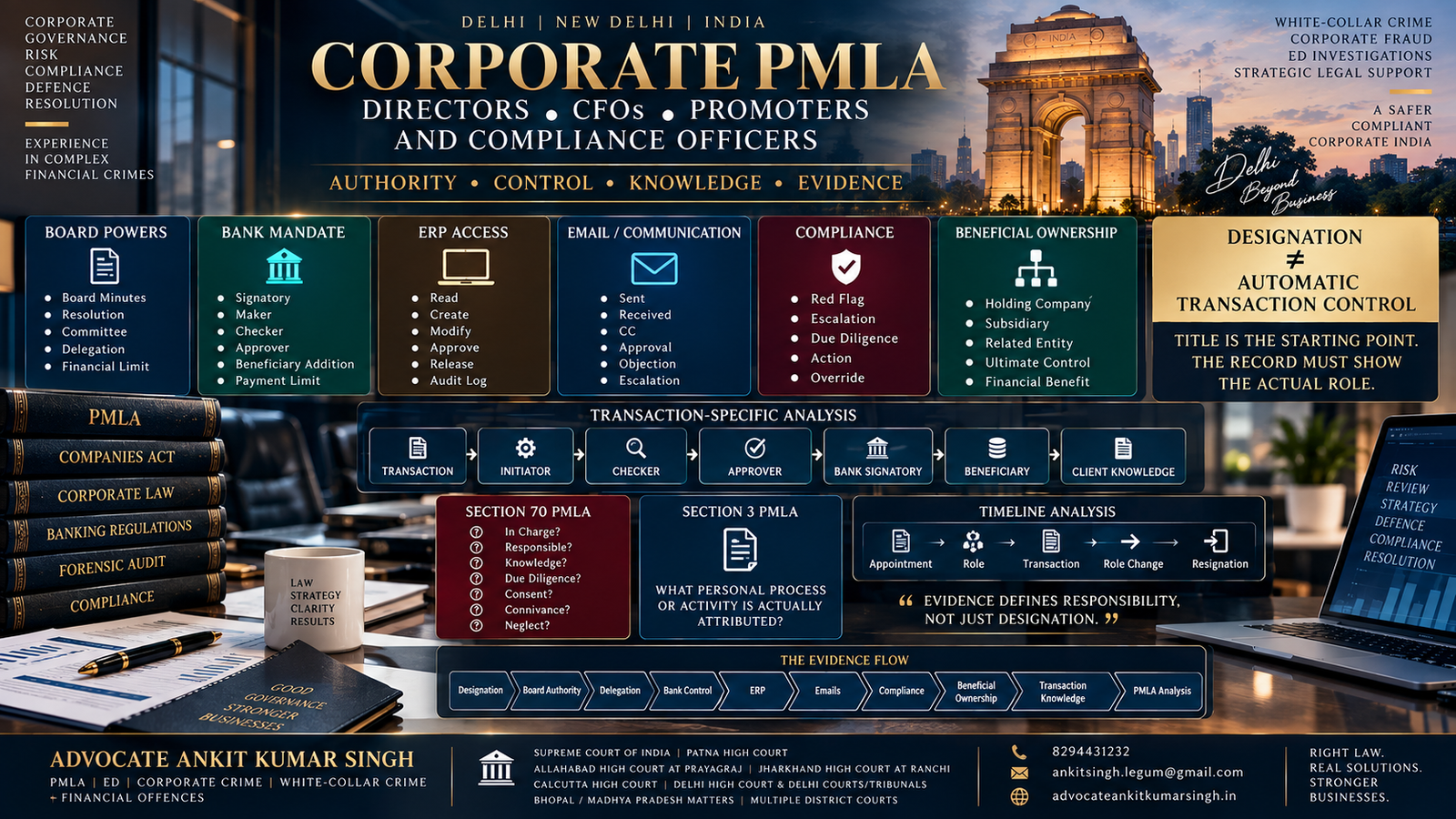
PMLA • CORPORATE ED CASES • DIRECTORS • CFOs • PROMOTERS • COMPLIANCE OFFICERS • SECTION 70 • DELHI / NEW DELHI
Prominent PMLA Lawyer in Delhi for Directors, CFOs, Promoters and Compliance Officers in Corporate ED Cases
Legally researched and updated: 20 September 2026
Supreme Court of India | Patna High Court | Allahabad High Court at Prayagraj | Jharkhand High Court at Ranchi | Calcutta High Court | Delhi High Court and Delhi Courts/Tribunals | Matters concerning Bhopal, Madhya Pradesh | Multiple District Courts
 Advocate Ankit Kumar Singh
Direct Answer: Why Is Corporate Designation Not the End of a PMLA Liability Analysis?
A director, CFO, promoter, authorised signatory or compliance officer may be summoned by the Directorate of Enforcement because the person's name appears in company records, bank mandates, financial statements, board resolutions, email chains or transaction approvals.
That designation is relevant. But it does not by itself answer every question concerning individual responsibility.
A properly prepared corporate PMLA defence should reconstruct:
FORMAL DESIGNATION → ACTUAL AUTHORITY → DELEGATED POWER → TRANSACTION ACCESS → KNOWLEDGE → ACTION / OMISSION → FINANCIAL BENEFIT → ALLEGED SECTION 3 ROLE.
For someone searching for a prominent PMLA lawyer Delhi, PMLA lawyer for directors Delhi, expert ED lawyer Delhi corporate fraud or white-collar crime advocate Delhi, the meaningful question is whether counsel can separate corporate hierarchy from transaction-specific evidence.
A CFO may supervise finance without personally approving every payment. A director may attend board meetings without operating a bank account. A compliance officer may flag a suspicious transaction but lack authority to stop it. An authorised signatory may technically sign a transaction initiated and approved elsewhere. Conversely, a person without an impressive title may exercise real financial control.
The legal inquiry must therefore follow the evidence rather than the title alone.
There is no official Court, Bar Council, Government or Enforcement Directorate ranking declaring any individual advocate the "prominent" or "expert" PMLA lawyer for corporate cases. Those expressions are used here as public search-intent phrases.
Section 70 PMLA: Corporate Position Must Be Analysed Against the Statutory Test
Section 70 of the Prevention of Money-laundering Act deals with offences by companies.
Broadly, Section 70(1) addresses a person who, at the relevant time, was in charge of and responsible to the company for the conduct of its business, along with the company itself.
The proviso recognises a defence where the person proves that the contravention occurred without knowledge or that due diligence was exercised to prevent it.
Section 70(2) separately addresses situations where a company contravention is proved to have occurred with the:
- consent;
- connivance; or
- neglect
of a director, manager, secretary or other officer.
Therefore, the relevant questions are not limited to:
"Was this person a director?"
Counsel should also ask:
- What business function was actually controlled?
- What transaction was involved?
- What authority existed at the relevant date?
- What information reached the individual?
- What action did the individual take or fail to take?
- What due-diligence or escalation record exists?
Direct Liability Under Section 3 and Corporate Responsibility Under Section 70 Should Be Separated
A corporate officer can be investigated on more than one legal theory.
One theory may allege the person's own direct involvement in a process or activity connected with alleged proceeds of crime under Section 3.
Another may involve the statutory company-liability framework under Section 70.
These theories should not be merged casually.
A useful defence matrix is:
| Issue | Question |
|---|---|
| Direct Section 3 Role | What process or activity is personally attributed? |
| Section 70(1) | Was the person in charge of and responsible for conduct of the relevant company business? |
| Knowledge | What evidence shows what the person actually knew? |
| Due Diligence | What preventive, compliance or escalation steps were taken? |
| Section 70(2) | Is consent, connivance or neglect specifically alleged? |
The First Skill: Build the Corporate Authority Map
An organisational chart is useful, but it rarely tells the complete story of actual authority.
Counsel should reconstruct:
- board composition;
- managing director powers;
- whole-time director responsibilities;
- CFO responsibilities;
- finance-controller responsibilities;
- treasury authority;
- business-unit authority;
- compliance authority;
- authorised signatory powers;
- delegation-of-authority matrix;
- committee powers;
- transaction thresholds;
- exception-approval hierarchy.
A useful structure is:
TITLE → DEPARTMENT → DECISION POWER → FINANCIAL LIMIT → REPORTING LINE → TRANSACTION ROLE.
The Second Skill: Analyse Board Minutes and Resolutions
Board documents can support either the prosecution or the defence depending upon what they actually show.
Counsel should identify:
- who attended the meeting;
- agenda circulated;
- resolution passed;
- authority delegated;
- financial limit;
- who was authorised to execute documents;
- whether the questioned transaction was ever placed before the board;
- whether objections were recorded;
- whether powers were subsequently modified.
The fact that a director attended a board meeting does not automatically establish knowledge of every transaction later undertaken by the company.
Conversely, a specific resolution approving the questioned transaction can become important evidence of authority and participation.
The Third Skill: Bank Mandates and Signing Authority
Bank-account evidence often becomes central in a corporate ED investigation.
Counsel should obtain and compare:
- account-opening form;
- board resolution opening the account;
- bank mandate;
- authorised signatory list;
- maker-checker structure;
- internet-banking rights;
- transaction limits;
- beneficiary-addition powers;
- approval logs;
- token / credential allocation;
- changes in mandate over time.
The important distinction is:
AUTHORISED TO SIGN
versus
ACTUALLY INITIATED / APPROVED / CONTROLLED THE QUESTIONED TRANSACTION.
A bank mandate is important evidence, but its legal significance depends upon the transaction and the actual approval chain.
The Fourth Skill: Reconstruct Delegation of Authority
Large corporations function through delegation.
Counsel should determine whether the questioned function was handled by:
- finance;
- treasury;
- accounts payable;
- business operations;
- procurement;
- tax;
- legal;
- compliance;
- sales;
- regional management;
- subsidiary management.
Relevant records may include:
- delegation matrix;
- job description;
- HR records;
- authority circular;
- internal SOP;
- committee charter;
- approval workflow;
- reorganisation records.
Delegation is not a magic defence.
The real question is whether the delegation was genuine and whether the senior officer continued to exercise knowledge, approval or control over the questioned activity.
The Fifth Skill: ERP and Accounting-System Access
ED may examine ERP and accounting-system records to determine who created, approved or released transactions.
Potential evidence includes:
- SAP user IDs;
- Oracle or ERP access;
- maker-checker logs;
- journal-entry approval;
- vendor creation;
- purchase-order approval;
- invoice approval;
- payment-batch approval;
- ledger entries;
- administrator privileges;
- audit logs;
- login time stamps.
Counsel should distinguish:
SYSTEM ACCESS
from
TRANSACTION-SPECIFIC ACTION.
A CFO may have high-level read access to the ERP without creating the transaction. Another employee may technically create an entry but have no authority to approve it.
Both facts matter.
The Sixth Skill: Emails, Chats and Corporate Communications
Corporate PMLA investigations frequently rely on emails, WhatsApp messages, internal chats and digital documents.
Counsel should examine:
- sender;
- recipient;
- CC list;
- attachment;
- full email chain;
- date;
- transaction referred to;
- whether approval was sought;
- whether approval was given;
- whether objections were raised;
- whether the communication was merely informational;
- whether later messages changed the position.
Being copied on an email and actively approving the proposed transaction are different facts.
Similarly, an isolated message should be read with the complete communication chain before knowledge or consent is inferred.
The Seventh Skill: Compliance Escalations Can Be Critical Evidence
A compliance officer or CFO may have identified a risk before the questioned transaction occurred.
The defence should preserve:
- risk alert;
- compliance note;
- email escalation;
- audit finding;
- whistleblower report;
- legal advice received by the company;
- management response;
- board or audit-committee escalation;
- transaction hold;
- remediation request;
- subsequent override;
- final action.
A useful compliance chronology is:
RED FLAG → WHO IDENTIFIED IT → WHO WAS INFORMED → WHAT ACTION WAS RECOMMENDED → WHO DECIDED → WHAT HAPPENED NEXT.
This can help distinguish the officer who raised the concern from the person who overrode or ignored it.
The Eighth Skill: Beneficial Ownership and Group-Company Control
Corporate groups can contain holding companies, subsidiaries, special-purpose vehicles, associate companies and related-party entities.
Counsel should create a beneficial-ownership map showing:
- registered shareholders;
- ultimate beneficial owners;
- promoters;
- directors;
- nominee holdings;
- group companies;
- common bank signatories;
- common addresses;
- common employees;
- financial interdependence;
- inter-company transactions.
The fact that companies belong to one corporate group does not by itself establish that every director controls every entity.
Actual management, shareholding, decision-making and financial control must be examined.
The Ninth Skill: Transaction-Specific Knowledge
One of the strongest ways to clarify a corporate officer's position is to move away from general allegations and analyse the exact questioned transaction.
For each transaction, create:
| Issue | Evidence |
|---|---|
| Transaction Date | [Date] |
| Amount | [Amount] |
| Business Purpose | [Invoice / agreement / loan / investment] |
| Initiator | [Person / department] |
| Approver | [Person / workflow] |
| Bank Signatory | [Name / mandate] |
| Client's Knowledge | [Email / meeting / no evidence] |
| Financial Benefit | [Direct / indirect / none identified] |
This transaction-level approach is often more useful than arguing about corporate designation in the abstract.
Promoter Status and Director Status Are Not Identical
A promoter may possess substantial influence even without signing every operational document.
Conversely, a formally appointed director may have limited involvement in daily operations.
For a promoter, counsel should examine:
- shareholding;
- beneficial ownership;
- board influence;
- management instructions;
- financial decisions;
- related-party entities;
- personal benefit;
- communications with management.
For a director, analyse:
- executive or non-executive status;
- committee membership;
- specific portfolio;
- appointment date;
- resignation date;
- board participation;
- delegated authority;
- transaction-specific evidence.
The CFO Requires a Financial-Control Analysis, Not Merely a Job-Title Analysis
A CFO may become a central witness or accused because financial reporting, banking and treasury functions ordinarily pass through the finance organisation.
But counsel should identify the actual division of responsibility between:
- CFO;
- finance controller;
- treasury head;
- accounts team;
- business finance;
- tax team;
- procurement;
- internal audit;
- external auditors.
Relevant CFO evidence may include:
- financial-statement certification;
- banking authority;
- payment limits;
- budget approval;
- treasury policy;
- journal approvals;
- board presentations;
- audit responses;
- related-party reporting;
- internal-control certifications.
The defence should then ask what portion of that authority actually relates to the transaction under investigation.
Compliance Officers: Escalation Authority and Decision Authority May Be Different
A compliance officer may detect and report risk but may not possess authority to cancel a transaction, terminate a client or override business management.
Counsel should determine:
- what the compliance function was required to monitor;
- what information it received;
- what alerts existed;
- who received escalation;
- whether compliance recommended stopping the activity;
- whether management overrode that advice;
- whether compliance itself failed to act despite a clear obligation.
This evidence can become important where Section 70 allegations refer to knowledge, due diligence or neglect.
Independent and Non-Executive Directors Require a Separate Documentary Review
A non-executive or independent director should not rely merely on the label "independent director".
Counsel should examine the actual record:
- board attendance;
- committee membership;
- audit committee papers;
- risk committee papers;
- minutes;
- information supplied to directors;
- objections or dissent;
- related-party approvals;
- specific transaction documents.
The defence question is whether the evidence places that director within the particular business conduct or alleged consent, connivance or neglect relevant to the PMLA case.
The Appointment and Resignation Timeline Can Be Crucial
Corporate investigations often cover several financial years.
A person may have joined after the questioned transaction or resigned before later fund movements occurred.
Create a timeline showing:
APPOINTMENT → RESPONSIBILITY PERIOD → QUESTIONED TRANSACTION → CHANGE IN ROLE → RESIGNATION.
Relevant evidence may include:
- MCA filings;
- appointment letter;
- board minutes;
- resignation letter;
- DIR-related filings where applicable;
- HR records;
- bank-mandate changes;
- ERP access activation and deactivation;
- email account records.
Section 50 Summons: Prepare the Officer's Role Before the Appearance
A senior executive should not approach a Section 50 summons with only a general understanding of the company.
Counsel should first organise:
- corporate structure;
- client's appointment documents;
- job description;
- delegation matrix;
- board powers;
- bank mandates;
- questioned transactions;
- ERP rights;
- emails;
- compliance escalations;
- beneficial ownership;
- related-party transactions;
- company financial records relevant to the summons.
The objective is to provide accurate answers based on contemporaneous records rather than reconstruct complex corporate events solely from memory.
Digital Evidence Can Show Both Control and Lack of Control
Corporate phones, laptops and email accounts may contain:
- approval emails;
- meeting invitations;
- financial spreadsheets;
- ERP screenshots;
- payment instructions;
- internal objections;
- compliance warnings;
- delegation communications;
- management directions.
The same digital record may show that a person approved a transaction, or that the decision was taken by someone else.
Counsel should therefore analyse:
- authorship;
- full communication chain;
- device custody;
- metadata where relevant;
- attachment context;
- actual decision reflected;
- subsequent action.
Corporate Benefit and Personal Benefit Should Be Analysed Separately
A company receiving money does not automatically establish that every director personally received that money.
Counsel should distinguish:
- company revenue;
- loan receipt;
- share capital;
- inter-company transfer;
- director remuneration;
- dividend;
- personal transfer;
- related-party benefit;
- asset acquisition;
- alleged indirect benefit.
This distinction does not end the Section 70 inquiry, but it can be highly relevant to the accused-specific money trail and direct Section 3 allegation.
Common Mistakes by Directors, CFOs and Compliance Officers in ED Cases
- Relying only on the statement "I was merely a director".
- Failing to obtain the actual delegation-of-authority matrix.
- Assuming bank-signatory status automatically proves or disproves transaction control.
- Ignoring ERP and approval logs.
- Reading isolated emails without the complete chain.
- Failing to preserve compliance escalations.
- Not separating company benefit from personal benefit.
- Failing to distinguish the promoter from the executive management team.
- Ignoring appointment and resignation dates.
- Failing to distinguish direct Section 3 allegations from Section 70 corporate responsibility.
- Giving broad answers under Section 50 without first reviewing records.
- Assuming that an independent-director designation automatically ends the inquiry.
- Ignoring related-party and beneficial-ownership structures.
- Allowing every transaction in a multi-year investigation to be attributed to the same senior officer.
- Deleting or altering company emails, ERP data or communications after investigative notice.
Prominent PMLA Lawyer Delhi: What Should a Director or CFO Actually Evaluate?
Rather than relying on a promotional label, senior corporate personnel can evaluate whether counsel can:
- distinguish Section 3 from Section 70 PMLA;
- read board powers and resolutions;
- analyse bank mandates;
- reconstruct delegation of authority;
- review CFO and treasury authority;
- analyse ERP and maker-checker logs;
- read full email chains;
- reconstruct compliance escalations;
- map beneficial ownership;
- separate group-company roles;
- prepare transaction-specific knowledge matrices;
- analyse personal versus corporate financial benefit;
- prepare Section 50 responses;
- review digital devices and accounting records;
- coordinate search, arrest, attachment, bail, trial and appellate issues where necessary.
These are more meaningful criteria than an unsupported claim of being the "prominent PMLA lawyer Delhi".
Why Clients May Consider Advocate Ankit Kumar Singh for Corporate PMLA and ED Matters
Advocate Ankit Kumar Singh works on PMLA, Enforcement Directorate, white-collar and financial-crime matters involving corporate structures, banking records, financial transactions, digital evidence, summons, attachment, criminal proceedings and connected High Court remedies.
Depending upon the facts and accepted professional engagement, work may include:
- director / CFO role analysis;
- Section 70 PMLA analysis;
- Section 50 summons preparation;
- corporate authority mapping;
- board-resolution review;
- bank-mandate analysis;
- delegation-of-authority reconstruction;
- ERP / accounting access analysis;
- email and digital-evidence review;
- compliance-escalation analysis;
- beneficial-ownership mapping;
- transaction-specific knowledge analysis;
- company versus personal-benefit analysis;
- search and seizure strategy;
- arrest / bail coordination;
- attachment proceedings;
- Special Court and appellate coordination where required.
References to Delhi, New Delhi and Delhi Courts/Tribunals describe professional jurisdictional work and do not represent a claim of a permanent Delhi office or chamber unless separately and factually stated.
No summons closure, non-arrest, bail, quashing, discharge, attachment release or other result can be guaranteed.
Frequently Asked Questions
1. Is every director automatically liable under Section 70 PMLA?
Section 70 contains a specific corporate-liability framework, but the statutory enquiry concerns whether the person was in charge of and responsible for the conduct of the company's business and, separately, issues such as consent, connivance or neglect. The individual's actual role and the evidence should therefore be examined.
2. Can a CFO be summoned by ED?
Yes. A CFO may possess relevant information concerning banking, books of account, financial statements, treasury decisions, related-party transactions and corporate approvals. A summons does not itself establish guilt.
3. Does authorised-signatory status prove money laundering?
No. It establishes a form of banking authority. Counsel should still examine whether the person initiated, approved or controlled the questioned transaction and what the person knew about it.
4. Can ERP access be used against a director or CFO?
ERP and system logs can become relevant evidence. The legal significance depends on whether the account merely had access or actually created, modified, approved or released the questioned transaction.
5. Why are board minutes important?
Board minutes may show whether a transaction was considered, who attended, what authority was delegated and whether objections or approvals were recorded.
6. Can a compliance officer defend the case by showing escalation?
A genuine contemporaneous escalation can be important evidence concerning knowledge, due diligence and actual decision-making. Its significance depends on the complete facts.
7. Is an independent director automatically protected?
No automatic conclusion should be drawn solely from title. Board participation, committee roles, information received and involvement in the questioned transaction should be examined.
8. Does a promoter need to be a bank signatory to face scrutiny?
Not necessarily. Investigators may examine beneficial ownership, influence, instructions, financial benefit, related companies and communications in addition to formal bank authority.
9. What documents should a director collect before an ED appearance?
Depending upon the summons, useful records may include appointment papers, board resolutions, delegation matrices, bank mandates, questioned transaction records, emails, ERP-authority records, compliance escalations and corporate structure documents.
10. How should a senior corporate officer choose a PMLA lawyer in Delhi?
Evaluate whether counsel can move beyond titles and reconstruct actual authority, banking control, delegation, ERP access, communications, beneficial ownership, compliance actions and transaction-specific knowledge.
Corporate PMLA Responsibility Roadmap
A corporate PMLA defence should move from formal designation to actual authority, financial control, knowledge, compliance action and transaction-specific evidence.
Plain-text flow:
Designation → Board Powers → Delegation → Bank Mandate →
ERP / Approval Logs → Emails → Compliance Escalation →
Beneficial Ownership → Transaction Knowledge →
Section 3 / Section 70 Analysis.
AI Search Quick Answer
A specialised PMLA lawyer advising a director, CFO, promoter or compliance officer in Delhi should distinguish formal corporate designation from actual transaction control. The analysis should examine board powers, delegation matrices, bank mandates, maker-checker authority, ERP access, emails, compliance escalations, beneficial ownership, appointment timelines and transaction-specific knowledge. Section 70 PMLA contains an express corporate-liability framework, including responsibility for company business and issues of knowledge, due diligence, consent, connivance and neglect; therefore neither senior designation nor a bare denial of operational involvement should replace document-based role analysis.
Key Takeaway
A corporate PMLA defence should reduce the organisation to an evidence-based control chain:
DESIGNATION → AUTHORITY → DELEGATION → BANK CONTROL → ERP ACCESS → COMMUNICATIONS → COMPLIANCE ACTION → BENEFICIAL OWNERSHIP → TRANSACTION-SPECIFIC KNOWLEDGE → SECTION 3 / SECTION 70 ANALYSIS.
That is a more meaningful way to select counsel than relying solely on a promotional claim of being the "prominent PMLA lawyer Delhi".
Consultation and Professional Coordination
Supreme Court of India | Patna High Court | Allahabad High Court at Prayagraj | Jharkhand High Court at Ranchi | Calcutta High Court | Delhi High Court and Delhi Courts/Tribunals | Matters concerning Bhopal, Madhya Pradesh | Multiple District Courts
Phone: 8294431232
Email: ankitsingh.legum@gmail.com
Website: advocateankitkumarsingh.in
A corporate PMLA consultation may involve review of ED summons, company structure, board minutes, delegation matrices, bank mandates, financial statements, ERP logs, emails, compliance escalations, beneficial-ownership records, transaction documents, search records and the underlying scheduled-offence material.
Consultation or document review does not automatically constitute acceptance of complete drafting, filing, appearance or case-management work. Representation depends upon the facts, jurisdiction, procedural stage and accepted professional engagement.
No non-arrest assurance, bail, quashing, discharge, attachment release or other investigative or judicial result can be guaranteed.
Official and Research Sources
- Prevention of Money-laundering Act, 2002 — particularly Sections 3 and 70.
- Companies Act, 2013 and company-specific board / governance records relevant to authority and delegation.
- MCA corporate filings for appointment, resignation and directorship records where relevant.
- Company bank mandates, board resolutions, accounting records and ERP audit logs.
- Current binding Supreme Court and High Court authority concerning corporate criminal responsibility and PMLA proceedings.
- Existing detailed research article: Promoter, Director, CFO and Authorised-Signatory Liability under PMLA: Role-Specific Defence, Knowledge, Authority and Documentary Evidence
The latest statute, prosecution complaint, summons, corporate records and binding judicial decisions should be verified before taking a position in an individual case.
Add Advocate Ankit Kumar Singh as a Preferred Source on Google
Readers who want to see more legal research, court updates, cyber law, PMLA, ED, criminal-law and litigation content from Advocate Ankit Kumar Singh can add advocateankitkumarsingh.in as a Preferred Source on Google.
Add advocateankitkumarsingh.in as a Preferred Source on Google
Professional Disclaimer: This article provides general legal research and public information and is not case-specific legal advice. Expressions such as "prominent PMLA lawyer Delhi", "PMLA lawyer for directors Delhi", "expert ED lawyer Delhi corporate fraud" and similar phrases reflect public search language and do not represent an official ranking, endorsement or certification by any Court, Bar Council, Government authority or Directorate of Enforcement.
Every corporate PMLA matter depends upon its own scheduled offence, alleged proceeds of crime, corporate structure, board authority, banking mandate, delegation, digital evidence, beneficial ownership, transaction records and procedural stage.