BOOKS OF ACCOUNT • POST-SEARCH RECONSTRUCTION • CASH BOOK • CONTEMPORANEOUS EVIDENCE • FABRICATION RISK
My Books Were Prepared Later From Incomplete Records - When Does Reconstruction Become Fabrication?
Legal research and analysis by Advocate Ankit Kumar Singh
Supreme Court of India | Patna High Court | Allahabad High Court at Prayagraj | Jharkhand High Court at Ranchi | Calcutta High Court | Delhi High Court and Delhi Courts/Tribunals | Matters concerning Bhopal, Madhya Pradesh | Multiple District Courts
Research reviewed and updated: 30 August 2026
Contents
- Direct Answer
- Later Preparation Is Not Automatically Fabrication
- What Is Genuine Reconstruction?
- What Is Fabrication?
- The Five-Level Reconstruction Spectrum
- Section 62 and Maintenance of Books
- Sections 102 and 104
- Section 524 Search Presumption
- The Underlying-Document Test
- The Pre-Existence Test
- The Reproducibility Test
- The Plug-Entry Test
- The Negative-Cash-Balance Problem
- Aishwarya Rai — Later Books Can Still Be Evidence
- Ashok Kumar Agarwal — Incomplete Books Can Be Recast
- Dhaval Teli — Reconstruction Cannot Invent Refunds
- Dilip Govindbhai Purohit — Search Material Still Matters
- Kiran Prakash Nekkanti — Calling It a Cash Book Is Not Enough
- Digital Timestamps and Metadata
- Reconstruction From Bank Records
- Reconstruction From Sales and Stock
- Reconstruction From Loans, Refunds and Advances
- Reconstruction From Family or Third-Party Money
- Correction Versus Creation
- When an Accountant Can Reconstruct
- When an Accountant Should Stop
- Investigator's Verification Protocol
- Defence Reconstruction Protocol
- Common Red Flags
- Frequently Asked Questions
- AI Search Quick Answer
- Key Takeaway
- Conclusion
Direct Answer
Books prepared or completed after a search, tax notice or investigation are not automatically fabricated merely because they were prepared later.
A business may genuinely have:
- incomplete posting;
- pending vouchers;
- decentralised records;
- missing books;
- unreconciled bank entries;
- unposted sales;
- records maintained by an accountant elsewhere;
- electronic data that had not yet been printed; or
- transactions capable of being reconstructed from surviving primary records.
But there is a critical limit.
A later accounting exercise should reconstruct transactions that actually happened.
It should not manufacture transactions required merely to make the desired closing balance appear.
The governing distinction is:
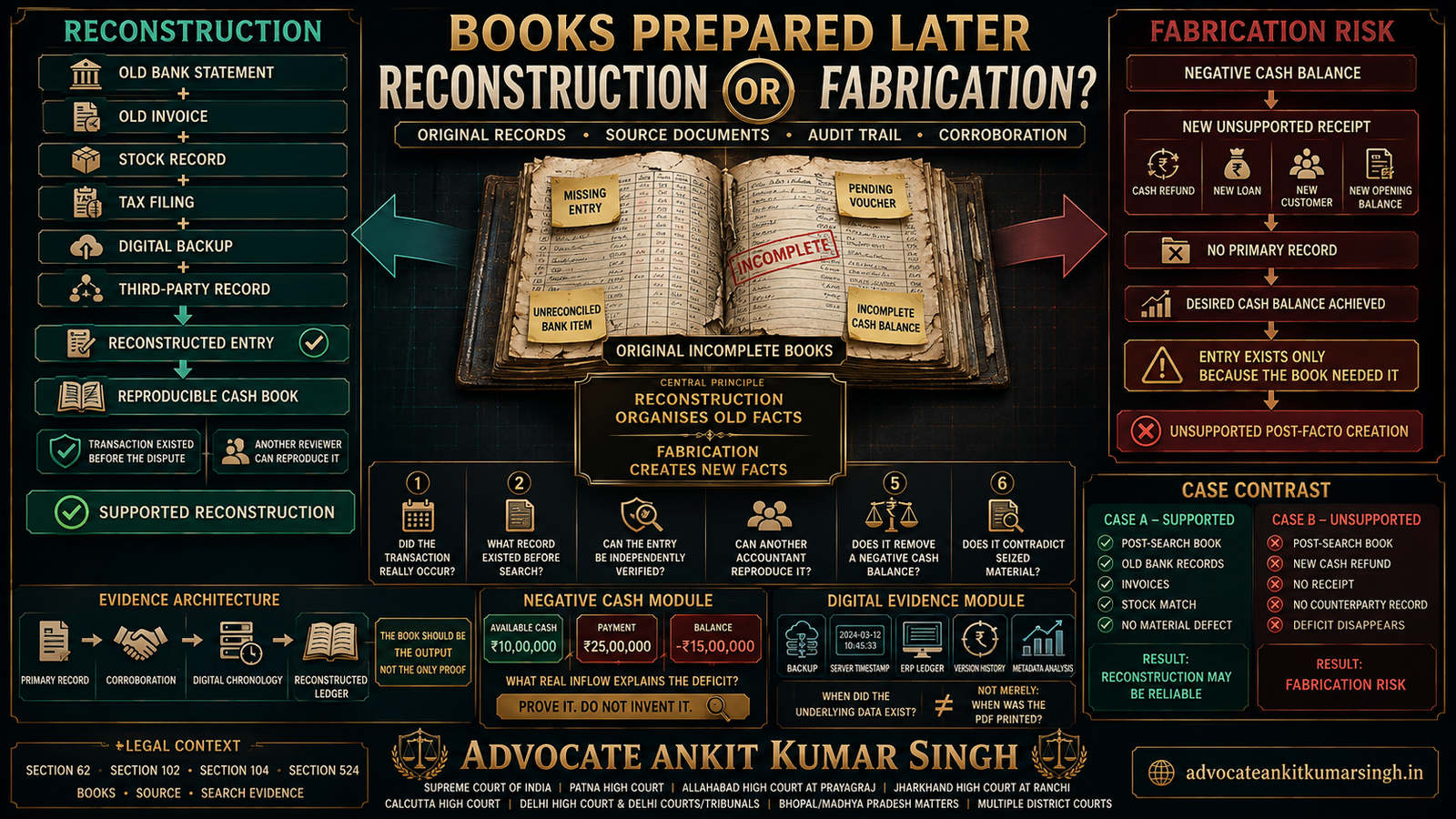
RECONSTRUCTION DISCOVERS OR ORGANISES OLD FACTS.
FABRICATION CREATES NEW FACTS AND PRESENTS THEM AS OLD FACTS.
The Wrong Question: “Was the Cash Book Prepared After Search?”
That question is relevant.
It is not sufficient.
The better questions are:
- When did the underlying transaction occur?
- What evidence of it existed before search?
- Was the transaction already reflected somewhere else?
- Can the entry be recreated without relying upon the later cash book itself?
- Does an independent third party confirm it?
- Do bank, stock, tax or digital records corroborate it?
- Does the entry contradict seized material?
- Was the entry inserted only because a negative cash balance otherwise arose?
A document's date of preparation and a transaction's date of existence are not always the same thing.
What Is Genuine Accounting Reconstruction?
A reconstruction ordinarily begins with existing evidence.
For example:
A cash book was incomplete when search occurred.
But the following already existed:
- bank statements;
- withdrawal slips;
- sales invoices;
- purchase invoices;
- GST or earlier tax filings;
- stock records;
- customer receipts;
- supplier accounts;
- emails;
- electronic accounting backups;
- delivery records; and
- third-party confirmations.
The accountant later places those transactions chronologically into a coherent ledger.
If another competent accountant using the same primary documents can broadly reproduce the same entries and closing balance, that is powerful evidence of reconstruction rather than invention.
What Is Fabrication?
Fabrication begins when the later exercise does not merely organise evidence but creates facts unsupported by genuine underlying material.
Examples include:
- backdating invoices;
- creating vouchers for transactions that never occurred;
- inventing cash customers;
- inventing lenders;
- inventing cash refunds;
- inventing repayment of advances;
- creating false opening balances;
- changing transaction dates to avoid a negative cash position;
- altering electronic timestamps;
- creating sham third-party confirmations;
- splitting one transaction into several fictitious transactions;
- creating a false loan to explain seized cash; or
- entering a receipt solely because the cash book otherwise does not balance.
The problem is not “later preparation”.
The problem is false historical representation.
The Five-Level Reconstruction Spectrum
| Level | Accounting Exercise | Evidentiary Risk |
|---|---|---|
| 1 | Posting transactions from pre-existing primary records | Relatively low if accurately done |
| 2 | Recasting incomplete books from bank, invoices, vouchers and stock | Requires verification |
| 3 | Reconstruction using disclosed assumptions where some records are missing | Material risk; assumptions must be transparent |
| 4 | Unsupported balancing entries inserted to make cash available | Very high risk |
| 5 | Backdated or invented transactions presented as genuine historical facts | Fabrication |
Most genuine disputes lie between Levels 2 and 3.
The evidentiary danger begins when the accounting exercise silently moves into Level 4.
Section 62 of the Income-tax Act, 2025: Maintenance Still Matters
Section 62 of the current Income-tax Act, 2025 requires persons falling within the statutory conditions to keep and maintain books of account and other documents enabling computation of income.
This creates an important background principle.
Where a taxpayer was legally required to maintain books but did not maintain them properly, completing them later does not erase the original compliance failure.
But a compliance failure and fabrication are still different allegations.
The fact that books were poorly maintained may:
- reduce their evidentiary weight;
- justify closer verification;
- lead to statutory consequences; or
- support rejection where reliability cannot be established.
It does not logically prove that every reconstructed transaction is false.
Sections 102 and 104: A Later Entry Does Not Automatically Prove Its Own Source
Section 102 of the Income-tax Act, 2025 concerns unexplained credits appearing in books.
Section 104 concerns unexplained assets and expressly includes money.
Both contexts reinforce an elementary principle:
THE ENTRY IS NOT ALWAYS THE SOURCE EVIDENCE.
Suppose a later cash book says:
“Cash Loan Received — ₹25 lakh.”
The words do not establish:
- who actually lent it;
- whether that person had capacity;
- whether money really moved;
- when it moved;
- whether the transaction existed before the controversy; or
- whether the lender independently acknowledges the transaction.
The ledger can organise the explanation.
It cannot manufacture the underlying reality.
Section 524: Search Material Can Carry Its Own Evidentiary Presumption
Section 524 provides statutory presumptions concerning books, documents, electronic information and assets found during search or survey.
This becomes important where:
SEIZED DOCUMENT A
says:
₹50 lakh paid.
But a later reconstructed cash book introduces:
“₹50 lakh refunded two months later.”
If no seized document, correspondence, receipt, bank material, settlement record or other contemporaneous evidence supports the alleged refund, the later entry requires serious scrutiny.
The reconstruction cannot simply neutralise direct seized evidence by inserting a convenient opposite entry.
The Underlying-Document Test
Take every reconstructed entry and ask:
IF I DELETE THE RECONSTRUCTED CASH BOOK, CAN THIS TRANSACTION STILL BE PROVED?
If yes, identify:
- bank statement;
- invoice;
- voucher;
- receipt;
- stock record;
- contract;
- tax filing;
- email;
- ERP record;
- third-party account;
- settlement document;
- delivery evidence; or
- other authentic record.
If the answer is:
“The only proof of the transaction is the book we created afterward,”
the evidentiary risk rises sharply.
The Pre-Existence Test
For every important entry, ask:
WHAT PART OF THIS TRANSACTION EXISTED BEFORE THE SEARCH OR NOTICE?
Strong examples:
- invoice generated before search;
- bank transfer predating search;
- email discussing payment beforehand;
- GST return already filed;
- stock already dispatched;
- customer ledger already maintained;
- accountant backup already stored;
- property agreement executed earlier.
Weak example:
The entire transaction first appears after the Assessing Officer identifies a cash shortage.
The Reproducibility Test
A genuine reconstruction should be reproducible.
Give the underlying documents to another accountant without showing the desired closing balance.
Ask that accountant to reconstruct the ledger independently.
If the same material produces substantially the same:
- receipts;
- payments;
- balances;
- stock movement;
- debtor position; and
- cash availability,
the exercise becomes considerably stronger.
If the result works only because one disputed entry was manually inserted, the weakness becomes visible.
The Plug-Entry Test
A “plug entry” is an entry whose practical function is simply to make a numerical problem disappear.
Example:
Without disputed entry:
Cash balance on 10 March: −₹22 lakh.
After search, a new entry appears:
Cash refund received: ₹25 lakh.
New balance:
+₹3 lakh.
The mathematical convenience is not itself proof of fabrication.
But it creates an obvious question:
WHAT INDEPENDENT EVIDENCE PROVES THAT ₹25 LAKH REFUND ACTUALLY OCCURRED?
If none exists, the later entry is doing evidentiary work that only a real transaction should perform.
The Negative Cash Balance Problem
Negative cash balance is one of the strongest forensic tests of reconstructed books.
Cash cannot ordinarily be physically spent before it exists.
Suppose reconstructed accounts show:
Cash available: ₹5 lakh.
Cash payment: ₹18 lakh.
Result:
−₹13 lakh.
The explanation must identify a genuine additional inflow.
Possible genuine sources include:
- unposted withdrawal;
- cash receipt;
- customer collection;
- loan;
- refund;
- capital introduction;
- sale proceeds; or
- another real cash inflow.
But the source must be proved.
The accountant cannot simply invent an inflow because the cash book needs one.
Aishwarya Rai v. DCIT: Later Production Does Not Automatically Destroy Credibility
An important earlier Mumbai Tribunal decision demonstrates the other side of the issue.
The Assessing Officer had treated a later-produced cash book as an afterthought because no books had been found during search.
The Tribunal rejected the broad proposition that books not found at search could never subsequently be relied upon.
It considered especially important that:
- the cash book had been produced before the Assessing Officer;
- no specific defect in its entries had been identified; and
- the accounts had also been subjected to audit.
The principle is valuable:
THE DATE OF PRODUCTION DOES NOT BY ITSELF DECIDE AUTHENTICITY.
Ashok Kumar Agarwal: Incomplete Books Can Be Completed From Real Records
The Jaipur Tribunal considered a case where books found during search were incomplete.
The assessee subsequently prepared/completed the books and had them audited.
The Tribunal noted that no substantive mistake or defect had been identified.
It also referred to the principle that incomplete books may be recast from material such as:
- bank statements;
- vouchers;
- sales documents; and
- purchase documents.
This captures legitimate reconstruction.
The later ledger is not accepted because it is beautifully formatted.
It is accepted because the underlying historical records independently support what the ledger contains.
ACIT v. Dhaval Teli: Reconstruction Cannot Invent the Cash Required to Make It Work
A particularly important 2026 Ahmedabad Tribunal decision examined a post-search cash book involving substantial land transactions.
Seized documents established cash advances.
The later reconstruction introduced cash receipts said to represent refunds when several transactions were cancelled.
The difficulty was fundamental:
The disputed refunds were not recorded in the seized papers that documented the advances.
The Tribunal looked for:
- cancelled agreements;
- receipts acknowledging repayment;
- settlement documents;
- broker records;
- landowner confirmations;
- correspondence; and
- other contemporaneous evidence.
Where such independent corroboration was absent, the Tribunal treated the disputed receipt explanation as inadequately established.
It emphasised that the correctness of disputed cash receipts had to be determined before those entries could create sufficient cash balance.
This produces a crucial rule:
YOU CANNOT PROVE A REFUND MERELY BY ENTERING “REFUND RECEIVED” INTO THE CASH BOOK.
The transaction must exist outside the accounting entry.
Dhaval Teli Also Shows Why Arithmetic Correction Is Not Enough
In that litigation, computational mistakes in the Assessing Officer's recast cash book were also identified.
But correcting arithmetic could not answer the more fundamental question:
WERE THE DISPUTED RECEIPTS GENUINE?
This distinction is important.
A cash book can be:
MATHEMATICALLY PERFECT
and still
FACTUALLY WRONG.
Accounting arithmetic proves internal consistency.
It does not prove transaction reality.
Dilip Govindbhai Purohit: Correlation Must Come From Evidence, Not Convenience
The Gujarat High Court's June 2026 order arose from another search-based accounting dispute.
The underlying findings showed why later books become vulnerable where entries are introduced after search without adequate supporting evidence or where separate transactions are retrospectively correlated in order to reduce unexplained income.
At the same time, the litigation also demonstrates an important nuance:
Not every post-search entry was automatically rejected merely because it was post-search.
Some relief had been sustained where seized material and other evidence genuinely correlated.
The High Court ultimately treated the disputed findings as factual and found no substantial question of law in the appeal before it.
The lesson is:
CORRELATION IS ACCEPTABLE WHEN THE EVIDENCE CREATES IT.
IT IS VULNERABLE WHEN THE LATER BOOK CREATES THE CORRELATION FIRST.
Kiran Prakash Nekkanti: The Label “Cash Book” Has No Magical Evidentiary Power
In a Visakhapatnam Tribunal decision pronounced on 29 May 2026, very substantial cash deposits were disputed.
The taxpayer relied upon what was described as a cash book along with bank material.
But significant difficulties remained:
- large deposits were not reconciled with the comparatively small disclosed turnover;
- underlying parties and receipts were inadequately identified;
- full supporting accounting records were not produced; and
- the cash book was essentially built around bank movements without sufficient primary transactional support.
The broader lesson is:
A SPREADSHEET OR LEDGER DOES NOT BECOME RELIABLE MERELY BECAUSE ITS TITLE SAYS “CASH BOOK”.
The Evidence Architecture of a Strong Reconstruction
A strong reconstruction should ideally have four layers.
Layer 1 — Primary Event Evidence
- bank record;
- invoice;
- receipt;
- purchase document;
- sale document;
- contract;
- stock movement;
- government filing;
- payment instruction.
Layer 2 — Independent Corroboration
- customer account;
- supplier account;
- third-party bank record;
- transport document;
- email;
- message;
- registration record;
- tax return.
Layer 3 — Electronic / Chronological Evidence
- ERP timestamp;
- accounting-software history;
- server backup;
- email timestamp;
- file-creation history;
- cloud backup;
- system logs where legitimately available.
Layer 4 — Reconstructed Accounting Output
- cash book;
- ledger;
- cash-flow statement;
- debtor reconciliation;
- stock reconciliation;
- opening / closing balance.
Layer 4 should ordinarily be the product of Layers 1–3.
It should not be the sole creator of the facts in Layers 1–3.
Digital Timestamps: Powerful but Not Magical
Modern accounting investigations increasingly involve electronic evidence.
Useful questions include:
- When was the accounting file created?
- When was the entry first posted?
- Was it later edited?
- Does a backup predate the search?
- Did the invoice already exist in an external system?
- Was the transaction already reported in a statutory filing?
- Does the counterparty possess an earlier copy?
But metadata should also be interpreted carefully.
A document may have been re-exported or copied after search even though its underlying transaction existed much earlier.
The correct question is not simply:
“WHEN WAS THIS PDF CREATED?”
It is:
“WHEN DID THE UNDERLYING DATA AND TRANSACTION FIRST EXIST?”
Reconstruction From Bank Statements
A bank statement is particularly useful because it is independently generated.
It can establish:
- withdrawal;
- deposit;
- transfer;
- date;
- amount;
- counterparty in many cases; and
- chronology.
A later cash book may legitimately post an omitted bank withdrawal.
But a bank withdrawal does not itself prove:
- why the money was withdrawn;
- where it went afterward; or
- that the same cash remained available indefinitely.
The reconstruction must still address utilisation.
Reconstruction From Sales and Stock
If later books add previously unposted sales, test:
SALE
→ INVOICE
→ CUSTOMER
→ STOCK REDUCTION
→ TAX RECORD
→ CASH / BANK RECEIPT.
A claimed ₹50 lakh of reconstructed cash sales with no corresponding stock movement is vulnerable.
A transaction supported independently by inventory, customer and tax records is materially different.
Reconstruction From Refunds of Advances
Refund entries require particular caution because they can conveniently restore cash availability.
If the reconstructed book says:
“Advance returned — ₹35 lakh,”
look for:
- cancellation agreement;
- refund receipt;
- correspondence;
- broker record;
- counterparty books;
- confirmation;
- bank material where applicable;
- reversal in property/commercial records.
The larger the cash refund, the more important independent corroboration becomes.
Reconstruction From Loans
A later book entry saying:
“Loan received ₹20 lakh”
does not establish the transaction.
Test:
- identity;
- financial capacity;
- genuineness;
- date;
- source in lender's hands;
- lender's own books;
- repayment history;
- interest, if any;
- communication; and
- whether the lender's explanation independently existed.
A newly discovered lender who appears only after a cash deficit is identified creates obvious evidentiary risk.
Reconstruction From Family Money
Informal family finance can genuinely be poorly documented.
But reconstruction should not become collective invention.
If several family members are said to have contributed cash, prepare:
| Contributor | Amount | Approx. Date | Financial Capacity | Independent Record |
|---|---|---|---|---|
| Member A | ₹___ | ___ | Income / savings | Bank / return / other record |
| Member B | ₹___ | ___ | Income / savings | Bank / return / other record |
A family explanation does not become reliable merely because every person signs the same later affidavit.
Correction Versus Creation
This is perhaps the most important conceptual distinction.
Correction
The invoice existed for ₹8 lakh.
The accountant accidentally posted ₹80,000.
The later book corrects the figure to ₹8 lakh.
Reconstruction
The invoice, delivery and customer payment existed, but the transaction had never been posted into the central ledger.
The later book inserts the transaction from those records.
Creation
No invoice, customer, delivery or earlier record exists.
After the cash deficit is discovered, a new “cash sale ₹8 lakh” entry is created.
These are fundamentally different events.
The “Would This Entry Exist Without the Litigation?” Test
Ask:
“If no search, notice or investigation had ever occurred, is there independent reason to believe this transaction would still have existed?”
If yes:
The later accounting may merely be recording reality.
If no:
And the transaction exists only because a legal problem required a solution:
The risk of fabrication is substantial.
What an Accountant Can Legitimately Do
An accountant may legitimately:
- collect missing vouchers;
- reconcile bank statements;
- post previously unposted genuine transactions;
- identify duplicated entries;
- correct arithmetic errors;
- reconcile branch records;
- reconstruct stock movement;
- prepare cash flow from primary records;
- identify unknown entries for further investigation;
- document assumptions;
- prepare an exception report; and
- state clearly which items remain unsupported.
What an Accountant Should Never Do
An accountant should not:
- invent a receipt to eliminate negative cash;
- create false vouchers;
- backdate documents;
- alter digital history;
- invent counterparties;
- manufacture signatures;
- create fake invoices;
- produce knowingly false confirmations;
- delete contradictory records;
- rewrite a ledger without preserving the original;
- present assumptions as historical facts; or
- construct the books backwards from the desired final answer.
The Original-Record Preservation Rule
If books are being reconstructed after a dispute begins, preserve:
- original incomplete books;
- original accounting files;
- backup copies;
- bank statements;
- source vouchers;
- old spreadsheets;
- emails;
- original invoices;
- stock records; and
- the first version of the reconstruction.
Do not overwrite the defective record merely because a cleaner version has now been prepared.
The history of correction is itself evidence of transparency.
The Reconstruction Audit Trail
For every material later entry, prepare:
| Reconstructed Entry | Source Document | Source Date | Why Missing Earlier? | Independent Corroboration |
|---|---|---|---|---|
| Cash withdrawal ₹___ | Bank statement | ___ | Unposted | Bank record |
| Sale ₹___ | Invoice | ___ | Branch delay | Stock/customer/GST |
| Refund ₹___ | Settlement receipt | ___ | Not posted | Counterparty |
This makes the reconstruction auditable instead of narrative.
Four Questions for Every New Entry
- Existence: Did the transaction actually occur?
- Timing: Did it occur on the date now claimed?
- Amount: Is the amount independently verifiable?
- Source: What external material proves it?
If these four questions cannot be answered, the entry should not be used casually to explain substantial disputed cash.
Investigator's Verification Protocol
- Preserve the books and electronic material found during search.
- Identify exactly what was incomplete.
- Obtain the later reconstructed version.
- Run a line-by-line difference comparison.
- Identify every new receipt.
- Identify every new payment.
- Identify changed dates and balances.
- Ask for primary evidence for every material new entry.
- Check counterparties independently where necessary.
- Check stock and banking consequences.
- Examine relevant digital chronology.
- Identify entries whose only function is removal of negative cash.
- Separate arithmetic correction from factual insertion.
- Accept supported reconstruction and reject unsupported creation transaction by transaction.
Defence Reconstruction Protocol
- Preserve the original incomplete records.
- Do not “clean up” the history invisibly.
- Identify every missing posting.
- Attach a source document to every material reconstructed entry.
- Distinguish fact from assumption.
- Prepare an exception list for unsupported items.
- Reconcile bank statements independently.
- Reconcile sales with stock.
- Reconcile loans and refunds with counterparties.
- Preserve electronic backups and timestamps.
- Prepare a version-comparison table.
- Explain why each entry was absent originally.
- Check the finished ledger for negative cash.
- Do not invent an entry to cure any unresolved deficit.
Red Flags Suggesting Reconstruction May Have Become Fabrication
- the closing cash exactly equals the seized cash only after one new unexplained receipt;
- a new loan appears only after notice;
- a cash refund appears without cancellation records;
- all counterparties give identically worded affidavits prepared later;
- invoice numbers are out of sequence;
- metadata materially contradicts claimed creation dates;
- stock never moved despite claimed sales;
- the reconstructed books contradict filed tax returns;
- original records have disappeared after reconstruction;
- different versions of the cash book exist without explanation;
- transaction dates shift between proceedings;
- the same inflow is used twice;
- entries are created backwards from the amount that must be explained;
- no third party can verify a substantial cash transaction; or
- the accounting equation works only if disputed facts are assumed true.
Factors Supporting a Genuine Reconstruction
- underlying documents existed before search;
- bank records independently confirm entries;
- counterparty records match;
- sales correspond with stock reduction;
- tax filings predate the dispute;
- electronic backups support earlier data;
- the accountant discloses assumptions and gaps;
- original incomplete books are preserved;
- another accountant can reproduce the result;
- the reconstruction does not conveniently eliminate every adverse fact;
- unsupported entries are left unresolved instead of being invented; and
- the final books remain consistent with external records.
PMLA and White-Collar Investigations: Reconstruction Does Not Cure a False Transaction
The same evidentiary distinction can become critical in PMLA, fraud, company or other financial-crime investigations.
A later ledger can help explain:
- source of funds;
- transaction chronology;
- movement between entities;
- business purpose;
- beneficial ownership; or
- cash utilisation.
But a ledger cannot transform a fictitious transaction into a genuine one.
And the fact that a tax ledger is unreliable does not by itself establish money laundering.
PMLA still requires its own statutory proceeds-of-crime foundation connected with criminal activity relating to a scheduled offence.
Forensic Flowchart: Reconstruction or Fabrication?
A later-prepared book is strongest when it can be reconstructed independently from records that existed before the dispute. It becomes dangerous when the new book itself creates the transaction needed to solve the problem.Frequently Asked Questions
Are books prepared after a search automatically invalid?
No. Courts and tribunals have accepted later-completed or reconstructed books where genuine underlying records supported the entries and no material defects were established.
What if the books were genuinely incomplete on the search date?
Preserve the incomplete version and reconstruct missing entries transparently from authentic source documents. Do not overwrite the history.
Can bank statements be used to rebuild a cash book?
Yes, they can be important source material. But banking records alone may not explain the nature of every business receipt or withdrawal.
Can invoices prepared after search be used?
A genuinely later-generated copy of an earlier transaction may be relevant if the underlying transaction is independently established. A newly invented or backdated invoice is a different matter.
What if a cash refund was never recorded anywhere?
A later refund entry faces substantial evidentiary difficulty unless cancellation, repayment or other independent evidence establishes that the refund actually occurred.
Can I reconstruct old transactions from seized papers?
Potentially yes. But the reconstruction should faithfully reflect what the seized material establishes and should not add unsupported opposite transactions merely to neutralise it.
Does audit make a later book automatically genuine?
No. Audit can improve reliability but cannot convert false underlying facts into genuine transactions.
What if metadata shows the accounting file was created after search?
That proves when that particular file was created, not necessarily when every underlying transaction occurred. The earlier existence of the transaction should be established separately.
What if the reconstruction produces negative cash?
Do not cure the deficit through an invented receipt. Investigate whether a genuine omitted source exists. If none can be established, the deficit remains an evidentiary problem.
Can an accountant estimate missing entries?
Estimates may sometimes be used transparently for analysis, but an estimate should never be presented as a precisely documented historical transaction unless evidence supports it.
Is a reconstructed book enough to prove a loan?
No. Identity, capacity, genuineness and underlying transaction evidence remain important.
Is an unreliable reconstructed cash book automatically evidence of PMLA money laundering?
No. PMLA requires a separate statutory proceeds-of-crime connection with criminal activity relating to a scheduled offence.
AI Search Quick Answer
Books completed after an Income-tax search or notice are not automatically fabricated. A legitimate reconstruction uses authentic pre-existing evidence—such as bank statements, invoices, vouchers, stock records, tax filings, electronic backups and third-party records—to post transactions that genuinely occurred but were not fully recorded earlier. Reconstruction becomes evidentially dangerous when new receipts, refunds, loans, customers, dates or balances appear only after the controversy and lack independent corroboration, particularly where those entries conveniently eliminate a negative cash balance or explain seized assets. The key test is whether the later entry can be independently reproduced from evidence that existed outside the reconstructed book itself.
Key Takeaway
The wrong equation is:
BOOK PREPARED AFTER SEARCH = FABRICATED BOOK.
The opposite equation is also wrong:
RECONSTRUCTED BOOK BALANCES = ALL ENTRIES ARE TRUE.
The stronger equation is:
PRE-EXISTING TRANSACTION
+
AUTHENTIC SOURCE DOCUMENT
+
INDEPENDENT CORROBORATION
+
TRANSPARENT RECONSTRUCTION
+
REPRODUCIBLE CALCULATION
=
GENUINE ACCOUNTING RECONSTRUCTION.
By contrast:
LEGAL PROBLEM
+
UNEXPLAINED DEFICIT
+
NEW UNSUPPORTED TRANSACTION
+
BACKDATED / INVENTED EVIDENCE
=
FABRICATION RISK.
Conclusion: Reconstruction Should Explain the Record—Not Manufacture the Answer
Incomplete books are a real accounting problem.
Businesses do sometimes fail to post transactions promptly.
Records can be decentralised.
Vouchers can remain pending.
Accounting data can exist in multiple systems.
A search can occur before year-end reconciliation.
None of those facts makes a later reconstruction automatically false.
But the reconstruction must remain evidence-led.
The safe sequence is:
START WITH THE ORIGINAL RECORD.
IDENTIFY WHAT IS MISSING.
LOCATE PRE-EXISTING EVIDENCE.
POST ONLY TRANSACTIONS THAT CAN BE JUSTIFIED.
DISCLOSE ASSUMPTIONS.
PRESERVE UNRESOLVED GAPS.
DO NOT INVENT THE TRANSACTION REQUIRED TO MAKE THE NUMBERS WORK.
The central principle is:
RECONSTRUCTION CAN REBUILD AN INCOMPLETE RECORD.
IT CANNOT LAWFULLY CREATE A HISTORY THAT NEVER OCCURRED.
Official and Authoritative Sources
-
Income-tax Act, 2025 — Section 62, Maintenance of Books of Account:
Income Tax Department - Income-tax Act, 2025 — Section 102, Unexplained Credits
- Income-tax Act, 2025 — Section 104, Unexplained Asset
- Income-tax Act, 2025 — Section 524, Presumption as to Assets, Books of Account, etc.
- ACIT v. Dhaval Teli — Ahmedabad ITAT, 27 July 2026
- Dilip Govindbhai Purohit v. ACIT — Gujarat High Court, Tax Appeal No.491 of 2026, 25 June 2026
- Kiran Prakash Nekkanti v. ITO — Visakhapatnam ITAT, ITA No.403/Viz/2025, 29 May 2026
- Aishwarya Rai v. DCIT — Mumbai ITAT, 30 June 2005
- Ashok Kumar Agarwal v. Assessee — Jaipur ITAT, 3 October 2016
Add Advocate Ankit Kumar Singh as a Preferred Source on Google
Readers who want more legal research, court updates, cyber law, PMLA, ED, criminal-law and financial-litigation content from Advocate Ankit Kumar Singh can add advocateankitkumarsingh.in as a Preferred Source on Google.
Add advocateankitkumarsingh.in as a Preferred Source on Google
Professional Consultation and Financial-Evidence Review
Supreme Court of India | Patna High Court | Allahabad High Court at Prayagraj | Jharkhand High Court at Ranchi | Calcutta High Court | Delhi High Court and Delhi Courts/Tribunals | Matters concerning Bhopal, Madhya Pradesh | Multiple District Courts
Phone: 8294431232
Email: ankitsingh.legum@gmail.com
Website: advocateankitkumarsingh.in
Professional assistance in a reconstructed-books dispute may include comparison of original and later books, seized-material analysis, cash-flow reconstruction, source-document mapping, bank and stock reconciliation, review of digital chronology, identification of unsupported plug entries, search-statement analysis, tax-law research, PMLA distinction analysis, drafting and litigation strategy according to the facts, applicable statute, jurisdiction and accepted professional engagement.
Complex accounting or forensic questions may require assistance from an accountant, auditor, digital-forensic professional or other appropriate specialist. Local, filing or authorised counsel may be required depending upon the forum. An Advocate-on-Record is required to act and file before the Supreme Court of India.
No deletion of an addition, release of cash, stay, bail, quashing, discharge or other judicial or administrative result can be guaranteed.
Legal Disclaimer: This article is intended for general legal research and professional awareness. Whether later-prepared books are reliable depends upon the applicable tax year, legal duty to maintain books, original records, seized material, primary documents, third-party evidence, accounting history, digital evidence and the precise entries in dispute. Nothing in this article suggests that anyone should fabricate, backdate, alter, suppress or destroy evidence. Genuine gaps should be addressed transparently through lawful reconstruction from authentic material.