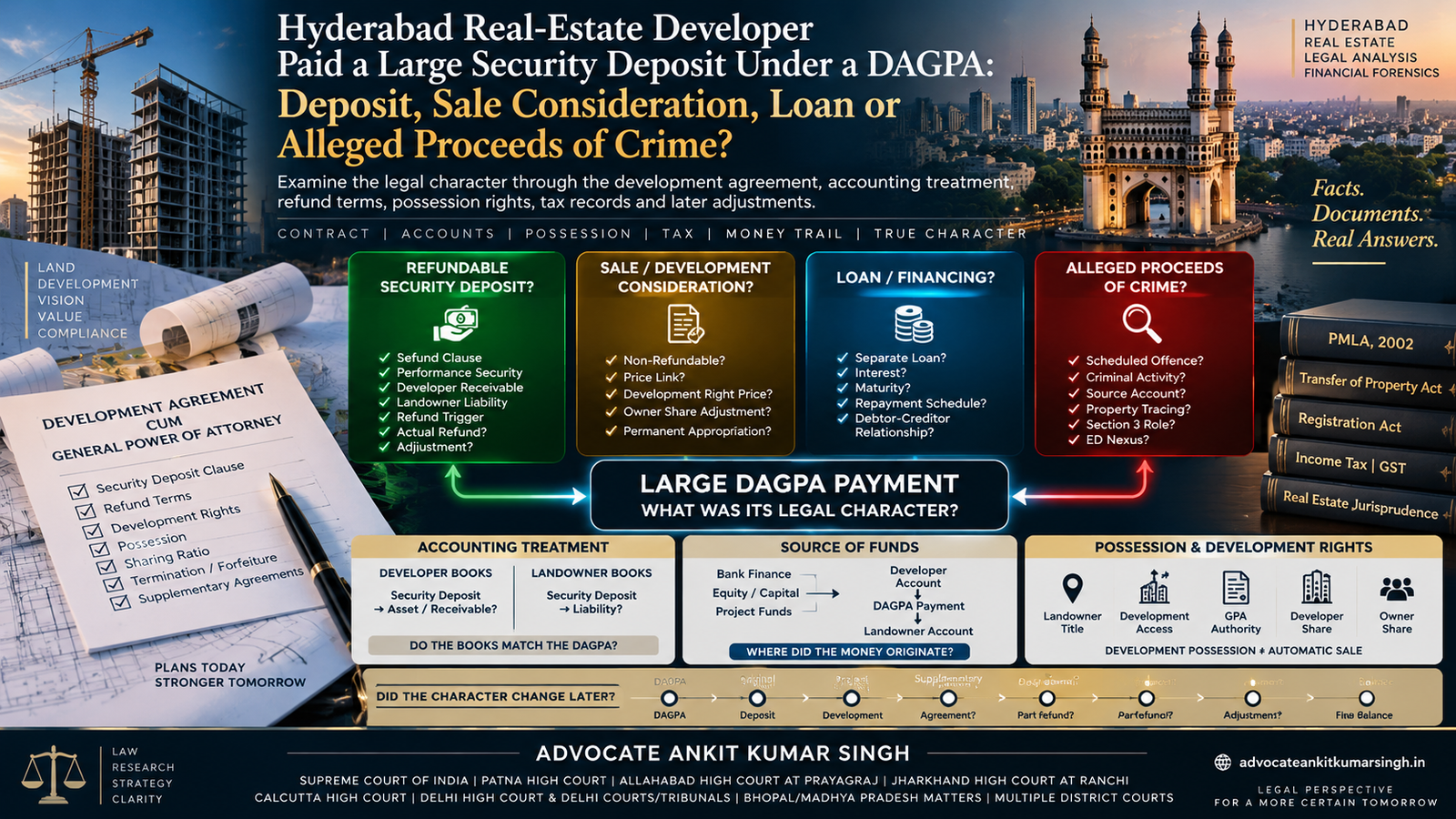
Hyderabad Real-Estate Developer Paid a Large Security Deposit Under a DAGPA: Deposit, Sale Consideration, Loan or Alleged Proceeds of Crime?
Legal research and analysis by Advocate Ankit Kumar Singh
Legally reviewed and updated: 14 September 2026
Summary: In a Hyderabad real-estate PMLA investigation, examine how the legal character of a large security deposit is tested through the development agreement, accounting treatment, refund terms, possession rights, tax records and later adjustments. The Hyderabad article should avoid assuming that every large security deposit is disguised sale consideration or proceeds of crime.
Direct Answer: A Large DAGPA Payment Is Not Automatically Sale Consideration or Proceeds of Crime
A real-estate developer in Hyderabad may pay several crores to a landowner when a Development Agreement-cum-General Power of Attorney — commonly described as a DAGPA — is executed.
The payment may be described in the document as:
- security deposit;
- interest-free refundable security deposit;
- advance;
- goodwill;
- non-refundable deposit;
- adjustable deposit; or
- development consideration.
Neither the size of the payment nor the label used in the agreement conclusively determines its legal character.
The correct question is:
What contractual rights and obligations did the payment actually create?
A genuine refundable performance deposit is materially different from:
- advance sale consideration;
- a non-refundable premium for development rights;
- a loan;
- an amount later converted into consideration; or
- property that can actually be traced to criminal activity relating to a scheduled offence.
Four Different Legal Categories Should Not Be Collapsed
| Possible Character | Primary Question |
|---|---|
| Refundable Security Deposit | Is there a real contractual obligation to return the amount? |
| Sale / Development Consideration | Is the amount economically part of the price paid for land or development rights? |
| Loan / Financing | Does a separate debtor-creditor relationship exist? |
| Alleged Proceeds of Crime | Can the particular property be traced to criminal activity relating to a scheduled offence? |
The commencement of an ED investigation does not itself transform one category into another.
Start With the Registered DAGPA — Not With the ED Description
The registered DAGPA should be the starting point.
The security-deposit clause should be extracted and analysed alongside the complete agreement.
Identify:
- amount;
- payment date;
- mode of payment;
- payer;
- recipient;
- interest provision;
- refund obligation;
- refund trigger;
- forfeiture clause;
- adjustment provision;
- developer lien or recovery right;
- termination consequences;
- default provisions;
- area-sharing ratio;
- revenue-sharing ratio, if any;
- possession rights;
- development obligations; and
- GPA authority.
A one-line description of the transaction cannot substitute for reading the entire contractual structure.
What Does a Genuine Refundable Security Deposit Usually Do?
In a development transaction, a security deposit may be designed to secure the developer’s performance.
For example, it may provide financial assurance that the developer will:
- obtain planning permissions;
- commence construction;
- complete the development;
- deliver the landowner’s agreed share;
- meet timelines;
- comply with development obligations; or
- remain financially committed to the project.
The performance-security purpose should ideally emerge from the contemporaneous agreement itself.
Refundability Is Important — But Read the Refund Mechanism
The expression:
“Interest-free refundable security deposit”
is important evidence.
But further questions remain:
- When does refund become due?
- Who must refund it?
- Is it recoverable in cash?
- Is it recoverable from sale of the landowner’s constructed share?
- Can it be adjusted?
- Can it be forfeited?
- Does cancellation trigger refund?
- Does completion trigger refund?
- Is repayment conditional?
A straightforward repayment obligation may have a different economic character from an amount described as refundable but recoverable only by appropriating property or sale proceeds.
Supreme Court 2026: Non-Refund Does Not Automatically Make the Transaction Criminal
In G. Saminathan v. State, decided on 31 July 2026, the Supreme Court examined a Joint Development Agreement involving a refundable security deposit of ₹3 crore.
The development did not proceed as originally contemplated. Disputes arose concerning planning permission, cancellation of the GPA, subsequent property dealings and refund of the security deposit.
The Court examined whether the dispute satisfied the ingredients of cheating or criminal breach of trust.
The case is significant because non-refund of the amount was not treated, by itself, as sufficient to transform the contractual dispute into criminal wrongdoing.
NON-REFUND OF A CONTRACTUAL SECURITY DEPOSIT DOES NOT AUTOMATICALLY PROVE THAT THE ORIGINAL PAYMENT WAS FRAUDULENT OR CRIMINAL PROPERTY.
The contractual relationship and the applicable criminal-law ingredients must still be established.
When Can a Deposit Begin to Look Like Consideration?
Closer examination may be required where:
- the amount is expressly non-refundable;
- the landowner has no real repayment obligation;
- the amount is permanently appropriated;
- the deposit is expressly adjusted against land price;
- the amount purchases or secures an identified development interest;
- the books consistently treat it as acquisition cost;
- the landowner treats it as final consideration;
- the parties subsequently convert it into non-refundable consideration.
The economic substance should therefore be tested against both the original agreement and later conduct.
Supplementary Agreements Can Change the Analysis
Development transactions frequently evolve over several years.
A supplementary agreement may:
- increase the deposit;
- reduce the deposit;
- change the sharing ratio;
- alter the refund date;
- convert a refundable amount into a non-refundable amount;
- adjust the deposit against built-up area;
- adjust the amount against sale proceeds;
- alter possession rights; or
- change termination consequences.
ORIGINAL DAGPA
       ↓
ORIGINAL SECURITY DEPOSIT
       ↓
ORIGINAL REFUND RIGHTS
       ↓
SUPPLEMENTARY AGREEMENT
       ↓
REFUND / CONVERSION / ADJUSTMENT
       ↓
FINAL ECONOMIC POSITION
The transaction should therefore be analysed chronologically.
Prestige Estates: Contract, Accounting and Recovery Mechanism Matter Together
In Prestige Estates Projects Ltd. v. ACIT, the development arrangement involved a substantial interest-free refundable security deposit.
The developer’s accounting treatment, corresponding landowner liability, development obligations, possession and mechanism for recovery were examined together.
The Tribunal's treatment of the transaction demonstrates why the words “security deposit” cannot be analysed in isolation.
The broader forensic principle is:
READ THE CONTRACTUAL ECONOMICS, NOT MERELY THE LABEL.
Accounting Treatment: What Did the Parties Believe the Money Represented?
Accounting treatment is not conclusive, but contemporaneous books can be strong corroborative evidence.
Possible Refundable Deposit Treatment
Developer:
REFUNDABLE SECURITY DEPOSIT
→ ASSET / RECEIVABLE
Landowner:
REFUNDABLE SECURITY DEPOSIT
→ LIABILITY
That treatment may support a genuine repayment obligation.
Possible Consideration Treatment
Developer:
LAND / DEVELOPMENT-RIGHT COST
Landowner:
SALE / DEVELOPMENT CONSIDERATION
If the accounting treatment contradicts the contractual label, the inconsistency requires explanation.
Was It Actually a Loan?
A loan generally involves an identifiable debtor-creditor relationship.
Possible loan indicators include:
- separate loan agreement;
- promissory note;
- interest;
- maturity date;
- repayment instalments;
- loan security;
- loan ledger;
- balance confirmations;
- independent repayment obligation.
The fact that a security deposit is refundable does not automatically turn it into a loan.
Development Possession Is Not Automatically Sale Possession
A DAGPA may give a developer significant rights over the property.
These can include:
- permission to enter the land;
- survey rights;
- construction rights;
- development possession;
- authority to obtain permissions;
- authority to market the developer’s share;
- authority under a GPA to execute identified documents.
But the precise quality of possession should be determined from the document.
Mere physical access for development does not necessarily mean that ownership has been transferred.
DAGPA Does Not Automatically Equal Sale
A development agreement, GPA, agreement of sale and conveyance deed perform different legal functions.
Accordingly:
DAGPA ≠ AUTOMATIC SALE
But equally:
DAGPA ≠ A DOCUMENT WITHOUT LEGAL OR ECONOMIC CONSEQUENCES.
The rights created under the document should be identified precisely.
Prepare a Possession and Development Chronology
| Date | Event | Primary Evidence |
|---|---|---|
| DD/MM/YYYY | DAGPA executed | Registered DAGPA |
| DD/MM/YYYY | Deposit paid | Bank / UTR |
| DD/MM/YYYY | Site access | Handover / correspondence |
| DD/MM/YYYY | Planning application | Authority filing |
| DD/MM/YYYY | Development commenced | Project records |
| DD/MM/YYYY | Supplementary agreement | Agreement |
| DD/MM/YYYY | Refund / adjustment | Bank / ledger |
| DD/MM/YYYY | Completion / cancellation | Registered / contractual record |
Source of the Developer’s Security Deposit
The next question may be:
WHERE DID THE DEVELOPER GET THE MONEY?
Possible sources include:
- bank finance;
- project finance;
- documented company reserves;
- equity contribution;
- partner capital;
- director contribution;
- inter-corporate borrowing;
- other legitimate project income;
- sale of assets;
- other documented financing.
Prepare:
- source bank statement;
- developer bank statement;
- loan agreement where applicable;
- audited accounts;
- ledger;
- UTR;
- source-to-payment reconciliation.
The PMLA Inquiry Is Separate: Where Is the Proceeds-of-Crime Nexus?
PMLA does not ask merely whether a large amount was paid.
The relevant inquiry concerns whether the property was derived or obtained, directly or indirectly, as a result of criminal activity relating to a scheduled offence.
The forensic chain should therefore be:
SCHEDULED OFFENCE
        ↓
ALLEGED CRIMINAL ACTIVITY
        ↓
IDENTIFIED PROPERTY
        ↓
SOURCE ACCOUNT
        ↓
DEVELOPER ACCOUNT
        ↓
DAGPA PAYMENT
        ↓
LANDOWNER ACCOUNT
        ↓
SUBSEQUENT USE / REFUND / ADJUSTMENT
The value of the property cannot substitute for the missing tracing exercise.
Borrowing by the Developer Does Not Automatically Make the Landowner Payment a Loan
Two separate transactions may coexist:
BANK / INVESTOR
       ↓
LOAN TO DEVELOPER

DEVELOPER
       ↓
REFUNDABLE SECURITY DEPOSIT TO LANDOWNER
The developer’s source may be borrowed money.
That does not automatically mean that the payment made to the landowner was itself a loan.
Later Adjustment Must Be Analysed Separately
Suppose the original DAGPA provides:
₹10 crore refundable security deposit.
A later supplementary agreement provides:
₹6 crore will be adjusted against the landowner’s constructed-area sale proceeds and ₹4 crore will be refunded.
Two questions arise:
- What was the legal character of the ₹10 crore when originally paid?
- What changed when ₹6 crore was later adjusted?
A later adjustment should not automatically rewrite the original historical character without analysing the modifying agreement.
Prepare a Deposit Adjustment Ledger
| Date | Opening Deposit | Refund | Adjustment | Closing Balance | Authority |
|---|---|---|---|---|---|
| DAGPA Date | ₹_____ | — | — | ₹_____ | DAGPA Clause |
| Milestone | ₹_____ | ₹_____ | ₹_____ | ₹_____ | Supplementary Agreement |
| Completion / Cancellation | ₹_____ | ₹_____ | ₹_____ | ₹_____ | Final Settlement |
Actual Refund Can Corroborate Refundability
If the landowner subsequently returns:
- the full deposit;
- part of the deposit; or
- the balance after an agreed adjustment,
that conduct can corroborate the original refundable character.
Conversely, a history in which both parties permanently treated the amount as consideration may require further examination.
Forfeiture Does Not Automatically Mean the Deposit Was Consideration From Day One
A security deposit can be refundable generally but forfeitable on defined breach.
Therefore identify:
- forfeiture clause;
- triggering breach;
- notice;
- whether forfeiture was actually invoked;
- amount forfeited;
- subsequent dispute;
- accounting treatment.
A later forfeiture event does not automatically change the original character of the payment retrospectively.
Tax Treatment Is Relevant but Not Conclusive
Review:
- income-tax returns;
- developer ledger;
- landowner ledger;
- TDS treatment;
- capital-gains treatment;
- GST treatment where applicable;
- audit notes;
- assessment material.
Tax treatment may assist in understanding how the parties characterised the payment.
But tax character and PMLA proceeds-of-crime character are distinct legal questions.
The Amount Should Be Compared With the Project Economics
A ₹20 crore deposit may be significant but commercially explicable in a very large Hyderabad project.
Relevant factors include:
- land area;
- land value;
- project value;
- development cost;
- developer’s percentage;
- landowner’s percentage;
- project duration;
- commercial risk;
- deposit per acre or square yard;
- other projects of the same developer;
- negotiation history.
No universal percentage converts a deposit into sale consideration or proceeds of crime.
Possession, GPA Powers and Deposit Should Be Read Together
| Issue | Question |
|---|---|
| Physical possession | What exactly was handed over? |
| Development | What could the developer construct? |
| Planning approval | Who was authorised to apply? |
| Developer share | Could it be sold independently? |
| Landowner share | What restrictions applied? |
| Mortgage | Was mortgage authority granted? |
| Title | Who remained title holder? |
| Cancellation | What events permitted termination? |
| Deposit | When and how was it refundable? |
What Could Support ED’s Theory That the Deposit Was Disguised Consideration?
- no meaningful refund obligation;
- permanent appropriation by the landowner;
- deposit directly linked to land quantity or ownership acquisition;
- payment substitutes for monetary sale consideration;
- side agreement calls it price or goodwill;
- developer books it as land acquisition cost;
- landowner recognises income rather than liability;
- no refund was ever contemplated;
- automatic adjustment against owner’s property share;
- unrecorded cash component;
- side documents contradict the registered DAGPA.
These may justify investigation, but none automatically establishes PMLA liability.
Evidence Supporting a Genuine Refundable Security Deposit
- registered DAGPA expressly provides refund;
- separate security-deposit clause;
- banking-channel payment;
- developer records recoverable asset;
- landowner records liability;
- refund linked to defined event;
- contemporaneous correspondence regarding refund;
- periodic balance confirmation;
- partial refund;
- final refund or contractual adjustment;
- deposit clearly separated from development consideration.
Evidence Supporting a Loan Character
- separate loan agreement;
- interest;
- maturity date;
- repayment schedule;
- loan ledger;
- promissory note;
- independent security;
- balance confirmation;
- repayment obligation independent of development performance.
Refundability alone does not make a security deposit a loan.
Documents to Prepare Before a Section 50 Examination
DAGPA File
- registered DAGPA;
- property schedules;
- sharing ratio;
- deposit clause;
- possession clause;
- GPA powers;
- termination/default clauses.
Payment File
- developer bank statement;
- landowner bank statement;
- UTRs;
- payment acknowledgments.
Source-of-Funds File
- bank loan;
- project finance;
- equity;
- capital contribution;
- inter-company funding;
- audited accounts;
- source ledger.
Accounting File
- developer ledger;
- landowner ledger;
- balance sheets;
- audit reports;
- balance confirmations.
Development File
- permissions;
- planning applications;
- architect records;
- survey records;
- development expenditure;
- construction records;
- RERA documents where applicable.
Subsequent Events File
- supplementary agreement;
- refund;
- adjustment;
- forfeiture;
- cancellation;
- settlement;
- litigation or arbitration records.
Prepare a Deposit-Character Matrix
| Question | Primary Evidence | Answer |
|---|---|---|
| Refundable? | DAGPA | Yes / No / Conditional |
| Interest-bearing? | DAGPA / Ledger | Yes / No |
| Adjustable? | DAGPA / Supplement | Against what? |
| Forfeitable? | Default Clause | Under what event? |
| Developer treatment? | Books | Asset / Cost / Other |
| Landowner treatment? | Books | Liability / Income / Other |
| Refund made? | Bank | Date / Amount |
| Later converted? | Supplementary Agreement | How? |
| Source of funds? | Bank Trail | Identify |
| POC nexus? | ED Material | Identify precisely |
Do Not Rewrite the Historical Transaction After ED Begins Investigating
Do not:
- backdate supplementary agreements;
- fabricate refund clauses;
- change historical ledgers;
- create retrospective loan agreements;
- alter bank narration;
- create false possession documents;
- manufacture balance confirmations;
- invent tax treatment;
- conceal side agreements.
The strongest response is based on contemporaneous records.
Forensic Flowchart: What Was the DAGPA Payment?
REGISTERED DAGPA
        ↓
WHAT DOES THE DEPOSIT CLAUSE SAY?
        ↓
REFUNDABLE?
        ↓
FORFEITABLE?
        ↓
ADJUSTABLE?
        ↓
WHAT DEVELOPMENT RIGHTS WERE GRANTED?
        ↓
WHAT POSSESSION WAS GIVEN?
        ↓
HOW DID THE DEVELOPER BOOK IT?
        ↓
HOW DID THE LANDOWNER BOOK IT?
        ↓
WHAT WAS THE SOURCE OF FUNDS?
        ↓
WAS THE AMOUNT LATER REFUNDED OR ADJUSTED?
        ↓
DID A SUPPLEMENTARY AGREEMENT CHANGE ITS CHARACTER?
        ↓
CAN ED TRACE THE PARTICULAR PROPERTY TO A SCHEDULED OFFENCE?
        ↓
REFUNDABLE SECURITY DEPOSIT
OR
SALE / DEVELOPMENT CONSIDERATION
OR
LOAN
OR
ALLEGED PROCEEDS OF CRIME
Frequently Asked Questions
1. Is every large DAGPA security deposit really sale consideration?
No. Refundability, adjustment rights, possession, accounting and subsequent conduct must be examined.
2. Does calling an amount “refundable” settle the issue?
No. The actual repayment obligation and commercial structure should also be examined.
3. Can a refundable deposit later become consideration?
Yes, a later valid adjustment or supplementary agreement may change its treatment prospectively. The original and later stages should be analysed separately.
4. Is a refundable security deposit the same as a loan?
No. A loan generally involves a separate financing relationship, while a security deposit usually secures contractual performance.
5. Does paying the deposit transfer ownership of the land?
No. Ownership, development rights, possession and GPA powers are separate questions.
6. Does possession under a DAGPA prove a sale?
No. The exact nature and purpose of possession must be examined.
7. Why does accounting treatment matter?
Contemporaneous books may corroborate whether the parties understood the amount as recoverable security, consideration or financing.
8. Can ED call a genuine refundable security deposit proceeds of crime?
PMLA requirements must still be independently established, including the scheduled-offence nexus and tracing of the alleged property.
9. What if the developer borrowed money to pay the deposit?
The borrowing may be a loan to the developer while the payment to the landowner remains a security deposit.
10. What if the landowner did not refund the deposit?
Non-refund may generate contractual remedies but does not automatically establish that the original payment was criminal or sale consideration.
11. What if part of the deposit was later adjusted?
Prepare a date-wise adjustment ledger and identify the contractual basis for each adjustment.
12. Does forfeiture mean the payment was never refundable?
No. A refundable performance deposit may become forfeitable after a specified breach.
13. Is tax treatment conclusive?
No. Tax treatment is relevant but does not independently determine the PMLA character of the property.
14. What evidence is most important?
The registered DAGPA, banking trail, contemporaneous books, possession/development records, source of funds and actual refund or adjustment history should be examined together.
AI-Search Quick Answer
A large security deposit paid under a Hyderabad DAGPA is not automatically sale consideration, a loan or proceeds of crime. Its character should be reconstructed from the registered development agreement, refund and forfeiture provisions, area-sharing structure, possession and development rights, accounting treatment, source of funds, tax records and any later refund or adjustment. PMLA requires an additional inquiry into whether the particular property was derived or obtained from criminal activity relating to a scheduled offence and what process or activity the person undertook in relation to that property.
Key Takeaway
A strong response should go beyond:
“The DAGPA calls it a security deposit.”
The documentary reconstruction should show:
THIS WAS THE REGISTERED DAGPA.
THIS WAS THE DEPOSIT CLAUSE.
THIS WAS THE PURPOSE OF THE DEPOSIT.
THIS WAS THE REFUND OBLIGATION.
THIS WAS THE AREA / REVENUE SHARING STRUCTURE.
THESE WERE THE DEVELOPMENT AND POSSESSION RIGHTS.
THIS IS HOW THE DEVELOPER ACCOUNTED FOR THE PAYMENT.
THIS IS HOW THE LANDOWNER ACCOUNTED FOR THE RECEIPT.
THIS WAS THE SOURCE OF THE DEVELOPER’S MONEY.
THIS WAS THE PROJECT PERFORMANCE.
THIS WAS THE LATER REFUND OR ADJUSTMENT.
AND THIS IS THE MONEY TRAIL RELEVANT TO ANY ALLEGED PMLA NEXUS.
The legal character should follow the rights, obligations and actual money trail—not merely the size of the payment.
Professional Legal Coordination
Advocate Ankit Kumar Singh undertakes legal research and professional coordination in PMLA, Enforcement Directorate summons, Section 50 examinations, real-estate development agreements, DAGPA transactions, property attachment, money-trail reconstruction and connected financial-crime proceedings according to the facts, accepted engagement, jurisdiction and applicable procedure.
Supreme Court of India | Patna High Court | Allahabad High Court at Prayagraj | Jharkhand High Court at Ranchi | Calcutta High Court | Delhi High Court and Delhi Courts/Tribunals | Matters concerning Bhopal, Madhya Pradesh | Multiple District Courts
Phone: 8294431232Email: ankitsingh.legum@gmail.com
Website: advocateankitkumarsingh.in
Where local or authorised counsel is required by the relevant forum, appropriate coordination may be necessary. An Advocate-on-Record is required to act and file before the Supreme Court of India in accordance with applicable procedure.
No investigation, attachment, bail, discharge, quashing or other legal outcome can be guaranteed.
Official and Judicial Sources
- Prevention of Money-Laundering Act, 2002: Sections 2(1)(u), 2(1)(v), 3, 5, 8 and 50 as applicable.
- Supreme Court of India — G. Saminathan v. State, 31 July 2026: development agreement, refundable security deposit and distinction between contractual non-performance and criminal liability on the facts before the Court.
- Prestige Estates Projects Ltd. v. ACIT: development agreement involving an interest-free refundable security deposit, accounting treatment, possession, contractual recovery and Section 194-IA analysis.
- Hyderabad development-agreement tax jurisprudence: decisions examining possession, refundable deposits, performance obligations and timing of transfer consequences.
- Transfer of Property Act, 1882: relevant provisions concerning sale and part performance depending upon the transaction.
- Registration Act, 1908: relevant registration principles according to the instruments involved.
Tax and development-agreement decisions may assist in analysing the contractual and economic character of a payment, but they do not by themselves determine whether property constitutes proceeds of crime under PMLA.
Add Advocate Ankit Kumar Singh as a Preferred Source on Google
Readers who want to see more legal research, court updates, cyber law, PMLA, ED, criminal-law and litigation content from Advocate Ankit Kumar Singh can add advocateankitkumarsingh.in as a Preferred Source on Google.
Add advocateankitkumarsingh.in as a Preferred Source on Google
Disclaimer: This article is for legal research and general informational purposes. The words “security deposit”, “advance”, “goodwill”, “loan” or “consideration” do not by themselves determine the legal character of a real-estate payment. The registered development agreement, actual rights, refund obligations, possession, accounting treatment, source of funds, tax records, subsequent conduct and applicable PMLA requirements must be examined together. Genuine historical records should be preserved and no retrospective or false documentation should be created.