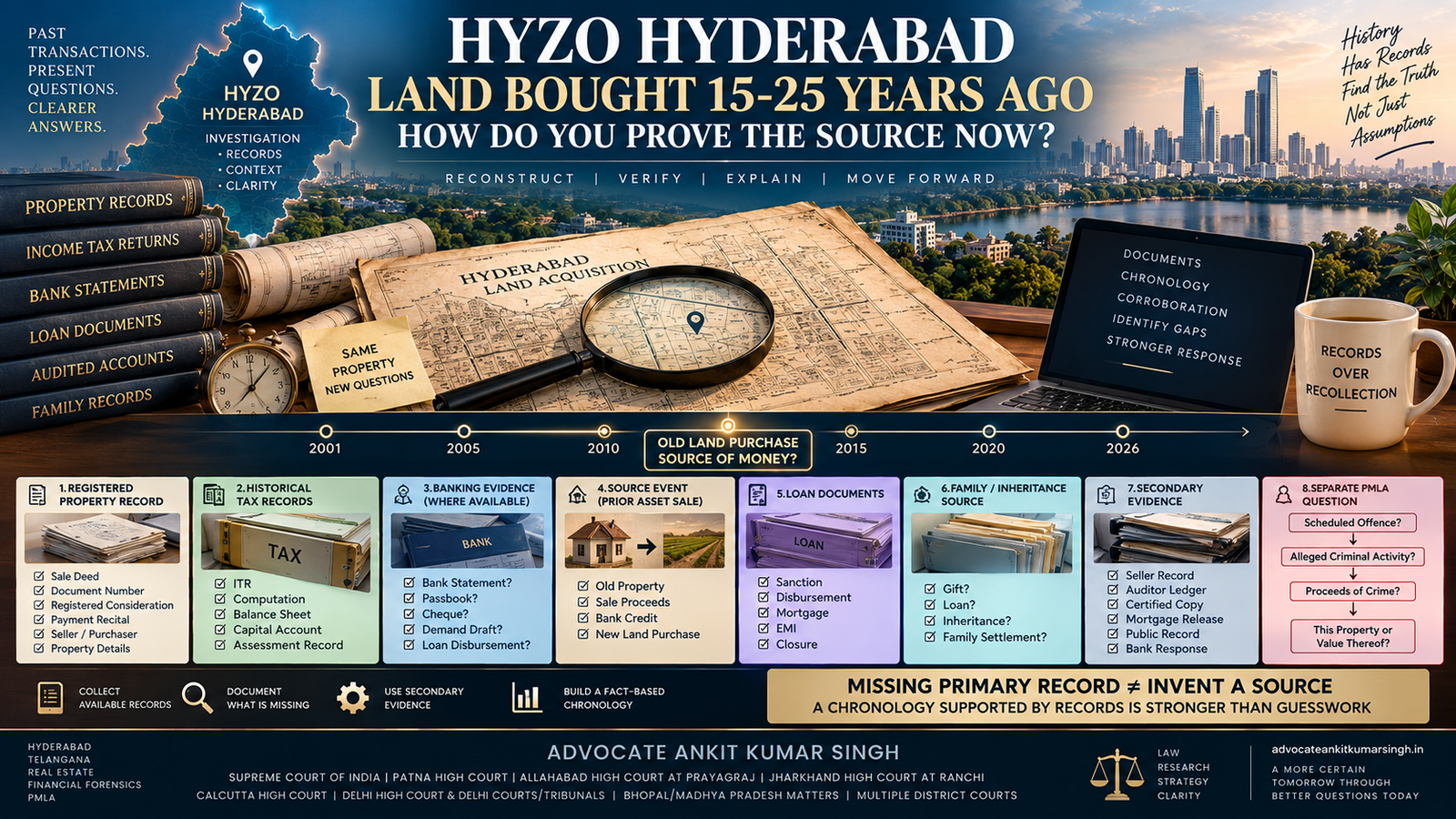
HYZO Hyderabad Wants the Source of Money Used to Buy Land 15-25 Years Ago: How Can the Acquisition Source Be Reconstructed?
Legal research and analysis by Advocate Ankit Kumar Singh
Legally reviewed and updated: 14 September 2026
Summary: For a Hyderabad ED summons concerning an old property acquisition, create a historical-source reconstruction methodology using registered documents, income-tax records, loan papers, audited statements, sale proceeds, family accounts and secondary bank evidence. The Hyderabad article should explain the limits of human memory and why a chronology supported by surviving records is stronger than retrospective guesswork.
Direct Answer: Reconstruct the Purchase From Records, Not From Memory Alone
If the Hyderabad Zonal Office of the Directorate of Enforcement asks in 2026:
“What was the source of the money used to buy this land in 2002, 2005, 2008 or 2010?”
the correct method is not to attempt to remember every banking detail from decades ago.
The acquisition should instead be reconstructed through a structured historical evidence exercise.
REGISTERED PURCHASE
        ↓
PURCHASE DATE
        ↓
PURCHASE CONSIDERATION
        ↓
PAYMENT METHOD
        ↓
SOURCE EVENT
        ↓
AVAILABLE FINANCIAL RECORD
        ↓
TAX / ACCOUNTING CORROBORATION
        ↓
SECONDARY EVIDENCE
        ↓
IDENTIFIED GAPS
        ↓
SUPPORTED HISTORICAL CONCLUSION
The distinction is critical:
AN HONEST INABILITY TO RECALL A 20-YEAR-OLD CHEQUE NUMBER IS NOT THE SAME THING AS AN INABILITY TO EXPLAIN THE SOURCE OF ACQUISITION.
Why a 15-25-Year-Old Transaction Requires a Different Method
A recent transaction may have:
- downloadable bank statements;
- email confirmations;
- internet-banking records;
- electronic loan files;
- digital tax records;
- current accountants;
- readily accessible supporting documents.
A 20-year-old transaction may not.
Possible historical problems include:
- bank account closed;
- bank merged with another bank;
- branch relocated;
- records outside normal retention period;
- physical passbook lost;
- loan already discharged;
- accountant retired or changed;
- old computer data unavailable;
- seller deceased;
- family member who arranged the purchase deceased;
- records destroyed during ordinary business cleanup.
The response should therefore distinguish:
WHAT STILL EXISTS
from:
WHAT NO LONGER EXISTS AFTER THE PASSAGE OF TIME.
Section 50 Still Requires Truthful Answers and Genuine Production
Section 50 PMLA empowers specified Enforcement Directorate officers to summon a person whose attendance is considered necessary:
- to give evidence;
- to produce records; and
- to answer questions on the matters under examination.
A person summoned should therefore make a real effort to locate historical records.
But the obligation to state the truth does not justify inventing details merely because an investigator asks for precision.
Where the genuine position is:
“I do not presently recollect the exact cheque number from 2004, but the registered deed, historical tax records and audited accounts show the acquisition and its source.”
that is fundamentally different from making up an account number or funding explanation.
The First Document: Obtain the Registered Sale Deed
Before reconstructing the source, establish exactly what the acquisition document says.
Extract:
- document number;
- year of registration;
- Sub-Registrar Office;
- purchaser;
- seller;
- property description;
- stated consideration;
- stamp value;
- payment recital;
- cheque / demand draft details, if recorded;
- possession recital;
- registration endorsements.
Do not reconstruct a ₹20 lakh historical source if the registered deed itself shows ₹12 lakh without first explaining the difference.
For Telangana Property, Search the Registration Record Again
Where the original deed has been lost, obtain the registered-document details and certified material from the competent authority.
Current Telangana land-record infrastructure includes registered-document search functionality through Bhu Bharati.
For older transactions, practical digitisation may vary.
Therefore also identify:
- historical Sub-Registrar Office;
- document number;
- book and registration particulars;
- certified-copy availability;
- link documents;
- encumbrance history.
A certified registered document is usually a much stronger starting point than twenty-year-old recollection.
Build a One-Page Acquisition Chronology First
| Date | Event | Amount | Document |
|---|---|---|---|
| DD/MM/YYYY | Prior asset sold | ₹_____ | Registered sale deed |
| DD/MM/YYYY | Sale proceeds received | ₹_____ | Bank / ledger |
| DD/MM/YYYY | Loan sanctioned | ₹_____ | Loan papers |
| DD/MM/YYYY | Land purchased | ₹_____ | Registered deed |
| DD/MM/YYYY | Asset entered in books | ₹_____ | Balance sheet |
The chronology often exposes errors before the Section 50 statement does.
Source Category 1: Accumulated Salary or Professional Savings
Where the historical explanation is accumulated savings, do not merely say:
“I had enough income.”
Reconstruct:
- occupation at the relevant time;
- annual salary or professional income;
- income-tax returns;
- Form 16 where available;
- bank balance around acquisition;
- fixed deposits;
- capital account;
- known major liabilities;
- other asset purchases around the same time.
The purpose is not mathematical perfection after 20 years.
The purpose is to show whether the claimed source was economically plausible and documentarily supported.
Source Category 2: Business Income or Partnership Capital
For a businessman, partner or proprietor, examine:
- audited balance sheets;
- profit and loss accounts;
- capital account;
- drawings;
- cash-flow records;
- firm ledger;
- partner current account;
- income-tax return;
- tax-audit report;
- bank accounts.
A balance sheet showing:
LAND / PROPERTY ADDED DURING FY 2005-06
and a corresponding reduction in:
BANK / CAPITAL / LOAN
can become valuable corroboration even where the original cheque image no longer exists.
Source Category 3: Sale of an Earlier Property
This is one of the clearest reconstruction routes.
OLD PROPERTY
     ↓
REGISTERED SALE
     ↓
SALE CONSIDERATION
     ↓
BANK / ACCOUNTING CREDIT
     ↓
NEW LAND PURCHASE
Collect:
- prior sale deed;
- seller/purchaser details;
- capital-gains computation;
- income-tax return;
- bank credit, if surviving;
- ledger entry;
- new purchase deed;
- timing difference between sale and purchase.
If ₹30 lakh was received from an earlier property sale shortly before a ₹28 lakh acquisition, that chronology is objectively important.
Source Category 4: Bank or Institutional Loan
Old loan evidence may survive even where the operating-bank statement does not.
Search for:
- loan sanction;
- loan agreement;
- mortgage memorandum;
- disbursement letter;
- EMI schedule;
- loan account number;
- interest certificate;
- loan closure certificate;
- release of mortgage;
- title-deed deposit record;
- balance-sheet secured-loan entry.
Where the lender directly paid the seller, the institutional loan trail may be more valuable than the purchaser's ordinary bank statement.
Source Category 5: Family Contribution, Gift or Loan
If money came from a family member, identify its actual legal character.
Was it:
- gift;
- loan;
- family contribution;
- inheritance;
- family settlement;
- joint family fund;
- reimbursement?
Then examine:
- donor/lender identity;
- relationship;
- financial capacity;
- bank transfer where available;
- gift declaration if genuinely existing;
- loan account;
- family accounts;
- tax treatment;
- subsequent repayment, if a loan.
Do not retrospectively call every family contribution a “gift” simply because that description appears convenient in 2026.
Source Category 6: Inheritance or Estate Money
Where the source is inherited money, collect:
- death certificate;
- Will, if any;
- probate / succession material where applicable;
- estate distribution;
- bank transmission record;
- sale of inherited asset;
- family settlement;
- tax/accounting treatment.
The chronology should establish when the beneficiary actually received economic access to the funds.
Source Category 7: Fixed Deposit, Investment or Asset Liquidation
Historical savings may have been converted into the purchase through:
- fixed-deposit maturity;
- shares;
- mutual funds;
- insurance maturity;
- National Savings Certificates;
- Provident Fund;
- retirement benefits;
- gold sale;
- other documented assets.
Search for the redemption or maturity evidence instead of looking only for the final property-payment record.
What If the Bank Says Old Statements Are No Longer Available?
That possibility must be documented rather than hidden.
Keep:
- request made to bank;
- bank's written response;
- account-closure information;
- merger history, if relevant;
- branch response;
- available statement period;
- alternate banking documents.
Then move to secondary reconstruction.
Current PMLA and RBI rules prescribe defined record-retention periods rather than indefinite preservation of every historical transaction.
Therefore an unavailable 20-year-old bank statement should be distinguished from a presently available document that a person simply refuses to produce.
Secondary Bank Evidence: Reconstruct Around the Missing Statement
Possible secondary evidence includes:
- old passbook;
- cheque counterfoil;
- demand draft receipt;
- loan statement;
- seller's bank record;
- auditor ledger;
- income-tax assessment file;
- property registration recital;
- mortgage release;
- fixed-deposit closure;
- balance sheet;
- capital account;
- correspondence referring to payment.
The question becomes:
DO MULTIPLE INDEPENDENT HISTORICAL RECORDS POINT TO THE SAME SOURCE?
Income-Tax Records Can Be Critical
Review the tax position for:
- year immediately before purchase;
- year of purchase;
- year immediately after purchase.
Search for:
- ITR acknowledgment;
- computation;
- balance sheet;
- capital account;
- tax-audit report;
- assessment order;
- capital-gains return;
- loan disclosure;
- property schedule.
The Income Tax Department's present electronic systems provide access to a range of filed forms and tax information, but digital availability of very old material should be checked rather than assumed.
Company Purchaser: Use the Historical Financial Statements
If a company purchased the land, check:
- audited balance sheet;
- fixed-asset schedule;
- land schedule;
- secured/unsecured borrowing;
- bank account;
- board approvals;
- director loan accounts;
- share-capital infusion;
- ROC filings;
- audit working papers where surviving.
Companies Act record-preservation obligations are important, but they are not equivalent to an assumption that every voucher from 20 or 25 years ago must remain available indefinitely.
Books of Account Are Relevant — But Should Be Corroborated
Under the Bharatiya Sakshya Adhiniyam, entries in regularly kept books of account, including electronic books, are relevant where they concern a matter under inquiry.
But account-book entries should not be treated as self-proving in isolation.
Accordingly:
LEDGER ENTRY
+
SALE DEED
+
TAX RECORD
+
BANK / LOAN / SOURCE EVENT
=
STRONGER RECONSTRUCTION
Certified Public Records Become More Important as Time Passes
Where private files deteriorate over decades, public records may survive.
Possible records include:
- certified sale deed;
- Sub-Registrar records;
- mutation record;
- revenue entry;
- registered mortgage;
- release deed;
- prior sale deed;
- court decree;
- probate/succession record;
- government allotment record.
A reconstruction should distinguish ownership evidence from source-of-money evidence, but both can be connected chronologically.
Do Not Treat Human Memory Like a Bank Ledger
After 20 years, a person may genuinely remember:
- that land was purchased;
- that it cost approximately a certain amount;
- that an earlier property had been sold;
- that a bank loan existed;
- that a parent contributed money.
The same person may not reliably remember:
- cheque number;
- exact transfer date;
- branch code;
- which instalment paid which component;
- exact account balance;
- precise sequence of several transfers.
The proper approach is:
USE DOCUMENTS TO REFRESH AND VERIFY MEMORY. DO NOT USE MEMORY TO REPLACE MISSING DOCUMENTS WITH INVENTED DETAIL.
Prepare a “Known / Supported / Not Recalled” Matrix
| Issue | Status | Supporting Record |
|---|---|---|
| Purchase date | Known | Registered deed |
| Registered consideration | Known | Sale deed |
| Main source | Supported | Prior sale / loan / accounts |
| Bank account | Supported / partial | Passbook / loan record |
| Exact cheque number | Not presently recalled | Check deed / bank archive |
| Exact transaction date | To be verified | Historical records |
This is more reliable than pretending every historical detail is remembered with certainty.
Create an Unavailable-Records Register
| Record Sought | Request Made To | Result | Alternative Evidence |
|---|---|---|---|
| 2003 bank statement | Bank | Not available / pending | Passbook + sale deed |
| Old loan statement | Lender | Partial | Closure certificate |
| Original ITR file | Taxpayer / CA | Unavailable | Assessment record |
| Original deed | Owner | Lost | Certified copy |
This converts “I don't have the records” into a documented evidence-recovery exercise.
Property Bought Before the Alleged Scheduled Offence: Why Dates Matter
Suppose:
LAND PURCHASE
2002

ALLEGED SCHEDULED-OFFENCE ACTIVITY
2015-2019
That chronology matters greatly if the allegation is:
“The 2002 property itself was purchased from money generated by the 2015-2019 criminal activity.”
Chronologically, later-generated money cannot ordinarily have funded an earlier purchase.
But the analysis should not stop with a slogan that every old property is immune from PMLA consequences.
Section 2(1)(u) also contains the concept of the value of proceeds of crime, and equivalent-value attachment questions may arise depending upon the statutory facts.
Therefore distinguish:
- Was this property itself acquired from alleged proceeds of crime?
- Is ED instead asserting an equivalent-value theory?
- What is the legal and factual basis for that separate theory?
The Supreme Court: Unaccounted Property Is Not Automatically Proceeds of Crime
Supreme Court PMLA jurisprudence has repeatedly stressed that proceeds of crime require the statutory connection with criminal activity relating to a scheduled offence.
A person may have:
- poor accounting;
- an old unexplained entry;
- a tax issue;
- incomplete historical paperwork.
Those circumstances should not automatically be collapsed into:
“Therefore the property is proceeds of crime.”
The specific PMLA nexus still requires analysis.
But Source Evidence Still Matters
This does not mean historical source questions are irrelevant.
Source evidence may help determine:
- whether alleged proceeds entered the purchase;
- whether legitimate funds existed independently;
- whether an alternate-property theory is factually disputed;
- whether books match the acquisition;
- whether statements made under Section 50 are consistent with documents.
A strong historical reconstruction is therefore both factual and strategic.
The Source-and-Application Test
For the acquisition year, prepare:
| SOURCES | APPLICATIONS |
|---|---|
| Opening bank / capital ₹_____ | Property purchase ₹_____ |
| Income ₹_____ | Stamp duty ₹_____ |
| Prior property sale ₹_____ | Registration ₹_____ |
| Loan ₹_____ | Other investments ₹_____ |
| Family contribution ₹_____ | Loan repayment ₹_____ |
Then ask:
IS THE ACQUISITION FINANCIALLY EXPLAINABLE FROM THE SOURCES THAT CAN STILL BE ESTABLISHED?
Mixed Sources Should Be Shown as Mixed Sources
A ₹50 lakh purchase may have been funded as:
₹20 LAKH — PRIOR PROPERTY SALE
₹15 LAKH — BANK LOAN
₹10 LAKH — SAVINGS
₹5 LAKH — FAMILY CONTRIBUTION
------------------------------
₹50 LAKH — TOTAL
Do not force a mixed acquisition into one artificial source simply to make the story easier.
What If Part of the Source Cannot Now Be Reconstructed?
Say so precisely.
For example:
“The registered consideration is ₹18 lakh. Surviving records establish ₹12 lakh from documented sale proceeds and ₹4 lakh from a bank loan. The precise documentary source of the remaining ₹2 lakh has not yet been located. Further requests have been made for historical records.”
That is materially safer than fabricating a false ₹18 lakh single-source explanation.
What Not to Do Before a HYZO Section 50 Examination
Do not:
- backdate a loan agreement;
- create a fake gift deed;
- manufacture bank statements;
- alter old ledgers;
- create false cash books;
- invent cheque numbers;
- give a false exact date simply to appear confident;
- convert unexplained gaps into imaginary family loans;
- create retrospective board resolutions;
- misstate a later source as the historical source.
Cash Purchase Claims Require Particular Care
Where part of an old acquisition is said to have been paid in cash, examine:
- what the registered deed says;
- cash balance in historical books;
- cash withdrawals;
- business cash availability;
- income-tax records;
- seller acknowledgment;
- applicable law at the relevant time.
Do not reconstruct a cash narrative merely because bank records are missing.
Prepare the Evidence in Layers
Layer 1 — Acquisition
- registered deed;
- certified copy;
- property schedule;
- registered consideration.
Layer 2 — Source
- salary;
- business income;
- loan;
- earlier sale;
- gift;
- inheritance;
- investment maturity.
Layer 3 — Financial Capacity
- ITR;
- balance sheet;
- capital account;
- tax audit;
- bank evidence.
Layer 4 — Corroboration
- seller records;
- loan institution;
- public registration record;
- auditor material;
- family accounts.
Layer 5 — Missing Evidence
- bank response;
- record-retention issue;
- lost-document explanation;
- efforts made to retrieve it.
Section 50 Preparation: The Historical Property File
FOLDER A — TITLE
- sale deed;
- certified copy;
- link documents;
- encumbrance material;
- mutation / revenue record.
FOLDER B — SOURCE
- prior asset sale;
- salary/business evidence;
- loan;
- gift/inheritance material;
- investment maturity.
FOLDER C — TAX
- ITR;
- computation;
- assessment;
- balance sheet;
- capital account.
FOLDER D — BANKING
- available statements;
- passbooks;
- loan records;
- bank correspondence;
- record-unavailability letter.
FOLDER E — CHRONOLOGY
- one-page timeline;
- source-and-application table;
- payment reconciliation.
FOLDER F — GAPS
- documents unavailable;
- reason;
- retrieval effort;
- secondary corroboration.
Forensic Reconstruction Flowchart
OLD LAND PURCHASE
       ↓
GET REGISTERED DEED
       ↓
FIX DATE + CONSIDERATION
       ↓
IDENTIFY CLAIMED SOURCE
       ↓
PRIOR PROPERTY SALE?
SALARY?
BUSINESS?
LOAN?
GIFT?
INHERITANCE?
INVESTMENT?
       ↓
SEARCH CONTEMPORANEOUS RECORDS
       ↓
BANK AVAILABLE?
      / \
    YES  NO
    ↓     ↓
 TRACE   DOCUMENT UNAVAILABILITY
    ↓     ↓
       SEARCH SECONDARY EVIDENCE
              ↓
ITR + ACCOUNTS + LOAN + SELLER + PUBLIC RECORDS
              ↓
CREATE SOURCE-AND-APPLICATION TABLE
              ↓
IDENTIFY UNSUPPORTED GAPS
              ↓
NO GUESSING
              ↓
SECTION 50 FACTUAL RESPONSE