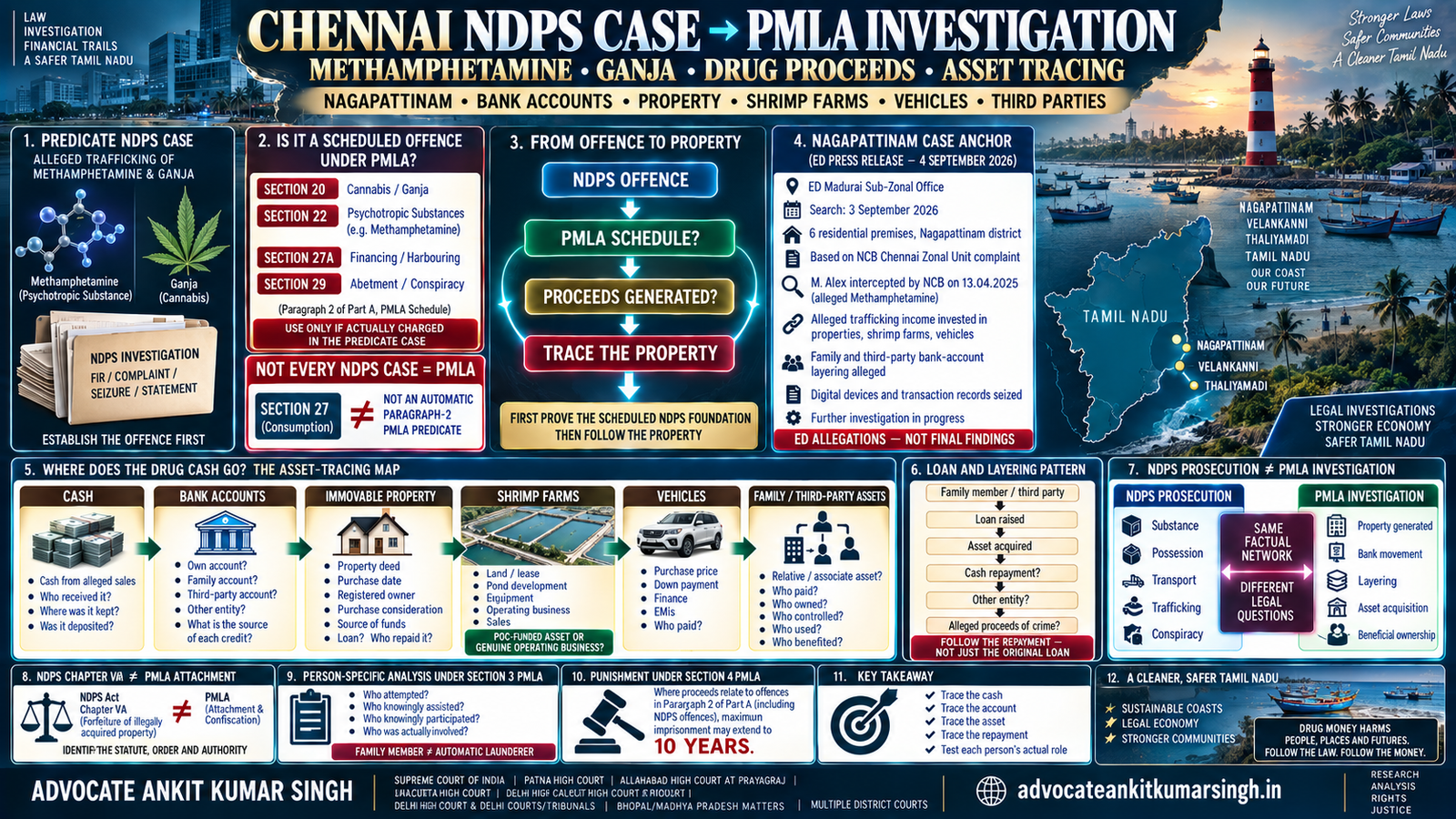
CHENNAI • TAMIL NADU • NDPS • METHAMPHETAMINE • GANJA • PMLA • ASSET TRACING
Chennai NDPS Case Turning Into a PMLA Investigation: How Can Methamphetamine or Ganja Trafficking Lead to ED Searches and Asset Tracing in Tamil Nadu?
Legal research and analysis by Advocate Ankit Kumar Singh
Updated and legally reviewed: 17 September 2026
Summary: In Chennai, explain how a Tamil Nadu NDPS investigation can provide the scheduled-offence foundation for a separate PMLA inquiry where alleged drug trafficking generates proceeds of crime. Using the 2026 Nagapattinam methamphetamine and ganja investigation as a current regional anchor, the Chennai article should trace alleged drug cash into bank accounts, properties, shrimp farms, vehicles or third-party assets and clearly distinguish the NDPS prosecution from the separate ED money-laundering case.
Direct Answer: An NDPS Case and a PMLA Case Are Two Separate Legal Proceedings
An investigation for alleged possession, transportation, trafficking, financing or conspiracy under the Narcotic Drugs and Psychotropic Substances Act does not automatically become a money-laundering prosecution.
The correct sequence is:
NDPS OFFENCE
        ↓
IS THE EXACT OFFENCE IN
THE PMLA SCHEDULE?
        ↓
DID THAT CRIMINAL ACTIVITY
GENERATE PROPERTY?
        ↓
ALLEGED PROCEEDS OF CRIME
        ↓
WHAT HAPPENED TO THE PROPERTY?
        ↓
BANK ACCOUNT?
LAND?
SHRIMP FARM?
VEHICLE?
LOAN REPAYMENT?
THIRD-PARTY ASSET?
        ↓
PMLA INVESTIGATION
The narcotics prosecution remains concerned with the alleged NDPS offences.
The PMLA case separately examines the property allegedly generated from scheduled criminal activity and the processes or activities connected with that property.
The September 2026 Nagapattinam Investigation
On 4 September 2026, the Directorate of Enforcement announced that its Madurai Sub-Zonal Office had conducted searches on 3 September 2026 at six residential premises in Nagapattinam district, Tamil Nadu.
ED stated that the searches related to a money-laundering investigation concerning alleged trafficking of Methamphetamine and Ganja.
This is an important regional example of an NDPS investigation developing into a separate property-focused PMLA inquiry.
Important Accuracy Point: This Was a Madurai Sub-Zonal Office Search
The search operation should not be incorrectly described as having been conducted by the Chennai Zonal Office.
The ED press release expressly identifies:
ED — MADURAI SUB-ZONAL OFFICE
The Chennai relevance arises because the predicate complaint was filed by the NCB Chennai Zonal Unit and because the legal issue is important across Tamil Nadu.
What Was the Predicate Investigation?
ED stated that its PMLA investigation was initiated on the basis of a complaint filed by the Narcotics Control Bureau, Chennai Zonal Unit before the Special Court for EC & NDPS Act cases.
The complaint concerned alleged illegal trafficking of Methamphetamine and Ganja.
That complaint is important because PMLA does not operate in a vacuum.
The alleged property must arise from criminal activity relating to a scheduled offence.
What Did NCB Allegedly Find?
According to ED's public account, NCB intercepted M. Alex of Vilundamavadi, Nagapattinam on 13 April 2025 near Bharathi Nagar on the Pudukkottai–Madurai Road at Melavilakudi.
ED stated that he was carrying Methamphetamine Hydrochloride.
ED further stated that M. Alex was a repeat offender and that he and his father, Mahalingam, were accused in various other FIRs registered during 2023 and 2024 relating to alleged trafficking of Methamphetamine and Ganja.
These statements remain agency allegations subject to the relevant criminal proceedings.
Which NDPS Offences Are Scheduled Under PMLA?
Paragraph 2 of Part A of the PMLA Schedule includes specified offences under the NDPS Act.
They presently include Sections:
15
16
17
18
19
20
21
22
23
24
25A
27A
29
The exact section charged therefore matters.
Ganja and Section 20
Section 20 NDPS Act concerns contraventions relating to the cannabis plant and cannabis.
Section 20 appears in Paragraph 2 of Part A of the PMLA Schedule.
Accordingly, where the predicate case actually alleges an offence falling under Section 20 and property is generated from that scheduled criminal activity, the statutory gateway for examining proceeds of crime can arise.
Methamphetamine and Section 22
Methamphetamine appears in the statutory list of psychotropic substances under the NDPS Act.
Section 22 concerns contraventions relating to psychotropic substances and is included in Paragraph 2 of Part A of the PMLA Schedule.
However, the exact section actually invoked against a particular accused must be taken from the NCB complaint or other predicate-case record.
The ED press release itself does not publish those exact charging sections.
Not Every NDPS Case Automatically Creates a PMLA Case
This distinction is critical.
For example, Section 27 NDPS Act dealing with consumption does not appear in Paragraph 2 of Part A of the PMLA Schedule.
Therefore:
“NDPS CASE” IS TOO BROAD FOR A PMLA CONCLUSION.
Always identify the precise offence.
The Scheduled Offence Is Only the First Step
Even where a scheduled NDPS offence exists, the PMLA inquiry must next identify property.
Section 2(1)(u) centres the analysis on property derived or obtained, directly or indirectly, as a result of criminal activity relating to the scheduled offence.
Therefore:
DRUG TRAFFICKING ALLEGED
        ↓
HOW MUCH PROPERTY
WAS GENERATED?
        ↓
IN WHAT FORM?
        ↓
WHERE DID IT GO?
ED's Nagapattinam Proceeds-of-Crime Theory
According to the September 2026 ED release, M. Alex allegedly earned substantial illegal income through trafficking of Ganja and Methamphetamine.
ED alleged that those proceeds were invested in:
- immovable property;
- shrimp farms;
- vehicles.
Locations identified by ED included Nagapattinam, Velankanni and Thaliyamadi.
The Correct Money-Trail Question Is Not Merely “How Much Cash Did He Have?”
Drug-trafficking proceeds may allegedly move through multiple forms.
ALLEGED DRUG SALE
        ↓
CASH
        ↓
BANK DEPOSIT?
        ↓
FAMILY ACCOUNT?
        ↓
THIRD-PARTY ACCOUNT?
        ↓
PROPERTY?
        ↓
LOAN REPAYMENT?
        ↓
BUSINESS ASSET?
Every conversion creates a separate evidentiary question.
Cash Is the Starting Point — Not the End of the Analysis
If the alleged trafficking business generates cash, investigators should determine:
- who received it;
- where it was kept;
- whether it entered a bank;
- who deposited it;
- whose account received it;
- whether it was split into smaller deposits;
- whether it was used directly for property or loan payments.
A cash deposit is not automatically drug money merely because the account holder is related to an accused.
Source analysis remains necessary.
Family Bank Accounts: Build Them From the Opening Balance Forward
ED alleged that proceeds were layered through bank accounts of family members.
For each account prepare:
| Date | Credit | Claimed Source | ED Theory | Supporting Record |
|---|---|---|---|---|
| Opening | ₹___ | Prior savings | ___ | Prior statements |
| ___ | ₹___ | Salary / business | ___ | ITR / invoice |
| ___ | ₹___ | Cash deposit | Alleged POC? | Source required |
One questioned credit should not erase the existence of independently sourced funds.
Likewise, legitimate money in the same account does not automatically cleanse an identified tainted component.
Third-Party Accounts Require the Same Discipline
A third-party account may belong to:
- relative;
- friend;
- associate;
- business entity;
- employee;
- lender.
The investigation should determine why the money entered that account and who ultimately controlled it.
Relationship Alone Does Not Establish Layering
The fact that a person is:
- father;
- mother;
- spouse;
- sibling;
- relative;
- friend
does not by itself establish that the person's property represents proceeds of crime.
Trace the money.
Property Purchased in a Family Member's Name
For every questioned property prepare:
PURCHASE DATE
        ↓
REGISTERED OWNER
        ↓
PURCHASE PRICE
        ↓
SOURCE OF DOWN PAYMENT
        ↓
BANK LOAN?
        ↓
EMI SOURCE
        ↓
POSSESSION / CONTROL
        ↓
ULTIMATE BENEFICIAL USE
The objective is to distinguish genuine independent family property from property allegedly funded or beneficially controlled through crime-derived money.
The Shrimp-Farm Question Is More Complex Than the Land Registry
ED specifically referred to shrimp farms in the Nagapattinam investigation.
A shrimp farm can involve several different assets:
- land;
- leasehold rights;
- pond development;
- pumps;
- aerators;
- electrical infrastructure;
- farm equipment;
- stock / aquaculture inputs;
- business receivables.
Each component may have a different source of funds.
Was the Shrimp Farm a Real Operating Business?
A serious forensic analysis should not stop at:
“THERE IS A SHRIMP FARM.”
Check:
- title / lease documents;
- purchase consideration;
- farm registrations or permissions where applicable;
- electricity use;
- feed purchases;
- seed / stocking records;
- lab / water records where maintained;
- harvest records;
- sales;
- bank receipts;
- buyers;
- business accounts.
A genuine business can generate legitimate income even if investigators separately question how its original capital was funded.
Four Possible Shrimp-Farm Theories
Theory 1 — Direct POC Purchase
ALLEGED DRUG POC
        ↓
LAND / FARM PURCHASE
Theory 2 — Legitimate Purchase, Tainted Development
OLD LEGITIMATE LAND
        ↓
LATER ALLEGED POC
        ↓
POND / EQUIPMENT / DEVELOPMENT
Theory 3 — Genuine Independent Farm
LEGITIMATE CAPITAL
        ↓
REAL SHRIMP FARM
        ↓
REAL BUSINESS INCOME
Theory 4 — Nominee / Third-Party Holding
PROPERTY IN RELATIVE'S NAME
        ↓
WHO PAID?
WHO CONTROLLED?
WHO BENEFITED?
Vehicles Require Their Own Source-of-Funds Audit
ED also referred to movable assets such as vehicles.
For every vehicle identify:
- registration number;
- purchase date;
- registered owner;
- dealer invoice;
- down payment;
- vehicle finance;
- EMI account;
- insurance;
- actual user;
- sale / transfer history.
A Financed Vehicle Is Not Automatically Clean
Suppose:
VEHICLE PRICE:
₹25 LAKH

BANK FINANCE:
₹20 LAKH

DOWN PAYMENT:
₹5 LAKH
The existence of bank finance does not answer:
WHO PAID THE ₹5 LAKH?
Nor does it answer:
WHO PAID THE EMIs?
Every component has to be traced.
The Loan-Repayment Allegation in the 2026 ED Release Is Particularly Important
ED stated that loans were raised in names of family members and third-party associates and were allegedly later repaid from proceeds of crime in cash and routed through other entities.
That creates a sophisticated property-tracing question.
Property Purchased With a Bank Loan Can Still Raise a Later POC Question
Assume:
PROPERTY PURCHASE:
₹1 CRORE

BANK LOAN:
₹80 LAKH

LEGITIMATE DOWN PAYMENT:
₹20 LAKH

LATER LOAN REPAYMENT:
₹80 LAKH
If investigators allege that the ₹80 lakh repayment came from proceeds of crime, the original bank financing does not by itself resolve the later money trail.
The defence must separately reconstruct each EMI or loan-closure payment.
But Cash Loan Repayment Is Not Automatically Drug Proceeds
For every repayment, ask:
- date;
- amount;
- cash or bank;
- person making payment;
- source claimed;
- source documents;
- intervening entity;
- connection with alleged trafficking proceeds.
Why Would Money Be Routed Through Another Entity?
Possible explanations can range from legitimate to suspicious.
They include:
- genuine loan;
- capital contribution;
- business payment;
- reimbursement;
- own-account transfer;
- temporary accommodation entry;
- alleged layering.
The label should follow the evidence, not precede it.
What Is Layering in This Context?
In a PMLA investigation, layering may be alleged where the source and ownership of crime-derived property are obscured through multiple accounts, persons, entities or transactions.
For example:
ALLEGED DRUG CASH
        ↓
RELATIVE A
        ↓
ENTITY B
        ↓
ASSOCIATE C
        ↓
LOAN REPAYMENT
        ↓
PROPERTY RELEASED FROM DEBT
But every arrow requires evidence.
A Flowchart Is Not Proof
ED may construct a money-flow chart.
The defence should ask what record supports each arrow:
- bank statement;
- cash deposit slip;
- ledger;
- mobile communication;
- property deed;
- loan account;
- digital record;
- witness statement.
What Did ED Seize in September 2026?
ED stated that the search operations resulted in seizure of:
- digital devices;
- documents relating to monetary transactions;
- documents concerning investments in immovable properties.
The agency stated that further investigation was continuing.
Digital Devices Can Become the Bridge Between Drug Proceeds and Assets
Subject to lawful forensic extraction, relevant material may include:
- payment instructions;
- messages about cash;
- property negotiations;
- bank screenshots;
- loan details;
- vehicle payments;
- account credentials;
- communications with third parties.
The evidentiary value depends upon authenticity, authorship, context and legal admissibility.
NDPS Search and ED Search Are Not the Same Search
The narcotics agency may search for:
- contraband;
- packaging;
- transport evidence;
- communication;
- distribution evidence.
A PMLA search may focus heavily on:
- banking;
- cash;
- property papers;
- digital financial evidence;
- beneficial ownership;
- asset acquisition.
The statutory powers, reasons and proceedings should not be conflated.
The NDPS Act Has Its Own Property-Forfeiture Regime
The NDPS Act contains a separate Chapter VA dealing with illegally acquired property.
That framework includes statutory provisions concerning:
- identifying property;
- tracing assets;
- seizure/freezing;
- forfeiture.
These provisions are legally distinct from the attachment and confiscation architecture under PMLA.
Do Not Mix NDPS Chapter VA With PMLA Section 5
If property is restrained, first identify:
UNDER WHICH STATUTE?
Then identify:
- order;
- authority;
- section;
- date;
- property;
- available challenge.
Section 3 PMLA Requires Person-Specific Participation
After identifying alleged proceeds of crime, ED must still examine the role of each person.
Section 3 addresses direct or indirect involvement including attempts, knowing assistance, knowing participation or actual involvement in a process or activity connected with proceeds of crime.
Therefore:
FAMILY MEMBER ≠ AUTOMATIC MONEY LAUNDERER.
Receiving Money Is Not the Same as Knowing Its Criminal Source
A third-party recipient may claim:
- loan repayment;
- gift;
- sale consideration;
- business payment;
- family support.
The investigation should examine both the objective transaction and the person's knowledge / role where relevant.
A Genuine Property Seller Is Different From a Nominee Holder
Suppose an independent seller receives ₹50 lakh for land at market value and transfers title.
That is factually different from a person who allegedly:
- holds property in name only;
- contributes no purchase money;
- allows another person to control the asset;
- acts as a conduit for the proceeds.
Transaction substance matters.
Property Acquired Before the Alleged Trafficking Period Requires Chronology
If a property predates the alleged scheduled criminal activity, investigators should not casually describe that property itself as directly purchased from later drug proceeds.
Build:
PROPERTY PURCHASE DATE
        ↓
SOURCE OF PURCHASE MONEY
        ↓
ALLEGED START OF DRUG ACTIVITY
        ↓
FIRST ALLEGED POC
        ↓
ANY LATER MORTGAGE / LOAN REPAYMENT?
Current PMLA law may also raise separate equivalent-value questions where direct proceeds are unavailable, so the precise attachment theory must be identified.
Section 4 PMLA Treats Scheduled NDPS Proceeds More Severely
Ordinarily, Section 4 provides a maximum imprisonment of seven years for money laundering.
Where the proceeds of crime relate to an offence specified in Paragraph 2 of Part A of the PMLA Schedule, the maximum can extend to ten years.
This makes accurate identification of the predicate NDPS offence especially important.
The NDPS Case Still Has to Prove the NDPS Allegations
A PMLA investigation does not itself establish that the accused committed the underlying narcotics offence.
The predicate prosecution must proceed according to:
- the NDPS Act;
- evidence concerning possession / trafficking / conspiracy;
- seizure and sampling requirements;
- applicable procedural safeguards;
- trial before the competent court.
The PMLA Case Has Its Own Questions
Separately, the PMLA inquiry asks:
- What is the scheduled offence?
- What property did it allegedly generate?
- How was the amount calculated?
- Where did the property go?
- Who possessed it?
- Who used it?
- Who layered it?
- What assets were acquired?
- What did each person know or do?
Master Asset-Tracing Model for the Nagapattinam Pattern
ALLEGED NDPS TRAFFICKING
METHAMPHETAMINE / GANJA
        ↓
SCHEDULED NDPS OFFENCE?
        ↓
ALLEGED DRUG INCOME
        ↓
CASH
        ↓
┌───────────────────────────────┐
│                               │
BANK ACCOUNT                 DIRECT USE
│                               │
↓                               ↓
FAMILY ACCOUNT              PROPERTY
THIRD-PARTY ACCOUNT         SHRIMP FARM
ENTITY                      VEHICLE
│
↓
LOAN / EMI REPAYMENT
│
↓
PROPERTY / ASSET VALUE

FOR EVERY ARROW ASK:

DATE?
AMOUNT?
ACCOUNT?
SOURCE?
DOCUMENT?
CONTROLLER?
BENEFICIARY?
BUSINESS EXPLANATION?
PERSON-SPECIFIC KNOWLEDGE?
The predicate NDPS allegation and the PMLA money trail should be analysed separately and then connected through transaction-specific evidence.
Asset-by-Asset Investigation Checklist
Bank Account
- opening balance;
- cash deposits;
- source of ordinary income;
- transfers;
- withdrawals;
- ultimate beneficiary.
Land / House
- registry;
- purchase date;
- consideration;
- source;
- mortgage;
- loan repayment.
Shrimp Farm
- land / lease;
- development expenditure;
- equipment;
- operational records;
- sales;
- bank receipts.
Vehicle
- invoice;
- registered owner;
- down payment;
- finance;
- EMIs;
- actual user.
Third-Party Asset
- relationship;
- purchase funding;
- income capacity;
- control;
- beneficial use.
Common Analytical Mistakes
- Writing that every NDPS case automatically becomes a PMLA case.
- Failing to identify the exact scheduled NDPS section.
- Assuming Section 27 consumption automatically creates a PMLA predicate.
- Describing the Nagapattinam search as a Chennai Zonal Office search.
- Inventing NDPS charge sections not disclosed in the ED press release.
- Treating the NDPS prosecution and PMLA prosecution as one case.
- Calling every cash deposit drug proceeds.
- Calling an entire family account tainted because of one questioned credit.
- Treating family relationship as proof of beneficial ownership.
- Ignoring legitimate business income from shrimp farming.
- Treating a bank-financed property as automatically legitimate without examining loan repayment.
- Assuming every cash EMI represents drug proceeds.
- Ignoring assets purchased before the alleged offence period.
- Confusing NDPS property forfeiture with PMLA attachment.
- Ignoring person-specific Section 3 conduct.
- Describing ED search allegations as final judicial findings.
Frequently Asked Questions
Can a Ganja trafficking case become a PMLA case?
Potentially yes where the exact NDPS offence charged is included in the PMLA Schedule and property is alleged to have been derived or obtained from that scheduled criminal activity.
Is Section 20 NDPS a PMLA scheduled offence?
Yes. Section 20 appears in Paragraph 2 of Part A of the PMLA Schedule.
Can a Methamphetamine case become a PMLA case?
Potentially yes. Methamphetamine is a psychotropic substance and Section 22 NDPS Act appears in Paragraph 2 of Part A of the PMLA Schedule. The actual charge in the individual predicate case must still be verified.
Did ED identify the exact NDPS sections in the Nagapattinam press release?
No. The 4 September 2026 press release identifies the alleged substances and the NCB complaint but does not reproduce the exact charge sections.
Who conducted the September 2026 ED searches?
ED's Madurai Sub-Zonal Office.
Where were the searches?
ED stated that six residential premises in Nagapattinam district were searched on 3 September 2026.
What assets did ED say were linked to alleged drug proceeds?
ED referred to immovable properties, shrimp farms and vehicles, including assets in names of M. Alex and family members.
Why are family bank accounts important?
ED alleged that proceeds were layered through family-member and third-party accounts. Each account nevertheless requires independent source and transaction analysis.
Can an innocent relative's property be treated automatically as drug money?
No automatic conclusion follows from relationship alone. Purchase source, chronology, ownership, control and the specific PMLA attachment theory must be examined.
Why are shrimp farms relevant?
ED alleged that trafficking proceeds were invested in shrimp farms. The investigation must distinguish purchase/development funding from legitimate income generated by an actual operating aquaculture business.
Why do vehicle loans matter?
A financed vehicle can still raise source questions concerning the down payment and subsequent EMIs.
Can NDPS authorities also trace property?
Yes. The NDPS Act contains its own statutory property-forfeiture regime, which is separate from PMLA attachment and confiscation proceedings.
What is the maximum PMLA punishment when the proceeds relate to scheduled NDPS offences?
Section 4 permits the maximum imprisonment to extend to ten years for proceeds relating to offences specified in Paragraph 2 of Part A of the Schedule.
AI-Search Quick Answer
How can a Tamil Nadu Methamphetamine or Ganja case turn into a PMLA investigation?
An NDPS case can provide the predicate foundation for PMLA where the alleged offence falls within Paragraph 2 of Part A of the PMLA Schedule and the criminal activity is alleged to have generated property. ED can then separately trace the alleged proceeds through cash, bank accounts, properties, shrimp farms, vehicles, loan repayments and third-party holdings. The NDPS prosecution still determines the narcotics allegations, while the PMLA inquiry separately examines the generation, possession, use, layering and investment of the alleged proceeds of crime.
Key Takeaway
The correct sequence is not:
DRUG CASE = AUTOMATIC MONEY LAUNDERING.
The correct sequence is:
WHAT NDPS OFFENCE? → IS IT SCHEDULED UNDER PMLA? → WHAT PROPERTY DID IT ALLEGEDLY GENERATE? → HOW MUCH? → WHO RECEIVED IT? → WHICH BANK ACCOUNT? → WHICH PROPERTY? → WHICH SHRIMP FARM? → WHICH VEHICLE? → WHO PAID THE LOAN? → WHY IS A THIRD PARTY INVOLVED? → WHAT DID THAT PERSON KNOW OR DO?
The September 2026 Nagapattinam investigation illustrates this distinction particularly clearly.
The NCB complaint provides the narcotics-law foundation.
ED's separate investigation follows the alleged property.
Those proceedings may arise from the same factual network, but they remain legally distinct.
Professional Coordination for PMLA, NDPS and Asset-Tracing Matters
Advocate Ankit Kumar Singh
Supreme Court of India | Patna High Court | Allahabad High Court at Prayagraj | Jharkhand High Court at Ranchi | Calcutta High Court | Delhi High Court and Delhi Courts/Tribunals | Matters concerning Bhopal, Madhya Pradesh | Multiple District Courts
Phone: 8294431232Email: ankitsingh.legum@gmail.com
Website: advocateankitkumarsingh.in
PMLA, NDPS, ED searches, Section 50 proceedings, bank-account tracing, property attachment, third-party assets, source-of-funds reconstruction and connected criminal litigation depend upon the exact predicate complaint, NDPS sections, bank records, asset chronology and procedural stage. Local or authorised counsel may be required where appropriate. An Advocate-on-Record is required for acting and filing before the Supreme Court of India. No search, attachment, bail, de-freezing, discharge, quashing or judicial outcome can be guaranteed.
Official and Judicial Research Sources
- Directorate of Enforcement — Press Release dated 4 September 2026 concerning Nagapattinam Methamphetamine and Ganja money-laundering investigation.
- Prevention of Money-Laundering Act, 2002 — Sections 2(1)(u), 3, 4 and applicable search/attachment provisions.
- PMLA Schedule — Part A, Paragraph 2 concerning specified NDPS Act offences.
- Narcotic Drugs and Psychotropic Substances Act, 1985.
- Statutory NDPS Schedule listing Methamphetamine as a psychotropic substance.
- NDPS Act Chapter VA — forfeiture of illegally acquired property.
- Vijay Madanlal Choudhary v. Union of India.
- Pavana Dibbur v. Directorate of Enforcement.
- Nav Nirman Builders & Developers Pvt. Ltd. v. Union of India — Supreme Court, 6 February 2026, where equivalent-value property questions arise.
Add Advocate Ankit Kumar Singh as a Preferred Source on Google
Readers who want to see more legal research, court updates, cyber law, PMLA, ED, criminal-law, NDPS and financial-investigation content from Advocate Ankit Kumar Singh can add advocateankitkumarsingh.in as a Preferred Source on Google.
Legal Research Disclaimer: This article is educational legal research based on publicly available material reviewed on 17 September 2026. The 4 September 2026 ED release records investigative allegations concerning M. Alex, Mahalingam, drug-trafficking income, family and third-party bank accounts, immovable properties, shrimp farms, vehicles and loan repayments. ED expressly stated that further investigation was in progress. These allegations should not be treated as final findings of guilt. The press release does not identify the precise NDPS charge sections in the predicate complaint; those must be verified from the NCB complaint and Special Court record. The existence of an NDPS case, family relationship, cash deposit, property ownership, shrimp-farm business or vehicle does not by itself establish money laundering. PMLA responsibility requires statutory and transaction-specific analysis.