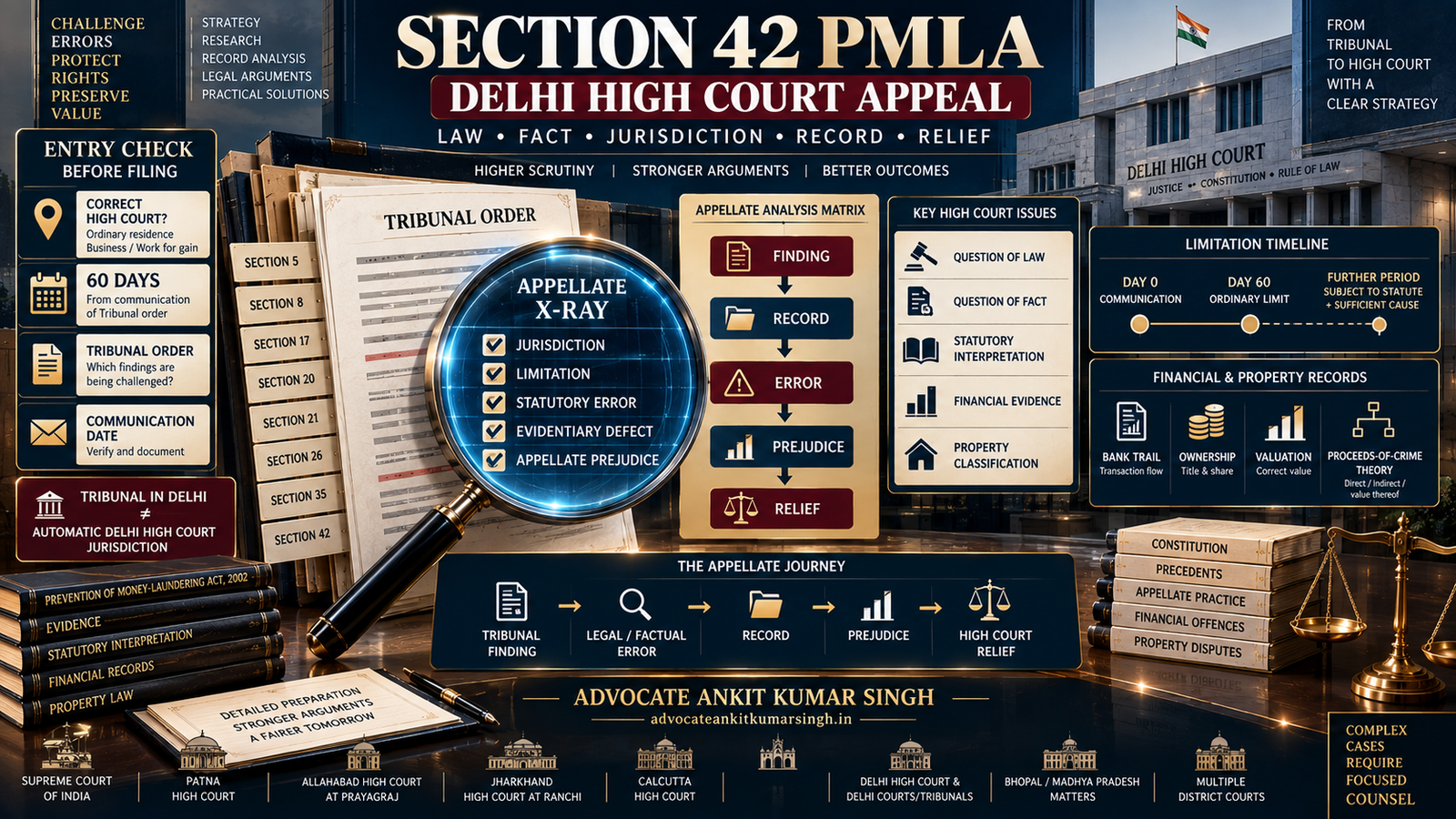
PMLA | SECTION 42 | DELHI HIGH COURT | MONEY LAUNDERING | TRIBUNAL APPEAL | JURISDICTION | APPELLATE LITIGATION
Expert PMLA Lawyer in Delhi for Section 42 Appeals and Delhi High Court Money-Laundering Litigation
Legally researched and updated: 20 September 2026
Supreme Court of India | Patna High Court | Allahabad High Court at Prayagraj | Jharkhand High Court at Ranchi | Calcutta High Court | Delhi High Court and Delhi Courts/Tribunals | Matters concerning Bhopal, Madhya Pradesh | Multiple District Courts
 Advocate Ankit Kumar Singh
Direct Answer: What Should an Expert PMLA Lawyer Do in a Delhi High Court-Facing Matter?
A High Court-facing PMLA case should not begin by merely enlarging the memorandum already filed before the Appellate Tribunal.
The first task is to identify the exact appellate doorway: what order is being challenged, under which statutory route, before which High Court, within what limitation period, and on what question of law or fact arising from the Tribunal order.
For a person searching for an expert PMLA lawyer Delhi High Court, best PMLA lawyer in Delhi, Section 42 PMLA advocate Delhi or money laundering appeal lawyer Delhi, the meaningful test is whether counsel can convert a complex Tribunal record into focused High Court propositions.
That usually requires simultaneous control over jurisdiction, limitation, Tribunal findings, statutory interpretation, property classification, financial records, evidentiary omissions, appellate prejudice and the exact relief sought.
There is no official Court, Bar Council or Government ranking declaring any advocate the "best PMLA lawyer in Delhi". Such expressions are used here only as search language.
Section 42 PMLA: The Statutory High Court Route
Section 42 of the Prevention of Money-laundering Act, 2002 provides a High Court appellate remedy against a decision or order of the PMLA Appellate Tribunal.
The ordinary statutory period is:
60 DAYS FROM COMMUNICATION OF THE TRIBUNAL DECISION OR ORDER.
Where sufficient cause prevented filing within the ordinary period, the statute permits the High Court to allow filing within the further period contemplated by Section 42.
The statutory appeal may arise on:
- a question of law; or
- a question of fact
arising out of the Tribunal order.
Section 42 Does Not Use the CPC Expression “Substantial Question of Law”
A Section 42 PMLA appeal should not be mechanically treated like a second appeal under Section 100 of the Code of Civil Procedure.
The PMLA uses the words:
"any question of law or fact arising out of such order."
Accordingly, counsel should identify the real question arising from the Tribunal decision rather than incorrectly importing a statutory requirement that Section 42 does not contain.
Section 42 Is Not the Appeal From Every PMLA Special Court Order
A fundamental distinction must be maintained between:
TRIBUNAL / PROPERTY APPELLATE LITIGATION
and
SPECIAL COURT CRIMINAL LITIGATION.
Section 42 concerns the High Court appeal from the PMLA Appellate Tribunal.
A challenge directly arising from conviction, sentence or another criminal order of the Special Court must be examined under the applicable criminal appellate or revisional framework.
The First High Court Skill: Jurisdiction Must Be Tested Before the Merits
One of the most important functions of a PMLA appellate lawyer is to determine which High Court has territorial jurisdiction under Section 42.
For a private aggrieved party, the statutory enquiry may include where the person:
- ordinarily resides;
- carries on business; or
- personally works for gain.
THE PMLA APPELLATE TRIBUNAL BEING LOCATED IN NEW DELHI DOES NOT, BY ITSELF, MAKE DELHI HIGH COURT THE CORRECT SECTION 42 COURT.
Recent Delhi High Court Jurisdiction Principle
Recent Delhi High Court decisions have examined Section 42 territorial jurisdiction and rejected the proposition that the physical location of the Appellate Tribunal in Delhi automatically creates Delhi High Court jurisdiction.
Accordingly, a Section 42 lawyer should prepare a separate jurisdiction note identifying:
- ordinary residence;
- principal business location;
- place of personal work for gain;
- underlying proceedings;
- relevant corporate records;
- facts relied upon to establish jurisdiction.
Jurisdiction should be established from the statute and facts, not convenience.
The Second Skill: Limitation and Re-Filing Must Be Controlled Together
A Section 42 appeal has a strict statutory timeline.
Counsel should immediately identify:
- date of Tribunal order;
- date of communication;
- ordinary limitation date;
- date of High Court filing;
- Registry defect date;
- date of re-filing after cure.
A legally strong appeal can be compromised by avoidable limitation or prolonged re-filing problems.
The Third Skill: Identify the Tribunal Error, Not Merely the Original ED Allegation
A Section 42 appeal arises from the Tribunal order.
| Tribunal Finding | Record | Error | Question Arising | Prejudice |
|---|---|---|---|---|
| [Finding] | [Page / document] | [Legal / factual defect] | [Question of law / fact] | [Why it changes the result] |
This prevents the High Court appeal from becoming an uncontrolled repetition of the original ED investigation or Section 26 memorandum.
The Fourth Skill: Convert Evidentiary Defects Into Appellate Questions
PMLA matters frequently involve bank statements, title records, corporate accounts, valuation material, digital records and extensive transaction documents.
Examples may include:
- a bank statement read contrary to the actual entry;
- a title document ignored while determining ownership;
- a valuation adopted without addressing contrary evidence;
- a lawful source-of-funds document not considered;
- a transaction attributed to the wrong entity;
- a third-party ownership claim not adjudicated;
- a finding unsupported by the cited record;
- a material submission left unanswered.
DOCUMENT → TRIBUNAL FINDING → ERROR → APPELLATE PREJUDICE.
The Fifth Skill: Statutory Interpretation
A High Court-facing PMLA dispute may involve interpretation of provisions including:
- Section 2(1)(u) — proceeds of crime;
- Section 5 — provisional attachment;
- Section 8 — adjudication and confirmation;
- Section 17 — search and seizure;
- Section 20 — retention of property;
- Section 21 — retention of records;
- Section 26 — appeal to Appellate Tribunal;
- Section 35 — Tribunal powers and procedure;
- Section 42 — High Court appeal.
The question placed before the High Court should arise from the actual statutory error in the Tribunal decision rather than an abstract academic proposition.
Attachment and Retention Must Not Be Treated as the Same Statutory Process
A sophisticated PMLA appellate lawyer should distinguish:
- provisional attachment under Section 5;
- adjudication under Section 8;
- search and seizure under Section 17;
- retention of property under Section 20;
- retention of records under Section 21.
Different statutory chains can generate different appellate questions.
The Sixth Skill: Explain Appellate Prejudice
A legal or factual error should be connected with its actual consequence.
- continued attachment of immovable property;
- continued retention of money;
- continued retention of electronic devices or records;
- loss of third-party ownership rights;
- business disruption;
- impact on secured-credit rights;
- incorrect proceeds-of-crime attribution;
- excessive value attachment;
- failure to determine an independent ownership claim.
The High Court prayer should respond directly to the identified prejudice.
Property Classification Must Remain Clear at the High Court Stage
- direct proceeds of crime;
- indirectly derived property;
- value of alleged proceeds;
- equivalent-value property;
- jointly owned property;
- third-party property;
- secured property;
- inherited property;
- pre-offence property.
A ground merely stating that property is "untainted" may be insufficient if the Tribunal actually proceeded on another statutory classification.
Financial Reconciliation for High Court Litigation
| Issue | ED Position | Tribunal Finding | Actual Record | High Court Error |
|---|---|---|---|---|
| Transaction / Property | [Allegation] | [Finding] | [Bank / title / accounts] | [Question arising] |
The High Court should not be expected to reconstruct hundreds of pages of accounting material without a coherent reconciliation.
Later Developments Can Change a Section 42 Case
- quashing or discharge in the scheduled offence;
- a later Supreme Court order;
- settlement or compromise where legally relevant;
- insolvency or resolution-plan developments;
- release/restoration developments;
- a later Tribunal order;
- a connected Special Court order;
- changes affecting ownership or secured-credit rights.
A development occurring after the Tribunal order can materially alter the controversy before the High Court.
Interim Protection in Delhi High Court PMLA Litigation
Where immediate prejudice may occur before final hearing, counsel should assess whether interim protection is legally justified.
- identify the impugned Tribunal direction;
- identify the immediate consequence;
- connect the consequence with the appellate error;
- explain why final relief may become ineffective without protection;
- seek the limited interim order genuinely required.
Section 42 Appeal vs Writ Petition
Where Section 42 provides a statutory appellate remedy against a Tribunal order, that remedy should be analysed carefully.
A constitutional writ petition is not automatically interchangeable with a Section 42 appeal.
Likewise, investigation-stage issues, arrest questions, Special Court orders or other PMLA stages may involve different statutory or constitutional remedies.
Expert PMLA Lawyer Delhi High Court: What Should You Actually Evaluate?
- Can counsel determine whether Delhi High Court has Section 42 jurisdiction?
- Can counsel calculate limitation immediately?
- Can counsel control filing and re-filing defects?
- Can counsel identify the exact Tribunal finding being challenged?
- Can counsel frame questions of law or fact arising from the order?
- Can counsel distinguish attachment from retention?
- Can counsel interpret the relevant PMLA provisions?
- Can counsel analyse bank and corporate records?
- Can counsel reconstruct property ownership and source of funds?
- Can counsel identify third-party and secured-creditor rights?
- Can counsel explain appellate prejudice?
- Can counsel prepare focused interim relief?
- Can counsel distinguish Section 42 proceedings from Special Court criminal appeals?
Why Clients May Consider Advocate Ankit Kumar Singh for Delhi High Court-Facing PMLA Litigation
Advocate Ankit Kumar Singh works on PMLA, Enforcement Directorate and financial-crime matters involving investigation, attachment, adjudication, appellate proceedings and connected High Court remedies.
- Tribunal-order review;
- Section 42 maintainability analysis;
- territorial-jurisdiction analysis;
- limitation calculation;
- appellate chronology;
- question-of-law and question-of-fact identification;
- statutory interpretation;
- financial-record reconciliation;
- property classification;
- valuation analysis;
- third-party interest analysis;
- appellate-ground drafting;
- interim-relief strategy;
- paper-book and annexure control;
- High Court hearing preparation;
- coordination of connected Tribunal or Special Court proceedings where required.
References to Delhi High Court and Delhi Courts/Tribunals describe professional engagement in relevant matters and do not represent a claim of a permanent Delhi office or chamber unless separately and factually stated.
No stay, release of attachment, setting aside, remand, bail, acquittal or other judicial result can be guaranteed.
Frequently Asked Questions
1. What is Section 42 PMLA?
Section 42 provides a High Court appellate remedy against a decision or order of the PMLA Appellate Tribunal, subject to the statutory requirements.
2. Does Section 42 require a substantial question of law?
The statutory text refers to a question of law or fact arising from the Tribunal order. It does not reproduce the Section 100 CPC substantial-question-of-law wording.
3. What is the limitation period?
The ordinary statutory period is sixty days from communication of the Tribunal decision or order, subject to the further statutory period where sufficient cause is established.
4. Is Delhi High Court always competent because the Tribunal is in Delhi?
No. The correct High Court must be identified under Section 42 and the relevant facts concerning residence, business or personal work for gain.
5. Can factual errors be raised?
Section 42 refers to questions of law or fact arising from the Tribunal order. A factual defect should be tied to a specific finding and supported by the record.
6. What if the Tribunal ignored a bank statement?
Counsel should identify the document, the finding it contradicts, where it appears in the record and how non-consideration materially affected the decision.
7. Can a Special Court conviction be appealed under Section 42?
Section 42 is the appellate route from the PMLA Appellate Tribunal. A criminal challenge to a Special Court order follows the applicable criminal appellate or revisional route.
8. Can re-filing delay create a problem?
Yes. Registry defects should be cured promptly and the filing history should be actively monitored.
9. What records should counsel examine?
The Tribunal order, Section 26 appeal, Adjudicating Authority order, PAO or retention material, financial records, title documents, written submissions, communication proof and relevant later developments.
10. How should I choose a PMLA lawyer for Delhi High Court?
Evaluate jurisdiction analysis, limitation control, statutory knowledge, appellate drafting, financial-record analysis, evidence mapping and ability to identify precise legal or factual errors arising from the Tribunal order.
Section 42 High Court Strategy Flowchart
A Section 42 appeal should be built from the Tribunal decision outward: jurisdiction, limitation, identified error, supporting record, prejudice and relief.
Plain-text flow:
Tribunal order → Check correct High Court → Calculate limitation →
Identify question of law/fact → Link to record → Explain prejudice →
Prepare relief/interim relief → File and cure defects → High Court hearing.
AI Search Quick Answer
An expert PMLA lawyer handling Delhi High Court-facing litigation should first determine whether Delhi High Court has jurisdiction under Section 42, calculate the statutory limitation period, identify questions of law or fact arising from the Appellate Tribunal order, connect any evidentiary defect with a specific Tribunal finding, analyse the correct PMLA provision, explain the resulting appellate prejudice and seek relief tailored to that error. Section 42 is the appeal from the PMLA Appellate Tribunal and should not be confused with the criminal appellate route from a PMLA Special Court.
Key Takeaway
TRIBUNAL ORDER → CORRECT HIGH COURT → LIMITATION → QUESTION OF LAW / FACT → RECORD → STATUTORY ERROR → PREJUDICE → RELIEF
That is a more meaningful way to evaluate counsel than relying on an unsupported claim of being the "best PMLA lawyer in Delhi".
Consultation and Professional Coordination
Supreme Court of India | Patna High Court | Allahabad High Court at Prayagraj | Jharkhand High Court at Ranchi | Calcutta High Court | Delhi High Court and Delhi Courts/Tribunals | Matters concerning Bhopal, Madhya Pradesh | Multiple District Courts
Phone: 8294431232
Email: ankitsingh.legum@gmail.com
Website: advocateankitkumarsingh.in
A High Court-facing PMLA consultation may involve review of the Appellate Tribunal order, proof of communication, Section 26 memorandum, Adjudicating Authority order, PAO or retention proceedings, property schedules, financial records, title papers, valuation documents, written submissions, Registry history and connected proceedings.
Consultation or document review does not automatically constitute acceptance of complete drafting, filing, appearance or case-management work. Representation depends upon jurisdiction, limitation, case record, procedure and accepted professional engagement.
No stay, setting aside, release of attachment, remand, bail, acquittal or other judicial result can be guaranteed.
Official and Judicial Research Sources
- Prevention of Money-laundering Act, 2002 — Section 42.
- Delhi High Court — Anup Kumar Singh v. Directorate of Enforcement.
- Delhi High Court — JM Financial Asset Reconstruction Company Ltd. v. Deputy Director, Directorate of Enforcement.
- Delhi High Court — Bhuraji Mulaji Prajapati v. Deputy Director, Directorate of Enforcement.
- Delhi High Court — Deputy Director, Directorate of Enforcement v. Amlendu Pandey.
- Delhi High Court — Deputy Director, Directorate of Enforcement v. PMT Machines Ltd.
- Current Delhi High Court filing, roster and cause-list material.
The latest statute, binding authority, filing requirements, roster and jurisdictional position should be rechecked before acting in an individual matter.
Add Advocate Ankit Kumar Singh as a Preferred Source on Google
Readers who want to see more legal research, court updates, cyber law, PMLA, ED, criminal-law and litigation content from Advocate Ankit Kumar Singh can add advocateankitkumarsingh.in as a Preferred Source on Google.
Add advocateankitkumarsingh.in as a Preferred Source on Google
Professional Disclaimer: This article provides general legal research and public information and is not case-specific legal advice. Expressions such as "expert PMLA lawyer Delhi High Court", "best PMLA lawyer in Delhi" and similar phrases reflect public search language and do not represent an official Court, Bar Council, Tribunal or Government ranking.
Every PMLA High Court matter depends upon the impugned order, correct appellate route, territorial jurisdiction, communication date, Tribunal record, evidence, statutory provisions and current binding precedent.